by
Greg Lopez
Prof. Mark Lawler
 Formation of Lake Tahoe
 The Ancient Bristlecone Pine
 The Amazing History of Wild Horses
 Principles of Relative Dating
 Basic Rock Classification
 References
 Lake Tahoe is over 2 million years old.
Tahoe is considered an ancient lake and is
counted among the 20 oldest lakes in the
world.
 The coordinates of the geographic center
of the main body of Lake Tahoe are 39° 06’
30” N and 120° 01’ 51” W. Lake Tahoe and
its watershed span the montane and
subalpine life zones.
 The length of the Lake is 21.2 miles (north
to south) and the width is 11.9 miles (east
to west). The shoreline length is 75.1 miles.
 The water is 99.994% pure, making it one
of the purest large lakes in the world. For
comparison, commercially distilled water
is 99.998% pure (Antonucci, 2015).
http://www.tahoenevada.com
 Three to five million years ago,
the valley that would become the
Tahoe Basin sank between
parallel fractures in the Earth’s
crust as the mountains on either
side continued to rise.
 A shallow lake began to form in
the resulting valley.
 Two to three million years ago,
erupting volcanoes blocked the
outlet on the north end, forcing
the lake to raise hundreds of feet
above its current elevation, and
eventually eroding down to near
its current outlet (Antonucci,
2015).
Remnant of a Basalt magma flow during the Cenozoic Era.
Located on the East rim of Lake Tahoe, near Glenbrook. NV.
Photo by Greg Lopez
 Between one million and 20,000 years ago,
large masses of glacial ice covered the west
side of the Tahoe Basin. The melting of the
glacier caused the lake level to rise.
 The Lake holds about 39 trillion gallons of
water, enough to cover the state of California
to a depth of 14½ inches (Antonucci, 2015).
 A maximum depth of 1,645 feet in Crystal Bay
makes Tahoe the second deepest lake in the
USA, third deepest in North America and 11th
deepest in the world (Antonucci, 2015).
http://openwalls.com
 Genus: Pinus
 Species: Longaeva
 Reproduction: Gymnosperm
 The bristlecone pine only
lives in the arid western
mountain regions of North
America.
 The oldest known tree is
"Methuselah", which is 4,789
years old.
 Because bristlecone pines are
such old organisms, the study
of these ancient trees has
revealed environmental
conditions dating back to
almost 9,000 years ago
(Wildscreen Arkive, 2015)
 The Bristle Cone Pine is a vascular plant
that reproduces by means of an
exposed seed, or ovule. The seeds of
many gymnosperms (literally “naked
seed”) are borne in cones and are not
visible until maturity (Encylcopaedia
Britannica, 2015).
 The male flowers, or catkins are red-
purple in color. The female cones are
ovoid, or egg-shaped, and dark purple
to brown when mature. Each cone is 2.5
to 3.75 inches long and take 2 years to
mature (Fryer, 2015).
 Gymnosperms were dominant in the
Mesozoic Era (about 252.2 million to 66
million years ago), during which time
some of the modern families originated
(Pinaceae, Araucariaceae,
Cupressaceae) (Schaffner, 2010).
http://healthyhomegardening.com
 The fossil plant Elkinsia polymorpha, a "seed
fern" from the Devonian period (about 400
million years ago) is considered the earliest
seed plant known to date.
 Fossil records indicate the first gymnosperms
(progymnosperms) most likely originated in
the Paleozoic era, during the middle
Devonian period about 390 million years ago.
 Gymnosperms expanded in the Mesozoic era
(about 240 million years ago), supplanting
ferns in the landscape, and reaching their
greatest diversity during this time.
 Although angiosperms (flowering plants) are
the major form of plant life in most biomes,
gymnosperms still dominate some
ecosystems, such as the taiga (boreal forests)
and the alpine forests at higher mountain
elevations because of their adaptation to cold
and dry growth conditions (Boundless, 2015).
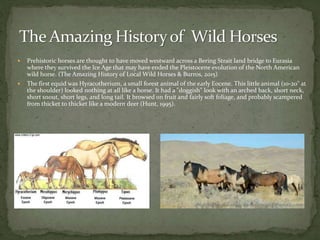
 Prehistoric horses are thought to have moved westward across a Bering Strait land bridge to Eurasia
where they survived the Ice Age that may have ended the Pleistocene evolution of the North American
wild horse. (The Amazing History of Local Wild Horses & Burros, 2015)
 The first equid was Hyracotherium, a small forest animal of the early Eocene. This little animal (10-20" at
the shoulder) looked nothing at all like a horse. It had a "doggish" look with an arched back, short neck,
short snout, short legs, and long tail. It browsed on fruit and fairly soft foliage, and probably scampered
from thicket to thicket like a modern deer (Hunt, 1995).
The is a brief description of the tree for those who are visually impaired. Hyracotherium is shown giving rise to three lineages. Two lineages quickly go extinct. The third branches many times. There are many branches alive during most times until two million years ago when only the various species of Equus remain. The tree itself is unreadable to those who are visually impaired so skip the tree graphic.
2My Old & New World Equus
 | /
 | /
4My Hippidion Equus Stylohipparion
| | Neohipparion Hipparion Cormohipparion
| | Astrohippus | | |
| | Pliohippus ---------------------------
12My Dinohippus Calippus  | /
| | Pseudhipparion  | /
| | | |
------------------------------------------- Sinohippus
15My  | / |
 | / Megahippus |
17My Merychippus | |
| Anchitherium Hypohippus
| | |
23My Parahippus Anchitherium Archeohippus
| | |
(Kalobatippus?)-----------------------------------------
25My  | /
 | /
|
35My |
Miohippus Mesohippus
| |
40My Mesohippus
|
|
|
45My Paleotherium |
| Epihippus
| |
Propalaeotherium | Haplohippus
| | |
50My Pachynolophus | Orohippus
| | |
| | |
------------------------------
 | /
 | /
55My Hyracotherium Kathleen Hunt 1995
 Tracing a line of descent from Hyracotherium to Equus reveals several apparant trends: reduction of
toe number, increase in size of cheek teeth, lengthening of the face, increase in body size.
 Most of the recent (5-10 My) horses were three-toed, not one-toed, and we see a "trend" to one toe
only because all the three-toed lines have recently become extinct (Hunt, 1995).
 The Law of Original Horizontality was first proposed by Danish geological pioneer Nicholas Steno
in the 17th century.
 The law states that layers of sediment were originally deposited horizontally under the action of
gravity. Any rock layers that are now folded and tilted have since been altered by later outside forces.
 This is a fundamental law in geology and especially important for the understanding of plate
tectonics. (Idaho Museum of Natural History Department of Geosciences, ISU, 2015)
Photo by Greg Lopez
* Sedimentary strata tilted by
uplifting. Located on South Curry
Street, Carson City, NV. 2015
 Unconformities represent non-deposition, erosion or both. The geologic record is incomplete
wherever an unconformity is present.
 Angular unconformity is an erosional surface on tilted or folded strata over which younger strata were
deposited. (pg. 441, Monroe & Wicander, 2009).
Photos by Greg Lopez
*Angular unconformity located on South Curry Street, Carson
City, NV. 2015
 Basalt is a dark-colored, fine-
grained, igneous rock
composed mainly of
plagioclase and pyroxene
minerals. It most commonly
forms as an extrusive rock,
such as a lava flow, but can
also form in small intrusive
bodies, such as an igneous
dike or a thin sill (Hobart M.
King, 2015).
 Basalt underlies more of
Earth's surface than any other
rock type. Most areas within
Earth's ocean basins are
underlain by basalt (Hobart
M. King, 2015).
 During the Late Triassic
period, much of Nevada was
covered by the newly created
Sundance Sea. (pg. 600-602,
Monroe & Wicander, 2009). Photo by Greg Lopez* Basalt rock with intrusive iron igneous.
Located S. Curry Street, Carson City, NV. 2015
 Metamorphic rocks
result from the alteration
of other rocks, usually
beneath the surface, by
heat, pressure, and the
chemical activity of
fluids.
 Most of the metamorphic
rocks in the Sierra
Nevada occur in the
Western Metamorphic
Belt.
 Most metamorphism
occurs in subduction
zones, where
sedimentary and volcanic
rocks are carried to
depths of 30 miles
(Hobart M. King, 2015).
Foliated metamorphic rock. Possibly composed of
silica precipitated from water, fine grained
metamorphosed limestone, Chert and Potassium
Feldspar. Curtesy of Gabe Ledesma.
Photo by Greg Lopez
 Granite rocks are
typically light-colored,
granular, and coarse-
grained.
 They consist of a
mixture of quartz,
plagioclase feldspar, and
potassium feldspar, with
lesser amounts of
biotite, hornblende, and
other minerals
 These minerals
crystallized from
magma that cooled deep
within the earth’s crust,
generally at depths
from three to six miles.
 The magma cooled
slowly, so there was
sufficient time for large
crystals to form (Hobart
M. King, 2015).
Photo by Greg Lopez
Possible Quartz monzonite with azurite and
malachite minerals. Quartz monzonite is similar
to granite, but less quartz. Curtesy of Gabe
Ledesma.
Antonucci, D. C. (2015, July 31). Lake Tahoe Fast Facts. Retrieved from Tahoe Fund:
http://www.tahoefund.org/about-tahoe/recreational-paradise/
Boundless. ( 2015, July 21 ). Evolution of Gymnosperms. Retrieved from Boundless Biology:
https://www.boundless.com/biology/textbooks/boundless-biology-textbook/seed-plants-
26/evolution-of-seed-plants-158/evolution-of-gymnosperms-619-11840/
Encylcopaedia Britannica. (2015, July 31). Bristlecone pine . Retrieved from Encyclopaedia
Britannica: http://www.britannica.com/plant/bristlecone-pine
Fryer, J. L. (2015, July 31). Pinus longaeva . Retrieved from Fire Effects Information System:
http://www.fs.fed.us/database/feis/
Hobart M. King, P. (2015, July 31). Basalt: What Is Basalt, How Does It Form and How Is It
Used? Retrieved from Geology.com: http://geology.com/rocks/basalt.shtml
Hunt, K. (1995, January 4). Horse Evolution. Retrieved from The Talk Orgins Archive:
http://www.talkorigins.org/faqs/horses/horse_evol.html
Idaho Museum of Natural History Department of Geosciences, ISU. (2015, July 31). Law of
Horizonality. Retrieved from Alamo Impact:
http://geology.isu.edu/Alamo/rocks/law_horizontality.php
Konigsmark, T. (2003). Geologic Trips: Sierra Nevada. Mendocino: Bored Feet Press.
Monroe, J. S., & Wicander, R. (2009). The Changing Earth: Exploring Geology and Evolution,
Fifth Edition. In J. S. Monroe, & R. Wicander, The Changing Earth: Exploring Geology
and Evolution, Fifth Edition (pp. 485-487). Belmont: Brooks/Cole.
Schaffner, B. (2010). Bristlecone Pine. Retrieved from Blue Planet Biomes:
http://www.blueplanetbiomes.org/bristlecone_pine.htm
The Amazing History of Local Wild Horses & Burros. (2015, July 31). Retrieved from Spring
Mountain Alliance: http://springmountainalliance.org/local-wild-horse-history/
Wildscreen Arkive. (2015, July 31). Bristlecone pine (Pinus longaeva). Retrieved from
Wildscreen Arkive: http://www.arkive.org/bristlecone-pine/pinus-longaeva/

Geology 103 field presentation

  • 1.
  • 2.
     Formation ofLake Tahoe  The Ancient Bristlecone Pine  The Amazing History of Wild Horses  Principles of Relative Dating  Basic Rock Classification  References
  • 3.
     Lake Tahoeis over 2 million years old. Tahoe is considered an ancient lake and is counted among the 20 oldest lakes in the world.  The coordinates of the geographic center of the main body of Lake Tahoe are 39° 06’ 30” N and 120° 01’ 51” W. Lake Tahoe and its watershed span the montane and subalpine life zones.  The length of the Lake is 21.2 miles (north to south) and the width is 11.9 miles (east to west). The shoreline length is 75.1 miles.  The water is 99.994% pure, making it one of the purest large lakes in the world. For comparison, commercially distilled water is 99.998% pure (Antonucci, 2015). http://www.tahoenevada.com
  • 4.
     Three tofive million years ago, the valley that would become the Tahoe Basin sank between parallel fractures in the Earth’s crust as the mountains on either side continued to rise.  A shallow lake began to form in the resulting valley.  Two to three million years ago, erupting volcanoes blocked the outlet on the north end, forcing the lake to raise hundreds of feet above its current elevation, and eventually eroding down to near its current outlet (Antonucci, 2015). Remnant of a Basalt magma flow during the Cenozoic Era. Located on the East rim of Lake Tahoe, near Glenbrook. NV. Photo by Greg Lopez
  • 5.
     Between onemillion and 20,000 years ago, large masses of glacial ice covered the west side of the Tahoe Basin. The melting of the glacier caused the lake level to rise.  The Lake holds about 39 trillion gallons of water, enough to cover the state of California to a depth of 14½ inches (Antonucci, 2015).  A maximum depth of 1,645 feet in Crystal Bay makes Tahoe the second deepest lake in the USA, third deepest in North America and 11th deepest in the world (Antonucci, 2015). http://openwalls.com
  • 6.
     Genus: Pinus Species: Longaeva  Reproduction: Gymnosperm  The bristlecone pine only lives in the arid western mountain regions of North America.  The oldest known tree is "Methuselah", which is 4,789 years old.  Because bristlecone pines are such old organisms, the study of these ancient trees has revealed environmental conditions dating back to almost 9,000 years ago (Wildscreen Arkive, 2015)
  • 7.
     The BristleCone Pine is a vascular plant that reproduces by means of an exposed seed, or ovule. The seeds of many gymnosperms (literally “naked seed”) are borne in cones and are not visible until maturity (Encylcopaedia Britannica, 2015).  The male flowers, or catkins are red- purple in color. The female cones are ovoid, or egg-shaped, and dark purple to brown when mature. Each cone is 2.5 to 3.75 inches long and take 2 years to mature (Fryer, 2015).  Gymnosperms were dominant in the Mesozoic Era (about 252.2 million to 66 million years ago), during which time some of the modern families originated (Pinaceae, Araucariaceae, Cupressaceae) (Schaffner, 2010). http://healthyhomegardening.com
  • 8.
     The fossilplant Elkinsia polymorpha, a "seed fern" from the Devonian period (about 400 million years ago) is considered the earliest seed plant known to date.  Fossil records indicate the first gymnosperms (progymnosperms) most likely originated in the Paleozoic era, during the middle Devonian period about 390 million years ago.  Gymnosperms expanded in the Mesozoic era (about 240 million years ago), supplanting ferns in the landscape, and reaching their greatest diversity during this time.  Although angiosperms (flowering plants) are the major form of plant life in most biomes, gymnosperms still dominate some ecosystems, such as the taiga (boreal forests) and the alpine forests at higher mountain elevations because of their adaptation to cold and dry growth conditions (Boundless, 2015).
  • 9.
     Prehistoric horsesare thought to have moved westward across a Bering Strait land bridge to Eurasia where they survived the Ice Age that may have ended the Pleistocene evolution of the North American wild horse. (The Amazing History of Local Wild Horses & Burros, 2015)  The first equid was Hyracotherium, a small forest animal of the early Eocene. This little animal (10-20" at the shoulder) looked nothing at all like a horse. It had a "doggish" look with an arched back, short neck, short snout, short legs, and long tail. It browsed on fruit and fairly soft foliage, and probably scampered from thicket to thicket like a modern deer (Hunt, 1995).
  • 10.
    The is abrief description of the tree for those who are visually impaired. Hyracotherium is shown giving rise to three lineages. Two lineages quickly go extinct. The third branches many times. There are many branches alive during most times until two million years ago when only the various species of Equus remain. The tree itself is unreadable to those who are visually impaired so skip the tree graphic. 2My Old & New World Equus | / | / 4My Hippidion Equus Stylohipparion | | Neohipparion Hipparion Cormohipparion | | Astrohippus | | | | | Pliohippus --------------------------- 12My Dinohippus Calippus | / | | Pseudhipparion | / | | | | ------------------------------------------- Sinohippus 15My | / | | / Megahippus | 17My Merychippus | | | Anchitherium Hypohippus | | | 23My Parahippus Anchitherium Archeohippus | | | (Kalobatippus?)----------------------------------------- 25My | / | / | 35My | Miohippus Mesohippus | | 40My Mesohippus | | | 45My Paleotherium | | Epihippus | | Propalaeotherium | Haplohippus | | | 50My Pachynolophus | Orohippus | | | | | | ------------------------------ | / | / 55My Hyracotherium Kathleen Hunt 1995
  • 11.
     Tracing aline of descent from Hyracotherium to Equus reveals several apparant trends: reduction of toe number, increase in size of cheek teeth, lengthening of the face, increase in body size.  Most of the recent (5-10 My) horses were three-toed, not one-toed, and we see a "trend" to one toe only because all the three-toed lines have recently become extinct (Hunt, 1995).
  • 12.
     The Lawof Original Horizontality was first proposed by Danish geological pioneer Nicholas Steno in the 17th century.  The law states that layers of sediment were originally deposited horizontally under the action of gravity. Any rock layers that are now folded and tilted have since been altered by later outside forces.  This is a fundamental law in geology and especially important for the understanding of plate tectonics. (Idaho Museum of Natural History Department of Geosciences, ISU, 2015) Photo by Greg Lopez * Sedimentary strata tilted by uplifting. Located on South Curry Street, Carson City, NV. 2015
  • 13.
     Unconformities representnon-deposition, erosion or both. The geologic record is incomplete wherever an unconformity is present.  Angular unconformity is an erosional surface on tilted or folded strata over which younger strata were deposited. (pg. 441, Monroe & Wicander, 2009). Photos by Greg Lopez *Angular unconformity located on South Curry Street, Carson City, NV. 2015
  • 14.
     Basalt isa dark-colored, fine- grained, igneous rock composed mainly of plagioclase and pyroxene minerals. It most commonly forms as an extrusive rock, such as a lava flow, but can also form in small intrusive bodies, such as an igneous dike or a thin sill (Hobart M. King, 2015).  Basalt underlies more of Earth's surface than any other rock type. Most areas within Earth's ocean basins are underlain by basalt (Hobart M. King, 2015).  During the Late Triassic period, much of Nevada was covered by the newly created Sundance Sea. (pg. 600-602, Monroe & Wicander, 2009). Photo by Greg Lopez* Basalt rock with intrusive iron igneous. Located S. Curry Street, Carson City, NV. 2015
  • 15.
     Metamorphic rocks resultfrom the alteration of other rocks, usually beneath the surface, by heat, pressure, and the chemical activity of fluids.  Most of the metamorphic rocks in the Sierra Nevada occur in the Western Metamorphic Belt.  Most metamorphism occurs in subduction zones, where sedimentary and volcanic rocks are carried to depths of 30 miles (Hobart M. King, 2015). Foliated metamorphic rock. Possibly composed of silica precipitated from water, fine grained metamorphosed limestone, Chert and Potassium Feldspar. Curtesy of Gabe Ledesma. Photo by Greg Lopez
  • 16.
     Granite rocksare typically light-colored, granular, and coarse- grained.  They consist of a mixture of quartz, plagioclase feldspar, and potassium feldspar, with lesser amounts of biotite, hornblende, and other minerals  These minerals crystallized from magma that cooled deep within the earth’s crust, generally at depths from three to six miles.  The magma cooled slowly, so there was sufficient time for large crystals to form (Hobart M. King, 2015). Photo by Greg Lopez Possible Quartz monzonite with azurite and malachite minerals. Quartz monzonite is similar to granite, but less quartz. Curtesy of Gabe Ledesma.
  • 17.
    Antonucci, D. C.(2015, July 31). Lake Tahoe Fast Facts. Retrieved from Tahoe Fund: http://www.tahoefund.org/about-tahoe/recreational-paradise/ Boundless. ( 2015, July 21 ). Evolution of Gymnosperms. Retrieved from Boundless Biology: https://www.boundless.com/biology/textbooks/boundless-biology-textbook/seed-plants- 26/evolution-of-seed-plants-158/evolution-of-gymnosperms-619-11840/ Encylcopaedia Britannica. (2015, July 31). Bristlecone pine . Retrieved from Encyclopaedia Britannica: http://www.britannica.com/plant/bristlecone-pine Fryer, J. L. (2015, July 31). Pinus longaeva . Retrieved from Fire Effects Information System: http://www.fs.fed.us/database/feis/ Hobart M. King, P. (2015, July 31). Basalt: What Is Basalt, How Does It Form and How Is It Used? Retrieved from Geology.com: http://geology.com/rocks/basalt.shtml Hunt, K. (1995, January 4). Horse Evolution. Retrieved from The Talk Orgins Archive: http://www.talkorigins.org/faqs/horses/horse_evol.html
  • 18.
    Idaho Museum ofNatural History Department of Geosciences, ISU. (2015, July 31). Law of Horizonality. Retrieved from Alamo Impact: http://geology.isu.edu/Alamo/rocks/law_horizontality.php Konigsmark, T. (2003). Geologic Trips: Sierra Nevada. Mendocino: Bored Feet Press. Monroe, J. S., & Wicander, R. (2009). The Changing Earth: Exploring Geology and Evolution, Fifth Edition. In J. S. Monroe, & R. Wicander, The Changing Earth: Exploring Geology and Evolution, Fifth Edition (pp. 485-487). Belmont: Brooks/Cole. Schaffner, B. (2010). Bristlecone Pine. Retrieved from Blue Planet Biomes: http://www.blueplanetbiomes.org/bristlecone_pine.htm The Amazing History of Local Wild Horses & Burros. (2015, July 31). Retrieved from Spring Mountain Alliance: http://springmountainalliance.org/local-wild-horse-history/ Wildscreen Arkive. (2015, July 31). Bristlecone pine (Pinus longaeva). Retrieved from Wildscreen Arkive: http://www.arkive.org/bristlecone-pine/pinus-longaeva/