SCIENCE
Denyze Claire F. Gorre
Grade 8 – Red Lauan
Into the Depths
How much of the ocean have we explored?
The ocean is the lifeblood of Earth, covering more than 70
percent of the planet's surface, driving weather, regulating
temperature, and ultimately supporting all living organisms.
Throughout history, the ocean has been a vital source of
sustenance, transport, commerce, growth, and inspiration.
Yet for all of our reliance on the ocean, more than eighty
percent of this vast, underwater realm remains unmapped,
unobserved, and unexplored.
• Given the high degree of difficulty and cost in exploring our
ocean using underwater vehicles, researchers have long relied
on technologies such as sonar to generate maps of the
seafloor.
• Currently, less than ten percent of the global ocean is mapped
using modern sonar technology. For the ocean and coastal
waters of the United States, only about 35 percent has been
mapped with modern methods.
• NOAA’s Office of Ocean Exploration and Research is leading
efforts to explore the ocean by supporting expeditions to
investigate and document its unknown and little known
regions. These expeditions are led by scientist-explorers
equipped with the latest exploration tools.
• Meanwhile, NOAA's Office of Coast Survey explores the ocean
in a different way, employing hydrographic surveys to
generate nautical charts. Since the mid-1830s, the U.S. Coast
Survey (a NOAA predecessor agency) has been the nation’s
nautical chartmaker. Today, Coast Survey is still responsible for
creating and maintaining all charts of U.S. coastal waters, the
Great Lakes, and waters surrounding U.S. territories.
DID YOU KNOW?
• 1. Our oceans cover more than 70 per cent of the Earth’s surface.
• With so much of the Earth’s surface taken up by ocean, it’s evident how vital these marine
environments are to the planet, and how much there still is to be explored.
• 2. The majority of life on Earth is aquatic.
• As so much of the Earth’s surface is underwater, it comes as no surprise that marine species
outnumber those on land. But, it’s an incredible 94 per cent of the Earth’s living species
that exist within the oceans.
• 3. Less than five per cent of the planet’s oceans have been explored.
• According to the Ocean Service, man has explored less than five per cent of Earth’s oceans.
As researchers strive to discover more, we’re continually getting to know our oceans better.
• 4. The world’s longest mountain chain is underwater.
• Earth’s longest chain of mountains, the Mid-Ocean Ridge, is almost entirely beneath the
ocean, stretching across a distance of 65,000 kilometres. It’s said that this mountain chain is
less explored than the surface of Venus or Mars.
• 6. We still only know a fraction of the marine species in our oceans.
• According to the World Register of Marine Species there are now 240,470 accepted species,
but this is believed to be just a small proportion of the species that exist, with new marine
life being discovered everyday.
• An underwater canyon
• 7. Over 70 per cent of our planet’s oxygen is produced by the ocean.
• It’s thought that between 70 and 80 per cent of the oxygen we breathe is
produced by marine plants, nearly all of which are marine algae.
• 8. It’s possible to find rivers and lakes beneath the ocean.
• When salt water and hydrogen sulfide combine, it becomes denser than the rest
of the water around it, enabling it to form a lake or river that flows beneath the
sea.
• a sea shell on the shore of a beach
• 9. Around 50 per cent of the US lies beneath the ocean.
• Not only does a large part of the planet exist beneath the ocean, so does the
United States – around 50 per cent, in fact.
• 10. The Pacific Ocean is the world’s largest ocean and contains around 25,000
islands.
• With 25,000 islands lying within it, the Pacific Ocean has more islands than
anywhere else on the planet.
• Through projects like Shark Savers and Surfrider, the TreadRight Foundation
champions the importance of our planet’s oceans, which we at Trafalgar support
wholeheartedly through our JoinTrafalgar initiatives.
Here are 10 weird sea creatures
that live into the ocean depths
1. RED HANDFISH
- he red handfish is distinguished by its
small, flattened wart-like protuberances
that cover its body and red coloration.
Two color morphs exist, a bright red
morph with red color on both body and
fins, with a black line separating the
white fin edges and a mottled morph
with pink body covered in many red
patches, with translucent pink fins
expressing some bright red patches.
- They measure an average standard
length of 61.4 mm (2.4 in) and an average
total length of 80.1 mm (3.2 in).[2] Like
other handfishes, they have large
developed pectoral fins, which they use
to walk along the sea floor.
2. ANGLER FISH
• The anglerfish are fish of the teleost
order Lophiiformes .They are bony
fish named for its characteristic mode
of predation, in which a modified fin
ray (the esca or illicium) that can be
luminescent acts as a lure for other
fish.
• Anglerfish occur worldwide. Some
are pelagic (dwelling away from the
sea floor), while others are benthic
(dwelling close to the sea floor).
Some live in the deep sea (such as
the Ceratiidae), while others on the
continental shelf, such as the
frogfishes and the Lophiidae
(monkfish or goosefish).
3. FRILLED SHARK
• The frilled shark
(Chlamydoselachus anguineus)
and the southern African frilled
shark (Chlamydoselachus
africana) are the two extant
species of shark in the family
Chlamydoselachidae. The frilled
shark is considered a living fossil,
because of its primitive,
anguilliform (eel-like) physical
traits, such as a dark-brown color,
amphistyly (the articulation of
the jaws to the cranium), and a
2.0 m (6.6 ft)–long body, which
has dorsal, pelvic, and anal fins
located towards the tail. The
common name, frilled shark,
derives from the fringed
appearance of the six pairs of gill
slits at the shark's throat.
4. PACIFIC VIPER FISH
• The Pacific viperfish, Chauliodus
macouni, is a predatory fish that lives
in the bathyal zone or bathypelgic,
ranging from 1000m-4000m and
having an average temperature of 4
degrees Celsius. However, the pacific
viperfish has been found in the
mesopelagic region, above the.
• The main fish they feed on are
myctophids, or otherwise known as
lanternfish.The pacific viperfish is one
of the nine different species that
belong to the genus Chauliodus or
Viperfish. The pacific viperfish tend to
be the largest of the species,typically
reaching lengths of up to 1 foot and
are considered an example of deep-
sea gigantism.
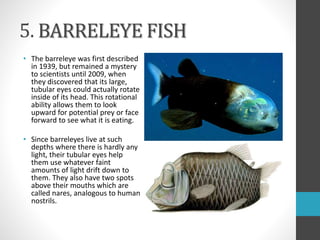
5. BARRELEYE FISH
• The barreleye was first described
in 1939, but remained a mystery
to scientists until 2009, when
they discovered that its large,
tubular eyes could actually rotate
inside of its head. This rotational
ability allows them to look
upward for potential prey or face
forward to see what it is eating.
• Since barreleyes live at such
depths where there is hardly any
light, their tubular eyes help
them use whatever faint
amounts of light drift down to
them. They also have two spots
above their mouths which are
called nares, analogous to human
nostrils.
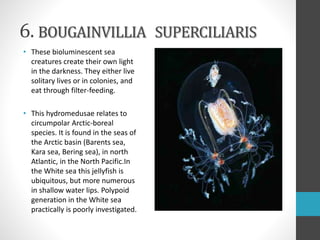
6. BOUGAINVILLIA SUPERCILIARIS
• These bioluminescent sea
creatures create their own light
in the darkness. They either live
solitary lives or in colonies, and
eat through filter-feeding.
• This hydromedusae relates to
сircumpolar Arctic-boreal
species. It is found in the seas of
the Arctic basin (Barents sea,
Kara sea, Bering sea), in north
Atlantic, in the North Pacific.In
the White sea this jellyfish is
ubiquitous, but more numerous
in shallow water lips. Polypoid
generation in the White sea
practically is poorly investigated.
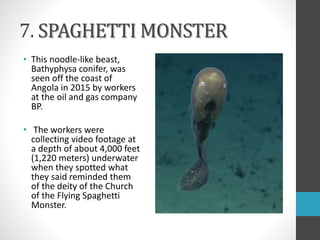
7. SPAGHETTI MONSTER
• This noodle-like beast,
Bathyphysa conifer, was
seen off the coast of
Angola in 2015 by workers
at the oil and gas company
BP.
• The workers were
collecting video footage at
a depth of about 4,000 feet
(1,220 meters) underwater
when they spotted what
they said reminded them
of the deity of the Church
of the Flying Spaghetti
Monster.
8. RED VAMPIRE SQUID
• In Latin, the name of this
cephalopod — which is neither a
squid nor an octopus — is even
more sinister. Its scientific name,
Vampyroteuthis infernalis, means
"vampire squid from hell."
• But the vampire squid, found in
the inky depths of the
mesopelagic zone (about 3,300
feet below the ocean's surface),
is gentler than its appellation
indicates. Unlike its namesake, it
doesn't feed on blood. Instead,
this creature subsists on "marine
snow," decaying organic material
that falls to the ocean floor —
kind of like the dead leaves that
litter forests.
9. SARCASTIC FRINGEHEAD
• Native to the northeast
Pacific Ocean near
California and Baja
California, the sarcastic
fringehead is a kind of tube
blenny, a type of small fish
that burrows in tube-like
structures created by other
creatures.
• Sarcastic fringeheads
primarily gorge on squid
eggs, but scientists believe
that the males' oversized
mouths may impede upon
their ability to feed.
10. BLOBFISH
• Named the "world's ugliest
animal" in an online poll
conducted by a British
organization called the Ugly
Animal Preservation Society, the
blobfish belongs to the fathead
sculpin family — a group of fish
that dwells in the Atlantic, Pacific,
and Indian Oceans at depths
ranging from 330 to 9,200 feet.
• The most famous blobfish, Mr.
Blobby, was discovered in 2003
off the coast of New Zealand and
has inspired everything from
plush toys to emoji. Preserved in
ethyl alcohol, Mr. Blobby's final
resting place is at the Australian
Museum in Sydney.

CREATURES BELOW THE DEPTHS OF THE SEA

  • 1.
    SCIENCE Denyze Claire F.Gorre Grade 8 – Red Lauan
  • 2.
    Into the Depths Howmuch of the ocean have we explored? The ocean is the lifeblood of Earth, covering more than 70 percent of the planet's surface, driving weather, regulating temperature, and ultimately supporting all living organisms. Throughout history, the ocean has been a vital source of sustenance, transport, commerce, growth, and inspiration. Yet for all of our reliance on the ocean, more than eighty percent of this vast, underwater realm remains unmapped, unobserved, and unexplored.
  • 3.
    • Given thehigh degree of difficulty and cost in exploring our ocean using underwater vehicles, researchers have long relied on technologies such as sonar to generate maps of the seafloor. • Currently, less than ten percent of the global ocean is mapped using modern sonar technology. For the ocean and coastal waters of the United States, only about 35 percent has been mapped with modern methods.
  • 4.
    • NOAA’s Officeof Ocean Exploration and Research is leading efforts to explore the ocean by supporting expeditions to investigate and document its unknown and little known regions. These expeditions are led by scientist-explorers equipped with the latest exploration tools. • Meanwhile, NOAA's Office of Coast Survey explores the ocean in a different way, employing hydrographic surveys to generate nautical charts. Since the mid-1830s, the U.S. Coast Survey (a NOAA predecessor agency) has been the nation’s nautical chartmaker. Today, Coast Survey is still responsible for creating and maintaining all charts of U.S. coastal waters, the Great Lakes, and waters surrounding U.S. territories.
  • 5.
    DID YOU KNOW? •1. Our oceans cover more than 70 per cent of the Earth’s surface. • With so much of the Earth’s surface taken up by ocean, it’s evident how vital these marine environments are to the planet, and how much there still is to be explored. • 2. The majority of life on Earth is aquatic. • As so much of the Earth’s surface is underwater, it comes as no surprise that marine species outnumber those on land. But, it’s an incredible 94 per cent of the Earth’s living species that exist within the oceans. • 3. Less than five per cent of the planet’s oceans have been explored. • According to the Ocean Service, man has explored less than five per cent of Earth’s oceans. As researchers strive to discover more, we’re continually getting to know our oceans better. • 4. The world’s longest mountain chain is underwater. • Earth’s longest chain of mountains, the Mid-Ocean Ridge, is almost entirely beneath the ocean, stretching across a distance of 65,000 kilometres. It’s said that this mountain chain is less explored than the surface of Venus or Mars. • 6. We still only know a fraction of the marine species in our oceans. • According to the World Register of Marine Species there are now 240,470 accepted species, but this is believed to be just a small proportion of the species that exist, with new marine life being discovered everyday.
  • 6.
    • An underwatercanyon • 7. Over 70 per cent of our planet’s oxygen is produced by the ocean. • It’s thought that between 70 and 80 per cent of the oxygen we breathe is produced by marine plants, nearly all of which are marine algae. • 8. It’s possible to find rivers and lakes beneath the ocean. • When salt water and hydrogen sulfide combine, it becomes denser than the rest of the water around it, enabling it to form a lake or river that flows beneath the sea. • a sea shell on the shore of a beach • 9. Around 50 per cent of the US lies beneath the ocean. • Not only does a large part of the planet exist beneath the ocean, so does the United States – around 50 per cent, in fact. • 10. The Pacific Ocean is the world’s largest ocean and contains around 25,000 islands. • With 25,000 islands lying within it, the Pacific Ocean has more islands than anywhere else on the planet. • Through projects like Shark Savers and Surfrider, the TreadRight Foundation champions the importance of our planet’s oceans, which we at Trafalgar support wholeheartedly through our JoinTrafalgar initiatives.
  • 7.
    Here are 10weird sea creatures that live into the ocean depths 1. RED HANDFISH - he red handfish is distinguished by its small, flattened wart-like protuberances that cover its body and red coloration. Two color morphs exist, a bright red morph with red color on both body and fins, with a black line separating the white fin edges and a mottled morph with pink body covered in many red patches, with translucent pink fins expressing some bright red patches. - They measure an average standard length of 61.4 mm (2.4 in) and an average total length of 80.1 mm (3.2 in).[2] Like other handfishes, they have large developed pectoral fins, which they use to walk along the sea floor.
  • 8.
    2. ANGLER FISH •The anglerfish are fish of the teleost order Lophiiformes .They are bony fish named for its characteristic mode of predation, in which a modified fin ray (the esca or illicium) that can be luminescent acts as a lure for other fish. • Anglerfish occur worldwide. Some are pelagic (dwelling away from the sea floor), while others are benthic (dwelling close to the sea floor). Some live in the deep sea (such as the Ceratiidae), while others on the continental shelf, such as the frogfishes and the Lophiidae (monkfish or goosefish).
  • 9.
    3. FRILLED SHARK •The frilled shark (Chlamydoselachus anguineus) and the southern African frilled shark (Chlamydoselachus africana) are the two extant species of shark in the family Chlamydoselachidae. The frilled shark is considered a living fossil, because of its primitive, anguilliform (eel-like) physical traits, such as a dark-brown color, amphistyly (the articulation of the jaws to the cranium), and a 2.0 m (6.6 ft)–long body, which has dorsal, pelvic, and anal fins located towards the tail. The common name, frilled shark, derives from the fringed appearance of the six pairs of gill slits at the shark's throat.
  • 10.
    4. PACIFIC VIPERFISH • The Pacific viperfish, Chauliodus macouni, is a predatory fish that lives in the bathyal zone or bathypelgic, ranging from 1000m-4000m and having an average temperature of 4 degrees Celsius. However, the pacific viperfish has been found in the mesopelagic region, above the. • The main fish they feed on are myctophids, or otherwise known as lanternfish.The pacific viperfish is one of the nine different species that belong to the genus Chauliodus or Viperfish. The pacific viperfish tend to be the largest of the species,typically reaching lengths of up to 1 foot and are considered an example of deep- sea gigantism.
  • 11.
    5. BARRELEYE FISH •The barreleye was first described in 1939, but remained a mystery to scientists until 2009, when they discovered that its large, tubular eyes could actually rotate inside of its head. This rotational ability allows them to look upward for potential prey or face forward to see what it is eating. • Since barreleyes live at such depths where there is hardly any light, their tubular eyes help them use whatever faint amounts of light drift down to them. They also have two spots above their mouths which are called nares, analogous to human nostrils.
  • 12.
    6. BOUGAINVILLIA SUPERCILIARIS •These bioluminescent sea creatures create their own light in the darkness. They either live solitary lives or in colonies, and eat through filter-feeding. • This hydromedusae relates to сircumpolar Arctic-boreal species. It is found in the seas of the Arctic basin (Barents sea, Kara sea, Bering sea), in north Atlantic, in the North Pacific.In the White sea this jellyfish is ubiquitous, but more numerous in shallow water lips. Polypoid generation in the White sea practically is poorly investigated.
  • 13.
    7. SPAGHETTI MONSTER •This noodle-like beast, Bathyphysa conifer, was seen off the coast of Angola in 2015 by workers at the oil and gas company BP. • The workers were collecting video footage at a depth of about 4,000 feet (1,220 meters) underwater when they spotted what they said reminded them of the deity of the Church of the Flying Spaghetti Monster.
  • 14.
    8. RED VAMPIRESQUID • In Latin, the name of this cephalopod — which is neither a squid nor an octopus — is even more sinister. Its scientific name, Vampyroteuthis infernalis, means "vampire squid from hell." • But the vampire squid, found in the inky depths of the mesopelagic zone (about 3,300 feet below the ocean's surface), is gentler than its appellation indicates. Unlike its namesake, it doesn't feed on blood. Instead, this creature subsists on "marine snow," decaying organic material that falls to the ocean floor — kind of like the dead leaves that litter forests.
  • 15.
    9. SARCASTIC FRINGEHEAD •Native to the northeast Pacific Ocean near California and Baja California, the sarcastic fringehead is a kind of tube blenny, a type of small fish that burrows in tube-like structures created by other creatures. • Sarcastic fringeheads primarily gorge on squid eggs, but scientists believe that the males' oversized mouths may impede upon their ability to feed.
  • 16.
    10. BLOBFISH • Namedthe "world's ugliest animal" in an online poll conducted by a British organization called the Ugly Animal Preservation Society, the blobfish belongs to the fathead sculpin family — a group of fish that dwells in the Atlantic, Pacific, and Indian Oceans at depths ranging from 330 to 9,200 feet. • The most famous blobfish, Mr. Blobby, was discovered in 2003 off the coast of New Zealand and has inspired everything from plush toys to emoji. Preserved in ethyl alcohol, Mr. Blobby's final resting place is at the Australian Museum in Sydney.