ACROSS
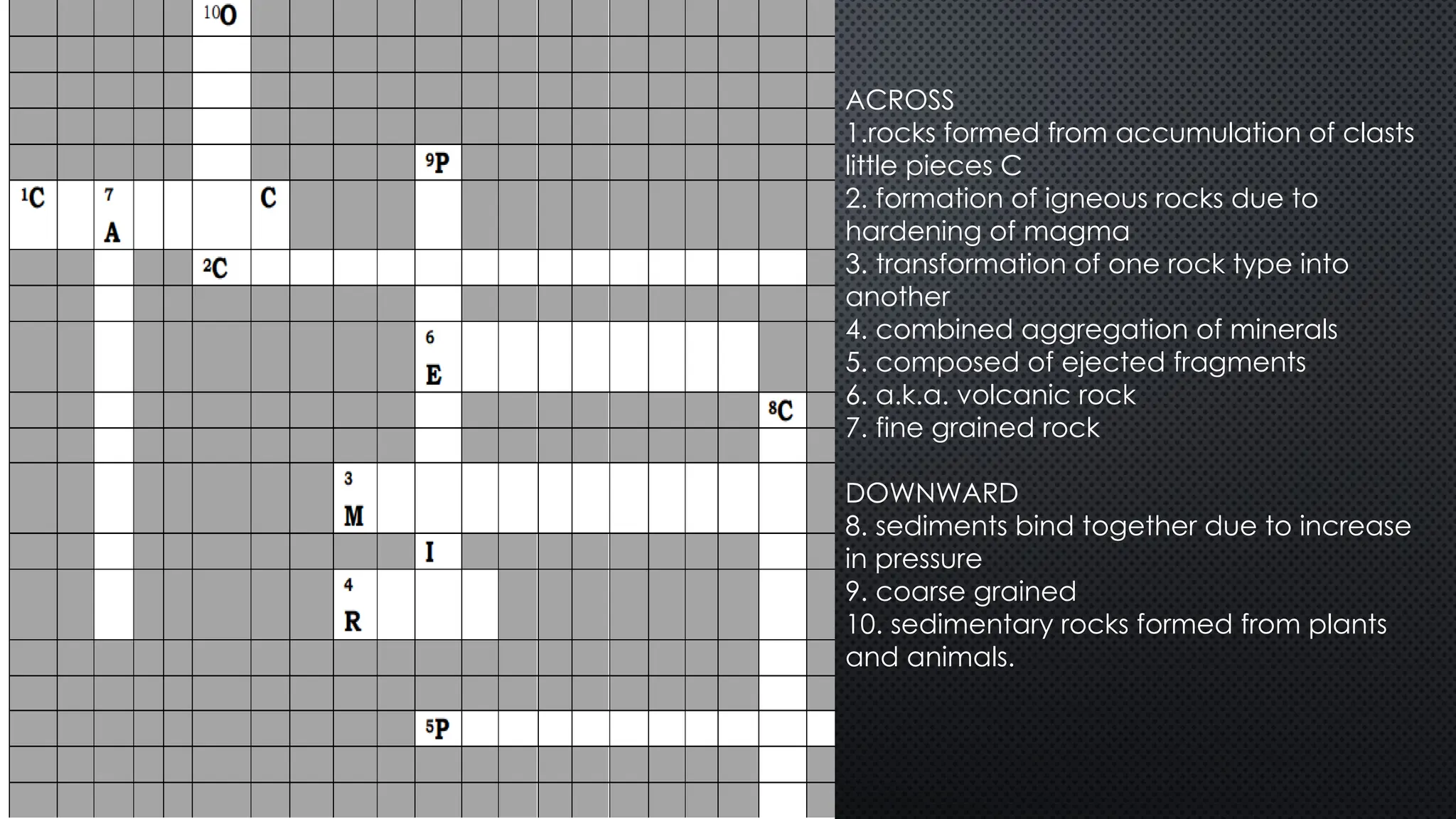
1.rocks formed from accumulation of clasts
little pieces C
2. formation of igneous rocks due to
hardening of magma
3. transformation of one rock type into
another
4. combined aggregation of minerals
5. composed of ejected fragments
6. a.k.a. volcanic rock
7. fine grained rock
DOWNWARD
8. sediments bind together due to increase
in pressure
9. coarse grained
10. sedimentary rocks formed from plants
and animals.
EXOGENIC
PROCESSES
Exogeny refers to coming from the outside, people,
planets, computers, and anything else can be influenced
either by things in its environment or by things within
itself. things from within itself are indigenous.
The earth is shaped by many geological processes. The
forces that make these things happen come from both
inside and outside the earth.
In geology, EXOGENOUS PROCESSES come from forces on
or above the Earth's surface. Processes caused by forces
from within the Earth are ENDOGENOUS PROCESSES.
Exo is a prefix meaning "out", and endo is a prefix
meaning "in".
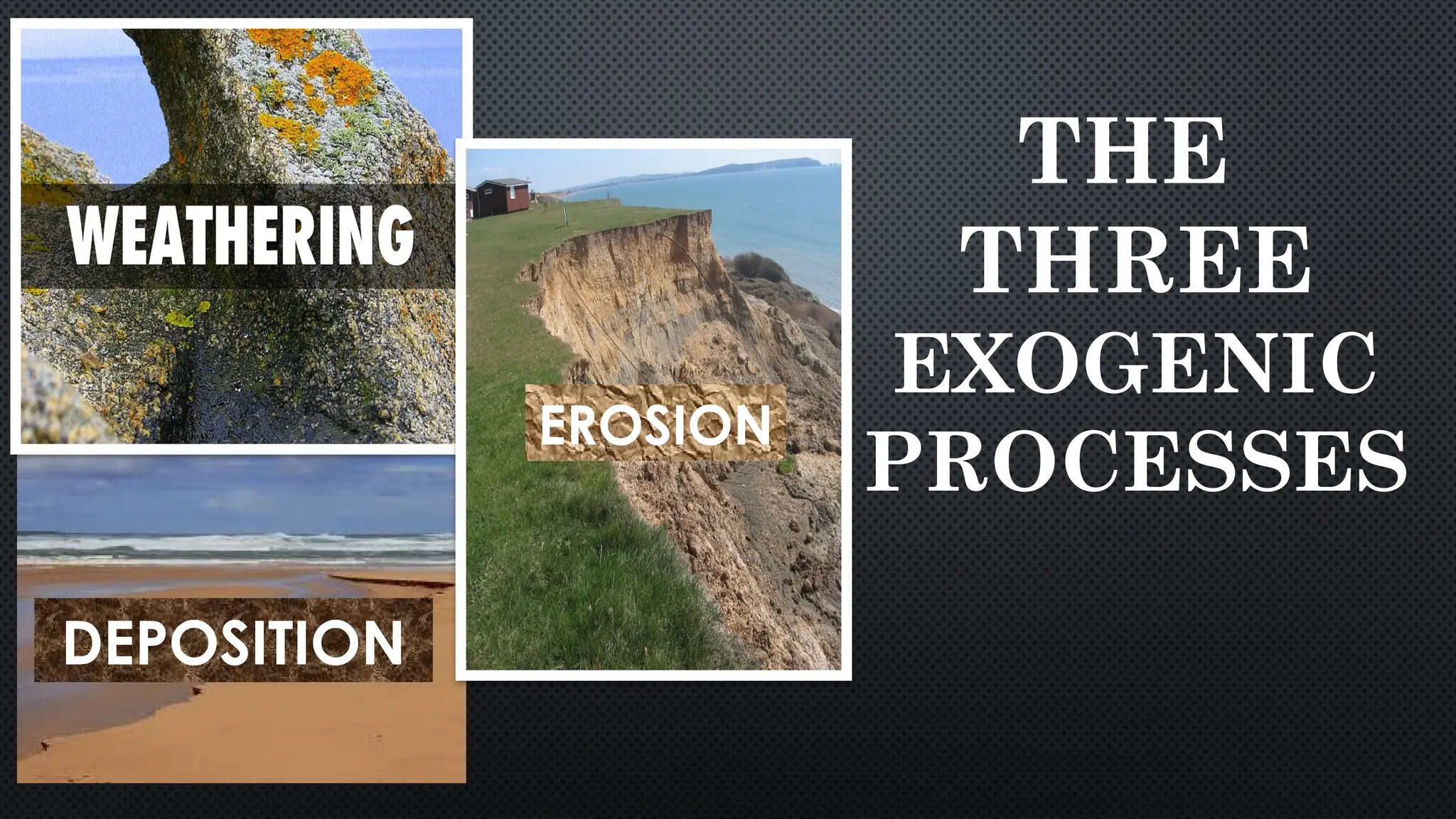
THE
THREE
EXOGENIC
PROCESSES
EROSION
DEPOSITION
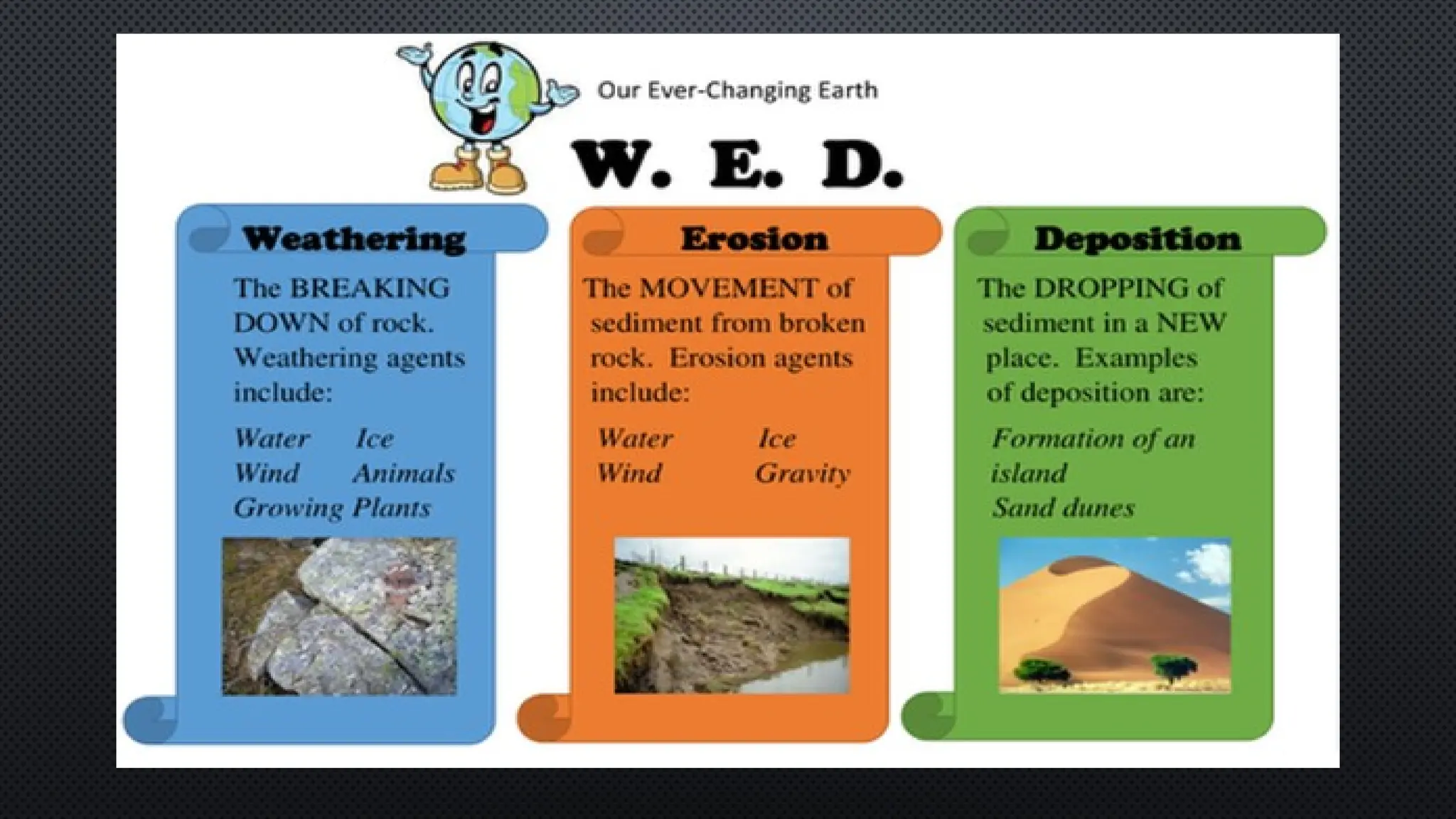
Weathering is a process of breaking
down rocks into small particles such as
sand, clay, gravel and other fragments
Weathering is the process of
disintegration (physical) and
decomposition (chemical) of rocks.
TWO
TYPES
OF
WEATHERING
• Mechanical
weathering or
Physical
weathering
(disintegration)
and
• Chemical
weathering
(decomposition)
MECHANICAL WEATHERING or Physical
weathering (disintegration)
is the breakdown of rocks into
pieces without any change in its
composition. In this process, the size
and shape of rocks changes and this
occurs because of the following
factors
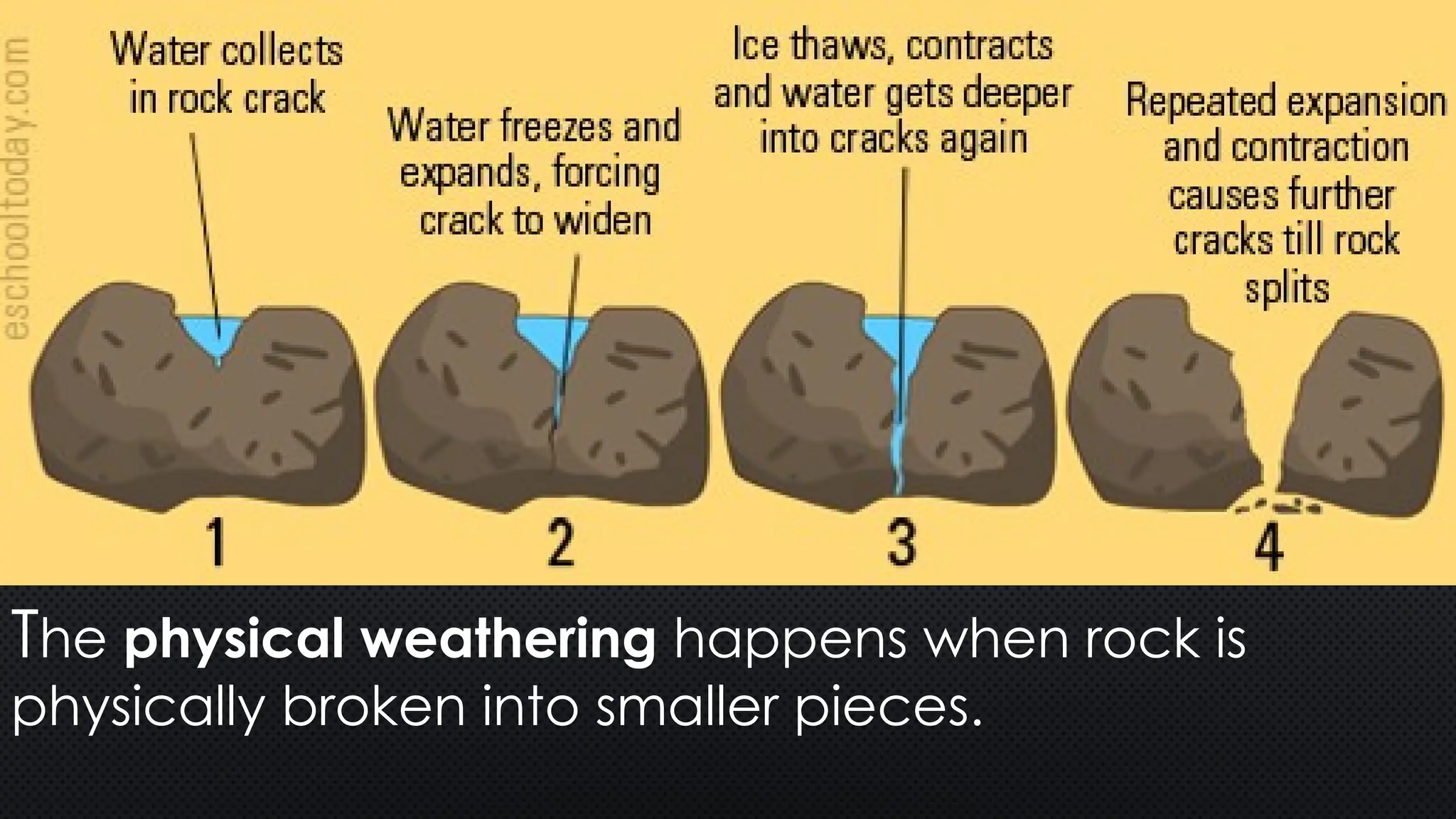
The physical weathering happens when rock is
physically broken into smaller pieces.
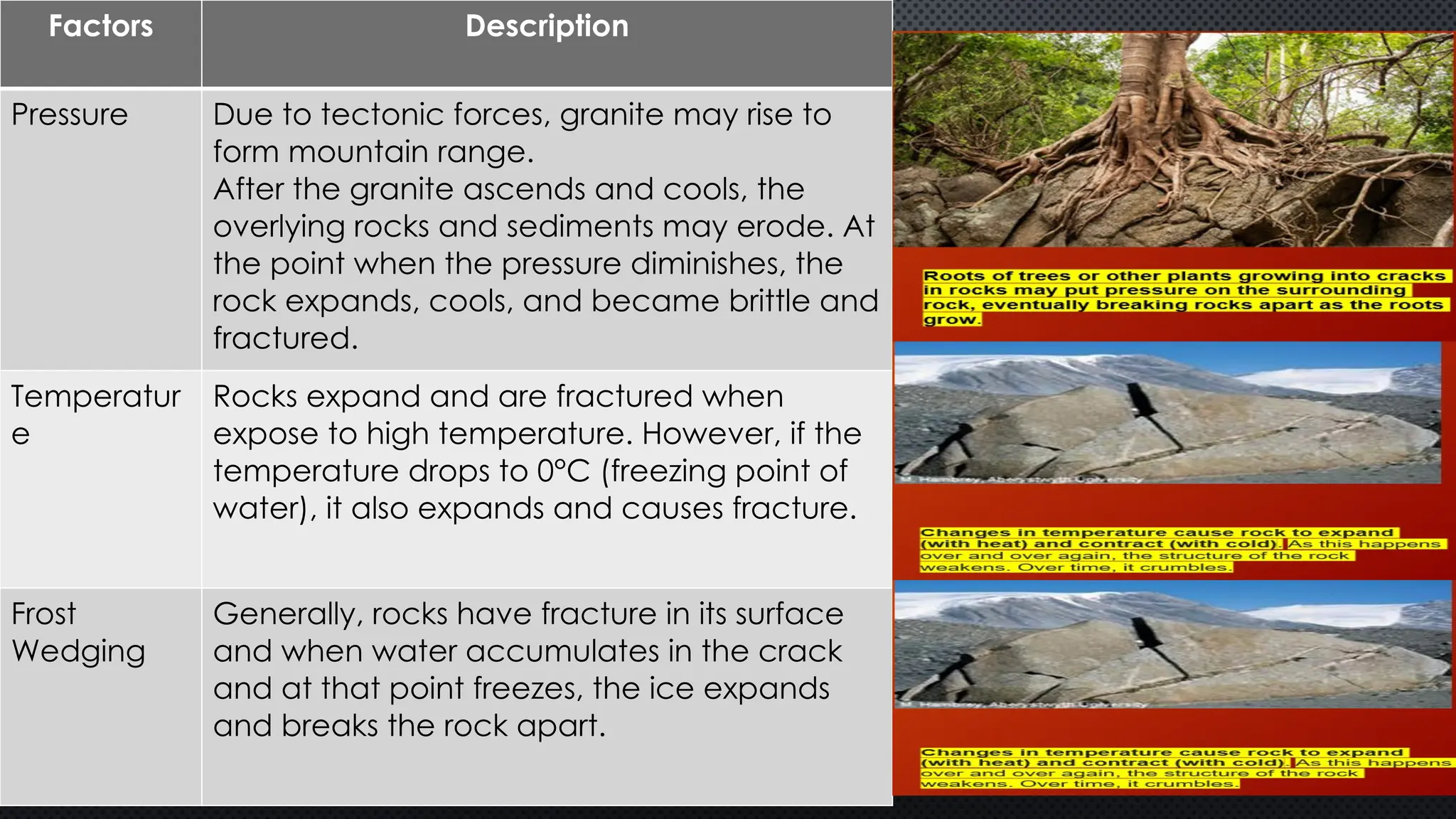
Factors Description
Pressure Due to tectonic forces, granite may rise to
form mountain range.
After the granite ascends and cools, the
overlying rocks and sediments may erode. At
the point when the pressure diminishes, the
rock expands, cools, and became brittle and
fractured.
Temperatur
e
Rocks expand and are fractured when
expose to high temperature. However, if the
temperature drops to 0°C (freezing point of
water), it also expands and causes fracture.
Frost
Wedging
Generally, rocks have fracture in its surface
and when water accumulates in the crack
and at that point freezes, the ice expands
and breaks the rock apart.
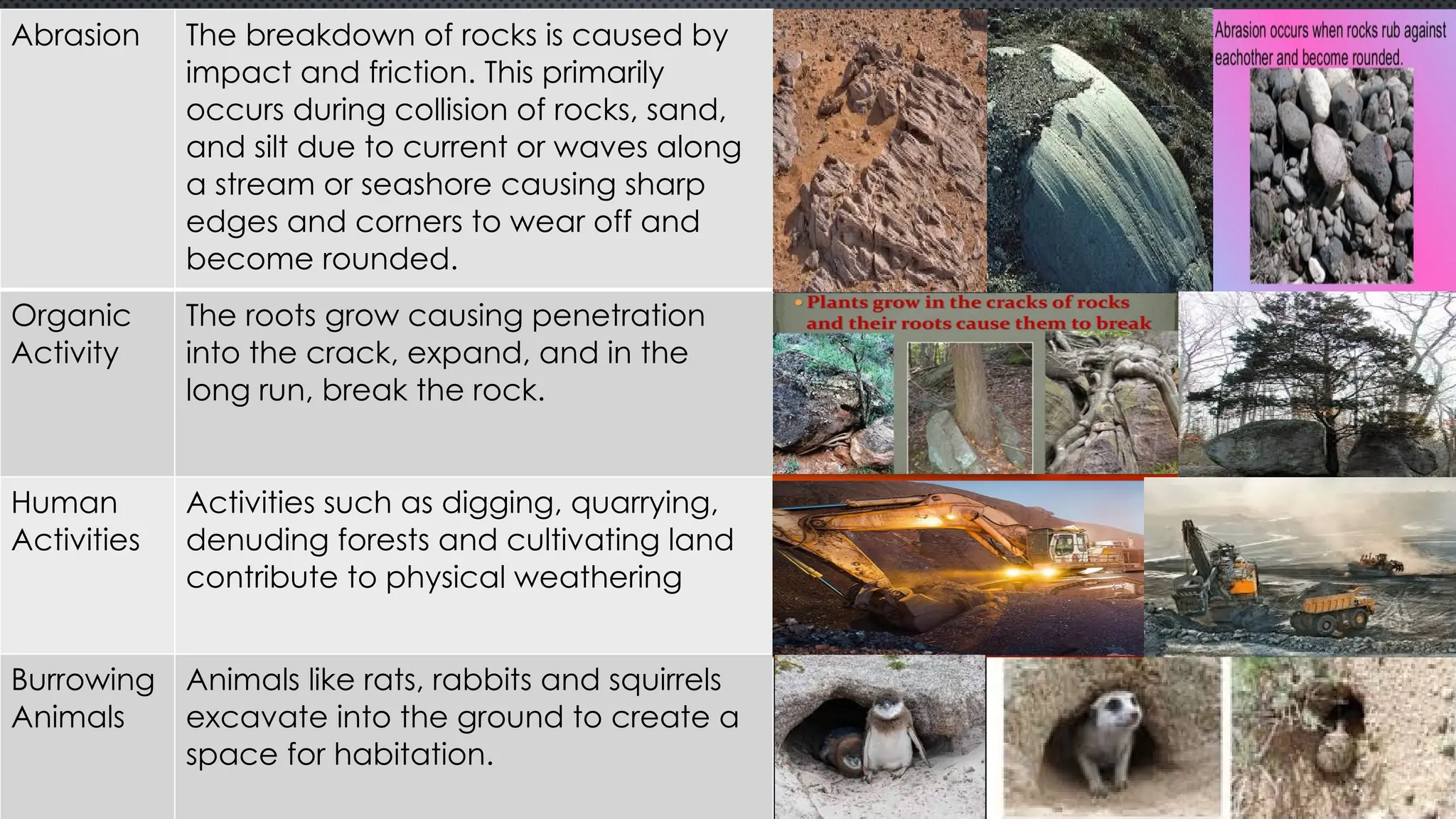
Abrasion The breakdown of rocks is caused by
impact and friction. This primarily
occurs during collision of rocks, sand,
and silt due to current or waves along
a stream or seashore causing sharp
edges and corners to wear off and
become rounded.
Organic
Activity
The roots grow causing penetration
into the crack, expand, and in the
long run, break the rock.
Human
Activities
Activities such as digging, quarrying,
denuding forests and cultivating land
contribute to physical weathering
Burrowing
Animals
Animals like rats, rabbits and squirrels
excavate into the ground to create a
space for habitation.
Chemical weathering involves
the interaction of rock with mineral
solutions (chemicals) to change the
composition of rocks. In this process,
water interacts with minerals to
create various chemical reactions
and transform the rocks.
CHEMICAL WEATHERING or
(decomposition)
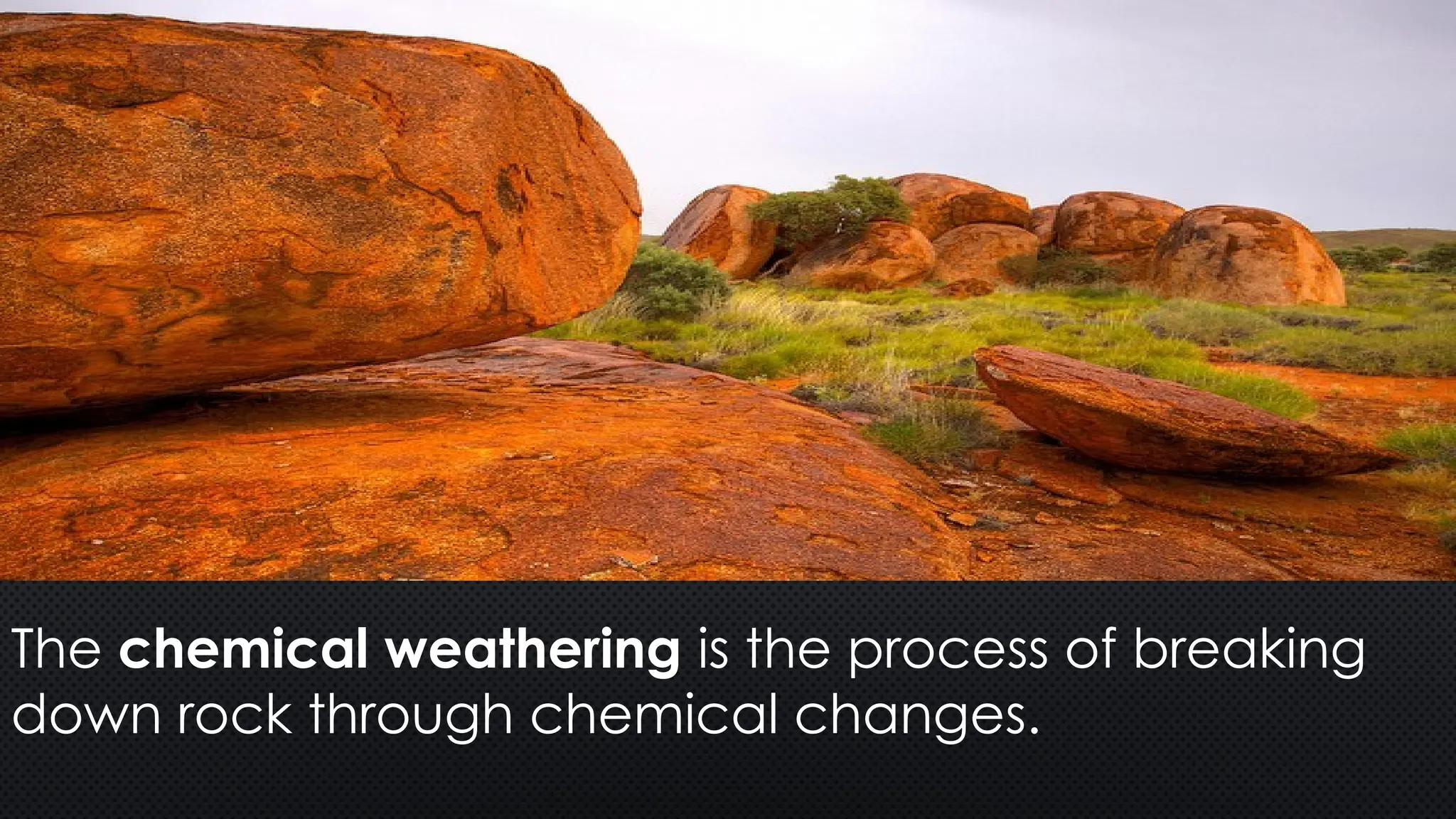
The chemical weathering is the process of breaking
down rock through chemical changes.
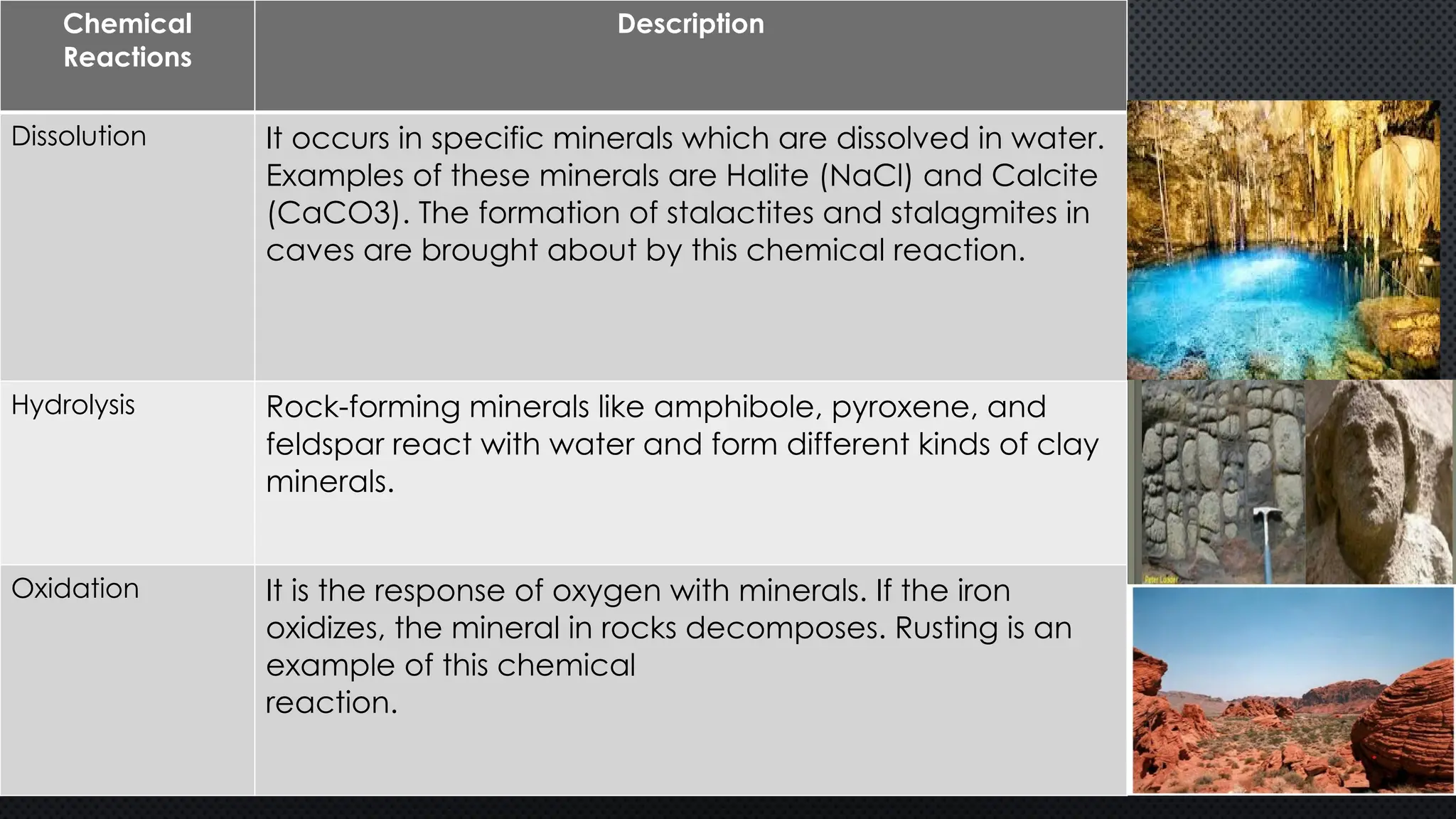
Chemical
Reactions
Description
Dissolution It occurs in specific minerals which are dissolved in water.
Examples of these minerals are Halite (NaCl) and Calcite
(CaCO3). The formation of stalactites and stalagmites in
caves are brought about by this chemical reaction.
Hydrolysis Rock-forming minerals like amphibole, pyroxene, and
feldspar react with water and form different kinds of clay
minerals.
Oxidation It is the response of oxygen with minerals. If the iron
oxidizes, the mineral in rocks decomposes. Rusting is an
example of this chemical
reaction.
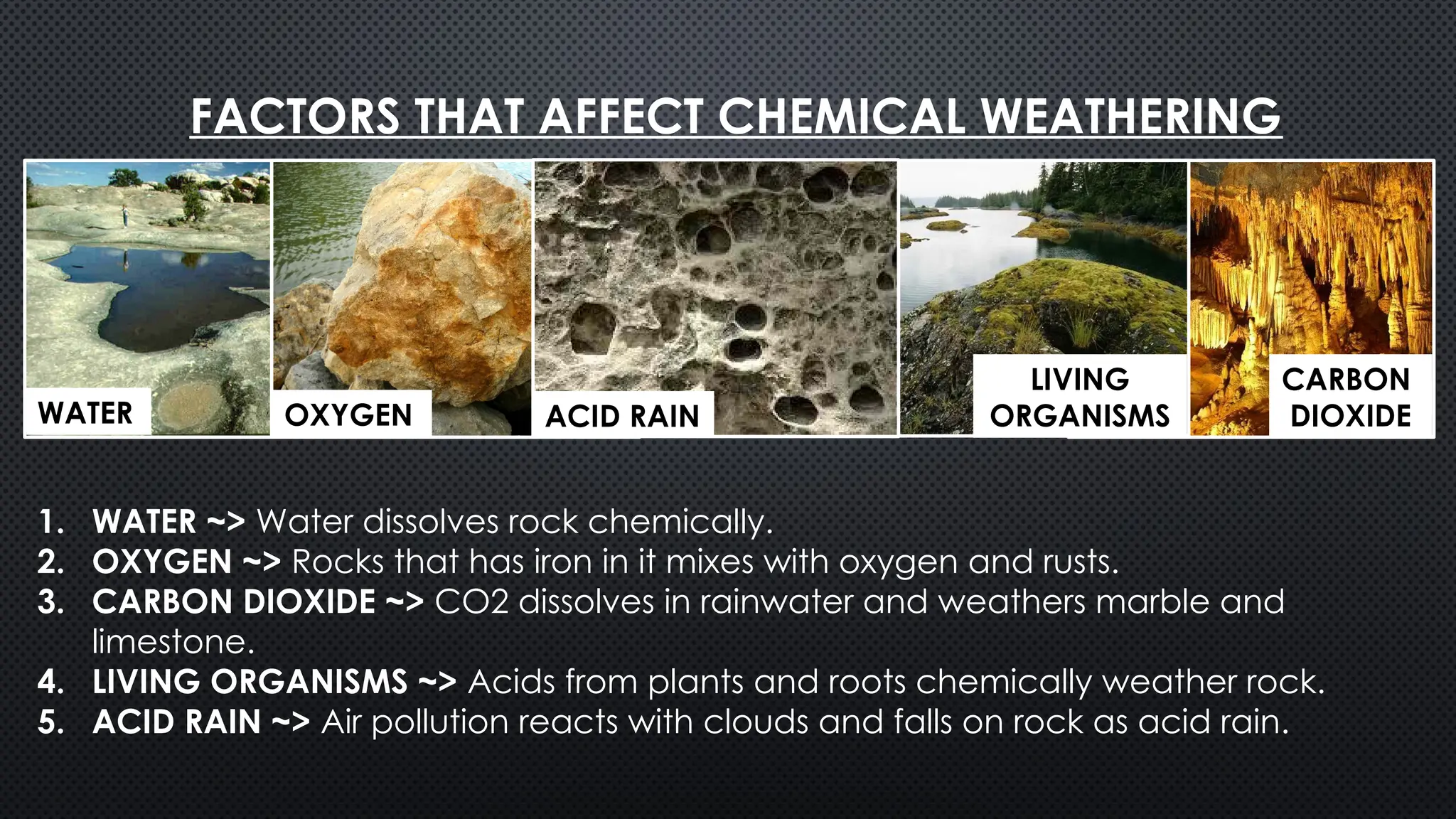
FACTORS THAT AFFECT CHEMICAL WEATHERING
WATER OXYGEN
CARBON
DIOXIDE
LIVING
ORGANISMS
1. WATER ~> Water dissolves rock chemically.
2. OXYGEN ~> Rocks that has iron in it mixes with oxygen and rusts.
3. CARBON DIOXIDE ~> CO2 dissolves in rainwater and weathers marble and
limestone.
4. LIVING ORGANISMS ~> Acids from plants and roots chemically weather rock.
5. ACID RAIN ~> Air pollution reacts with clouds and falls on rock as acid rain.
ACID RAIN
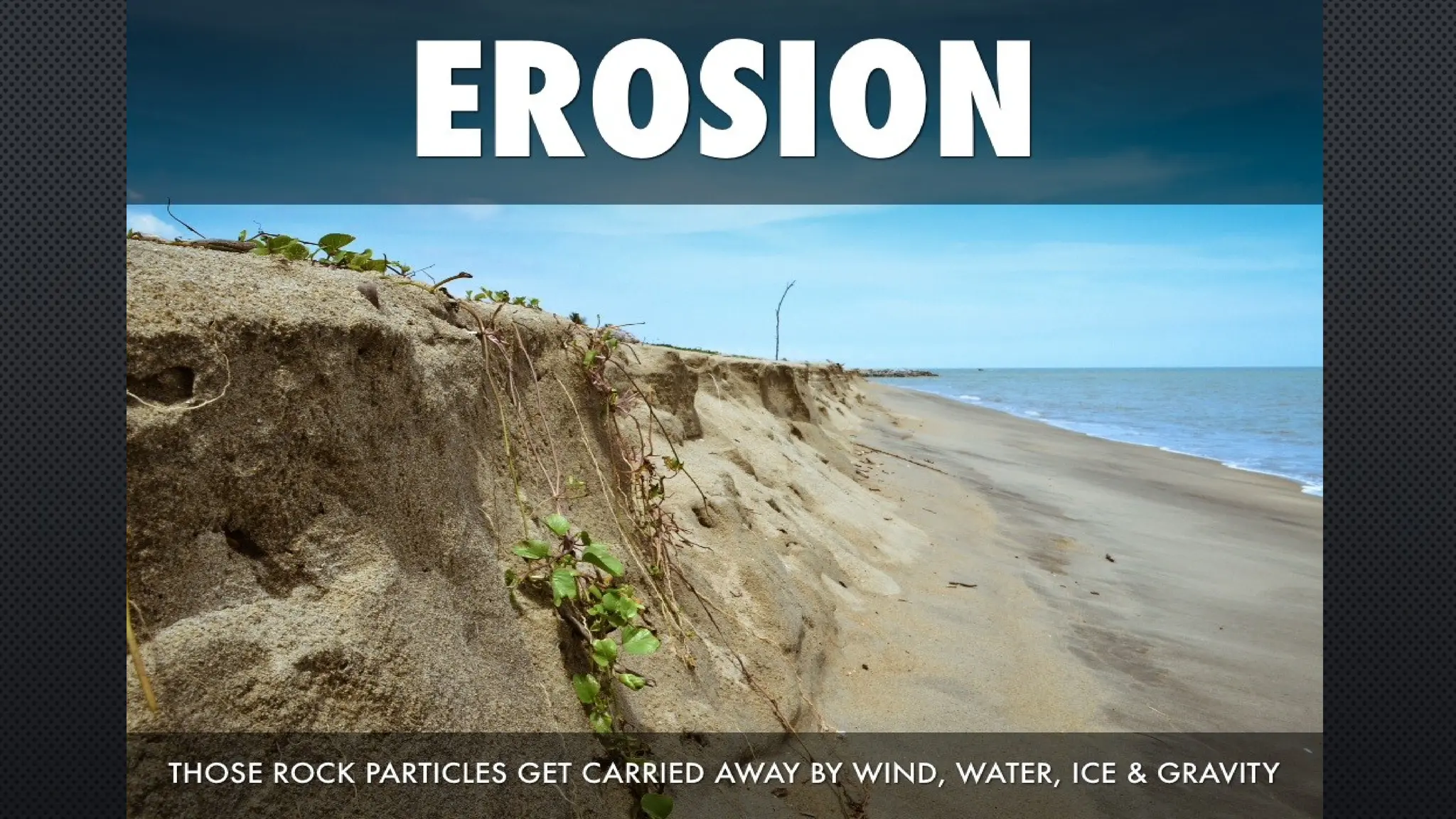
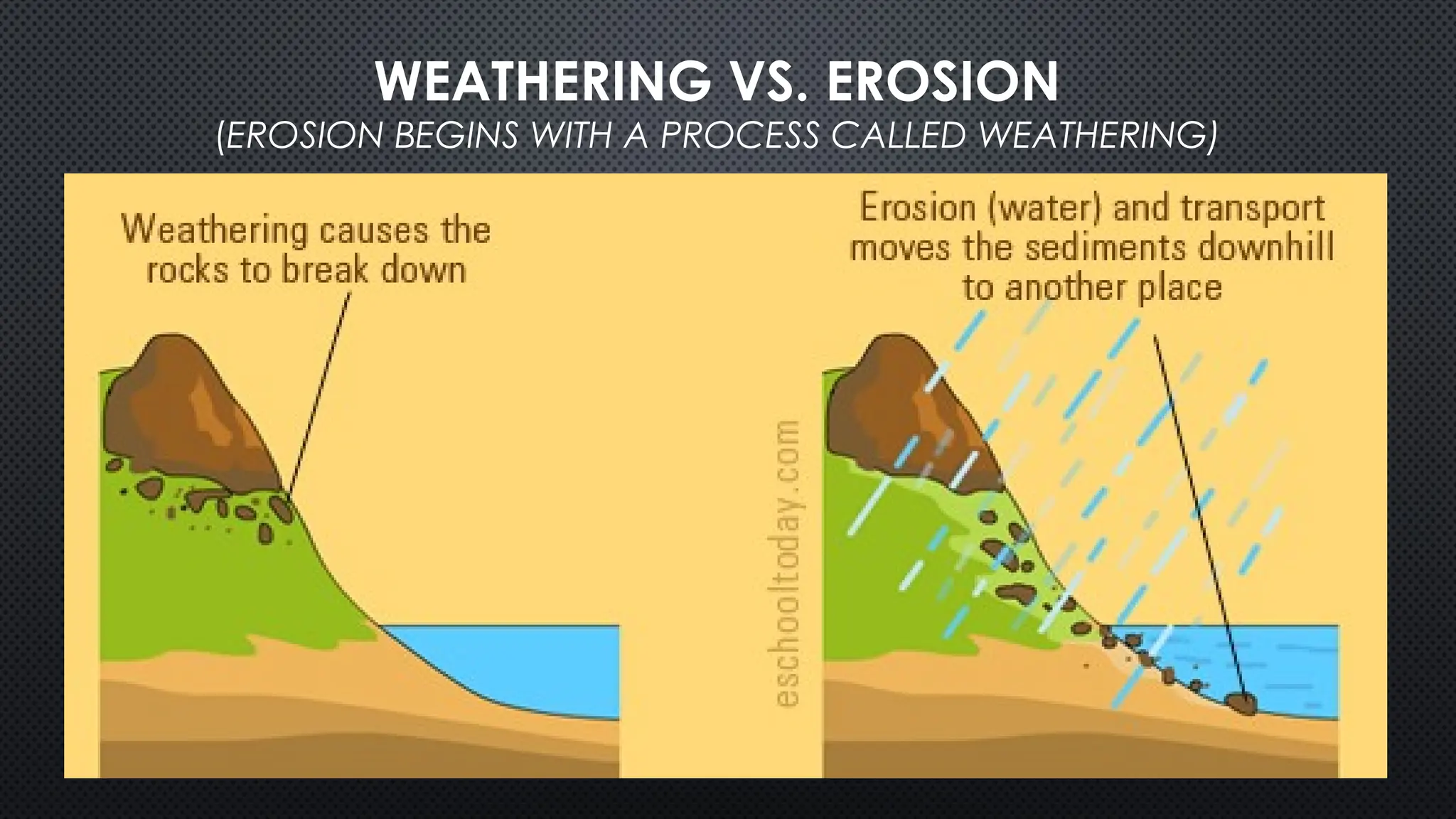
Erosion is the separation and removal of weathered
rocks due to different agents like water, wind, and
glacier that causes transportation of the material to
where they are deposited. Plants, animals, and humans
play an important role in the erosional process.
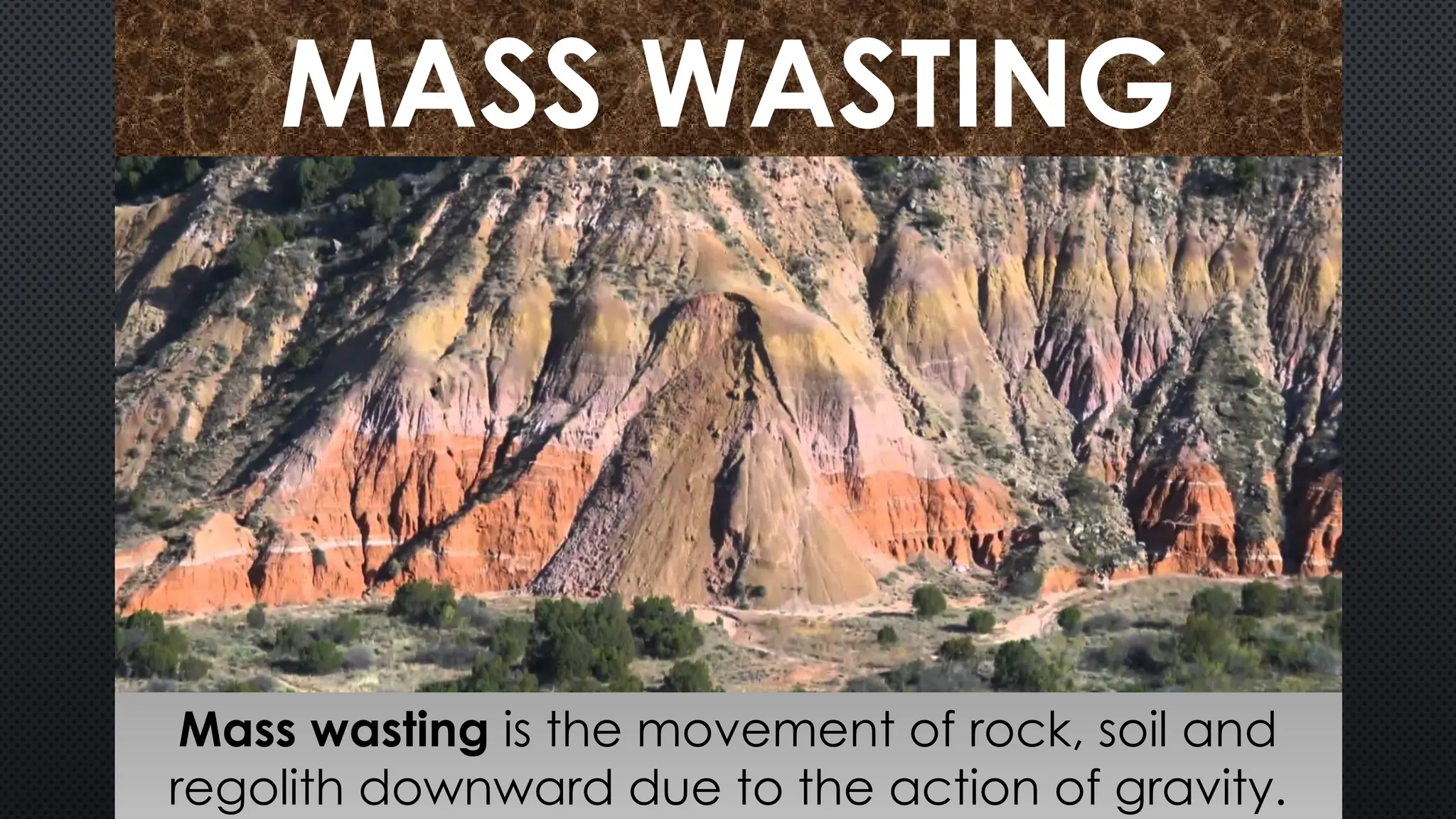
The movement of sediments downslope under the
influence of gravity is called mass wasting. The example
of this are fall, slide, avalanche, and flow. On the other
hand, deposition is the process in which the weathered
materials carried out by erosion settle down in a
particular location.
AGENTS OF EROSION
(WATER, WIND, ICE, AND
GRAVITY)
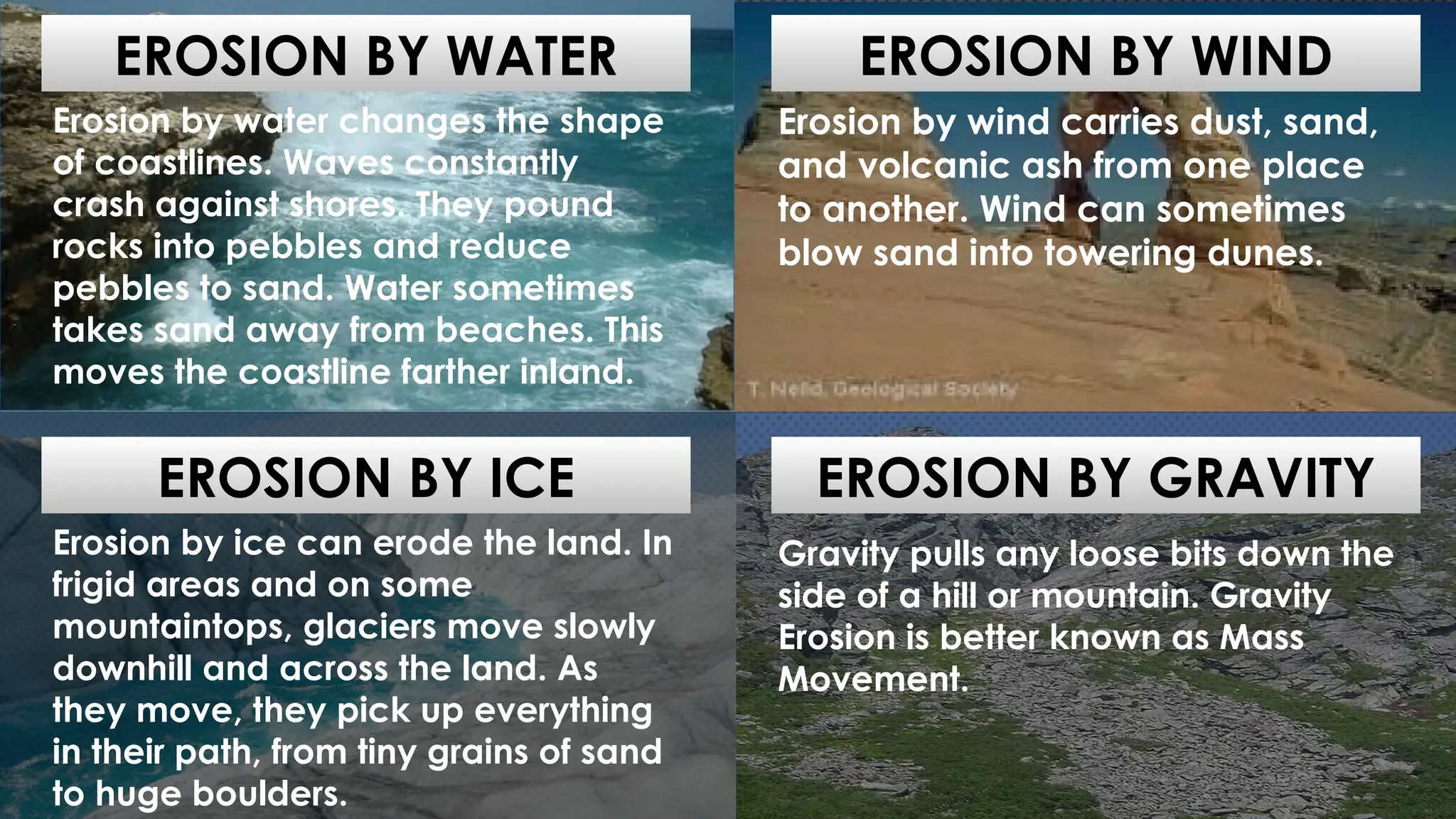
EROSION BY WATER
EROSION BY GRAVITY
EROSION BY WIND
EROSION BY ICE
Erosion by water changes the shape
of coastlines. Waves constantly
crash against shores. They pound
rocks into pebbles and reduce
pebbles to sand. Water sometimes
takes sand away from beaches. This
moves the coastline farther inland.
Gravity pulls any loose bits down the
side of a hill or mountain. Gravity
Erosion is better known as Mass
Movement.
Erosion by ice can erode the land. In
frigid areas and on some
mountaintops, glaciers move slowly
downhill and across the land. As
they move, they pick up everything
in their path, from tiny grains of sand
to huge boulders.
Erosion by wind carries dust, sand,
and volcanic ash from one place
to another. Wind can sometimes
blow sand into towering dunes.
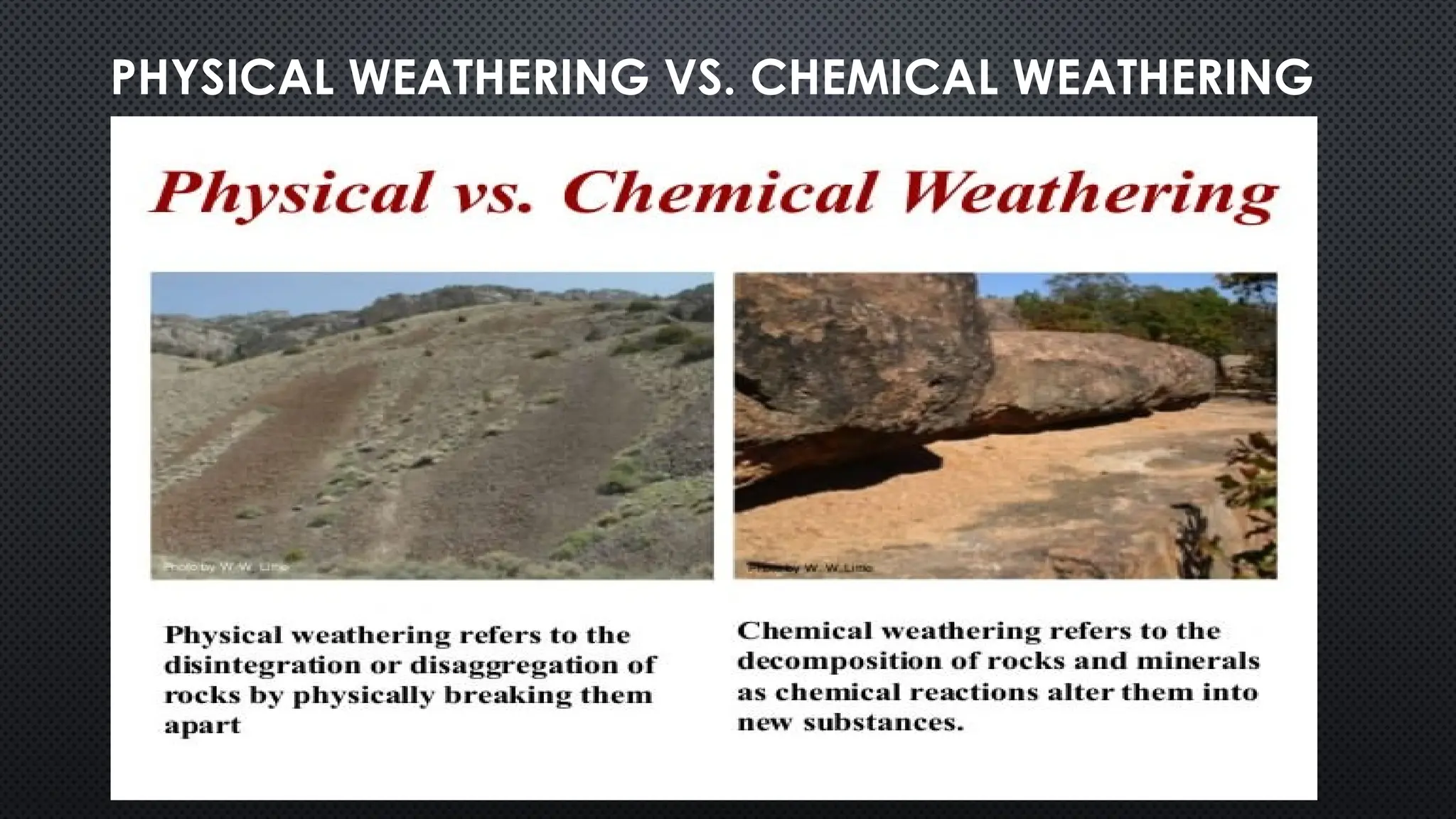
PHYSICAL WEATHERING VS. CHEMICAL WEATHERING
WEATHERING VS. EROSION
(EROSION BEGINS WITH A PROCESS CALLED WEATHERING)
MASS WASTING
Mass wasting is the movement of rock, soil and
regolith downward due to the action of gravity.
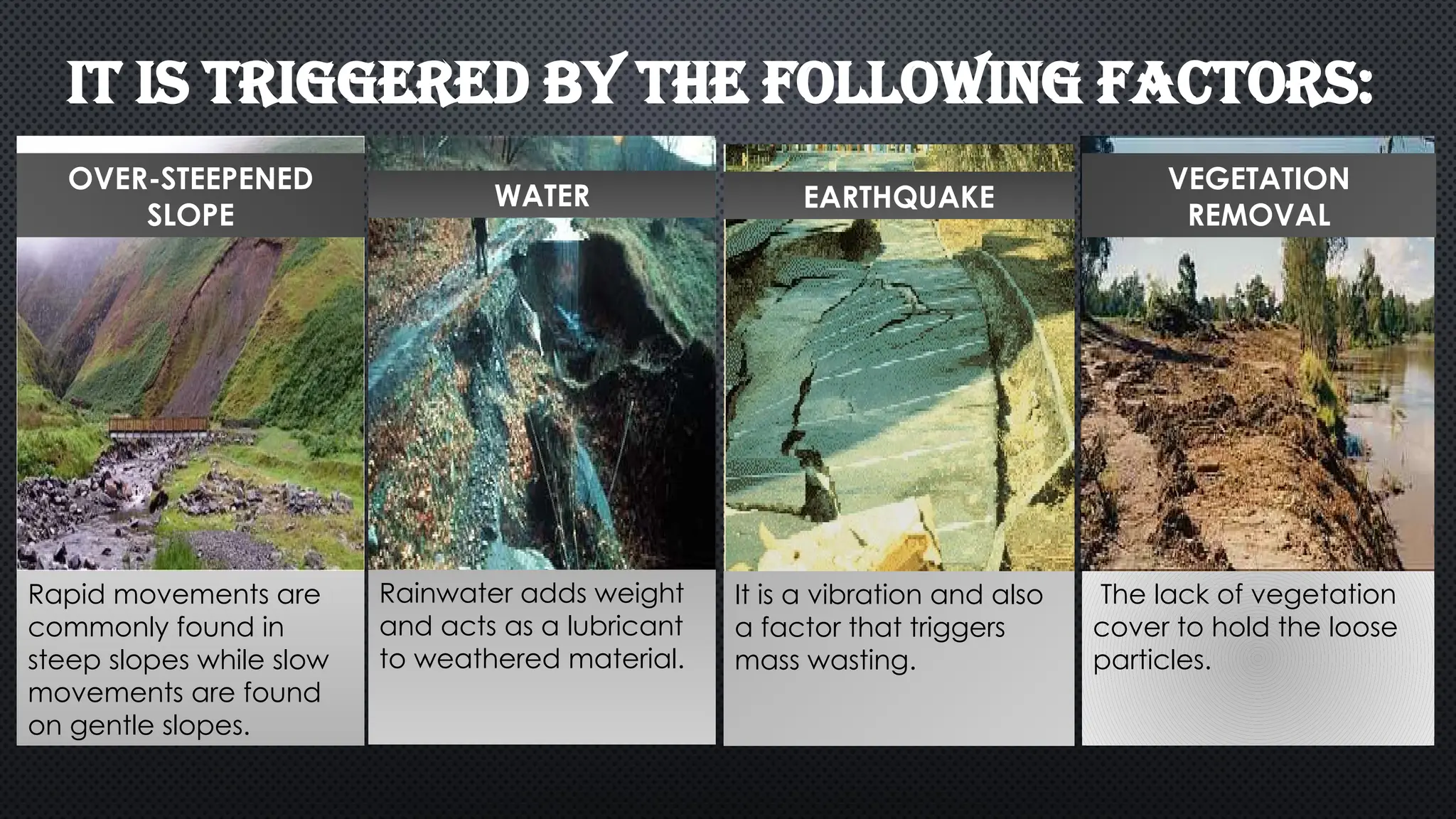
It is triggered by the following factors:
WATER EARTHQUAKE
Rainwater adds weight
and acts as a lubricant
to weathered material.
It is a vibration and also
a factor that triggers
mass wasting.
The lack of vegetation
cover to hold the loose
particles.
VEGETATION
REMOVAL
OVER-STEEPENED
SLOPE
Rapid movements are
commonly found in
steep slopes while slow
movements are found
on gentle slopes.
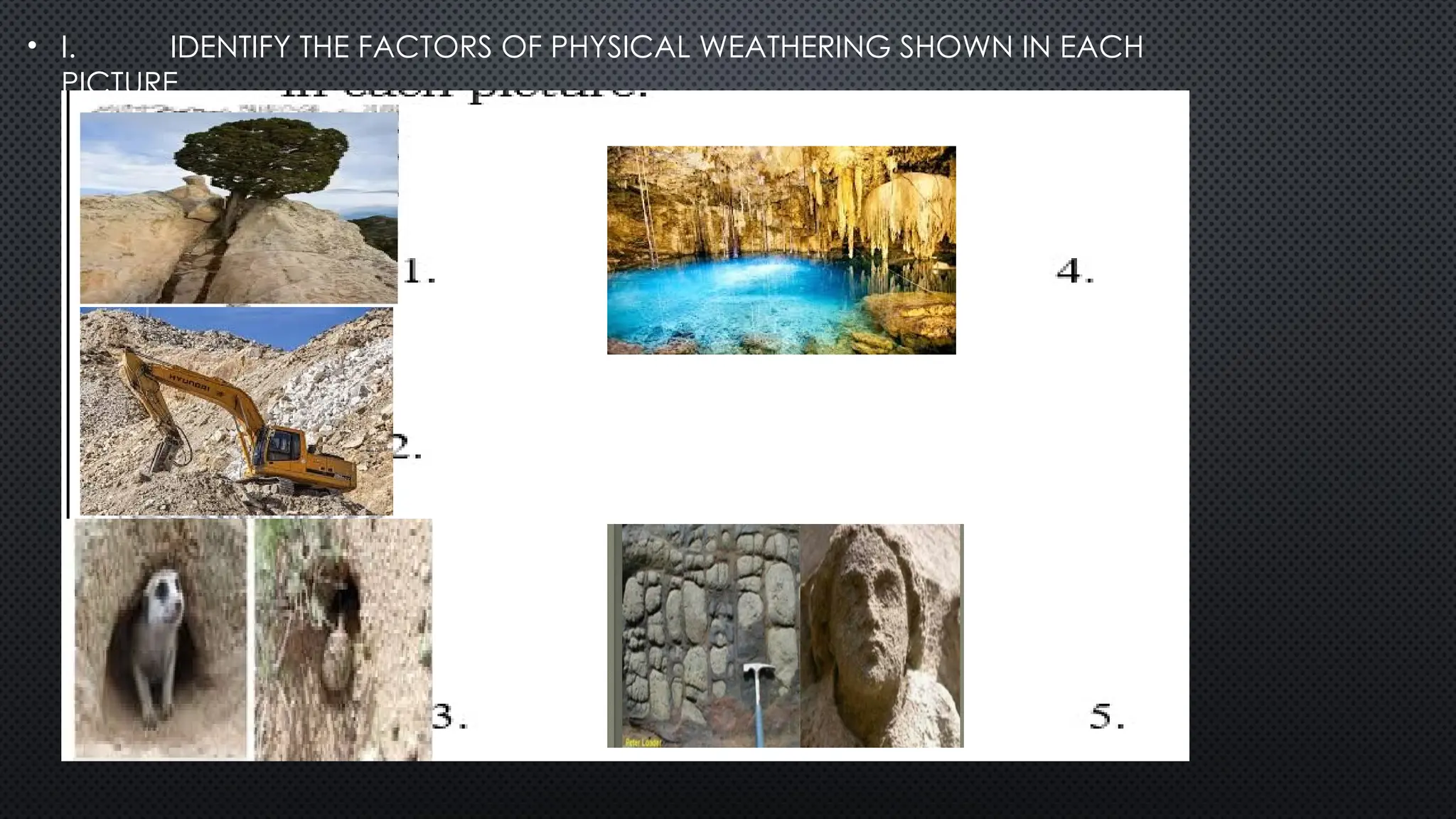
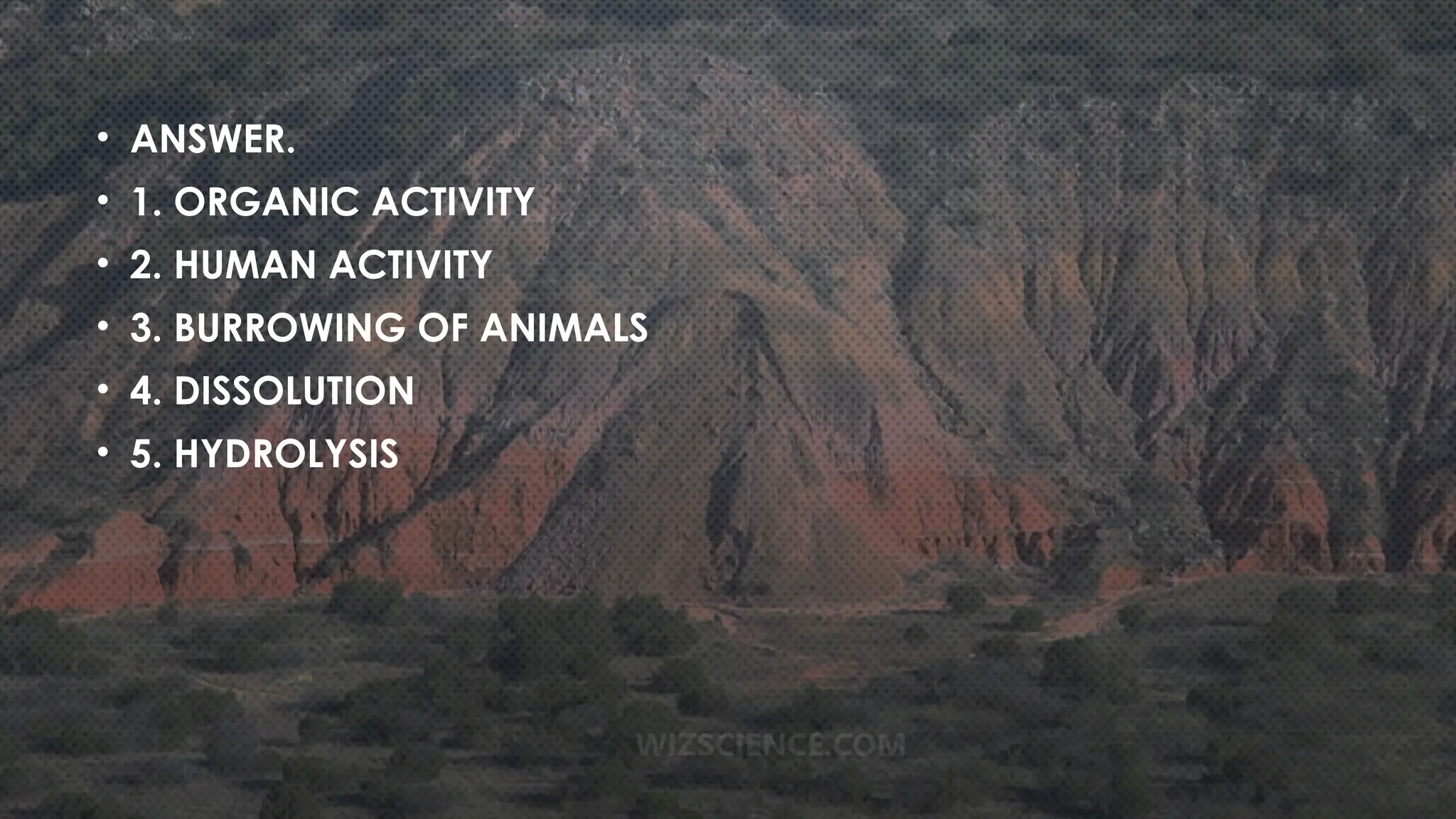
• I. IDENTIFY THE FACTORS OF PHYSICAL WEATHERING SHOWN IN EACH
PICTURE.
• ANSWER.
• 1. ORGANIC ACTIVITY
• 2. HUMAN ACTIVITY
• 3. BURROWING OF ANIMALS
• 4. DISSOLUTION
• 5. HYDROLYSIS
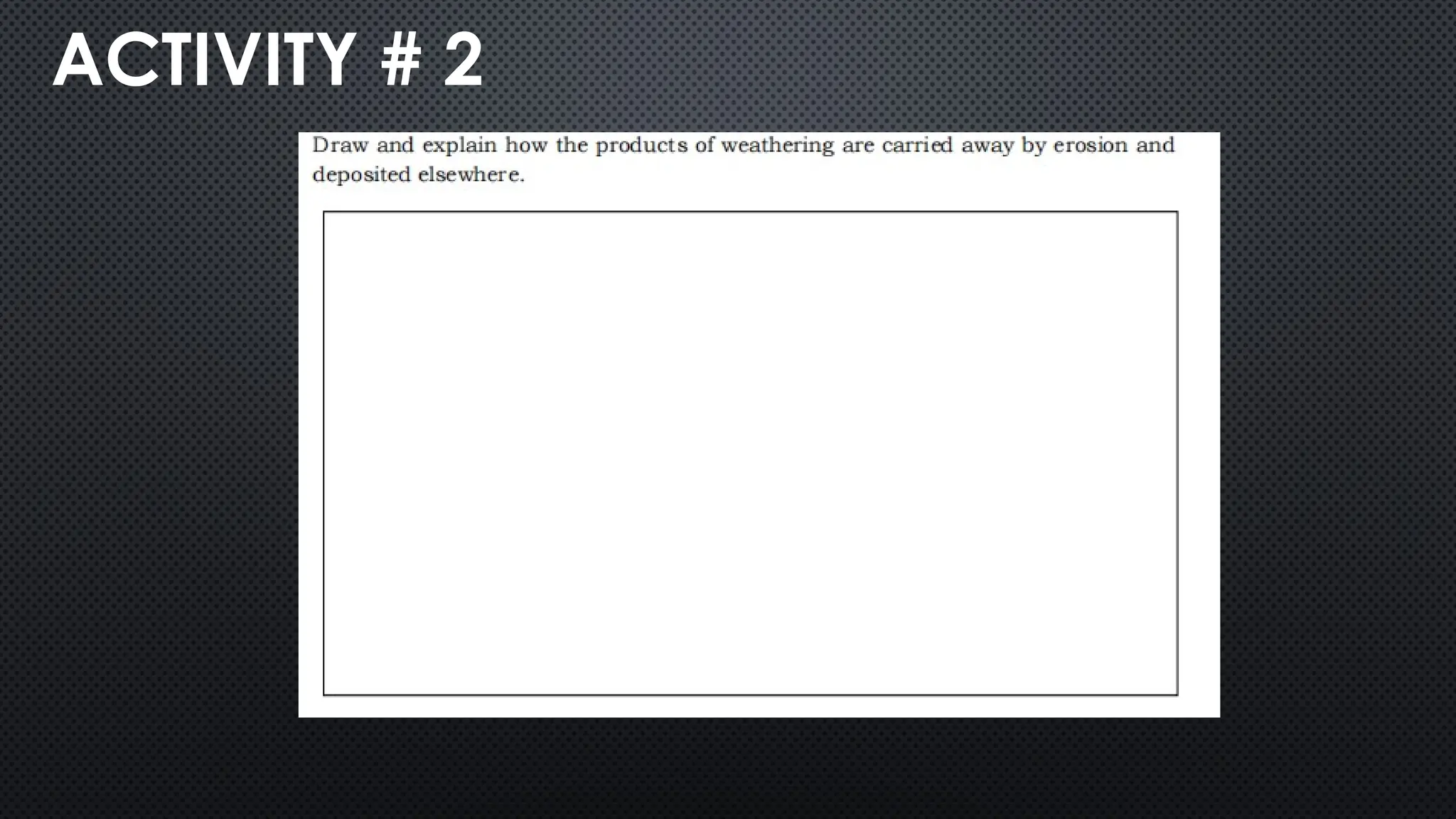
ACTIVITY # 2
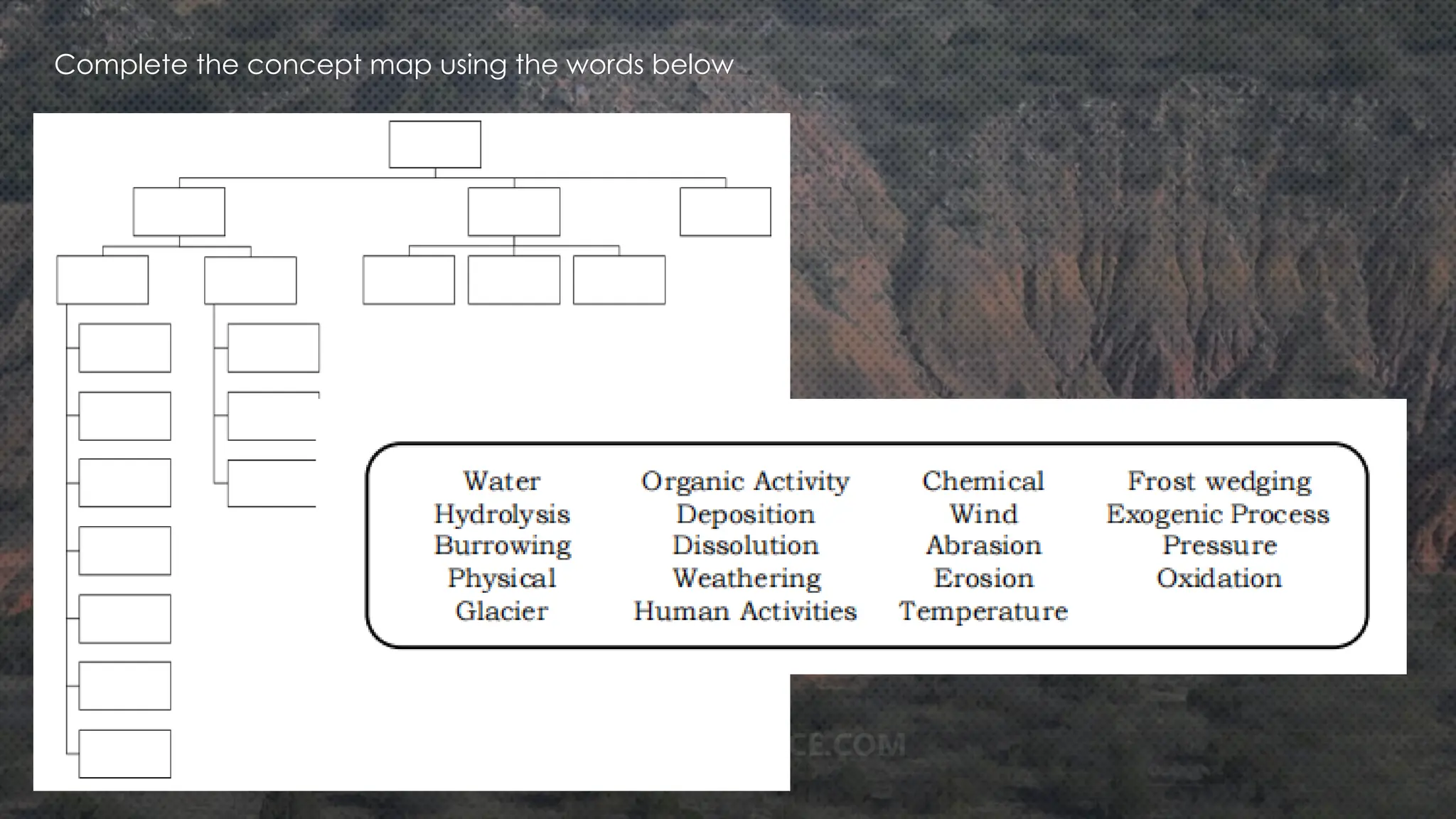
Complete the concept map using the words below
• SOIL IS AN ESSENTIAL COMPONENT OF THE EARTH’S
CRUST. IT ENABLED LIFE TO EXIST AND PROVIDES THE
SERVICES NECESSARY FOR HUMAN SURVIVAL. WHAT
IS THE EFFECT OF SOIL EROSION? WHAT WILL YOU DO
TO PROTECT THE COMMUNITY?

Exogenic Process composed of three types, weathering, erosion and deposition

  • 1.
    ACROSS 1.rocks formed fromaccumulation of clasts little pieces C 2. formation of igneous rocks due to hardening of magma 3. transformation of one rock type into another 4. combined aggregation of minerals 5. composed of ejected fragments 6. a.k.a. volcanic rock 7. fine grained rock DOWNWARD 8. sediments bind together due to increase in pressure 9. coarse grained 10. sedimentary rocks formed from plants and animals.
  • 2.
  • 3.
    Exogeny refers tocoming from the outside, people, planets, computers, and anything else can be influenced either by things in its environment or by things within itself. things from within itself are indigenous. The earth is shaped by many geological processes. The forces that make these things happen come from both inside and outside the earth.
  • 4.
    In geology, EXOGENOUSPROCESSES come from forces on or above the Earth's surface. Processes caused by forces from within the Earth are ENDOGENOUS PROCESSES. Exo is a prefix meaning "out", and endo is a prefix meaning "in".
  • 5.
  • 6.
    Weathering is aprocess of breaking down rocks into small particles such as sand, clay, gravel and other fragments Weathering is the process of disintegration (physical) and decomposition (chemical) of rocks.
  • 7.
  • 8.
    MECHANICAL WEATHERING orPhysical weathering (disintegration) is the breakdown of rocks into pieces without any change in its composition. In this process, the size and shape of rocks changes and this occurs because of the following factors
  • 9.
    The physical weatheringhappens when rock is physically broken into smaller pieces.
  • 10.
    Factors Description Pressure Dueto tectonic forces, granite may rise to form mountain range. After the granite ascends and cools, the overlying rocks and sediments may erode. At the point when the pressure diminishes, the rock expands, cools, and became brittle and fractured. Temperatur e Rocks expand and are fractured when expose to high temperature. However, if the temperature drops to 0°C (freezing point of water), it also expands and causes fracture. Frost Wedging Generally, rocks have fracture in its surface and when water accumulates in the crack and at that point freezes, the ice expands and breaks the rock apart.
  • 11.
    Abrasion The breakdownof rocks is caused by impact and friction. This primarily occurs during collision of rocks, sand, and silt due to current or waves along a stream or seashore causing sharp edges and corners to wear off and become rounded. Organic Activity The roots grow causing penetration into the crack, expand, and in the long run, break the rock. Human Activities Activities such as digging, quarrying, denuding forests and cultivating land contribute to physical weathering Burrowing Animals Animals like rats, rabbits and squirrels excavate into the ground to create a space for habitation.
  • 12.
    Chemical weathering involves theinteraction of rock with mineral solutions (chemicals) to change the composition of rocks. In this process, water interacts with minerals to create various chemical reactions and transform the rocks. CHEMICAL WEATHERING or (decomposition)
  • 13.
    The chemical weatheringis the process of breaking down rock through chemical changes.
  • 14.
    Chemical Reactions Description Dissolution It occursin specific minerals which are dissolved in water. Examples of these minerals are Halite (NaCl) and Calcite (CaCO3). The formation of stalactites and stalagmites in caves are brought about by this chemical reaction. Hydrolysis Rock-forming minerals like amphibole, pyroxene, and feldspar react with water and form different kinds of clay minerals. Oxidation It is the response of oxygen with minerals. If the iron oxidizes, the mineral in rocks decomposes. Rusting is an example of this chemical reaction.
  • 15.
    FACTORS THAT AFFECTCHEMICAL WEATHERING WATER OXYGEN CARBON DIOXIDE LIVING ORGANISMS 1. WATER ~> Water dissolves rock chemically. 2. OXYGEN ~> Rocks that has iron in it mixes with oxygen and rusts. 3. CARBON DIOXIDE ~> CO2 dissolves in rainwater and weathers marble and limestone. 4. LIVING ORGANISMS ~> Acids from plants and roots chemically weather rock. 5. ACID RAIN ~> Air pollution reacts with clouds and falls on rock as acid rain. ACID RAIN
  • 17.
    Erosion is theseparation and removal of weathered rocks due to different agents like water, wind, and glacier that causes transportation of the material to where they are deposited. Plants, animals, and humans play an important role in the erosional process. The movement of sediments downslope under the influence of gravity is called mass wasting. The example of this are fall, slide, avalanche, and flow. On the other hand, deposition is the process in which the weathered materials carried out by erosion settle down in a particular location.
  • 18.
    AGENTS OF EROSION (WATER,WIND, ICE, AND GRAVITY)
  • 19.
    EROSION BY WATER EROSIONBY GRAVITY EROSION BY WIND EROSION BY ICE Erosion by water changes the shape of coastlines. Waves constantly crash against shores. They pound rocks into pebbles and reduce pebbles to sand. Water sometimes takes sand away from beaches. This moves the coastline farther inland. Gravity pulls any loose bits down the side of a hill or mountain. Gravity Erosion is better known as Mass Movement. Erosion by ice can erode the land. In frigid areas and on some mountaintops, glaciers move slowly downhill and across the land. As they move, they pick up everything in their path, from tiny grains of sand to huge boulders. Erosion by wind carries dust, sand, and volcanic ash from one place to another. Wind can sometimes blow sand into towering dunes.
  • 20.
    PHYSICAL WEATHERING VS.CHEMICAL WEATHERING
  • 21.
    WEATHERING VS. EROSION (EROSIONBEGINS WITH A PROCESS CALLED WEATHERING)
  • 22.
    MASS WASTING Mass wastingis the movement of rock, soil and regolith downward due to the action of gravity.
  • 23.
    It is triggeredby the following factors: WATER EARTHQUAKE Rainwater adds weight and acts as a lubricant to weathered material. It is a vibration and also a factor that triggers mass wasting. The lack of vegetation cover to hold the loose particles. VEGETATION REMOVAL OVER-STEEPENED SLOPE Rapid movements are commonly found in steep slopes while slow movements are found on gentle slopes.
  • 24.
    • I. IDENTIFYTHE FACTORS OF PHYSICAL WEATHERING SHOWN IN EACH PICTURE.
  • 25.
    • ANSWER. • 1.ORGANIC ACTIVITY • 2. HUMAN ACTIVITY • 3. BURROWING OF ANIMALS • 4. DISSOLUTION • 5. HYDROLYSIS
  • 26.
  • 27.
    Complete the conceptmap using the words below
  • 29.
    • SOIL ISAN ESSENTIAL COMPONENT OF THE EARTH’S CRUST. IT ENABLED LIFE TO EXIST AND PROVIDES THE SERVICES NECESSARY FOR HUMAN SURVIVAL. WHAT IS THE EFFECT OF SOIL EROSION? WHAT WILL YOU DO TO PROTECT THE COMMUNITY?