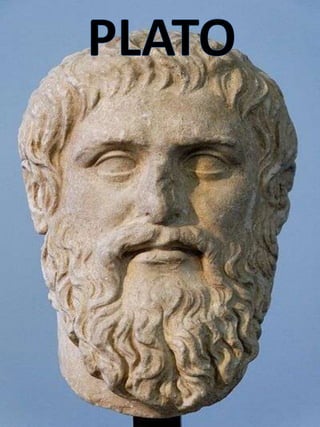
PLATO
GREEK PHILOSOPHER, MATHEMATICIAN AND WRITER OF PHILOSOPHICAL DIALOGUESWHO?HIS 36 SOCRATIC DIALOGUES AND 13 LETTERS HAVE BEEN USED TO TEACH A RANGE OF SUBJECTS FROM ETIHIC TO MATHEMATICS.Recurrent themes through his dialogue includesdiscussing the father and son relationship and whether the intrest into his sons has much to do with how well they turn outOne theory: the material world is not the real world, but only an image or a copy of the real world
Plato, through the words of Socrates, asserts that societies have a tripartite class structure corresponding to the appetite/spirit/reason structure of the individual soul. The appetite/spirit/reason stand for different parts of the body. The body parts symbolize the castes of society.Productive, which represents the abdomen. (Workers) — The laborers, carpenters, plumbers, masons, merchants, farmers, ranchers, etc. These correspond to the "appetite" part of the soul.
Protective, which represents the chest. (Warriors or Guardians) — Those that  are adventurous, strong and brave; in the armed forces. These correspond to the "spirit" part of the soul.
Governing, this represents the head. (Rulers or Philosopher Kings) — Those who are intelligent, rational, self-controlled, in love with wisdom, well suited to make decisions for the community. These correspond to the "reason" part of the soul.Plato dialogue-body parts representing societyPlato, through the words of Socrates, asserts that societies have a tripartite class structure corresponding to the appetite/spirit/reason structure of the individual soul. The appetite/spirit/reason stand for different parts of the body. The body parts symbolize the castes of society.Productive, which represents the abdomen. (Workers) — The labourers, carpenters, plumbers, masons, merchants, farmers, ranchers, etc. These correspond to the "appetite" part of the soul.Protective, which represents the chest. (Warriors or Guardians) — Those that  are adventurous, strong and brave; in the armed forces. These correspond to the "spirit" part of the soul.Governing, this represents the head. — Those who are intelligent, rational, self-controlled, in love with wisdom, well suited to make decisions for the community. These correspond to the "reason" part of the soul and are very few
The cave theoryIn Plato's cave, those who cast the shadows have the power to project intentionality through the formation of the icons to be cast in front of the fire. In other terms, they have a degree of control over the image cast, and a degree of control over their own intention that the director of a stage play does not have. In the case of a stage play where the play is shown several times, there is always the threat to the director of the intentions of the actors. Whereas in the casting of images on the screen or wall of the cave, the projector has the power to control, much more effectively, the casting of the image also in films, having an even greater power, the director has the ability to control the way in which the image will be perceived.With camera and film, a scene or image can be shot and reshot, so as to capture the image desired, in a way this retains a certain power to the director but, the director has a power greater than even Plato's smaller version of film as with the camera, the director can insure that a particular way of seeing things, people, and events is guaranteed, and can also make sure that everyone in the audience will view a particular scene from the same angle, will see it in the same way, such as from above looking down, from the right or left, from one end of a passageway to the other, etc.

Plato presentation

  • 1.
  • 2.
    GREEK PHILOSOPHER, MATHEMATICIANAND WRITER OF PHILOSOPHICAL DIALOGUESWHO?HIS 36 SOCRATIC DIALOGUES AND 13 LETTERS HAVE BEEN USED TO TEACH A RANGE OF SUBJECTS FROM ETIHIC TO MATHEMATICS.Recurrent themes through his dialogue includesdiscussing the father and son relationship and whether the intrest into his sons has much to do with how well they turn outOne theory: the material world is not the real world, but only an image or a copy of the real world
  • 3.
    Plato, through thewords of Socrates, asserts that societies have a tripartite class structure corresponding to the appetite/spirit/reason structure of the individual soul. The appetite/spirit/reason stand for different parts of the body. The body parts symbolize the castes of society.Productive, which represents the abdomen. (Workers) — The laborers, carpenters, plumbers, masons, merchants, farmers, ranchers, etc. These correspond to the "appetite" part of the soul.
  • 4.
    Protective, which representsthe chest. (Warriors or Guardians) — Those that are adventurous, strong and brave; in the armed forces. These correspond to the "spirit" part of the soul.
  • 5.
    Governing, this representsthe head. (Rulers or Philosopher Kings) — Those who are intelligent, rational, self-controlled, in love with wisdom, well suited to make decisions for the community. These correspond to the "reason" part of the soul.Plato dialogue-body parts representing societyPlato, through the words of Socrates, asserts that societies have a tripartite class structure corresponding to the appetite/spirit/reason structure of the individual soul. The appetite/spirit/reason stand for different parts of the body. The body parts symbolize the castes of society.Productive, which represents the abdomen. (Workers) — The labourers, carpenters, plumbers, masons, merchants, farmers, ranchers, etc. These correspond to the "appetite" part of the soul.Protective, which represents the chest. (Warriors or Guardians) — Those that are adventurous, strong and brave; in the armed forces. These correspond to the "spirit" part of the soul.Governing, this represents the head. — Those who are intelligent, rational, self-controlled, in love with wisdom, well suited to make decisions for the community. These correspond to the "reason" part of the soul and are very few
  • 6.
    The cave theoryInPlato's cave, those who cast the shadows have the power to project intentionality through the formation of the icons to be cast in front of the fire. In other terms, they have a degree of control over the image cast, and a degree of control over their own intention that the director of a stage play does not have. In the case of a stage play where the play is shown several times, there is always the threat to the director of the intentions of the actors. Whereas in the casting of images on the screen or wall of the cave, the projector has the power to control, much more effectively, the casting of the image also in films, having an even greater power, the director has the ability to control the way in which the image will be perceived.With camera and film, a scene or image can be shot and reshot, so as to capture the image desired, in a way this retains a certain power to the director but, the director has a power greater than even Plato's smaller version of film as with the camera, the director can insure that a particular way of seeing things, people, and events is guaranteed, and can also make sure that everyone in the audience will view a particular scene from the same angle, will see it in the same way, such as from above looking down, from the right or left, from one end of a passageway to the other, etc.