THE PRE-SOCRATICS
Prepared by Raizza P. Corpuz ©2015
Lyceum of the Philippines University, CAS Dept.
Ancient Greek philosophy
• arose in the 6th century BCE and
continued through the Hellenistic
period, at which point Ancient
Greece was incorporated in
the Roman Empire
The early Greek philosophers saw the
world around them and asked
questions about it.
Instead of attributing its creation to
anthropomorphic gods, they sought
rational explanations
• BIG QUESTION:
WHAT was a single underlying
substance that held within
itself ?
WHAT is the building blocks of
matter?
The early philosophers looked at the
stars, music, and number systems.
Later philosophers focused entirely on
conduct or ethics.
Instead of asking what made the
world, they asked what was the best
way to live.
PRE SOCRATICS
• 6th and 5th century BCE Greek thinkers who
introduced a new way of inquiring into the world
and the place of human beings in it
1. Milesian School
school of thought that practiced material monism.
Material monism is a belief which provides an
explanation of the physical world.
World's objects are composed of a single element.
WHAT IS THE ARCHE OF ALL THINGS in
THE COSMOS?
• Arche a Greek word means the primary senses
“BEGINNING”
• The origin or “source of action”
• The principles of knowledge
• The ultimate underlying substance
• Origin and the root of things that exists
THUS, it is the element or a principle exists in the
world
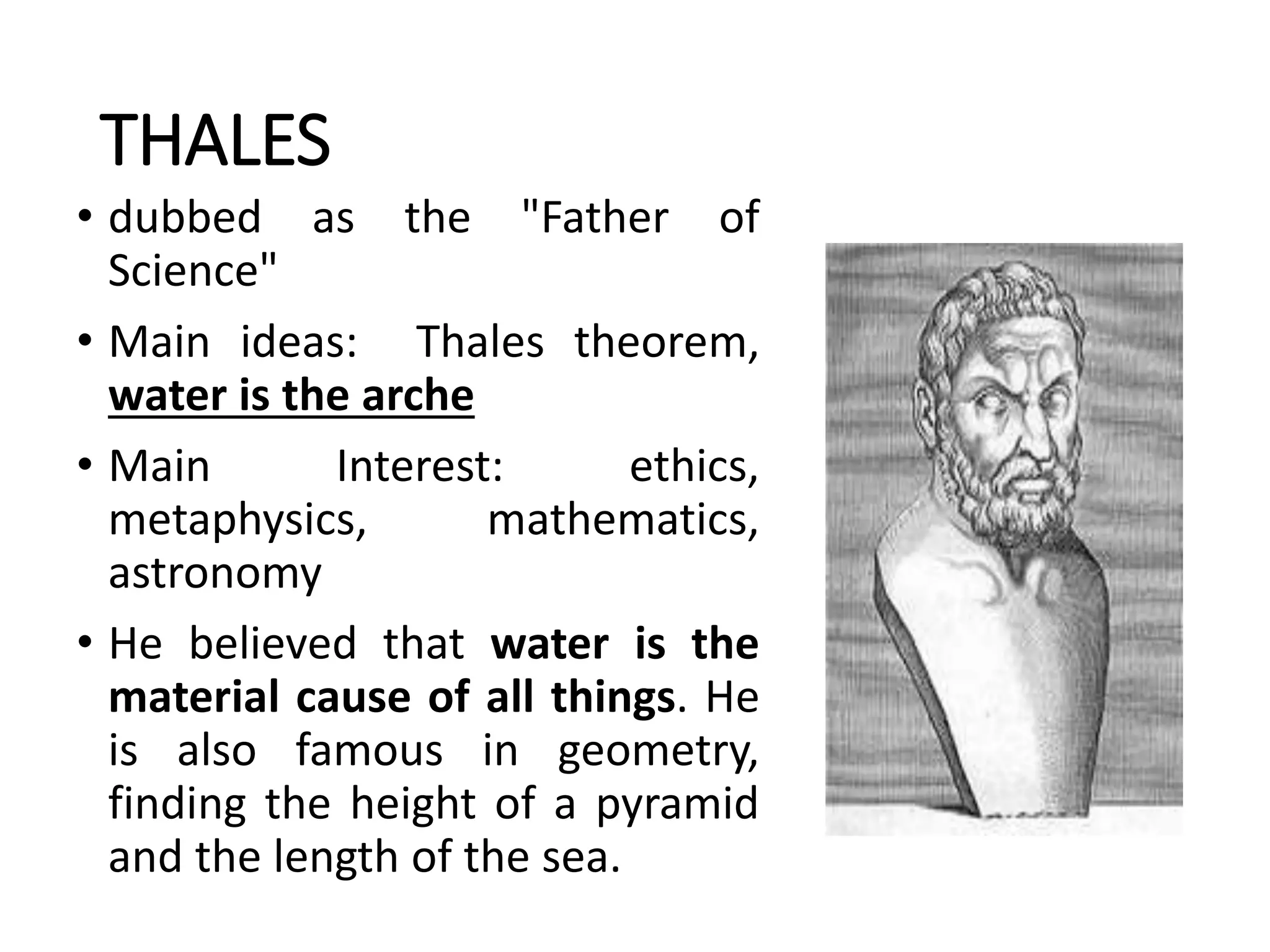
THALES
• dubbed as the "Father of
Science"
• Main ideas: Thales theorem,
water is the arche
• Main Interest: ethics,
metaphysics, mathematics,
astronomy
• He believed that water is the
material cause of all things. He
is also famous in geometry,
finding the height of a pyramid
and the length of the sea.
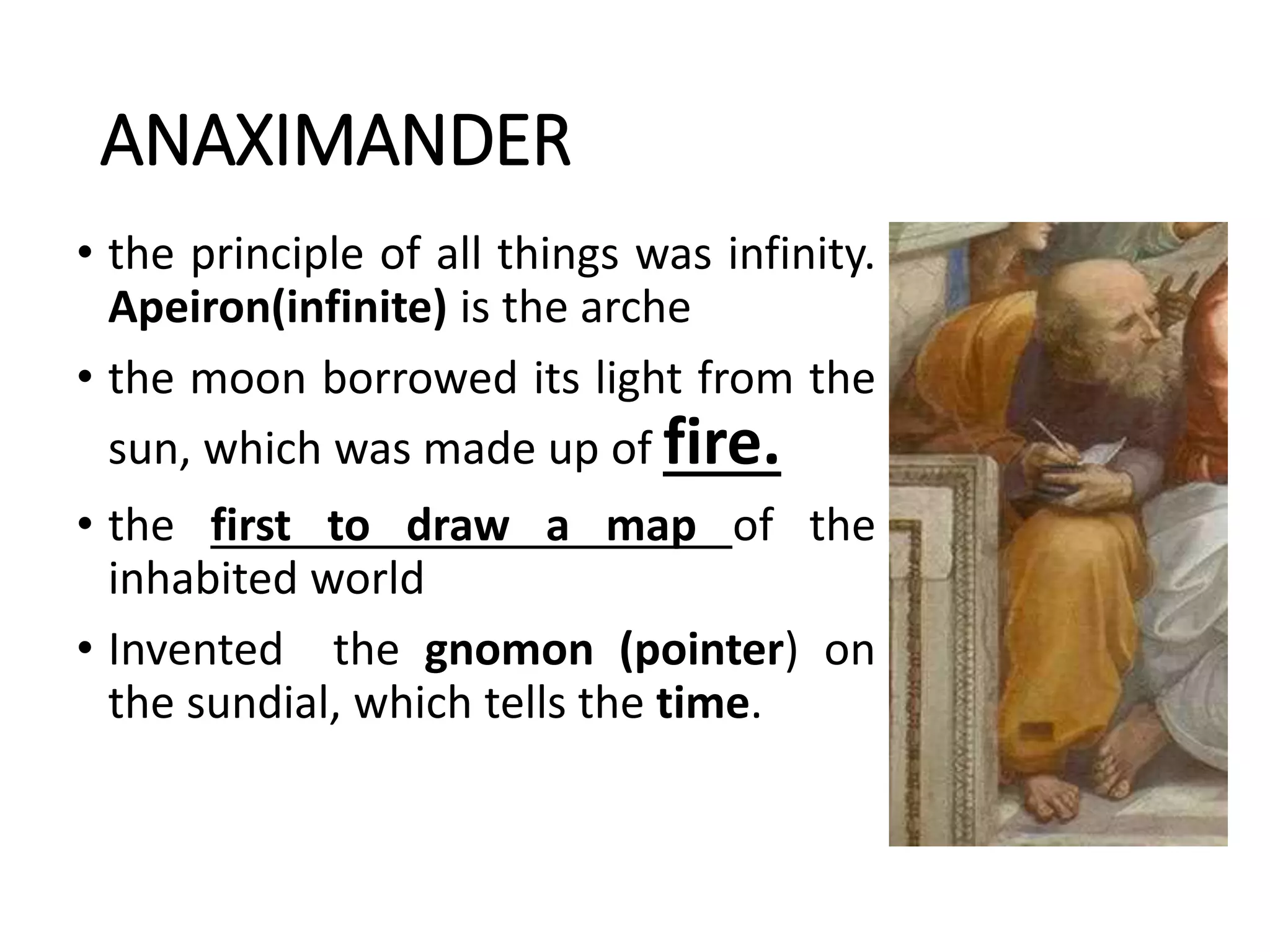
ANAXIMANDER
• the principle of all things was infinity.
Apeiron(infinite) is the arche
• the moon borrowed its light from the
sun, which was made up of fire.
• the first to draw a map of the
inhabited world
• Invented the gnomon (pointer) on
the sundial, which tells the time.
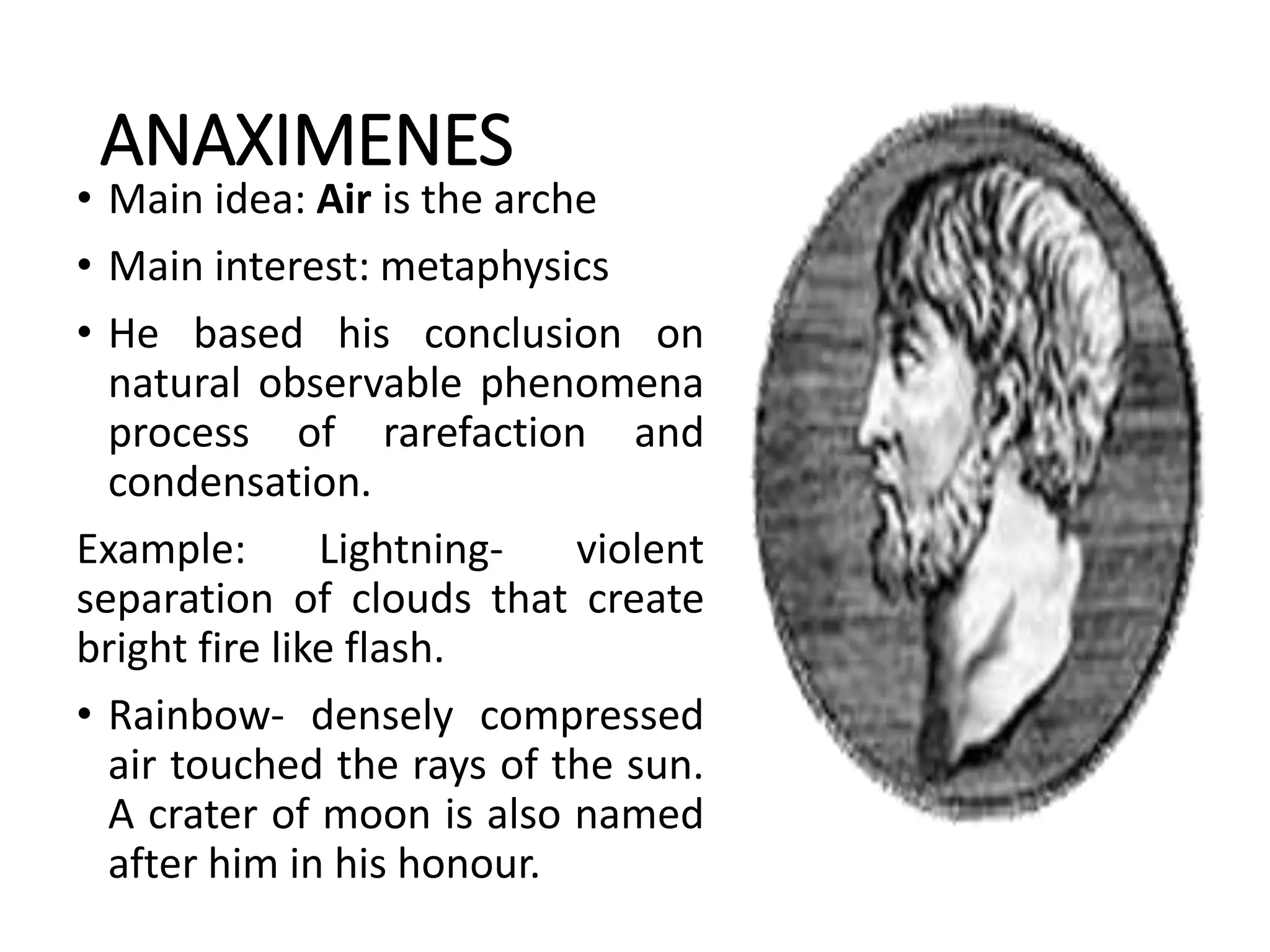
ANAXIMENES
• Main idea: Air is the arche
• Main interest: metaphysics
• He based his conclusion on
natural observable phenomena
process of rarefaction and
condensation.
Example: Lightning- violent
separation of clouds that create
bright fire like flash.
• Rainbow- densely compressed
air touched the rays of the sun.
A crater of moon is also named
after him in his honour.
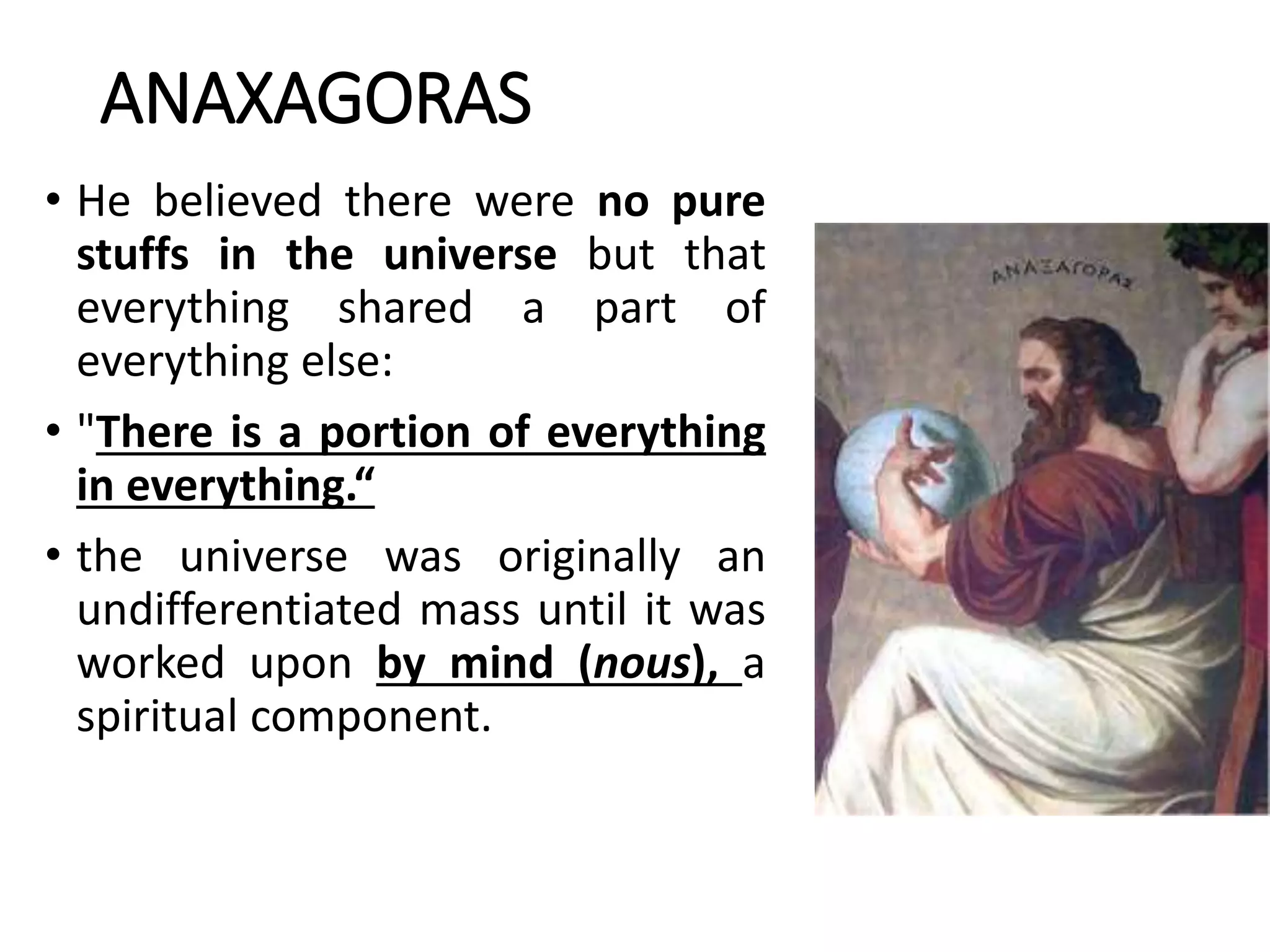
ANAXAGORAS
• He believed there were no pure
stuffs in the universe but that
everything shared a part of
everything else:
• "There is a portion of everything
in everything.“
• the universe was originally an
undifferentiated mass until it was
worked upon by mind (nous), a
spiritual component.
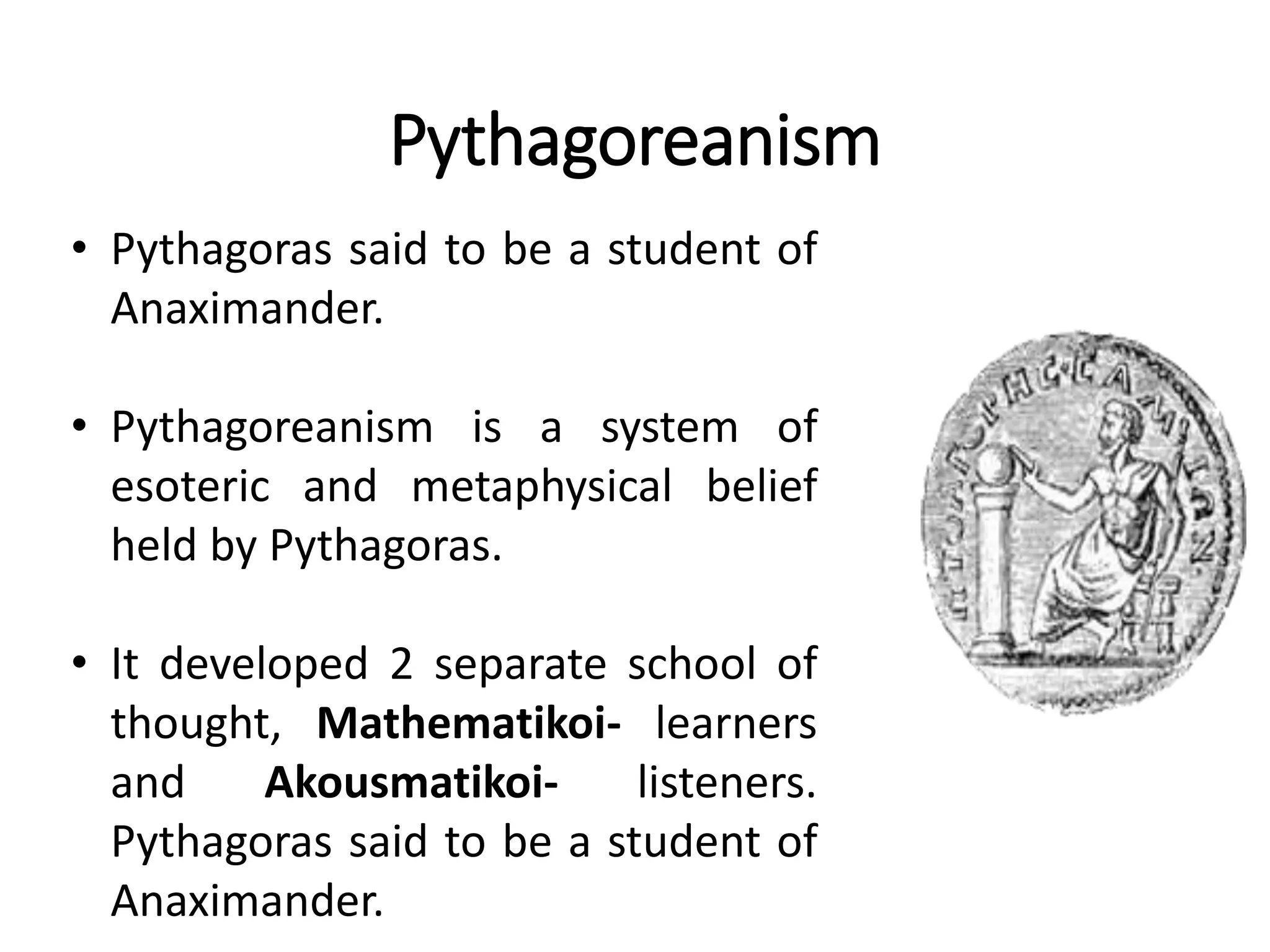
Pythagoreanism
• Pythagoras said to be a student of
Anaximander.
• Pythagoreanism is a system of
esoteric and metaphysical belief
held by Pythagoras.
• It developed 2 separate school of
thought, Mathematikoi- learners
and Akousmatikoi- listeners.
Pythagoras said to be a student of
Anaximander.
• Main idea: musica universalis, pythagorean tuning,
pythagorean theorem
• Main interest: metaphysics, music, mathematics,
ethics and politics
• Musica universalis is the harmony of spheres
regarding the proportions in the movement of
celestial bodies.
• Pythagoras believed in transmigration or
reincarnation of soul again and again.
• He was also said to have spread the seeds of political
liberty to Crotons, Sybaris, Sicili, etc.
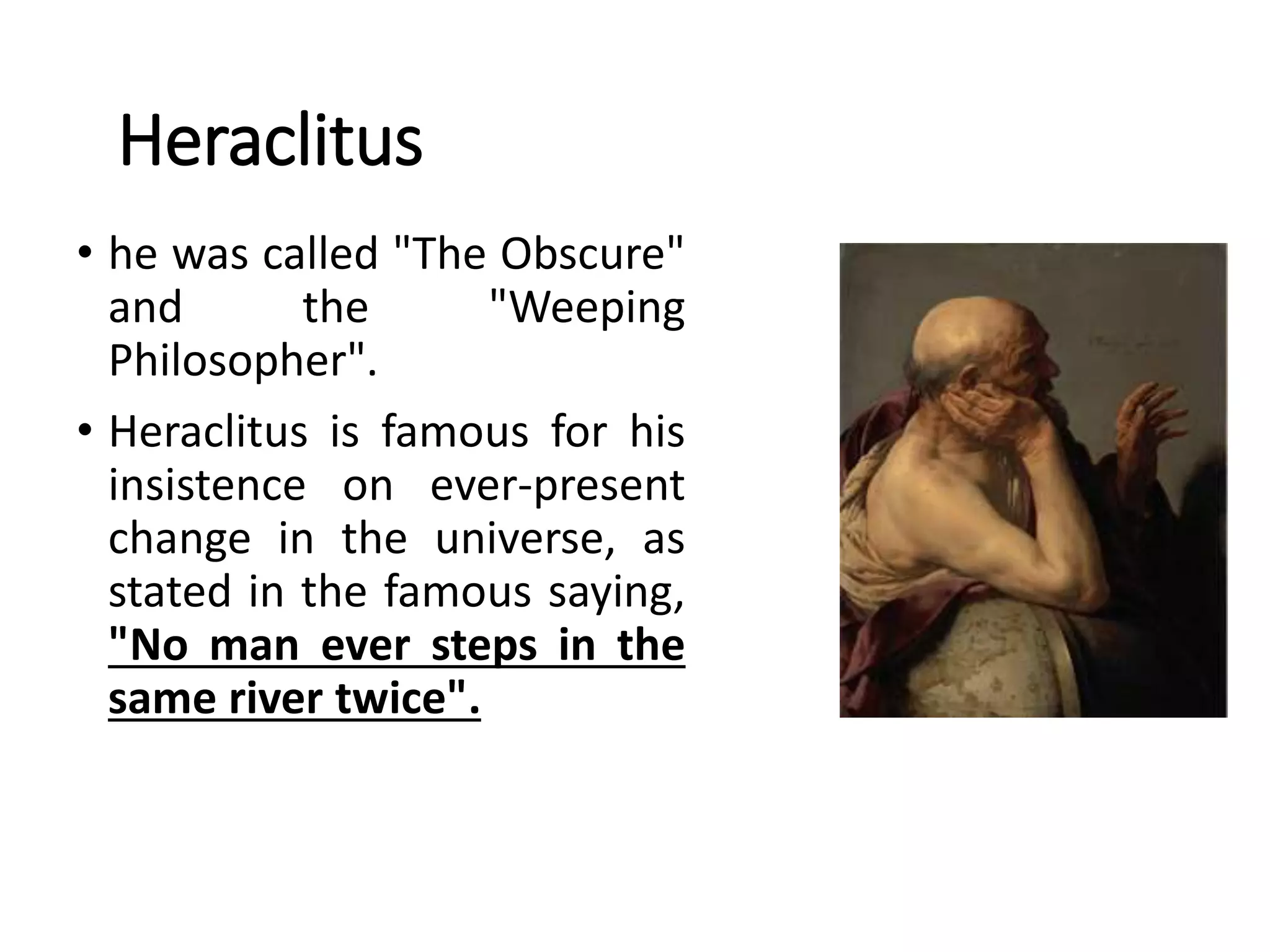
Heraclitus
• he was called "The Obscure"
and the "Weeping
Philosopher".
• Heraclitus is famous for his
insistence on ever-present
change in the universe, as
stated in the famous saying,
"No man ever steps in the
same river twice".
References
• Introduction to Philosophy : The Big Questions
• 1995. Jostein GaarderSophies World,
• 1991. The Story of Philosophy, Will Durant
• Ancient Philosophy (The Greek Philosophers)
• 1975, W.K.C Guthrie , Cambridge University
• From Socrates to Sartre
• Dr. Tenorio Lecture Introduction to Philosphy De La
Salle University
THANK YOU!
AND HAVE a
BLESSED DAY
AHEAD!   

THE PRE-SOCRATIC PHILOSOPHERS

  • 1.
    THE PRE-SOCRATICS Prepared byRaizza P. Corpuz ©2015 Lyceum of the Philippines University, CAS Dept.
  • 2.
    Ancient Greek philosophy •arose in the 6th century BCE and continued through the Hellenistic period, at which point Ancient Greece was incorporated in the Roman Empire
  • 3.
    The early Greekphilosophers saw the world around them and asked questions about it. Instead of attributing its creation to anthropomorphic gods, they sought rational explanations
  • 4.
    • BIG QUESTION: WHATwas a single underlying substance that held within itself ? WHAT is the building blocks of matter?
  • 5.
    The early philosopherslooked at the stars, music, and number systems. Later philosophers focused entirely on conduct or ethics. Instead of asking what made the world, they asked what was the best way to live.
  • 6.
    PRE SOCRATICS • 6thand 5th century BCE Greek thinkers who introduced a new way of inquiring into the world and the place of human beings in it 1. Milesian School school of thought that practiced material monism. Material monism is a belief which provides an explanation of the physical world. World's objects are composed of a single element.
  • 7.
    WHAT IS THEARCHE OF ALL THINGS in THE COSMOS? • Arche a Greek word means the primary senses “BEGINNING” • The origin or “source of action” • The principles of knowledge • The ultimate underlying substance • Origin and the root of things that exists THUS, it is the element or a principle exists in the world
  • 8.
    THALES • dubbed asthe "Father of Science" • Main ideas: Thales theorem, water is the arche • Main Interest: ethics, metaphysics, mathematics, astronomy • He believed that water is the material cause of all things. He is also famous in geometry, finding the height of a pyramid and the length of the sea.
  • 9.
    ANAXIMANDER • the principleof all things was infinity. Apeiron(infinite) is the arche • the moon borrowed its light from the sun, which was made up of fire. • the first to draw a map of the inhabited world • Invented the gnomon (pointer) on the sundial, which tells the time.
  • 10.
    ANAXIMENES • Main idea:Air is the arche • Main interest: metaphysics • He based his conclusion on natural observable phenomena process of rarefaction and condensation. Example: Lightning- violent separation of clouds that create bright fire like flash. • Rainbow- densely compressed air touched the rays of the sun. A crater of moon is also named after him in his honour.
  • 11.
    ANAXAGORAS • He believedthere were no pure stuffs in the universe but that everything shared a part of everything else: • "There is a portion of everything in everything.“ • the universe was originally an undifferentiated mass until it was worked upon by mind (nous), a spiritual component.
  • 12.
    Pythagoreanism • Pythagoras saidto be a student of Anaximander. • Pythagoreanism is a system of esoteric and metaphysical belief held by Pythagoras. • It developed 2 separate school of thought, Mathematikoi- learners and Akousmatikoi- listeners. Pythagoras said to be a student of Anaximander.
  • 13.
    • Main idea:musica universalis, pythagorean tuning, pythagorean theorem • Main interest: metaphysics, music, mathematics, ethics and politics • Musica universalis is the harmony of spheres regarding the proportions in the movement of celestial bodies. • Pythagoras believed in transmigration or reincarnation of soul again and again. • He was also said to have spread the seeds of political liberty to Crotons, Sybaris, Sicili, etc.
  • 14.
    Heraclitus • he wascalled "The Obscure" and the "Weeping Philosopher". • Heraclitus is famous for his insistence on ever-present change in the universe, as stated in the famous saying, "No man ever steps in the same river twice".
  • 15.
    References • Introduction toPhilosophy : The Big Questions • 1995. Jostein GaarderSophies World, • 1991. The Story of Philosophy, Will Durant • Ancient Philosophy (The Greek Philosophers) • 1975, W.K.C Guthrie , Cambridge University • From Socrates to Sartre • Dr. Tenorio Lecture Introduction to Philosphy De La Salle University
  • 16.
    THANK YOU! AND HAVEa BLESSED DAY AHEAD!   

Editor's Notes

  • #14 Crotons, Sybaris, Sicili, etc. Greek cities of Magna Graceia