By –
PARITA JAYSWAL
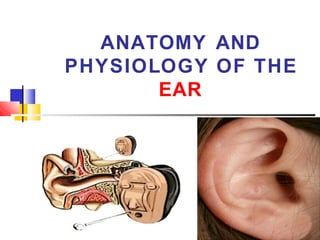
ANATOMY AND
PHYSIOLOGY OF THE
EAR
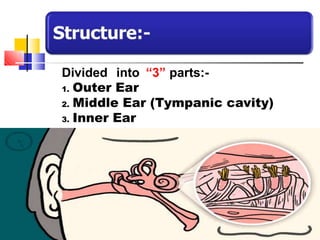
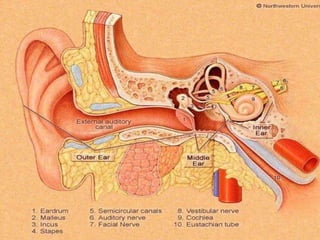
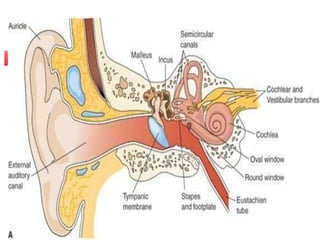
Divided into “3” parts:-
1. Outer Ear
2. Middle Ear (Tympanic cavity)
3. Inner Ear
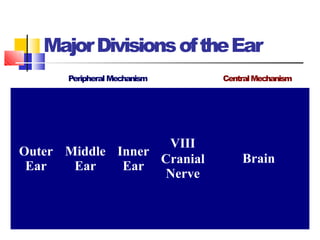
MajorDivisionsoftheEar
Peripheral Mechanism CentralMechanism
Outer
Ear
Middle
Ear
Inner
Ear
VIII
Cranial
Nerve
Brain

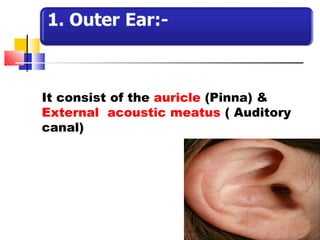
It consist of the auricle (Pinna) &
External acoustic meatus ( Auditory
canal)
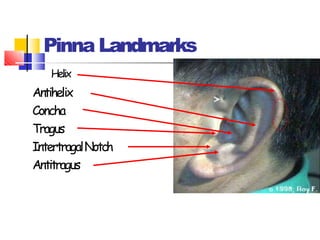
Pinna Landmarks
Helix
Antihelix
Concha
Tragus
IntertragalNotch
Antitragus
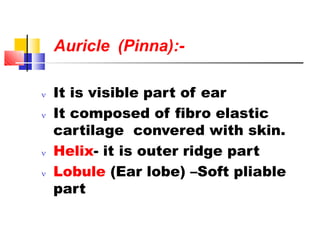
Auricle (Pinna):-
 It is visible part of ear
 It composed of fibro elastic
cartilage convered with skin.
 Helix- it is outer ridge part
 Lobule (Ear lobe) –Soft pliable
part
External acoustic meatus( Auditory canal)
• Slightly “S” Shaped tube
• About 2.5 cm long ( 1 inch )
• External from auricle to tympanic
membrane
• There numerous sebaceous and sweat gland
& hair follicles
• Numerous gland are modified sweat gland
that secret cerumen (Earwax)
• Foreign materials are prevented from
reaching TM by wax, hair and curvature.
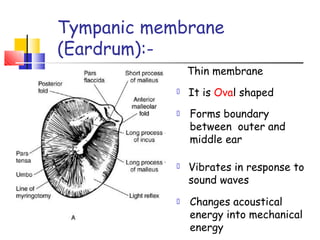
Tympanic membrane
(Eardrum):-
Thin membrane
It is Oval shaped
Forms boundary
between outer and
middle ear
Vibrates in response to
sound waves
Changes acoustical
energy into mechanical
energy
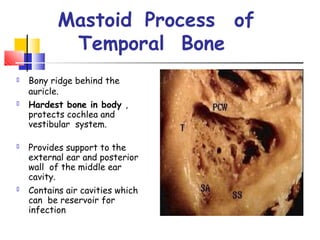
Mastoid Process of
Temporal Bone
Bony ridge behind the
auricle.
Hardest bone in body ,
protects cochlea and
vestibular system.
Provides support to the
external ear and posterior
wall of the middle ear
cavity.
Contains air cavities which
can be reservoir for
infection
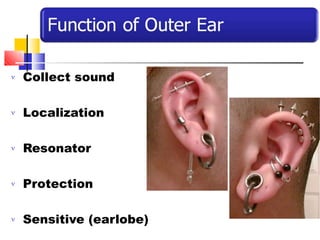
 Collect sound
 Localization
 Resonator
 Protection
 Sensitive (earlobe)
d
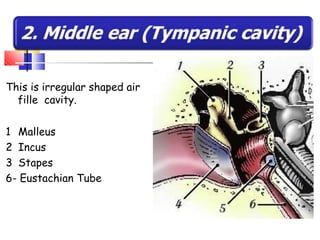
This is irregular shaped air
fille cavity.
1 Malleus
2 Incus
3 Stapes
6- Eustachian Tube
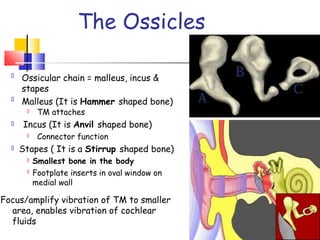
The Ossicles
Ossicular chain = malleus, incus &
stapes
Malleus (It is Hammer shaped bone)
TM attaches
Incus (It is Anvil shaped bone)
Connector function
Stapes ( It is a Stirrup shaped bone)
Smallest bone in the body
Footplate inserts in oval window on
medial wall
Focus/amplify vibration of TM to smaller
area, enables vibration of cochlear
fluids
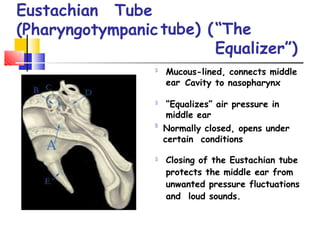
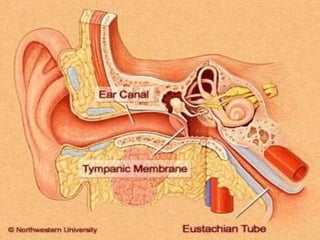
Eustachian Tube
(Pharyngotympanictube) (“The
Equalizer”)
Mucous-lined, connects middle
ear Cavity to nasopharynx
“Equalizes” air pressure in
middle ear
Normally closed, opens under
certain conditions
Closing of the Eustachian tube
protects the middle ear from
unwanted pressure fluctuations
and loud sounds.
Conduction
Conduct sound from the outer ear to the inner ear
Protection
Creates a barrier that protects the middle and inner
areas from foreign objects
Transducer
Converts acoustic energy to mechanical energy
Converts mechanical energy to hydraulic energy
Amplifier
Transformer action of the middle ear
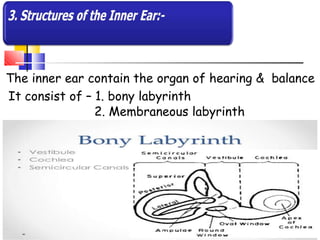
The inner ear contain the organ of hearing & balance
It consist of – 1. bony labyrinth
2. Membraneous labyrinth
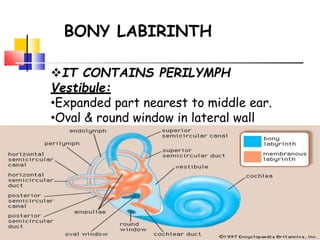
BONY LABIRINTH
IT CONTAINS PERILYMPH
Vestibule:
•Expanded part nearest to middle ear.
•Oval & round window in lateral wall
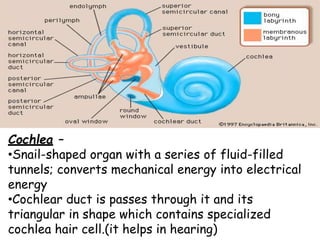
Cochlea –
•Snail-shaped organ with a series of fluid-filled
tunnels; converts mechanical energy into electrical
energy
•Cochlear duct is passes through it and its
triangular in shape which contains specialized
cochlea hair cell.(it helps in hearing)
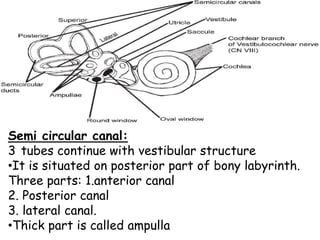
Semi circular canal:
3 tubes continue with vestibular structure
•It is situated on posterior part of bony labyrinth.
Three parts: 1.anterior canal
2. Posterior canal
3. lateral canal.
•Thick part is called ampulla
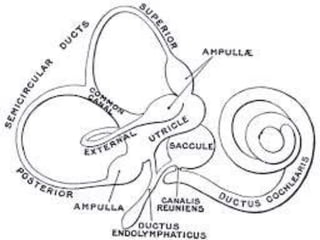
MEMBRANEOUS LABYRINTH
It contains endolymph.
Vestibule:– contains utricle and saccule
Cochlea:- cross section of cochlea have 3
compartments.
1. Scala vastibuli : originate at oval window
2. Sacala tympani : ends at round window.
[two compartments are continous with
each other]
3. Scala media (cochlear duct)
23
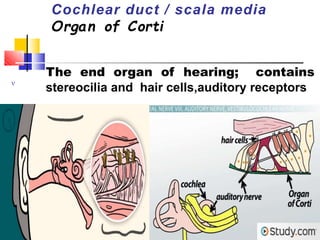
Cochlear duct / scala media
Organ of Corti

The end organ of hearing; contains
stereocilia and hair cells,auditory receptors
22
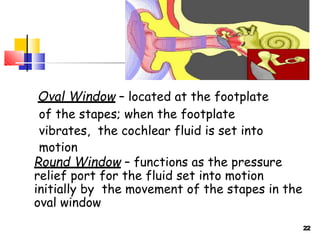
Oval Window – located at the footplate
of the stapes; when the footplate
vibrates, the cochlear fluid is set into
motion
Round Window – functions as the pressure
relief port for the fluid set into motion
initially by the movement of the stapes in the
oval window
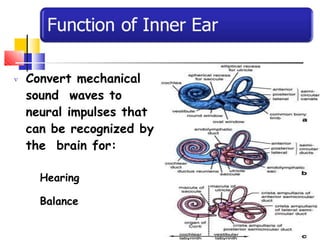
 Convert mechanical
sound waves to
neural impulses that
can be recognized by
the brain for:
Hearing
Balance
PHYSIOLOGYOFHEARING






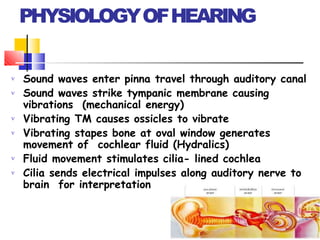
Sound waves enter pinna travel through auditory canal
Sound waves strike tympanic membrane causing
vibrations (mechanical energy)
Vibrating TM causes ossicles to vibrate
Vibrating stapes bone at oval window generates
movement of cochlear fluid (Hydralics)
Fluid movement stimulates cilia- lined cochlea
Cilia sends electrical impulses along auditory nerve to
brain for interpretation
Sound waves & vibration
from air travels [332mtr/sec]
enters in pinna
O1
Through auditory canal it
goes and cause vibration in
Tympanic membrane.
O2
Tympanic membrane
vibration transmitted and
amplify middle ear by
ossicle movements
O3
Stapes bone moves to
and fro in oval window.
O4
Fluid waves transmitted:
perilymph & endolymph
into cochlear duct
O5
It stiimulate auditory
receptors O6
Nerve impulses generate &
pass to brain by 8th cranial
nerve and reaches to hearing
areaof cerebrum and sound
preserved.
O7
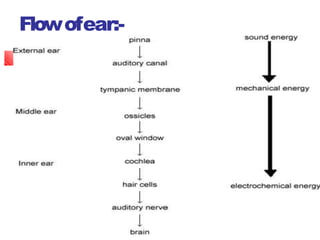
Flowofear:-
PHYSIOLOGY OF BALANCE
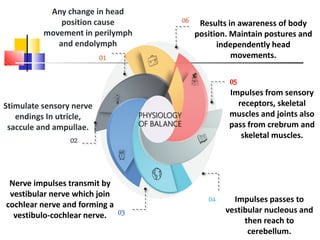
01
Any change in head
position cause
movement in perilymph
and endolymph
02
Stimulate sensory nerve
endings In utricle,
saccule and ampullae.
03
Nerve impulses transmit by
vestibular nerve which join
cochlear nerve and forming a
vestibulo-cochlear nerve.
04 Impulses passes to
vestibular nucleous and
then reach to
cerebellum.
05
Impulses from sensory
receptors, skeletal
muscles and joints also
pass from crebrum and
skeletal muscles.
06 Results in awareness of body
position. Maintain postures and
independently head
movements.
PHYSIOLOGY
OF BALANCE
BLOOD SUPPLY & NERVE SUPPLY
NERVE SUPPLY:
Nerve Supply By 8th Cranial Nerve
Auditory Nerve
BLOOD SUPPLY:
Internal Auditory Artery And Its
Branches Provide Pure Blood And
Internal Auditory Vein Collects Impure
Blood To Internal Jugular Vein.
 Hearing
 Sound Conduction and Transmission
 Balance and Equilibrium
Ear Anatomy & Physiology

Ear Anatomy & Physiology

  • 1.
  • 3.
  • 4.
    Divided into “3”parts:- 1. Outer Ear 2. Middle Ear (Tympanic cavity) 3. Inner Ear
  • 5.
  • 8.
     It consist ofthe auricle (Pinna) & External acoustic meatus ( Auditory canal)
  • 9.
  • 10.
    Auricle (Pinna):-  Itis visible part of ear  It composed of fibro elastic cartilage convered with skin.  Helix- it is outer ridge part  Lobule (Ear lobe) –Soft pliable part
  • 11.
    External acoustic meatus(Auditory canal) • Slightly “S” Shaped tube • About 2.5 cm long ( 1 inch ) • External from auricle to tympanic membrane • There numerous sebaceous and sweat gland & hair follicles • Numerous gland are modified sweat gland that secret cerumen (Earwax) • Foreign materials are prevented from reaching TM by wax, hair and curvature.
  • 12.
    Tympanic membrane (Eardrum):- Thin membrane Itis Oval shaped Forms boundary between outer and middle ear Vibrates in response to sound waves Changes acoustical energy into mechanical energy
  • 13.
    Mastoid Process of TemporalBone Bony ridge behind the auricle. Hardest bone in body , protects cochlea and vestibular system. Provides support to the external ear and posterior wall of the middle ear cavity. Contains air cavities which can be reservoir for infection
  • 14.
     Collect sound Localization  Resonator  Protection  Sensitive (earlobe)
  • 15.
    d This is irregularshaped air fille cavity. 1 Malleus 2 Incus 3 Stapes 6- Eustachian Tube
  • 16.
    The Ossicles Ossicular chain= malleus, incus & stapes Malleus (It is Hammer shaped bone) TM attaches Incus (It is Anvil shaped bone) Connector function Stapes ( It is a Stirrup shaped bone) Smallest bone in the body Footplate inserts in oval window on medial wall Focus/amplify vibration of TM to smaller area, enables vibration of cochlear fluids
  • 17.
    Eustachian Tube (Pharyngotympanictube) (“The Equalizer”) Mucous-lined,connects middle ear Cavity to nasopharynx “Equalizes” air pressure in middle ear Normally closed, opens under certain conditions Closing of the Eustachian tube protects the middle ear from unwanted pressure fluctuations and loud sounds.
  • 19.
    Conduction Conduct sound fromthe outer ear to the inner ear Protection Creates a barrier that protects the middle and inner areas from foreign objects Transducer Converts acoustic energy to mechanical energy Converts mechanical energy to hydraulic energy Amplifier Transformer action of the middle ear
  • 20.
    The inner earcontain the organ of hearing & balance It consist of – 1. bony labyrinth 2. Membraneous labyrinth
  • 21.
    BONY LABIRINTH IT CONTAINSPERILYMPH Vestibule: •Expanded part nearest to middle ear. •Oval & round window in lateral wall
  • 22.
    Cochlea – •Snail-shaped organwith a series of fluid-filled tunnels; converts mechanical energy into electrical energy •Cochlear duct is passes through it and its triangular in shape which contains specialized cochlea hair cell.(it helps in hearing)
  • 23.
    Semi circular canal: 3tubes continue with vestibular structure •It is situated on posterior part of bony labyrinth. Three parts: 1.anterior canal 2. Posterior canal 3. lateral canal. •Thick part is called ampulla
  • 24.
    MEMBRANEOUS LABYRINTH It containsendolymph. Vestibule:– contains utricle and saccule Cochlea:- cross section of cochlea have 3 compartments. 1. Scala vastibuli : originate at oval window 2. Sacala tympani : ends at round window. [two compartments are continous with each other] 3. Scala media (cochlear duct)
  • 25.
    23 Cochlear duct /scala media Organ of Corti  The end organ of hearing; contains stereocilia and hair cells,auditory receptors
  • 27.
    22 Oval Window –located at the footplate of the stapes; when the footplate vibrates, the cochlear fluid is set into motion Round Window – functions as the pressure relief port for the fluid set into motion initially by the movement of the stapes in the oval window
  • 28.
     Convert mechanical soundwaves to neural impulses that can be recognized by the brain for: Hearing Balance
  • 29.
    PHYSIOLOGYOFHEARING       Sound waves enterpinna travel through auditory canal Sound waves strike tympanic membrane causing vibrations (mechanical energy) Vibrating TM causes ossicles to vibrate Vibrating stapes bone at oval window generates movement of cochlear fluid (Hydralics) Fluid movement stimulates cilia- lined cochlea Cilia sends electrical impulses along auditory nerve to brain for interpretation
  • 30.
    Sound waves &vibration from air travels [332mtr/sec] enters in pinna O1 Through auditory canal it goes and cause vibration in Tympanic membrane. O2 Tympanic membrane vibration transmitted and amplify middle ear by ossicle movements O3 Stapes bone moves to and fro in oval window. O4 Fluid waves transmitted: perilymph & endolymph into cochlear duct O5 It stiimulate auditory receptors O6 Nerve impulses generate & pass to brain by 8th cranial nerve and reaches to hearing areaof cerebrum and sound preserved. O7
  • 31.
  • 32.
  • 33.
    01 Any change inhead position cause movement in perilymph and endolymph 02 Stimulate sensory nerve endings In utricle, saccule and ampullae. 03 Nerve impulses transmit by vestibular nerve which join cochlear nerve and forming a vestibulo-cochlear nerve. 04 Impulses passes to vestibular nucleous and then reach to cerebellum. 05 Impulses from sensory receptors, skeletal muscles and joints also pass from crebrum and skeletal muscles. 06 Results in awareness of body position. Maintain postures and independently head movements. PHYSIOLOGY OF BALANCE
  • 34.
    BLOOD SUPPLY &NERVE SUPPLY NERVE SUPPLY: Nerve Supply By 8th Cranial Nerve Auditory Nerve BLOOD SUPPLY: Internal Auditory Artery And Its Branches Provide Pure Blood And Internal Auditory Vein Collects Impure Blood To Internal Jugular Vein.
  • 35.
     Hearing  SoundConduction and Transmission  Balance and Equilibrium