BRISSO ARACKAL
overview
• It lies behind the nose, mouth and larynx and is
wider at its upper end.
• The upper part of the pharynx transmits only
air, the lower part( below the inlet of the
larynx) only food, but the middle part is a
common passage for both air and food.
STRUCTURES ASSOCIATED WITH
THE PHARYNX
Superiorly : the inferior surface of the base of
the skull.
Inferiorly : it is continuous with the
oesophages.
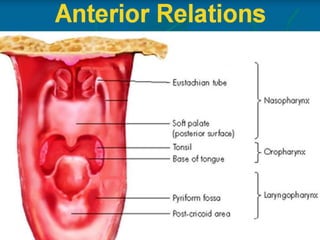
Anteriorly : the wall is incomplete because of
the openings into the nose, mouth and larynx.
Posteriorly: areolar tissue, involuntary muscle
and bodies of the first six cervical vertebrae.
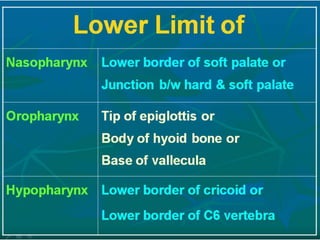
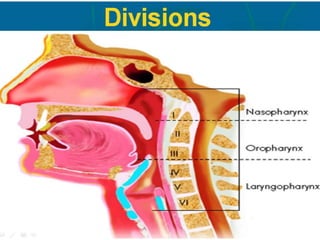
DIVISION OF PHARYNX
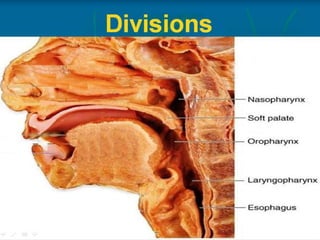
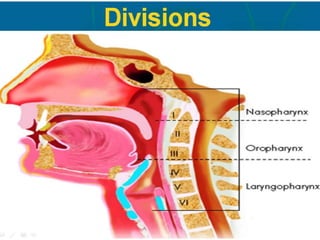
• For descriptive purposes the pharynx is
divided into three parts:
i. NASOPHARYNX
ii. OROPHARYNX
iii. LARYNGOPHARYNX
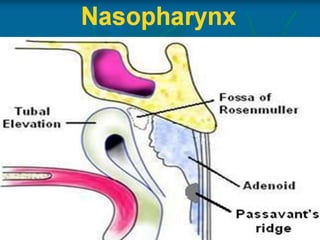
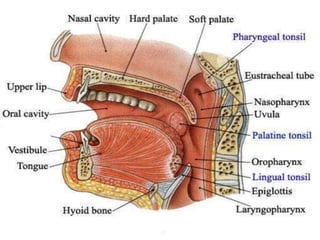
THE NASOPHARYNX
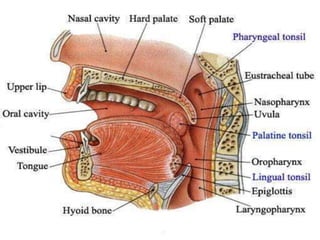
The nasal part of the pharynx lies behind the nose
above the level of the soft palate.
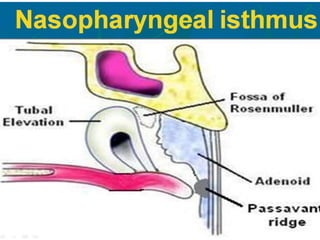
On its lateral walls are the two openings of the
auditory tubes, one leading to each middle ear.
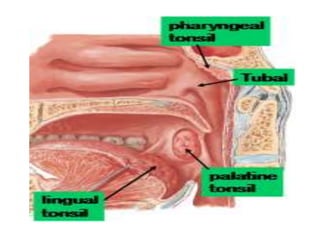
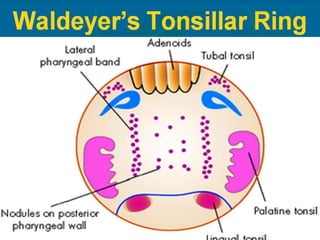
On the posterior wall are the pharyngeal
tonsils(adenoids), consisting of lymphoid tissue.
They are most prominent in children up to
approximately 7 years of age. There after they
gradually atrophy.
OROPHARYNX
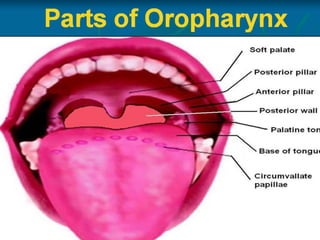
 The oral part of the pharynx lies behind the
mouth, extending from below the level of the
soft palate to the level of the upper part of the
body of the 3 rd cervical vertebra.
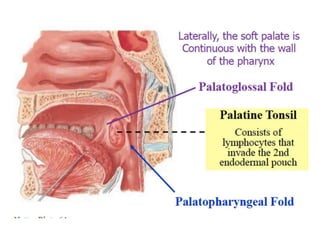
 The lateral walls of the pharynx blend with the
soft palate to form two folds on each side.
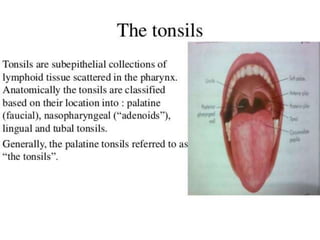
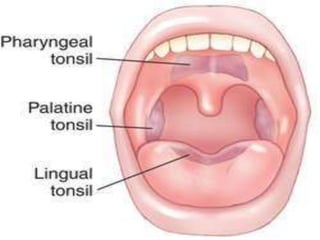
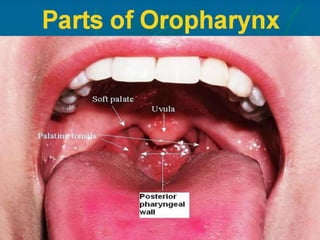
 Between each pair of folds is a collection of
lymphoid tissue called the palatine tonsil.
 The tonsil is almond shaped.
 During swallowing ,the nasal and oral parts are
separated by the soft palate and uvula.
OROPHARYNX
THE LARYNGOPHARYNX
• The laryngeal part of the pharynx extends from
the oropharynx above and continues as the
oesophagus below, ie. From the level of the 3
rd to the 6 th cervical vertebrae.
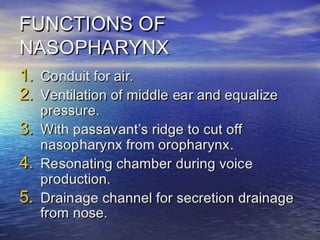
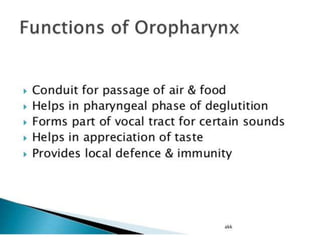
FUNCTIONS OF PHARYNX
Passageway for air and food.
The pharynx is involved in both the respiratory
and the digestive systems: air passes through the
nasal and oral sections, and food through the oral
and laryngeal sections.
Warming and humidifying. By the same
methods as in the nose, the air is further warmed
and moistened as it passes through the pharynx.
Taste :there are olfactory nerve endings of the
sense of taste in the epithelium of the oral and
pharyngeal parts.
Hearing : the auditory tube , extending from
the nasopharynx to each middle ear , allows air
to enter the middle ear. Satisfactory hearing
depends on the presence of air at atmospheric
pressure on each side of the tympanic
membrane.
FUNCTIONS OF PHARYNX
Protection: the lymphatic tissue of the
pharyngeal and laryngeal tonsils produces
antibodies in response to antigens , eg bacteria.
The tonsils are larger in children and tend to
atrophy in adults.
Speech: the pharynx functions in speech , by
acting as a resonating chamber for sound
ascending from the larynx, it helps to give the
voice its individual characteristics.
FUNCTIONS OF PHARYNX
Pharynx ANATOMY AND PHYSIOLOGY

Pharynx ANATOMY AND PHYSIOLOGY

  • 3.
  • 6.
    overview • It liesbehind the nose, mouth and larynx and is wider at its upper end. • The upper part of the pharynx transmits only air, the lower part( below the inlet of the larynx) only food, but the middle part is a common passage for both air and food.
  • 7.
    STRUCTURES ASSOCIATED WITH THEPHARYNX Superiorly : the inferior surface of the base of the skull. Inferiorly : it is continuous with the oesophages. Anteriorly : the wall is incomplete because of the openings into the nose, mouth and larynx. Posteriorly: areolar tissue, involuntary muscle and bodies of the first six cervical vertebrae.
  • 8.
    DIVISION OF PHARYNX •For descriptive purposes the pharynx is divided into three parts: i. NASOPHARYNX ii. OROPHARYNX iii. LARYNGOPHARYNX
  • 14.
    THE NASOPHARYNX The nasalpart of the pharynx lies behind the nose above the level of the soft palate. On its lateral walls are the two openings of the auditory tubes, one leading to each middle ear. On the posterior wall are the pharyngeal tonsils(adenoids), consisting of lymphoid tissue. They are most prominent in children up to approximately 7 years of age. There after they gradually atrophy.
  • 23.
    OROPHARYNX  The oralpart of the pharynx lies behind the mouth, extending from below the level of the soft palate to the level of the upper part of the body of the 3 rd cervical vertebra.  The lateral walls of the pharynx blend with the soft palate to form two folds on each side.  Between each pair of folds is a collection of lymphoid tissue called the palatine tonsil.  The tonsil is almond shaped.
  • 25.
     During swallowing,the nasal and oral parts are separated by the soft palate and uvula. OROPHARYNX
  • 33.
    THE LARYNGOPHARYNX • Thelaryngeal part of the pharynx extends from the oropharynx above and continues as the oesophagus below, ie. From the level of the 3 rd to the 6 th cervical vertebrae.
  • 45.
    FUNCTIONS OF PHARYNX Passagewayfor air and food. The pharynx is involved in both the respiratory and the digestive systems: air passes through the nasal and oral sections, and food through the oral and laryngeal sections. Warming and humidifying. By the same methods as in the nose, the air is further warmed and moistened as it passes through the pharynx.
  • 46.
    Taste :there areolfactory nerve endings of the sense of taste in the epithelium of the oral and pharyngeal parts. Hearing : the auditory tube , extending from the nasopharynx to each middle ear , allows air to enter the middle ear. Satisfactory hearing depends on the presence of air at atmospheric pressure on each side of the tympanic membrane. FUNCTIONS OF PHARYNX
  • 47.
    Protection: the lymphatictissue of the pharyngeal and laryngeal tonsils produces antibodies in response to antigens , eg bacteria. The tonsils are larger in children and tend to atrophy in adults. Speech: the pharynx functions in speech , by acting as a resonating chamber for sound ascending from the larynx, it helps to give the voice its individual characteristics. FUNCTIONS OF PHARYNX