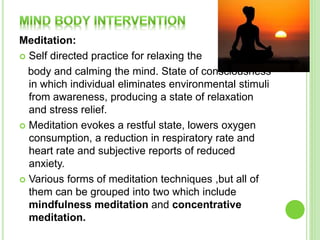
Meditation:
 Self directed practice for relaxing the
body and calming the mind. State of consciousness
in which individual eliminates environmental stimuli
from awareness, producing a state of relaxation
and stress relief.
 Meditation evokes a restful state, lowers oxygen
consumption, a reduction in respiratory rate and
heart rate and subjective reports of reduced
anxiety.
 Various forms of meditation techniques ,but all of
them can be grouped into two which include
mindfulness meditation and concentrative
meditation.
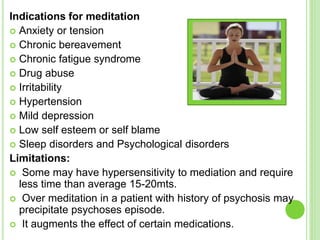
Indications for meditation
 Anxiety or tension
 Chronic bereavement
 Chronic fatigue syndrome
 Drug abuse
 Irritability
 Hypertension
 Mild depression
 Low self esteem or self blame
 Sleep disorders and Psychological disorders
Limitations:
 Some may have hypersensitivity to mediation and require
less time than average 15-20mts.
 Over meditation in a patient with history of psychosis may
precipitate psychoses episode.
 It augments the effect of certain medications.
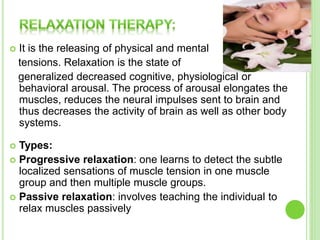
 It is the releasing of physical and mental
tensions. Relaxation is the state of
generalized decreased cognitive, physiological or
behavioral arousal. The process of arousal elongates the
muscles, reduces the neural impulses sent to brain and
thus decreases the activity of brain as well as other body
systems.
 Types:
 Progressive relaxation: one learns to detect the subtle
localized sensations of muscle tension in one muscle
group and then multiple muscle groups.
 Passive relaxation: involves teaching the individual to
relax muscles passively
Clinical applications of relaxation therapy:
 Lowering HR,RR and muscle tension
 Improving well being and reducing symptom distress
 In combination with imagery, yoga etc known to reduce
pain, improve emotional wellbeing and immune functions.
Limitations of relaxation therapy:
 fear of loss of control, feeling like they are floating
 In advance diseased patients relaxation therapy would not
be appropriate.
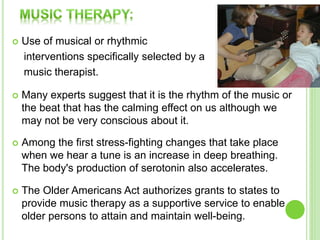
 Use of musical or rhythmic
interventions specifically selected by a
music therapist.
 Many experts suggest that it is the rhythm of the music or
the beat that has the calming effect on us although we
may not be very conscious about it.
 Among the first stress-fighting changes that take place
when we hear a tune is an increase in deep breathing.
The body's production of serotonin also accelerates.
 The Older Americans Act authorizes grants to states to
provide music therapy as a supportive service to enable
older persons to attain and maintain well-being.
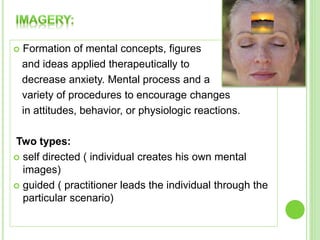
 Formation of mental concepts, figures
and ideas applied therapeutically to
decrease anxiety. Mental process and a
variety of procedures to encourage changes
in attitudes, behavior, or physiologic reactions.
Two types:
 self directed ( individual creates his own mental
images)
 guided ( practitioner leads the individual through the
particular scenario)
Technique of guided Imagery:
 A common guided imagery technique is a general
relaxation process asking the person to slowly
close their eyes and focus on their breathing
 They are encouraged to relax, clear their mind, and
surround themselves in images that are peaceful
and calm.
 Guided imaginary may be practiced
independently,wirh coach or with an audio or
videotape.
 Clinical applications
 Control or relief of pain
 Decrease blood pressure
 Decrease blood glucose levels (Diabetes)
 Decrease allergy and respiratory symptoms
 Decrease the severity of headaches
 Achieve calmness and serenity
 Treatment of chronic conditions as asthma, hypertension
and GI disorders
 Limitations of guided imagery
 Least clearly defined intervention, can range from being
highly structured to consisting of day dreaming by the
individual.
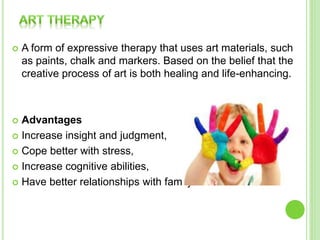
 A form of expressive therapy that uses art materials, such
as paints, chalk and markers. Based on the belief that the
creative process of art is both healing and life-enhancing.
 Advantages
 Increase insight and judgment,
 Cope better with stress,
 Increase cognitive abilities,
 Have better relationships with family and friends.
 Uses:
 For managers and staff under pressure
 For people who are generally stressed and overworked
 For people with mental health problems
 For people with severe learning difficulties
 For children and young people who have problems
conforming in school and with personal problems at
home
 For people who feel they are problem free but would like
the opportunity to explore issues within themselves
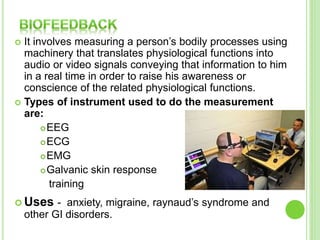
 It involves measuring a person’s bodily processes using
machinery that translates physiological functions into
audio or video signals conveying that information to him
in a real time in order to raise his awareness or
conscience of the related physiological functions.
 Types of instrument used to do the measurement
are:
EEG
ECG
EMG
Galvanic skin response
training
 Uses - anxiety, migraine, raynaud’s syndrome and
other GI disorders.
 How it works:
 By ensuring the inhalation of more
oxygen, it makes people feel better
 It decreases stress leading to lowered stiffness of muscles
- muscle relaxation
 Gives a sense of well being because of release of
endorphins and neuropeptides
 Very useful for patients of hypertension
 It also improves the immunity (increases level of
interferon)
 Decrease incidences of cough and cold.
 Types of therapy:
 Humor therapy : books, shows, movies, or stories
to encourage spontaneous discussion of the
patients own humorous experiences)
 Clown therapy: clowns perform some role with the
use of magic, music, fun, joy
 Laughter therapy : client's laughter triggers are
identified
 Benefits
 Laughter has innumerable other benefits.
 It proves a potent anti-stress factor, decreases
asthmatic attacks, increases stamina, relives
arthritic pain, ensures good sleep and elevates
mood.
 Since the serotonin levels go up after laughter, it is
an effective antidote for depression too.
 Positive qualities are cultivated, thereby removing
negative emotions as jealousy, fear, guilt and
anger.
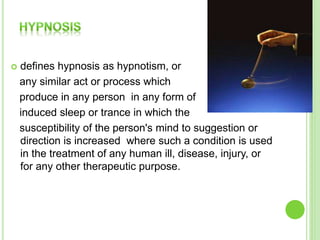
 defines hypnosis as hypnotism, or
any similar act or process which
produce in any person in any form of
induced sleep or trance in which the
susceptibility of the person's mind to suggestion or
direction is increased where such a condition is used
in the treatment of any human ill, disease, injury, or
for any other therapeutic purpose.
 Hypnosis phases
 Preparation:- The first phase typically involves having the
subject sit or lie down and getting comfortable.
 Induction:- Induction takes the subject from normal
awareness to a state of enhanced relaxation.
 Deepening:- The deepening phase takes the subject from a
very relaxed state into the fully "hypnotized" state, where
conscious thinking is minimized
 Awakening:-The awakening phase is when the subject is
taken out of the hypnotic state. If the session is to try to
alleviate insomnia, then the subject is encouraged to sleep,
otherwise the subject is brought back to a state of awareness
with the conscious mind fully reengaged.
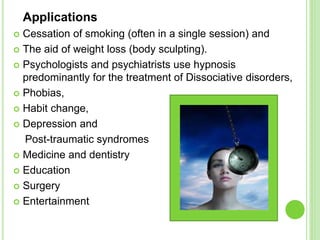
Applications
 Cessation of smoking (often in a single session) and
 The aid of weight loss (body sculpting).
 Psychologists and psychiatrists use hypnosis
predominantly for the treatment of Dissociative disorders,
 Phobias,
 Habit change,
 Depression and
Post-traumatic syndromes
 Medicine and dentistry
 Education
 Surgery
 Entertainment
 Self-hypnosis
 Hypnosis in which a person hypnotizes himself or herself
without the assistance of another person to serve as the
hypnotist
 Most often used to help the self-hypnotist stay on a diet,
overcome smoking or some other addiction, or to
generally boost the hypnotized person's self-esteem.
 Walking hypnosis
 Naturally occurring trance that one can enter while
performing a monotonous repetitive task, such as walking
or gardening, or in sedentary pursuits such as listening to
a lecture or reading, in which one's attention drifts from
the task into a trance-like state, often known as "zoning
out".
HERBALISM
 A traditional medicinal or folk medicine
practice based on the use of plants and
plant extracts.Also called as herbal medicine, herbology,
and phytotherapy.A number of traditions dominate the
practice of herbal medicine. Homeopathy, Naturopathy,
the Ayurvedic medicine system from India and Chinese
herbal medicine
Some herbs may cause negative effect
 Alkaloids: - dramatic effect of CNS (e.g. caffeine provides
a mild lift, Datura cause severe intoxication and even
death.
 Quinine from Chincona, Morphine and Codeine from the
Poppy, and Digoxin from the Foxglove are toxic and cause
harmful effect to the body.
 Mode of uses of herbs
 Herbal bath:- with hot water disperse the qualities of
herbs.
 Herbal wrap: - body is enveloped in warm linen
sheets which have been soaked in a special blend of
herbs.
 Aloe vera: -heals burn wounds;stimulates cell
regeneration and has antifungal, antibacterial and
antiviral properties.
 Ginger:- cleanses the colon and useful for bowel
disorders.
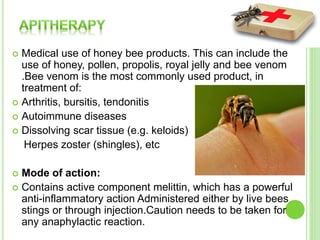
 Medical use of honey bee products. This can include the
use of honey, pollen, propolis, royal jelly and bee venom
.Bee venom is the most commonly used product, in
treatment of:
 Arthritis, bursitis, tendonitis
 Autoimmune diseases
 Dissolving scar tissue (e.g. keloids)
Herpes zoster (shingles), etc
 Mode of action:
 Contains active component melittin, which has a powerful
anti-inflammatory action Administered either by live bees
stings or through injection.Caution needs to be taken for
any anaphylactic reaction.
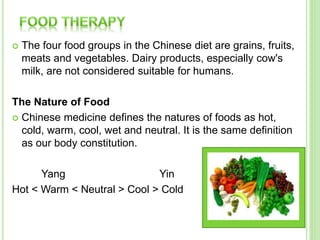
 The four food groups in the Chinese diet are grains, fruits,
meats and vegetables. Dairy products, especially cow's
milk, are not considered suitable for humans.
The Nature of Food
 Chinese medicine defines the natures of foods as hot,
cold, warm, cool, wet and neutral. It is the same definition
as our body constitution.
Yang Yin
Hot < Warm < Neutral > Cool > Cold
Special diet therapies, megadose of vitamins
or minerals
 Good nutrition can help with adaptation to the
inevitable stress of life , promoting healthy body and
feeling of well-being.the imbalance in body system can be
regulated by nutrition supplements.
 For example, a depression may be cause by amino acid
imbalance or vitamins deficiency. The B vitamins omega-3
fatty acids and folic acid are helpful for regulating stress
and balancing mood.
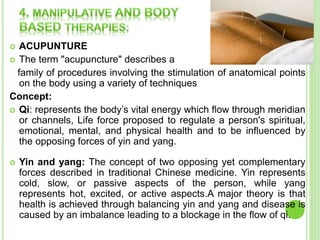
 ACUPUNTURE
 The term "acupuncture" describes a
family of procedures involving the stimulation of anatomical points
on the body using a variety of techniques
Concept:
 Qi: represents the body’s vital energy which flow through meridian
or channels, Life force proposed to regulate a person's spiritual,
emotional, mental, and physical health and to be influenced by
the opposing forces of yin and yang.
 Yin and yang: The concept of two opposing yet complementary
forces described in traditional Chinese medicine. Yin represents
cold, slow, or passive aspects of the person, while yang
represents hot, excited, or active aspects.A major theory is that
health is achieved through balancing yin and yang and disease is
caused by an imbalance leading to a blockage in the flow of qi.
 Technique of acupuncture:
 It involves penetrating the skin with thin, solid, metallic
needles that are manipulated by the hands or by electrical
stimulation. People experience acupuncture differently, but
most feel no or minimal pain as the needles is inserted.
Some people feel energized by treatment, while others feel
relaxed.
 Mode of action: It is thought that acupuncture needling
releases endorphins and other nerurotransmitters in the
brain.
Duration: Treatment may take place over a period of
several weeks or more.
 Uses: in vomiting and pain relief of cancer patients.
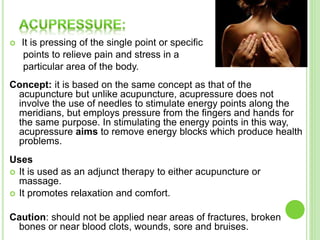
 It is pressing of the single point or specific
points to relieve pain and stress in a
particular area of the body.
Concept: it is based on the same concept as that of the
acupuncture but unlike acupuncture, acupressure does not
involve the use of needles to stimulate energy points along the
meridians, but employs pressure from the fingers and hands for
the same purpose. In stimulating the energy points in this way,
acupressure aims to remove energy blocks which produce health
problems.
Uses
 It is used as an adjunct therapy to either acupuncture or
massage.
 It promotes relaxation and comfort.
Caution: should not be applied near areas of fractures, broken
bones or near blood clots, wounds, sore and bruises.
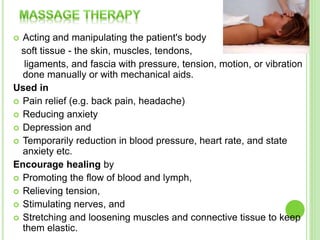
 Acting and manipulating the patient's body
soft tissue - the skin, muscles, tendons,
ligaments, and fascia with pressure, tension, motion, or vibration
done manually or with mechanical aids.
Used in
 Pain relief (e.g. back pain, headache)
 Reducing anxiety
 Depression and
 Temporarily reduction in blood pressure, heart rate, and state
anxiety etc.
Encourage healing by
 Promoting the flow of blood and lymph,
 Relieving tension,
 Stimulating nerves, and
 Stretching and loosening muscles and connective tissue to keep
them elastic.
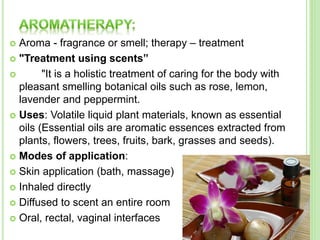
 Aroma - fragrance or smell; therapy – treatment
 "Treatment using scents”
 "It is a holistic treatment of caring for the body with
pleasant smelling botanical oils such as rose, lemon,
lavender and peppermint.
 Uses: Volatile liquid plant materials, known as essential
oils (Essential oils are aromatic essences extracted from
plants, flowers, trees, fruits, bark, grasses and seeds).
 Modes of application:
 Skin application (bath, massage)
 Inhaled directly
 Diffused to scent an entire room
 Oral, rectal, vaginal interfaces
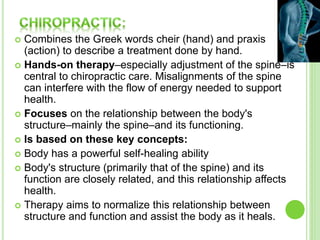
 Combines the Greek words cheir (hand) and praxis
(action) to describe a treatment done by hand.
 Hands-on therapy–especially adjustment of the spine–is
central to chiropractic care. Misalignments of the spine
can interfere with the flow of energy needed to support
health.
 Focuses on the relationship between the body's
structure–mainly the spine–and its functioning.
 Is based on these key concepts:
 Body has a powerful self-healing ability
 Body's structure (primarily that of the spine) and its
function are closely related, and this relationship affects
health.
 Therapy aims to normalize this relationship between
structure and function and assist the body as it heals.
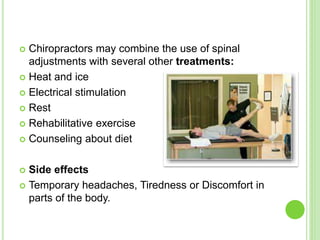
 Chiropractors may combine the use of spinal
adjustments with several other treatments:
 Heat and ice
 Electrical stimulation
 Rest
 Rehabilitative exercise
 Counseling about diet
 Side effects
 Temporary headaches, Tiredness or Discomfort in
parts of the body.
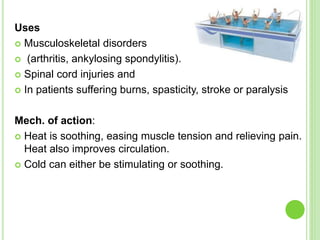
 Treatment of disease by the use of water. Specifically
a method of treatment that attempts to cure all diseases
by the external (bath) or internal (colonic irrigation) use of
much water.Water can be in the form of ice, vapor, or
liquid. It Can be hot or cold water which is used.
 Types
 Packing
 Hot air baths (Saunas)
 General baths
 Local baths
 Compress
Uses
 Musculoskeletal disorders
 (arthritis, ankylosing spondylitis).
 Spinal cord injuries and
 In patients suffering burns, spasticity, stroke or paralysis
Mech. of action:
 Heat is soothing, easing muscle tension and relieving pain.
Heat also improves circulation.
 Cold can either be stimulating or soothing.
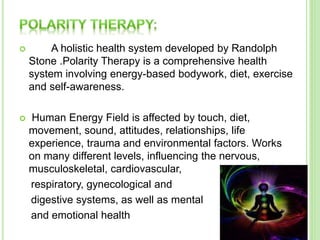
 A holistic health system developed by Randolph
Stone .Polarity Therapy is a comprehensive health
system involving energy-based bodywork, diet, exercise
and self-awareness.
 Human Energy Field is affected by touch, diet,
movement, sound, attitudes, relationships, life
experience, trauma and environmental factors. Works
on many different levels, influencing the nervous,
musculoskeletal, cardiovascular,
respiratory, gynecological and
digestive systems, as well as mental
and emotional health
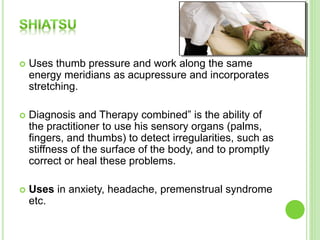
 Uses thumb pressure and work along the same
energy meridians as acupressure and incorporates
stretching.
 Diagnosis and Therapy combined” is the ability of
the practitioner to use his sensory organs (palms,
fingers, and thumbs) to detect irregularities, such as
stiffness of the surface of the body, and to promptly
correct or heal these problems.
 Uses in anxiety, headache, premenstrual syndrome
etc.
 Derived Chinese word, rei- unseen or spiritual and ki- life
force or energy. (Universal life energy)A form of spiritual
practice. It is derived from ancient Buddhist
practices.Practitioner places his hands on or above the
body area and transfers, “universal life energy” to the
patient.
 Technique:
 Hands are kept either in direct contact or few
centimeters away from the body.
 Kept in the same position for about 5 mts and then
moved to next position.
 Total it takes around 45 mts.
 Practitioners state that energy flows through their
palms.
 This energy provides strength, harmony and balance
to treat the health disturbances.
 It can be given with direct exposure or from distance
by means of some symbols.
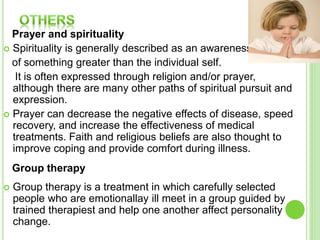
Prayer and spirituality
 Spirituality is generally described as an awareness
of something greater than the individual self.
It is often expressed through religion and/or prayer,
although there are many other paths of spiritual pursuit and
expression.
 Prayer can decrease the negative effects of disease, speed
recovery, and increase the effectiveness of medical
treatments. Faith and religious beliefs are also thought to
improve coping and provide comfort during illness.
Group therapy
 Group therapy is a treatment in which carefully selected
people who are emotionallay ill meet in a group guided by
trained therapiest and help one another affect personality
change.
IMPORTANCE OF ALTERNATIVE SYSTEMS
OF MEDICINES
 The most important reason is allopathic therapy disturb and
agitate the mind of the people.people are getting afraid of
increasing side effects' of allopathic medicine and such
effects.
 The second most important consideration is the cost of the
allopathic medicine.
 The third reason is that when people are frustrated and not
getting the desired cures of their ailments from the orthodox
medicine they look for some alternative forms of healing that
will bring solace and relief. Hence an Interest In alternative
medicine is seen.
SALIENT FEATURES OF ALTERNATIVE
MODALITIES OF TREATMENT
 It considers the health of a person as a whole.
 It believes the maintenance of health is by
following healthy life styles
 Simplicity
 less or no side effects
 The time tested traditional system of medicine has
a reasonable alternative and answer to most of the
diseases
 Faith
Alternative & Complementary Therapies

Alternative & Complementary Therapies

  • 2.
    Meditation:  Self directedpractice for relaxing the body and calming the mind. State of consciousness in which individual eliminates environmental stimuli from awareness, producing a state of relaxation and stress relief.  Meditation evokes a restful state, lowers oxygen consumption, a reduction in respiratory rate and heart rate and subjective reports of reduced anxiety.  Various forms of meditation techniques ,but all of them can be grouped into two which include mindfulness meditation and concentrative meditation.
  • 3.
    Indications for meditation Anxiety or tension  Chronic bereavement  Chronic fatigue syndrome  Drug abuse  Irritability  Hypertension  Mild depression  Low self esteem or self blame  Sleep disorders and Psychological disorders Limitations:  Some may have hypersensitivity to mediation and require less time than average 15-20mts.  Over meditation in a patient with history of psychosis may precipitate psychoses episode.  It augments the effect of certain medications.
  • 4.
     It isthe releasing of physical and mental tensions. Relaxation is the state of generalized decreased cognitive, physiological or behavioral arousal. The process of arousal elongates the muscles, reduces the neural impulses sent to brain and thus decreases the activity of brain as well as other body systems.  Types:  Progressive relaxation: one learns to detect the subtle localized sensations of muscle tension in one muscle group and then multiple muscle groups.  Passive relaxation: involves teaching the individual to relax muscles passively
  • 5.
    Clinical applications ofrelaxation therapy:  Lowering HR,RR and muscle tension  Improving well being and reducing symptom distress  In combination with imagery, yoga etc known to reduce pain, improve emotional wellbeing and immune functions. Limitations of relaxation therapy:  fear of loss of control, feeling like they are floating  In advance diseased patients relaxation therapy would not be appropriate.
  • 6.
     Use ofmusical or rhythmic interventions specifically selected by a music therapist.  Many experts suggest that it is the rhythm of the music or the beat that has the calming effect on us although we may not be very conscious about it.  Among the first stress-fighting changes that take place when we hear a tune is an increase in deep breathing. The body's production of serotonin also accelerates.  The Older Americans Act authorizes grants to states to provide music therapy as a supportive service to enable older persons to attain and maintain well-being.
  • 7.
     Formation ofmental concepts, figures and ideas applied therapeutically to decrease anxiety. Mental process and a variety of procedures to encourage changes in attitudes, behavior, or physiologic reactions. Two types:  self directed ( individual creates his own mental images)  guided ( practitioner leads the individual through the particular scenario)
  • 8.
    Technique of guidedImagery:  A common guided imagery technique is a general relaxation process asking the person to slowly close their eyes and focus on their breathing  They are encouraged to relax, clear their mind, and surround themselves in images that are peaceful and calm.  Guided imaginary may be practiced independently,wirh coach or with an audio or videotape.
  • 9.
     Clinical applications Control or relief of pain  Decrease blood pressure  Decrease blood glucose levels (Diabetes)  Decrease allergy and respiratory symptoms  Decrease the severity of headaches  Achieve calmness and serenity  Treatment of chronic conditions as asthma, hypertension and GI disorders  Limitations of guided imagery  Least clearly defined intervention, can range from being highly structured to consisting of day dreaming by the individual.
  • 10.
     A formof expressive therapy that uses art materials, such as paints, chalk and markers. Based on the belief that the creative process of art is both healing and life-enhancing.  Advantages  Increase insight and judgment,  Cope better with stress,  Increase cognitive abilities,  Have better relationships with family and friends.
  • 11.
     Uses:  Formanagers and staff under pressure  For people who are generally stressed and overworked  For people with mental health problems  For people with severe learning difficulties  For children and young people who have problems conforming in school and with personal problems at home  For people who feel they are problem free but would like the opportunity to explore issues within themselves
  • 12.
     It involvesmeasuring a person’s bodily processes using machinery that translates physiological functions into audio or video signals conveying that information to him in a real time in order to raise his awareness or conscience of the related physiological functions.  Types of instrument used to do the measurement are: EEG ECG EMG Galvanic skin response training  Uses - anxiety, migraine, raynaud’s syndrome and other GI disorders.
  • 13.
     How itworks:  By ensuring the inhalation of more oxygen, it makes people feel better  It decreases stress leading to lowered stiffness of muscles - muscle relaxation  Gives a sense of well being because of release of endorphins and neuropeptides  Very useful for patients of hypertension  It also improves the immunity (increases level of interferon)  Decrease incidences of cough and cold.
  • 14.
     Types oftherapy:  Humor therapy : books, shows, movies, or stories to encourage spontaneous discussion of the patients own humorous experiences)  Clown therapy: clowns perform some role with the use of magic, music, fun, joy  Laughter therapy : client's laughter triggers are identified
  • 15.
     Benefits  Laughterhas innumerable other benefits.  It proves a potent anti-stress factor, decreases asthmatic attacks, increases stamina, relives arthritic pain, ensures good sleep and elevates mood.  Since the serotonin levels go up after laughter, it is an effective antidote for depression too.  Positive qualities are cultivated, thereby removing negative emotions as jealousy, fear, guilt and anger.
  • 16.
     defines hypnosisas hypnotism, or any similar act or process which produce in any person in any form of induced sleep or trance in which the susceptibility of the person's mind to suggestion or direction is increased where such a condition is used in the treatment of any human ill, disease, injury, or for any other therapeutic purpose.
  • 17.
     Hypnosis phases Preparation:- The first phase typically involves having the subject sit or lie down and getting comfortable.  Induction:- Induction takes the subject from normal awareness to a state of enhanced relaxation.  Deepening:- The deepening phase takes the subject from a very relaxed state into the fully "hypnotized" state, where conscious thinking is minimized  Awakening:-The awakening phase is when the subject is taken out of the hypnotic state. If the session is to try to alleviate insomnia, then the subject is encouraged to sleep, otherwise the subject is brought back to a state of awareness with the conscious mind fully reengaged.
  • 18.
    Applications  Cessation ofsmoking (often in a single session) and  The aid of weight loss (body sculpting).  Psychologists and psychiatrists use hypnosis predominantly for the treatment of Dissociative disorders,  Phobias,  Habit change,  Depression and Post-traumatic syndromes  Medicine and dentistry  Education  Surgery  Entertainment
  • 19.
     Self-hypnosis  Hypnosisin which a person hypnotizes himself or herself without the assistance of another person to serve as the hypnotist  Most often used to help the self-hypnotist stay on a diet, overcome smoking or some other addiction, or to generally boost the hypnotized person's self-esteem.  Walking hypnosis  Naturally occurring trance that one can enter while performing a monotonous repetitive task, such as walking or gardening, or in sedentary pursuits such as listening to a lecture or reading, in which one's attention drifts from the task into a trance-like state, often known as "zoning out".
  • 20.
    HERBALISM  A traditionalmedicinal or folk medicine practice based on the use of plants and plant extracts.Also called as herbal medicine, herbology, and phytotherapy.A number of traditions dominate the practice of herbal medicine. Homeopathy, Naturopathy, the Ayurvedic medicine system from India and Chinese herbal medicine Some herbs may cause negative effect  Alkaloids: - dramatic effect of CNS (e.g. caffeine provides a mild lift, Datura cause severe intoxication and even death.  Quinine from Chincona, Morphine and Codeine from the Poppy, and Digoxin from the Foxglove are toxic and cause harmful effect to the body.
  • 21.
     Mode ofuses of herbs  Herbal bath:- with hot water disperse the qualities of herbs.  Herbal wrap: - body is enveloped in warm linen sheets which have been soaked in a special blend of herbs.  Aloe vera: -heals burn wounds;stimulates cell regeneration and has antifungal, antibacterial and antiviral properties.  Ginger:- cleanses the colon and useful for bowel disorders.
  • 22.
     Medical useof honey bee products. This can include the use of honey, pollen, propolis, royal jelly and bee venom .Bee venom is the most commonly used product, in treatment of:  Arthritis, bursitis, tendonitis  Autoimmune diseases  Dissolving scar tissue (e.g. keloids) Herpes zoster (shingles), etc  Mode of action:  Contains active component melittin, which has a powerful anti-inflammatory action Administered either by live bees stings or through injection.Caution needs to be taken for any anaphylactic reaction.
  • 23.
     The fourfood groups in the Chinese diet are grains, fruits, meats and vegetables. Dairy products, especially cow's milk, are not considered suitable for humans. The Nature of Food  Chinese medicine defines the natures of foods as hot, cold, warm, cool, wet and neutral. It is the same definition as our body constitution. Yang Yin Hot < Warm < Neutral > Cool > Cold
  • 24.
    Special diet therapies,megadose of vitamins or minerals  Good nutrition can help with adaptation to the inevitable stress of life , promoting healthy body and feeling of well-being.the imbalance in body system can be regulated by nutrition supplements.  For example, a depression may be cause by amino acid imbalance or vitamins deficiency. The B vitamins omega-3 fatty acids and folic acid are helpful for regulating stress and balancing mood.
  • 25.
     ACUPUNTURE  Theterm "acupuncture" describes a family of procedures involving the stimulation of anatomical points on the body using a variety of techniques Concept:  Qi: represents the body’s vital energy which flow through meridian or channels, Life force proposed to regulate a person's spiritual, emotional, mental, and physical health and to be influenced by the opposing forces of yin and yang.  Yin and yang: The concept of two opposing yet complementary forces described in traditional Chinese medicine. Yin represents cold, slow, or passive aspects of the person, while yang represents hot, excited, or active aspects.A major theory is that health is achieved through balancing yin and yang and disease is caused by an imbalance leading to a blockage in the flow of qi.
  • 26.
     Technique ofacupuncture:  It involves penetrating the skin with thin, solid, metallic needles that are manipulated by the hands or by electrical stimulation. People experience acupuncture differently, but most feel no or minimal pain as the needles is inserted. Some people feel energized by treatment, while others feel relaxed.  Mode of action: It is thought that acupuncture needling releases endorphins and other nerurotransmitters in the brain. Duration: Treatment may take place over a period of several weeks or more.  Uses: in vomiting and pain relief of cancer patients.
  • 27.
     It ispressing of the single point or specific points to relieve pain and stress in a particular area of the body. Concept: it is based on the same concept as that of the acupuncture but unlike acupuncture, acupressure does not involve the use of needles to stimulate energy points along the meridians, but employs pressure from the fingers and hands for the same purpose. In stimulating the energy points in this way, acupressure aims to remove energy blocks which produce health problems. Uses  It is used as an adjunct therapy to either acupuncture or massage.  It promotes relaxation and comfort. Caution: should not be applied near areas of fractures, broken bones or near blood clots, wounds, sore and bruises.
  • 28.
     Acting andmanipulating the patient's body soft tissue - the skin, muscles, tendons, ligaments, and fascia with pressure, tension, motion, or vibration done manually or with mechanical aids. Used in  Pain relief (e.g. back pain, headache)  Reducing anxiety  Depression and  Temporarily reduction in blood pressure, heart rate, and state anxiety etc. Encourage healing by  Promoting the flow of blood and lymph,  Relieving tension,  Stimulating nerves, and  Stretching and loosening muscles and connective tissue to keep them elastic.
  • 29.
     Aroma -fragrance or smell; therapy – treatment  "Treatment using scents”  "It is a holistic treatment of caring for the body with pleasant smelling botanical oils such as rose, lemon, lavender and peppermint.  Uses: Volatile liquid plant materials, known as essential oils (Essential oils are aromatic essences extracted from plants, flowers, trees, fruits, bark, grasses and seeds).  Modes of application:  Skin application (bath, massage)  Inhaled directly  Diffused to scent an entire room  Oral, rectal, vaginal interfaces
  • 30.
     Combines theGreek words cheir (hand) and praxis (action) to describe a treatment done by hand.  Hands-on therapy–especially adjustment of the spine–is central to chiropractic care. Misalignments of the spine can interfere with the flow of energy needed to support health.  Focuses on the relationship between the body's structure–mainly the spine–and its functioning.  Is based on these key concepts:  Body has a powerful self-healing ability  Body's structure (primarily that of the spine) and its function are closely related, and this relationship affects health.  Therapy aims to normalize this relationship between structure and function and assist the body as it heals.
  • 31.
     Chiropractors maycombine the use of spinal adjustments with several other treatments:  Heat and ice  Electrical stimulation  Rest  Rehabilitative exercise  Counseling about diet  Side effects  Temporary headaches, Tiredness or Discomfort in parts of the body.
  • 32.
     Treatment ofdisease by the use of water. Specifically a method of treatment that attempts to cure all diseases by the external (bath) or internal (colonic irrigation) use of much water.Water can be in the form of ice, vapor, or liquid. It Can be hot or cold water which is used.  Types  Packing  Hot air baths (Saunas)  General baths  Local baths  Compress
  • 33.
    Uses  Musculoskeletal disorders (arthritis, ankylosing spondylitis).  Spinal cord injuries and  In patients suffering burns, spasticity, stroke or paralysis Mech. of action:  Heat is soothing, easing muscle tension and relieving pain. Heat also improves circulation.  Cold can either be stimulating or soothing.
  • 34.
     A holistichealth system developed by Randolph Stone .Polarity Therapy is a comprehensive health system involving energy-based bodywork, diet, exercise and self-awareness.  Human Energy Field is affected by touch, diet, movement, sound, attitudes, relationships, life experience, trauma and environmental factors. Works on many different levels, influencing the nervous, musculoskeletal, cardiovascular, respiratory, gynecological and digestive systems, as well as mental and emotional health
  • 35.
     Uses thumbpressure and work along the same energy meridians as acupressure and incorporates stretching.  Diagnosis and Therapy combined” is the ability of the practitioner to use his sensory organs (palms, fingers, and thumbs) to detect irregularities, such as stiffness of the surface of the body, and to promptly correct or heal these problems.  Uses in anxiety, headache, premenstrual syndrome etc.
  • 36.
     Derived Chineseword, rei- unseen or spiritual and ki- life force or energy. (Universal life energy)A form of spiritual practice. It is derived from ancient Buddhist practices.Practitioner places his hands on or above the body area and transfers, “universal life energy” to the patient.
  • 37.
     Technique:  Handsare kept either in direct contact or few centimeters away from the body.  Kept in the same position for about 5 mts and then moved to next position.  Total it takes around 45 mts.  Practitioners state that energy flows through their palms.  This energy provides strength, harmony and balance to treat the health disturbances.  It can be given with direct exposure or from distance by means of some symbols.
  • 38.
    Prayer and spirituality Spirituality is generally described as an awareness of something greater than the individual self. It is often expressed through religion and/or prayer, although there are many other paths of spiritual pursuit and expression.  Prayer can decrease the negative effects of disease, speed recovery, and increase the effectiveness of medical treatments. Faith and religious beliefs are also thought to improve coping and provide comfort during illness. Group therapy  Group therapy is a treatment in which carefully selected people who are emotionallay ill meet in a group guided by trained therapiest and help one another affect personality change.
  • 39.
    IMPORTANCE OF ALTERNATIVESYSTEMS OF MEDICINES  The most important reason is allopathic therapy disturb and agitate the mind of the people.people are getting afraid of increasing side effects' of allopathic medicine and such effects.  The second most important consideration is the cost of the allopathic medicine.  The third reason is that when people are frustrated and not getting the desired cures of their ailments from the orthodox medicine they look for some alternative forms of healing that will bring solace and relief. Hence an Interest In alternative medicine is seen.
  • 40.
    SALIENT FEATURES OFALTERNATIVE MODALITIES OF TREATMENT  It considers the health of a person as a whole.  It believes the maintenance of health is by following healthy life styles  Simplicity  less or no side effects  The time tested traditional system of medicine has a reasonable alternative and answer to most of the diseases  Faith

Editor's Notes

  • #20 According to the tradition, Lord Shiva conveyed the knowledge of medicine to his wife Parvati. The knowledge was passed from her to Nandi and finally it was given to the Siddhas. The word Siddha denotes one who has achieved some extraordinary powers (siddhi). This achievement was related to the discipline of mind and its superiority over body, and was accomplished through both yoga and medicine. Thus siddhars (practitioners of Siddha) became the symbols of psychosomatic perfection and so the Siddha medicine became a combination of medicine and yoga.  
  • #31 What are the indications? In what conditions meditations are effective?
  • #32 Precautions should be taken to alter the dose of medicines.
  • #33 This therapy will lead the person to relaxing state.
  • #35 It is an emerging therapy in our health care system. It can be provided by trained personal because structured knowledge is require to know what kind of music can be provided in what condition.
  • #36 It is the process of incorporating the power of mind to assist the body to heal, to maintain the health and to relax by involving all senses,. Touch taste smell, light sound
  • #41 You might have came across to this word. It helps the individual to controll the physiological functions that are most difficult to control. E.g. in stroke patients muscle recovery.
  • #46 It has been helpful in the management of pain dyspnea, anxiety and phobias Contraindicated in persn with cognitie impairement
  • #52 Knowing your body's constitution and the nature of foods are necessary to eat right for your type. When the body is in balance, it is in good health and is more resistance to disease and external evils.
  • #63 Dr. Stone called his therapy 'polarity' because it balances the electromagnetic currents of energy, which flow backwards, and forwards between the positive and negative poles of the human body, which is like a living magnet. Without polarity we can have no life on this material plane, no energy flow, no breathing in and breathing out, no feelings of hot or cold, pleasure or pain, love or hate. For life to flow there must be poles for it to flow between, just as planet Earth needs it's North Pole and South Pole.
  • #64 Shiatsu technique refers to the use of fingers and palm of one's hand to apply pressure to particular sections on the surface of the body for the purpose of correcting the imbalances of the body, and for maintaining and promoting health. It is also a method contributing to the healing of specific illnesses." 
  • #67 Attendance at religious events and services is sometimes linked with improvement of various health conditions such as heart disease, hypertension, stroke, colitis, uterine and other cancers, and overall health status.
  • #68 In many societies, especially In rural areas, there are cultural links to the traditional medical systems. Hence it is easier for the rural folk to accept It. The simplicity of these practices also attract some people. There are some Individuals that have religious or philosophical aversion to certain western medical practices.