IOSR Journal of Computer Engineering (IOSR-JCE)
e-ISSN: 2278-0661,p-ISSN: 2278-8727, Volume 18, Issue 1, Ver. II (Jan – Feb. 2016), PP 25-30
www.iosrjournals.org
DOI: 10.9790/0661-18122530 www.iosrjournals.org 25 | Page
Management Support System (Mss) In Higher Educational
Institutions (Heis): University Of Jos, Nigeria. Ict Support
Adamu Umaru1
, Mohammed Abdul Sarkin-Fada2
1
Nigeria Prison Service Headquarters Office Plateau State Command Jos
2
(Ph.D in progress) Deparment of Arts and Social Science education Faculty of Education
Ahmadu Bello University Zaria
Abstract: Management support system is of great importance in the institutions of higher learning, as an
interactive computer-base system that support cooperate memory or knowledge base that constitutes the
problem-solving rules, facts, and procedure for the basic specific data relevant to the problem domain. The
theoretical frame work underpinning this paper is situated on Delone and McLean (1992) causal model for
information system, and the conceptual frame work developed by the author’s (management support system).
The paper also examines the importance of Management Support System, Challenges of Management Support
System, i.e. humanistic factors, Organizational factors and Environmental factors, the paper reviewed literature
of related studies and made recommendations on how best to tackle the challenges confronting the management
support system in our intuitions of higher learning.
Keywords: Management Support System, institutions, ICT, Nigeria.
I. Introduction
In Nigeria and the world over, the system of management and its operations have been swept by the
pressure on the need for the application of information and communication technologies (ICTs). Information
technology (IT) is considered as a commodity in today‟s business world similar to water and electricity (Carr,
2003, McFarlan and Nolan, 2003). “It is a necessary resource for an enterprise to maintain its sustainability” (Li,
2014). “Today, which we call information age as many technological developments have been experienced; the
biggest task that an organization should shoulder is to stay sensitive to change” (MatebTafere, 2014). Similarly,
Webber (2003) opined that “many significant factors such as continuous developments in information
technologies, information exchange, increasing expectations of the society, modern managing perceptions and
applications cause organizations all over the world to develop new information management systems in order to
survive”. The pressure has been found to be brought about due to the inevitable changes and needs brought
about by the use of ICTs to support management practice or decision in the Nigerian university system. “One
major observation during the early stages of university education in Nigeria was the little emphasis on the
development of ICTs; computers were in short supply to the institutions” (Emmanuel and Etuh, 2014), and
where they were available they were the old type of IBM computers (Akopta 1999) in Emmanuel and Etuh,
(2014). “Communication gadgets were also in short supply such things like telephones and intercom services
could only be seen in few offices. Technology materials for effective communication were not common and also
it was recorded that the use of compact disc started in the 1990s while the use of handsets started in 2003”
(Federal Government of Nigeria 2008). Management Support Systems (MSS) is computer-based systems that is
supposed to provide information to be used by or at least to support management judgment, which extends the
information retrieval capabilities of the end-users with „query and analysis functions‟ for searching a database,
generating „what if scenarios, and other such purposes. Ndombi, Wakhungu and Mutongwa, (2014), noted that
“Management Information System (MIS) provides information for the managerial activities in an organization.
It provide speedy, inexpensive and convenient means of communication”. Management Support Systems is seen
as a subset of management information system (MIS). “Management support System (MSS) is basically
concerned with processing data into information and is then communicated to the various Departments in an
organization for appropriate decision-making”. (Ndombi, 2014)
The Support Services Desk was established in 2008 to provide best practice Support system that is
responsive to ICT solution need of the University of Jos community. This paper seeks to achieve the following
objectives:
i. To reduce the work load on CIS staff as most of the queries are to be handled on the Support Desk.
ii. To serve as an avenue to resolve most problems encountered during and after registration by the students.
iii. To serve as an avenue where the university staff could call for support services most especially on issues
relating to opening and checking of their mail box.( Department of Maintenance and System Support
Services University of Jos)
Management Support System (Mss) In Higher Educational Institutions (Heis): University Of Jos, Nig..
DOI: 10.9790/0661-18122530 www.iosrjournals.org 26 | Page
II. Theoretical And Conceptual Frame Work
The theory underpinning this paper is hinged on Delone and McLean (1992) causal model for
information system. The Primary purpose of the original DeLone and McLean paper was to synthesize previous
research involving IS success into a more coherent body of knowledge and to provide guidance to future
researchers. Based on the communications research of Shannon and Weaver and the information “influence”
theory of Mason, as well as empirical management information systems (MIS) research studies from 1981–87, a
comprehensive, multidimensional model of IS success was postulated. According to this model the system
quality and information quality affect user satisfaction and use. The model also posits use and user satisfaction
as interdependent factors in a reciprocal compact. Moreover, it presumes that the interdependent factors are
direct antecedents of individual impact which, in turn, affects organizational impact. Empirical investigation
was carried out on the model, fully and partially, in various settings and contexts. The model was further
developed with the inputs of Pitt, Watson and Kavan (1995), Seddon and Kiew (1994). Recommendations of
Pitt, Watson, and Kavan, (1995). Resulted in the incorporation of service quality as a new dimension. The
model underwent fine-tuning with the comments of Seddon and Kiew (1994) resulted in grouping of individual
and organizational impact into one variable as net benefits and also the use variable now has two meanings,
depending upon its volitional or mandatory use. For Volitional use one “use” may be used as the construct in the
whereas for mandatory use one may use “intentions to use” as the construct.
The focus of this paper is on Management Support System (MSS) in Higher Educational Institutions:
University of Jos ICT Support. The system quality and information quality in management support system of the
university of Jos ICT support affect user satisfaction and use. The use and user satisfaction are interdependent
factors in a reciprocal squashed. It is assumed that the interdependent factors are direct antecedents of individual
impact which, in turn, affects organizational impact. Thus, for the management support system of the University
of Jos to achieve any meaningful success there is the need to develop an efficient system where client will be
satisfied with its service delivery.
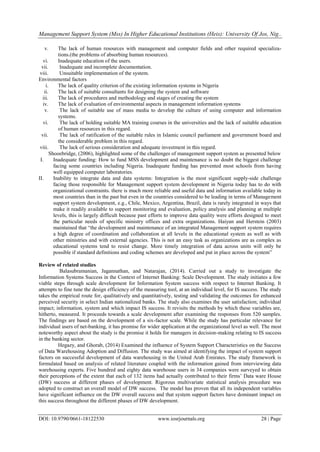
Figure.1. management support system
Source: author’s field work
This frame work accommodate three users at the same time requesting different support services from
the service provider (ICT support of the University of Jos) through the support manager. The support manager
regulates the access point or determines the services that can be utilized by the users. The services are accessed
by the users through the web portal that relies on the internet services for access.
Request
service
Support
Manager
Service
provider
PROVIDER
USER
MANAGER
Management Support System (Mss) In Higher Educational Institutions (Heis): University Of Jos, Nig..
DOI: 10.9790/0661-18122530 www.iosrjournals.org 27 | Page
III. Concept Of Information Support System
The concept of management support system has no single word definition, many scholar have defined
the concept from different perspectives. Management support system is a computer based information system
that provides for management oriented reporting based on transaction processing and business operations of the
organization” (Nowduril and Al-Dossary, 2012). Similarly Hasan, Shamsuddin, and Aziati, (2013)
“management support system is type of information systems that take internal data from the system and
summarized it to meaningful and useful forms as management reports to use it to support management activities
and managerial decision making”. “Management support systems basically concerned with converting data from
internal sources into information which is then communicated to managers at all the levels, in all functions to
make timely and effective decisions for planning, directing and controlling the activities for which they are
responsible”. (Al-Mamary, Shamsuddin, and Aziati, 2014), adds Awad, (1988) “The management support
system is an integrated, computerized and machine user system providing the required information to support
the operation and decision making. The main elements of this system are:
i. An integrated system to give service to many users,
ii. The computer system linking some of information software via a database.
iii. User-machine interface responding to the temporary and immediate searches.
iv. Presenting the information to all management level,
v. Supporting the operation and decision making.
From the foregoing, we can define management support system as an interactive computer-base system
that support cooperate memory or knowledge base that constitutes the problem-solving rules, facts, and
procedure for the basic specific data relevant to the problem domain.
Importance of Management Support System
The benefit of management support system is to come out with appropriate responses to a business
situation. Babu and Sekhar, (2012).argued that “the Primary purpose of management support system is to help
an organization achieve its goals by providing managers with insight into the regular operations of the
organization so that they can control, organize, and plan more effectively. In addition management support
system provides the right information to the right person in the right format at the right time”. This view is
supported by Nath and Badguja, (2013) they observed that “Management support system provides a valuable
time-saving benefit to the employees. Employees do not have to collect data manually for filing and analysis.
Instead, that information can be entered quickly and easily into a computer program. Access to the information
needed is faster”. Similarly Nowduri1 and Al-Dossary, (2012), noted that “MSS provide reports to various
managers among the middle and low level managers of the organization. Especially, for middle level manager‟s
management support system provides the organizational performance reports, which in turn help predicting the
future performance of the organization”
Challenges of Management Support System
The fact that management support system is beneficial to an organization; there are other factors that
can hinder the smooth implementation of mss in an organization. Writes Babaei and Beikzad, (2013) the
challenges of mss can be classified into three, namely: humanistic, organizational and environmental factors.
Humanistic factors
i. The lack of information of the managers and users as they don‟t know exactly what they want and what
their information needs are.
ii. The lack of understanding of the needs of the users by designers (the lack of correct definition of the
needs and their analysis).
iii. The lack of information of the managers and users about the collaboration method with the designer
team.
iv. The lack of participation of the managers and users in system design.
v. The lack of understanding of the managers of software and information systems.
vi. The lack of information of most of the analysts and programmers (designers) with new system work
environment.
vii. The lack of acceptance of the system executers and resistance against the change.
viii. The lack of accuracy in the data collected.
Organizational factors
i. The lack of good conditions for participation and collaboration of the managers, users and system
directors.
ii. The lack of consistency and complexity of the existing manual systems.
iii. The lack of existing systems and methods analysis before the system design.
iv. The lack of evaluation of the existing power Bad condition of educating the specialized forces.
Management Support System (Mss) In Higher Educational Institutions (Heis): University Of Jos, Nig..
DOI: 10.9790/0661-18122530 www.iosrjournals.org 28 | Page
v. The lack of human resources with management and computer fields and other required specializa-
tions.(the problems of absorbing human resources).
vi. Inadequate education of the users.
vii. Inadequate and incomplete documentation.
viii. Unsuitable implementation of the system.
Environmental factors
i. The lack of quality criterion of the existing information systems in Nigeria
ii. The lack of suitable consultants for designing the system and software
iii. The lack of procedures and methodology and stages of creating the system
iv. The lack of evaluation of environmental aspects in management information systems
v. The lack of suitable use of mass media to develop the culture of using computer and information
systems.
vi. The lack of holding suitable MA training courses in the universities and the lack of suitable education
of human resources in this regard.
vii. The lack of ratification of the suitable rules in Islamic council parliament and government board and
the considerable problem in this regard.
viii. The lack of serious consideration and adequate investment in this regard.
Shooebridge, (2006), highlighted some of the challenges of management support system as presented below
I. Inadequate funding: How to fund MSS development and maintenance is no doubt the biggest challenge
facing some countries including Nigeria. Inadequate funding has prevented most schools from having
well equipped computer laboratories.
II. Inability to integrate data and data systems: Integration is the most significant supply-side challenge
facing those responsible for Management support system development in Nigeria today has to do with
organizational constraints. there is much more reliable and useful data and information available today in
most countries than in the past but even in the countries considered to be leading in terms of Management
support system development, e.g., Chile, Mexico, Argentina, Brazil, data is rarely integrated in ways that
make it readily available to support monitoring and evaluation, policy analysis and planning at multiple
levels, this is largely difficult because past efforts to improve data quality were efforts designed to meet
the particular needs of specific ministry offices and extra organizations. Haiyan and Herstein (2003)
maintained that “the development and maintenance of an integrated Management support system requires
a high degree of coordination and collaboration at all levels in the educational system as well as with
other ministries and with external agencies. This is not an easy task as organizations are as complex as
educational systems tend to resist change. More timely integration of data across units will only be
possible if standard definitions and coding schemes are developed and put in place across the system”
Review of related studies
Balasubramanian, Jagannathan, and Natarajan, (2014). Carried out a study to investigate the
Information Systems Success in the Context of Internet Banking: Scale Development. The study initiates a few
viable steps through scale development for Information System success with respect to Internet Banking. It
attempts to fine tune the design efficiency of the measuring tool, at an individual level, for IS success. The study
takes the empirical route for, qualitatively and quantitatively, testing and validating the outcomes for enhanced
perceived security in select Indian nationalized banks. The study also examines the user satisfaction; individual
impact; information, system and which impact IS success. It revisits the methods by which these variables are,
hitherto, measured. It proceeds towards a scale development after examining the responses from 520 samples.
The findings are based on the development of a six-factor scale. While the study has particular relevance for
individual users of net-banking, it has promise for wider application at the organizational level as well. The most
noteworthy aspect about the study is the promise it holds for managers in decision-making relating to IS success
in the banking sector.
Hegazy, and Ghorab, (2014) Examined the influence of System Support Characteristics on the Success
of Data Warehousing Adoption and Diffusion. The study was aimed at identifying the impact of system support
factors on successful development of data warehousing in the United Arab Emirates. The study framework is
formulated based on analysis of related literature coupled with the information gained from interviewing data
warehousing experts. Five hundred and eighty data warehouse users in 34 companies were surveyed to obtain
their perceptions of the extent that each of 132 items had actually contributed to their firms‟ Data ware House
(DW) success at different phases of development. Rigorous multivariate statistical analysis procedure was
adopted to construct an overall model of DW success. The model has proven that all its independent variables
have significant influence on the DW overall success and that system support factors have dominant impact on
this success throughout the different phases of DW development.
Management Support System (Mss) In Higher Educational Institutions (Heis): University Of Jos, Nig..
DOI: 10.9790/0661-18122530 www.iosrjournals.org 29 | Page
Kyakulumbye, Olobo, and Kisenyi, (2013), examined the Information Communication Technology
(ICT) Utilization in Private Universities in Uganda: The study was an extension of a similar study by
Kyakulumbye, Muhenda, and Namanya, (2012) conducted among local government staff in Uganda and was
extended among staff at Uganda Christian University. A total of 108 respondents out of the accessible 130
representing 83.0% response rate was realized after administering the study instruments over a period of two (2)
weeks. Of the 108 respondents, 70.4% constituted staff in administration, 8.0% heads of sections and 21.6%
academic staff. Data was analyzed using different statistical techniques which included descriptive statistics,
mainly mean and standard deviation, Pearson Product Moment Correlation Coefficient to establish the
relationships between variables and multiple regression analysis to establish causal influence of factors on ICT
utilization. At bivariate level, organizational support systems, ICT infrastructure and users‟ perceptions had a
strong relationship on ICT utilization. Multiple regression analysis revealed that only user perceptions
(perceived ease of use) and user knowledge and skills had a significant causal influence on ICT utilization. The
study Recommended that UCU strategic management cater for personnel ICT capacity building to improve their
skills and therefore enhance ICT usability, and further recommended that a study may consider segmenting staff
by faculties and study how utilization levels differ using ANOVA. A comparative study can also be undertaken
to assess UCU and any other private university.
IV. Conclusion
From the foregoing, it is evident that management support system in an organization most especially
the university is central to achievement of success by both the management team and the clients (students). The
management support system also helps in providing a better solution to the identified problems. In other to
address the challenge facing management support system such as reducing the work load on cooperate
information system (CIS) staff, resolving most problems encountered during and after registration by the
students, and provide an avenue where the university staff could call for support services most especially on
issues relating to opening and checking of their mail box, this paper presents the following recommendations:
Human factors
1. In dealing with humanistic factors, the managers and users of ICT should have basic and necessary
information about the use of ICT.
2. Programme designers should carry out a survey that will help them understand the needs of the users by
designing programmes that can take care of the needs and aspiration of the managers and users. The
managers and users should be made participants in system design.
3. Managers of ICT units in an organization should be train on software and information systems, this will
make them ready to accept change and other innovations.
Organizational factors
1. There is the need for the management of ICT to employ quality human resources with managerial skills
with knowledge of computer fields and other required specializations.
2. There is the need for regular evaluation of all programmes in the ICT units
3. There should be consistency in the existing manual systems.
Environmental factors
1. There should be quality criterion of the existing information systems in Nigeria
2. Suitable consultants for designing the system and software is necessary to achieve success in an
organization
3. There is the need for suitable procedures and methodology and stages of creating any system
4. There should be evaluation of environmental aspects in management information systems
5. There is the need for proper use of mass media to develop the culture of using computer and information
systems in Nigeria.
6. The MSS should be adequately funded, to create room for most schools to have a well-equipped
computer laboratories.
7.
References
[1]. DeLone, W.H., & McLean, E.R. (1992). Information systems success: The quest for the dependent variable. Information Systems
Research, 3, 1 60–95.
[2]. Carr, N.G. (2003) „IT doesn‟t matter‟, Harvard Business Review, Vol. 81, No. 5.41–49.
[3]. McFarlan, F.W. & Nolan, R.L. (2003) „Why IT does matter‟, Working Knowledge (online). Retrieved, March. 03, 2015 from
[4]. Li, E.Y. (2014) Editorial: Information systems and management in the digital era Int. J. Information Systems and Management, Vol.
1, Nos. 1/2, 2014
[5]. MatebTafere, G. (2014). Information management practice of Bahirdar University. Journal of internet and information system. Vol.
4(1)
[6]. Webber CF (2003).New technologies and educative leadership. J. Edu. Admin. 41(2):119-123.
[7]. Emmanuel O.U, & Etuh B, N. (2014). An Analysis of ICT impact on the Curricular of Major Nigerian Universities in the Last Ten
Years 2003-2013. International journal of science and technology. Vol. 3. No.1. 59-66
Management Support System (Mss) In Higher Educational Institutions (Heis): University Of Jos, Nig..
DOI: 10.9790/0661-18122530 www.iosrjournals.org 30 | Page
[8]. Ndombi, R.M, Wakhungu, A.N. & Mutongwa , M.S.(2014). Analysis of ICT and Management Systems in Driving World
Economy. International journal of academic research in business and social science. Vol. 14 No. 1. 197- 220
[9]. Pitt, L. F., Watson, R. T., & Kavan, C. B. (1995). Service Quality: A Measure of Information Systems Effectiveness. MIS quarterly,
19(2).
[10]. Seddon, P .B, & Kiew, M.Y. (1994). A partial test and development of the DeLone and McLeanmodel of IS success. In J.I.
DeGross, S.L. Huff, and M.C. Munro (eds.), Proceedings of the International Conference on Information Systems. Atlanta, GA:
Association for information Systems. 99–110.
[11]. Nowduri1, S., & Al-Dossary, S. (2012). Management Information Systems and Its Support to Sustainable Small and Medium
Enterprises International Journal of Business and Management; Vol. 7, No. 19. 125-131.
[12]. Hasan,Y., & Shamsuddin,A., & Aziati, N. (2013), The Impact of Management Information Systems adoption in Managerial
Decision Making : A Review, The International Scientific Journal of Management Information Systems, Vol. 8, No. 4. 010-017.
[13]. Al-Mamary, Y.H., & Shamsuddin, A., & Aziati, N. (2014). The Role of Different Types of Information Systems in Business
Organizations: A ReviewInternational Journal of Research, Vol. 1, Issue. 7, pp. 333-339.
[14]. Babu, K.V.S.N.J., & Sekhar, B.M.R (2012). MIS. Vs. DSSS in Decision Making, Global Journal of Management and Business
Research, Volume 12 Issue 16 Version 1.0
[15]. Nath, R.P., & Badgujar, M. (2013) Use of Management Information System in an Organization for Decision Making, ASM's
International E-Journal of Ongoing Research in Management and IT.
[16]. Al-Dossary, S (2012). Management Information Systems and Its Support to Sustainable Small and Medium Enterprises.
International Journal of Business and Management. Vol. 7, No. 19.
[17]. Babaei,M, & Beikzad, J. (2013). Management information system, challenges and solutions.
[18]. Shooebridge, J. (2006). Educational Management Information System: Case Studies and Lessons Learnt. Case Study of Nigeria.
[19]. Haiyan, A and Herstein, J. (2003). Educational Management Information System: Integrated Dataand Information and their
Implications. Paper presented at the Annual Conference of Comparative and International Education Society, New Olean, LA.
[20]. Balasubramanian, S.A, Jagannathan, V. & Natarajan, T (2014). Information Systems Success in the Context of Internet Banking:
Scale Development. Journal of Internet Banking and Commerce. Vol., No.3. Retrieved, June, 02, 2015 from
http://www.arraydev.com/commerce/jibc/
[21]. Hegazy, F & Ghorab, K (2014).The influence of System Support Characteristics on the Success of Data Warehousing Adoption &
Diffusion. International Journal of Engineering and computer science. Vol. 14. No 01.
[22]. Kyakulumbye, S, Olobo, M & Kisenyi, V (2013). Information Communication Technology (ICT) Utilization in Private
Universities in Uganda: Exploring Strategies to Improve. A Case of Uganda Christian University. Technology and Investment. 4.
22-29. Retrieved june 01, 2015 from http://www.scirp.org/journal/ti
[23]. Kyakulumbye,S, Muhenda, M.B, & Namanya, A.M (2012). “ICT Utilization in Uganda Local Governments: Why Low Uptake?”
LAP Lambert Academy Publishing, Deut- shland.

E018122530

  • 1.
    IOSR Journal ofComputer Engineering (IOSR-JCE) e-ISSN: 2278-0661,p-ISSN: 2278-8727, Volume 18, Issue 1, Ver. II (Jan – Feb. 2016), PP 25-30 www.iosrjournals.org DOI: 10.9790/0661-18122530 www.iosrjournals.org 25 | Page Management Support System (Mss) In Higher Educational Institutions (Heis): University Of Jos, Nigeria. Ict Support Adamu Umaru1 , Mohammed Abdul Sarkin-Fada2 1 Nigeria Prison Service Headquarters Office Plateau State Command Jos 2 (Ph.D in progress) Deparment of Arts and Social Science education Faculty of Education Ahmadu Bello University Zaria Abstract: Management support system is of great importance in the institutions of higher learning, as an interactive computer-base system that support cooperate memory or knowledge base that constitutes the problem-solving rules, facts, and procedure for the basic specific data relevant to the problem domain. The theoretical frame work underpinning this paper is situated on Delone and McLean (1992) causal model for information system, and the conceptual frame work developed by the author’s (management support system). The paper also examines the importance of Management Support System, Challenges of Management Support System, i.e. humanistic factors, Organizational factors and Environmental factors, the paper reviewed literature of related studies and made recommendations on how best to tackle the challenges confronting the management support system in our intuitions of higher learning. Keywords: Management Support System, institutions, ICT, Nigeria. I. Introduction In Nigeria and the world over, the system of management and its operations have been swept by the pressure on the need for the application of information and communication technologies (ICTs). Information technology (IT) is considered as a commodity in today‟s business world similar to water and electricity (Carr, 2003, McFarlan and Nolan, 2003). “It is a necessary resource for an enterprise to maintain its sustainability” (Li, 2014). “Today, which we call information age as many technological developments have been experienced; the biggest task that an organization should shoulder is to stay sensitive to change” (MatebTafere, 2014). Similarly, Webber (2003) opined that “many significant factors such as continuous developments in information technologies, information exchange, increasing expectations of the society, modern managing perceptions and applications cause organizations all over the world to develop new information management systems in order to survive”. The pressure has been found to be brought about due to the inevitable changes and needs brought about by the use of ICTs to support management practice or decision in the Nigerian university system. “One major observation during the early stages of university education in Nigeria was the little emphasis on the development of ICTs; computers were in short supply to the institutions” (Emmanuel and Etuh, 2014), and where they were available they were the old type of IBM computers (Akopta 1999) in Emmanuel and Etuh, (2014). “Communication gadgets were also in short supply such things like telephones and intercom services could only be seen in few offices. Technology materials for effective communication were not common and also it was recorded that the use of compact disc started in the 1990s while the use of handsets started in 2003” (Federal Government of Nigeria 2008). Management Support Systems (MSS) is computer-based systems that is supposed to provide information to be used by or at least to support management judgment, which extends the information retrieval capabilities of the end-users with „query and analysis functions‟ for searching a database, generating „what if scenarios, and other such purposes. Ndombi, Wakhungu and Mutongwa, (2014), noted that “Management Information System (MIS) provides information for the managerial activities in an organization. It provide speedy, inexpensive and convenient means of communication”. Management Support Systems is seen as a subset of management information system (MIS). “Management support System (MSS) is basically concerned with processing data into information and is then communicated to the various Departments in an organization for appropriate decision-making”. (Ndombi, 2014) The Support Services Desk was established in 2008 to provide best practice Support system that is responsive to ICT solution need of the University of Jos community. This paper seeks to achieve the following objectives: i. To reduce the work load on CIS staff as most of the queries are to be handled on the Support Desk. ii. To serve as an avenue to resolve most problems encountered during and after registration by the students. iii. To serve as an avenue where the university staff could call for support services most especially on issues relating to opening and checking of their mail box.( Department of Maintenance and System Support Services University of Jos)
  • 2.
    Management Support System(Mss) In Higher Educational Institutions (Heis): University Of Jos, Nig.. DOI: 10.9790/0661-18122530 www.iosrjournals.org 26 | Page II. Theoretical And Conceptual Frame Work The theory underpinning this paper is hinged on Delone and McLean (1992) causal model for information system. The Primary purpose of the original DeLone and McLean paper was to synthesize previous research involving IS success into a more coherent body of knowledge and to provide guidance to future researchers. Based on the communications research of Shannon and Weaver and the information “influence” theory of Mason, as well as empirical management information systems (MIS) research studies from 1981–87, a comprehensive, multidimensional model of IS success was postulated. According to this model the system quality and information quality affect user satisfaction and use. The model also posits use and user satisfaction as interdependent factors in a reciprocal compact. Moreover, it presumes that the interdependent factors are direct antecedents of individual impact which, in turn, affects organizational impact. Empirical investigation was carried out on the model, fully and partially, in various settings and contexts. The model was further developed with the inputs of Pitt, Watson and Kavan (1995), Seddon and Kiew (1994). Recommendations of Pitt, Watson, and Kavan, (1995). Resulted in the incorporation of service quality as a new dimension. The model underwent fine-tuning with the comments of Seddon and Kiew (1994) resulted in grouping of individual and organizational impact into one variable as net benefits and also the use variable now has two meanings, depending upon its volitional or mandatory use. For Volitional use one “use” may be used as the construct in the whereas for mandatory use one may use “intentions to use” as the construct. The focus of this paper is on Management Support System (MSS) in Higher Educational Institutions: University of Jos ICT Support. The system quality and information quality in management support system of the university of Jos ICT support affect user satisfaction and use. The use and user satisfaction are interdependent factors in a reciprocal squashed. It is assumed that the interdependent factors are direct antecedents of individual impact which, in turn, affects organizational impact. Thus, for the management support system of the University of Jos to achieve any meaningful success there is the need to develop an efficient system where client will be satisfied with its service delivery. Figure.1. management support system Source: author’s field work This frame work accommodate three users at the same time requesting different support services from the service provider (ICT support of the University of Jos) through the support manager. The support manager regulates the access point or determines the services that can be utilized by the users. The services are accessed by the users through the web portal that relies on the internet services for access. Request service Support Manager Service provider PROVIDER USER MANAGER
  • 3.
    Management Support System(Mss) In Higher Educational Institutions (Heis): University Of Jos, Nig.. DOI: 10.9790/0661-18122530 www.iosrjournals.org 27 | Page III. Concept Of Information Support System The concept of management support system has no single word definition, many scholar have defined the concept from different perspectives. Management support system is a computer based information system that provides for management oriented reporting based on transaction processing and business operations of the organization” (Nowduril and Al-Dossary, 2012). Similarly Hasan, Shamsuddin, and Aziati, (2013) “management support system is type of information systems that take internal data from the system and summarized it to meaningful and useful forms as management reports to use it to support management activities and managerial decision making”. “Management support systems basically concerned with converting data from internal sources into information which is then communicated to managers at all the levels, in all functions to make timely and effective decisions for planning, directing and controlling the activities for which they are responsible”. (Al-Mamary, Shamsuddin, and Aziati, 2014), adds Awad, (1988) “The management support system is an integrated, computerized and machine user system providing the required information to support the operation and decision making. The main elements of this system are: i. An integrated system to give service to many users, ii. The computer system linking some of information software via a database. iii. User-machine interface responding to the temporary and immediate searches. iv. Presenting the information to all management level, v. Supporting the operation and decision making. From the foregoing, we can define management support system as an interactive computer-base system that support cooperate memory or knowledge base that constitutes the problem-solving rules, facts, and procedure for the basic specific data relevant to the problem domain. Importance of Management Support System The benefit of management support system is to come out with appropriate responses to a business situation. Babu and Sekhar, (2012).argued that “the Primary purpose of management support system is to help an organization achieve its goals by providing managers with insight into the regular operations of the organization so that they can control, organize, and plan more effectively. In addition management support system provides the right information to the right person in the right format at the right time”. This view is supported by Nath and Badguja, (2013) they observed that “Management support system provides a valuable time-saving benefit to the employees. Employees do not have to collect data manually for filing and analysis. Instead, that information can be entered quickly and easily into a computer program. Access to the information needed is faster”. Similarly Nowduri1 and Al-Dossary, (2012), noted that “MSS provide reports to various managers among the middle and low level managers of the organization. Especially, for middle level manager‟s management support system provides the organizational performance reports, which in turn help predicting the future performance of the organization” Challenges of Management Support System The fact that management support system is beneficial to an organization; there are other factors that can hinder the smooth implementation of mss in an organization. Writes Babaei and Beikzad, (2013) the challenges of mss can be classified into three, namely: humanistic, organizational and environmental factors. Humanistic factors i. The lack of information of the managers and users as they don‟t know exactly what they want and what their information needs are. ii. The lack of understanding of the needs of the users by designers (the lack of correct definition of the needs and their analysis). iii. The lack of information of the managers and users about the collaboration method with the designer team. iv. The lack of participation of the managers and users in system design. v. The lack of understanding of the managers of software and information systems. vi. The lack of information of most of the analysts and programmers (designers) with new system work environment. vii. The lack of acceptance of the system executers and resistance against the change. viii. The lack of accuracy in the data collected. Organizational factors i. The lack of good conditions for participation and collaboration of the managers, users and system directors. ii. The lack of consistency and complexity of the existing manual systems. iii. The lack of existing systems and methods analysis before the system design. iv. The lack of evaluation of the existing power Bad condition of educating the specialized forces.
  • 4.
    Management Support System(Mss) In Higher Educational Institutions (Heis): University Of Jos, Nig.. DOI: 10.9790/0661-18122530 www.iosrjournals.org 28 | Page v. The lack of human resources with management and computer fields and other required specializa- tions.(the problems of absorbing human resources). vi. Inadequate education of the users. vii. Inadequate and incomplete documentation. viii. Unsuitable implementation of the system. Environmental factors i. The lack of quality criterion of the existing information systems in Nigeria ii. The lack of suitable consultants for designing the system and software iii. The lack of procedures and methodology and stages of creating the system iv. The lack of evaluation of environmental aspects in management information systems v. The lack of suitable use of mass media to develop the culture of using computer and information systems. vi. The lack of holding suitable MA training courses in the universities and the lack of suitable education of human resources in this regard. vii. The lack of ratification of the suitable rules in Islamic council parliament and government board and the considerable problem in this regard. viii. The lack of serious consideration and adequate investment in this regard. Shooebridge, (2006), highlighted some of the challenges of management support system as presented below I. Inadequate funding: How to fund MSS development and maintenance is no doubt the biggest challenge facing some countries including Nigeria. Inadequate funding has prevented most schools from having well equipped computer laboratories. II. Inability to integrate data and data systems: Integration is the most significant supply-side challenge facing those responsible for Management support system development in Nigeria today has to do with organizational constraints. there is much more reliable and useful data and information available today in most countries than in the past but even in the countries considered to be leading in terms of Management support system development, e.g., Chile, Mexico, Argentina, Brazil, data is rarely integrated in ways that make it readily available to support monitoring and evaluation, policy analysis and planning at multiple levels, this is largely difficult because past efforts to improve data quality were efforts designed to meet the particular needs of specific ministry offices and extra organizations. Haiyan and Herstein (2003) maintained that “the development and maintenance of an integrated Management support system requires a high degree of coordination and collaboration at all levels in the educational system as well as with other ministries and with external agencies. This is not an easy task as organizations are as complex as educational systems tend to resist change. More timely integration of data across units will only be possible if standard definitions and coding schemes are developed and put in place across the system” Review of related studies Balasubramanian, Jagannathan, and Natarajan, (2014). Carried out a study to investigate the Information Systems Success in the Context of Internet Banking: Scale Development. The study initiates a few viable steps through scale development for Information System success with respect to Internet Banking. It attempts to fine tune the design efficiency of the measuring tool, at an individual level, for IS success. The study takes the empirical route for, qualitatively and quantitatively, testing and validating the outcomes for enhanced perceived security in select Indian nationalized banks. The study also examines the user satisfaction; individual impact; information, system and which impact IS success. It revisits the methods by which these variables are, hitherto, measured. It proceeds towards a scale development after examining the responses from 520 samples. The findings are based on the development of a six-factor scale. While the study has particular relevance for individual users of net-banking, it has promise for wider application at the organizational level as well. The most noteworthy aspect about the study is the promise it holds for managers in decision-making relating to IS success in the banking sector. Hegazy, and Ghorab, (2014) Examined the influence of System Support Characteristics on the Success of Data Warehousing Adoption and Diffusion. The study was aimed at identifying the impact of system support factors on successful development of data warehousing in the United Arab Emirates. The study framework is formulated based on analysis of related literature coupled with the information gained from interviewing data warehousing experts. Five hundred and eighty data warehouse users in 34 companies were surveyed to obtain their perceptions of the extent that each of 132 items had actually contributed to their firms‟ Data ware House (DW) success at different phases of development. Rigorous multivariate statistical analysis procedure was adopted to construct an overall model of DW success. The model has proven that all its independent variables have significant influence on the DW overall success and that system support factors have dominant impact on this success throughout the different phases of DW development.
  • 5.
    Management Support System(Mss) In Higher Educational Institutions (Heis): University Of Jos, Nig.. DOI: 10.9790/0661-18122530 www.iosrjournals.org 29 | Page Kyakulumbye, Olobo, and Kisenyi, (2013), examined the Information Communication Technology (ICT) Utilization in Private Universities in Uganda: The study was an extension of a similar study by Kyakulumbye, Muhenda, and Namanya, (2012) conducted among local government staff in Uganda and was extended among staff at Uganda Christian University. A total of 108 respondents out of the accessible 130 representing 83.0% response rate was realized after administering the study instruments over a period of two (2) weeks. Of the 108 respondents, 70.4% constituted staff in administration, 8.0% heads of sections and 21.6% academic staff. Data was analyzed using different statistical techniques which included descriptive statistics, mainly mean and standard deviation, Pearson Product Moment Correlation Coefficient to establish the relationships between variables and multiple regression analysis to establish causal influence of factors on ICT utilization. At bivariate level, organizational support systems, ICT infrastructure and users‟ perceptions had a strong relationship on ICT utilization. Multiple regression analysis revealed that only user perceptions (perceived ease of use) and user knowledge and skills had a significant causal influence on ICT utilization. The study Recommended that UCU strategic management cater for personnel ICT capacity building to improve their skills and therefore enhance ICT usability, and further recommended that a study may consider segmenting staff by faculties and study how utilization levels differ using ANOVA. A comparative study can also be undertaken to assess UCU and any other private university. IV. Conclusion From the foregoing, it is evident that management support system in an organization most especially the university is central to achievement of success by both the management team and the clients (students). The management support system also helps in providing a better solution to the identified problems. In other to address the challenge facing management support system such as reducing the work load on cooperate information system (CIS) staff, resolving most problems encountered during and after registration by the students, and provide an avenue where the university staff could call for support services most especially on issues relating to opening and checking of their mail box, this paper presents the following recommendations: Human factors 1. In dealing with humanistic factors, the managers and users of ICT should have basic and necessary information about the use of ICT. 2. Programme designers should carry out a survey that will help them understand the needs of the users by designing programmes that can take care of the needs and aspiration of the managers and users. The managers and users should be made participants in system design. 3. Managers of ICT units in an organization should be train on software and information systems, this will make them ready to accept change and other innovations. Organizational factors 1. There is the need for the management of ICT to employ quality human resources with managerial skills with knowledge of computer fields and other required specializations. 2. There is the need for regular evaluation of all programmes in the ICT units 3. There should be consistency in the existing manual systems. Environmental factors 1. There should be quality criterion of the existing information systems in Nigeria 2. Suitable consultants for designing the system and software is necessary to achieve success in an organization 3. There is the need for suitable procedures and methodology and stages of creating any system 4. There should be evaluation of environmental aspects in management information systems 5. There is the need for proper use of mass media to develop the culture of using computer and information systems in Nigeria. 6. The MSS should be adequately funded, to create room for most schools to have a well-equipped computer laboratories. 7. References [1]. DeLone, W.H., & McLean, E.R. (1992). Information systems success: The quest for the dependent variable. Information Systems Research, 3, 1 60–95. [2]. Carr, N.G. (2003) „IT doesn‟t matter‟, Harvard Business Review, Vol. 81, No. 5.41–49. [3]. McFarlan, F.W. & Nolan, R.L. (2003) „Why IT does matter‟, Working Knowledge (online). Retrieved, March. 03, 2015 from [4]. Li, E.Y. (2014) Editorial: Information systems and management in the digital era Int. J. Information Systems and Management, Vol. 1, Nos. 1/2, 2014 [5]. MatebTafere, G. (2014). Information management practice of Bahirdar University. Journal of internet and information system. Vol. 4(1) [6]. Webber CF (2003).New technologies and educative leadership. J. Edu. Admin. 41(2):119-123. [7]. Emmanuel O.U, & Etuh B, N. (2014). An Analysis of ICT impact on the Curricular of Major Nigerian Universities in the Last Ten Years 2003-2013. International journal of science and technology. Vol. 3. No.1. 59-66
  • 6.
    Management Support System(Mss) In Higher Educational Institutions (Heis): University Of Jos, Nig.. DOI: 10.9790/0661-18122530 www.iosrjournals.org 30 | Page [8]. Ndombi, R.M, Wakhungu, A.N. & Mutongwa , M.S.(2014). Analysis of ICT and Management Systems in Driving World Economy. International journal of academic research in business and social science. Vol. 14 No. 1. 197- 220 [9]. Pitt, L. F., Watson, R. T., & Kavan, C. B. (1995). Service Quality: A Measure of Information Systems Effectiveness. MIS quarterly, 19(2). [10]. Seddon, P .B, & Kiew, M.Y. (1994). A partial test and development of the DeLone and McLeanmodel of IS success. In J.I. DeGross, S.L. Huff, and M.C. Munro (eds.), Proceedings of the International Conference on Information Systems. Atlanta, GA: Association for information Systems. 99–110. [11]. Nowduri1, S., & Al-Dossary, S. (2012). Management Information Systems and Its Support to Sustainable Small and Medium Enterprises International Journal of Business and Management; Vol. 7, No. 19. 125-131. [12]. Hasan,Y., & Shamsuddin,A., & Aziati, N. (2013), The Impact of Management Information Systems adoption in Managerial Decision Making : A Review, The International Scientific Journal of Management Information Systems, Vol. 8, No. 4. 010-017. [13]. Al-Mamary, Y.H., & Shamsuddin, A., & Aziati, N. (2014). The Role of Different Types of Information Systems in Business Organizations: A ReviewInternational Journal of Research, Vol. 1, Issue. 7, pp. 333-339. [14]. Babu, K.V.S.N.J., & Sekhar, B.M.R (2012). MIS. Vs. DSSS in Decision Making, Global Journal of Management and Business Research, Volume 12 Issue 16 Version 1.0 [15]. Nath, R.P., & Badgujar, M. (2013) Use of Management Information System in an Organization for Decision Making, ASM's International E-Journal of Ongoing Research in Management and IT. [16]. Al-Dossary, S (2012). Management Information Systems and Its Support to Sustainable Small and Medium Enterprises. International Journal of Business and Management. Vol. 7, No. 19. [17]. Babaei,M, & Beikzad, J. (2013). Management information system, challenges and solutions. [18]. Shooebridge, J. (2006). Educational Management Information System: Case Studies and Lessons Learnt. Case Study of Nigeria. [19]. Haiyan, A and Herstein, J. (2003). Educational Management Information System: Integrated Dataand Information and their Implications. Paper presented at the Annual Conference of Comparative and International Education Society, New Olean, LA. [20]. Balasubramanian, S.A, Jagannathan, V. & Natarajan, T (2014). Information Systems Success in the Context of Internet Banking: Scale Development. Journal of Internet Banking and Commerce. Vol., No.3. Retrieved, June, 02, 2015 from http://www.arraydev.com/commerce/jibc/ [21]. Hegazy, F & Ghorab, K (2014).The influence of System Support Characteristics on the Success of Data Warehousing Adoption & Diffusion. International Journal of Engineering and computer science. Vol. 14. No 01. [22]. Kyakulumbye, S, Olobo, M & Kisenyi, V (2013). Information Communication Technology (ICT) Utilization in Private Universities in Uganda: Exploring Strategies to Improve. A Case of Uganda Christian University. Technology and Investment. 4. 22-29. Retrieved june 01, 2015 from http://www.scirp.org/journal/ti [23]. Kyakulumbye,S, Muhenda, M.B, & Namanya, A.M (2012). “ICT Utilization in Uganda Local Governments: Why Low Uptake?” LAP Lambert Academy Publishing, Deut- shland.