E-Marketing 4/E Judy Strauss, Adel I. El-Ansary, and Raymond Frost Chapter 7: Consumer Behavior
Chapter 7 Objectives After reading Chapter 7 you will be able to: Discuss general statistics about the Internet population. Describe the Internet exchange process and the technological, social/cultural and legal   context in which consumers participate in this process. Outline the broad individual characteristics and consumer resources that consumers bring to the online exchange. Highlight the four main categories of outcomes that consumers seek from online exchanges.
Hanover Direct’s 4 million customers buy through 12 different catalogs and Web sites. 99% of telephone customers complete an order; only 2% of all online visitors buy during a visit. Consumer research revealed several reasons for shopping cart abandonment: Technical difficulties. Consumer indecision at final check-out page. By monitoring online behavior, Hanover has achieved 33% improvement. Have you ever abandoned an online shopping cart? Why or why not? The Hanover Story
The Internet has grown faster than any other medium in history. In 2004, 958 million people had access, representing 16% of the global population. Internet usage in developed nations has reached a critical mass, leading marketers to ask more questions about consumer behavior on the Internet. Consumers in the 21 st  Century
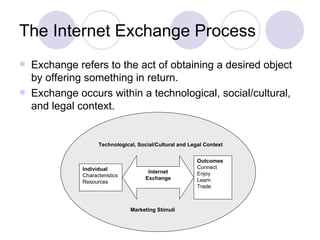
Exchange refers to the act of obtaining a desired object by offering something in return. Exchange occurs within a technological, social/cultural, and legal context. The Internet Exchange Process Technological, Social/Cultural and Legal Context Individual Characteristics Resources Internet Exchange Outcomes Connect Enjoy Learn Trade Marketing Stimuli
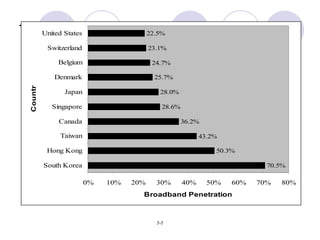
Technological Context 35% of online Americans connect to the Internet with a broadband connection. Broadband has increased by 20% in the past 2 years. The U.S. is only the 10 th  largest broadband market. Broadband users exhibit different online behavior than those using mobile handheld devices or dial up.
Top Broadband Country Markets
Social and Cultural Contexts Social/cultural trends have a huge effect on online exchanges. Information overload overwhelms consumers. Time poverty creates multitasking and contributes to a stressful environment. Home and work boundaries are dissolving. Consumers seek convenience and have high expectations regarding customer service. Consumers cannot do without Internet access: “online oxygen.”
Social and Cultural Contexts, cont. Self-service is required. Sophisticated consumers know they are in control and have choices. Privacy and data security are paramount. Online crime worries consumers.
Legal factors were discussed in Chapter 5. Despite piracy laws, illegally used software abounds. In spite of the new Can-Spam law, the number of unsolicited emails has increased. However, when the recording industry sued thousands of illegal music file downloaders, consumer behavior changed. In 2002, 37% of online consumers shared music files. Only 23% shared files in 2004. Legal Context
Individual characteristics affect Internet use. Age, income, education, ethnicity, and gender  Attitudes toward technology Online skill and experience Goal orientation Convenience or price orientation Family life cycle Consumer resources for exchange Money, time, energy and psychic costs Individual Characteristics & Resources
The Internet exchange doesn’t use cash or paper checks for online transactions. Many forms of digital money: Credit and debit cards. Electronic checks through a third-party such as PayPal. Smart cards or Splash Plastic. Other innovative forms are appearing in other countries. Monetary Cost
Online attention is a desirable and scarce commodity. Worldwide, the average user goes online 29 times/month, 49 minutes each time. Some researchers believe that consumers pay more focused attention online than with other media. Hoffman and Novak applied the concept of flow to online behavior. Time Cost
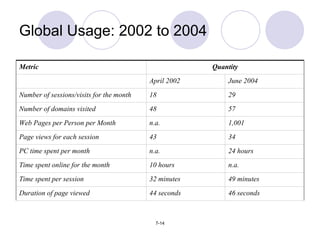
Global Usage: 2002 to 2004 June 2004 April 2002 46 seconds 44 seconds Duration of page viewed 49 minutes 32 minutes Time spent per session n.a. 10 hours Time spent online for the month 24 hours n.a. PC time spent per month 34 43 Page views for each session 1,001 n.a. Web Pages per Person per Month 57 48 Number of domains visited 29 18  Number of sessions/visits for the month Quantity Metric
Energy and Psychic Costs It takes effort to log on and check email, especially for dial-up users. Consumers apply psychic resources to understand information or when facing technical problems. Shopping cart abandonment and failed online purchases have numerous causes. Technical reasons. The consumer may be “window shopping,”  comparing several carts at once.
Exchange Outcomes There are 4 basic things that people do online: Connect Enjoy Learn Trade Each is ripe with marketing opportunity.

E Marketing Ch7 Consumer Behavior

  • 1.
    E-Marketing 4/E JudyStrauss, Adel I. El-Ansary, and Raymond Frost Chapter 7: Consumer Behavior
  • 2.
    Chapter 7 ObjectivesAfter reading Chapter 7 you will be able to: Discuss general statistics about the Internet population. Describe the Internet exchange process and the technological, social/cultural and legal context in which consumers participate in this process. Outline the broad individual characteristics and consumer resources that consumers bring to the online exchange. Highlight the four main categories of outcomes that consumers seek from online exchanges.
  • 3.
    Hanover Direct’s 4million customers buy through 12 different catalogs and Web sites. 99% of telephone customers complete an order; only 2% of all online visitors buy during a visit. Consumer research revealed several reasons for shopping cart abandonment: Technical difficulties. Consumer indecision at final check-out page. By monitoring online behavior, Hanover has achieved 33% improvement. Have you ever abandoned an online shopping cart? Why or why not? The Hanover Story
  • 4.
    The Internet hasgrown faster than any other medium in history. In 2004, 958 million people had access, representing 16% of the global population. Internet usage in developed nations has reached a critical mass, leading marketers to ask more questions about consumer behavior on the Internet. Consumers in the 21 st Century
  • 5.
    Exchange refers tothe act of obtaining a desired object by offering something in return. Exchange occurs within a technological, social/cultural, and legal context. The Internet Exchange Process Technological, Social/Cultural and Legal Context Individual Characteristics Resources Internet Exchange Outcomes Connect Enjoy Learn Trade Marketing Stimuli
  • 6.
    Technological Context 35%of online Americans connect to the Internet with a broadband connection. Broadband has increased by 20% in the past 2 years. The U.S. is only the 10 th largest broadband market. Broadband users exhibit different online behavior than those using mobile handheld devices or dial up.
  • 7.
  • 8.
    Social and CulturalContexts Social/cultural trends have a huge effect on online exchanges. Information overload overwhelms consumers. Time poverty creates multitasking and contributes to a stressful environment. Home and work boundaries are dissolving. Consumers seek convenience and have high expectations regarding customer service. Consumers cannot do without Internet access: “online oxygen.”
  • 9.
    Social and CulturalContexts, cont. Self-service is required. Sophisticated consumers know they are in control and have choices. Privacy and data security are paramount. Online crime worries consumers.
  • 10.
    Legal factors werediscussed in Chapter 5. Despite piracy laws, illegally used software abounds. In spite of the new Can-Spam law, the number of unsolicited emails has increased. However, when the recording industry sued thousands of illegal music file downloaders, consumer behavior changed. In 2002, 37% of online consumers shared music files. Only 23% shared files in 2004. Legal Context
  • 11.
    Individual characteristics affectInternet use. Age, income, education, ethnicity, and gender Attitudes toward technology Online skill and experience Goal orientation Convenience or price orientation Family life cycle Consumer resources for exchange Money, time, energy and psychic costs Individual Characteristics & Resources
  • 12.
    The Internet exchangedoesn’t use cash or paper checks for online transactions. Many forms of digital money: Credit and debit cards. Electronic checks through a third-party such as PayPal. Smart cards or Splash Plastic. Other innovative forms are appearing in other countries. Monetary Cost
  • 13.
    Online attention isa desirable and scarce commodity. Worldwide, the average user goes online 29 times/month, 49 minutes each time. Some researchers believe that consumers pay more focused attention online than with other media. Hoffman and Novak applied the concept of flow to online behavior. Time Cost
  • 14.
    Global Usage: 2002to 2004 June 2004 April 2002 46 seconds 44 seconds Duration of page viewed 49 minutes 32 minutes Time spent per session n.a. 10 hours Time spent online for the month 24 hours n.a. PC time spent per month 34 43 Page views for each session 1,001 n.a. Web Pages per Person per Month 57 48 Number of domains visited 29 18 Number of sessions/visits for the month Quantity Metric
  • 15.
    Energy and PsychicCosts It takes effort to log on and check email, especially for dial-up users. Consumers apply psychic resources to understand information or when facing technical problems. Shopping cart abandonment and failed online purchases have numerous causes. Technical reasons. The consumer may be “window shopping,” comparing several carts at once.
  • 16.
    Exchange Outcomes Thereare 4 basic things that people do online: Connect Enjoy Learn Trade Each is ripe with marketing opportunity.