


Advertising Management Opening Lecture
Lecture Objectives Explain the concept of brand Identify Marketing Communication tools used to develop brands Describe the importance of brand relationships and brand equity Discuss why branding is so important
What is a brand? Principles of Marketing definition “a name, term, sign, symbol, or design…intended to identify the goods or services of a seller…and to differentiate them from those of competitors.”
But it’s more than that A promise Beliefs in your target’s mind about your product or service Driven by what your company says and does A relationship
Duncan on Brands A  perception   resulting from experiences with, and information about, a company or line of products”
Why is branding so important? For the Consumer Simplifies their decision making and reduces risk Provides benefits above and beyond the product or service itself For the Producer Provides a process to grow share, revenue, and profit over the long-term Provides a way to more easily make business and creative decisions
Why is branding so important? For the Distributor/Retailer Drives inventory turns and the profit per transaction Can help them position their own business to reach a certain target audience
Proof in the Pricing Messaging and packaging so people are willing to pay more for similar core products or services Toothpaste (Dove vs. Safeguard) Coffee (Starbucks vs. Nescafe)
Characteristics of strong brands Based on deep consumer and market understanding Have a distinct, relevant, and credible  position Positioning is what we do to the  mind  (convince the market of the differences)  Physical (product itself or channel, personnel) Psychological (image)
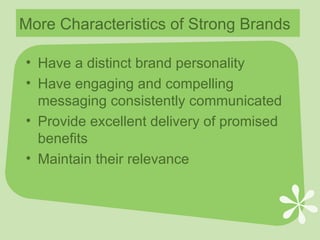
More Characteristics of Strong Brands Have a distinct brand personality Have engaging and compelling messaging consistently communicated Provide excellent delivery of promised benefits Maintain their relevance
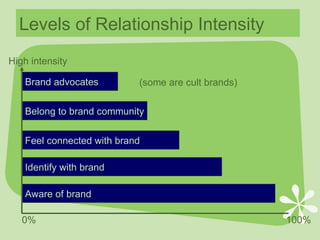
Levels of Relationship Intensity Aware of brand Identify with brand Feel connected with brand Belong to brand community Brand advocates 0%   100% High intensity (some are cult brands)
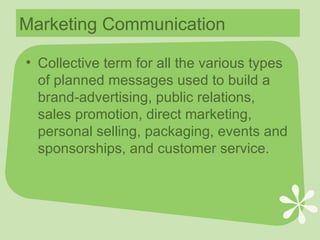
Marketing Communication Collective term for all the various types of planned messages used to build a brand-advertising, public relations, sales promotion, direct marketing, personal selling, packaging, events and sponsorships, and customer service.
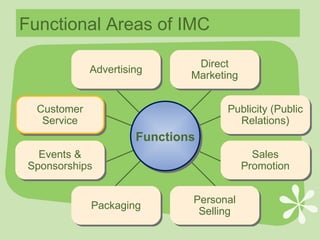
Functional Areas of IMC Customer Service Events & Sponsorships Publicity (Public Relations) Sales Promotion Advertising Direct Marketing Packaging Personal Selling Events & Sponsorships Publicity (Public Relations) Sales Promotion Advertising Direct Marketing Packaging Personal Selling Functions
Functional Areas of MC Advertising- non-personal, paid announcements by an identified sponsor. Direct Marketing-an interactive, database-driven marketing communication process that uses a range of media to motivate a response from customers and prospects.
Functional Areas… Cont’d Public Relations- communication activities that help “an organization and its publics adapt mutually with each other”. Sales Promotion- short-term, added-value offer designed to motivate an immediate response.
Functional Areas… Cont’d Personal Selling- interpersonal communication in which a salesperson uncovers and satisfies the needs of a customer to the mutual benefit of both. Packaging- container and conveyor of information
Functional Areas… Cont’d Events- highly targeted brand-associated activities designed to actively engage customers and prospects and generate publicity. Sponsorships- financial support of an organization, person or activity in exchange for brand publicity and association.
Functional Areas… Cont’d Customer Service- a company’s attitude and behavior during interactions with customers.
Using IMC to Build Brands Planned (and unplanned) messages Formed by all customer “touch points” Internal External  Experience with the product
Integrated Marketing Communication (IMC) Process for planning, executing and monitoring the brand messages that create customer relationships. An ongoing process
Integration Combining separate parts to a unified whole
Synergy Outcome of integration which is the interaction of individual parts in a way that makes the integrated whole greater than the sum of its parts. 2+2=5
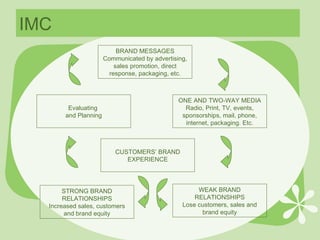
IMC BRAND MESSAGES Communicated by advertising, sales promotion, direct response, packaging, etc. ONE AND TWO-WAY MEDIA Radio, Print, TV, events, sponsorships, mail, phone, internet, packaging. Etc. CUSTOMERS’ BRAND EXPERIENCE Evaluating  and Planning WEAK BRAND RELATIONSHIPS Lose customers, sales and brand equity STRONG BRAND RELATIONSHIPS Increased sales, customers and brand equity
IMC Media The means by which the various types of marketing communication messages are sent and received
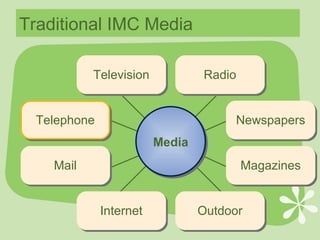
Traditional IMC Media Mail Newspapers Magazines Television Radio Internet Outdoor Mail Internet Outdoor Magazines Newspapers Radio Television Telephone Media
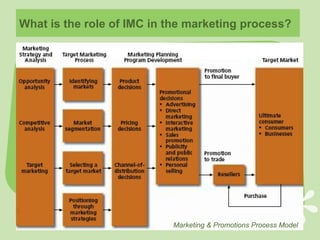
What is the role of IMC in the marketing process? Marketing & Promotions Process Model
The End   Thanks

Adman lecture 1

  • 1.
  • 2.
    Lecture Objectives Explainthe concept of brand Identify Marketing Communication tools used to develop brands Describe the importance of brand relationships and brand equity Discuss why branding is so important
  • 3.
    What is abrand? Principles of Marketing definition “a name, term, sign, symbol, or design…intended to identify the goods or services of a seller…and to differentiate them from those of competitors.”
  • 4.
    But it’s morethan that A promise Beliefs in your target’s mind about your product or service Driven by what your company says and does A relationship
  • 5.
    Duncan on BrandsA perception resulting from experiences with, and information about, a company or line of products”
  • 6.
    Why is brandingso important? For the Consumer Simplifies their decision making and reduces risk Provides benefits above and beyond the product or service itself For the Producer Provides a process to grow share, revenue, and profit over the long-term Provides a way to more easily make business and creative decisions
  • 7.
    Why is brandingso important? For the Distributor/Retailer Drives inventory turns and the profit per transaction Can help them position their own business to reach a certain target audience
  • 8.
    Proof in thePricing Messaging and packaging so people are willing to pay more for similar core products or services Toothpaste (Dove vs. Safeguard) Coffee (Starbucks vs. Nescafe)
  • 9.
    Characteristics of strongbrands Based on deep consumer and market understanding Have a distinct, relevant, and credible position Positioning is what we do to the mind (convince the market of the differences) Physical (product itself or channel, personnel) Psychological (image)
  • 10.
    More Characteristics ofStrong Brands Have a distinct brand personality Have engaging and compelling messaging consistently communicated Provide excellent delivery of promised benefits Maintain their relevance
  • 11.
    Levels of RelationshipIntensity Aware of brand Identify with brand Feel connected with brand Belong to brand community Brand advocates 0% 100% High intensity (some are cult brands)
  • 12.
    Marketing Communication Collectiveterm for all the various types of planned messages used to build a brand-advertising, public relations, sales promotion, direct marketing, personal selling, packaging, events and sponsorships, and customer service.
  • 13.
    Functional Areas ofIMC Customer Service Events & Sponsorships Publicity (Public Relations) Sales Promotion Advertising Direct Marketing Packaging Personal Selling Events & Sponsorships Publicity (Public Relations) Sales Promotion Advertising Direct Marketing Packaging Personal Selling Functions
  • 14.
    Functional Areas ofMC Advertising- non-personal, paid announcements by an identified sponsor. Direct Marketing-an interactive, database-driven marketing communication process that uses a range of media to motivate a response from customers and prospects.
  • 15.
    Functional Areas… Cont’dPublic Relations- communication activities that help “an organization and its publics adapt mutually with each other”. Sales Promotion- short-term, added-value offer designed to motivate an immediate response.
  • 16.
    Functional Areas… Cont’dPersonal Selling- interpersonal communication in which a salesperson uncovers and satisfies the needs of a customer to the mutual benefit of both. Packaging- container and conveyor of information
  • 17.
    Functional Areas… Cont’dEvents- highly targeted brand-associated activities designed to actively engage customers and prospects and generate publicity. Sponsorships- financial support of an organization, person or activity in exchange for brand publicity and association.
  • 18.
    Functional Areas… Cont’dCustomer Service- a company’s attitude and behavior during interactions with customers.
  • 19.
    Using IMC toBuild Brands Planned (and unplanned) messages Formed by all customer “touch points” Internal External Experience with the product
  • 20.
    Integrated Marketing Communication(IMC) Process for planning, executing and monitoring the brand messages that create customer relationships. An ongoing process
  • 21.
    Integration Combining separateparts to a unified whole
  • 22.
    Synergy Outcome ofintegration which is the interaction of individual parts in a way that makes the integrated whole greater than the sum of its parts. 2+2=5
  • 23.
    IMC BRAND MESSAGESCommunicated by advertising, sales promotion, direct response, packaging, etc. ONE AND TWO-WAY MEDIA Radio, Print, TV, events, sponsorships, mail, phone, internet, packaging. Etc. CUSTOMERS’ BRAND EXPERIENCE Evaluating and Planning WEAK BRAND RELATIONSHIPS Lose customers, sales and brand equity STRONG BRAND RELATIONSHIPS Increased sales, customers and brand equity
  • 24.
    IMC Media Themeans by which the various types of marketing communication messages are sent and received
  • 25.
    Traditional IMC MediaMail Newspapers Magazines Television Radio Internet Outdoor Mail Internet Outdoor Magazines Newspapers Radio Television Telephone Media
  • 26.
    What is therole of IMC in the marketing process? Marketing & Promotions Process Model
  • 27.
    The End  Thanks