Advertising Management Review of How Brand Communication Works
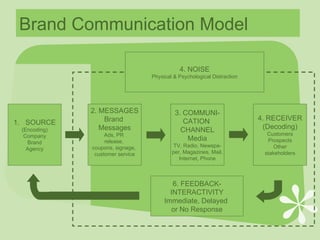
How Brand Communication Works Source or Sender-the initiator of a message Encoding-process of creating a brand message to convey an intended meaning and elicit a certain type of response Message-an idea encoded in a combination of words, pictures, actions, symbols, and/or events
How Brand Communication Works… Cont’d MC message-anything that talks about a brand, such as ads, radio commercials, direct-mail pieces, sales clerks or customer service Channel or media vehicle-means by which a message is delivered-letter, e-mail, radio, television, newspaper, telephone, an event, etc. Receiver-anyone who is exposed to a message
How Brand Communication Works… Cont’d Decoding-process of interpreting what a message means Feedback-response that conveys a message back to the source Noise-interference or distractions that can negatively affect the transmission and reception of a message
How Brand Communication Works… Cont’d Brand messages-all the information and experiences that impact how customers and other stakeholders perceive a brand.
Brand Communication Model SOURCE (Encoding) Company Brand Agency 6. FEEDBACK- INTERACTIVITY Immediate, Delayed  or No Response 2. MESSAGES Brand  Messages Ads, PR  release,  coupons, signage,  customer service 3. COMMUNI- CATION  CHANNEL Media TV, Radio, Newspa- per, Magazines, Mail, Internet, Phone 4. RECEIVER (Decoding) Customers Prospects Other stakeholders 4. NOISE Physical & Psychological Distraction
Brand Customer Touch Points Any situation in which a customer comes into contact with a brand or company
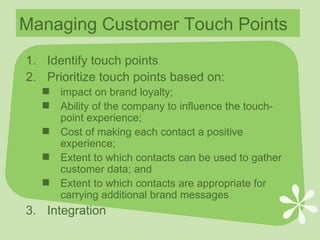
Managing Customer Touch Points Identify touch points Prioritize touch points based on: impact on brand loyalty; Ability of the company to influence the touch-point experience; Cost of making each contact a positive experience; Extent to which contacts can be used to gather customer data; and Extent to which contacts are appropriate for carrying additional brand messages Integration
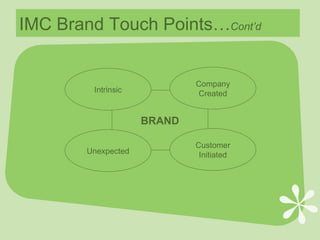
IMC Brand Touch Points Intrinsic touch point-interactions with a brand required during the process of buying or using that brand Unexpected touch point-unanticipated references to a brand that are beyond the control of the company. (eg. Word-of-mouth brand messages) Customer-initiated touch point-an interaction that occurs whenever a customer or prospect contacts a company.
IMC Brand Touch Points… Cont’d BRAND Intrinsic Company Created Unexpected Customer Initiated
4 Rs to Purposeful Dialogue Recourse-easy access to someone who can solve a problem Recognition-company acknowledgement of purchases and of the customer’s interaction history with the company Responsiveness-a reaction that produces customer satisfaction after a customer-initiated company contact. Respect-consideration

Adman Lecture 5

  • 1.
    Advertising Management Reviewof How Brand Communication Works
  • 2.
    How Brand CommunicationWorks Source or Sender-the initiator of a message Encoding-process of creating a brand message to convey an intended meaning and elicit a certain type of response Message-an idea encoded in a combination of words, pictures, actions, symbols, and/or events
  • 3.
    How Brand CommunicationWorks… Cont’d MC message-anything that talks about a brand, such as ads, radio commercials, direct-mail pieces, sales clerks or customer service Channel or media vehicle-means by which a message is delivered-letter, e-mail, radio, television, newspaper, telephone, an event, etc. Receiver-anyone who is exposed to a message
  • 4.
    How Brand CommunicationWorks… Cont’d Decoding-process of interpreting what a message means Feedback-response that conveys a message back to the source Noise-interference or distractions that can negatively affect the transmission and reception of a message
  • 5.
    How Brand CommunicationWorks… Cont’d Brand messages-all the information and experiences that impact how customers and other stakeholders perceive a brand.
  • 6.
    Brand Communication ModelSOURCE (Encoding) Company Brand Agency 6. FEEDBACK- INTERACTIVITY Immediate, Delayed or No Response 2. MESSAGES Brand Messages Ads, PR release, coupons, signage, customer service 3. COMMUNI- CATION CHANNEL Media TV, Radio, Newspa- per, Magazines, Mail, Internet, Phone 4. RECEIVER (Decoding) Customers Prospects Other stakeholders 4. NOISE Physical & Psychological Distraction
  • 7.
    Brand Customer TouchPoints Any situation in which a customer comes into contact with a brand or company
  • 8.
    Managing Customer TouchPoints Identify touch points Prioritize touch points based on: impact on brand loyalty; Ability of the company to influence the touch-point experience; Cost of making each contact a positive experience; Extent to which contacts can be used to gather customer data; and Extent to which contacts are appropriate for carrying additional brand messages Integration
  • 9.
    IMC Brand TouchPoints Intrinsic touch point-interactions with a brand required during the process of buying or using that brand Unexpected touch point-unanticipated references to a brand that are beyond the control of the company. (eg. Word-of-mouth brand messages) Customer-initiated touch point-an interaction that occurs whenever a customer or prospect contacts a company.
  • 10.
    IMC Brand TouchPoints… Cont’d BRAND Intrinsic Company Created Unexpected Customer Initiated
  • 11.
    4 Rs toPurposeful Dialogue Recourse-easy access to someone who can solve a problem Recognition-company acknowledgement of purchases and of the customer’s interaction history with the company Responsiveness-a reaction that produces customer satisfaction after a customer-initiated company contact. Respect-consideration