Slide © 2010 by Lovelock & Wirtz Services Marketing 7/e Chapter 5 – Page 1
Chapter 5:
Distributing Services
Through Physical
And Electronic Channels
Services Marketing 7e, Global Edition
Slide © 2010 by Lovelock & Wirtz Services Marketing 7/e Chapter 5 – Page 2
Overview Of Chapter 5
 Distribution in a Services Context
 Options for Service Delivery
 Place and Time Decisions
 Delivering Services in Cyberspace
 The Role of Intermediaries
 The Challenge of Distribution in Large Domestic Markets
 Distributing Services Internationally
Slide © 2010 by Lovelock & Wirtz Services Marketing 7/e Chapter 5 – Page 3
Distribution in a Services
Context
Slide © 2010 by Lovelock & Wirtz Services Marketing 7/e Chapter 5 – Page 4
Distribution in a Services Context
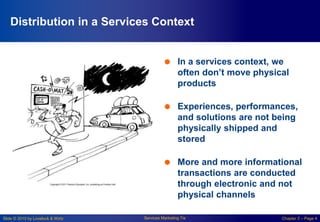
 In a services context, we
often don’t move physical
products
 Experiences, performances,
and solutions are not being
physically shipped and
stored
 More and more informational
transactions are conducted
through electronic and not
physical channels
Slide © 2010 by Lovelock & Wirtz Services Marketing 7/e Chapter 5 – Page 5
Applying the Flow Model of
Distribution to Services
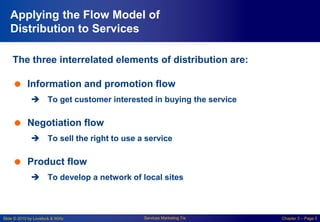
The three interrelated elements of distribution are:
 Information and promotion flow
 To get customer interested in buying the service
 Negotiation flow
 To sell the right to use a service
 Product flow
 To develop a network of local sites
Slide © 2010 by Lovelock & Wirtz Services Marketing 7/e Chapter 5 – Page 6
Distinguishing between Distribution
of Supplementary and Core Services
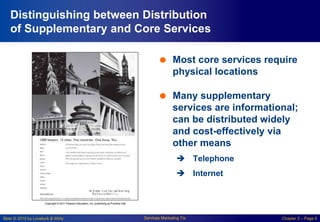
 Most core services require
physical locations
 Many supplementary
services are informational;
can be distributed widely
and cost-effectively via
other means
 Telephone
 Internet
Slide © 2010 by Lovelock & Wirtz Services Marketing 7/e Chapter 5 – Page 7
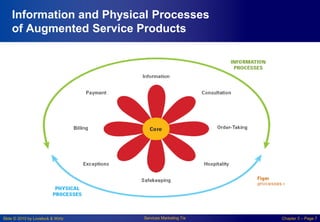
Information and Physical Processes
of Augmented Service Products
Slide © 2010 by Lovelock & Wirtz Services Marketing 7/e Chapter 5 – Page 8
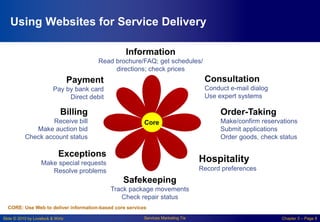
Using Websites for Service Delivery
Order-Taking
Make/confirm reservations
Submit applications
Order goods, check status
Safekeeping
Track package movements
Check repair status
CORE: Use Web to deliver information-based core services
Core
Consultation
Conduct e-mail dialog
Use expert systems
Hospitality
Record preferences
Billing
Receive bill
Make auction bid
Check account status
Exceptions
Make special requests
Resolve problems
Payment
Pay by bank card
Direct debit
Information
Read brochure/FAQ; get schedules/
directions; check prices
Slide © 2010 by Lovelock & Wirtz Services Marketing 7/e Chapter 5 – Page 9
Options for Service Delivery
Slide © 2010 by Lovelock & Wirtz Services Marketing 7/e Chapter 5 – Page 10
Distribution Options for Serving
Customers
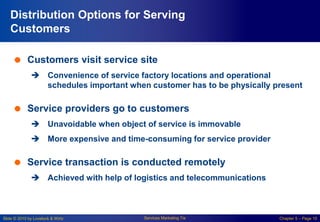
 Customers visit service site
 Convenience of service factory locations and operational
schedules important when customer has to be physically present
 Service providers go to customers
 Unavoidable when object of service is immovable
 More expensive and time-consuming for service provider
 Service transaction is conducted remotely
 Achieved with help of logistics and telecommunications
Slide © 2010 by Lovelock & Wirtz Services Marketing 7/e Chapter 5 – Page 11
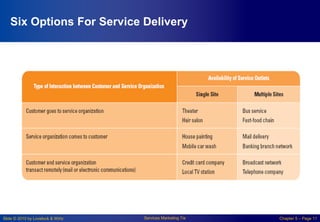
Six Options For Service Delivery
Slide © 2010 by Lovelock & Wirtz Services Marketing 7/e Chapter 5 – Page 12
Channel Preferences Vary Among
Customers
 For complex and high-perceived risk services, people tend
to rely on personal channels
 Individuals with greater confidence and knowledge about a
service/channel tend to use impersonal and self-service
channels
 Customers with social motives tend to use personal
channels
 Convenience is a key driver of channel choice
Slide © 2010 by Lovelock & Wirtz Services Marketing 7/e Chapter 5 – Page 13
Place and Time Decisions
Slide © 2010 by Lovelock & Wirtz Services Marketing 7/e Chapter 5 – Page 14
Place Decisions of Service Delivery
 Cost, productivity, and access to labor are key determinants
to locating a service facility
 Location constraints
 Operational requirement (e.g., airports)
 Geographic factor (e.g.,ski resorts)
 Need for economies of scale (e.g., hospitals)
Slide © 2010 by Lovelock & Wirtz Services Marketing 7/e Chapter 5 – Page 15
Place Decisions of Service Delivery
 Ministores
 Creating many small service factories to maximize geographic
coverage
 Separating front and back stages of operation
 Purchasing space from another provider in complementary field
 Locating in Multipurpose Facilities
 Proximity to where customers live or work
- Service Stations
Slide © 2010 by Lovelock & Wirtz Services Marketing 7/e Chapter 5 – Page 16
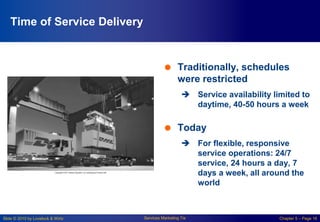
Time of Service Delivery
 Traditionally, schedules
were restricted
 Service availability limited to
daytime, 40-50 hours a week
 Today
 For flexible, responsive
service operations: 24/7
service, 24 hours a day, 7
days a week, all around the
world
Slide © 2010 by Lovelock & Wirtz Services Marketing 7/e Chapter 5 – Page 17
Delivering Services in
Cyberspace
Slide © 2010 by Lovelock & Wirtz Services Marketing 7/e Chapter 5 – Page 18
Service Delivery Innovations
Facilitated by Technology
 Technological Innovations
 Development of “smart” mobile telephones and PDAs, and
presence of Wi-Fi
 Voice-recognition technology
 Websites
 Smart cards
- Store detailed information about customer
- Act as electronic purse containing digital money
 Electronic channels can be offered together with physical
channels, or replace physical channels
Slide © 2010 by Lovelock & Wirtz Services Marketing 7/e Chapter 5 – Page 19
Voice Recognition Technology
Slide © 2010 by Lovelock & Wirtz Services Marketing 7/e Chapter 5 – Page 20
E-Commerce: Move to Cyberspace
 What are the factors that encourage you to use virtual
stores?
 Convenience
 Ease of search
 Broader selection
 Potential for better prices
 24-hour service with prompt delivery
 As a distribution channel, The Internet facilitates five
categories of “flow”: Information, Negotiation, Service,
Transactions and Promotion
Slide © 2010 by Lovelock & Wirtz Services Marketing 7/e Chapter 5 – Page 21
E-Commerce: Move to Cyberspace
 Recentdevelopments: websites, customer management
(CRM) systems, and mobile telephony
 Integrating mobile devices into the service delivery
infrastructure can be used as means to:
 Access services
 Alert customers to opportunities/problems
 Update information in real time
Slide © 2010 by Lovelock & Wirtz Services Marketing 7/e Chapter 5 – Page 22
Role of Intermediaries
Slide © 2010 by Lovelock & Wirtz Services Marketing 7/e Chapter 5 – Page 23
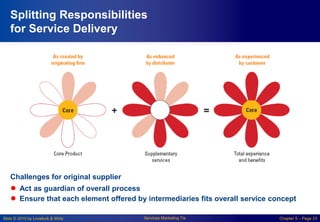
Splitting Responsibilities
for Service Delivery
Challenges for original supplier
● Act as guardian of overall process
● Ensure that each element offered by intermediaries fits overall service concept
Slide © 2010 by Lovelock & Wirtz Services Marketing 7/e Chapter 5 – Page 24
Franchising
 Franchisor provides training, equipment, and support
marketing activities.
 Franchisees invest time and finance, and follow copy and
media guidelines of franchisor.
 Advantages:
 Expand delivery of effective service concept without a high level of
monetary investment
 Franchisees are motivated to ensure good customer service and
high-quality service operations
Slide © 2010 by Lovelock & Wirtz Services Marketing 7/e Chapter 5 – Page 25
Franchising
 Disadvantages of franchising
 Loss of control over delivery system and how customers
experience actual service
 Effective quality control is difficult
 Conflict between franchisees may arise especially as they gain
experience
 Alternative: license another supplier to act on the original
supplier’s behalf to deliver core product
 Trucking companies
 Banks selling insurance products
Slide © 2010 by Lovelock & Wirtz Services Marketing 7/e Chapter 5 – Page 26
Challenge of Distribution in
Large Domestic Markets
Slide © 2010 by Lovelock & Wirtz Services Marketing 7/e Chapter 5 – Page 27
The Challenge of
DistributioninLarge Domestic
Markets
 Distributing services (i.e.,physical logistics) faces
challenges due to:
 Distances involved
 Multiple time zones
 Multiculturalism
 Differences in laws and tax rates
Slide © 2010 by Lovelock & Wirtz Services Marketing 7/e Chapter 5 – Page 28
Distributing Services
Internationally
Slide © 2010 by Lovelock & Wirtz Services Marketing 7/e Chapter 5 – Page 29
Factors Favoring Adoption of
Transnational Strategies
Transnational strategy involves integration of strategy
formulation and its implementation across all countries in
which company elects to do business
 Market Drivers
 Common customer needs across countries
 Corporate customers seek to standardize and simplify suppliers used in
different countries – ad agencies, logistics suppliers, Big 4 accounting
firms
 Government Drivers
 Favorable trade policies, compatible technical standards, common
marketing regulations
Slide © 2010 by Lovelock & Wirtz Services Marketing 7/e Chapter 5 – Page 30
Factors Favoring Adoption of
Transnational Strategies
 Competition Drivers
 Competitors from overseas; interdependence of countries
 Firms may be obliged to follow competitors into new markets to protect
own positions elsewhere
 Technology Drivers
 Advances in information technology – miniaturization and mobility of
equipment, digitization of voice
 Cost Drivers
 Economies of scale
 Lower operating costs
Slide © 2010 by Lovelock & Wirtz Services Marketing 7/e Chapter 5 – Page 31
How Service Processes Affect
International Market Entry
 People processing services require direct contact with
customers
 Export service concept
- Acting alone or in partnership with local suppliers
e.g., chain restaurants, hotels, car rental firms
 Importcustomers
- Inviting customers from overseas to firm’s home country
e.g., hospitals catering to “medical tourism”
 Transport customers to new locations
- Passenger transportation (air, sea, rail, road)
Slide © 2010 by Lovelock & Wirtz Services Marketing 7/e Chapter 5 – Page 32
How Service Processes Affect
International Market Entry
 Possession processing involves services to customer’s
physical possessions
- Repair and maintenance, freight transport
 Information-based services include mental processing
services and information processing services
 Export the service to a local service factory
- Hollywood film shown around the world
 Import customers
 Export the information via telecommunications and transform it
locally
- Data can be downloaded via CDs or DVDs
Slide © 2010 by Lovelock & Wirtz Services Marketing 7/e Chapter 5 – Page 33
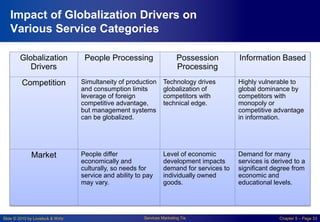
Impact of Globalization Drivers on
Various Service Categories
Globalization
Drivers
People Processing Possession
Processing
Information Based
Competition Simultaneity of production
and consumption limits
leverage of foreign
competitive advantage,
but management systems
can be globalized.
Technology drives
globalization of
competitors with
technical edge.
Highly vulnerable to
global dominance by
competitors with
monopoly or
competitive advantage
in information.
Market People differ
economically and
culturally, so needs for
service and ability to pay
may vary.
Level of economic
development impacts
demand for services to
individually owned
goods.
Demand for many
services is derived to a
significant degree from
economic and
educational levels.
Slide © 2010 by Lovelock & Wirtz Services Marketing 7/e Chapter 5 – Page 34
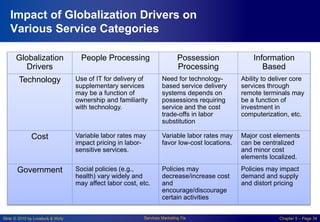
Impact of Globalization Drivers on
Various Service Categories
Globalization
Drivers
People Processing Possession
Processing
Information
Based
Technology Use of IT for delivery of
supplementary services
may be a function of
ownership and familiarity
with technology.
Need for technology-
based service delivery
systems depends on
possessions requiring
service and the cost
trade-offs in labor
substitution
Ability to deliver core
services through
remote terminals may
be a function of
investment in
computerization, etc.
Cost Variable labor rates may
impact pricing in labor-
sensitive services.
Variable labor rates may
favor low-cost locations.
Major cost elements
can be centralized
and minor cost
elements localized.
Government Social policies (e.g.,
health) vary widely and
may affect labor cost, etc.
Policies may
decrease/increase cost
and
encourage/discourage
certain activities
Policies may impact
demand and supply
and distort pricing
Slide © 2010 by Lovelock & Wirtz Services Marketing 7/e Chapter 5 – Page 35
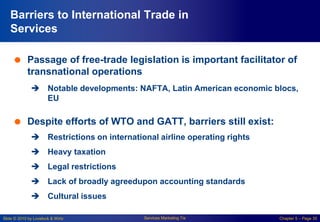
Barriers to International Trade in
Services
 Passage of free-trade legislation is important facilitator of
transnational operations
 Notable developments: NAFTA, Latin American economic blocs,
EU
 Despite efforts of WTO and GATT, barriers still exist:
 Restrictions on international airline operating rights
 Heavy taxation
 Legal restrictions
 Lack of broadly agreedupon accounting standards
 Cultural issues
Slide © 2010 by Lovelock & Wirtz Services Marketing 7/e Chapter 5 – Page 36
Summary
 Distribution relates to both core and supplementary
services and embraces three interrelated elements
 Information and promotion flow, negotiation flow, product flow
 Channel options include:
 Customers visit the service site
 Service providers go to their customers
 Service transaction is conducted remotely
 Place and time decisions include where services should be
delivered in bricks-and-mortar context, when it should be
delivered
Slide © 2010 by Lovelock & Wirtz Services Marketing 7/e Chapter 5 – Page 37
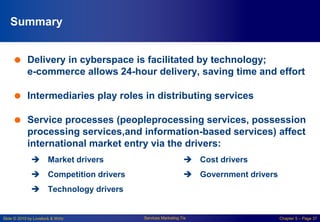
Summary
 Delivery in cyberspace is facilitated by technology;
e-commerce allows 24-hour delivery, saving time and effort
 Intermediaries play roles in distributing services
 Service processes (peopleprocessing services, possession
processing services,and information-based services) affect
international market entry via the drivers:
 Market drivers
 Competition drivers
 Technology drivers
 Cost drivers
 Government drivers
Slide © 2010 by Lovelock & Wirtz Services Marketing 7/e Chapter 5 – Page 38
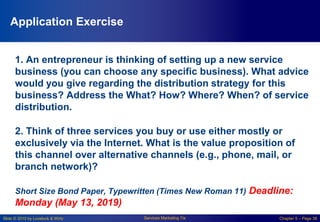
Application Exercise
1. An entrepreneur is thinking of setting up a new service
business (you can choose any specific business). What advice
would you give regarding the distribution strategy for this
business? Address the What? How? Where? When? of service
distribution.
2. Think of three services you buy or use either mostly or
exclusively via the Internet. What is the value proposition of
this channel over alternative channels (e.g., phone, mail, or
branch network)?
Short Size Bond Paper, Typewritten (Times New Roman 11) Deadline:
Monday (May 13, 2019)

Mktg 436 - Chapter 5

  • 1.
    Slide © 2010by Lovelock & Wirtz Services Marketing 7/e Chapter 5 – Page 1 Chapter 5: Distributing Services Through Physical And Electronic Channels Services Marketing 7e, Global Edition
  • 2.
    Slide © 2010by Lovelock & Wirtz Services Marketing 7/e Chapter 5 – Page 2 Overview Of Chapter 5  Distribution in a Services Context  Options for Service Delivery  Place and Time Decisions  Delivering Services in Cyberspace  The Role of Intermediaries  The Challenge of Distribution in Large Domestic Markets  Distributing Services Internationally
  • 3.
    Slide © 2010by Lovelock & Wirtz Services Marketing 7/e Chapter 5 – Page 3 Distribution in a Services Context
  • 4.
    Slide © 2010by Lovelock & Wirtz Services Marketing 7/e Chapter 5 – Page 4 Distribution in a Services Context  In a services context, we often don’t move physical products  Experiences, performances, and solutions are not being physically shipped and stored  More and more informational transactions are conducted through electronic and not physical channels
  • 5.
    Slide © 2010by Lovelock & Wirtz Services Marketing 7/e Chapter 5 – Page 5 Applying the Flow Model of Distribution to Services The three interrelated elements of distribution are:  Information and promotion flow  To get customer interested in buying the service  Negotiation flow  To sell the right to use a service  Product flow  To develop a network of local sites
  • 6.
    Slide © 2010by Lovelock & Wirtz Services Marketing 7/e Chapter 5 – Page 6 Distinguishing between Distribution of Supplementary and Core Services  Most core services require physical locations  Many supplementary services are informational; can be distributed widely and cost-effectively via other means  Telephone  Internet
  • 7.
    Slide © 2010by Lovelock & Wirtz Services Marketing 7/e Chapter 5 – Page 7 Information and Physical Processes of Augmented Service Products
  • 8.
    Slide © 2010by Lovelock & Wirtz Services Marketing 7/e Chapter 5 – Page 8 Using Websites for Service Delivery Order-Taking Make/confirm reservations Submit applications Order goods, check status Safekeeping Track package movements Check repair status CORE: Use Web to deliver information-based core services Core Consultation Conduct e-mail dialog Use expert systems Hospitality Record preferences Billing Receive bill Make auction bid Check account status Exceptions Make special requests Resolve problems Payment Pay by bank card Direct debit Information Read brochure/FAQ; get schedules/ directions; check prices
  • 9.
    Slide © 2010by Lovelock & Wirtz Services Marketing 7/e Chapter 5 – Page 9 Options for Service Delivery
  • 10.
    Slide © 2010by Lovelock & Wirtz Services Marketing 7/e Chapter 5 – Page 10 Distribution Options for Serving Customers  Customers visit service site  Convenience of service factory locations and operational schedules important when customer has to be physically present  Service providers go to customers  Unavoidable when object of service is immovable  More expensive and time-consuming for service provider  Service transaction is conducted remotely  Achieved with help of logistics and telecommunications
  • 11.
    Slide © 2010by Lovelock & Wirtz Services Marketing 7/e Chapter 5 – Page 11 Six Options For Service Delivery
  • 12.
    Slide © 2010by Lovelock & Wirtz Services Marketing 7/e Chapter 5 – Page 12 Channel Preferences Vary Among Customers  For complex and high-perceived risk services, people tend to rely on personal channels  Individuals with greater confidence and knowledge about a service/channel tend to use impersonal and self-service channels  Customers with social motives tend to use personal channels  Convenience is a key driver of channel choice
  • 13.
    Slide © 2010by Lovelock & Wirtz Services Marketing 7/e Chapter 5 – Page 13 Place and Time Decisions
  • 14.
    Slide © 2010by Lovelock & Wirtz Services Marketing 7/e Chapter 5 – Page 14 Place Decisions of Service Delivery  Cost, productivity, and access to labor are key determinants to locating a service facility  Location constraints  Operational requirement (e.g., airports)  Geographic factor (e.g.,ski resorts)  Need for economies of scale (e.g., hospitals)
  • 15.
    Slide © 2010by Lovelock & Wirtz Services Marketing 7/e Chapter 5 – Page 15 Place Decisions of Service Delivery  Ministores  Creating many small service factories to maximize geographic coverage  Separating front and back stages of operation  Purchasing space from another provider in complementary field  Locating in Multipurpose Facilities  Proximity to where customers live or work - Service Stations
  • 16.
    Slide © 2010by Lovelock & Wirtz Services Marketing 7/e Chapter 5 – Page 16 Time of Service Delivery  Traditionally, schedules were restricted  Service availability limited to daytime, 40-50 hours a week  Today  For flexible, responsive service operations: 24/7 service, 24 hours a day, 7 days a week, all around the world
  • 17.
    Slide © 2010by Lovelock & Wirtz Services Marketing 7/e Chapter 5 – Page 17 Delivering Services in Cyberspace
  • 18.
    Slide © 2010by Lovelock & Wirtz Services Marketing 7/e Chapter 5 – Page 18 Service Delivery Innovations Facilitated by Technology  Technological Innovations  Development of “smart” mobile telephones and PDAs, and presence of Wi-Fi  Voice-recognition technology  Websites  Smart cards - Store detailed information about customer - Act as electronic purse containing digital money  Electronic channels can be offered together with physical channels, or replace physical channels
  • 19.
    Slide © 2010by Lovelock & Wirtz Services Marketing 7/e Chapter 5 – Page 19 Voice Recognition Technology
  • 20.
    Slide © 2010by Lovelock & Wirtz Services Marketing 7/e Chapter 5 – Page 20 E-Commerce: Move to Cyberspace  What are the factors that encourage you to use virtual stores?  Convenience  Ease of search  Broader selection  Potential for better prices  24-hour service with prompt delivery  As a distribution channel, The Internet facilitates five categories of “flow”: Information, Negotiation, Service, Transactions and Promotion
  • 21.
    Slide © 2010by Lovelock & Wirtz Services Marketing 7/e Chapter 5 – Page 21 E-Commerce: Move to Cyberspace  Recentdevelopments: websites, customer management (CRM) systems, and mobile telephony  Integrating mobile devices into the service delivery infrastructure can be used as means to:  Access services  Alert customers to opportunities/problems  Update information in real time
  • 22.
    Slide © 2010by Lovelock & Wirtz Services Marketing 7/e Chapter 5 – Page 22 Role of Intermediaries
  • 23.
    Slide © 2010by Lovelock & Wirtz Services Marketing 7/e Chapter 5 – Page 23 Splitting Responsibilities for Service Delivery Challenges for original supplier ● Act as guardian of overall process ● Ensure that each element offered by intermediaries fits overall service concept
  • 24.
    Slide © 2010by Lovelock & Wirtz Services Marketing 7/e Chapter 5 – Page 24 Franchising  Franchisor provides training, equipment, and support marketing activities.  Franchisees invest time and finance, and follow copy and media guidelines of franchisor.  Advantages:  Expand delivery of effective service concept without a high level of monetary investment  Franchisees are motivated to ensure good customer service and high-quality service operations
  • 25.
    Slide © 2010by Lovelock & Wirtz Services Marketing 7/e Chapter 5 – Page 25 Franchising  Disadvantages of franchising  Loss of control over delivery system and how customers experience actual service  Effective quality control is difficult  Conflict between franchisees may arise especially as they gain experience  Alternative: license another supplier to act on the original supplier’s behalf to deliver core product  Trucking companies  Banks selling insurance products
  • 26.
    Slide © 2010by Lovelock & Wirtz Services Marketing 7/e Chapter 5 – Page 26 Challenge of Distribution in Large Domestic Markets
  • 27.
    Slide © 2010by Lovelock & Wirtz Services Marketing 7/e Chapter 5 – Page 27 The Challenge of DistributioninLarge Domestic Markets  Distributing services (i.e.,physical logistics) faces challenges due to:  Distances involved  Multiple time zones  Multiculturalism  Differences in laws and tax rates
  • 28.
    Slide © 2010by Lovelock & Wirtz Services Marketing 7/e Chapter 5 – Page 28 Distributing Services Internationally
  • 29.
    Slide © 2010by Lovelock & Wirtz Services Marketing 7/e Chapter 5 – Page 29 Factors Favoring Adoption of Transnational Strategies Transnational strategy involves integration of strategy formulation and its implementation across all countries in which company elects to do business  Market Drivers  Common customer needs across countries  Corporate customers seek to standardize and simplify suppliers used in different countries – ad agencies, logistics suppliers, Big 4 accounting firms  Government Drivers  Favorable trade policies, compatible technical standards, common marketing regulations
  • 30.
    Slide © 2010by Lovelock & Wirtz Services Marketing 7/e Chapter 5 – Page 30 Factors Favoring Adoption of Transnational Strategies  Competition Drivers  Competitors from overseas; interdependence of countries  Firms may be obliged to follow competitors into new markets to protect own positions elsewhere  Technology Drivers  Advances in information technology – miniaturization and mobility of equipment, digitization of voice  Cost Drivers  Economies of scale  Lower operating costs
  • 31.
    Slide © 2010by Lovelock & Wirtz Services Marketing 7/e Chapter 5 – Page 31 How Service Processes Affect International Market Entry  People processing services require direct contact with customers  Export service concept - Acting alone or in partnership with local suppliers e.g., chain restaurants, hotels, car rental firms  Importcustomers - Inviting customers from overseas to firm’s home country e.g., hospitals catering to “medical tourism”  Transport customers to new locations - Passenger transportation (air, sea, rail, road)
  • 32.
    Slide © 2010by Lovelock & Wirtz Services Marketing 7/e Chapter 5 – Page 32 How Service Processes Affect International Market Entry  Possession processing involves services to customer’s physical possessions - Repair and maintenance, freight transport  Information-based services include mental processing services and information processing services  Export the service to a local service factory - Hollywood film shown around the world  Import customers  Export the information via telecommunications and transform it locally - Data can be downloaded via CDs or DVDs
  • 33.
    Slide © 2010by Lovelock & Wirtz Services Marketing 7/e Chapter 5 – Page 33 Impact of Globalization Drivers on Various Service Categories Globalization Drivers People Processing Possession Processing Information Based Competition Simultaneity of production and consumption limits leverage of foreign competitive advantage, but management systems can be globalized. Technology drives globalization of competitors with technical edge. Highly vulnerable to global dominance by competitors with monopoly or competitive advantage in information. Market People differ economically and culturally, so needs for service and ability to pay may vary. Level of economic development impacts demand for services to individually owned goods. Demand for many services is derived to a significant degree from economic and educational levels.
  • 34.
    Slide © 2010by Lovelock & Wirtz Services Marketing 7/e Chapter 5 – Page 34 Impact of Globalization Drivers on Various Service Categories Globalization Drivers People Processing Possession Processing Information Based Technology Use of IT for delivery of supplementary services may be a function of ownership and familiarity with technology. Need for technology- based service delivery systems depends on possessions requiring service and the cost trade-offs in labor substitution Ability to deliver core services through remote terminals may be a function of investment in computerization, etc. Cost Variable labor rates may impact pricing in labor- sensitive services. Variable labor rates may favor low-cost locations. Major cost elements can be centralized and minor cost elements localized. Government Social policies (e.g., health) vary widely and may affect labor cost, etc. Policies may decrease/increase cost and encourage/discourage certain activities Policies may impact demand and supply and distort pricing
  • 35.
    Slide © 2010by Lovelock & Wirtz Services Marketing 7/e Chapter 5 – Page 35 Barriers to International Trade in Services  Passage of free-trade legislation is important facilitator of transnational operations  Notable developments: NAFTA, Latin American economic blocs, EU  Despite efforts of WTO and GATT, barriers still exist:  Restrictions on international airline operating rights  Heavy taxation  Legal restrictions  Lack of broadly agreedupon accounting standards  Cultural issues
  • 36.
    Slide © 2010by Lovelock & Wirtz Services Marketing 7/e Chapter 5 – Page 36 Summary  Distribution relates to both core and supplementary services and embraces three interrelated elements  Information and promotion flow, negotiation flow, product flow  Channel options include:  Customers visit the service site  Service providers go to their customers  Service transaction is conducted remotely  Place and time decisions include where services should be delivered in bricks-and-mortar context, when it should be delivered
  • 37.
    Slide © 2010by Lovelock & Wirtz Services Marketing 7/e Chapter 5 – Page 37 Summary  Delivery in cyberspace is facilitated by technology; e-commerce allows 24-hour delivery, saving time and effort  Intermediaries play roles in distributing services  Service processes (peopleprocessing services, possession processing services,and information-based services) affect international market entry via the drivers:  Market drivers  Competition drivers  Technology drivers  Cost drivers  Government drivers
  • 38.
    Slide © 2010by Lovelock & Wirtz Services Marketing 7/e Chapter 5 – Page 38 Application Exercise 1. An entrepreneur is thinking of setting up a new service business (you can choose any specific business). What advice would you give regarding the distribution strategy for this business? Address the What? How? Where? When? of service distribution. 2. Think of three services you buy or use either mostly or exclusively via the Internet. What is the value proposition of this channel over alternative channels (e.g., phone, mail, or branch network)? Short Size Bond Paper, Typewritten (Times New Roman 11) Deadline: Monday (May 13, 2019)