PROJECT REPORT
ON
“A STUDY TOWARDS CUSTOMER PERCEPTION ON E-COMMERCE
WEBSITES”
SUBMITTED BY:
TAMANNA GUPTA (1671401021)
In partial fulfillment for the requirements of the degree of
MASTER OF BUSINESS ADMINISTRATION
SCHOOL OF BUSINESS MANAGEMENT & LIBERAL ARTS
SHOOLINI UNIVERSITY OF BOITECHNOLOGY AND
MANAGEMENT SCIENCE
BAJHOL, SOLAN, HP-173212
APRIL 2018
ACKNOWLEDGEMENT
The success and final outcome of this project required a lot of guidance and assistance from
many people and I am extremely privileged to have this all along the completion of my project.
All that I have done is only due to such supervision and assistance and I would not forget to
thank them.
Firstly, I would like to thank my project guide Dr.Nitin Gupta, School of Business Management
and Shoolini University for providing me the opportunity to work under his guidance. He helped
me a lot in completing this project report and provided me with all the necessary information,
knowledge which was needed for project completion. His guidance and support for project made
its completion possible.
I would like to thank our Dean Mr. Atul Khosla who provided us a platform and opportunity to
work on this project. I would like to thank my faculty members, without their support and
continuous guidance this would not have been possible. They made us confident that yes we can
do everything.
This acknowledgement cannot be ended without thanking my parents who always supported me
and also supported me emotionally, motivated me and encouraged me every time.
At last, but more valuable in my life, my friends, who directly and indirectly helped me in
completing this project report.
TAMANNA GUPTA
CERTIFICATE
This is to certify that the Project work entitled “A STUDY TOWARDS CUSTOMER
PERCEPTION ON E-COMMERCE WEBSITES” submitted in partial fulfillment of
the requirement for the award of degree of Master of Business Administration to Shoolini
University of Biotechnology and Management Sciences, Bajhol, Solan (H.P.) is a bonafide
Project work carried out by TAMANNA GUPTA(167140121). No part of this work has been
submitted for any other degree or diploma.
Name of Student: Name of the Guide:
TAMANNA GUPTA DR.NITIN GUPTA
Place: Solan
Date:
TABLE OF CONTENTS
S.NO. CONTENTS PAGE NO.
1. Introduction 6-11
2. Review Of Literature 14-16
3. Research methodology 18-20
4. Data Analysis & Interpretation 22-31
5. Findings & Recommendations 33-34
6. Conclusion 35
7. Bibliography 37
Appendices
INTRODUCTION
INTRODUCTION
The emergence of World Wide Web has made the services available to customers without
leaving their home. The usage of internet is increasing more on the marketing services and e-
business. Online shopping is one of them which are emerging as the fastest growing
phenomenon. Companies are now using internet to build closer relation with consumers and
existing marketing partners. As said by Srisuwan & Barnes(2008;et al.,2007) that from virtual
reality displays that test new products to online virtual stores that sell them, the technology
explosion is affecting every aspect of marketing. The Internet has now become a truly global
phenomenon.
Online shopping is the process whereby consumers directly buy goods, services etc. from a seller
interactively in real-time without an intermediary service over the internet. Shoppers can visit
web stores from the comfort of their homes and shop as they sit in front of the computer.
Consumers buy a variety of items from online stores.
Nowadays, online shopping is emerging a convenient way of shopping. Customers will be able
to save time & money, retrieve all the product information with clicks in few minutes. According
to survey done in 2010 by the Clicks stats, the growth & diverse internet population means the
people having diverse taste and purposes are going to web for information and buy product and
services. This survey is becoming true as now customers use online shopping according to their
needs, wants and adopting new technologies.
Online shopping made it easy for everyone with their product variations. An attempt of
comparison has been done considering e-commerce challenges, their business model, funding,
revenue generation, growth, survival strategies, Shoppers online shopping experience, value
added differentiation, and product offerings. Big players made their own mark in India, but who
is going to be ultimate winner or be the top one is going to be. A comparative study of e-
commerce sites delivers the information about the different strategies to succeed in e-commerce
market and different opportunities available in India.
India has always been a land of great potential. The socioeconomic condition of the country has
improved many folds after independence and India is now emerging as one of the leading
countries in the world. Moreover with the introduction of 4G network the use of e-commerce
have increased many folds in India .As technology is spreading to the remotest villages and
many job opportunities are presenting themselves to the unemployed youth more and more
people are gaining awareness and the money to purchase expensive and luxurious items over the
internet.
E-COMMERCE WORKING:-
Electronic commerce, commonly known as E-commerce or e-commerce, is trading in products
or services using computer networks, such as the Internet. Electronic commerce draws on
technologies such as mobile commerce, electronic funds transfer, supply chain management,
Internet marketing, online transaction processing, electronic data interchange (EDI), inventory
management systems, and automated data collection systems. Modern electronic commerce
typically uses the World Wide Web for at least one part of the transaction's life cycle, although
it may also use other technologies such as e-mail.
E-commerce offers products and services through websites, a customer simply has to visit an e-
commerce website and browse various offering through browser catalog, a customer can select
multiple offerings and can add them to the shopping cart, once the shopping is done the
customer can checkout and proceed to payment section where various online payment options
are available like internet banking, credit card, debit card etc. Once payment is done the
customer is notified about the order and order is shipped on the postal address provided by the
customer.
E-commerce businesses may employ some or all of the following:
o Online shopping web sites for retail sales direct to consumers.
o Providing or participating in online marketplaces, which process third-party business-to-
consumer or consumer-to-consumer sales.
o Business-to-business buying and selling.
o Gathering and using demographic data through web contacts and social media.
o Business-to-business electronic data interchange.
o Marketing to prospective and established customers by e-mail or fax (for example, with
newsletters).
o Prevail for launching new products and services
BENEFITS OF E-COMMERCE:
E-commerce benefits are broadly classified in 3 major categories:-
 Benefit to organization
 Benefit to consumers
 Benefit to society
BENEFIT TO ORGANIZATION:-
o Using e-commerce, organizations can expand their market to national and international
markets with minimum capital investment. An organization can easily locate more
customers, best suppliers, and suitable business partners across the globe.
o E-commerce helps organizations to reduce the cost to create process, distribute, retrieve and
manage the paper based information by digitizing the information.
o E-commerce improves the brand image of the company.
o E-commerce helps organization to provide better customer services.
o E-commerce helps to simplify the business processes and makes them faster and efficient.
o E-commerce reduces the paper work.
o E-commerce increases the productivity of organizations.
BENEFIT TO CUSTOMERS:-
o Customers can enquire about a product /service and place orders anytime, anywhere from
any location.
o E-commerce application provides users with more options to compare and select the cheaper
and better options & also quicker delivery of products.
o A customer can put review comments about a product and can see what others are buying, or
see the review comments of other customers before making a final purchase.
o A customer can see the relevant detailed information within seconds, rather than waiting for
days or weeks.
o E-Commerce increases the competition among organizations and as a result, organizations
provide substantial discounts to customers.
BENEFITS TO SOCIETY:-
o Customers need not travel to shop a product, thus less traffic on road and low air pollution.
o E-commerce helps in reducing the cost of products, so less affluent people can also afford
the products.
o E-commerce has enabled rural areas to access services and products, which are otherwise not
available to them.
o E-commerce helps the government to deliver public services such as healthcare, education,
social services at a reduced cost and in an improved manner.
E-COMMERCE IN INDIA:
The birth and growth of Internet has been the biggest event of the century. E-commerce in India
has come a long way from a timid beginning in the 1999-2000 to a period where one can sell and
find all sorts of stuff from a high end product to a meager peanut online. Most corporations are
using Internet to represent their product range and services so that it is accessible to the global
market and to reach out to a larger range of their audience.
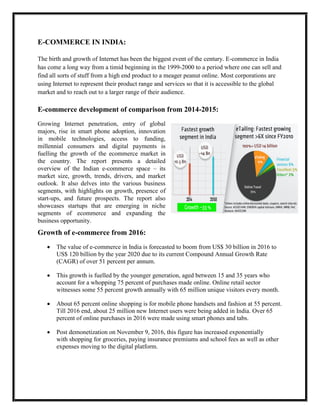
E-commerce development of comparison from 2014-2015:
Growing Internet penetration, entry of global
majors, rise in smart phone adoption, innovation
in mobile technologies, access to funding,
millennial consumers and digital payments is
fuelling the growth of the ecommerce market in
the country. The report presents a detailed
overview of the Indian e-commerce space – its
market size, growth, trends, drivers, and market
outlook. It also delves into the various business
segments, with highlights on growth, presence of
start-ups, and future prospects. The report also
showcases startups that are emerging in niche
segments of ecommerce and expanding the
business opportunity.
Growth of e-commerce from 2016:
 The value of e-commerce in India is forecasted to boom from US$ 30 billion in 2016 to
US$ 120 billion by the year 2020 due to its current Compound Annual Growth Rate
(CAGR) of over 51 percent per annum.
 This growth is fuelled by the younger generation, aged between 15 and 35 years who
account for a whopping 75 percent of purchases made online. Online retail sector
witnesses some 55 percent growth annually with 65 million unique visitors every month.
 About 65 percent online shopping is for mobile phone handsets and fashion at 55 percent.
Till 2016 end, about 25 million new Internet users were being added in India. Over 65
percent of online purchases in 2016 were made using smart phones and tabs.
 Post demonetization on November 9, 2016, this figure has increased exponentially
with shopping for groceries, paying insurance premiums and school fees as well as other
expenses moving to the digital platform.
TOP 10 E-COMMERCE SITES IN INDIA IN 2018
1. Flipkart.com
This one has to come first hands down. The entire country is completely dependent on Flipkart
for nearly all their shopping needs. Flipkart sells everything from gift vouchers to electronics to
home appliances. In fact, statistics claim that there are more items on flipkart than in a mall.
Hence, Indians are heavily reliant on flipkart for all their shopping needs.
2. Amazon.in
A large number of people from India swear by the services of amazon. Amazon and flipkart are
always at war with each other and are always at close heels. Amazon has an equally large
number of products as flipkart. In fact, Amazon apparently sells more than flipkart. Since
amazon is an American company, it lacks the desi taste that would be preferred by an Indian. It
would be wise to indianise its Indian domain. It would then be an instant hit amongst the masses.
3. Snapdeal.com
Snapdeal is a completely Indian website and is often preferred by the masses for its cheap rates.
It sells products at really low prices and hence, is a favourite of the masses. It is a good idea to
buy from Snapdeal if you are looking for absolutely cheap prices. However, there have been
times when consumers have complained of the products of Snapdeal and hence, some of them
stay away from Snapdeal.
4. Jabong.com
Jabong is again an American brand but seems to be doing very well in India. It has a large
number of clothes and accessories for sale and is a complete paradise for those who love
shopping for clothes. It has all kinds of products from western wear to desi kurtis and it would be
fun to sit home and shop for clothes on Jabong. Jabong is excessively preferred by women
shoppers.
5. Myntra.com
Myntra also has a large number of accessories and clothes on its online portal. It has a large
number of categories as well and one can buy from a category of their choices. From western to
ethnic to traditional, all kinds of clothes are sold on Myntra.
6. Homeshop18
This is an equally popular website amongst online shoppers. Those who do not mind waiting a
little extra for delivery at the reward of a lower price, order from here. A lot of times, the
cheapest of items and the remotest of items are easily found on homeshop18.com. Thus, this site
also has an equally large number of shoppers who are loyalists. However, homeshop18 cannot be
trusted when one is in an emergency. You’d rather buy from one of the websites where they give
express deliveries.
7. Shopclues.com
Shopclues is famous for their heavily discounted best shopping deals. Shopclues is one of the
best online stores that offers a wide variety of cameras, Computer accessories, Mobile, Gift,
Jewellery, Cosmetics, toys, clothes, books and bag.
8. Paytm.com
Started just as mobile recharge app, now Paytm become the Indian Alibaba. Provides a number
of services like mobile recharge, bill payments, tickets etc. along with a variety of generic
products. Paytm offers cashback with the discounts, that makes it different from other shopping
sites in India. Sometimes such cashback makes a big difference and saves your extra money.
PayTM has now launched PayTM Mall which is equivalent to Amazon and Flipkart. You can go
and shop anything on PayTM mall. PayTM mall offers electronic items, shoes, bags, home
décor, clothing for men and women and many more products which are 100% authentic. Once,
you do shopping from PayTM mall then you will get cashbacks, these cashbacks can be used
later to process mobile recharges, pay bills and other stuff.
9. Voonik.com
Voonik is one of those sites that specifically focus on only women products. This thing makes it
more popular among women as compare to other fashion sites. The products include Indian
wear, western wear, lingerie & sleepwear, footwear, bags and accessories, jewellery and beauty
products. Voonik offers deep discounts on its products along with cash back offers. Voonik was
started in Bangalore with the vision of being the personal stylist to every woman. It provides the
free personalization which is inbuilt in the app for its user.
10. Bigbasket.com
Bigbasket is the top grocery shopping site in India. From Bigbasket you can purchase products
under the category of grocery, household, personal care, gourmet, beverage, dairy and fruit &
veggie. It offers a wide range of top brands product. It additionally offers up to 20% cash back
on different debit and credit cards.
REVIEW
OF
LITERATURE
REVIEW OF LITERATURE
A detailed review of literature has been done and the information collected and utilized for the
research works have been presented below:-
Porter and Millar (1985) information gives competitive advantage to a company in three
different ways:
a) By changing industry structure and changing the rules of competition.
b) By providing companies with new ways to outperform their competitors.
c) By creating new businesses, even from within a company’s existing operations.
Additionally, authors suggest five ways for Information Technology to be successfully
implemented in business processes. This can be done by:
a) Assessing the intensity of information.
b) Determining the role that Information Technology will have in the industry structure.
c) Understanding the ways that it can create competitive advantage for their companies.
d) Investigating the possibilities of new businesses.
e) Developing a strategic plan to take advantage of Information Technology.
Martin Dodges (1999),”finding the source of Amazon.com: examining the hype of the earth’s
biggest book store”, center for advanced spatial analysis. Concluded that Amazon com have
been one of the most promising e-commerce companies and has grown rapidly by providing
quality service.
Miyazaki and Fernandez (2001) substantiated that the prior experience was found to affect the
intention and behavior significantly and in a variety of ways. The results of this study imply that
the technology acceptance model should be applied to electronic commerce research with
caution. In order to develop a successful and profitable web shop, understanding customers'
needs is essential. It has to be ensured that products are as cheap in a web shop as purchased
from traditional channels.
Kotler, (2003) described Consumer buying method as learning, information-processing and
decision-making activity divided in several consequent steps: Problem identification,
Information search, Alternatives evaluation, Purchasing decision, Post-purchase behavior.
Efthymios, identified the main constituent of the online shopping experience as follows: the
functionality of the Web site that includes the elements trade with the site’s usability. the
emotional elements planned for lowering the customer’s hesitation by communicating trust and
credibility of the online seller and Web site and the content elements including the aesthetic
aspects of the online presentation and the marketing mix.
Kotler & Keller (2009), a buyer goes through five stages while making a decision to purchase.
These stages are best explainable when a buyer goes for buying costly items, such as a house, a
car, diamond jewellery etc. However, in day- to- day purchase, consumers may not go through
all these stages, since some commodes do not need information, and based on buyer’s previous
experience they will visit a store for the purchase.
Sharma and mittal (2009) in their study “prospects of e-commerce in India”, mentions that
India is showing tremendous growth in the e-commerce. Undoubtedly, with the middle class of
288 million people, online shopping shows unlimited potential in India. The real estate costs are
touching the sky. Today e-commerce has become an integral part of our daily life. There are
websites providing any number of goods and services. The e-commerce portals provide goods
and services in a variety of categories. To name a few: apparel and accessories for men and
women, health and beauty products, books and magazines, computers and peripherals, vehicles,
software, consumer electronics, household appliances, jewelry, audio, video, entertainment,
goods, gift articles, real estate and services.
Samadi and Ali (2010) compared the perceived risk level between internet and store shopping,
and revisit the relationships among past positive experience, perceived risk level, and future
purchase intention within the internet shopping environment.
Kanwal Gurleen (2012), “Customers satisfaction towards Online shopping”, discussed that
different options in internet encouraged people to search and eventually purchase online, because
there are more than 100 million internet users in India. People those who are using internet from
5 to 7 hours a day were found to be adopter of online shopping. Price consciousness,
convenience and variety, easy payment options and challenges of online shopping are the factors
found to be a significant in online shopping.
Adrita Goswami (2013), studied “Customer Satisfaction towards Online Shopping with Special
Reference to Teenage Group of Jorhat Town” study concludes that online customers are satisfied
in the aspects such as Price, Quality of products, Ease of use in mobile platform and Timely
Delivery at remote areas. This research explicitly indicates that online marketer should give more
importance on price factor and after sale factor.
Abhijit mitra. (2013), “e-commerce in India-a review”, international journal of marketing,
financial services & management research. Concluded that the e-commerce has broken the
geographical limitations and it is a revolution-commerce will improve tremendously in next five
years in India.
D.k.gangeshwar. (2013),” e-commerce or internet marketing: a business review from Indian
context”, international journal of u- and e- service, science and technology. Concluded that the e-
commerce has a very bright future in India although security, privacy and dependency on
technology are some of the drawbacks of e-commerce but still there is a bright future to e-
commerce.
Dhevika V.P.T, Latasri O.T.V, S Karmugil (2014), in their paper “Factors Affecting Online
shopping of Customers” revealed that the most important factor influencing online shopping is-
security, followed by – trust worthy shopping and – website design/features and the least
important factor influencing is – bargaining shopping, there is no significant association between
security and website design/features of the respondents and their overall online buying behavior.
Saravanan S and Brindha Devi K (2015), “A Study on Online Buying behavior with special
reference to Coimbatore city” focused on online shoppers’ preferences and problems on various
online shopping marketers. Higher computer literacy makes internet shopping smarter. Their

awareness about the internet also makes them better positioned to identify and take decision for
products and services.
Pooja Gupta (2015), The study tries to recognize that, how consumer measure channels for their
purchasing. Specifically, it progresses a conceptual model that addresses consumer value

perception for using the internet shopping versus the traditional shopping. Earlier study showed
that perceptions of price, product quality, service quality and threat strongly impact perceived
value and purchase intents in the offline and online network. Observations of online and offline
buyers can be evaluated to see how value is constructed in both channels. It is hitherto to
recognize what factors influence online and offline shopping choice progression. The objective
of this study is to provide an impression of online shopping decision process by comparing the
offline and online decision making and identifying the factors that motivate customers to decide
whether to do online shopping or go for the offline shopping. Consumer’s shop when and where
they want, where they are comfortable with the products and the choice of shopping. The study
finds that female are more into online shopping than male.
Francis Sudhakar K, Habeeb Syed (2016), “A Comparative study between Flipkart and
Amazon India”, conducted a study to critically examine various corporate and business level
strategies of two big e-tailers and those are Flipkart and Amazon. Comparison have been done
considering e-commerce challenges, their business model, funding, revenue generation, growth,
survival strategies, Shoppers’ online shopping experience, value added differentiation, and
product offerings. Both these big players made their own mark in India. The survey ended with
Amazon as the winner, which satisfied the customer in all the aspects.
Vijay govindarajan is one of the world’s leading experts on strategy and innovation.
Govindarajan, coxe distinguished professor at dartmouth college’s tuck school of business and
marvin bower fellow at harvard business school, is also a best-selling author. The biggest
opportunity in India is e-commerce. Why? Three important factors will drive this: 1) mobile
sphone penetration; 2) a young demographic that is used to ordering things using the mobile
platform; 3) growth of consumerism with more Indians with higher disposable income. We will
see many new innovative business models in the e-commerce space in the next five years. No
doubt we will see new innovative high-growth companies—Indian equivalents of Alibaba.
Shippa Gupta 'Indian online shoppers believed there was a wider purchase choice online rather
than offline, that shopping online was extremely convenient and easy, and that most goods were
cheaper online than they were offline,' says, Country Manager, West Africa, MasterCard
Worldwide.
Times of India also explored the reasons why the majorities (78%) of Indians surveyed do not
currently shop online. Of this group, 59% said they were not sure that making transactions online
was secure or safe, 43% said they simply preferred to shop in -store to look at the physical
products and an additional 40% raised their concerns about the time it would take for items to be
delivered to them.
RESEARCH
METHODOLOGY
RESEARCH METHODOLOGY
Research methodology process includes a number of activities to be performed. These are
arranged in proper sequence of timing for conducting research. One activity after another is
performed to complete the research work.
TITLE OF THE STUDY:
“A Comparative Study on customer perception towards online shopping.”
Objectives
 To understand the respondent perception towards online shopping.
 To understand the factors affecting customer’s behavior for choosing e-commerce sites.
 To understand tactics used for gaining the customers.
 To know how consumers are evaluating e-commerce sites for their purchases.
RESEARCH DESIGN
The Research design of this study is descriptive. The study is concerned about the factors that
lead to stress among working women come under descriptive Research category.
Data Collection
The goal for all data collection is to capture quality evidence that then translates to rich data
analysis and allows the building of a convincing and credible answer to questions that have
been posed.
Primary Data
Primary data was collected from various people and their opinion and information for the
specific purposes of study helped to run the analysis. In essence, the questions asked were
tailored to elicit the data that will help for study. The data was collected through questionnaire to
understand their experience and preference towards their loyal company.
Secondary Data
To make primary data collection more specific, secondary data will help to make it more useful.
It helps to improve the understanding of the problem. Secondary data was collected from various
sources such as different business websites and published papers.
SAMPLING DECISIONS:
Convenient sampling technique has been used to collect the data.
1. Sample size: 100 samples were taken for the study.
2. Research Instrument:
A structured questionnaire has been prepared to get the relevant information from the
respondents. The questionnaire consists of variety of questions presented to the respondents for
their responses. The researcher has been used structured questionnaire, support and cooperation
of the selected respondents of various fields.
DATA COLLECTION, ANALYSIS AND INTERPRETATION:
The researcher has collected primary data, classified, tabulated, analyzed, interpreted and
reported using suitable statistical tools and techniques.
LIMITATIONS OF STUDY:
 The study in the confined area to Solan city.
 The study is based upon the consumer satisfaction, perception and experience of
online shopping.
 The data collected for the research is fully primary data given by the respondents by
filling the google form.
 The questionnaire was made available to consumers through google drive – forms.
 No personal biasness happen while taking filling the questionnaire because of the
online google form.
 Limited time frame.
 Responses were restricted to only 100 sample out of the large population size.
DATA ANALYSIS
AND
INTERPRETATION
DATA ANALYSIS & INTERPRETATION
The study was conducted to know the consumers satisfaction and thought towards e-commerce
websites. The study was made by collecting the data from the source of filling questionnaire by
100 samples taken out of the entire population.
The analysis of the data is as follows:-
1) SOCIO-ECONOMIC PROFILE OF THE RESPONDENTS –
a. Gender b. Age c. Qualification
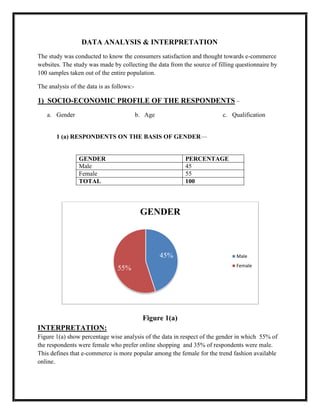
1 (a) RESPONDENTS ON THE BASIS OF GENDER—
GENDER PERCENTAGE
Male 45
Female 55
TOTAL 100
Figure 1(a)
INTERPRETATION:
Figure 1(a) show percentage wise analysis of the data in respect of the gender in which 55% of
the respondents were female who prefer online shopping and 35% of respondents were male.
This defines that e-commerce is more popular among the female for the trend fashion available
online.
45%
55%
GENDER
Male
Female
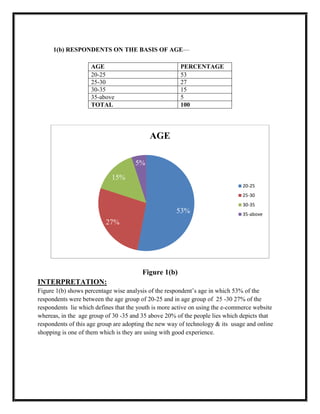
1(b) RESPONDENTS ON THE BASIS OF AGE—
AGE PERCENTAGE
20-25 53
25-30 27
30-35 15
35-above 5
TOTAL 100
Figure 1(b)
INTERPRETATION:
Figure 1(b) shows percentage wise analysis of the respondent’s age in which 53% of the
respondents were between the age group of 20-25 and in age group of 25 -30 27% of the
respondents lie which defines that the youth is more active on using the e-commerce website
whereas, in the age group of 30 -35 and 35 above 20% of the people lies which depicts that
respondents of this age group are adopting the new way of technology & its usage and online
shopping is one of them which is they are using with good experience.
53%
27%
15%
5%
AGE
20-25
25-30
30-35
35-above
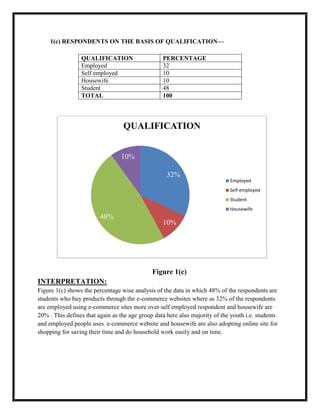
1(c) RESPONDENTS ON THE BASIS OF QUALIFICATION—
QUALIFICATION PERCENTAGE
Employed 32
Self employed 10
Housewife 10
Student 48
TOTAL 100
Figure 1(c)
INTERPRETATION:
Figure 1(c) shows the percentage wise analysis of the data in which 48% of the respondents are
students who buy products through the e-commerce websites where as 32% of the respondents
are employed using e-commerce sites more over self employed respondent and housewife are
20% . This defines that again as the age group data here also majority of the youth i.e. students
and employed people uses e-commerce website and housewife are also adopting online site for
shopping for saving their time and do household work easily and on time.
32%
10%
48%
10%
QUALIFICATION
Employed
Self employed
Student
Housewife
2) RESPONDANTS BEHAVIOUR TOWARDS E-COMMERCE SITES:-
2(a) How frequently respondents shop through e-commerce websites—
FREQUENTLY SHOPPING PERCENTAGE
More than once in a month 12
Once in 1- 2 months 47
Once in 3- 6 months 37
Once in 7-12 months 4
TOTAL 100
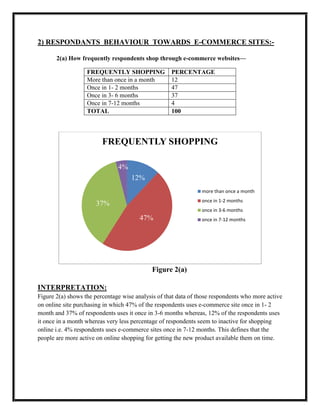
Figure 2(a)
INTERPRETATION:
Figure 2(a) shows the percentage wise analysis of that data of those respondents who more active
on online site purchasing in which 47% of the respondents uses e-commerce site once in 1- 2
month and 37% of respondents uses it once in 3-6 months whereas, 12% of the respondents uses
it once in a month whereas very less percentage of respondents seem to inactive for shopping
online i.e. 4% respondents uses e-commerce sites once in 7-12 months. This defines that the
people are more active on online shopping for getting the new product available them on time.
12%
47%
37%
4%
FREQUENTLY SHOPPING
more than once a month
once in 1-2 months
once in 3-6 months
once in 7-12 months
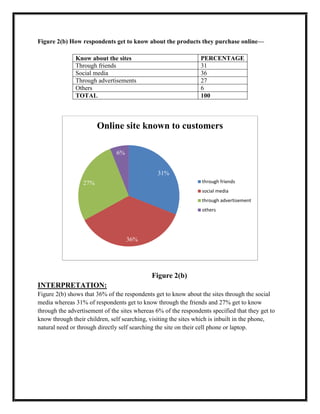
Figure 2(b) How respondents get to know about the products they purchase online—
Know about the sites PERCENTAGE
Through friends 31
Social media 36
Through advertisements 27
Others 6
TOTAL 100
Figure 2(b)
INTERPRETATION:
Figure 2(b) shows that 36% of the respondents get to know about the sites through the social
media whereas 31% of respondents get to know through the friends and 27% get to know
through the advertisement of the sites whereas 6% of the respondents specified that they get to
know through their children, self searching, visiting the sites which is inbuilt in the phone,
natural need or through directly self searching the site on their cell phone or laptop.
31%
36%
27%
6%
Online site known to customers
through friends
social media
through advertisement
others
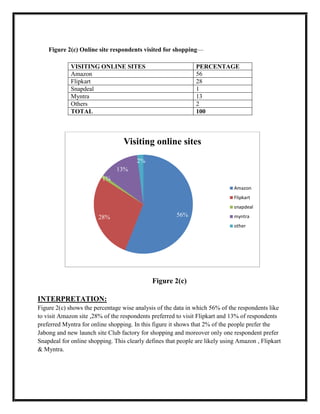
Figure 2(c) Online site respondents visited for shopping—
VISITING ONLINE SITES PERCENTAGE
Amazon 56
Flipkart 28
Snapdeal 1
Myntra 13
Others 2
TOTAL 100
Figure 2(c)
INTERPRETATION:
Figure 2(c) shows the percentage wise analysis of the data in which 56% of the respondents like
to visit Amazon site ,28% of the respondents preferred to visit Flipkart and 13% of respondents
preferred Myntra for online shopping. In this figure it shows that 2% of the people prefer the
Jabong and new launch site Club factory for shopping and moreover only one respondent prefer
Snapdeal for online shopping. This clearly defines that people are likely using Amazon , Flipkart
& Myntra.
56%28%
1%
13%
2%
Visiting online sites
Amazon
Flipkart
snapdeal
myntra
other
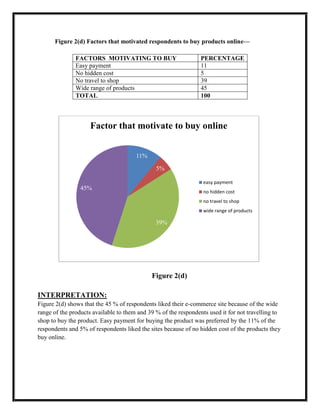
Figure 2(d) Factors that motivated respondents to buy products online—
FACTORS MOTIVATING TO BUY PERCENTAGE
Easy payment 11
No hidden cost 5
No travel to shop 39
Wide range of products 45
TOTAL 100
Figure 2(d)
INTERPRETATION:
Figure 2(d) shows that the 45 % of respondents liked their e-commerce site because of the wide
range of the products available to them and 39 % of the respondents used it for not travelling to
shop to buy the product. Easy payment for buying the product was preferred by the 11% of the
respondents and 5% of respondents liked the sites because of no hidden cost of the products they
buy online.
11%
5%
39%
45%
Factor that motivate to buy online
easy payment
no hidden cost
no travel to shop
wide range of products
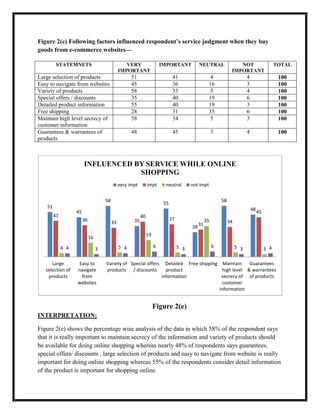
Figure 2(e) Following factors influenced respondent’s service judgment when they buy
goods from e-commerce websites—
Figure 2(e)
INTERPRETATION:
Figure 2(e) shows the percentage wise analysis of the data in which 58% of the respondent says
that it is really important to maintain secrecy of the information and variety of products should
be available for doing online shopping whereas nearly 48% of respondents says guarantees,
special offers/ discounts , large selection of products and easy to navigate from website is really
important for doing online shopping whereas 55% of the respondents consider detail information
of the product is important for shopping online.
51
45
58
35
55
28
58
48
41
36
33
40
37
31
34
45
4
16
5
19
5
35
5 34 3 4 6
3
6
3 4
Large
selection of
products
Easy to
navigate
from
websites
Variety of
products
Special offers
/ discounts
Detailed
product
information
Free shipping Maintain
high level
secrecy of
customer
information
Guarantees
& warrantees
of products
INFLUENCED BY SERVICE WHILE ONLINE
SHOPPING
very impt impt neutral not impt
STATEMNETS VERY
IMPORTANT
IMPORTANT NEUTRAL NOT
IMPORTANT
TOTAL
Large selection of products 51 41 4 4 100
Easy to navigate from websites 45 36 16 3 100
Variety of products 58 33 5 4 100
Special offers / discounts 35 40 19 6 100
Detailed product information 55 40 19 3 100
Free shipping 28 31 35 6 100
Maintain high level secrecy of
customer information
58 34 5 3 100
Guarantees & warrantees of
products
48 45 3 4 100
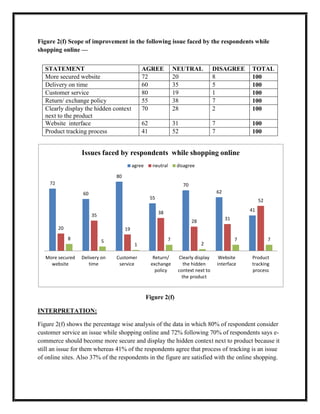
Figure 2(f) Scope of improvement in the following issue faced by the respondents while
shopping online —
Figure 2(f)
INTERPRETATION:
Figure 2(f) shows the percentage wise analysis of the data in which 80% of respondent consider
customer service an issue while shopping online and 72% following 70% of respondents says e-
commerce should become more secure and display the hidden context next to product because it
still an issue for them whereas 41% of the respondents agree that process of tracking is an issue
of online sites. Also 37% of the respondents in the figure are satisfied with the online shopping.
72
60
80
55
70
62
41
20
35
19
38
28 31
52
8 5
1
7
2
7 7
More secured
website
Delivery on
time
Customer
service
Return/
exchange
policy
Clearly display
the hidden
context next to
the product
Website
interface
Product
tracking
process
Issues faced by respondents while shopping online
agree neutral disagree
STATEMENT AGREE NEUTRAL DISAGREE TOTAL
More secured website 72 20 8 100
Delivery on time 60 35 5 100
Customer service 80 19 1 100
Return/ exchange policy 55 38 7 100
Clearly display the hidden context
next to the product
70 28 2 100
Website interface 62 31 7 100
Product tracking process 41 52 7 100
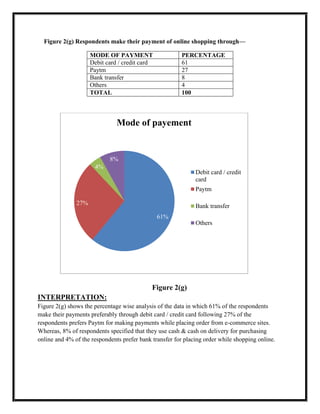
Figure 2(g) Respondents make their payment of online shopping through—
MODE OF PAYMENT PERCENTAGE
Debit card / credit card 61
Paytm 27
Bank transfer 8
Others 4
TOTAL 100
Figure 2(g)
INTERPRETATION:
Figure 2(g) shows the percentage wise analysis of the data in which 61% of the respondents
make their payments preferably through debit card / credit card following 27% of the
respondents prefers Paytm for making payments while placing order from e-commerce sites.
Whereas, 8% of respondents specified that they use cash & cash on delivery for purchasing
online and 4% of the respondents prefer bank transfer for placing order while shopping online.
61%
27%
4%
8%
Mode of payement
Debit card / credit
card
Paytm
Bank transfer
Others
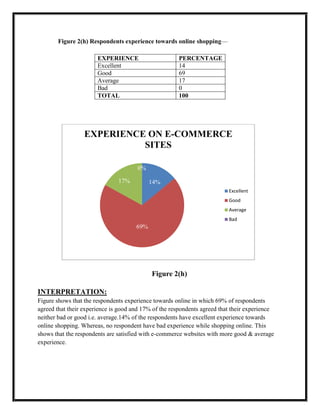
Figure 2(h) Respondents experience towards online shopping—
EXPERIENCE PERCENTAGE
Excellent 14
Good 69
Average 17
Bad 0
TOTAL 100
Figure 2(h)
INTERPRETATION:
Figure shows that the respondents experience towards online in which 69% of respondents
agreed that their experience is good and 17% of the respondents agreed that their experience
neither bad or good i.e. average.14% of the respondents have excellent experience towards
online shopping. Whereas, no respondent have bad experience while shopping online. This
shows that the respondents are satisfied with e-commerce websites with more good & average
experience.
14%
69%
17%
0%
EXPERIENCE ON E-COMMERCE
SITES
Excellent
Good
Average
Bad
FINDINGS,
RECOMMENDATIONS
AND
CONCLUSION
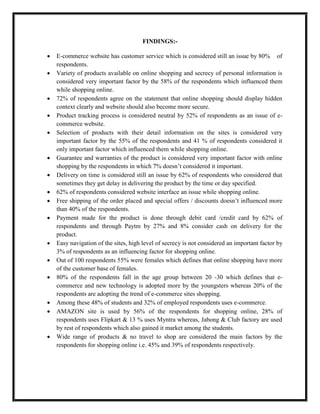
FINDINGS:-
 E-commerce website has customer service which is considered still an issue by 80% of
respondents.
 Variety of products available on online shopping and secrecy of personal information is
considered very important factor by the 58% of the respondents which influenced them
while shopping online.
 72% of respondents agree on the statement that online shopping should display hidden
context clearly and website should also become more secure.
 Product tracking process is considered neutral by 52% of respondents as an issue of e-
commerce website.
 Selection of products with their detail information on the sites is considered very
important factor by the 55% of the respondents and 41 % of respondents considered it
only important factor which influenced them while shopping online.
 Guarantee and warranties of the product is considered very important factor with online
shopping by the respondents in which 7% doesn’t considered it important.
 Delivery on time is considered still an issue by 62% of respondents who considered that
sometimes they get delay in delivering the product by the time or day specified.
 62% of respondents considered website interface an issue while shopping online.
 Free shipping of the order placed and special offers / discounts doesn’t influenced more
than 40% of the respondents.
 Payment made for the product is done through debit card /credit card by 62% of
respondents and through Paytm by 27% and 8% consider cash on delivery for the
product.
 Easy navigation of the sites, high level of secrecy is not considered an important factor by
3% of respondents as an influencing factor for shopping online.
 Out of 100 respondents 55% were females which defines that online shopping have more
of the customer base of females.
 80% of the respondents fall in the age group between 20 -30 which defines that e-
commerce and new technology is adopted more by the youngsters whereas 20% of the
respondents are adopting the trend of e-commerce sites shopping.
 Among these 48% of students and 32% of employed respondents uses e-commerce.
 AMAZON site is used by 56% of the respondents for shopping online, 28% of
respondents uses Flipkart & 13 % uses Myntra whereas, Jabong & Club factory are used
by rest of respondents which also gained it market among the students.
 Wide range of products & no travel to shop are considered the main factors by the
respondents for shopping online i.e. 45% and 39% of respondents respectively.
RECOMMENDATIONS
 As still India in large segment of population is untapped regarding the online shopping
the available online shopping store can widen their market by getting into expansion
strategies.
 Remove the fear of product quality, durability and payments etc from the mind of
customers in regards of online shopping
 Wide expansion of internet services facilities in rural area can bring the more customers
for the online shopping sites.
 Through prompt service , wide variety in rural area can bring the more customers from
the remote area can be tapped.
 Transaction security and consumers data safety are principal concerns of online
customers purchasing products or services online. Therefore online vendors can assure
their consumers by providing them guarantee, delivery on time , special offers , by
improving their technological system.
CONCLUSION
Online shopping is becoming more popular day by day with the increase in the usage of World
Wide Web. Understanding customers need for online selling has become challenge for
marketers. Special understanding the customer’s satisfaction level with their experience towards
online shopping, making improvement in the factors that influence consumers to shop online and
working on the factors that affect consumers to shop online will help marketers to gain the
competitive edge over others. Online shopping to consumer is the help in finding the wide range
of product without going to shop and get home delivery of the product. With this online
shopping has truly revolutionized and influenced our society as a whole. This use of technology
has open doors opportunities that enable for more convenient lifestyle today. However, this
concept of online shopping led to the possibilities of fraud and privacy conflicts. Unfortunately,
it has shown that it is possible for criminal to manipulate the system and access personal
information. Luckily, today with the latest features of technology, measures are being taken in
order to stop hackers and criminals from inappropriately private database. Through privacy and
security policies, website designers are doing their best to put an end to this unethical practice.
By doing so , society will continue to depend upon online shopping, which will allow it to
remain a tremendous success in the future.
BIBLIOGRAPHY
BIBLIOGRAPHY
 http://www.nasscom.in/knowledge-center/publications/ecommerce-india-fuelling-billion-
digital-dreams-0
 https://www.smartinsights.com/ecommerce/ecommerce-strategy/top-ecommerce-trends-
inform-2017-marketing-strategy/
 https://www.smartinsights.com/ecommerce/ecommerce-strategy/top-ecommerce-trends-
inform-2017-marketing-strategy/
 Research paper by Nandhini Balasubramanian over “Comparative study on customer
satisfaction. ”
 Marketingland.com/wp-content/ml-loads.2014/08/online-shopping-ecommerce-ss-
1920.png
 http://www.bloggersideas.com/top-10-online-shopping-sites-in-india-best-shopping-sites-
india/
 Kanwal Gurleen (2012), “Consumers Perception Towards online Shopping”,
International journal of management & Information Technology.
 Goswami (2013), “Customer Satisfaction towards Online Shopping with Special
Reference to Teenage Group of Jorhat Town”, Indian Journal of Research.
 Dhevika V.P.T, Latasri O.T.V, S Karmugil (2014), in their paper “Factors Affecting
Online shopping of Customers”
 Saravanan S and Brindha Devi K (2015), “A Study on Online Buying behavior with
special reference to Coimbatore city”, International Journal of Commerce, Business and
Management.
 Francis Sudhakar K, Habeeb Syed (2016), “A Comparative study between Flipkart and
Amazon India”, International Journal of Research in Regional Studies, Law, Social
Sciences ,Journalism and Management Practices.
 https://www.researchgate.net/publication/272827967_Customer_Satisfaction_in_Online_
Shopping_a_study_into_the_reasons_for_motivations_and_inhibitions.
 http://shodhganga.inflibnet.ac.in/bitstream/10603/3704/12/12_chapter%202.pdf.
 Kothari C. R., Research Methodology, New Age Publication, 2nd
Edition, New Delhi.
 https://www.surveymonkey.com/r/6SRDW9V
APPENDIX
QUESTIONNAIRE
The purpose of this questionnaire is to find out their opinion about online shopping and identify
what main factors Indian online consumers take into consideration when purchasing products
online. Please read the questions carefully and respond by marking the option that represents
your opinion. Remember there are no wrong or right answers. We are only interested in your
opinion. Your responses will remain anonymous and confidential. Thank you very much for your
valuable time. Your help is appreciated.
1. Name:….......................
2. Gender : Male [ ] Female [ ]
3. Age :
a. 20-25 [ ]
b. 25-30 [ ]
c. 30-35 [ ]
d. 35- above [ ]
4. Qualification :
a. Employed [ ]
b. Self employed [ ]
c. Student [ ]
d. Housewife [ ]
5. How frequently you shop through e-commerce websites?
a. More than once a month [ ]
b. Once in 1-2 months [ ]
c. Once in 3-6 months [ ]
d. Once in 7- 12 months [ ]
6. How do you get to know about the products that you purchase online?
a. Through friends
b. Social media
c. Through advertisements
d. Others(specify)………….
7. Which of the following site you visit for shopping?
a. Amazon [ ]
b. Flipkart [ ]
c. Snapdeal [ ]
d. Myntra [ ]
e. Others(specify)……………….
8. What motivates to buy products online?
a. Easy payment [ ]
b. No hidden cost [ ]
c. No travel to shop [ ]
d. Wide range of products [ ]
e. Others(specify)……………...
9. To what extent do these following factors influence your service judgment when buying shopping goods
online?
STATEMENT
VERY
IMPORTANT
IMPORTANT NEUTRAL
NOT
IMPORTANT
Large selection of products
Easy to navigate from websites
Variety of products
Special offers / discounts
Detailed product of information
Free shipping
Maintain high level secrecy of customer
information
Guarantees & warrantees of products
10. How do you make your payments on internet?
a. Debit card / credit card [ ]
b. Paytm [ ]
c. Bank transfer [ ]
d. Other (specify)……………….
11. Do you think there is scope of improvement in the following issue you faced while shopping online?
STATEMENT AGREE NEUTRAL DISAGREE
More secured website
Delivery on time
Customer service
Return/ exchange policy
Clearly display the hidden context next to the product
Website interface
Product tracking process
12. What is your experience towards online shopping?
a. Excellent [ ]
b. Good [ ]
c. Average [ ]
d. Bad [ ]

A study on the customer perception towards online shopping (2)

  • 1.
    PROJECT REPORT ON “A STUDYTOWARDS CUSTOMER PERCEPTION ON E-COMMERCE WEBSITES” SUBMITTED BY: TAMANNA GUPTA (1671401021) In partial fulfillment for the requirements of the degree of MASTER OF BUSINESS ADMINISTRATION SCHOOL OF BUSINESS MANAGEMENT & LIBERAL ARTS SHOOLINI UNIVERSITY OF BOITECHNOLOGY AND MANAGEMENT SCIENCE BAJHOL, SOLAN, HP-173212 APRIL 2018
  • 2.
    ACKNOWLEDGEMENT The success andfinal outcome of this project required a lot of guidance and assistance from many people and I am extremely privileged to have this all along the completion of my project. All that I have done is only due to such supervision and assistance and I would not forget to thank them. Firstly, I would like to thank my project guide Dr.Nitin Gupta, School of Business Management and Shoolini University for providing me the opportunity to work under his guidance. He helped me a lot in completing this project report and provided me with all the necessary information, knowledge which was needed for project completion. His guidance and support for project made its completion possible. I would like to thank our Dean Mr. Atul Khosla who provided us a platform and opportunity to work on this project. I would like to thank my faculty members, without their support and continuous guidance this would not have been possible. They made us confident that yes we can do everything. This acknowledgement cannot be ended without thanking my parents who always supported me and also supported me emotionally, motivated me and encouraged me every time. At last, but more valuable in my life, my friends, who directly and indirectly helped me in completing this project report. TAMANNA GUPTA
  • 3.
    CERTIFICATE This is tocertify that the Project work entitled “A STUDY TOWARDS CUSTOMER PERCEPTION ON E-COMMERCE WEBSITES” submitted in partial fulfillment of the requirement for the award of degree of Master of Business Administration to Shoolini University of Biotechnology and Management Sciences, Bajhol, Solan (H.P.) is a bonafide Project work carried out by TAMANNA GUPTA(167140121). No part of this work has been submitted for any other degree or diploma. Name of Student: Name of the Guide: TAMANNA GUPTA DR.NITIN GUPTA Place: Solan Date:
  • 4.
    TABLE OF CONTENTS S.NO.CONTENTS PAGE NO. 1. Introduction 6-11 2. Review Of Literature 14-16 3. Research methodology 18-20 4. Data Analysis & Interpretation 22-31 5. Findings & Recommendations 33-34 6. Conclusion 35 7. Bibliography 37 Appendices
  • 5.
  • 6.
    INTRODUCTION The emergence ofWorld Wide Web has made the services available to customers without leaving their home. The usage of internet is increasing more on the marketing services and e- business. Online shopping is one of them which are emerging as the fastest growing phenomenon. Companies are now using internet to build closer relation with consumers and existing marketing partners. As said by Srisuwan & Barnes(2008;et al.,2007) that from virtual reality displays that test new products to online virtual stores that sell them, the technology explosion is affecting every aspect of marketing. The Internet has now become a truly global phenomenon. Online shopping is the process whereby consumers directly buy goods, services etc. from a seller interactively in real-time without an intermediary service over the internet. Shoppers can visit web stores from the comfort of their homes and shop as they sit in front of the computer. Consumers buy a variety of items from online stores. Nowadays, online shopping is emerging a convenient way of shopping. Customers will be able to save time & money, retrieve all the product information with clicks in few minutes. According to survey done in 2010 by the Clicks stats, the growth & diverse internet population means the people having diverse taste and purposes are going to web for information and buy product and services. This survey is becoming true as now customers use online shopping according to their needs, wants and adopting new technologies. Online shopping made it easy for everyone with their product variations. An attempt of comparison has been done considering e-commerce challenges, their business model, funding, revenue generation, growth, survival strategies, Shoppers online shopping experience, value added differentiation, and product offerings. Big players made their own mark in India, but who is going to be ultimate winner or be the top one is going to be. A comparative study of e- commerce sites delivers the information about the different strategies to succeed in e-commerce market and different opportunities available in India. India has always been a land of great potential. The socioeconomic condition of the country has improved many folds after independence and India is now emerging as one of the leading countries in the world. Moreover with the introduction of 4G network the use of e-commerce have increased many folds in India .As technology is spreading to the remotest villages and many job opportunities are presenting themselves to the unemployed youth more and more people are gaining awareness and the money to purchase expensive and luxurious items over the internet.
  • 7.
    E-COMMERCE WORKING:- Electronic commerce,commonly known as E-commerce or e-commerce, is trading in products or services using computer networks, such as the Internet. Electronic commerce draws on technologies such as mobile commerce, electronic funds transfer, supply chain management, Internet marketing, online transaction processing, electronic data interchange (EDI), inventory management systems, and automated data collection systems. Modern electronic commerce typically uses the World Wide Web for at least one part of the transaction's life cycle, although it may also use other technologies such as e-mail. E-commerce offers products and services through websites, a customer simply has to visit an e- commerce website and browse various offering through browser catalog, a customer can select multiple offerings and can add them to the shopping cart, once the shopping is done the customer can checkout and proceed to payment section where various online payment options are available like internet banking, credit card, debit card etc. Once payment is done the customer is notified about the order and order is shipped on the postal address provided by the customer. E-commerce businesses may employ some or all of the following: o Online shopping web sites for retail sales direct to consumers. o Providing or participating in online marketplaces, which process third-party business-to- consumer or consumer-to-consumer sales. o Business-to-business buying and selling. o Gathering and using demographic data through web contacts and social media. o Business-to-business electronic data interchange. o Marketing to prospective and established customers by e-mail or fax (for example, with newsletters). o Prevail for launching new products and services
  • 8.
    BENEFITS OF E-COMMERCE: E-commercebenefits are broadly classified in 3 major categories:-  Benefit to organization  Benefit to consumers  Benefit to society BENEFIT TO ORGANIZATION:- o Using e-commerce, organizations can expand their market to national and international markets with minimum capital investment. An organization can easily locate more customers, best suppliers, and suitable business partners across the globe. o E-commerce helps organizations to reduce the cost to create process, distribute, retrieve and manage the paper based information by digitizing the information. o E-commerce improves the brand image of the company. o E-commerce helps organization to provide better customer services. o E-commerce helps to simplify the business processes and makes them faster and efficient. o E-commerce reduces the paper work. o E-commerce increases the productivity of organizations. BENEFIT TO CUSTOMERS:- o Customers can enquire about a product /service and place orders anytime, anywhere from any location. o E-commerce application provides users with more options to compare and select the cheaper and better options & also quicker delivery of products. o A customer can put review comments about a product and can see what others are buying, or see the review comments of other customers before making a final purchase. o A customer can see the relevant detailed information within seconds, rather than waiting for days or weeks. o E-Commerce increases the competition among organizations and as a result, organizations provide substantial discounts to customers. BENEFITS TO SOCIETY:- o Customers need not travel to shop a product, thus less traffic on road and low air pollution. o E-commerce helps in reducing the cost of products, so less affluent people can also afford the products. o E-commerce has enabled rural areas to access services and products, which are otherwise not available to them. o E-commerce helps the government to deliver public services such as healthcare, education, social services at a reduced cost and in an improved manner.
  • 9.
    E-COMMERCE IN INDIA: Thebirth and growth of Internet has been the biggest event of the century. E-commerce in India has come a long way from a timid beginning in the 1999-2000 to a period where one can sell and find all sorts of stuff from a high end product to a meager peanut online. Most corporations are using Internet to represent their product range and services so that it is accessible to the global market and to reach out to a larger range of their audience. E-commerce development of comparison from 2014-2015: Growing Internet penetration, entry of global majors, rise in smart phone adoption, innovation in mobile technologies, access to funding, millennial consumers and digital payments is fuelling the growth of the ecommerce market in the country. The report presents a detailed overview of the Indian e-commerce space – its market size, growth, trends, drivers, and market outlook. It also delves into the various business segments, with highlights on growth, presence of start-ups, and future prospects. The report also showcases startups that are emerging in niche segments of ecommerce and expanding the business opportunity. Growth of e-commerce from 2016:  The value of e-commerce in India is forecasted to boom from US$ 30 billion in 2016 to US$ 120 billion by the year 2020 due to its current Compound Annual Growth Rate (CAGR) of over 51 percent per annum.  This growth is fuelled by the younger generation, aged between 15 and 35 years who account for a whopping 75 percent of purchases made online. Online retail sector witnesses some 55 percent growth annually with 65 million unique visitors every month.  About 65 percent online shopping is for mobile phone handsets and fashion at 55 percent. Till 2016 end, about 25 million new Internet users were being added in India. Over 65 percent of online purchases in 2016 were made using smart phones and tabs.  Post demonetization on November 9, 2016, this figure has increased exponentially with shopping for groceries, paying insurance premiums and school fees as well as other expenses moving to the digital platform.
  • 10.
    TOP 10 E-COMMERCESITES IN INDIA IN 2018 1. Flipkart.com This one has to come first hands down. The entire country is completely dependent on Flipkart for nearly all their shopping needs. Flipkart sells everything from gift vouchers to electronics to home appliances. In fact, statistics claim that there are more items on flipkart than in a mall. Hence, Indians are heavily reliant on flipkart for all their shopping needs. 2. Amazon.in A large number of people from India swear by the services of amazon. Amazon and flipkart are always at war with each other and are always at close heels. Amazon has an equally large number of products as flipkart. In fact, Amazon apparently sells more than flipkart. Since amazon is an American company, it lacks the desi taste that would be preferred by an Indian. It would be wise to indianise its Indian domain. It would then be an instant hit amongst the masses. 3. Snapdeal.com Snapdeal is a completely Indian website and is often preferred by the masses for its cheap rates. It sells products at really low prices and hence, is a favourite of the masses. It is a good idea to buy from Snapdeal if you are looking for absolutely cheap prices. However, there have been times when consumers have complained of the products of Snapdeal and hence, some of them stay away from Snapdeal. 4. Jabong.com Jabong is again an American brand but seems to be doing very well in India. It has a large number of clothes and accessories for sale and is a complete paradise for those who love shopping for clothes. It has all kinds of products from western wear to desi kurtis and it would be fun to sit home and shop for clothes on Jabong. Jabong is excessively preferred by women shoppers. 5. Myntra.com Myntra also has a large number of accessories and clothes on its online portal. It has a large number of categories as well and one can buy from a category of their choices. From western to ethnic to traditional, all kinds of clothes are sold on Myntra. 6. Homeshop18 This is an equally popular website amongst online shoppers. Those who do not mind waiting a little extra for delivery at the reward of a lower price, order from here. A lot of times, the cheapest of items and the remotest of items are easily found on homeshop18.com. Thus, this site also has an equally large number of shoppers who are loyalists. However, homeshop18 cannot be trusted when one is in an emergency. You’d rather buy from one of the websites where they give express deliveries.
  • 11.
    7. Shopclues.com Shopclues isfamous for their heavily discounted best shopping deals. Shopclues is one of the best online stores that offers a wide variety of cameras, Computer accessories, Mobile, Gift, Jewellery, Cosmetics, toys, clothes, books and bag. 8. Paytm.com Started just as mobile recharge app, now Paytm become the Indian Alibaba. Provides a number of services like mobile recharge, bill payments, tickets etc. along with a variety of generic products. Paytm offers cashback with the discounts, that makes it different from other shopping sites in India. Sometimes such cashback makes a big difference and saves your extra money. PayTM has now launched PayTM Mall which is equivalent to Amazon and Flipkart. You can go and shop anything on PayTM mall. PayTM mall offers electronic items, shoes, bags, home décor, clothing for men and women and many more products which are 100% authentic. Once, you do shopping from PayTM mall then you will get cashbacks, these cashbacks can be used later to process mobile recharges, pay bills and other stuff. 9. Voonik.com Voonik is one of those sites that specifically focus on only women products. This thing makes it more popular among women as compare to other fashion sites. The products include Indian wear, western wear, lingerie & sleepwear, footwear, bags and accessories, jewellery and beauty products. Voonik offers deep discounts on its products along with cash back offers. Voonik was started in Bangalore with the vision of being the personal stylist to every woman. It provides the free personalization which is inbuilt in the app for its user. 10. Bigbasket.com Bigbasket is the top grocery shopping site in India. From Bigbasket you can purchase products under the category of grocery, household, personal care, gourmet, beverage, dairy and fruit & veggie. It offers a wide range of top brands product. It additionally offers up to 20% cash back on different debit and credit cards.
  • 12.
  • 13.
    REVIEW OF LITERATURE Adetailed review of literature has been done and the information collected and utilized for the research works have been presented below:- Porter and Millar (1985) information gives competitive advantage to a company in three different ways: a) By changing industry structure and changing the rules of competition. b) By providing companies with new ways to outperform their competitors. c) By creating new businesses, even from within a company’s existing operations. Additionally, authors suggest five ways for Information Technology to be successfully implemented in business processes. This can be done by: a) Assessing the intensity of information. b) Determining the role that Information Technology will have in the industry structure. c) Understanding the ways that it can create competitive advantage for their companies. d) Investigating the possibilities of new businesses. e) Developing a strategic plan to take advantage of Information Technology. Martin Dodges (1999),”finding the source of Amazon.com: examining the hype of the earth’s biggest book store”, center for advanced spatial analysis. Concluded that Amazon com have been one of the most promising e-commerce companies and has grown rapidly by providing quality service. Miyazaki and Fernandez (2001) substantiated that the prior experience was found to affect the intention and behavior significantly and in a variety of ways. The results of this study imply that the technology acceptance model should be applied to electronic commerce research with caution. In order to develop a successful and profitable web shop, understanding customers' needs is essential. It has to be ensured that products are as cheap in a web shop as purchased from traditional channels. Kotler, (2003) described Consumer buying method as learning, information-processing and decision-making activity divided in several consequent steps: Problem identification, Information search, Alternatives evaluation, Purchasing decision, Post-purchase behavior. Efthymios, identified the main constituent of the online shopping experience as follows: the functionality of the Web site that includes the elements trade with the site’s usability. the emotional elements planned for lowering the customer’s hesitation by communicating trust and credibility of the online seller and Web site and the content elements including the aesthetic aspects of the online presentation and the marketing mix.
  • 14.
    Kotler & Keller(2009), a buyer goes through five stages while making a decision to purchase. These stages are best explainable when a buyer goes for buying costly items, such as a house, a car, diamond jewellery etc. However, in day- to- day purchase, consumers may not go through all these stages, since some commodes do not need information, and based on buyer’s previous experience they will visit a store for the purchase. Sharma and mittal (2009) in their study “prospects of e-commerce in India”, mentions that India is showing tremendous growth in the e-commerce. Undoubtedly, with the middle class of 288 million people, online shopping shows unlimited potential in India. The real estate costs are touching the sky. Today e-commerce has become an integral part of our daily life. There are websites providing any number of goods and services. The e-commerce portals provide goods and services in a variety of categories. To name a few: apparel and accessories for men and women, health and beauty products, books and magazines, computers and peripherals, vehicles, software, consumer electronics, household appliances, jewelry, audio, video, entertainment, goods, gift articles, real estate and services. Samadi and Ali (2010) compared the perceived risk level between internet and store shopping, and revisit the relationships among past positive experience, perceived risk level, and future purchase intention within the internet shopping environment. Kanwal Gurleen (2012), “Customers satisfaction towards Online shopping”, discussed that different options in internet encouraged people to search and eventually purchase online, because there are more than 100 million internet users in India. People those who are using internet from 5 to 7 hours a day were found to be adopter of online shopping. Price consciousness, convenience and variety, easy payment options and challenges of online shopping are the factors found to be a significant in online shopping. Adrita Goswami (2013), studied “Customer Satisfaction towards Online Shopping with Special Reference to Teenage Group of Jorhat Town” study concludes that online customers are satisfied in the aspects such as Price, Quality of products, Ease of use in mobile platform and Timely Delivery at remote areas. This research explicitly indicates that online marketer should give more importance on price factor and after sale factor. Abhijit mitra. (2013), “e-commerce in India-a review”, international journal of marketing, financial services & management research. Concluded that the e-commerce has broken the geographical limitations and it is a revolution-commerce will improve tremendously in next five years in India. D.k.gangeshwar. (2013),” e-commerce or internet marketing: a business review from Indian context”, international journal of u- and e- service, science and technology. Concluded that the e- commerce has a very bright future in India although security, privacy and dependency on technology are some of the drawbacks of e-commerce but still there is a bright future to e- commerce.
  • 15.
    Dhevika V.P.T, LatasriO.T.V, S Karmugil (2014), in their paper “Factors Affecting Online shopping of Customers” revealed that the most important factor influencing online shopping is- security, followed by – trust worthy shopping and – website design/features and the least important factor influencing is – bargaining shopping, there is no significant association between security and website design/features of the respondents and their overall online buying behavior. Saravanan S and Brindha Devi K (2015), “A Study on Online Buying behavior with special reference to Coimbatore city” focused on online shoppers’ preferences and problems on various online shopping marketers. Higher computer literacy makes internet shopping smarter. Their awareness about the internet also makes them better positioned to identify and take decision for products and services. Pooja Gupta (2015), The study tries to recognize that, how consumer measure channels for their purchasing. Specifically, it progresses a conceptual model that addresses consumer value perception for using the internet shopping versus the traditional shopping. Earlier study showed that perceptions of price, product quality, service quality and threat strongly impact perceived value and purchase intents in the offline and online network. Observations of online and offline buyers can be evaluated to see how value is constructed in both channels. It is hitherto to recognize what factors influence online and offline shopping choice progression. The objective of this study is to provide an impression of online shopping decision process by comparing the offline and online decision making and identifying the factors that motivate customers to decide whether to do online shopping or go for the offline shopping. Consumer’s shop when and where they want, where they are comfortable with the products and the choice of shopping. The study finds that female are more into online shopping than male. Francis Sudhakar K, Habeeb Syed (2016), “A Comparative study between Flipkart and Amazon India”, conducted a study to critically examine various corporate and business level strategies of two big e-tailers and those are Flipkart and Amazon. Comparison have been done considering e-commerce challenges, their business model, funding, revenue generation, growth, survival strategies, Shoppers’ online shopping experience, value added differentiation, and product offerings. Both these big players made their own mark in India. The survey ended with Amazon as the winner, which satisfied the customer in all the aspects. Vijay govindarajan is one of the world’s leading experts on strategy and innovation. Govindarajan, coxe distinguished professor at dartmouth college’s tuck school of business and marvin bower fellow at harvard business school, is also a best-selling author. The biggest opportunity in India is e-commerce. Why? Three important factors will drive this: 1) mobile sphone penetration; 2) a young demographic that is used to ordering things using the mobile platform; 3) growth of consumerism with more Indians with higher disposable income. We will see many new innovative business models in the e-commerce space in the next five years. No doubt we will see new innovative high-growth companies—Indian equivalents of Alibaba.
  • 16.
    Shippa Gupta 'Indianonline shoppers believed there was a wider purchase choice online rather than offline, that shopping online was extremely convenient and easy, and that most goods were cheaper online than they were offline,' says, Country Manager, West Africa, MasterCard Worldwide. Times of India also explored the reasons why the majorities (78%) of Indians surveyed do not currently shop online. Of this group, 59% said they were not sure that making transactions online was secure or safe, 43% said they simply preferred to shop in -store to look at the physical products and an additional 40% raised their concerns about the time it would take for items to be delivered to them.
  • 17.
  • 18.
    RESEARCH METHODOLOGY Research methodologyprocess includes a number of activities to be performed. These are arranged in proper sequence of timing for conducting research. One activity after another is performed to complete the research work. TITLE OF THE STUDY: “A Comparative Study on customer perception towards online shopping.” Objectives  To understand the respondent perception towards online shopping.  To understand the factors affecting customer’s behavior for choosing e-commerce sites.  To understand tactics used for gaining the customers.  To know how consumers are evaluating e-commerce sites for their purchases. RESEARCH DESIGN The Research design of this study is descriptive. The study is concerned about the factors that lead to stress among working women come under descriptive Research category. Data Collection The goal for all data collection is to capture quality evidence that then translates to rich data analysis and allows the building of a convincing and credible answer to questions that have been posed. Primary Data Primary data was collected from various people and their opinion and information for the specific purposes of study helped to run the analysis. In essence, the questions asked were tailored to elicit the data that will help for study. The data was collected through questionnaire to understand their experience and preference towards their loyal company. Secondary Data To make primary data collection more specific, secondary data will help to make it more useful. It helps to improve the understanding of the problem. Secondary data was collected from various sources such as different business websites and published papers. SAMPLING DECISIONS: Convenient sampling technique has been used to collect the data. 1. Sample size: 100 samples were taken for the study.
  • 19.
    2. Research Instrument: Astructured questionnaire has been prepared to get the relevant information from the respondents. The questionnaire consists of variety of questions presented to the respondents for their responses. The researcher has been used structured questionnaire, support and cooperation of the selected respondents of various fields. DATA COLLECTION, ANALYSIS AND INTERPRETATION: The researcher has collected primary data, classified, tabulated, analyzed, interpreted and reported using suitable statistical tools and techniques. LIMITATIONS OF STUDY:  The study in the confined area to Solan city.  The study is based upon the consumer satisfaction, perception and experience of online shopping.  The data collected for the research is fully primary data given by the respondents by filling the google form.  The questionnaire was made available to consumers through google drive – forms.  No personal biasness happen while taking filling the questionnaire because of the online google form.  Limited time frame.  Responses were restricted to only 100 sample out of the large population size.
  • 20.
  • 21.
    DATA ANALYSIS &INTERPRETATION The study was conducted to know the consumers satisfaction and thought towards e-commerce websites. The study was made by collecting the data from the source of filling questionnaire by 100 samples taken out of the entire population. The analysis of the data is as follows:- 1) SOCIO-ECONOMIC PROFILE OF THE RESPONDENTS – a. Gender b. Age c. Qualification 1 (a) RESPONDENTS ON THE BASIS OF GENDER— GENDER PERCENTAGE Male 45 Female 55 TOTAL 100 Figure 1(a) INTERPRETATION: Figure 1(a) show percentage wise analysis of the data in respect of the gender in which 55% of the respondents were female who prefer online shopping and 35% of respondents were male. This defines that e-commerce is more popular among the female for the trend fashion available online. 45% 55% GENDER Male Female
  • 22.
    1(b) RESPONDENTS ONTHE BASIS OF AGE— AGE PERCENTAGE 20-25 53 25-30 27 30-35 15 35-above 5 TOTAL 100 Figure 1(b) INTERPRETATION: Figure 1(b) shows percentage wise analysis of the respondent’s age in which 53% of the respondents were between the age group of 20-25 and in age group of 25 -30 27% of the respondents lie which defines that the youth is more active on using the e-commerce website whereas, in the age group of 30 -35 and 35 above 20% of the people lies which depicts that respondents of this age group are adopting the new way of technology & its usage and online shopping is one of them which is they are using with good experience. 53% 27% 15% 5% AGE 20-25 25-30 30-35 35-above
  • 23.
    1(c) RESPONDENTS ONTHE BASIS OF QUALIFICATION— QUALIFICATION PERCENTAGE Employed 32 Self employed 10 Housewife 10 Student 48 TOTAL 100 Figure 1(c) INTERPRETATION: Figure 1(c) shows the percentage wise analysis of the data in which 48% of the respondents are students who buy products through the e-commerce websites where as 32% of the respondents are employed using e-commerce sites more over self employed respondent and housewife are 20% . This defines that again as the age group data here also majority of the youth i.e. students and employed people uses e-commerce website and housewife are also adopting online site for shopping for saving their time and do household work easily and on time. 32% 10% 48% 10% QUALIFICATION Employed Self employed Student Housewife
  • 24.
    2) RESPONDANTS BEHAVIOURTOWARDS E-COMMERCE SITES:- 2(a) How frequently respondents shop through e-commerce websites— FREQUENTLY SHOPPING PERCENTAGE More than once in a month 12 Once in 1- 2 months 47 Once in 3- 6 months 37 Once in 7-12 months 4 TOTAL 100 Figure 2(a) INTERPRETATION: Figure 2(a) shows the percentage wise analysis of that data of those respondents who more active on online site purchasing in which 47% of the respondents uses e-commerce site once in 1- 2 month and 37% of respondents uses it once in 3-6 months whereas, 12% of the respondents uses it once in a month whereas very less percentage of respondents seem to inactive for shopping online i.e. 4% respondents uses e-commerce sites once in 7-12 months. This defines that the people are more active on online shopping for getting the new product available them on time. 12% 47% 37% 4% FREQUENTLY SHOPPING more than once a month once in 1-2 months once in 3-6 months once in 7-12 months
  • 25.
    Figure 2(b) Howrespondents get to know about the products they purchase online— Know about the sites PERCENTAGE Through friends 31 Social media 36 Through advertisements 27 Others 6 TOTAL 100 Figure 2(b) INTERPRETATION: Figure 2(b) shows that 36% of the respondents get to know about the sites through the social media whereas 31% of respondents get to know through the friends and 27% get to know through the advertisement of the sites whereas 6% of the respondents specified that they get to know through their children, self searching, visiting the sites which is inbuilt in the phone, natural need or through directly self searching the site on their cell phone or laptop. 31% 36% 27% 6% Online site known to customers through friends social media through advertisement others
  • 26.
    Figure 2(c) Onlinesite respondents visited for shopping— VISITING ONLINE SITES PERCENTAGE Amazon 56 Flipkart 28 Snapdeal 1 Myntra 13 Others 2 TOTAL 100 Figure 2(c) INTERPRETATION: Figure 2(c) shows the percentage wise analysis of the data in which 56% of the respondents like to visit Amazon site ,28% of the respondents preferred to visit Flipkart and 13% of respondents preferred Myntra for online shopping. In this figure it shows that 2% of the people prefer the Jabong and new launch site Club factory for shopping and moreover only one respondent prefer Snapdeal for online shopping. This clearly defines that people are likely using Amazon , Flipkart & Myntra. 56%28% 1% 13% 2% Visiting online sites Amazon Flipkart snapdeal myntra other
  • 27.
    Figure 2(d) Factorsthat motivated respondents to buy products online— FACTORS MOTIVATING TO BUY PERCENTAGE Easy payment 11 No hidden cost 5 No travel to shop 39 Wide range of products 45 TOTAL 100 Figure 2(d) INTERPRETATION: Figure 2(d) shows that the 45 % of respondents liked their e-commerce site because of the wide range of the products available to them and 39 % of the respondents used it for not travelling to shop to buy the product. Easy payment for buying the product was preferred by the 11% of the respondents and 5% of respondents liked the sites because of no hidden cost of the products they buy online. 11% 5% 39% 45% Factor that motivate to buy online easy payment no hidden cost no travel to shop wide range of products
  • 28.
    Figure 2(e) Followingfactors influenced respondent’s service judgment when they buy goods from e-commerce websites— Figure 2(e) INTERPRETATION: Figure 2(e) shows the percentage wise analysis of the data in which 58% of the respondent says that it is really important to maintain secrecy of the information and variety of products should be available for doing online shopping whereas nearly 48% of respondents says guarantees, special offers/ discounts , large selection of products and easy to navigate from website is really important for doing online shopping whereas 55% of the respondents consider detail information of the product is important for shopping online. 51 45 58 35 55 28 58 48 41 36 33 40 37 31 34 45 4 16 5 19 5 35 5 34 3 4 6 3 6 3 4 Large selection of products Easy to navigate from websites Variety of products Special offers / discounts Detailed product information Free shipping Maintain high level secrecy of customer information Guarantees & warrantees of products INFLUENCED BY SERVICE WHILE ONLINE SHOPPING very impt impt neutral not impt STATEMNETS VERY IMPORTANT IMPORTANT NEUTRAL NOT IMPORTANT TOTAL Large selection of products 51 41 4 4 100 Easy to navigate from websites 45 36 16 3 100 Variety of products 58 33 5 4 100 Special offers / discounts 35 40 19 6 100 Detailed product information 55 40 19 3 100 Free shipping 28 31 35 6 100 Maintain high level secrecy of customer information 58 34 5 3 100 Guarantees & warrantees of products 48 45 3 4 100
  • 29.
    Figure 2(f) Scopeof improvement in the following issue faced by the respondents while shopping online — Figure 2(f) INTERPRETATION: Figure 2(f) shows the percentage wise analysis of the data in which 80% of respondent consider customer service an issue while shopping online and 72% following 70% of respondents says e- commerce should become more secure and display the hidden context next to product because it still an issue for them whereas 41% of the respondents agree that process of tracking is an issue of online sites. Also 37% of the respondents in the figure are satisfied with the online shopping. 72 60 80 55 70 62 41 20 35 19 38 28 31 52 8 5 1 7 2 7 7 More secured website Delivery on time Customer service Return/ exchange policy Clearly display the hidden context next to the product Website interface Product tracking process Issues faced by respondents while shopping online agree neutral disagree STATEMENT AGREE NEUTRAL DISAGREE TOTAL More secured website 72 20 8 100 Delivery on time 60 35 5 100 Customer service 80 19 1 100 Return/ exchange policy 55 38 7 100 Clearly display the hidden context next to the product 70 28 2 100 Website interface 62 31 7 100 Product tracking process 41 52 7 100
  • 30.
    Figure 2(g) Respondentsmake their payment of online shopping through— MODE OF PAYMENT PERCENTAGE Debit card / credit card 61 Paytm 27 Bank transfer 8 Others 4 TOTAL 100 Figure 2(g) INTERPRETATION: Figure 2(g) shows the percentage wise analysis of the data in which 61% of the respondents make their payments preferably through debit card / credit card following 27% of the respondents prefers Paytm for making payments while placing order from e-commerce sites. Whereas, 8% of respondents specified that they use cash & cash on delivery for purchasing online and 4% of the respondents prefer bank transfer for placing order while shopping online. 61% 27% 4% 8% Mode of payement Debit card / credit card Paytm Bank transfer Others
  • 31.
    Figure 2(h) Respondentsexperience towards online shopping— EXPERIENCE PERCENTAGE Excellent 14 Good 69 Average 17 Bad 0 TOTAL 100 Figure 2(h) INTERPRETATION: Figure shows that the respondents experience towards online in which 69% of respondents agreed that their experience is good and 17% of the respondents agreed that their experience neither bad or good i.e. average.14% of the respondents have excellent experience towards online shopping. Whereas, no respondent have bad experience while shopping online. This shows that the respondents are satisfied with e-commerce websites with more good & average experience. 14% 69% 17% 0% EXPERIENCE ON E-COMMERCE SITES Excellent Good Average Bad
  • 32.
  • 33.
    FINDINGS:-  E-commerce websitehas customer service which is considered still an issue by 80% of respondents.  Variety of products available on online shopping and secrecy of personal information is considered very important factor by the 58% of the respondents which influenced them while shopping online.  72% of respondents agree on the statement that online shopping should display hidden context clearly and website should also become more secure.  Product tracking process is considered neutral by 52% of respondents as an issue of e- commerce website.  Selection of products with their detail information on the sites is considered very important factor by the 55% of the respondents and 41 % of respondents considered it only important factor which influenced them while shopping online.  Guarantee and warranties of the product is considered very important factor with online shopping by the respondents in which 7% doesn’t considered it important.  Delivery on time is considered still an issue by 62% of respondents who considered that sometimes they get delay in delivering the product by the time or day specified.  62% of respondents considered website interface an issue while shopping online.  Free shipping of the order placed and special offers / discounts doesn’t influenced more than 40% of the respondents.  Payment made for the product is done through debit card /credit card by 62% of respondents and through Paytm by 27% and 8% consider cash on delivery for the product.  Easy navigation of the sites, high level of secrecy is not considered an important factor by 3% of respondents as an influencing factor for shopping online.  Out of 100 respondents 55% were females which defines that online shopping have more of the customer base of females.  80% of the respondents fall in the age group between 20 -30 which defines that e- commerce and new technology is adopted more by the youngsters whereas 20% of the respondents are adopting the trend of e-commerce sites shopping.  Among these 48% of students and 32% of employed respondents uses e-commerce.  AMAZON site is used by 56% of the respondents for shopping online, 28% of respondents uses Flipkart & 13 % uses Myntra whereas, Jabong & Club factory are used by rest of respondents which also gained it market among the students.  Wide range of products & no travel to shop are considered the main factors by the respondents for shopping online i.e. 45% and 39% of respondents respectively.
  • 34.
    RECOMMENDATIONS  As stillIndia in large segment of population is untapped regarding the online shopping the available online shopping store can widen their market by getting into expansion strategies.  Remove the fear of product quality, durability and payments etc from the mind of customers in regards of online shopping  Wide expansion of internet services facilities in rural area can bring the more customers for the online shopping sites.  Through prompt service , wide variety in rural area can bring the more customers from the remote area can be tapped.  Transaction security and consumers data safety are principal concerns of online customers purchasing products or services online. Therefore online vendors can assure their consumers by providing them guarantee, delivery on time , special offers , by improving their technological system.
  • 35.
    CONCLUSION Online shopping isbecoming more popular day by day with the increase in the usage of World Wide Web. Understanding customers need for online selling has become challenge for marketers. Special understanding the customer’s satisfaction level with their experience towards online shopping, making improvement in the factors that influence consumers to shop online and working on the factors that affect consumers to shop online will help marketers to gain the competitive edge over others. Online shopping to consumer is the help in finding the wide range of product without going to shop and get home delivery of the product. With this online shopping has truly revolutionized and influenced our society as a whole. This use of technology has open doors opportunities that enable for more convenient lifestyle today. However, this concept of online shopping led to the possibilities of fraud and privacy conflicts. Unfortunately, it has shown that it is possible for criminal to manipulate the system and access personal information. Luckily, today with the latest features of technology, measures are being taken in order to stop hackers and criminals from inappropriately private database. Through privacy and security policies, website designers are doing their best to put an end to this unethical practice. By doing so , society will continue to depend upon online shopping, which will allow it to remain a tremendous success in the future.
  • 36.
  • 37.
    BIBLIOGRAPHY  http://www.nasscom.in/knowledge-center/publications/ecommerce-india-fuelling-billion- digital-dreams-0  https://www.smartinsights.com/ecommerce/ecommerce-strategy/top-ecommerce-trends- inform-2017-marketing-strategy/ https://www.smartinsights.com/ecommerce/ecommerce-strategy/top-ecommerce-trends- inform-2017-marketing-strategy/  Research paper by Nandhini Balasubramanian over “Comparative study on customer satisfaction. ”  Marketingland.com/wp-content/ml-loads.2014/08/online-shopping-ecommerce-ss- 1920.png  http://www.bloggersideas.com/top-10-online-shopping-sites-in-india-best-shopping-sites- india/  Kanwal Gurleen (2012), “Consumers Perception Towards online Shopping”, International journal of management & Information Technology.  Goswami (2013), “Customer Satisfaction towards Online Shopping with Special Reference to Teenage Group of Jorhat Town”, Indian Journal of Research.  Dhevika V.P.T, Latasri O.T.V, S Karmugil (2014), in their paper “Factors Affecting Online shopping of Customers”  Saravanan S and Brindha Devi K (2015), “A Study on Online Buying behavior with special reference to Coimbatore city”, International Journal of Commerce, Business and Management.  Francis Sudhakar K, Habeeb Syed (2016), “A Comparative study between Flipkart and Amazon India”, International Journal of Research in Regional Studies, Law, Social Sciences ,Journalism and Management Practices.  https://www.researchgate.net/publication/272827967_Customer_Satisfaction_in_Online_ Shopping_a_study_into_the_reasons_for_motivations_and_inhibitions.  http://shodhganga.inflibnet.ac.in/bitstream/10603/3704/12/12_chapter%202.pdf.  Kothari C. R., Research Methodology, New Age Publication, 2nd Edition, New Delhi.  https://www.surveymonkey.com/r/6SRDW9V
  • 38.
  • 39.
    QUESTIONNAIRE The purpose ofthis questionnaire is to find out their opinion about online shopping and identify what main factors Indian online consumers take into consideration when purchasing products online. Please read the questions carefully and respond by marking the option that represents your opinion. Remember there are no wrong or right answers. We are only interested in your opinion. Your responses will remain anonymous and confidential. Thank you very much for your valuable time. Your help is appreciated. 1. Name:…....................... 2. Gender : Male [ ] Female [ ] 3. Age : a. 20-25 [ ] b. 25-30 [ ] c. 30-35 [ ] d. 35- above [ ] 4. Qualification : a. Employed [ ] b. Self employed [ ] c. Student [ ] d. Housewife [ ] 5. How frequently you shop through e-commerce websites? a. More than once a month [ ] b. Once in 1-2 months [ ] c. Once in 3-6 months [ ] d. Once in 7- 12 months [ ] 6. How do you get to know about the products that you purchase online? a. Through friends b. Social media c. Through advertisements d. Others(specify)…………. 7. Which of the following site you visit for shopping? a. Amazon [ ] b. Flipkart [ ] c. Snapdeal [ ] d. Myntra [ ] e. Others(specify)………………. 8. What motivates to buy products online? a. Easy payment [ ] b. No hidden cost [ ] c. No travel to shop [ ] d. Wide range of products [ ] e. Others(specify)……………... 9. To what extent do these following factors influence your service judgment when buying shopping goods online? STATEMENT VERY IMPORTANT IMPORTANT NEUTRAL NOT IMPORTANT Large selection of products Easy to navigate from websites Variety of products Special offers / discounts Detailed product of information Free shipping Maintain high level secrecy of customer information Guarantees & warrantees of products
  • 40.
    10. How doyou make your payments on internet? a. Debit card / credit card [ ] b. Paytm [ ] c. Bank transfer [ ] d. Other (specify)………………. 11. Do you think there is scope of improvement in the following issue you faced while shopping online? STATEMENT AGREE NEUTRAL DISAGREE More secured website Delivery on time Customer service Return/ exchange policy Clearly display the hidden context next to the product Website interface Product tracking process 12. What is your experience towards online shopping? a. Excellent [ ] b. Good [ ] c. Average [ ] d. Bad [ ]