Kotler • Keller
Phillip Kevin Lane
Marketing Management • 14e
Developing
Pricing Strategies
and Programs
Chapter 14
Copyright © 2012 Pearson Education, Inc. Publishing as Prentice Hall Slide 3 of 33
Marketing Mix
PromotionPlace
Revenue
Producer
Cost
Cost
Cost
Copyright © 2012 Pearson Education, Inc. Publishing as Prentice Hall Slide 4 of 33
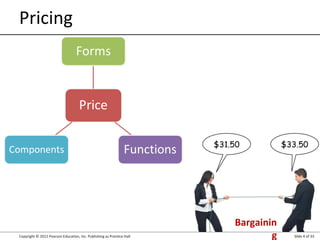
Pricing
Bargainin
g
$31.50 $33.50
Copyright © 2012 Pearson Education, Inc. Publishing as Prentice Hall Slide 5 of 33
Consumer Psychology and Pricing
Reference Prices
Price-Quality Inferences
Price Endings
$1.99
Copyright © 2012 Pearson Education, Inc. Publishing as Prentice Hall Slide 6 of 33
A Black T-Shirt
Armani - $275
Gap - $14.90
H&M - $7.90
Copyright © 2012 Pearson Education, Inc. Publishing as Prentice Hall Slide 7 of 33
Select Final Price
Setting the Price
1
Price Method
Competitor Analysis
2
3
4
5
6
Estimate Costs
Determine Demand
Pricing Objective
Copyright © 2012 Pearson Education, Inc. Publishing as Prentice Hall Slide 8 of 33
Selecting the Pricing Objective
Survival
Maximum Current Profit
Maximum Market Share
Maximum Market Skimming
Product-Quality Leadership
Other Objectives
Copyright © 2012 Pearson Education, Inc. Publishing as Prentice Hall Slide 9 of 33
Estimating Costs
Demand Price Ceiling
Costs
Profit
Price
Price Floor
Copyright © 2012 Pearson Education, Inc. Publishing as Prentice Hall Slide 10 of 33
Estimating Costs
Fixed Costs
(overhead)
Variable Costs Total Costs
Types of costs
Copyright © 2012 Pearson Education, Inc. Publishing as Prentice Hall Slide 11 of 33
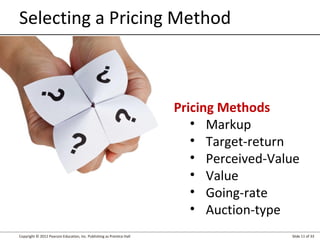
Selecting a Pricing Method
Pricing Methods
• Markup
• Target-return
• Perceived-Value
• Value
• Going-rate
• Auction-type
Copyright © 2012 Pearson Education, Inc. Publishing as Prentice Hall Slide 12 of 33
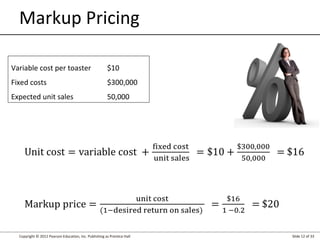
Markup Pricing
Variable cost per toaster $10
Fixed costs $300,000
Expected unit sales 50,000
Copyright © 2012 Pearson Education, Inc. Publishing as Prentice Hall Slide 13 of 33
Target-Return Pricing
Copyright © 2012 Pearson Education, Inc. Publishing as Prentice Hall Slide 14 of 33
Going-Rate Pricing
Follow the Leader
Commodities
Copyright © 2012 Pearson Education, Inc. Publishing as Prentice Hall Slide 15 of 33
Auction Pricing
English auction
(ascending bids)
Dutch auction
(descending bids)
Sealed-bid auction

Developing pricing strategies and programs

  • 1.
    Kotler • Keller PhillipKevin Lane Marketing Management • 14e
  • 2.
  • 3.
    Copyright © 2012Pearson Education, Inc. Publishing as Prentice Hall Slide 3 of 33 Marketing Mix PromotionPlace Revenue Producer Cost Cost Cost
  • 4.
    Copyright © 2012Pearson Education, Inc. Publishing as Prentice Hall Slide 4 of 33 Pricing Bargainin g $31.50 $33.50
  • 5.
    Copyright © 2012Pearson Education, Inc. Publishing as Prentice Hall Slide 5 of 33 Consumer Psychology and Pricing Reference Prices Price-Quality Inferences Price Endings $1.99
  • 6.
    Copyright © 2012Pearson Education, Inc. Publishing as Prentice Hall Slide 6 of 33 A Black T-Shirt Armani - $275 Gap - $14.90 H&M - $7.90
  • 7.
    Copyright © 2012Pearson Education, Inc. Publishing as Prentice Hall Slide 7 of 33 Select Final Price Setting the Price 1 Price Method Competitor Analysis 2 3 4 5 6 Estimate Costs Determine Demand Pricing Objective
  • 8.
    Copyright © 2012Pearson Education, Inc. Publishing as Prentice Hall Slide 8 of 33 Selecting the Pricing Objective Survival Maximum Current Profit Maximum Market Share Maximum Market Skimming Product-Quality Leadership Other Objectives
  • 9.
    Copyright © 2012Pearson Education, Inc. Publishing as Prentice Hall Slide 9 of 33 Estimating Costs Demand Price Ceiling Costs Profit Price Price Floor
  • 10.
    Copyright © 2012Pearson Education, Inc. Publishing as Prentice Hall Slide 10 of 33 Estimating Costs Fixed Costs (overhead) Variable Costs Total Costs Types of costs
  • 11.
    Copyright © 2012Pearson Education, Inc. Publishing as Prentice Hall Slide 11 of 33 Selecting a Pricing Method Pricing Methods • Markup • Target-return • Perceived-Value • Value • Going-rate • Auction-type
  • 12.
    Copyright © 2012Pearson Education, Inc. Publishing as Prentice Hall Slide 12 of 33 Markup Pricing Variable cost per toaster $10 Fixed costs $300,000 Expected unit sales 50,000
  • 13.
    Copyright © 2012Pearson Education, Inc. Publishing as Prentice Hall Slide 13 of 33 Target-Return Pricing
  • 14.
    Copyright © 2012Pearson Education, Inc. Publishing as Prentice Hall Slide 14 of 33 Going-Rate Pricing Follow the Leader Commodities
  • 15.
    Copyright © 2012Pearson Education, Inc. Publishing as Prentice Hall Slide 15 of 33 Auction Pricing English auction (ascending bids) Dutch auction (descending bids) Sealed-bid auction

Editor's Notes

  • #4 Price is the only one of the 4 P’s that produces revenue, all over elements produce costs. Price is also the easiest element of the marketing mix to adjust, and communicates the intended value of the offering.
  • #5 Holistic marketers take into account the company, their customers, the competition, and the marketing environment in determine prices. Pricing decisions must be consistent with the firm’s marketing strategy and its target market and brand positioning's. Pricing takes many forms and performs many functions. Rent, tuition, fares, fees, rates, tolls, retainers, wages, and commissions are all the price people pay for some good or service. Price also has many components. Prices can be altered through rebates and incentives, and payment can be made with more than cash, such as through the use of frequent flyer miles.
  • #6 Purchase decisions are based on how consumers perceive prices and what they consider the current actual price to be—not on the marketer’s stated price. Reference prices: consumers compare an observed price to an internal reference price they remember or an external frame of reference such as a posted “regular retail price.” Price-quality inferences: consumers use price as an indicator of quality. Image pricing is especially effective with ego-sensitive products such as perfumes, expensive cars, and designer clothing. Price endings: Many sellers believe prices should end in an odd number. Customers see an item priced at $299 as being in the $200 rather than the $300 range; they tend to process prices “left-to-right” rather than by rounding. Another explanation for the popularity of “9” endings is that they suggest a discount or bargain. Prices that end with 0 and 5 are also popular and are thought to be easier for consumers to process and retrieve from memory.
  • #7 “A Black T-Shirt” example illustrates the large part consumer psychology plays in determining three different prices for essentially the same item.
  • #8 A firm must consider many factors in setting its pricing policy.31 The chart above summarizes the six steps in the process.
  • #9 Survival is a short-run objective for firms to deal with overcapacity, intense competition, or changing consumer wants. Maximize current profits emphasis current performance . But firms may sacrifice long-run performance by ignoring the effects of other marketing variables, competitors’ reactions, and legal restraints on price. Maximum market share utilizes a market-penetration pricing strategy, in which a higher sales volume will lead to lower unit costs and higher long-run profit. Maximum market skimming utilizes a market-skimming pricing strategy, in which prices start high and slowly drip over time. This strategy can be fatal if competitors price low. A firm striving to be a product-quality leader offers brands that are “affordable luxuries” –products or services characterized by high levels of perceived quality, taste, and status with a price just high enough not to be out of consumers’ reach. Other objectives: Nonprofit and public organizations may have other pricing objectives.
  • #10 Demand sets the price ceiling while costs set the floor. Costs include production, distribution, and selling expenses, plus a fair return (profit) to cover effort and risk. The company wants to charge a price that covers its cost of producing, distributing, and selling the product, including a fair return for its effort and risk. Yet when companies price products to cover their full costs, profitability isn’t always the net result.
  • #11 Fixed costs, also known as overhead, are costs that do not vary with production level or sales revenue. Variable costs vary directly with the level of production. Total costs consist of the sum of the fixed and variable costs for any given level of production. Average cost is the cost per unit at that level of production; it equals total costs divided by production.
  • #12 Prices fall between the price floor (costs) and price ceiling (customer demand based on their assessment of unique features). The price of competitive offerings and substitute goods serve as an orientation point.
  • #13 Standard markup is the most basic method used to calculate price, used by construction companies, lawyers, and accountants. This method does not take into account current demand, perceived value, or competition.
  • #14 In target-return pricing, the firm determines the price that yields its target rate of return on investment. Public utilities, which need to make a fair return on investment, often use this method.
  • #15 Going-rate pricing is popular for commodities such as steel, paper, and fertilizer as all firms normally charge the same price. Small firms follow the leader, changing prices when the market leader prices change.
  • #16 Auction-type pricing is growing more popular in the electronic marketplaces. English auctions (ascending bids) have one seller and many buyers. E.g., eBay, Amazon.com. Dutch auctions (descending bids) feature one seller and many buyers (an auctioneer announces a high price for a product and then slowly decreases the price until a bidder accepts) , or one buyer and many sellers (the buyer announces something he or she wants to buy, and potential sellers compete to offer the lowest price. E.g., FreeMarkets.com. Sealed-bid auctions let would-be suppliers submit only one bid; they cannot know the other bids. The U.S. government often uses this method to procure supplies.