Copyright © 2013 Pearson Education
CHAPTER 1:
BRANDS AND BRAND
MANAGEMENT
Copyright © 2013 Pearson Education
Learning Objectives
 Define “brand,” state how brand differs from a
product, and explain what brand equity is
 Summarize why brands are important
 Explain how branding applies to virtually
everything
 Describe the main branding challenges and
opportunities
 Identify the steps in the strategic brand
management process
Copyright © 2013 Pearson Education
History of Branding
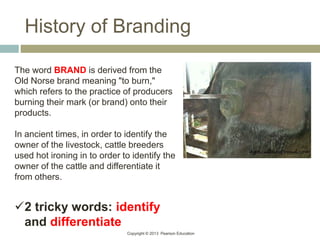
The word BRAND is derived from the
Old Norse brand meaning "to burn,"
which refers to the practice of producers
burning their mark (or brand) onto their
products.
In ancient times, in order to identify the
owner of the livestock, cattle breeders
used hot ironing in to order to identify the
owner of the cattle and differentiate it
from others.
2 tricky words: identify
and differentiate
Copyright © 2013 Pearson Education
What is a brand?
 According to AMA (American Marketing
Association)
 A brand is “ name, term, sign, symbol, or
design or a combination of them intended to
identify the goods and services of one seller or
group of sellers and to differentiate them from
those of competition”
 2 tricky words: identify and
differentiate
Copyright © 2013 Pearson Education
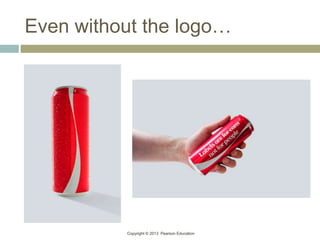
Even without the logo…
Copyright © 2013 Pearson Education
Simply,
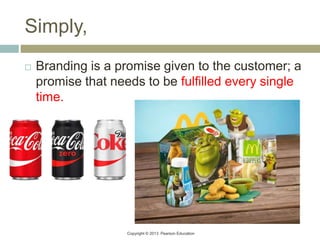
 Branding is a promise given to the customer; a
promise that needs to be fulfilled every single
time.
Copyright © 2013 Pearson Education
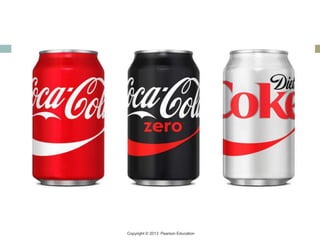
In class reading: Coca Cola’s Branding
Lesson
 Page 32 from textbook
Copyright © 2013 Pearson Education
Q to the class
 Why do brands/branding matter? Why is it
important?
1. Simplify decision making process
(E.g. in a supermarket to pick up coca-cola, le
cola, bi cola, pepsi)
2. Reduces risk
3. Set expectations
Copyright © 2013 Pearson Education
What is a Brand?
Brand Elements
Brands versus Products
Set of expectations, memories,
stories and relationships taken
together!
Copyright © 2013 Pearson Education
Brand Elements
 Different components that identifies and
differentiates a brand
 Name, logo, symbol, package design, or other
characteristic
 Can be based on people, places, things, and
abstract images
Copyright © 2013 Pearson Education
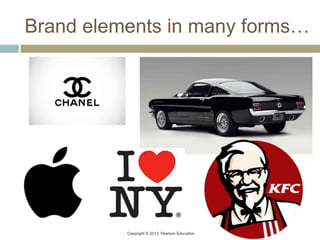
Brand elements in many forms…
Copyright © 2013 Pearson Education
Brand elements come
together…
https://www.youtube.com/watch?v=auEdEYY3ao4
Advertisement for Audi…
Copyright © 2013 Pearson Education
Brand versus Product
Brand Product
Has dimensions that differentiate it in
some way from other products designed
to satisfy the same need
Anything available in the market for use
or consumption, that may satisfy a need
or want
Can be differentiated on the basis of:
• Packaging
• Services provided
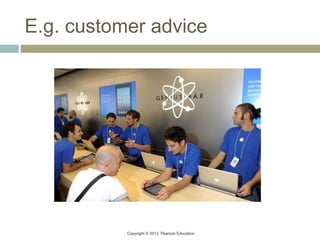
• Customer advice
• Financing
• Delivery arrangements
• Warehousing
• Other things valued by the customers
Can be categorized into five levels
namely:
• Core benefit level
• Generic product level
• Expected product level
• Augmented product level
• Potential product level
Copyright © 2013 Pearson Education
E.g. customer advice
Copyright © 2013 Pearson Education
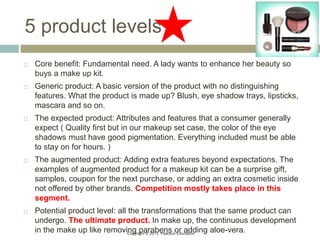
5 product levels
 Core benefit: Fundamental need. A lady wants to enhance her beauty so
buys a make up kit.
 Generic product: A basic version of the product with no distinguishing
features. What the product is made up? Blush, eye shadow trays, lipsticks,
mascara and so on.
 The expected product: Attributes and features that a consumer generally
expect ( Quality first but in our makeup set case, the color of the eye
shadows must have good pigmentation. Everything included must be able
to stay on for hours. )
 The augmented product: Adding extra features beyond expectations. The
examples of augmented product for a makeup kit can be a surprise gift,
samples, coupon for the next purchase, or adding an extra cosmetic inside
not offered by other brands. Competition mostly takes place in this
segment.
 Potential product level: all the transformations that the same product can
undergo. The ultimate product. In make up, the continuous development
in the make up like removing parabens or adding aloe-vera.
Copyright © 2013 Pearson Education
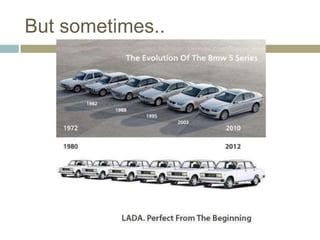
But sometimes..
Copyright © 2013 Pearson Education
Brand vs Product
 The new competition is not between what
companies produce in their factories but
between what they add to their factory output
in the form of packaging, advertising,
services, customer advice, financing,
delivery arrangements, warehousing and
other things.
Copyright © 2013 Pearson Education
To Sum Up ....
 Through branding, organizations:
 Create perceived differences among products
 Develop loyal customers
 Create value that can translate to financial profits
 Tricky word PREMIUM PRICING
Copyright © 2013 Pearson Education
Why Do Brands Matter?
Consumers
Firms
Copyright © 2013 Pearson Education
Consumers
Consumer: Encompass all types of customers,
including individuals as well as organizations
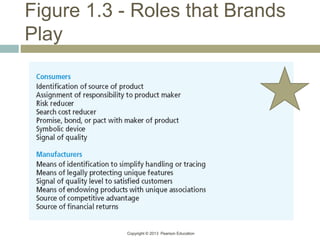
 Functions provided by brands to consumers
 Identify the source or maker of the product
 Simplify product decisions
 Lower the search costs for products internally
(thinking) and externally (looking around)
 Helps set reasonable expectations about what
consumers may not know about the brand
Copyright © 2013 Pearson Education
Consumers
 Signal product characteristics and attributes
 On the basis of attributes products can be classified
as:
 Search goods (e.g. grocery products-visual inspection)
 Experience goods (e.g. automobile tires-experience
needed)
 Credence goods (e.g. insurance coverage-rarely
experienced)
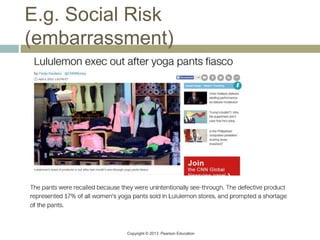
 Reduce risks in product decision
 These risk can be categorised as
 Functional ,physical, financial, social psychological, and
time
Copyright © 2013 Pearson Education
E.g. Social Risk
(embarrassment)
Copyright © 2013 Pearson Education
Firms
 Brands provide valuable functions
 Simplify product handling and tracing
 Help organizing inventory and accounting records
 Offer the firm legal protection for unique features
or aspects of the product (trade marks, patents,
copyrights and designs)
 Provide predictability and security of demand for
the firm (customer satisfaction leads to loyalty
ends up with repeat purchase)
 Creates barriers of entry for competitors and
provide a powerful means to secure competitive
advantage
Copyright © 2013 Pearson Education
Figure 1.3 - Roles that Brands
Play
Copyright © 2013 Pearson Education
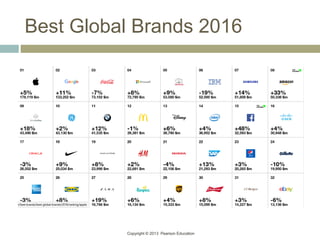
Best Global Brands 2016
Copyright © 2013 Pearson Education
Q: Can Anything Be Branded?
 To brand a product marketers should identify
- WHO the product is
- Provide meaning for the brand WHAT it stands
for
Since branding is about the perceptions of the
consumer and rooted deeply in the minds of the
consumers.
Marketers benefit from branding whenever
Copyright © 2013 Pearson Education
Can Anything Be Branded
Physical Goods
Services
Copyright © 2013 Pearson Education
Physical Goods
Business-to-Business
Products
High-tech Products
Businesses put the fate of their
company in the hands of another
company E.g. aircraft engine vs.
toothpaste
Even commodities can be
branded E.g. De Beers
Many hi tech companies see branding
as naming. But innovation is not solely
enough for marketplace success. See
the next slide!
Copyright © 2013 Pearson Education
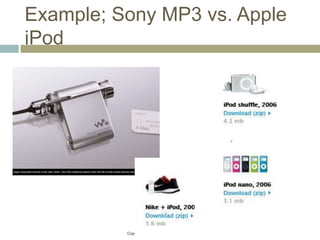
Example; Sony MP3 vs. Apple
iPod
Copyright © 2013 Pearson Education
Physical Goods: B2B Branding
B2B brands E.g. INTEL (Intel Inside Campaign),
Accenture (Tiger Woods Campaign) etc.
• Guidelines for marketers of B2B brands
• Ensure that entire organization supports branding and brand
management. (especially salesforce since B2B requires more
personal selling)
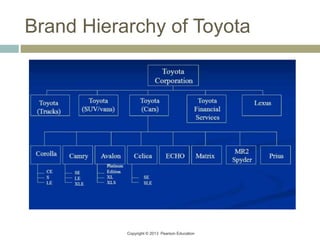
• Adopt a corporate branding strategy if possible and create a well-
defined brand hierarchy.
• Frame value perceptions. (putting best foot forward)
• Link relevant non-product-related brand associations (superior
customer service, financial easiness)
• Find relevant emotional associations for the brand.
• Segment customers carefully both within and across companies.
Copyright © 2013 Pearson Education
Brand Hierarchy of Toyota
Copyright © 2013 Pearson Education
Services
Role of Branding with
Services
Professional Services
Copyright © 2013 Pearson Education
Can Anything Be Branded
Retailers and Distributors
Online Products and Services
People and Organizations
Copyright © 2013 Pearson Education
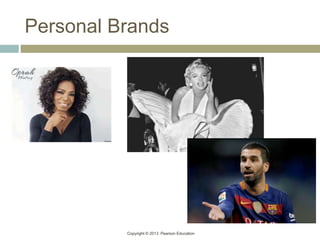
Personal Brands
Copyright © 2013 Pearson Education
Can anything be branded
Sports , Arts, and Entertainment
Geographic Locations
Ideas and Causes
Copyright © 2013 Pearson Education
To Sum up....
 Branding is universal and pervasive in different
product categories
 Applicable to both tangible and intangible
offerings of an organization
 Technological developments have impacted
the way firms market their offerings
 Organizations reap financial benefits from
positive brand images
Copyright © 2013 Pearson Education
Strong Brands
 Brands that have been market leaders in their
categories for decades
 Any brand is vulnerable and susceptible to
poor brand management
Copyright © 2013 Pearson Education
Factors Responsible for Branding
Challenges
Savvy customers
Economic downturns
Brand proliferation
Media transformation
Copyright © 2013 Pearson Education
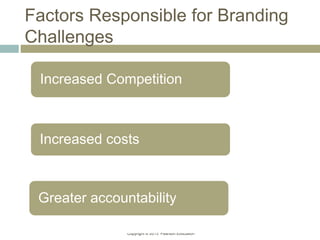
Factors Responsible for Branding
Challenges
Increased Competition
Increased costs
Greater accountability
Copyright © 2013 Pearson Education
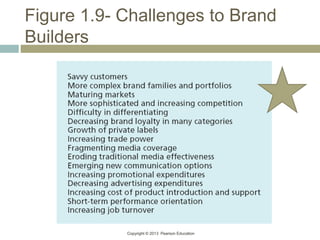
Figure 1.9- Challenges to Brand
Builders
Copyright © 2013 Pearson Education
Brand Equity
Brand equity is a phrase which describes the
value of having a well-known brand name.
Simply put brand equity = value of the brand
Copyright © 2013 Pearson Education
Brand Equity
 Principles of branding and brand equity
 Differences in outcomes arise from the “added value”
endowed to a product
 The added value can be created for a brand in many
different ways (different branding strategies)
 Brand equity provides a common denominator for
interpreting marketing strategies and assessing the
value of a brand
 There are many different ways in which the value of a
brand can be exploited to benefit the firm (from customer
loyalty to premium pricing)
Copyright © 2013 Pearson Education
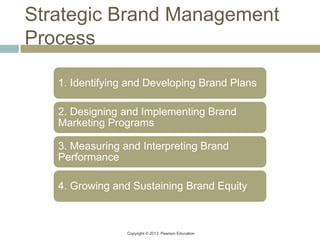
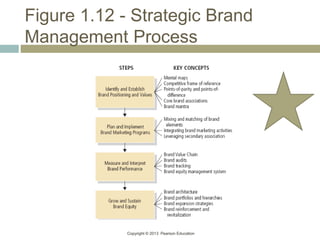
Strategic Brand Management
Process
1. Identifying and Developing Brand Plans
2. Designing and Implementing Brand
Marketing Programs
3. Measuring and Interpreting Brand
Performance
4. Growing and Sustaining Brand Equity
Copyright © 2013 Pearson Education
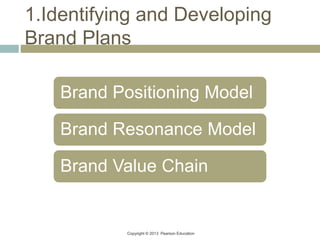
1.Identifying and Developing
Brand Plans
Brand Positioning Model
Brand Resonance Model
Brand Value Chain
Copyright © 2013 Pearson Education
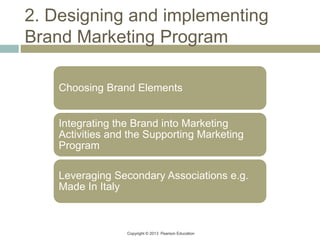
2. Designing and implementing
Brand Marketing Program
Choosing Brand Elements
Integrating the Brand into Marketing
Activities and the Supporting Marketing
Program
Leveraging Secondary Associations e.g.
Made In Italy
Copyright © 2013 Pearson Education
3.. Measuring and Interpreting
Brand Performance
 To manage brands profitably, managers must
implement a brand equity measurement
system
 Brand equity measurement system involves:
 Brand audits
 Brand tracking studies
 Brand equity management system
Copyright © 2013 Pearson Education
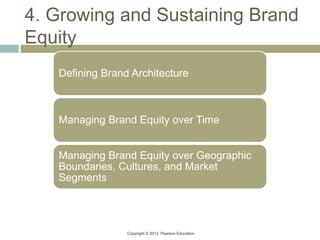
4. Growing and Sustaining Brand
Equity
Defining Brand Architecture
Managing Brand Equity over Time
Managing Brand Equity over Geographic
Boundaries, Cultures, and Market
Segments
Copyright © 2013 Pearson Education
Figure 1.12 - Strategic Brand
Management Process
Copyright © 2013 Pearson Education
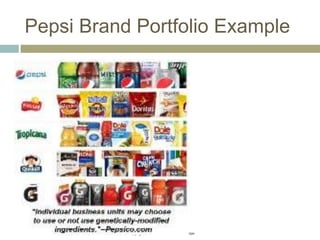
Pepsi Brand Portfolio Example