Open Technology
The Third Pillar of Open Education
Clint Lalonde, BCcampus
March 30, 2017 KPU
Unless otherwise noted, this presentation is licensed
under a Creative Commons Attribution License.
Feel free to use, modify or distribute any or all of this
presentation with attribution to Clint Lalonde.
Image Credit: Defender of the Commons by Alan Levine CC0
Agenda
What are open technologies?
Why are they important?
The BC Open EdTech Collaborative
Experiments and Initiatives
What are the first 2 pillars?
Pillar 1: Open Educational Resources
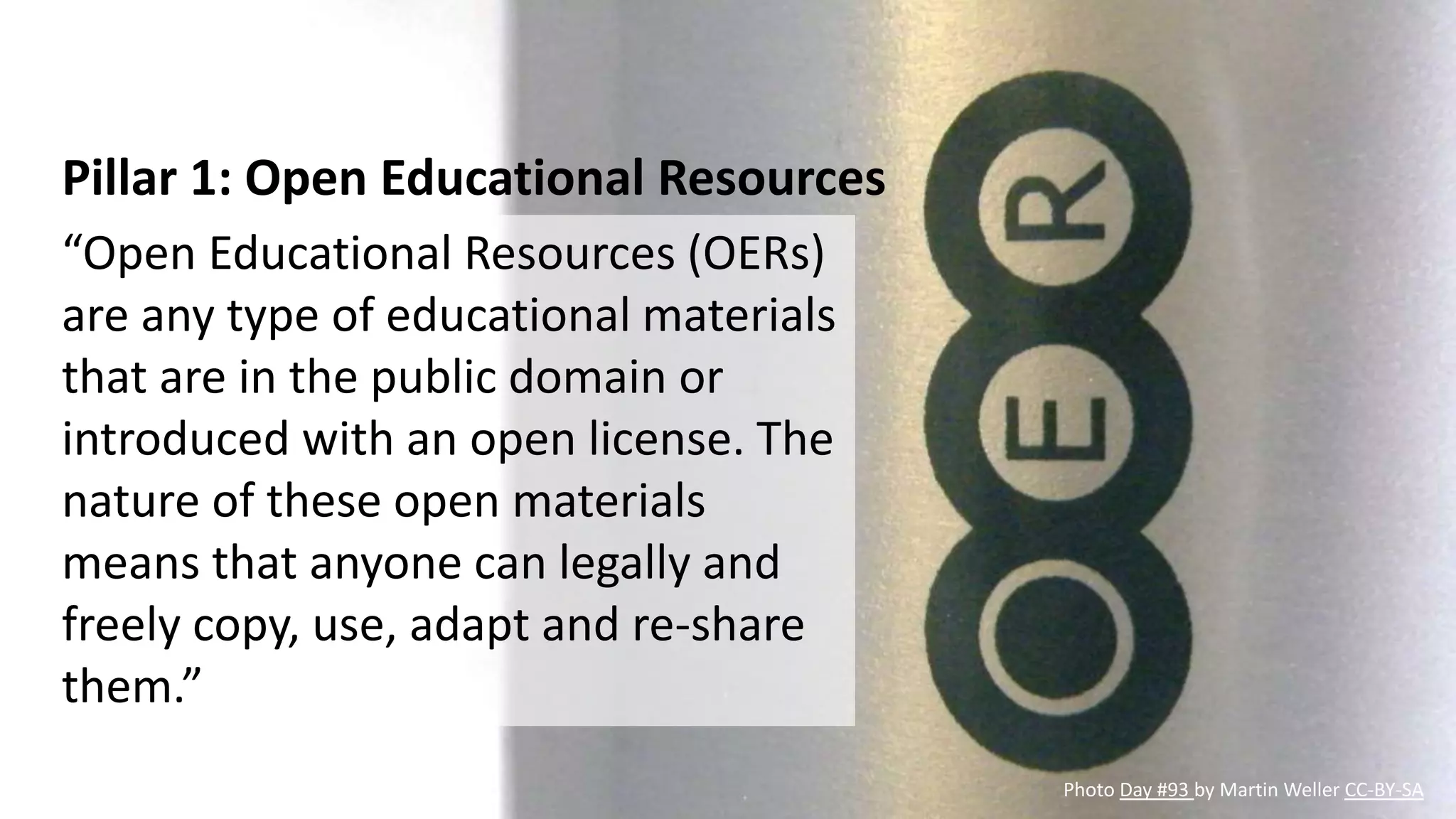
Photo Day #93 by Martin Weller CC-BY-SA
“Open Educational Resources (OERs)
are any type of educational materials
that are in the public domain or
introduced with an open license. The
nature of these open materials
means that anyone can legally and
freely copy, use, adapt and re-share
them.”
UNESCO
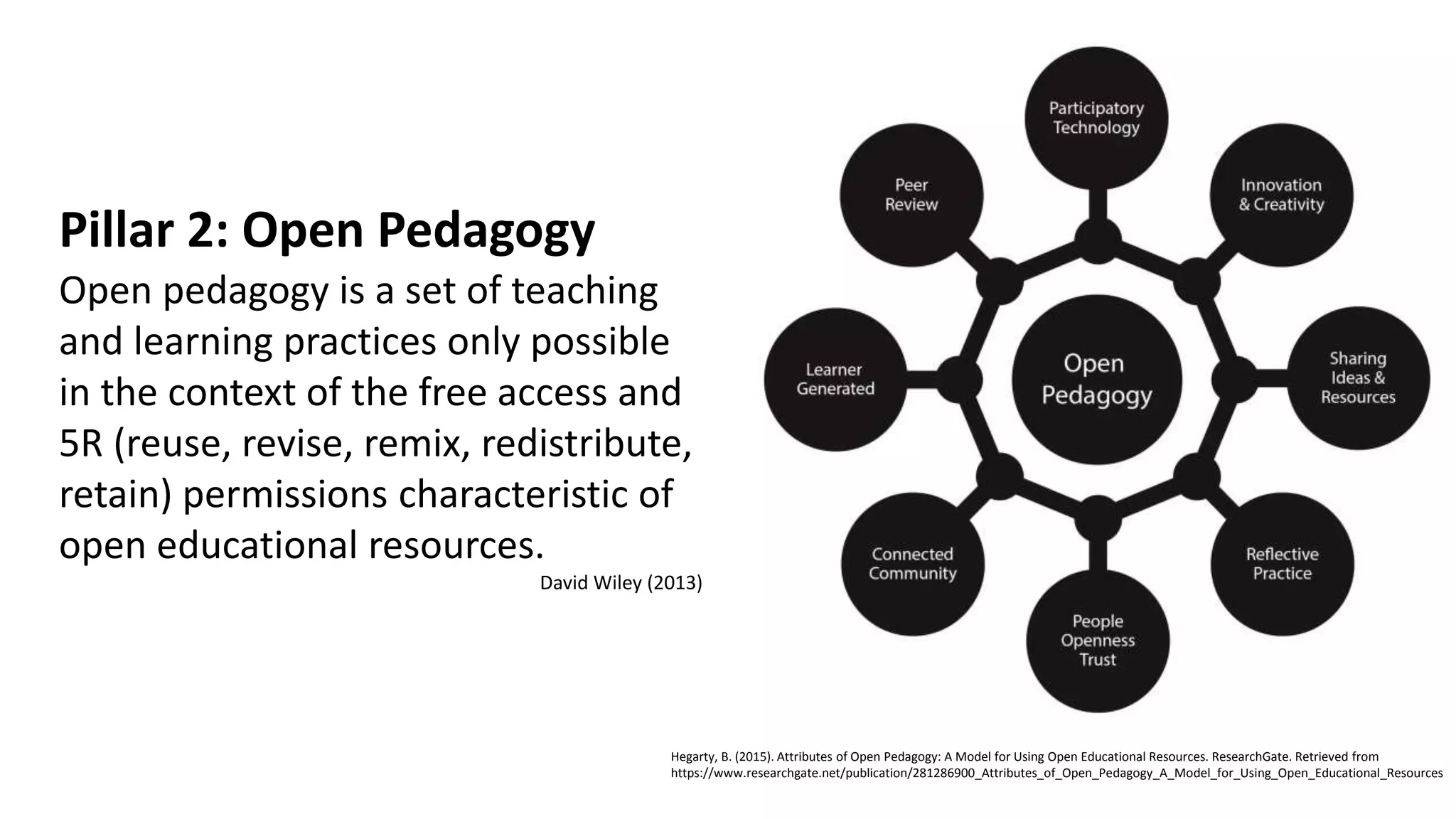
Pillar 2: Open Pedagogy
Open pedagogy is a set of teaching
and learning practices only possible
in the context of the free access and
5R (reuse, revise, remix, redistribute,
retain) permissions characteristic of
open educational resources.
David Wiley (2013)
Hegarty, B. (2015). Attributes of Open Pedagogy: A Model for Using Open Educational Resources. ResearchGate. Retrieved from
https://www.researchgate.net/publication/281286900_Attributes_of_Open_Pedagogy_A_Model_for_Using_Open_Educational_Resources
“Open education is not limited to just open
educational resources. It also draws upon
open technologies that facilitate
collaborative, flexible learning and the open
sharing of teaching practices that empower
educators to benefit from the best ideas of
their colleagues.”
Cape Town Open Education Declaration, 2007
Pillar 3: Open technology
http://www.cbc.ca/radio/spark/297-the-future-
of-food-farming-and-more-1.3275728/why-this-
farmer-built-a-cool-robot-tractor-1.3284431
http://www.cbc.ca/radio/spark/297-the-future-of-
food-farming-and-more-1.3275728/why-this-
farmer-built-a-cool-robot-tractor-1.3284431
https://www.extremetech.com/extreme/203913-general-
motors-john-deere-want-to-keep-tinkering-self-repair-illegal
http://www.cbc.ca/radio/spark/297-the-future-of-
food-farming-and-more-1.3275728/why-this-
farmer-built-a-cool-robot-tractor-1.3284431
https://www.extremetech.com/extreme/203913-general-
motors-john-deere-want-to-keep-tinkering-self-repair-illegal
https://www.extremetech.com/computing/246314-farmers-
pirating-john-deere-tractor-software-stick-man
What are
technologies?
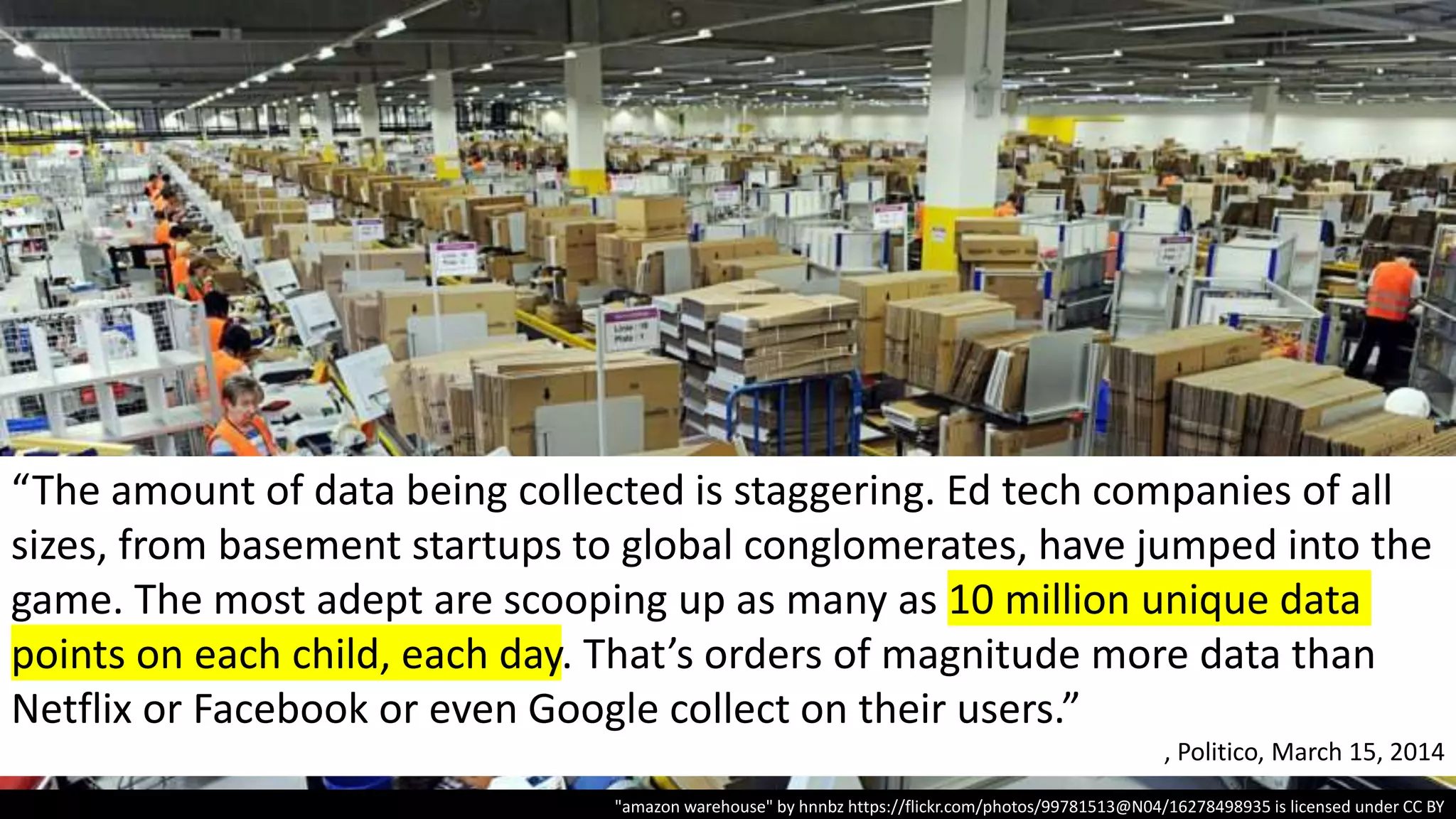
“The amount of data being collected is staggering. Ed tech companies of all
sizes, from basement startups to global conglomerates, have jumped into the
game. The most adept are scooping up as many as 10 million unique data
points on each child, each day. That’s orders of magnitude more data than
Netflix or Facebook or even Google collect on their users.”
The big biz of spying on little kids, Politico, March 15, 2014
"amazon warehouse" by hnnbz https://flickr.com/photos/99781513@N04/16278498935 is licensed under CC BY
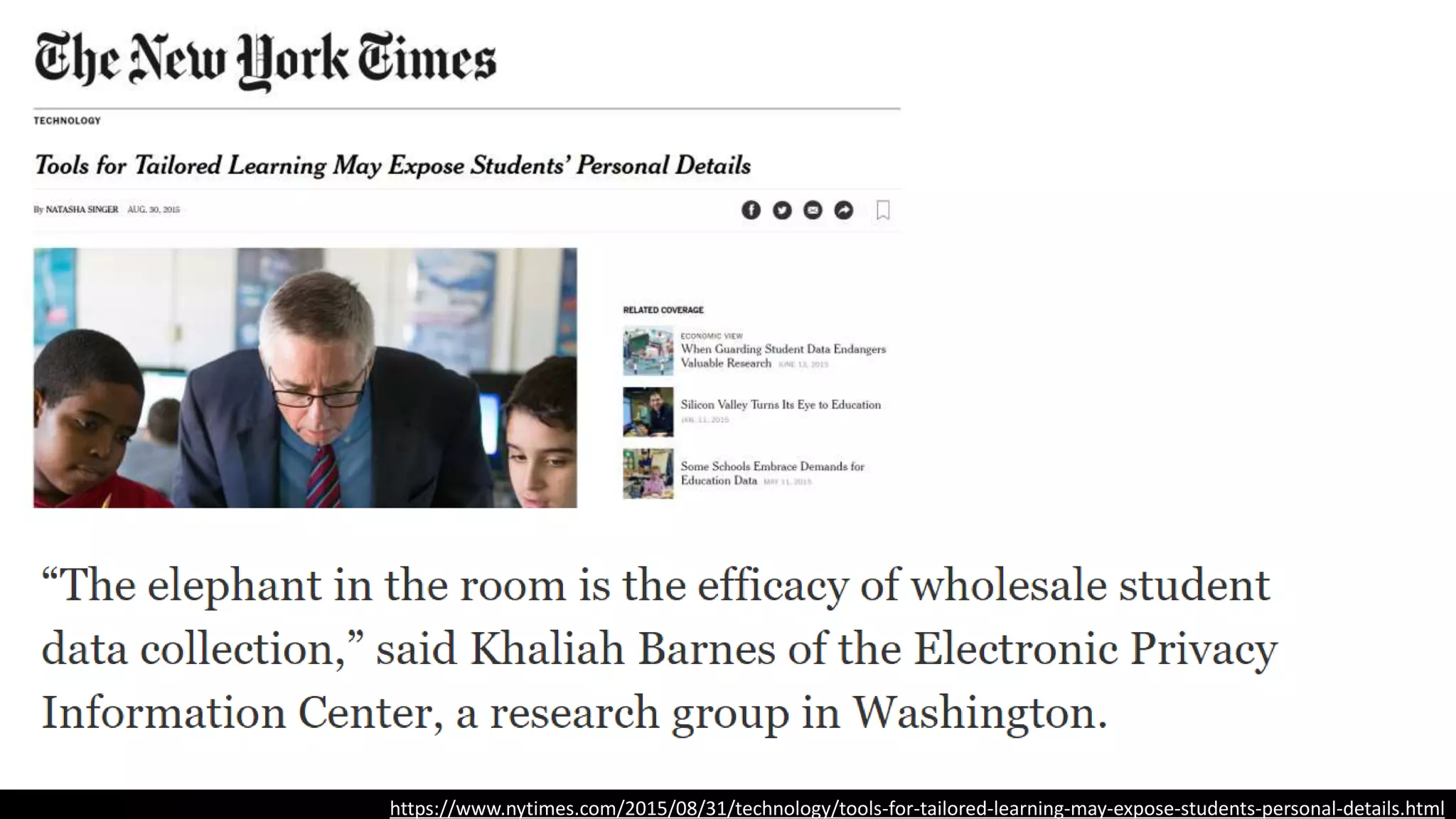
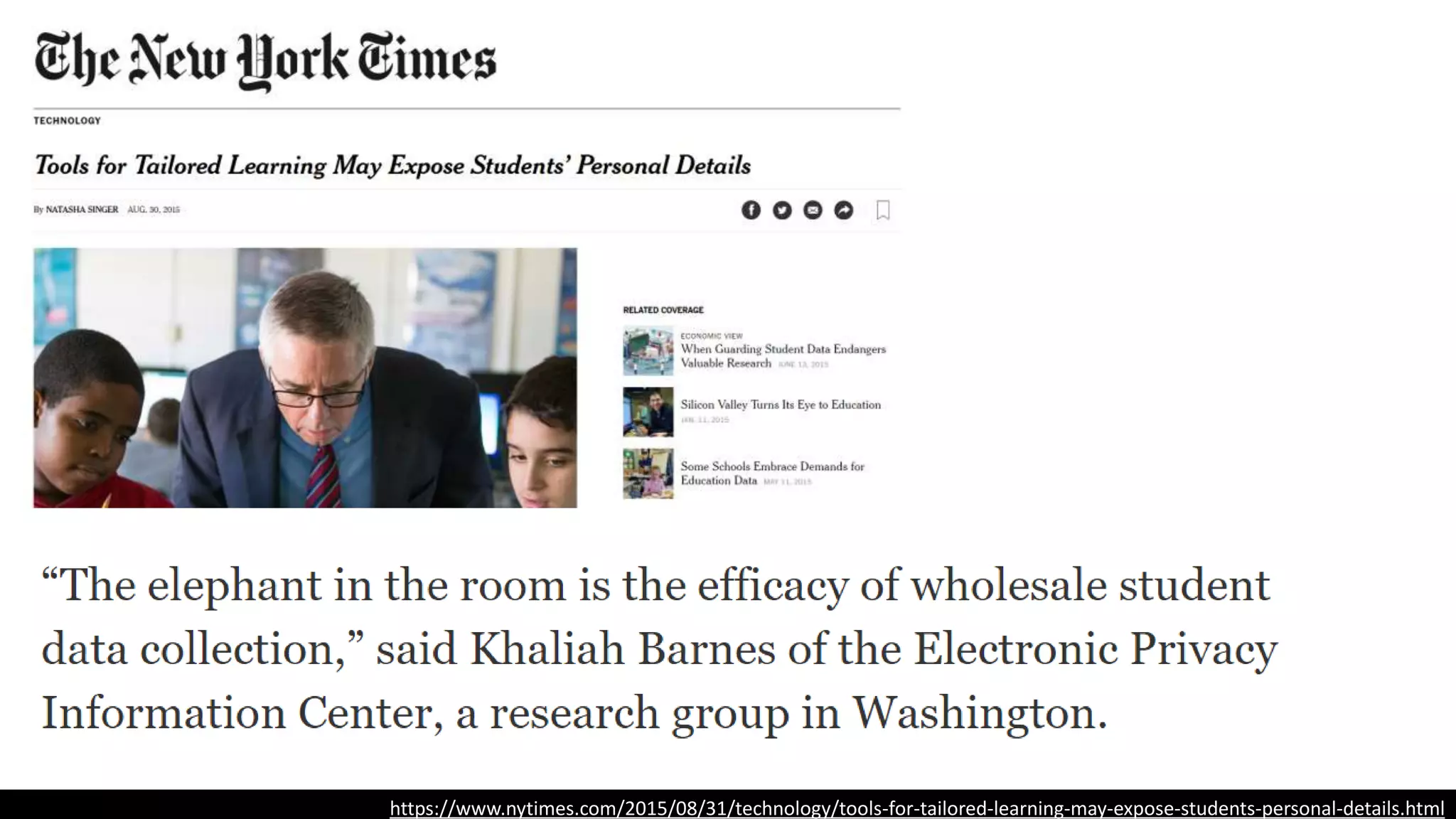
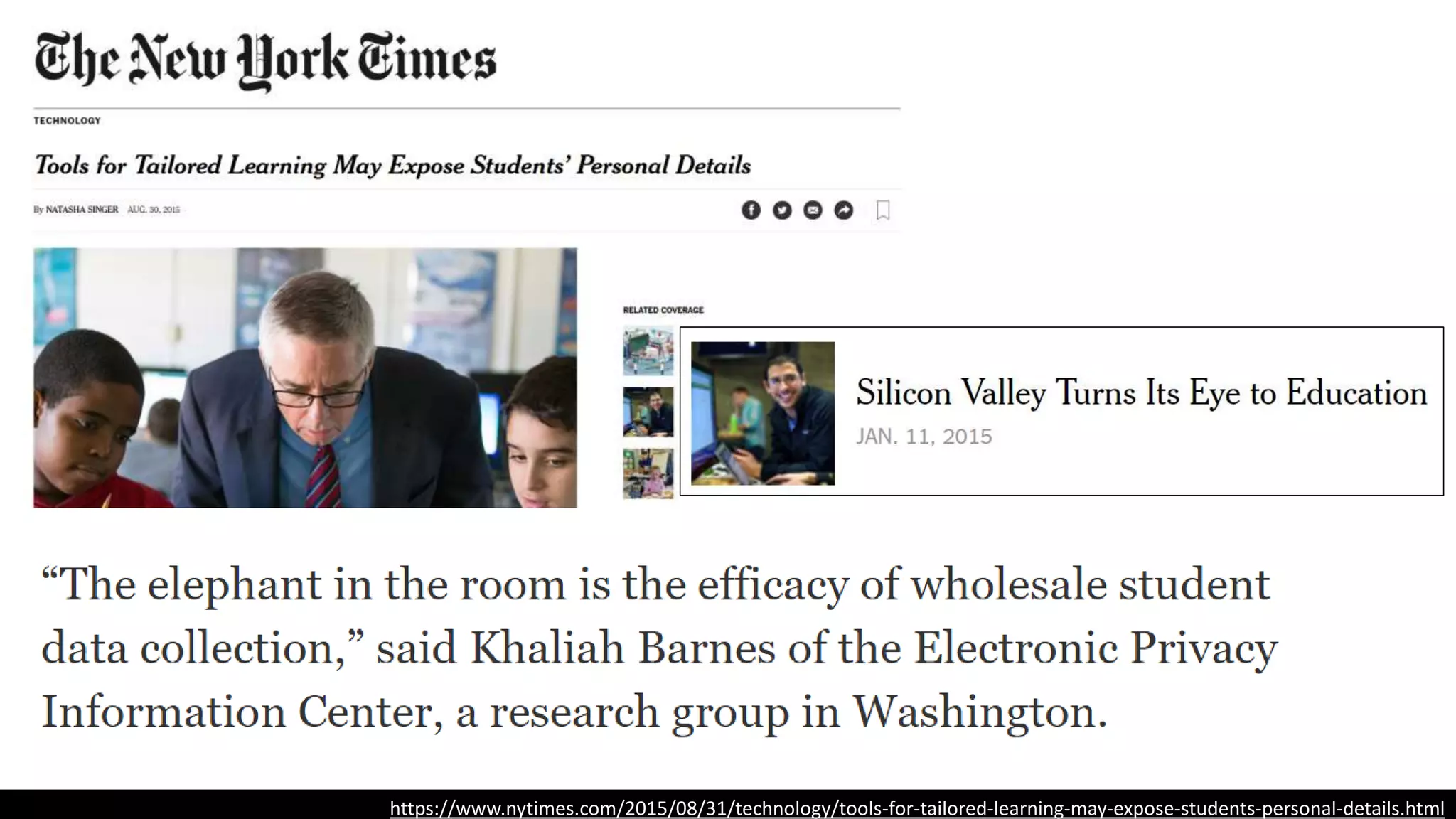
https://www.nytimes.com/2015/08/31/technology/tools-for-tailored-learning-may-expose-students-personal-details.html
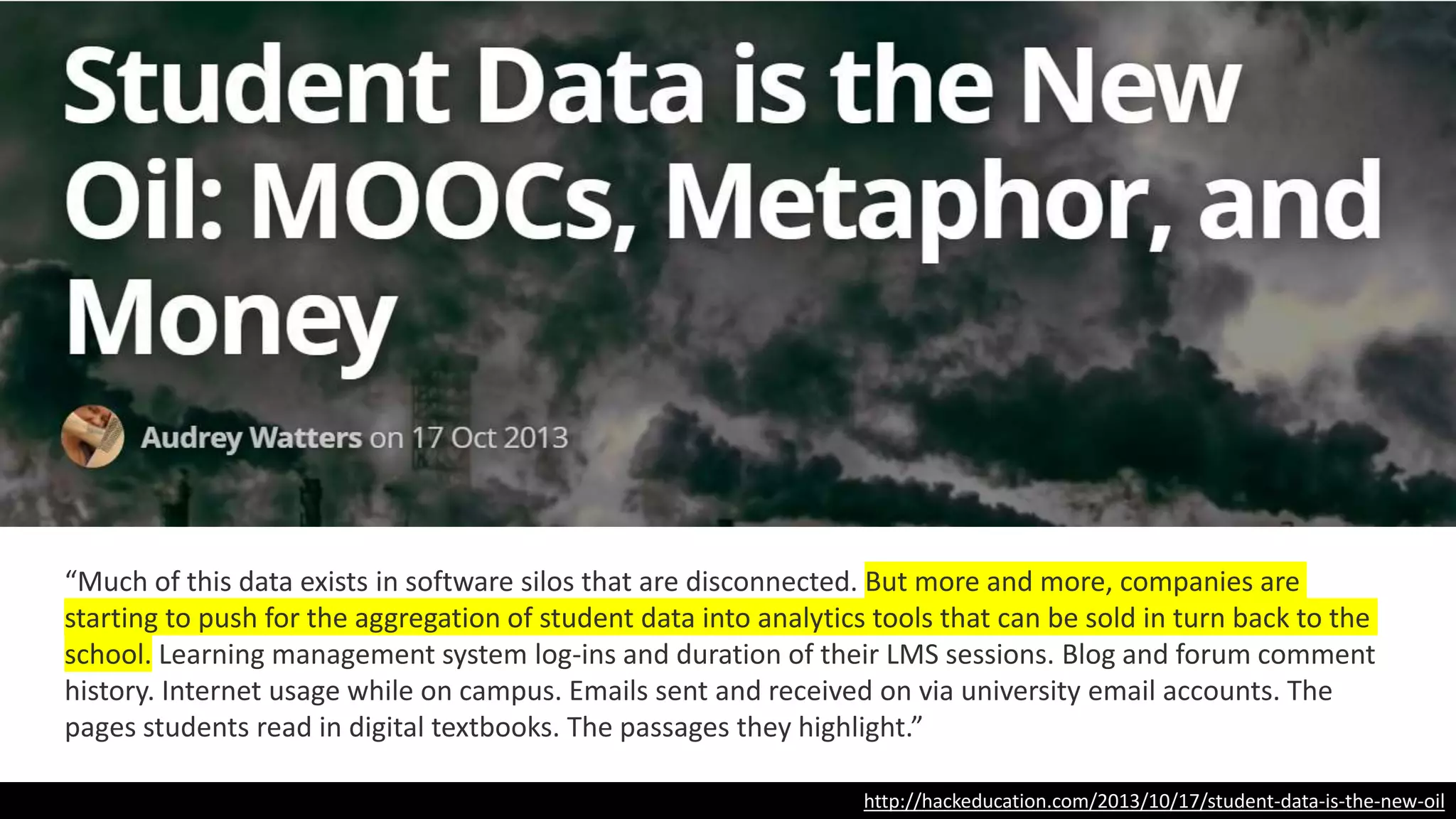
http://hackeducation.com/2013/10/17/student-data-is-the-new-oil
“Much of this data exists in software silos that are disconnected. But more and more, companies are
starting to push for the aggregation of student data into analytics tools that can be sold in turn back to the
school. Learning management system log-ins and duration of their LMS sessions. Blog and forum comment
history. Internet usage while on campus. Emails sent and received on via university email accounts. The
pages students read in digital textbooks. The passages they highlight.”
http://hackeducation.com/2013/10/17/student-data-is-the-new-oil
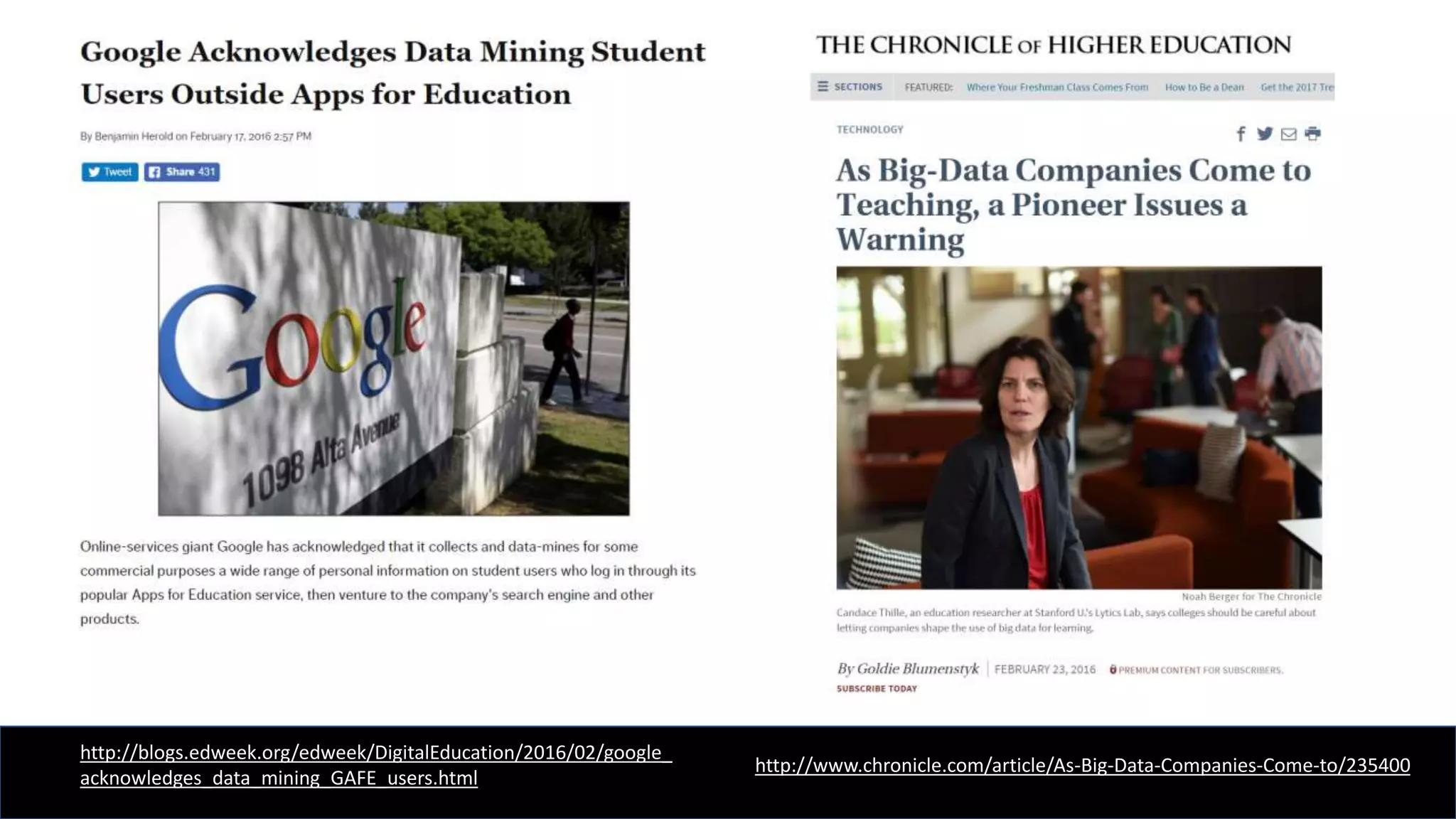
http://blogs.edweek.org/edweek/DigitalEducation/2016/02/google_
acknowledges_data_mining_GAFE_users.html
http://www.chronicle.com/article/As-Big-Data-Companies-Come-to/235400
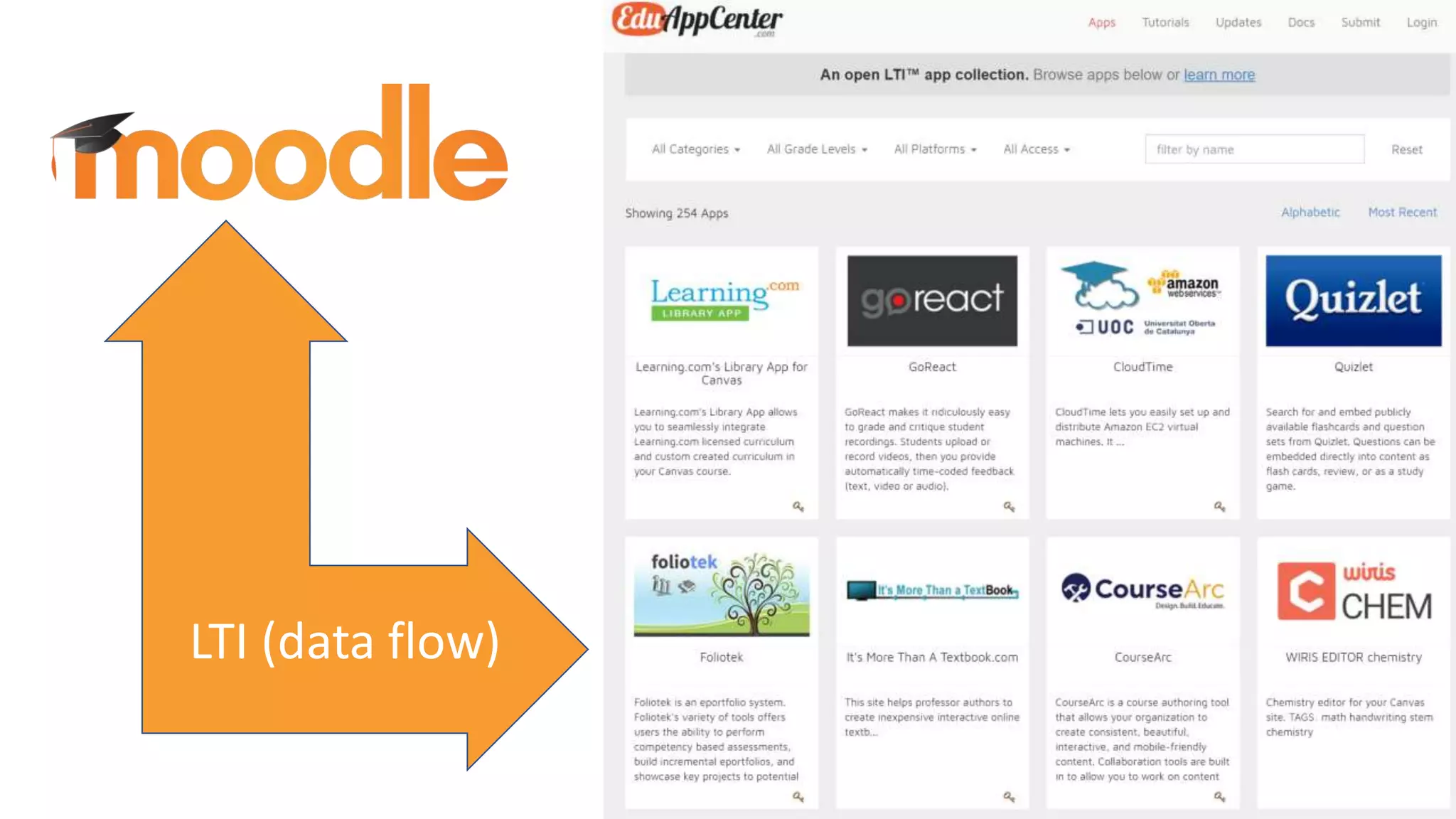
LTI (data flow)
LTI (data flow)
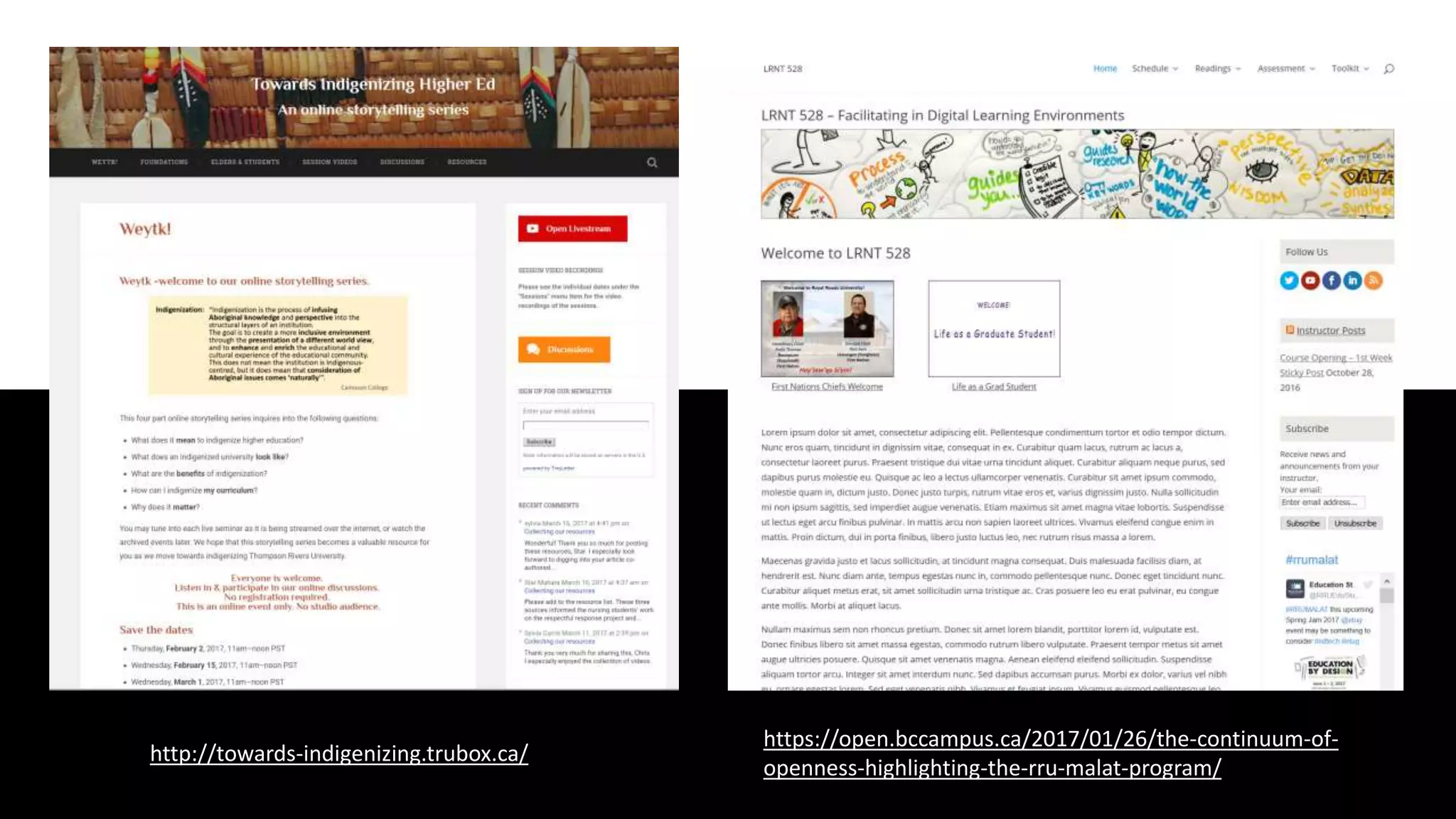
http://towards-indigenizing.trubox.ca/
https://open.bccampus.ca/2017/01/26/the-continuum-of-
openness-highlighting-the-rru-malat-program/
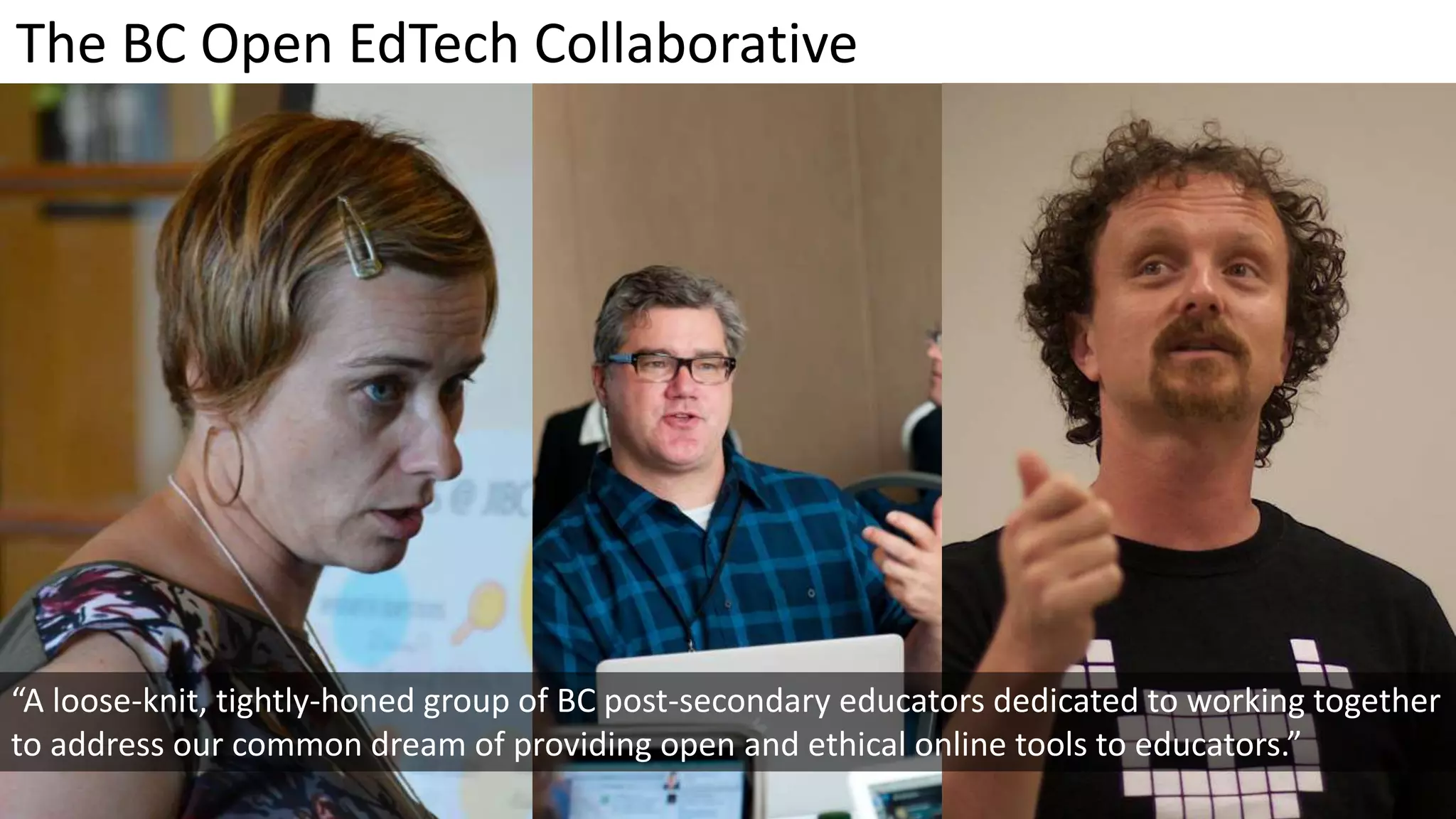
“A loose-knit, tightly-honed group of BC post-secondary educators dedicated to working together
to address our common dream of providing open and ethical online tools to educators.”
The BC Open EdTech Collaborative (BCOETC)
1. To promote the use of open source software (OSS) applications focused on teaching & learning.
Photo: How To: Founding an Open Source Software Center at a University by opensourceway is licensed under CC BY-SA. Photo was cropped
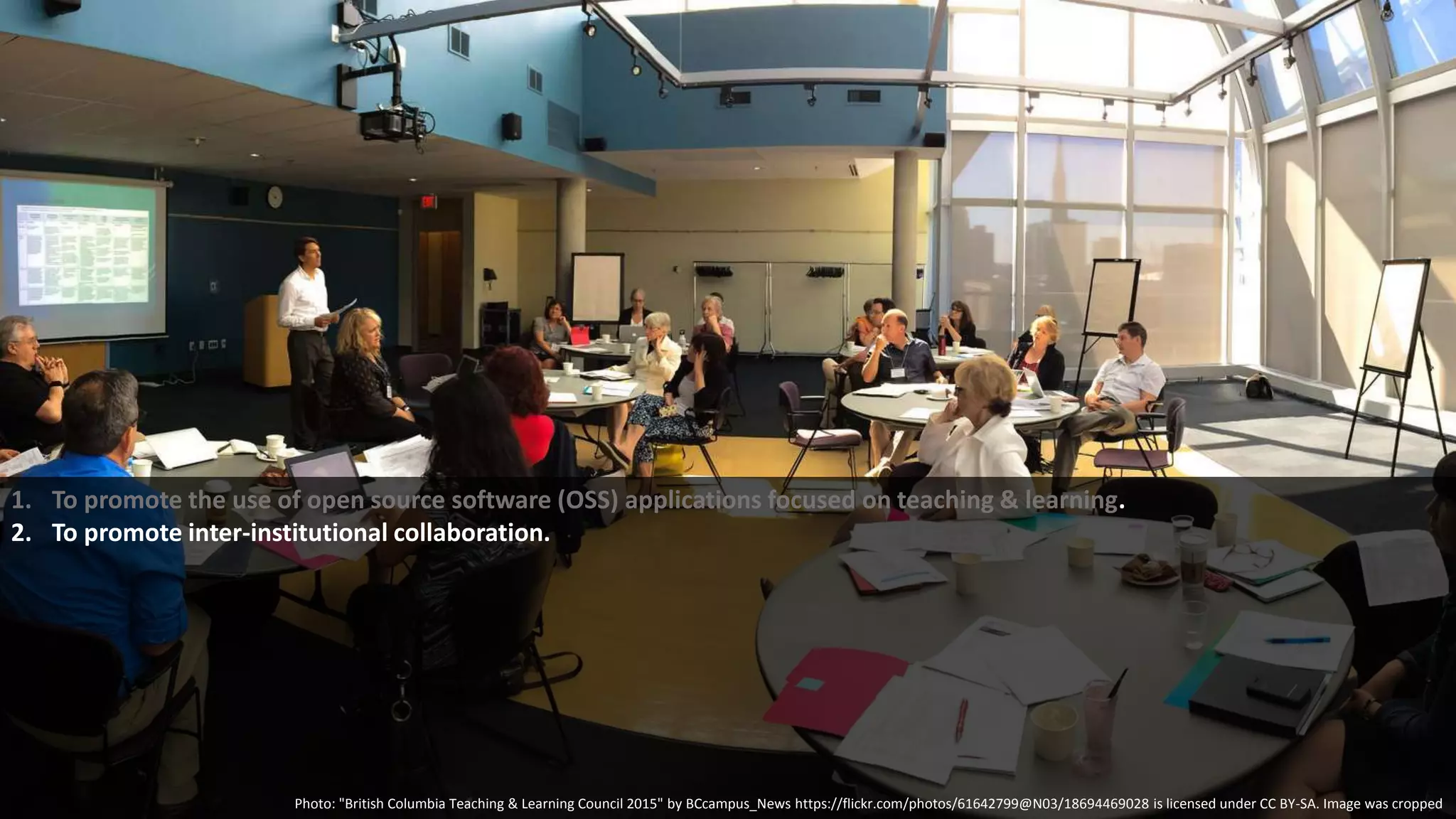
1. To promote the use of open source software (OSS) applications focused on teaching & learning.
2. To promote inter-institutional collaboration.
Photo: "British Columbia Teaching & Learning Council 2015" by BCcampus_News https://flickr.com/photos/61642799@N03/18694469028 is licensed under CC BY-SA. Image was cropped
1. To promote the use of open source software (OSS) applications focused on teaching & learning.
2. To promote inter-institutional collaboration.
3. To provide a pathway for institutions and educators to actively participate in OSS projects focused on teaching & learning.
1. To promote the use of open source software (OSS) applications focused on teaching & learning.
2. To promote inter-institutional collaboration.
3. To provide a pathway for institutions and educators to actively participate in OSS projects focused on teaching & learning.
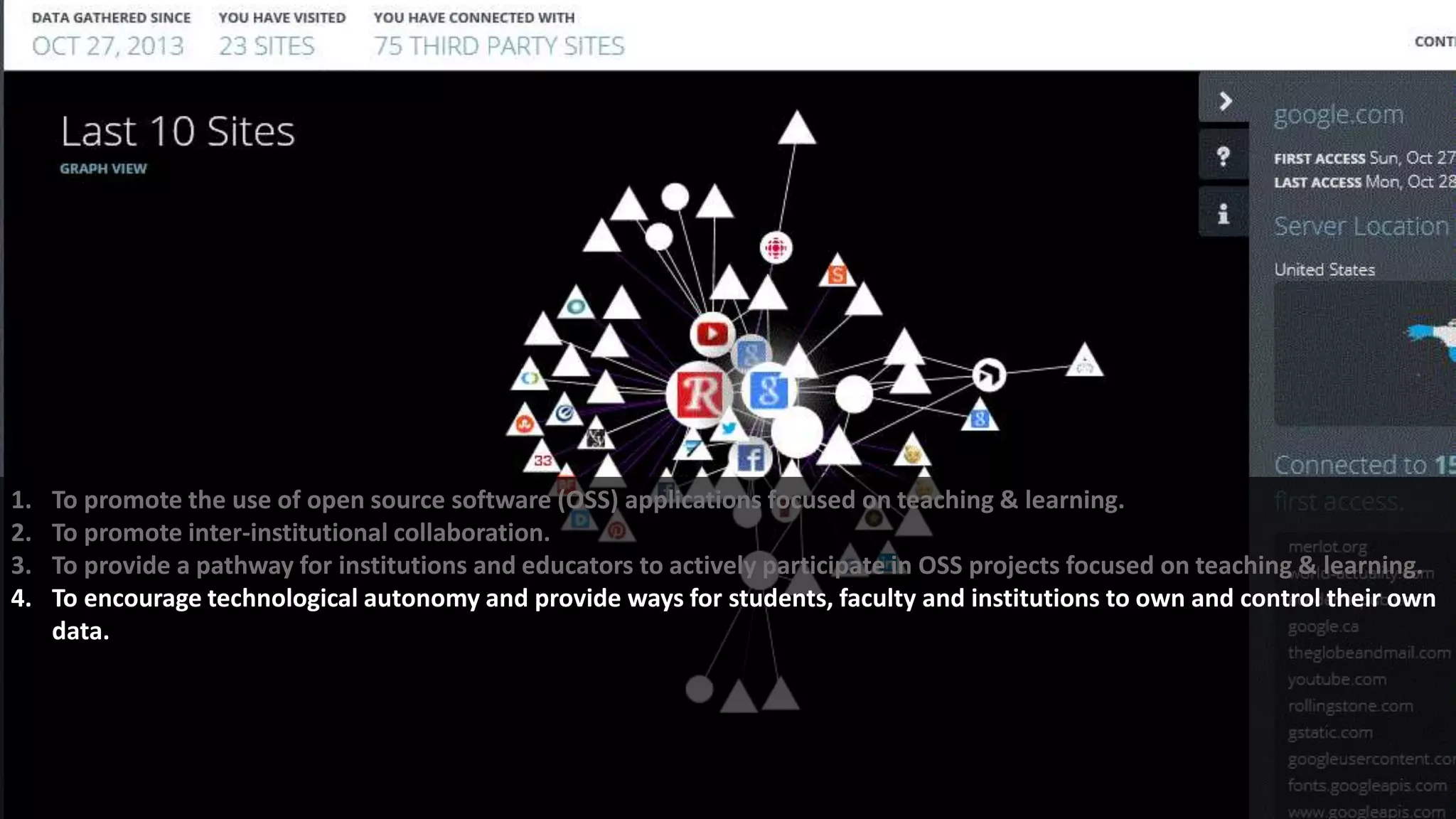
4. To encourage technological autonomy and provide ways for students, faculty and institutions to own and control their own
data.
1. To promote the use of open source software (OSS) applications focused on teaching & learning.
2. To promote inter-institutional collaboration.
3. To provide a pathway for institutions and educators to actively participate in OSS projects focused on teaching & learning.
4. To encourage technological autonomy and provide ways for students, faculty and institutions to own and control their own
data.
5. To lower the barriers to participation on the open web for BC faculty and students.
Photo: "Mid-Morning Light in Our North Georgia Garden" by UGArdener https://flickr.com/photos/ugardener/4840554392 is licensed under CC BY-NC
1. To promote the use of open source software (OSS) applications focused on teaching & learning.
2. To promote inter-institutional collaboration.
3. To provide a pathway for institutions and educators to actively participate in OSS projects focused on teaching & learning.
4. To encourage technological autonomy and provide ways for students, faculty and institutions to own and control their own
data.
5. To lower the barriers to participation on the open web for BC faculty and students.
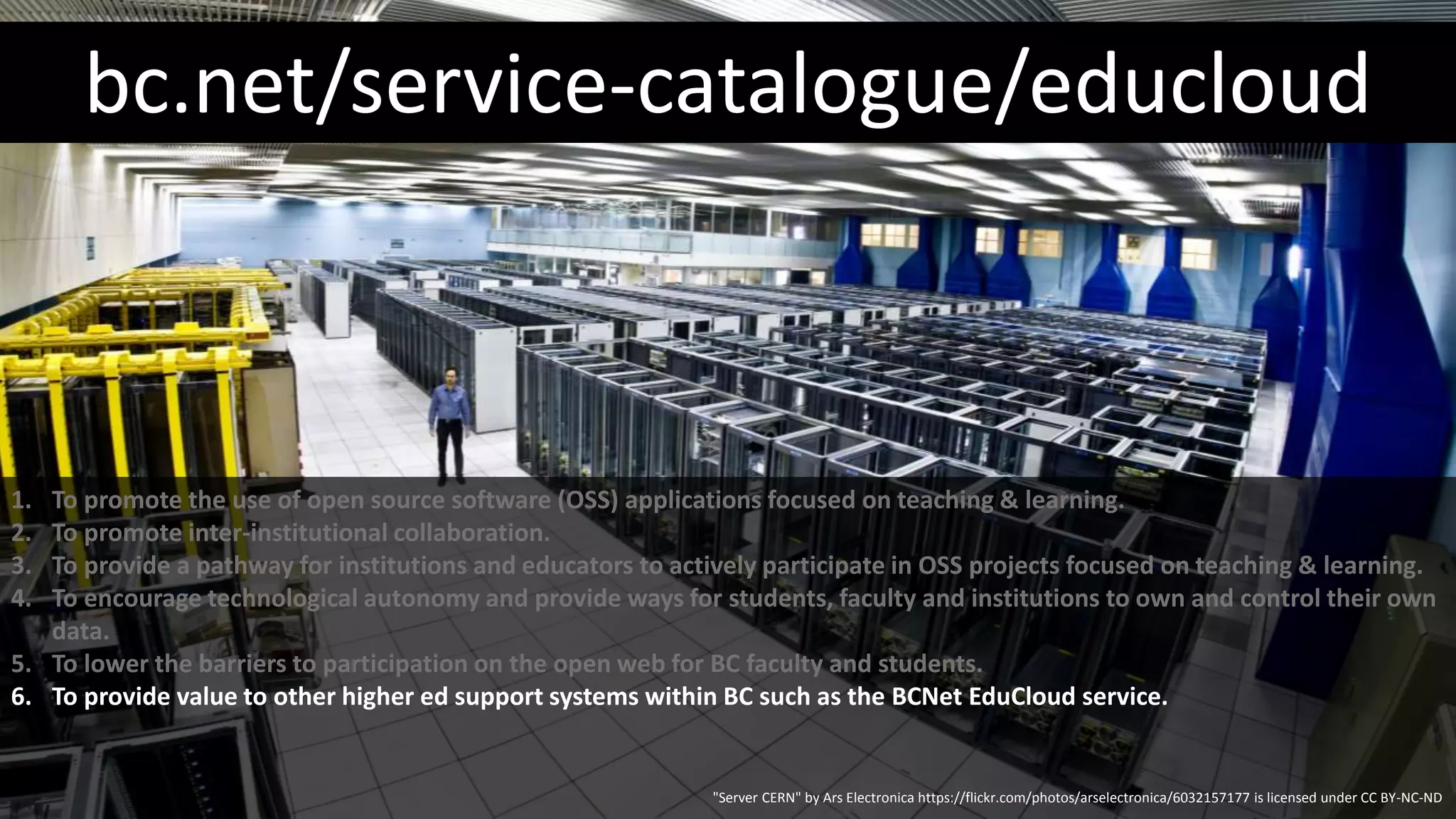
6. To provide value to other higher ed support systems within BC such as the BCNet EduCloud service.
bc.net/service-catalogue/educloud
"Server CERN" by Ars Electronica https://flickr.com/photos/arselectronica/6032157177 is licensed under CC BY-NC-ND
1. To promote the use of open source software (OSS) applications focused on teaching & learning.
2. To promote inter-institutional collaboration.
3. To provide a pathway for institutions and educators to actively participate in OSS projects focused on teaching & learning.
4. To encourage technological autonomy and provide ways for students, faculty and institutions to own and control their own
data.
5. To lower the barriers to participation on the open web for BC faculty and students.
6. To provide value to other higher ed support systems within BC such as the BCNet EduCloud service.
7. To provide another path for sustainable ed tech infrastructure to BC higher education.
"Sustainable" by LexnGer https://flickr.com/photos/lexnger/4404927583 is licensed under CC BY-NC
1. To promote the use of open source software (OSS) applications focused on teaching & learning.
2. To promote inter-institutional collaboration.
3. To provide a pathway for institutions and educators to actively participate in OSS projects focused on teaching & learning.
4. To encourage technological autonomy and provide ways for students, faculty and institutions to own and control their own
data.
5. To lower the barriers to participation on the open web for BC faculty and students.
6. To provide value to other higher ed support systems within BC such as the BCNet EduCloud service.
7. To provide another path for sustainable ed tech infrastructure to BC higher education.
8. To assist BC faculty in evaluating and making informed pedagogical decisions around open source teaching and learning
applications.
Together
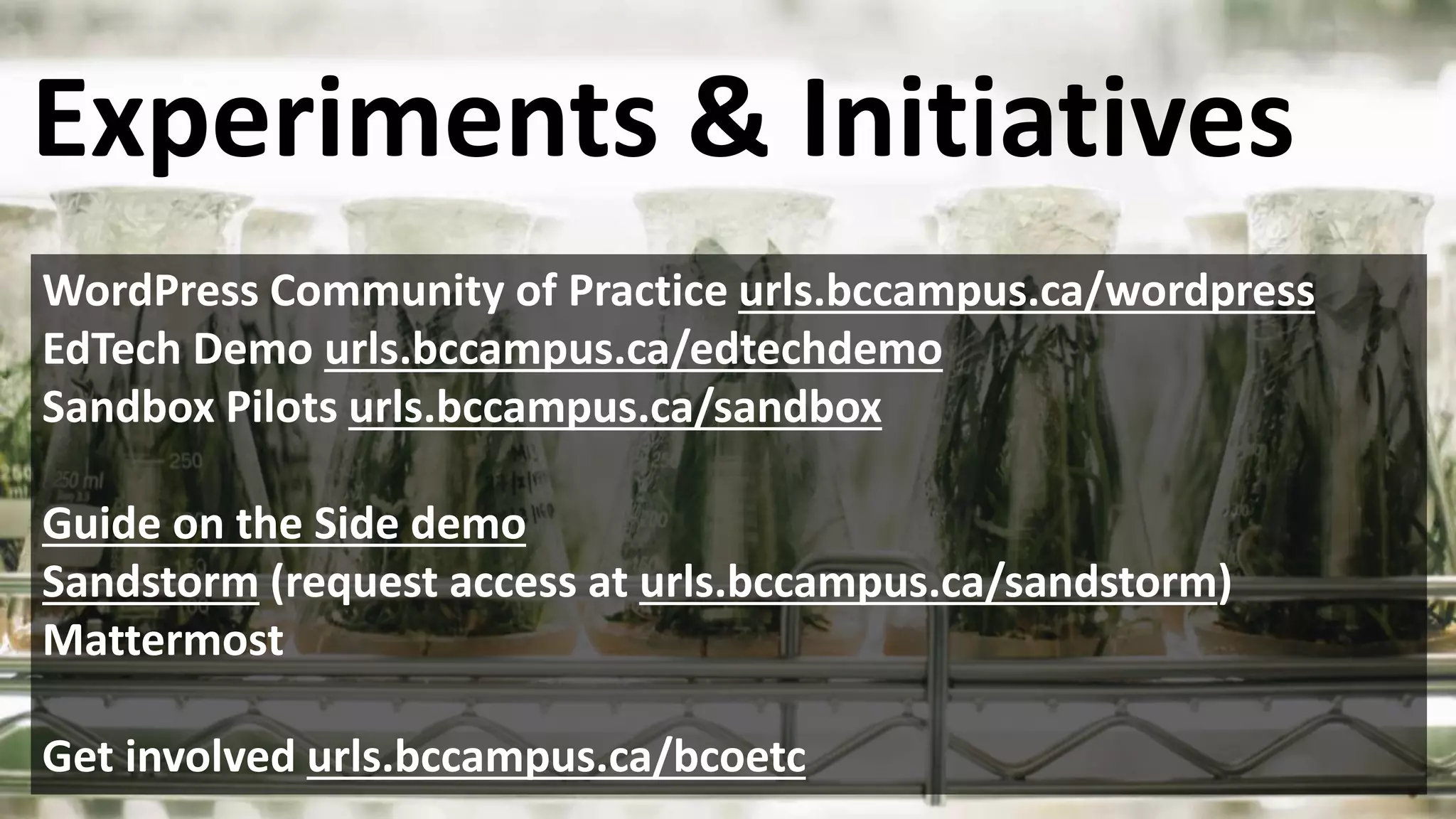
WordPress Community of Practice urls.bccampus.ca/wordpress
EdTech Demo urls.bccampus.ca/edtechdemo
Sandbox Pilots urls.bccampus.ca/sandbox
Guide on the Side demo
Sandstorm (BCOETC instance)
Mattermost
Get involved urls.bccampus.ca/bcoetc
Experiments & Initiatives
Slides: urls.bccampus.ca/3rdpillar
I used a number of images from Unsplash.com that are licensed with a CC0 license

Open Technology - The 3rd Pillar of Open Education

Editor's Notes

  • #2 Usually speak about open textbooks New presentation now topic new work – bear with me
  • #3 Events around the globe Free webinars openeducationweek.org
  • #7 Open Education Resources Granddaddy of the open education movement Begin around the turn of the century Inspired by open source software movement - Why can’t we do this in education? Open Textbooks, Open Courseware Online Program Development Fund & Open Textbook Project Free (5R reuse, revise, remix, redistribute, retain)
  • #8 Pedagogy that is enabled by the internet and collaborative technology Disposable assignment Wiki-Educator program (Wikipedia) Students build the textbook
  • #9 It is built on the belief that everyone should have the freedom to use, customize, improve and redistribute educational resources without constraint. Even more important than 10 years ago business models for ownership of software changes Technology enables Open – OER, OP require technology (specifically internet) Tech reduce the cost of copying and distribution to almost nothing No proprietary software or files -Defeats purpose to have free open OER if costs $$$ to use them Reason we chose Pressbooks for OTB – source files can be used with other PB Require tech knowledge Tech – become more restrictive more proprietary – ownership vs leasing John Deere – farmers repairing tractors
  • #10 Matt Reimer MOOC learned how to make a robot tractor to help with the harvest
  • #14 What are open technologies? We are interested in networked technologies - ability to install on our own servers Open source – code is not proprietary not owned by a company or a single entity. Released with an open licenses. Free license, but costs in different ways (development, support) But with that extra effort, you develop institutional capacity and deep understanding of how tech works. Needed by educators to have influence in the future development Not just free – free with permissions. – you can install this software on your own servers (Edu-cloud) Pathways to influence decisions around how the product is developed Development of communities Enables different models of participating and engaging with technology Develop institutional capacity around developing and installing technology (fear higher ed is moving away from this role) Own and control data
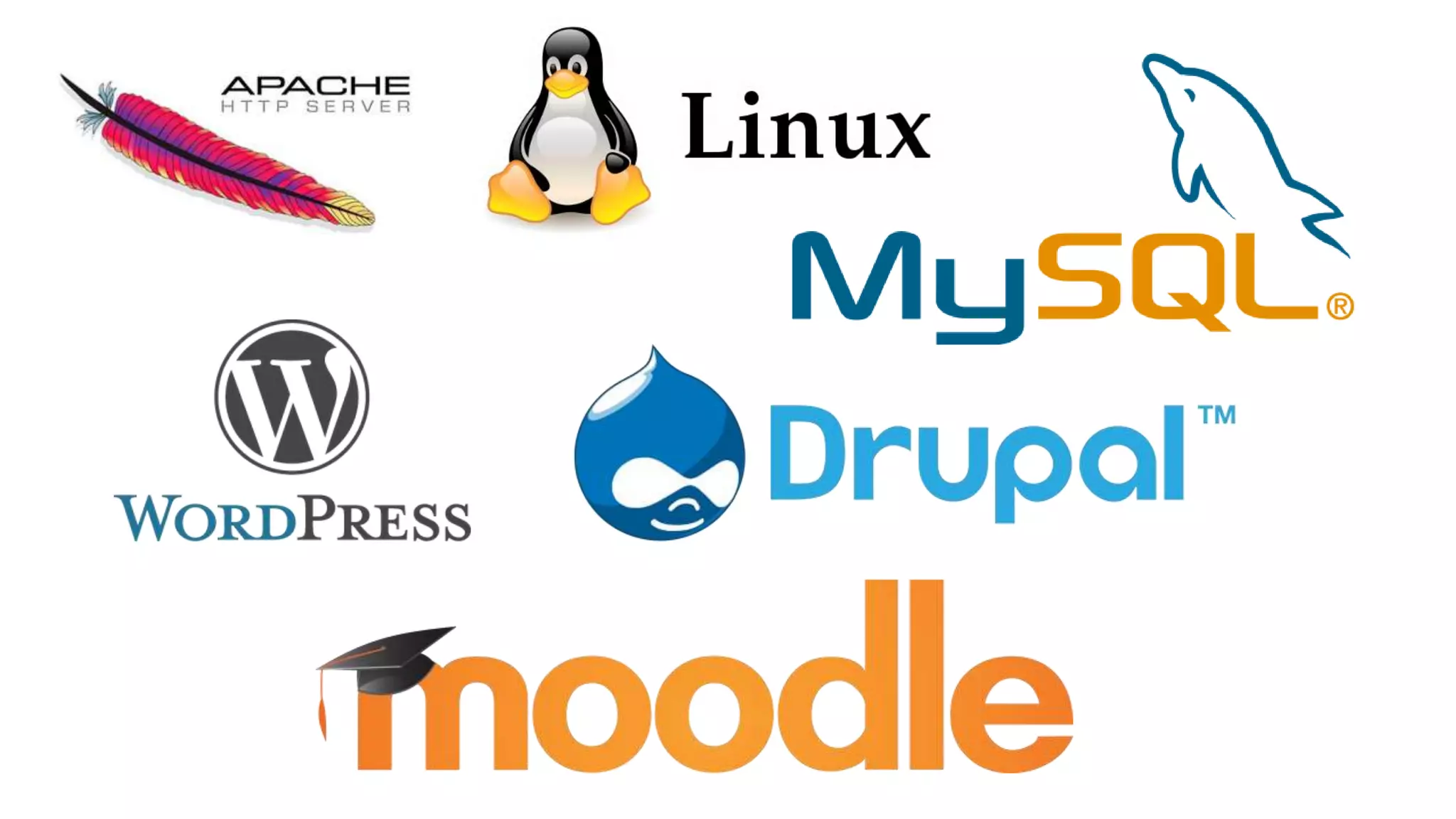
  • #15 Some OSS in use
  • #16 Why are we interested? Data & FIPPA Barrier to the use of cloud based systems Can get informed consent, but often hassle (need to make special accommodations for students) Change in attitude around FIPPA (after decade of work) – animosity to ambivalence to appreciation There is growing concern over data privacy (FIPPA) and data ownership, especially in British Columbia where strict privacy regulations often prevent the use of cloud based services hosted outside of Canada. New ways of using technology in education, such as personalized learning, are exerting more of an influence on educational technology tools, and making us examine more deeply the ways in which data is collected and used by those tools. This is raising some concerns among post-secondary educators who feel higher education may be outsourcing its core purpose.
  • #17 EdTech companies collecting massive amounts of data on our students. Knewton (adaptive learning platform) collects over a million pieces of data about students using their cloud-based system. VitalSource has a reading platform that tracks how a student interacts with ebooks – use to improve their ebooks, which you can argue helps improve the books. It also doesn’t hurt that it helps the bottom line of VitalSource.
  • #21 When Silicon Valley starts turning their eye to your sector
  • #22 Good arguments about students having control over this data. We as institutions should be making sure that student learning data is protected – it is the law (as stewards of student data) One of the easiest ways to maintain control over data is by choosing applications that we can host ourselves and control ourselves
  • #23 From Education Week - Use Google Apps for Education, track you even when you log out. Candace Till – pioneer found Open Learning Initiative Carnagie-Mellon Says learning analytics and using data to help students is reality and educators should have more control. Gets to core of what higher ed is about – teaching & learning and “a core tenet of any business is that you don't outsource your core business process.“ “…professors and higher-education leaders are making a dangerous mistake by letting companies take the lead in shaping the learning-analytics market. When companies lead the development of learning software, the decisions these systems make are hidden from professors and colleges. Ms. Thille says companies that won't share their processes are essentially saying, "Just trust the black box." For most academics, she says, "that's alchemy, that's not science.“
  • #24 KPU uses Moodle Open Source – great! Step 1 to maintaining control over learning data Student Traditional LMS is becoming middleware One size fits all approach doesn’t work today Good to have choice – fit your pedagogy
  • #25 KPU uses Moodle Open Source – great! Traditional LMS is becoming middleware One size fits all approach doesn’t work today Good to have choice – fit your pedagogy
  • #26  Second reason we are interested is in supporting open pedagogy models of teaching & learning – engaging with the world as a pedagogical model Hard to do with traditional LMS where it is very difficult to conduct teaching and learning on the web in the open RRU Elizabeth Child “Students will gain and maintain their own WordPress site throughout the program, allowing them to take an active and participatory role in the wider education community.” The RRU Teaching and Learning Model speaks to authentic experiential and inquiry-based learning, outcomes-based learning, enhanced learning through technology so when we lined these characteristics up with principles of openness and open pedagogy broadly defined there was a direct dovetail. Often challenge for IT departments (rightly so) to work outside of the box on projects like these
  • #27 Purpose is to provide space for BC higher education institutions to participate in the development and application of open source Next Generation Digital Learning Environments. BCcampus is providing support to help bootstrap this group and some of their initiatives Close to 70 members over a dozen institutions participating – faculty, IT, administrators, learning developers 359 registered users of Sandstorm (one of the platforms I will show you later) Details on how you can join coming up 8 goals for the work they are doing
  • #28 While there are numerous commercial vendors promoting the use of commercial software, numerous open source applications get overlooked because there are no vendors selling & marketing OSS. Open Source educational technologies are often not considered as viable alternatives as OSS edtech often cannot compete with commercial vendors to respond to standard IT procurement practices, like the RFP process which can favour commercial applications and limit Open Source involvement in the EdTech space at most institutions
  • #29 Open source software relies on the development of communities of both developers and users in order to be successful. The success comes from sharing knowledge about how the software is constructed and can be utilized. An open source software application is the focal point around which a community can develop.
  • #30 Pathways to participate in OSS projects can sometime be obtuse and difficult to maneuver, meaning educators may not want to, or feel welcome to, participate in EDU OSS projects. The collaborative can provide support for those who wish to dive deeper and participate in specific community projects, and in ways that are not just software development. This provides benefit to the OSS project as it brings new members into the community. Active involvement in OSS communities strengthens the software, the community developing & maintaining the software, and the long term sustainability of the software.
  • #32  Doing T&L activities outside of the walled garden of the LMS is a tough thing to do. Having students blog in the open, for example, often means asking them to do it on a private company website. Collaborating together on a platform like Google Docs – difficult.
  • #33  EduCloud – BCNEt service provides a cloud based option for institutions here in BC at competitive cost. Really allows us to be able to do some of the activites we are doing, and show value with something that BCNEt is doing EduCloud is a low-cost, virtual data centre for higher education institutions EduCloud Server is a self-managed, private higher education cloud server service that provides simple and secure virtual data centre access to provision, manage and utilize servers at a fraction of the cost of implementing physical servers.
  • #34 Institutions are currently at the mercy of vendor pricing, upgrade cycles, and exit strategies.  This puts institutions at a certain degree of risk when there are changes to any of the variables beyond their control.   OSS is not immune
  • #35 Where to find these? How to evaluate these tools without a vendor? One institution cannot do it all.
  • #36 oet.sandcats.io has 359 users Top apps at oet.sandcats.io - Etherpad (189 instances) - Wekan (54 instances) - Rocket Chat (39 instances) - Draw.io (36 instances)