


CENTRE FOR INNOVATION
IN TECHNOLOGIES & EDUCATION
Increasing Collaboration
through MOOCs
And working with Furturelearn
Hugh Davis:
23rd April 2013
CENTRE FOR INNOVATION
IN TECHNOLOGIES & EDUCATION
What are MOOCs
Disruptive Technologies: Is there an avalanche coming?
Why Southampton are doing this
Futurelearn
Collaboration within Futurelearn
Learning Resources in MOOCs
This Talk
2
CENTRE FOR INNOVATION
IN TECHNOLOGIES & EDUCATION
Massive - some have 10,000s registered.
Open = free, and anyone can register
Online although many have a parallel blended incarnation
Course (but not necessarily accredited for anything)
What is a MOOC?
3
CENTRE FOR INNOVATION
IN TECHNOLOGIES & EDUCATION
• Many short videos
• Some talking heads
• Some “worked examples”
• Some experiments etc.
• On-line papers etc.
• Discussion forums
• On-line activities
• Formative assessments
Assessment (and feedback) will need
to be
• Objective (multiple choice etc.)
• Peer review
• Self evaluation
Learning Design Workflow and
Learning Analytics are central
The emphasis must be on the
student as a self-motivated learner.
Most Courses consist of
4
Why the
Avalanche Alert?
5
Barber, M. Donnelly, K & Rizvi, S. (March 2013).
An Avalanche is Coming; Higher Education and the Revolution Ahead.
Institute for Public Policy Research.
CENTRE FOR INNOVATION
IN TECHNOLOGIES & EDUCATION
6
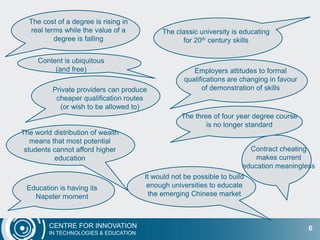
The cost of a degree is rising in
real terms while the value of a
degree is falling
Content is ubiquitous
(and free)
Private providers can produce
cheaper qualification routes
(or wish to be allowed to)
The world distribution of wealth
means that most potential
students cannot afford higher
education
It would not be possible to build
enough universities to educate
the emerging Chinese market
The classic university is educating
for 20th century skills
Employers attitudes to formal
qualifications are changing in favour
of demonstration of skills
The three of four year degree course
is no longer standard
Education is having its
Napster moment
Contract cheating
makes current
education meaningless
CENTRE FOR INNOVATION
IN TECHNOLOGIES & EDUCATION
7
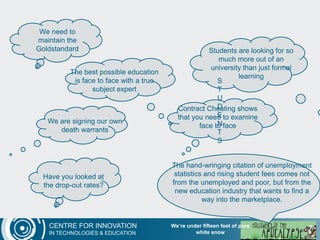
We need to
maintain the
Goldstandard
The best possible education
is face to face with a true
subject expert
Students are looking for so
much more out of an
university than just formal
learning
Contract Cheating shows
that you need to examine
face to face
The hand-wringing citation of unemployment
statistics and rising student fees comes not
from the unemployed and poor, but from the
new education industry that wants to find a
way into the marketplace.
We are signing our own
death warrants
Have you looked at
the drop-out rates?
We’re under fifteen feet of pure
white snow
CENTRE FOR INNOVATION
IN TECHNOLOGIES & EDUCATION
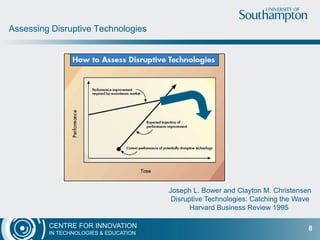
Assessing Disruptive Technologies
8
Joseph L. Bower and Clayton M. Christensen
Disruptive Technologies: Catching the Wave
Harvard Business Review 1995
CENTRE FOR INNOVATION
IN TECHNOLOGIES & EDUCATION
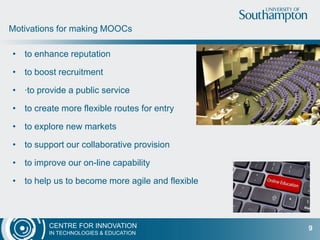
• to enhance reputation
• to boost recruitment
• ·to provide a public service
• to create more flexible routes for entry
• to explore new markets
• to support our collaborative provision
• to improve our on-line capability
• to help us to become more agile and flexible
Motivations for making MOOCs
9
CENTRE FOR INNOVATION
IN TECHNOLOGIES & EDUCATION
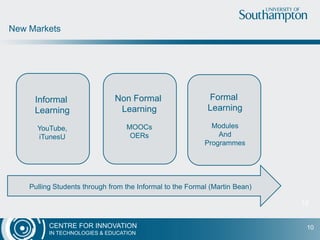
New Markets
10
Informal
Learning
YouTube,
iTunesU
Non Formal
Learning
MOOCs
OERs
Formal
Learning
Modules
And
Programmes
Pulling Students through from the Informal to the Formal (Martin Bean)
10
CENTRE FOR INNOVATION
IN TECHNOLOGIES & EDUCATION
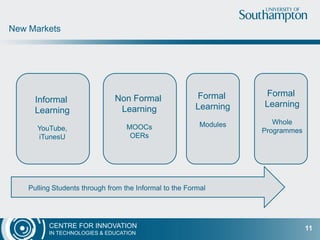
New Markets
11
Informal
Learning
YouTube,
iTunesU
Non Formal
Learning
MOOCs
OERs
Formal
Learning
Modules
Formal
Learning
Whole
Programmes
Pulling Students through from the Informal to the Formal
CENTRE FOR INNOVATION
IN TECHNOLOGIES & EDUCATION
• Certifications
• Authentic assessments
• Human tutoring
• Corporate learning
• Sponsorship
• Access to student records
How do MOOCs make money?
12
CENTRE FOR INNOVATION
IN TECHNOLOGIES & EDUCATION
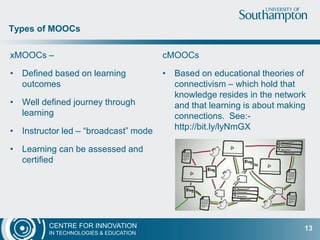
xMOOCs –
• Defined based on learning
outcomes
• Well defined journey through
learning
• Instructor led – “broadcast” mode
• Learning can be assessed and
certified
cMOOCs
• Based on educational theories of
connectivism – which hold that
knowledge resides in the network
and that learning is about making
connections. See:-
http://bit.ly/lyNmGX
Types of MOOCs
13
CENTRE FOR INNOVATION
IN TECHNOLOGIES & EDUCATION
Udacity, The first – “democratizing education” – but still for
profit. Started at Stanford.
Coursera – for profit (but business model only just
emerging). 2,000,000 people have taken a course, from the
catalogue of around 200. Only 7-9% complete.
EdX. Not for Profit. MIT, Harvard, Berkeley
Futurelearn. - Based in UK at OU, and aspiring to include
top 30-40 universities. For profit. Director is Simon Nelson –
responsible previously for BBC digital strategy
MOOC Providers
14
(also mention some precedents such as OERs – MIT’s
OpenCourseWare and OU’s OpenLearn; also Khan Academy)
CENTRE FOR INNOVATION
IN TECHNOLOGIES & EDUCATION
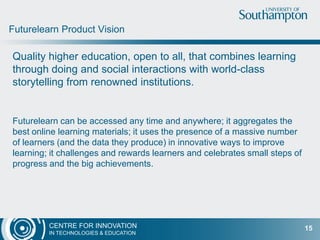
Quality higher education, open to all, that combines learning
through doing and social interactions with world-class
storytelling from renowned institutions.
Futurelearn can be accessed any time and anywhere; it aggregates the
best online learning materials; it uses the presence of a massive number
of learners (and the data they produce) in innovative ways to improve
learning; it challenges and rewards learners and celebrates small steps of
progress and the big achievements.
Futurelearn Product Vision
15
CENTRE FOR INNOVATION
IN TECHNOLOGIES & EDUCATION
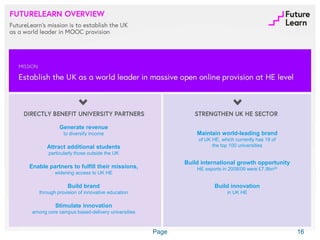
Stimulate innovation
among core campus based-delivery universities
Build brand
through provision of innovative education
Build international growth opportunity
HE exports in 2008/09 were £7.9bn22Enable partners to fulfill their missions,
widening access to UK HE
Maintain world-leading brand
of UK HE, which currently has 18 of
the top 100 universities
Build innovation
in UK HE
Attract additional students
particularly those outside the UK
Generate revenue
to diversify income
16Page
CENTRE FOR INNOVATION
IN TECHNOLOGIES & EDUCATION
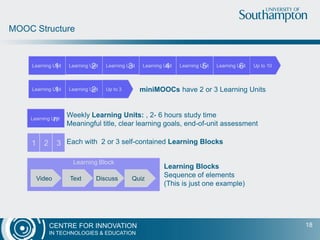
MOOC Structure
Learning Unit1 Learning Unit2 Learning Unit3 Learning Unit4 Learning Unit5 Learning Unit6 Up to 10
Learning Unit1 Learning Unit2 Up to 3
Learning Unitn
Weekly Learning Units: , 2- 6 hours study time
Meaningful title, clear learning goals, end-of-unit assessment
1 2 3 Each with 2 or 3 self-contained Learning Blocks
Learning Block
Video Text Discuss Quiz
Learning Blocks
Sequence of elements
(This is just one example)
miniMOOCs have 2 or 3 Learning Units
17
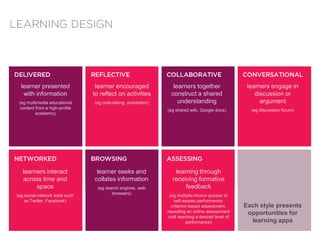
learner presented
with information
(eg multimedia educational
content from a high-profile
academic)
learner encouraged
to reflect on activities
(eg note-taking, annotation)
learners together
construct a shared
understanding
(eg shared wiki, Google docs)
learners engage in
discussion or
argument
(eg discussion forum)
learners interact
across time and
space
(eg social-network tools such
as Twitter, Facebook)
learner seeks and
collates information
(eg search engines, web
browsers)
learning through
receiving formative
feedback
(eg multiple-choice quizzes to
self-assess performance;
criterion based assessment,
repeating an online assessment
until reaching a desired level of
performance)
Each style presents
opportunities for
learning apps
CENTRE FOR INNOVATION
IN TECHNOLOGIES & EDUCATION
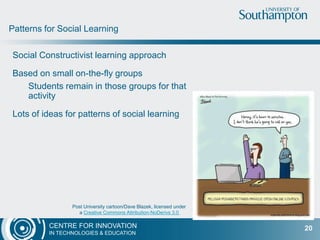
Social Constructivist learning approach
Based on small on-the-fly groups
Students remain in those groups for that
activity
Lots of ideas for patterns of social learning
Patterns for Social Learning
Post University cartoon/Dave Blazek, licensed under
a Creative Commons Attribution-NoDerivs 3.0
19
CENTRE FOR INNOVATION
IN TECHNOLOGIES & EDUCATION
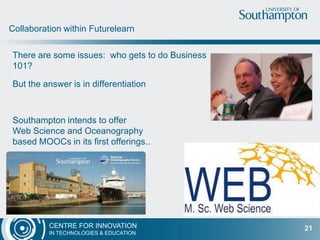
There are some issues: who gets to do Business
101?
But the answer is in differentiation
Southampton intends to offer
Web Science and Oceanography
based MOOCs in its first offerings..
Collaboration within Futurelearn
20
CENTRE FOR INNOVATION
IN TECHNOLOGIES & EDUCATION
Managing Tensions
21
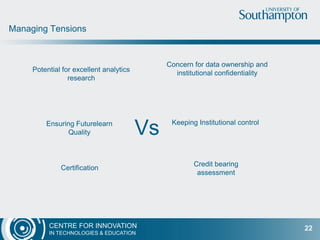
Potential for excellent analytics
research
Concern for data ownership and
institutional confidentiality
Ensuring Futurelearn
Quality
Keeping Institutional control
Certification
Credit bearing
assessment
Vs
CENTRE FOR INNOVATION
IN TECHNOLOGIES & EDUCATION
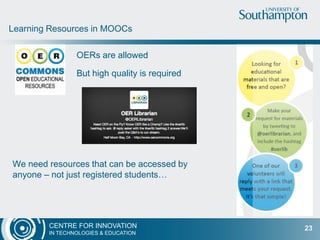
OERs are allowed
But high quality is required
We need resources that can be accessed by
anyone – not just registered students…
Learning Resources in MOOCs
22
CENTRE FOR INNOVATION
IN TECHNOLOGIES & EDUCATION
Who owns the work?
The text book?
What happens if the
expert goes?
MOOCs will force us to
sort out these issues if
not already
Ownership of Materials developed
23
CENTRE FOR INNOVATION
IN TECHNOLOGIES & EDUCATION
Groups internal to the University: CITE – academics – librarians
Academic disciplines within the University – Humanities and Maritime
archaeology?
Groups across institutions – Oceanography at Southampton and OU
Librarians at OU, Southampton and elsewhere
Partners of FutureLearn – Universities within and beyond Russell Group
Universities and other organisations within FutureLearn – BL and British
Council and Southampton
Multiple opportunities for increasing collaboration in MOOCs
24
Thank you
Any Questions?
Hugh Davis: hcd@soton.ac.uk
users.ecs.soton.ac.uk/hcd
25

Collaboration, MOOCs and Futurelearn

  • 1.
    CENTRE FOR INNOVATION INTECHNOLOGIES & EDUCATION Increasing Collaboration through MOOCs And working with Furturelearn Hugh Davis: 23rd April 2013
  • 2.
    CENTRE FOR INNOVATION INTECHNOLOGIES & EDUCATION What are MOOCs Disruptive Technologies: Is there an avalanche coming? Why Southampton are doing this Futurelearn Collaboration within Futurelearn Learning Resources in MOOCs This Talk 2
  • 3.
    CENTRE FOR INNOVATION INTECHNOLOGIES & EDUCATION Massive - some have 10,000s registered. Open = free, and anyone can register Online although many have a parallel blended incarnation Course (but not necessarily accredited for anything) What is a MOOC? 3
  • 4.
    CENTRE FOR INNOVATION INTECHNOLOGIES & EDUCATION • Many short videos • Some talking heads • Some “worked examples” • Some experiments etc. • On-line papers etc. • Discussion forums • On-line activities • Formative assessments Assessment (and feedback) will need to be • Objective (multiple choice etc.) • Peer review • Self evaluation Learning Design Workflow and Learning Analytics are central The emphasis must be on the student as a self-motivated learner. Most Courses consist of 4
  • 5.
    Why the Avalanche Alert? 5 Barber,M. Donnelly, K & Rizvi, S. (March 2013). An Avalanche is Coming; Higher Education and the Revolution Ahead. Institute for Public Policy Research.
  • 6.
    CENTRE FOR INNOVATION INTECHNOLOGIES & EDUCATION 6 The cost of a degree is rising in real terms while the value of a degree is falling Content is ubiquitous (and free) Private providers can produce cheaper qualification routes (or wish to be allowed to) The world distribution of wealth means that most potential students cannot afford higher education It would not be possible to build enough universities to educate the emerging Chinese market The classic university is educating for 20th century skills Employers attitudes to formal qualifications are changing in favour of demonstration of skills The three of four year degree course is no longer standard Education is having its Napster moment Contract cheating makes current education meaningless
  • 7.
    CENTRE FOR INNOVATION INTECHNOLOGIES & EDUCATION 7 We need to maintain the Goldstandard The best possible education is face to face with a true subject expert Students are looking for so much more out of an university than just formal learning Contract Cheating shows that you need to examine face to face The hand-wringing citation of unemployment statistics and rising student fees comes not from the unemployed and poor, but from the new education industry that wants to find a way into the marketplace. We are signing our own death warrants Have you looked at the drop-out rates? We’re under fifteen feet of pure white snow
  • 8.
    CENTRE FOR INNOVATION INTECHNOLOGIES & EDUCATION Assessing Disruptive Technologies 8 Joseph L. Bower and Clayton M. Christensen Disruptive Technologies: Catching the Wave Harvard Business Review 1995
  • 9.
    CENTRE FOR INNOVATION INTECHNOLOGIES & EDUCATION • to enhance reputation • to boost recruitment • ·to provide a public service • to create more flexible routes for entry • to explore new markets • to support our collaborative provision • to improve our on-line capability • to help us to become more agile and flexible Motivations for making MOOCs 9
  • 10.
    CENTRE FOR INNOVATION INTECHNOLOGIES & EDUCATION New Markets 10 Informal Learning YouTube, iTunesU Non Formal Learning MOOCs OERs Formal Learning Modules And Programmes Pulling Students through from the Informal to the Formal (Martin Bean) 10
  • 11.
    CENTRE FOR INNOVATION INTECHNOLOGIES & EDUCATION New Markets 11 Informal Learning YouTube, iTunesU Non Formal Learning MOOCs OERs Formal Learning Modules Formal Learning Whole Programmes Pulling Students through from the Informal to the Formal
  • 12.
    CENTRE FOR INNOVATION INTECHNOLOGIES & EDUCATION • Certifications • Authentic assessments • Human tutoring • Corporate learning • Sponsorship • Access to student records How do MOOCs make money? 12
  • 13.
    CENTRE FOR INNOVATION INTECHNOLOGIES & EDUCATION xMOOCs – • Defined based on learning outcomes • Well defined journey through learning • Instructor led – “broadcast” mode • Learning can be assessed and certified cMOOCs • Based on educational theories of connectivism – which hold that knowledge resides in the network and that learning is about making connections. See:- http://bit.ly/lyNmGX Types of MOOCs 13
  • 14.
    CENTRE FOR INNOVATION INTECHNOLOGIES & EDUCATION Udacity, The first – “democratizing education” – but still for profit. Started at Stanford. Coursera – for profit (but business model only just emerging). 2,000,000 people have taken a course, from the catalogue of around 200. Only 7-9% complete. EdX. Not for Profit. MIT, Harvard, Berkeley Futurelearn. - Based in UK at OU, and aspiring to include top 30-40 universities. For profit. Director is Simon Nelson – responsible previously for BBC digital strategy MOOC Providers 14 (also mention some precedents such as OERs – MIT’s OpenCourseWare and OU’s OpenLearn; also Khan Academy)
  • 15.
    CENTRE FOR INNOVATION INTECHNOLOGIES & EDUCATION Quality higher education, open to all, that combines learning through doing and social interactions with world-class storytelling from renowned institutions. Futurelearn can be accessed any time and anywhere; it aggregates the best online learning materials; it uses the presence of a massive number of learners (and the data they produce) in innovative ways to improve learning; it challenges and rewards learners and celebrates small steps of progress and the big achievements. Futurelearn Product Vision 15
  • 16.
    CENTRE FOR INNOVATION INTECHNOLOGIES & EDUCATION Stimulate innovation among core campus based-delivery universities Build brand through provision of innovative education Build international growth opportunity HE exports in 2008/09 were £7.9bn22Enable partners to fulfill their missions, widening access to UK HE Maintain world-leading brand of UK HE, which currently has 18 of the top 100 universities Build innovation in UK HE Attract additional students particularly those outside the UK Generate revenue to diversify income 16Page
  • 17.
    CENTRE FOR INNOVATION INTECHNOLOGIES & EDUCATION MOOC Structure Learning Unit1 Learning Unit2 Learning Unit3 Learning Unit4 Learning Unit5 Learning Unit6 Up to 10 Learning Unit1 Learning Unit2 Up to 3 Learning Unitn Weekly Learning Units: , 2- 6 hours study time Meaningful title, clear learning goals, end-of-unit assessment 1 2 3 Each with 2 or 3 self-contained Learning Blocks Learning Block Video Text Discuss Quiz Learning Blocks Sequence of elements (This is just one example) miniMOOCs have 2 or 3 Learning Units 17
  • 18.
    learner presented with information (egmultimedia educational content from a high-profile academic) learner encouraged to reflect on activities (eg note-taking, annotation) learners together construct a shared understanding (eg shared wiki, Google docs) learners engage in discussion or argument (eg discussion forum) learners interact across time and space (eg social-network tools such as Twitter, Facebook) learner seeks and collates information (eg search engines, web browsers) learning through receiving formative feedback (eg multiple-choice quizzes to self-assess performance; criterion based assessment, repeating an online assessment until reaching a desired level of performance) Each style presents opportunities for learning apps
  • 19.
    CENTRE FOR INNOVATION INTECHNOLOGIES & EDUCATION Social Constructivist learning approach Based on small on-the-fly groups Students remain in those groups for that activity Lots of ideas for patterns of social learning Patterns for Social Learning Post University cartoon/Dave Blazek, licensed under a Creative Commons Attribution-NoDerivs 3.0 19
  • 20.
    CENTRE FOR INNOVATION INTECHNOLOGIES & EDUCATION There are some issues: who gets to do Business 101? But the answer is in differentiation Southampton intends to offer Web Science and Oceanography based MOOCs in its first offerings.. Collaboration within Futurelearn 20
  • 21.
    CENTRE FOR INNOVATION INTECHNOLOGIES & EDUCATION Managing Tensions 21 Potential for excellent analytics research Concern for data ownership and institutional confidentiality Ensuring Futurelearn Quality Keeping Institutional control Certification Credit bearing assessment Vs
  • 22.
    CENTRE FOR INNOVATION INTECHNOLOGIES & EDUCATION OERs are allowed But high quality is required We need resources that can be accessed by anyone – not just registered students… Learning Resources in MOOCs 22
  • 23.
    CENTRE FOR INNOVATION INTECHNOLOGIES & EDUCATION Who owns the work? The text book? What happens if the expert goes? MOOCs will force us to sort out these issues if not already Ownership of Materials developed 23
  • 24.
    CENTRE FOR INNOVATION INTECHNOLOGIES & EDUCATION Groups internal to the University: CITE – academics – librarians Academic disciplines within the University – Humanities and Maritime archaeology? Groups across institutions – Oceanography at Southampton and OU Librarians at OU, Southampton and elsewhere Partners of FutureLearn – Universities within and beyond Russell Group Universities and other organisations within FutureLearn – BL and British Council and Southampton Multiple opportunities for increasing collaboration in MOOCs 24
  • 25.
    Thank you Any Questions? HughDavis: hcd@soton.ac.uk users.ecs.soton.ac.uk/hcd 25

Editor's Notes

  • #17 Key point is the Mission