Why spend time on MOOCs and
OER?
Ebba Ossiannilsson, PhD
Lund University, Sweden
15th April 2014
Webinar
Ebba Ossiannilsson, PhD Lund University
Open Educational Cultures
- open arenas
Open Access
Open Licenses
Open Software
MOOCs
OER/OEP/OEC
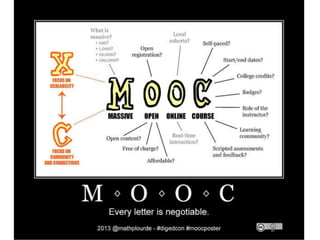
M
O
O
C
© Gabi Witthaus, Institute of Learning Innovation, University of
Leicester, 2014 (slides) and Derek Keats (image) CC-BY
Ossiannilsson_Boldic2014
Mobility
Collaboration
Openness
Personalization
Quality
21 century skills
Ossiannilsson_Boldic2014
Digital literacy across the curricula
(Hauge & Payton 2010 p 19
" We must engage in a fundamental transformation of our
education and training systems
And we need to fully exploit the potential that open and flexible
education offers" (Commissionaire Vassilio EADTU 120929)
Ossiannilsson_Boldic2014
EC Recommendations for Higher
Education Opening up Education
review their organisational strategies
exploit the potential of Massive Open Online Courses
(MOOCs)
stimulate innovative learning practices such as
blended learning
equip teachers with high digital competences
equip learners with digital skills
think about how to validate and recognise learner’s
achievements in online education
make high quality Open Education Resources (OER)
visible and accessible
Ossiannilsson_Boldic2014
© Gabi Witthaus, Institute of Learning Innovation, University of Leicester, 2014 (slides) and Thomas Sly (image) CC-BY
Entering the online jungle
Ossiannilsson_Boldic014
The community is the curricula
Ossiannilsson_Boldic2014
Learning
• learning is more critical than knowing
• “the network is the learning”
• know-how supplemented by
“know-where” (& know-who)
Why network?
George Siemens“connectivism”
© Stephen Downes
Ossiannilsson_Boldic2014
Learning design
Ossiannilsson_Boldic2014
The Networked Teacher – my PLN
meWork Friends
Twitter
(# and
people)
Conferences/
PD meetings
Blogs
Social
mediaWikis
Twitter
chats
Websites
& media
A quick tour through some acronyms
• RBL - resource based learning
• RLO – reusable learning object
• OER – open educational resource
• OEP – open educational practice
• OEC – open edcuational culture
• OEI – open education idea*
• MOOC- massive open online courses (c and x,and a lot in
between)
• TLA – three letter acronymn
* Source: http://www.idea-space.eu/open-educational-ideas-a-new-approach-
for-open-education/ - 31 Jan 2014
Ossiannilsson_Boldic2014
50 shades of openness
©
Copyright Public domainCreativeCommons
Ossiannilsson_Boldic2014
50 shades…
Validation, Examination
Tutoring, feedback
Guidlines
Courses
MOOCs
Self study
Formal and/vs Informal learning
Ossiannilsson_Boldic2014
BIS RESEARCH PAPER NUMBER 130
The Maturing of the MOOC
Why the interest in resource reuse?
Emphasis on mass HE, measuring
quality in learning and teaching.
Reuse helps to pay for online learning
Cost reduction by sharing at scale.
Knowledge transfer to developing
world. Changing teaching practices.
Technological changes with online and
digital resources easy to repurpose/reuse.
P
E
S
T
2013 Chris Pegler
Where are we now?
• We’ve solved most of the technical problems
• We now have is the human issues*
* Hm. Would money or
recognition or reward
(technical) or greater clarity
about copyright (technical)
solve these problems?
2013 Chris Pegler
#boldic
Vad gjorde vi (1)…
#oereswe
9 webinars
1589 registered
1146 participants
4232 views
The domain www.oersverige.se
7800 unique visitors from 2230 sources
All together unique visitors and those who viewed the recordings
were appr 12000
1 SverdNytt 3, 2012 http://nytt.sverd.se/
2
ScieCom, http://nile.lub.lu.se/ojs/index.php/sciecominfo/article/
view/5678/4929
3 Final report
4 Presentations, OER13, April 2013, Nottingham, NGL14, Dalarna
University, Falun, March 2014
HU Journal Higher Education (Swedish)
Establish Networks and CoP
To be continued….
Whats up in Sweden?
Framtidens lärande
Nya vägar
Regeringsutredning
Tillväxtananlys
SOU 2014:13 En digital agenda i människans tjänst
– en ljusnande framtid kan bli vår
Utbildningsvetenskapligt råd
MOOCs KI, LU, UU
Several HEIs – strategies, policy, action plans
Position paper, NordicOER
#nordicoer
Goals and Objectives
Barriers
Actions
Recommendations
• Policy
• Institutions
• Individuals
Ossiannilsson_Boldic2014
Nordic OER #nordicoer
Network and project
Recommendations in 7
languages
Position paper
Cooperation with other
projects
www.noordicoer.org
Ossiannilsson_Boldic2014
BIC 2013 The Maturing of the MOOC
MOOC Like reading a newspaper- go
for the headings and the bold
text/Downes
S Downes – Like reading a newspaper
(21 March 2014)
MOOC dimensions
Openness
Scale
Multimedia
Communication
Collaboration
Learning pathway
Ref: MOOCs as disruptive technologies: strategies for enhancing the learner experience and quality of
MOOCs, Conole G 2013
Quality
assurance
Reflection
Certification
Formal learning
Autonomy
Diversity
Ossiannilsson_Boldic2014
Quality – in the eye of the beholder?
Ossiannilsson_Boldic2014
Quality framework for MOOCs in Europe
• Openness to learners
• Digital openness
• Learner-centred approach
• Independent learning
• Media-supported interaction
• Recognition options
• Quality focus
• Spectrum of diversity
Ossiannilsson_Boldic2014
Massive target group
Mixing groups
Learning across contexts
Support self-organization
Declare whats in it
Peer to peer pedagogy
MOOCs support choice based
learning
MOOC.EFQUEL.ORG
MOOC Quality Project:
Ossiannilsson_Boldic2014
Research
Content
Guidance
Assessment
CertificationSelection
Today
2030
Assessment
Content
Certification
Guidance
Research
Selection
EducationalInstitution
Learner initiated
Externally
set
Learning contextGuided
Learninggoals
§
Self-
guided
Networked knowledge Distributed knowledge
Fit for success My career path
Universities play a key role:
→ As professional training
providers
→ As educational content
providers
Universities play a key role:
→ As educational content
providers
→ For certification and
accreditation
A global open research
arena enables anybody
to engage in research
Universities play a key role:
→ as research hubs
Guided discovery Self-guided discovery
Guided journey Self-guided journey
MOOCs MOOCs
Research
Content
Guidance
Assessment
Certification
Selection
Today
EducationalInstitution
Research
Research
Research
MOOCs
MOOCs
2030
Research
Content
Guidance
Assessment
Certification
Selection
Selection
Research
Content
Guidance
Assessment
Certification
Research
Research
Research
MOOCs
MOOCs
2030
What do we need to
think about today?
• New business
models
• New funding
schemes
• Certification, recogn
ition and credit
transfer across
institutions, across
borders
• New interfaces
between education
and research
• Experimentation!
So why spend time on MOOCs and
OER
Individual level
Institutional level
National level
Global level
Personalization
Sustainbility
Collaborate to compete
Life long learning
Get the best of the best…
Ossiannilsson_Boldic2014
International workshop on policy for OER
and less used languages
28 April, Oslo
OER and challenges and opportunities for less used
languages in a global, European, Nordic and national
perspective.
Caring is sharing, sharing is
caring
• Footprints
• W:www.lu.se/ced
• E:Ebba.Ossiannilsson@ced.lu.se
• FB:Ebba Ossiannilsson
• T:@EbbaOssian
• Phone: +4670995448
• S:http://www.slideshare.net/
EbbaOssiann
Ossiannilsson_Boldic2014

Boldic webinar Why spend time on MOOCs and OERs140415

  • 1.
    Why spend timeon MOOCs and OER? Ebba Ossiannilsson, PhD Lund University, Sweden 15th April 2014 Webinar
  • 2.
    Ebba Ossiannilsson, PhDLund University
  • 3.
    Open Educational Cultures -open arenas Open Access Open Licenses Open Software MOOCs OER/OEP/OEC M O O C © Gabi Witthaus, Institute of Learning Innovation, University of Leicester, 2014 (slides) and Derek Keats (image) CC-BY Ossiannilsson_Boldic2014
  • 4.
  • 5.
    21 century skills Ossiannilsson_Boldic2014 Digitalliteracy across the curricula (Hauge & Payton 2010 p 19
  • 6.
    " We mustengage in a fundamental transformation of our education and training systems And we need to fully exploit the potential that open and flexible education offers" (Commissionaire Vassilio EADTU 120929) Ossiannilsson_Boldic2014
  • 7.
    EC Recommendations forHigher Education Opening up Education review their organisational strategies exploit the potential of Massive Open Online Courses (MOOCs) stimulate innovative learning practices such as blended learning equip teachers with high digital competences equip learners with digital skills think about how to validate and recognise learner’s achievements in online education make high quality Open Education Resources (OER) visible and accessible Ossiannilsson_Boldic2014
  • 8.
  • 9.
    © Gabi Witthaus,Institute of Learning Innovation, University of Leicester, 2014 (slides) and Thomas Sly (image) CC-BY Entering the online jungle Ossiannilsson_Boldic014
  • 10.
    The community isthe curricula Ossiannilsson_Boldic2014
  • 11.
    Learning • learning ismore critical than knowing • “the network is the learning” • know-how supplemented by “know-where” (& know-who) Why network? George Siemens“connectivism” © Stephen Downes Ossiannilsson_Boldic2014
  • 12.
  • 13.
    Ossiannilsson_Boldic2014 The Networked Teacher– my PLN meWork Friends Twitter (# and people) Conferences/ PD meetings Blogs Social mediaWikis Twitter chats Websites & media
  • 15.
    A quick tourthrough some acronyms • RBL - resource based learning • RLO – reusable learning object • OER – open educational resource • OEP – open educational practice • OEC – open edcuational culture • OEI – open education idea* • MOOC- massive open online courses (c and x,and a lot in between) • TLA – three letter acronymn * Source: http://www.idea-space.eu/open-educational-ideas-a-new-approach- for-open-education/ - 31 Jan 2014 Ossiannilsson_Boldic2014
  • 16.
    50 shades ofopenness © Copyright Public domainCreativeCommons Ossiannilsson_Boldic2014
  • 17.
    50 shades… Validation, Examination Tutoring,feedback Guidlines Courses MOOCs Self study Formal and/vs Informal learning Ossiannilsson_Boldic2014
  • 18.
    BIS RESEARCH PAPERNUMBER 130 The Maturing of the MOOC
  • 19.
    Why the interestin resource reuse? Emphasis on mass HE, measuring quality in learning and teaching. Reuse helps to pay for online learning Cost reduction by sharing at scale. Knowledge transfer to developing world. Changing teaching practices. Technological changes with online and digital resources easy to repurpose/reuse. P E S T 2013 Chris Pegler
  • 20.
    Where are wenow? • We’ve solved most of the technical problems • We now have is the human issues* * Hm. Would money or recognition or reward (technical) or greater clarity about copyright (technical) solve these problems? 2013 Chris Pegler
  • 21.
  • 22.
  • 23.
    #oereswe 9 webinars 1589 registered 1146participants 4232 views The domain www.oersverige.se 7800 unique visitors from 2230 sources All together unique visitors and those who viewed the recordings were appr 12000 1 SverdNytt 3, 2012 http://nytt.sverd.se/ 2 ScieCom, http://nile.lub.lu.se/ojs/index.php/sciecominfo/article/ view/5678/4929 3 Final report 4 Presentations, OER13, April 2013, Nottingham, NGL14, Dalarna University, Falun, March 2014 HU Journal Higher Education (Swedish) Establish Networks and CoP To be continued….
  • 24.
    Whats up inSweden? Framtidens lärande Nya vägar Regeringsutredning Tillväxtananlys SOU 2014:13 En digital agenda i människans tjänst – en ljusnande framtid kan bli vår Utbildningsvetenskapligt råd MOOCs KI, LU, UU Several HEIs – strategies, policy, action plans
  • 27.
    Position paper, NordicOER #nordicoer Goalsand Objectives Barriers Actions Recommendations • Policy • Institutions • Individuals Ossiannilsson_Boldic2014
  • 28.
    Nordic OER #nordicoer Networkand project Recommendations in 7 languages Position paper Cooperation with other projects www.noordicoer.org Ossiannilsson_Boldic2014
  • 30.
    BIC 2013 TheMaturing of the MOOC
  • 31.
    MOOC Like readinga newspaper- go for the headings and the bold text/Downes S Downes – Like reading a newspaper (21 March 2014)
  • 32.
    MOOC dimensions Openness Scale Multimedia Communication Collaboration Learning pathway Ref:MOOCs as disruptive technologies: strategies for enhancing the learner experience and quality of MOOCs, Conole G 2013 Quality assurance Reflection Certification Formal learning Autonomy Diversity Ossiannilsson_Boldic2014
  • 34.
    Quality – inthe eye of the beholder? Ossiannilsson_Boldic2014
  • 35.
    Quality framework forMOOCs in Europe • Openness to learners • Digital openness • Learner-centred approach • Independent learning • Media-supported interaction • Recognition options • Quality focus • Spectrum of diversity Ossiannilsson_Boldic2014
  • 36.
    Massive target group Mixinggroups Learning across contexts Support self-organization Declare whats in it Peer to peer pedagogy MOOCs support choice based learning MOOC.EFQUEL.ORG MOOC Quality Project: Ossiannilsson_Boldic2014
  • 37.
  • 38.
    Learner initiated Externally set Learning contextGuided Learninggoals § Self- guided Networkedknowledge Distributed knowledge Fit for success My career path Universities play a key role: → As professional training providers → As educational content providers Universities play a key role: → As educational content providers → For certification and accreditation A global open research arena enables anybody to engage in research Universities play a key role: → as research hubs Guided discovery Self-guided discovery Guided journey Self-guided journey MOOCs MOOCs
  • 39.
  • 40.
    Research Content Guidance Assessment Certification Research Research Research MOOCs MOOCs 2030 What do weneed to think about today? • New business models • New funding schemes • Certification, recogn ition and credit transfer across institutions, across borders • New interfaces between education and research • Experimentation!
  • 41.
    So why spendtime on MOOCs and OER Individual level Institutional level National level Global level Personalization Sustainbility Collaborate to compete Life long learning Get the best of the best… Ossiannilsson_Boldic2014
  • 42.
    International workshop onpolicy for OER and less used languages 28 April, Oslo OER and challenges and opportunities for less used languages in a global, European, Nordic and national perspective.
  • 43.
    Caring is sharing,sharing is caring • Footprints • W:www.lu.se/ced • E:Ebba.Ossiannilsson@ced.lu.se • FB:Ebba Ossiannilsson • T:@EbbaOssian • Phone: +4670995448 • S:http://www.slideshare.net/ EbbaOssiann Ossiannilsson_Boldic2014

Editor's Notes

  • #4 http://www.flickr.com/photos/dkeats/12255771486/ Derek Keats
  • #10 http://www.flickr.com/photos/tomsly/94236282/ - Thomas Sly
  • #12 We live in a time when knowledge is increasing at an exponential rate. People’s roles, jobs and skills change many times over a lifetime - so the ability to keep learning essential. Learning is more critical than knowing. “Our ability to learn what we need for tomorrow is more important than what we know today” (Siemens)This is a basic principle of connectivism, an influential theory of learning for a digital age first put forward by George Siemens.He also said “the network is the learning” - new knowledge can be found in many places, distributed across a network of connections, so in order to learn we need to be able to “construct and traverse those networks” (NB “network”= the pipeline(how you connect), people (who can tell you what you need to know) or things (e.g. websites, corpus data)In the “old” days, new knowledge was only available through universities, conferences or articles. Nowadays this know-how is available to EVERYONE, we just have to know where to look - or who to ask.
  • #14 Karen: If you had told me my PLN would look like this a year ago, I would have laughed in your face! I wasn’t even on Facebook let alone Twitter…..and had no idea what PLN meant…Twitter & Blogs are larger font as these have the most impact on my learning at the moment (explain briefly some of the connections in the diagram).You can see how connected the PLN is. I learn from many many other people, and with other people: I am basically connected to a global staffroom of engaged and interested teachers…..>>