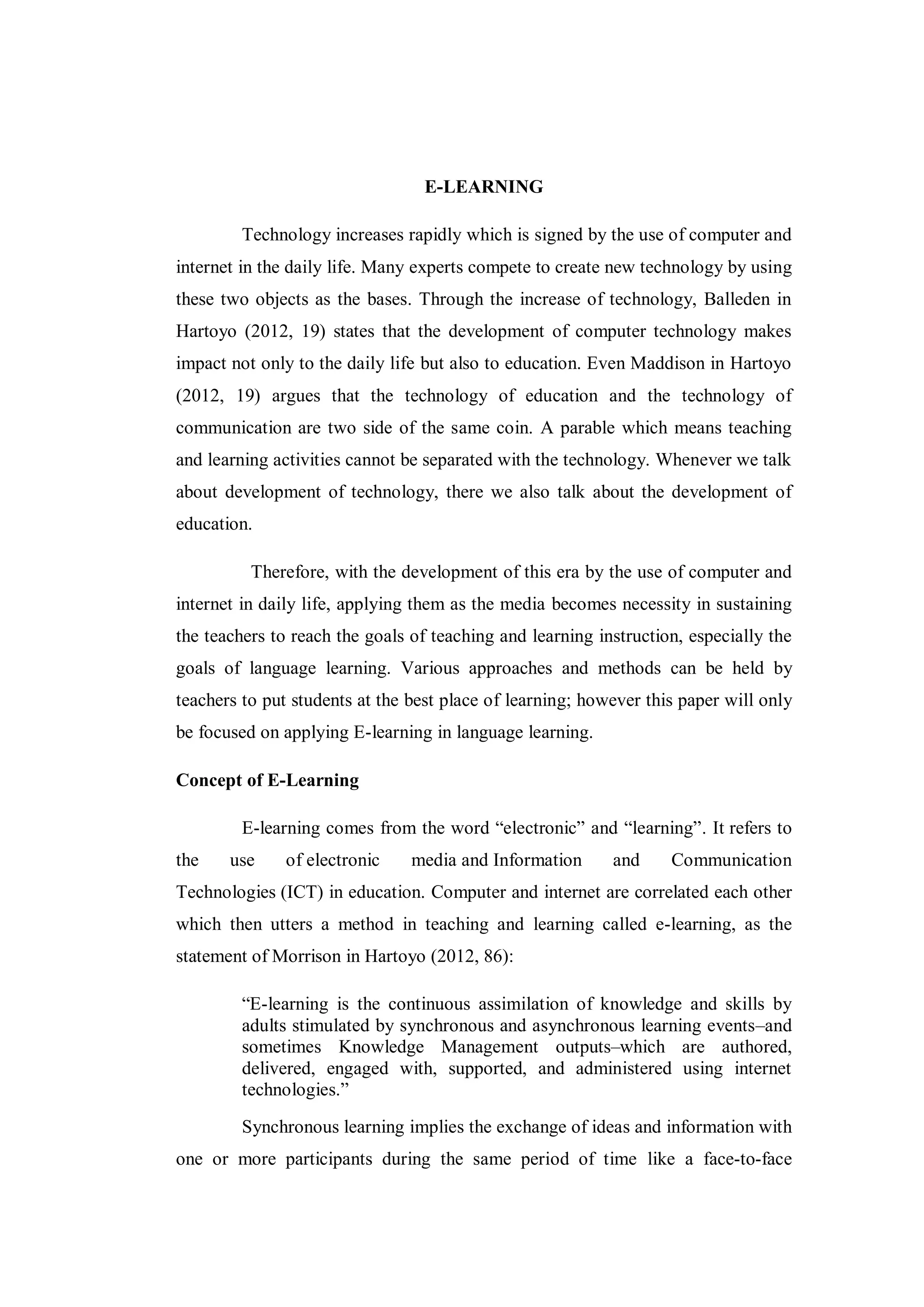
E-LEARNING
Technology increases rapidly which is signed by the use of computer and
internet in the daily life. Many experts compete to create new technology by using
these two objects as the bases. Through the increase of technology, Balleden in
Hartoyo (2012, 19) states that the development of computer technology makes
impact not only to the daily life but also to education. Even Maddison in Hartoyo
(2012, 19) argues that the technology of education and the technology of
communication are two side of the same coin. A parable which means teaching
and learning activities cannot be separated with the technology. Whenever we talk
about development of technology, there we also talk about the development of
education.
Therefore, with the development of this era by the use of computer and
internet in daily life, applying them as the media becomes necessity in sustaining
the teachers to reach the goals of teaching and learning instruction, especially the
goals of language learning. Various approaches and methods can be held by
teachers to put students at the best place of learning; however this paper will only
be focused on applying E-learning in language learning.
Concept of E-Learning
E-learning comes from the word “electronic” and “learning”. It refers to
the use of electronic media and Information and Communication
Technologies (ICT) in education. Computer and internet are correlated each other
which then utters a method in teaching and learning called e-learning, as the
statement of Morrison in Hartoyo (2012, 86):
“E-learning is the continuous assimilation of knowledge and skills by
adults stimulated by synchronous and asynchronous learning events–and
sometimes Knowledge Management outputs–which are authored,
delivered, engaged with, supported, and administered using internet
technologies.”
Synchronous learning implies the exchange of ideas and information with
one or more participants during the same period of time like a face-to-face
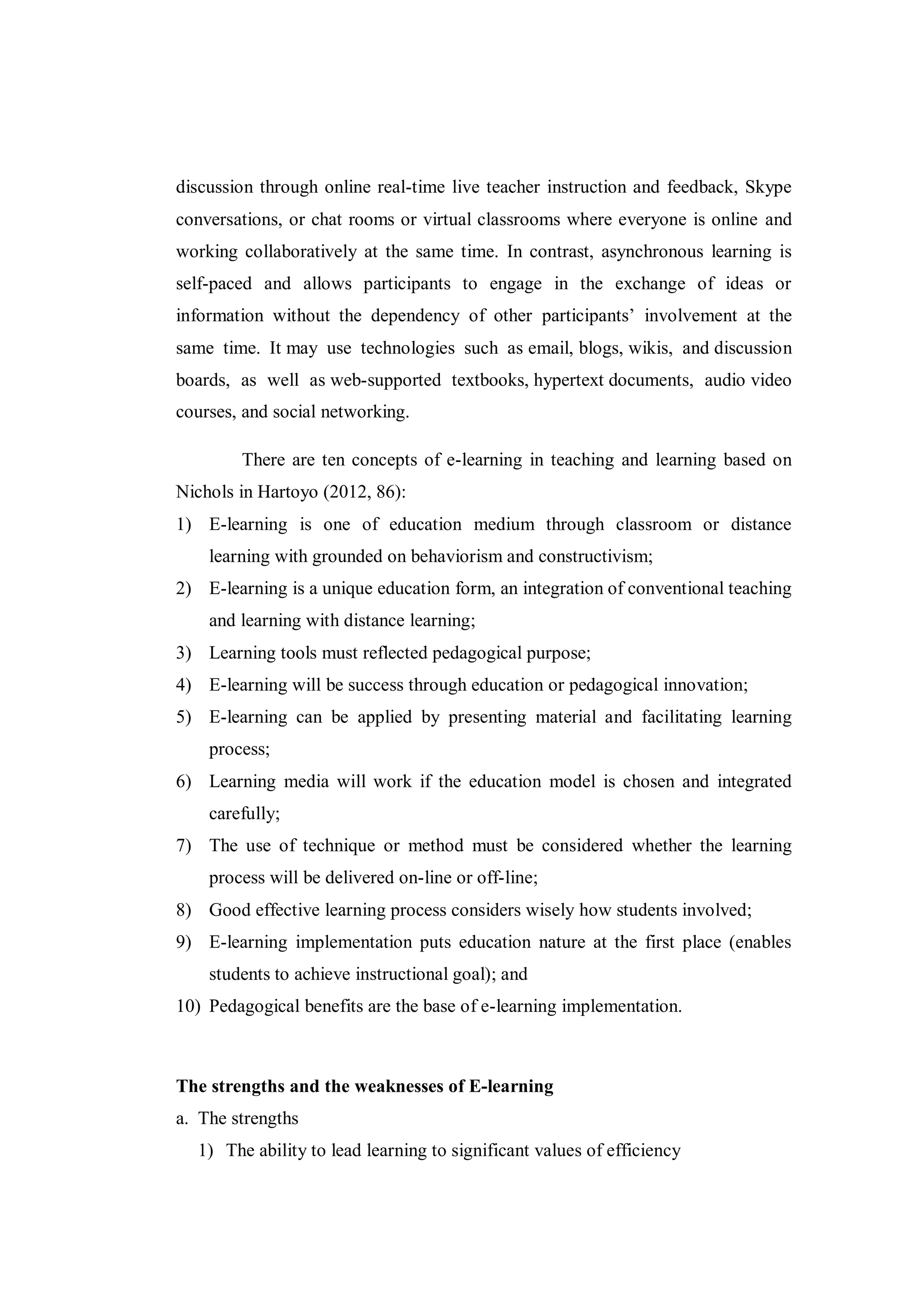
discussion through online real-time live teacher instruction and feedback, Skype
conversations, or chat rooms or virtual classrooms where everyone is online and
working collaboratively at the same time. In contrast, asynchronous learning is
self-paced and allows participants to engage in the exchange of ideas or
information without the dependency of other participants’ involvement at the
same time. It may use technologies such as email, blogs, wikis, and discussion
boards, as well as web-supported textbooks, hypertext documents, audio video
courses, and social networking.
There are ten concepts of e-learning in teaching and learning based on
Nichols in Hartoyo (2012, 86):
1) E-learning is one of education medium through classroom or distance
learning with grounded on behaviorism and constructivism;
2) E-learning is a unique education form, an integration of conventional teaching
and learning with distance learning;
3) Learning tools must reflected pedagogical purpose;
4) E-learning will be success through education or pedagogical innovation;
5) E-learning can be applied by presenting material and facilitating learning
process;
6) Learning media will work if the education model is chosen and integrated
carefully;
7) The use of technique or method must be considered whether the learning
process will be delivered on-line or off-line;
8) Good effective learning process considers wisely how students involved;
9) E-learning implementation puts education nature at the first place (enables
students to achieve instructional goal); and
10) Pedagogical benefits are the base of e-learning implementation.
The strengths and the weaknesses of E-learning
a. The strengths
1) The ability to lead learning to significant values of efficiency
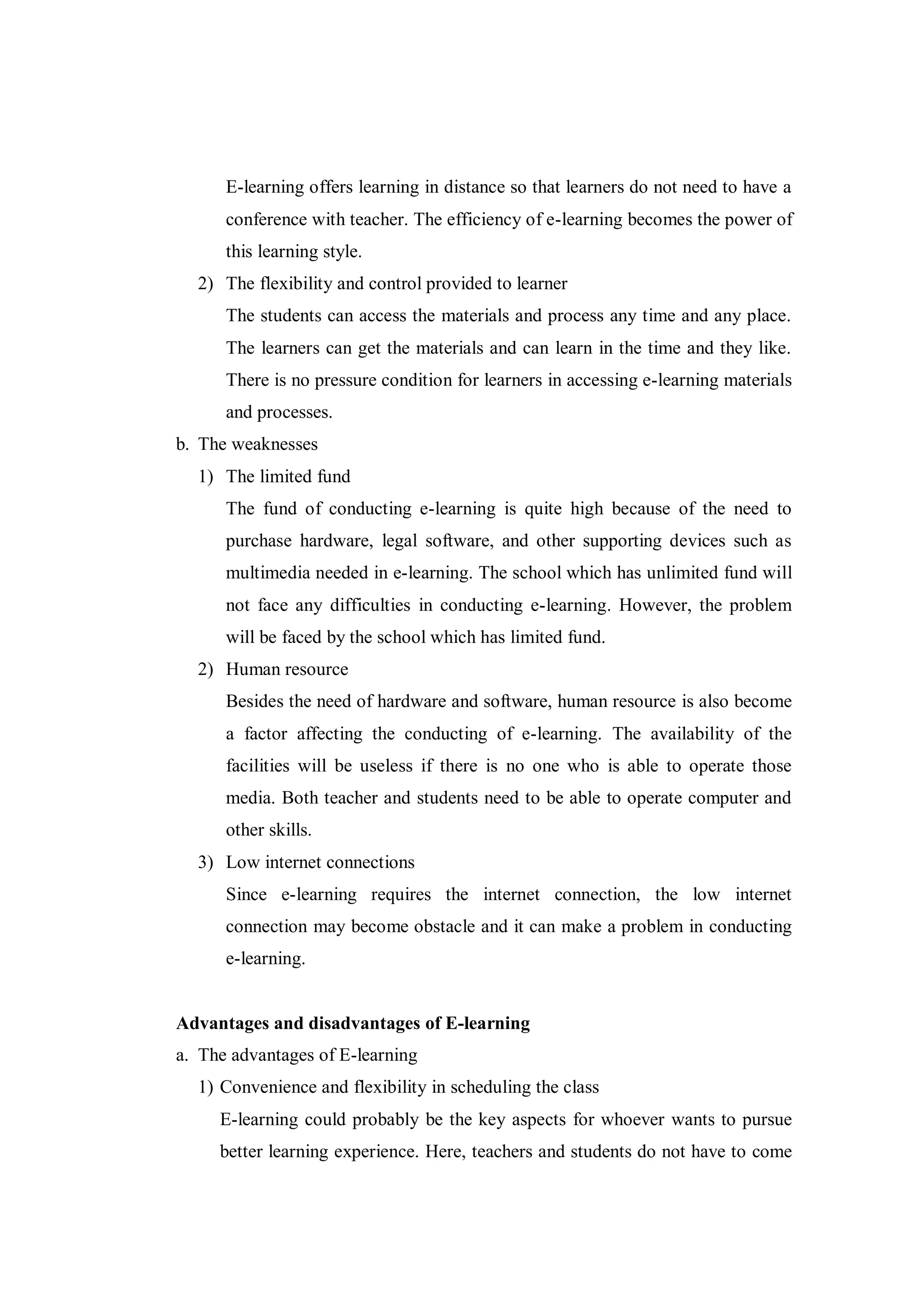
E-learning offers learning in distance so that learners do not need to have a
conference with teacher. The efficiency of e-learning becomes the power of
this learning style.
2) The flexibility and control provided to learner
The students can access the materials and process any time and any place.
The learners can get the materials and can learn in the time and they like.
There is no pressure condition for learners in accessing e-learning materials
and processes.
b. The weaknesses
1) The limited fund
The fund of conducting e-learning is quite high because of the need to
purchase hardware, legal software, and other supporting devices such as
multimedia needed in e-learning. The school which has unlimited fund will
not face any difficulties in conducting e-learning. However, the problem
will be faced by the school which has limited fund.
2) Human resource
Besides the need of hardware and software, human resource is also become
a factor affecting the conducting of e-learning. The availability of the
facilities will be useless if there is no one who is able to operate those
media. Both teacher and students need to be able to operate computer and
other skills.
3) Low internet connections
Since e-learning requires the internet connection, the low internet
connection may become obstacle and it can make a problem in conducting
e-learning.
Advantages and disadvantages of E-learning
a. The advantages of E-learning
1) Convenience and flexibility in scheduling the class
E-learning could probably be the key aspects for whoever wants to pursue
better learning experience. Here, teachers and students do not have to come
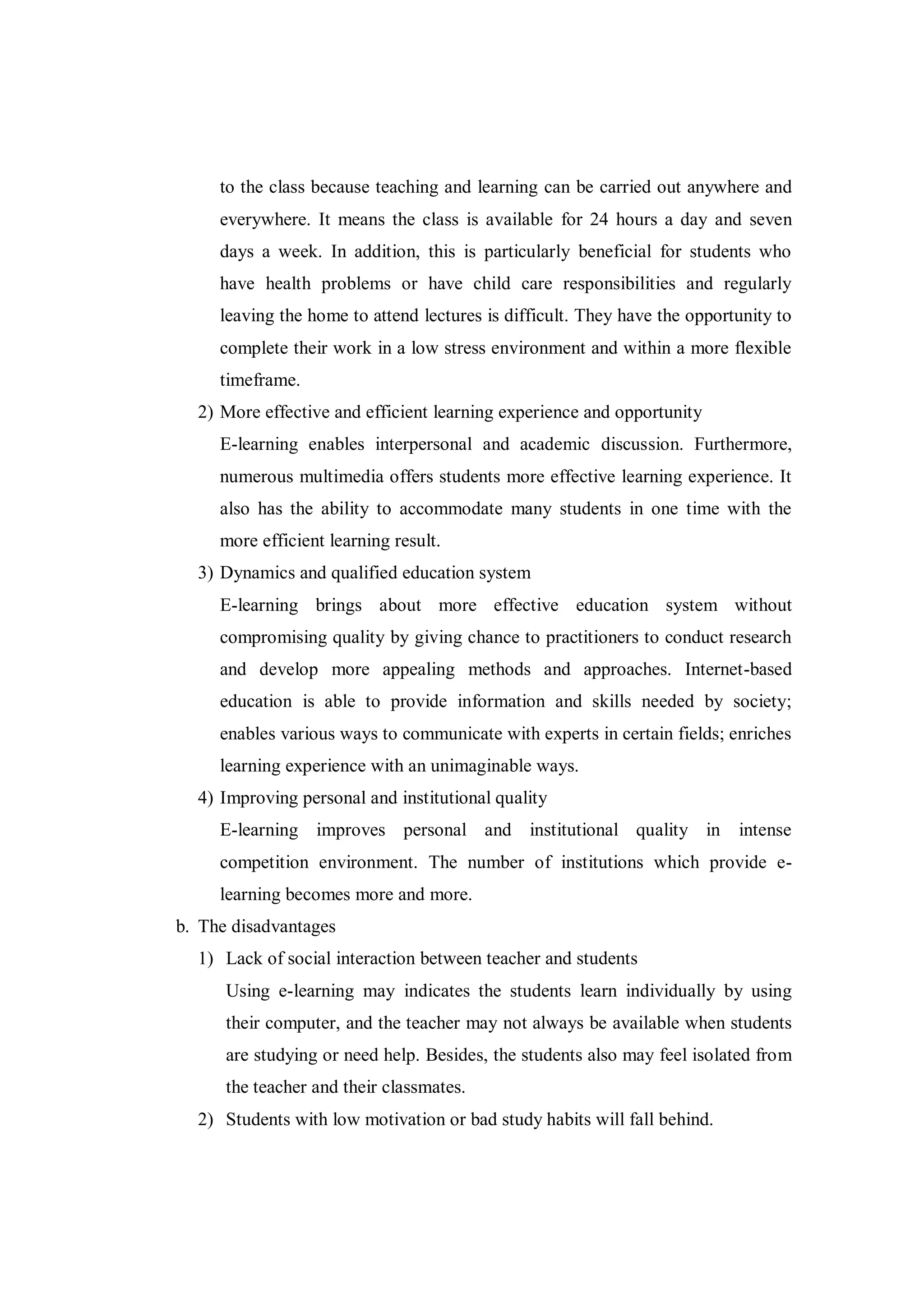
to the class because teaching and learning can be carried out anywhere and
everywhere. It means the class is available for 24 hours a day and seven
days a week. In addition, this is particularly beneficial for students who
have health problems or have child care responsibilities and regularly
leaving the home to attend lectures is difficult. They have the opportunity to
complete their work in a low stress environment and within a more flexible
timeframe.
2) More effective and efficient learning experience and opportunity
E-learning enables interpersonal and academic discussion. Furthermore,
numerous multimedia offers students more effective learning experience. It
also has the ability to accommodate many students in one time with the
more efficient learning result.
3) Dynamics and qualified education system
E-learning brings about more effective education system without
compromising quality by giving chance to practitioners to conduct research
and develop more appealing methods and approaches. Internet-based
education is able to provide information and skills needed by society;
enables various ways to communicate with experts in certain fields; enriches
learning experience with an unimaginable ways.
4) Improving personal and institutional quality
E-learning improves personal and institutional quality in intense
competition environment. The number of institutions which provide e-
learning becomes more and more.
b. The disadvantages
1) Lack of social interaction between teacher and students
Using e-learning may indicates the students learn individually by using
their computer, and the teacher may not always be available when students
are studying or need help. Besides, the students also may feel isolated from
the teacher and their classmates.
2) Students with low motivation or bad study habits will fall behind.
Refer to the previous explanation that the students learn individually, the
students with low motivation will be careless to learn the learning material.
It surely will make impact to the students’ result of their study.
3) Ease of cheating
It may happen when the test is executed not in the same place in a time.
The students can cheat without being known by the teacher, even the
teacher will not know whether the students do the test by their selves or
not. But if it is executed in the same place, the teacher can avoid the
cheating.
REFERENCES
Bates, Tony. 2007. Strategic Planning for E-Learning in a polytechnic. In Making
the Transition to E-Learning: Strategies and Issues. ed. Mark Bullen and
Diane P. Janes. London: Idea Group Inc.
Donelly, Peter, Joel Benson and Paul Kirk. 2012. How to Succeed at E-learning.
West Sussex: John Wiley & Sons Ltd.
Hartoyo. 2012. ICT in Language Learning. Semarang: Pelita Insani Semarang.
http://en.wikipedia.org/wiki/E-learning
http://www.scie.org.uk/publications/getconnectedtoelearning/strengthsofelearning
.asp
http://ezinearticles.com/?expert=Karen_L._Jones
http://www.dso.iastate.edu/asc/academic/elearner/advantage.html

Mid test of ict

  • 1.
    E-LEARNING Technology increases rapidlywhich is signed by the use of computer and internet in the daily life. Many experts compete to create new technology by using these two objects as the bases. Through the increase of technology, Balleden in Hartoyo (2012, 19) states that the development of computer technology makes impact not only to the daily life but also to education. Even Maddison in Hartoyo (2012, 19) argues that the technology of education and the technology of communication are two side of the same coin. A parable which means teaching and learning activities cannot be separated with the technology. Whenever we talk about development of technology, there we also talk about the development of education. Therefore, with the development of this era by the use of computer and internet in daily life, applying them as the media becomes necessity in sustaining the teachers to reach the goals of teaching and learning instruction, especially the goals of language learning. Various approaches and methods can be held by teachers to put students at the best place of learning; however this paper will only be focused on applying E-learning in language learning. Concept of E-Learning E-learning comes from the word “electronic” and “learning”. It refers to the use of electronic media and Information and Communication Technologies (ICT) in education. Computer and internet are correlated each other which then utters a method in teaching and learning called e-learning, as the statement of Morrison in Hartoyo (2012, 86): “E-learning is the continuous assimilation of knowledge and skills by adults stimulated by synchronous and asynchronous learning events–and sometimes Knowledge Management outputs–which are authored, delivered, engaged with, supported, and administered using internet technologies.” Synchronous learning implies the exchange of ideas and information with one or more participants during the same period of time like a face-to-face
  • 2.
    discussion through onlinereal-time live teacher instruction and feedback, Skype conversations, or chat rooms or virtual classrooms where everyone is online and working collaboratively at the same time. In contrast, asynchronous learning is self-paced and allows participants to engage in the exchange of ideas or information without the dependency of other participants’ involvement at the same time. It may use technologies such as email, blogs, wikis, and discussion boards, as well as web-supported textbooks, hypertext documents, audio video courses, and social networking. There are ten concepts of e-learning in teaching and learning based on Nichols in Hartoyo (2012, 86): 1) E-learning is one of education medium through classroom or distance learning with grounded on behaviorism and constructivism; 2) E-learning is a unique education form, an integration of conventional teaching and learning with distance learning; 3) Learning tools must reflected pedagogical purpose; 4) E-learning will be success through education or pedagogical innovation; 5) E-learning can be applied by presenting material and facilitating learning process; 6) Learning media will work if the education model is chosen and integrated carefully; 7) The use of technique or method must be considered whether the learning process will be delivered on-line or off-line; 8) Good effective learning process considers wisely how students involved; 9) E-learning implementation puts education nature at the first place (enables students to achieve instructional goal); and 10) Pedagogical benefits are the base of e-learning implementation. The strengths and the weaknesses of E-learning a. The strengths 1) The ability to lead learning to significant values of efficiency
  • 3.
    E-learning offers learningin distance so that learners do not need to have a conference with teacher. The efficiency of e-learning becomes the power of this learning style. 2) The flexibility and control provided to learner The students can access the materials and process any time and any place. The learners can get the materials and can learn in the time and they like. There is no pressure condition for learners in accessing e-learning materials and processes. b. The weaknesses 1) The limited fund The fund of conducting e-learning is quite high because of the need to purchase hardware, legal software, and other supporting devices such as multimedia needed in e-learning. The school which has unlimited fund will not face any difficulties in conducting e-learning. However, the problem will be faced by the school which has limited fund. 2) Human resource Besides the need of hardware and software, human resource is also become a factor affecting the conducting of e-learning. The availability of the facilities will be useless if there is no one who is able to operate those media. Both teacher and students need to be able to operate computer and other skills. 3) Low internet connections Since e-learning requires the internet connection, the low internet connection may become obstacle and it can make a problem in conducting e-learning. Advantages and disadvantages of E-learning a. The advantages of E-learning 1) Convenience and flexibility in scheduling the class E-learning could probably be the key aspects for whoever wants to pursue better learning experience. Here, teachers and students do not have to come
  • 4.
    to the classbecause teaching and learning can be carried out anywhere and everywhere. It means the class is available for 24 hours a day and seven days a week. In addition, this is particularly beneficial for students who have health problems or have child care responsibilities and regularly leaving the home to attend lectures is difficult. They have the opportunity to complete their work in a low stress environment and within a more flexible timeframe. 2) More effective and efficient learning experience and opportunity E-learning enables interpersonal and academic discussion. Furthermore, numerous multimedia offers students more effective learning experience. It also has the ability to accommodate many students in one time with the more efficient learning result. 3) Dynamics and qualified education system E-learning brings about more effective education system without compromising quality by giving chance to practitioners to conduct research and develop more appealing methods and approaches. Internet-based education is able to provide information and skills needed by society; enables various ways to communicate with experts in certain fields; enriches learning experience with an unimaginable ways. 4) Improving personal and institutional quality E-learning improves personal and institutional quality in intense competition environment. The number of institutions which provide e- learning becomes more and more. b. The disadvantages 1) Lack of social interaction between teacher and students Using e-learning may indicates the students learn individually by using their computer, and the teacher may not always be available when students are studying or need help. Besides, the students also may feel isolated from the teacher and their classmates. 2) Students with low motivation or bad study habits will fall behind.
  • 5.
    Refer to theprevious explanation that the students learn individually, the students with low motivation will be careless to learn the learning material. It surely will make impact to the students’ result of their study. 3) Ease of cheating It may happen when the test is executed not in the same place in a time. The students can cheat without being known by the teacher, even the teacher will not know whether the students do the test by their selves or not. But if it is executed in the same place, the teacher can avoid the cheating.
  • 6.
    REFERENCES Bates, Tony. 2007.Strategic Planning for E-Learning in a polytechnic. In Making the Transition to E-Learning: Strategies and Issues. ed. Mark Bullen and Diane P. Janes. London: Idea Group Inc. Donelly, Peter, Joel Benson and Paul Kirk. 2012. How to Succeed at E-learning. West Sussex: John Wiley & Sons Ltd. Hartoyo. 2012. ICT in Language Learning. Semarang: Pelita Insani Semarang. http://en.wikipedia.org/wiki/E-learning http://www.scie.org.uk/publications/getconnectedtoelearning/strengthsofelearning .asp http://ezinearticles.com/?expert=Karen_L._Jones http://www.dso.iastate.edu/asc/academic/elearner/advantage.html