E-learning has transcended the traditional definition of 
“education through internet only”. The E- learning process is 
like an umbrella, under which lots of things are arranged to 
make the global educational system more uniform, cost-effective 
and quality-rich. Broadly speaking e-learning is a 
process of training for all types of learner in their required fields 
through IT Techniques. The E- learning process includes 
courses from technology to art of living. 
However, to get a clear knowledge about the scope and objective 
of the E-learning process we are going to discuss about some 
features of this process.
introduction 
 E-learning (or eLearning) is the use of electronic media, 
educational technology and information and communication 
technologies (ICT) in education. E-learning includes numerous 
types of media that deliver text, audio, images, animation, and 
streaming video, and includes technology applications and 
processes such as audio or video tape, satellite TV, CD-ROM, and 
computer-based learning, as well as local intranet/extranet and 
web-based learning. Information and communication systems, 
whether free-standing or based on either local networks or the 
Internet in networked learning, underly many e-learning 
processes.
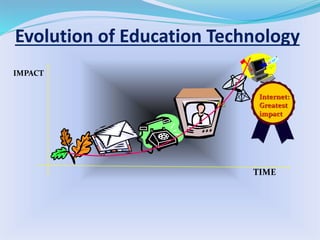
Evolution of Education Technology 
TIME 
TIME 
IMPACT 
Internet: 
Greatest 
impact
Features 
Cost effectiveness 
Time saving 
Rich media support 
Test engine 
Accessibility
Educational approach 
 Synchronous 
 Occurs in real-time, with all 
participants interacting at the 
same time. 
 Eg. face-to-face discussion, 
online real-time live teacher 
instruction and feedback, 
Skype conversations, and 
chat rooms. 
 Asynchronous 
 Self-paced and allows 
participants to engage in 
the exchange of ideas or 
information without the 
dependency of other 
participants. 
 Eg. email, blogs, wikis, 
and discussion boards, as 
well as web- supported 
textbooks.
Advantages 
 Improved open access to education, including access 
to full degree programs. 
 Improved interactions between students and 
instructors. 
 Provision of tools to enable students to independently 
solve problems. 
 No age-based restrictions on difficulty level, i.e. 
students can go at their own pace. 
 eLearning can accommodate different learning styles 
and facilitate learning through a variety of activities .
Disadvantages 
 Ease of cheating. 
 Bias towards tech-savvy students over non-technical 
students. 
 Teachers' lack of knowledge and experience to manage 
virtual teacher-student interaction. 
 Lack of social interaction between teacher and 
students. 
 Lack of direct and immediate feedback from teachers.
Technology and Infrastructure 
 Internet 
 Learning management systems 
 (Multi-media) software for course development 
 Virtual libraries 
 E-learning infrastructure
Smart Class
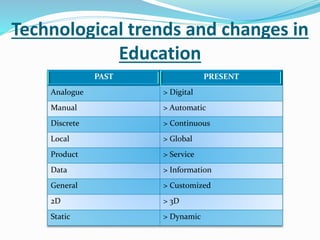
Technological trends and changes in 
Education 
PAST PRESENT 
Analogue > Digital 
Manual > Automatic 
Discrete > Continuous 
Local > Global 
Product > Service 
Data > Information 
General > Customized 
2D > 3D 
Static > Dynamic
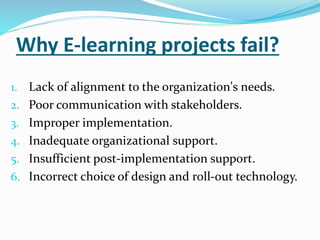
Why E-learning projects fail? 
1. Lack of alignment to the organization's needs. 
2. Poor communication with stakeholders. 
3. Improper implementation. 
4. Inadequate organizational support. 
5. Insufficient post-implementation support. 
6. Incorrect choice of design and roll-out technology.
BIBLIOGRAPHY 
http://www.dso.iastate.edu/asc/academic/elearner/advantag 
e.html 
http://en.wikipedia.org/wiki/E-learning 
http://www.smartclass.educomp.com/about.aspx 
http://elearningindustry.com/managing-e-learning-projects 
http://thejournal.com/Articles/2014/02/03/10-Major- 
Technology-Trends-in-Education.aspx?
e learning

e learning

  • 2.
    E-learning has transcendedthe traditional definition of “education through internet only”. The E- learning process is like an umbrella, under which lots of things are arranged to make the global educational system more uniform, cost-effective and quality-rich. Broadly speaking e-learning is a process of training for all types of learner in their required fields through IT Techniques. The E- learning process includes courses from technology to art of living. However, to get a clear knowledge about the scope and objective of the E-learning process we are going to discuss about some features of this process.
  • 3.
    introduction  E-learning(or eLearning) is the use of electronic media, educational technology and information and communication technologies (ICT) in education. E-learning includes numerous types of media that deliver text, audio, images, animation, and streaming video, and includes technology applications and processes such as audio or video tape, satellite TV, CD-ROM, and computer-based learning, as well as local intranet/extranet and web-based learning. Information and communication systems, whether free-standing or based on either local networks or the Internet in networked learning, underly many e-learning processes.
  • 4.
    Evolution of EducationTechnology TIME TIME IMPACT Internet: Greatest impact
  • 5.
    Features Cost effectiveness Time saving Rich media support Test engine Accessibility
  • 6.
    Educational approach Synchronous  Occurs in real-time, with all participants interacting at the same time.  Eg. face-to-face discussion, online real-time live teacher instruction and feedback, Skype conversations, and chat rooms.  Asynchronous  Self-paced and allows participants to engage in the exchange of ideas or information without the dependency of other participants.  Eg. email, blogs, wikis, and discussion boards, as well as web- supported textbooks.
  • 7.
    Advantages  Improvedopen access to education, including access to full degree programs.  Improved interactions between students and instructors.  Provision of tools to enable students to independently solve problems.  No age-based restrictions on difficulty level, i.e. students can go at their own pace.  eLearning can accommodate different learning styles and facilitate learning through a variety of activities .
  • 8.
    Disadvantages  Easeof cheating.  Bias towards tech-savvy students over non-technical students.  Teachers' lack of knowledge and experience to manage virtual teacher-student interaction.  Lack of social interaction between teacher and students.  Lack of direct and immediate feedback from teachers.
  • 9.
    Technology and Infrastructure  Internet  Learning management systems  (Multi-media) software for course development  Virtual libraries  E-learning infrastructure
  • 11.
  • 12.
    Technological trends andchanges in Education PAST PRESENT Analogue > Digital Manual > Automatic Discrete > Continuous Local > Global Product > Service Data > Information General > Customized 2D > 3D Static > Dynamic
  • 13.
    Why E-learning projectsfail? 1. Lack of alignment to the organization's needs. 2. Poor communication with stakeholders. 3. Improper implementation. 4. Inadequate organizational support. 5. Insufficient post-implementation support. 6. Incorrect choice of design and roll-out technology.
  • 14.
    BIBLIOGRAPHY http://www.dso.iastate.edu/asc/academic/elearner/advantag e.html http://en.wikipedia.org/wiki/E-learning http://www.smartclass.educomp.com/about.aspx http://elearningindustry.com/managing-e-learning-projects http://thejournal.com/Articles/2014/02/03/10-Major- Technology-Trends-in-Education.aspx?