E-LEARNING
Siti Munawati
Ade Suci Lestari
Dera Frana Kusuma
Arini Irbahtaqiyanis Kiki Rizky Illahi
Nurul Syawalina
What is E-Learning?
E-learning is a learning
system which is used for long
distance education.
Why have to e-learning?
E-learning is one solution for students who
have problem of distance from their house to
the school.
Why have to e-learning?
 Paperless
 Global
 Possibly adaptive
E-learning concept strongly correlated to the use of
computer and internet.
E-LEARNING CONCEPT
Nichols outline ten e-learning concepts in
teaching and learning process
Distance learning
Learning tool
Pedagogical
innovation
Presenting &
facilitating implementation
Achieve goal
Effective learning
On line/off line
Learning media
Unique education
E-LEARNING
CONCEPT
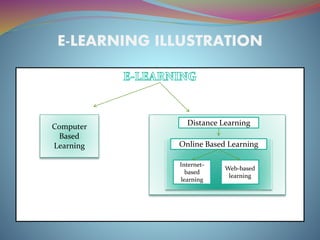
E-LEARNING ILLUSTRATION
Internet-
based
learning
Web-based
learning
Distance Learning
Online Based Learning
Computer
Based
Learning
COMUNICATION
Different ways
Within communication we distinguish different
directions/ways to communicate:
 one to one
 one to many
 many to one
 many to many
Situation
Learner to learner
Learner to trainer
Trainer to learner
Examples
chat: private chat in a chat room or the instant messenger
e-mail: send mail to a colleague or ask a question to a trainer
screen sharing: sharing Microsoft Word, collaborate on a Word
document
Situation
Trainer to learners
Learner to learners
Examples
chat: trainer is explaining content to learners
video conference: trainer is explaining content to learners via web
broadcast
screen sharing: using the net for giving learners a tour through
PowerPoint slides or web pages
newsgroups: posting a question in a newsgroup or discussion forum
e-seminar: lecture or presentation over the internet
Situation
Learners to trainer
Learners to learner
Examples
chat: ask or discuss real-time questions or issues to a
learning desk
newsgroup: react on a posted message in a discussion
forum
MANY TO MANY
Situation
Learners to learners
Learners to learners and trainers
 Examples
 chat: discussion where learners can exchange learning
experiences or just talk or a discussion led by trainers where
students solve a case by collaboration through discussion
 two-way video conferencing: virtual classroom situation
where trainer explains and learners react or meeting where
subjects can be discussed
 telephone conferencing
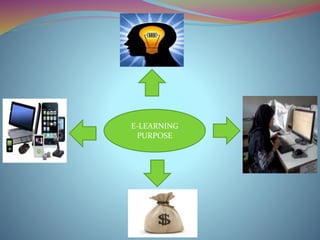
E-LEARNING
PURPOSE
E-Learning
Future
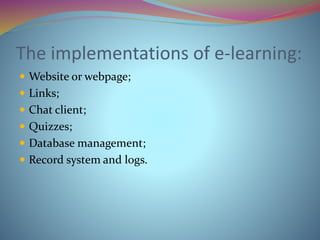
The implementations of e-learning:
 Website or webpage;
 Links;
 Chat client;
 Quizzes;
 Database management;
 Record system and logs.
E-learning as a Process
The changes of paradigm in education
Student-centered
instruction
Multisensory stimulation
Multipath progression
Multimedia
Teacher-centered
instruction
Single-sense stimulation
Single-path progression
Single media
Collaborate workIsolated work
Information delivery Information exchange
1) Limited fund
1) Human resource
Conclusion
 In implementation E-learning is the best result and
benefit will be achieved successfully.
 E-learning implementation need qualified design and
plan.
 The improvement of ICT utilization in education is
expected to be able to improve education in Indonesia.

E learning concept

  • 1.
    E-LEARNING Siti Munawati Ade SuciLestari Dera Frana Kusuma Arini Irbahtaqiyanis Kiki Rizky Illahi Nurul Syawalina
  • 2.
    What is E-Learning? E-learningis a learning system which is used for long distance education.
  • 3.
    Why have toe-learning? E-learning is one solution for students who have problem of distance from their house to the school.
  • 4.
    Why have toe-learning?  Paperless  Global  Possibly adaptive
  • 5.
    E-learning concept stronglycorrelated to the use of computer and internet.
  • 6.
  • 7.
    Nichols outline tene-learning concepts in teaching and learning process Distance learning Learning tool Pedagogical innovation Presenting & facilitating implementation Achieve goal Effective learning On line/off line Learning media Unique education E-LEARNING CONCEPT
  • 8.
  • 9.
    COMUNICATION Different ways Within communicationwe distinguish different directions/ways to communicate:  one to one  one to many  many to one  many to many
  • 10.
    Situation Learner to learner Learnerto trainer Trainer to learner Examples chat: private chat in a chat room or the instant messenger e-mail: send mail to a colleague or ask a question to a trainer screen sharing: sharing Microsoft Word, collaborate on a Word document
  • 11.
    Situation Trainer to learners Learnerto learners Examples chat: trainer is explaining content to learners video conference: trainer is explaining content to learners via web broadcast screen sharing: using the net for giving learners a tour through PowerPoint slides or web pages newsgroups: posting a question in a newsgroup or discussion forum e-seminar: lecture or presentation over the internet
  • 12.
    Situation Learners to trainer Learnersto learner Examples chat: ask or discuss real-time questions or issues to a learning desk newsgroup: react on a posted message in a discussion forum
  • 13.
    MANY TO MANY Situation Learnersto learners Learners to learners and trainers  Examples  chat: discussion where learners can exchange learning experiences or just talk or a discussion led by trainers where students solve a case by collaboration through discussion  two-way video conferencing: virtual classroom situation where trainer explains and learners react or meeting where subjects can be discussed  telephone conferencing
  • 14.
  • 15.
  • 16.
    The implementations ofe-learning:  Website or webpage;  Links;  Chat client;  Quizzes;  Database management;  Record system and logs.
  • 17.
    E-learning as aProcess The changes of paradigm in education Student-centered instruction Multisensory stimulation Multipath progression Multimedia Teacher-centered instruction Single-sense stimulation Single-path progression Single media Collaborate workIsolated work Information delivery Information exchange
  • 18.
    1) Limited fund 1)Human resource
  • 19.
    Conclusion  In implementationE-learning is the best result and benefit will be achieved successfully.  E-learning implementation need qualified design and plan.  The improvement of ICT utilization in education is expected to be able to improve education in Indonesia.