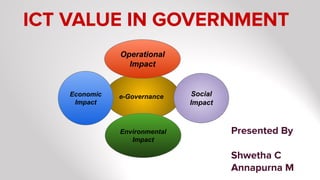
ICT VALUE IN GOVERNMENT
e-Governance
Operational
Impact
Social
Impact
Economic
Impact
Environmental
Impact
Presented By
Shwetha C
Annapurna M
e-governance
E-governance is the application of Information Technology to the
process of government functioning to bring about….
Smart
Moral
Accountable
Responsive
Transparent Governance.
How it was introduced in THE WORLD?
The United States of America
was especially driven by the
1998 Government Paperwork
Elimination Act, introduced by
former President Mr. Bill Clinton
on December 17, 1999.
4 PILLARS of e-governance
e-Governance
P
E
O
P
L
E
P
R
O
C
E
S
S
T
E
C
H
N
O
L
O
G
Y
R
E
S
O
U
R
C
E
S
Top 5 countries which implemented e-governance
RANK COUNTRIES
1. SWEDEN
2. DENMARK
3. NORWAY
4. UNITED STATES
5. NETHERLAND
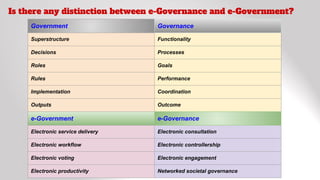
Is there any distinction between e-Governance and e-Government?
Government Governance
Superstructure Functionality
Decisions Processes
Roles Goals
Rules Performance
Implementation Coordination
Outputs Outcome
e-Government e-Governance
Electronic service delivery Electronic consultation
Electronic workflow Electronic controllership
Electronic voting Electronic engagement
Electronic productivity Networked societal governance
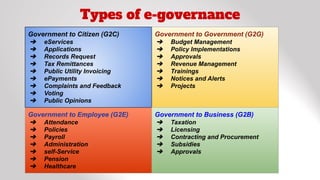
Types of e-governance
Government to Citizen (G2C)
➔ eServices
➔ Applications
➔ Records Request
➔ Tax Remittances
➔ Public Utility Invoicing
➔ ePayments
➔ Complaints and Feedback
➔ Voting
➔ Public Opinions
Government to Government (G2G)
➔ Budget Management
➔ Policy Implementations
➔ Approvals
➔ Revenue Management
➔ Trainings
➔ Notices and Alerts
➔ Projects
Government to Employee (G2E)
➔ Attendance
➔ Policies
➔ Payroll
➔ Administration
➔ self-Service
➔ Pension
➔ Healthcare
Government to Business (G2B)
➔ Taxation
➔ Licensing
➔ Contracting and Procurement
➔ Subsidies
➔ Approvals
Scope of e-Governance
Youth
● Employment Services
● Vehicle Registration
● Driver’s License
● Passport/Visa
Family
● Agriculture
● Land Records
● Property Registration
● Marriage Certificate
● Taxes
● Utility Services
● Municipality Services
Old Age
● Pension
● Insurance
● Healthcare
● Death Certificate
Child
● Birth Certificate
● Healthcare
Student
● School/College admissions
● Scholarships
● e-Learning
● Examination Results
Importance of e-governance
❖ Building strong and effective information chian.
❖ To bridge the gap between India and developed countries.
❖ Effective utilization of resources.
❖ Reduction in delays, Red tape and corruption.
❖ Information delivery is greatly simplified for citizen and business.
❖ It gives varied department information to the public and helps in
decision making .
❖ It ensure citizens participation at all levels of governance.
Conti..
❖ It leads to automated services so that all works of public welfare is
available to all citizens.
❖ It revolutionizes the functions of the government and ensures
transparency.
❖ Each department and its actions is closely monitored.
❖ Public can get their work smartly done and save their time.
❖ It provides better services to citizens and brings government close to
public.
❖ Public can be in touch with the government agency.
❖ It cuts middlemen and bribery if any from the picture.
Examples of e-Governance
Limitations of e-government
❖ Although India had ever increasing population using mobile internet
but still it is below 2.5% .
❖ Overall internet users in India are 243 million only.
❖ Most of the governments are still using analog or paper work, thus
slow rate of modernization has limited the use of e-governance.
❖ Most of government officials lack internet/computer literacy.
❖ No strong law and system to regulate internet, information on
internet or date of users. Thus making whole system vulnerable to
cyberattacks.
Conti..
❖ Slow speed of internet.
❖ Low literacy in India especially in rural regions.
❖ Lack of information about e-governance to people results in low usage
of technology.
❖ High internet cost as telecommunication infrastructure is still evolving.
India still uses 2G speed internet in age of 5G.
9 PILLARS OF DIGITAL INDIA
E-Government Under IT Act
Section 8 in case of the electronic as well as the traditionally printed
gazette, it is stipulated that publication of rules, regulations and
notifications in the Electronic Gazette shall also be legally recognized.
Section 9 Act the same time, no person can insist on electronic filing of
returns or records.
Section 10 The Central Government has been conferred with the power to
make rules in respect of Digital Signature.
Section 10A Validity of contracts formed through electronic means.
Conti..
Chapter 3 of the IT Act, 2000 confers legal recognition to electronic
records.
Section 5 confers legal recognition to digital recognition signatures and
equates it with handwritten signatures.
Section 6 aims to promote use of electronic records and digital signatures
in Government and its agencies.
Section 7 allows retention of electronic records.
Security Drawbacks
There are IT acts to protect or safeguard the e-governance activities but
those acts are not strong enough that is because of the drawbacks. Here
are some of the security drawbacks and other challenges.
❏ Spoofing.
❏ Tampering of e-governance system.
❏ Repudiation.
❏ Disclosure of the e-governance information.
❏ Denial of service.
❏ Elevation of privilege.
❏ Cyber crimes
Conti..
Other challenges are, funding, Management of change, privacy,
authentication, interoperability, delivery of services, standardization,
technology issues and use of local language.
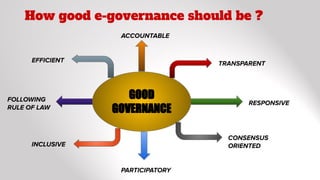
How good e-governance should be ?
GOOD
GOVERNANCE
TRANSPARENT
ACCOUNTABLE
RESPONSIVE
CONSENSUS
ORIENTED
PARTICIPATORY
INCLUSIVE
FOLLOWING
RULE OF LAW
EFFICIENT
Suggestions
★ Improve technology in government offices along with proper training to
officials.
★ Sensitize people about e-governance.
★ Reduce cumbersome processes into smooth transactions.
★ Internet governance to regulate internet and safe usage is required.
★ Increase internet penetration with technology, increased speed,
decrease rates.
Conclusion
● The goal of e-Governance is the ability to access and interact
with the world.
● Developing countries have many opportunities to better
themselves through e-governance.
● WALK WITH THE WORLD.
● An educated is an illiterate, if she/he doesn't have the
knowledge of technology.
THANK
YOU

E governance

  • 1.
    ICT VALUE INGOVERNMENT e-Governance Operational Impact Social Impact Economic Impact Environmental Impact Presented By Shwetha C Annapurna M
  • 2.
    e-governance E-governance is theapplication of Information Technology to the process of government functioning to bring about…. Smart Moral Accountable Responsive Transparent Governance.
  • 3.
    How it wasintroduced in THE WORLD? The United States of America was especially driven by the 1998 Government Paperwork Elimination Act, introduced by former President Mr. Bill Clinton on December 17, 1999.
  • 4.
    4 PILLARS ofe-governance e-Governance P E O P L E P R O C E S S T E C H N O L O G Y R E S O U R C E S
  • 5.
    Top 5 countrieswhich implemented e-governance RANK COUNTRIES 1. SWEDEN 2. DENMARK 3. NORWAY 4. UNITED STATES 5. NETHERLAND
  • 6.
    Is there anydistinction between e-Governance and e-Government? Government Governance Superstructure Functionality Decisions Processes Roles Goals Rules Performance Implementation Coordination Outputs Outcome e-Government e-Governance Electronic service delivery Electronic consultation Electronic workflow Electronic controllership Electronic voting Electronic engagement Electronic productivity Networked societal governance
  • 7.
    Types of e-governance Governmentto Citizen (G2C) ➔ eServices ➔ Applications ➔ Records Request ➔ Tax Remittances ➔ Public Utility Invoicing ➔ ePayments ➔ Complaints and Feedback ➔ Voting ➔ Public Opinions Government to Government (G2G) ➔ Budget Management ➔ Policy Implementations ➔ Approvals ➔ Revenue Management ➔ Trainings ➔ Notices and Alerts ➔ Projects Government to Employee (G2E) ➔ Attendance ➔ Policies ➔ Payroll ➔ Administration ➔ self-Service ➔ Pension ➔ Healthcare Government to Business (G2B) ➔ Taxation ➔ Licensing ➔ Contracting and Procurement ➔ Subsidies ➔ Approvals
  • 8.
    Scope of e-Governance Youth ●Employment Services ● Vehicle Registration ● Driver’s License ● Passport/Visa Family ● Agriculture ● Land Records ● Property Registration ● Marriage Certificate ● Taxes ● Utility Services ● Municipality Services Old Age ● Pension ● Insurance ● Healthcare ● Death Certificate Child ● Birth Certificate ● Healthcare Student ● School/College admissions ● Scholarships ● e-Learning ● Examination Results
  • 9.
    Importance of e-governance ❖Building strong and effective information chian. ❖ To bridge the gap between India and developed countries. ❖ Effective utilization of resources. ❖ Reduction in delays, Red tape and corruption. ❖ Information delivery is greatly simplified for citizen and business. ❖ It gives varied department information to the public and helps in decision making . ❖ It ensure citizens participation at all levels of governance.
  • 10.
    Conti.. ❖ It leadsto automated services so that all works of public welfare is available to all citizens. ❖ It revolutionizes the functions of the government and ensures transparency. ❖ Each department and its actions is closely monitored. ❖ Public can get their work smartly done and save their time. ❖ It provides better services to citizens and brings government close to public. ❖ Public can be in touch with the government agency. ❖ It cuts middlemen and bribery if any from the picture.
  • 11.
  • 12.
  • 13.
    Limitations of e-government ❖Although India had ever increasing population using mobile internet but still it is below 2.5% . ❖ Overall internet users in India are 243 million only. ❖ Most of the governments are still using analog or paper work, thus slow rate of modernization has limited the use of e-governance. ❖ Most of government officials lack internet/computer literacy. ❖ No strong law and system to regulate internet, information on internet or date of users. Thus making whole system vulnerable to cyberattacks.
  • 14.
    Conti.. ❖ Slow speedof internet. ❖ Low literacy in India especially in rural regions. ❖ Lack of information about e-governance to people results in low usage of technology. ❖ High internet cost as telecommunication infrastructure is still evolving. India still uses 2G speed internet in age of 5G.
  • 15.
    9 PILLARS OFDIGITAL INDIA
  • 16.
    E-Government Under ITAct Section 8 in case of the electronic as well as the traditionally printed gazette, it is stipulated that publication of rules, regulations and notifications in the Electronic Gazette shall also be legally recognized. Section 9 Act the same time, no person can insist on electronic filing of returns or records. Section 10 The Central Government has been conferred with the power to make rules in respect of Digital Signature. Section 10A Validity of contracts formed through electronic means.
  • 17.
    Conti.. Chapter 3 ofthe IT Act, 2000 confers legal recognition to electronic records. Section 5 confers legal recognition to digital recognition signatures and equates it with handwritten signatures. Section 6 aims to promote use of electronic records and digital signatures in Government and its agencies. Section 7 allows retention of electronic records.
  • 18.
    Security Drawbacks There areIT acts to protect or safeguard the e-governance activities but those acts are not strong enough that is because of the drawbacks. Here are some of the security drawbacks and other challenges. ❏ Spoofing. ❏ Tampering of e-governance system. ❏ Repudiation. ❏ Disclosure of the e-governance information. ❏ Denial of service. ❏ Elevation of privilege. ❏ Cyber crimes
  • 19.
    Conti.. Other challenges are,funding, Management of change, privacy, authentication, interoperability, delivery of services, standardization, technology issues and use of local language.
  • 20.
    How good e-governanceshould be ? GOOD GOVERNANCE TRANSPARENT ACCOUNTABLE RESPONSIVE CONSENSUS ORIENTED PARTICIPATORY INCLUSIVE FOLLOWING RULE OF LAW EFFICIENT
  • 21.
    Suggestions ★ Improve technologyin government offices along with proper training to officials. ★ Sensitize people about e-governance. ★ Reduce cumbersome processes into smooth transactions. ★ Internet governance to regulate internet and safe usage is required. ★ Increase internet penetration with technology, increased speed, decrease rates.
  • 22.
    Conclusion ● The goalof e-Governance is the ability to access and interact with the world. ● Developing countries have many opportunities to better themselves through e-governance. ● WALK WITH THE WORLD. ● An educated is an illiterate, if she/he doesn't have the knowledge of technology.
  • 23.