Automatic Rain Operated Wiper
1
Abstract
Over the past two decades, the automotive industry has aggressively researched ways to
exploit modern computing and electronic advances in the development of safety,
reliability, and entertainment technologies for vehicles. With drivers exposed to an ever
increasing number of distractions, automatic rain-sensing wiper systems become an even
more appealing feature, as they work to minimize the time the driver must take his/her
hands off the wheel. Most traditional systems offer intermittent as well as variable speed
operation. The traditional wiper system however requires driver constant attention in
adjusting the wiper speed .Traditional windshield wiper speed constantly varies
according to time and vehicle’s speed. Because the manual adjustment of the wiper
distracts driver's attention, which may be a direct cause accidents. This is review paper
for automatic wier in various method and also explain the basic skeleton for adjust speed
of wiper automatically cording to the amount of water on the windshield and in addition
with also in advance removal of moisture inside the car while raining. The system
activates the wiper to operate in full automatic mode and detect moister using CAN
technology.
Keywords
Moisture sensor (SH200), PIC 18F/16F series Microcontrollers with CAN function
provisions, temperature sensor, moisture sensor, rain level sensor.
Automatic Rain Operated Wiper
2
Chapter 1: Introduction
We have pleasure in introducing our new project “AUTOMATIC RAIN
OPERATED WIPER”, which is fully equipped by sensors circuit and wiper motor. It is
a genuine project which is fully equipped and designed for Automobile vehicles. This
forms an integral part of best quality. This product underwent strenuous test in our
Automobile vehicles and it is good. The Automatic rain operated wiper system is a fully
automation project.
This is an era of automation where it is broadly defined as replacement of manual
effort by mechanical power in all degrees of automation. The operation remains an
essential part of the system although with changing demands on physical input as the
degree of mechanization is increased.
1.1. Why Automatic Wiper?
Over the past two decades, the automotive industry has aggressively researched
ways to exploit modern computing and electronic advances in the development of safety,
reliability, and entertainment technologies for vehicles. Previously remarkable and
uncommon features such as auto dimming mirrors and rear-view cameras have become
standard in the modern era. Today consumers expect their automobiles to be able to
connect to their MP3 players, provide GPS-assisted visual directions, and allow hands-
free phone calls via Bluetooth technology. While these features have improved the
driving experience for many, they also imply the increasingly common interaction
between driver and electronic gadgetry during vehicle operation. These interactions can
be a dangerous distraction for the driver, who must take his/her eyes off the road to attend
to a device.
With drivers exposed to an ever increasing number of distractions, automatic rain-
sensing wiper systems become an even more appealing feature, as they work to minimize
the time the driver must take his/her hands off the wheel. These systems detect droplets
of rain on the windshield and automatically turn on and adjust the wiper system in
Automatic Rain Operated Wiper
3
accordance to the level of precipitation. Current rain-sensing systems use an optical
sensor to detect the presence of water on the windshield, and relay wiper control data to
the vehicle's body control module (BCM). Unfortunately, these optical rain sensors suffer
from a small sensing area, are prone to false-positives, and are too expensive to be
included as standard equipment in most vehicles.
Degrees of automation are of two types, viz.
 Full automation.
 Semi automation.
In semi automation a combination of manual effort and mechanical power is
required whereas in full automation human participation is very negligible.
Automatic Rain Operated Wiper
4
Chapter 2: Related Work
Many attempts have been made at constructing an effective, reliable, and cheap
rain detection and wiper control system for vehicles. A perfect system could subtract one
more task from the driver's workload, and allow them to better keep their eyes on the
road and hands on the wheel during foul weather. Despite this, automatic rain-sensing
wiper systems are relatively uncommon in modern vehicles for a number of reasons.
They are often too expensive, too unsightly, or too unreliable to be desired in new
automobiles. While a number of different design approaches have been made to improve
upon these issues, none have been successful enough for the technology to become
widely adapted in new vehicles.
At the beginning of Michigan State University's spring semester in 2010, HATCI
tasked ECE 480 Design Team 6 with designing a new automatic rain-sensing system
utilizing recent advances in capacitive sensor technology. Design Team 6 has delivered
on their proposal with a compact, highly accurate, and cost effective capacitive rain
sensor system. This sensor has been designed to be able to easily replace optical units, as
it mounts in the same location of the vehicle, on the interior of the windshield, and relays
the same control signals to the BCM of the automobile. Sigma-Delta capacitance-to-
digital converter circuits from Analog Devices convert minute changes in capacitance
from the sensor traces into a 24-bit digital output signal, which is then processed by an
on-board microprocessor to determine appropriate wiper action. The sensor improves
upon the preexisting optical unit in detection area, reliability, package size, and most
importantly, cost. Design Team 6 estimates that a production-level run of capacitive rain
sensors will cost under $12 per unit, significantly less than the optical sensor at $18 per
unit.
By far the most common rain detection method, and the one currently employed
by Hyundai vehicles, is the use of an optical sensor. These optical sensors function by
transmitting an infrared beam at an angle through the windshield and measuring the
reflection to determine the presence of water. This is a relatively difficult task, requiring
Automatic Rain Operated Wiper
5
complex circuitry and precision manufacturing. Optical sensors are thus somewhat
expensive and can produce false readings when dirt or other particles on the windshield
cause a reflection mimicking that of rain. Because it relies on an infrared beam for
detection, the optical sensor also suffers from a very small sensing area on the
windshield, limiting its effectiveness in rapidly responding to light rain. In addition, the
sensor housing is physically bulky, reducing its appeal in luxury vehicles.
These issues can largely be mitigated by using a capacitive sensor rather than an
optical one. Instead of sending an infrared beam through the windshield glass, a
capacitive sensor works by emitting an electric field which can pass through the glass to
interact with objects resting on it. Because water and other objects such as dirt or rocks
interfere with the electric field in very different ways, the sensor will be less likely to be
fooled if designed correctly.
Automatic Rain Operated Wiper
6
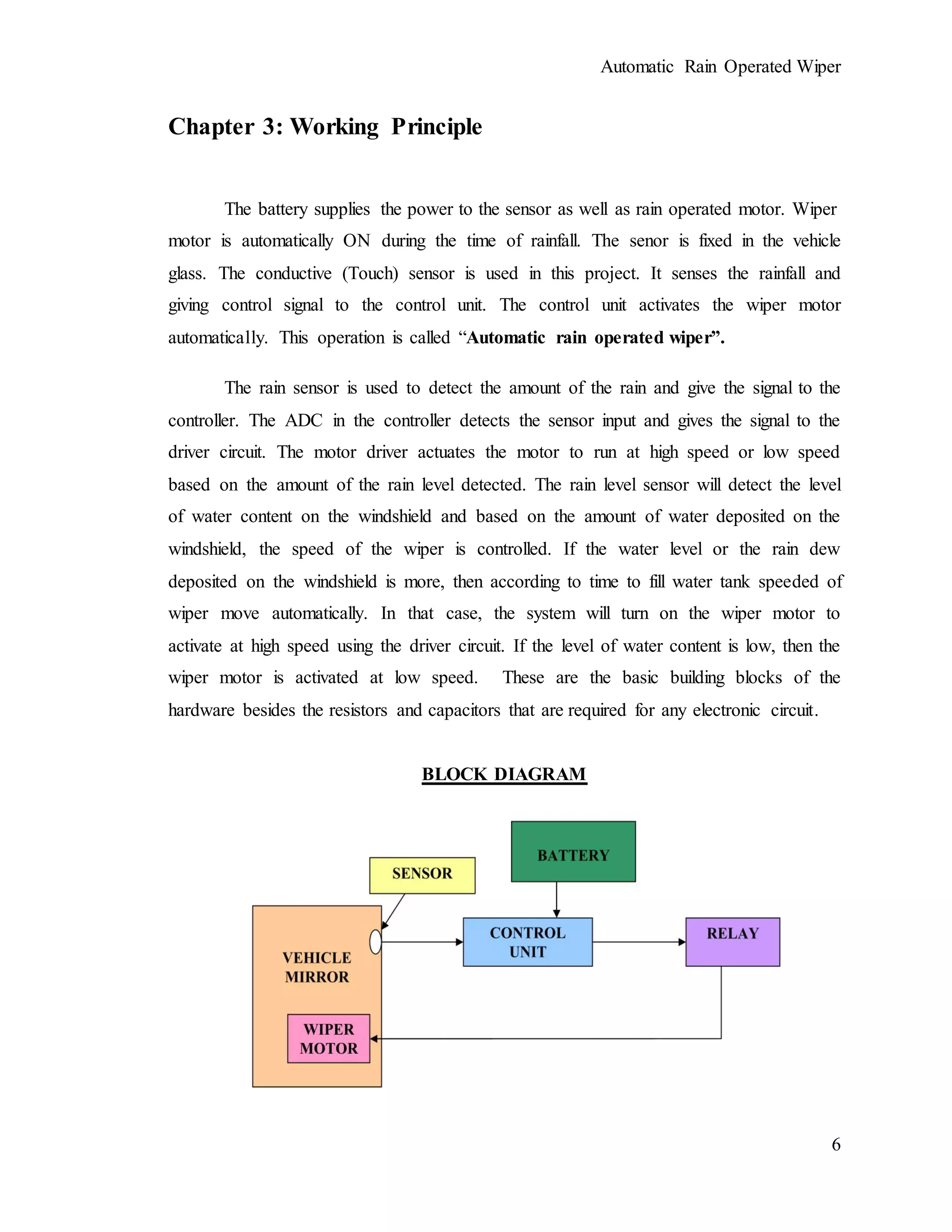
Chapter 3: Working Principle
The battery supplies the power to the sensor as well as rain operated motor. Wiper
motor is automatically ON during the time of rainfall. The senor is fixed in the vehicle
glass. The conductive (Touch) sensor is used in this project. It senses the rainfall and
giving control signal to the control unit. The control unit activates the wiper motor
automatically. This operation is called “Automatic rain operated wiper”.
The rain sensor is used to detect the amount of the rain and give the signal to the
controller. The ADC in the controller detects the sensor input and gives the signal to the
driver circuit. The motor driver actuates the motor to run at high speed or low speed
based on the amount of the rain level detected. The rain level sensor will detect the level
of water content on the windshield and based on the amount of water deposited on the
windshield, the speed of the wiper is controlled. If the water level or the rain dew
deposited on the windshield is more, then according to time to fill water tank speeded of
wiper move automatically. In that case, the system will turn on the wiper motor to
activate at high speed using the driver circuit. If the level of water content is low, then the
wiper motor is activated at low speed. These are the basic building blocks of the
hardware besides the resistors and capacitors that are required for any electronic circuit.
BLOCK DIAGRAM
Automatic Rain Operated Wiper
7
Chapter 4: Design Principle
The major components of the “Automatic rain operated wiper” are follows
 Conductive Sensor
 Class frame and Supporting Structure
 Battery
 Wiper Motor and its arrangement
 Relay
In designing the rain sensor, the following design specifications were provided by the
sponsor:
 Functionality
 Detect and report the presence of one drop of water placed on top of a 6mm thick
glass windshield above the sensor trace area.
 Accuracy
 Must not falsely trigger the wipers when a hand is placed in proximity of the
sensor trace area.
 Provide at least two different output signal levels depending on the amount of rain
present on the windshield.
 Be shielded from the vehicle interior to avoid interference; only water on the
windshield should activate the wipers, not objects or circuits inside the vehicle.
 Maintain all performance characteristics across the temperature range from 33 –
120 degrees Fahrenheit.
 Compatibility
 Device mounts to interior of windshield via adhesive.
 Device can operate on vehicle’s 12 V power supply.
 Cost
 Estimated production cost less than $12 / unit.
Automatic Rain Operated Wiper
8
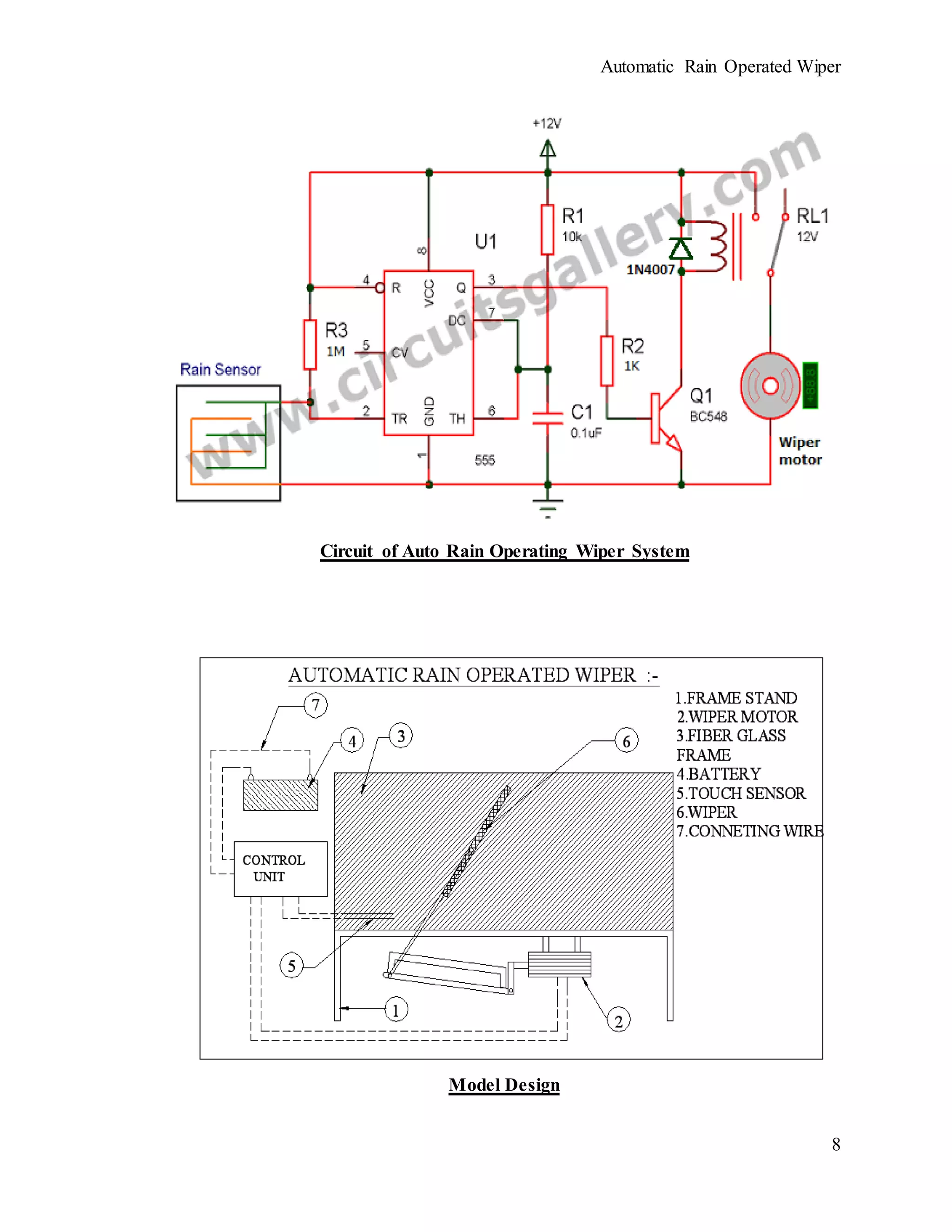
Model Design
Circuit of Auto Rain Operating Wiper System
Automatic Rain Operated Wiper
9
Chapter 5: Advantages
 Low cost automation project.
 Free from wear adjustment.
 Less power consumption
 Operating Principle is very easy.
 Installation is simplified very much.
 To avoid other burnable interactions viz.… (Diaphragm) is not used.
 It is possible to operate Manually/automatically by proving On/Off switch.
 Sensor cost is very low due to conductive sensor
Chapter 6: Disadvantages
 This system applied in the case of water falling on the class only.
 Addition cost is required to install this system to four wheeler.
Chapter 7: Applications
 Four wheeler application
 It is used in aircraft
 It is used in train
 It is used in six wheeler
Automatic Rain Operated Wiper
10
Chapter 8: Conclusion
We have to developed an automatic wiper control system which is improved
version of intermittent wiper system. This wiper system reduce cumbersome wiper
operation and improve driver’s level comfort. It will give a new dimension of comfort
and aid to the drivers who work at night and traffic prone areas where they already have
to concentrate on brakes and clutch. The removal of controlling the wipers during rain
will provide them much ease and help them concentrate on the basic ABC (accelerator,
brake and clutch) of driving. Our system features high accuracy, high sensitivity, and
non-contact measurement. The system are used as component in home automation system
because it can detect a sudden rain and notify people in the house.
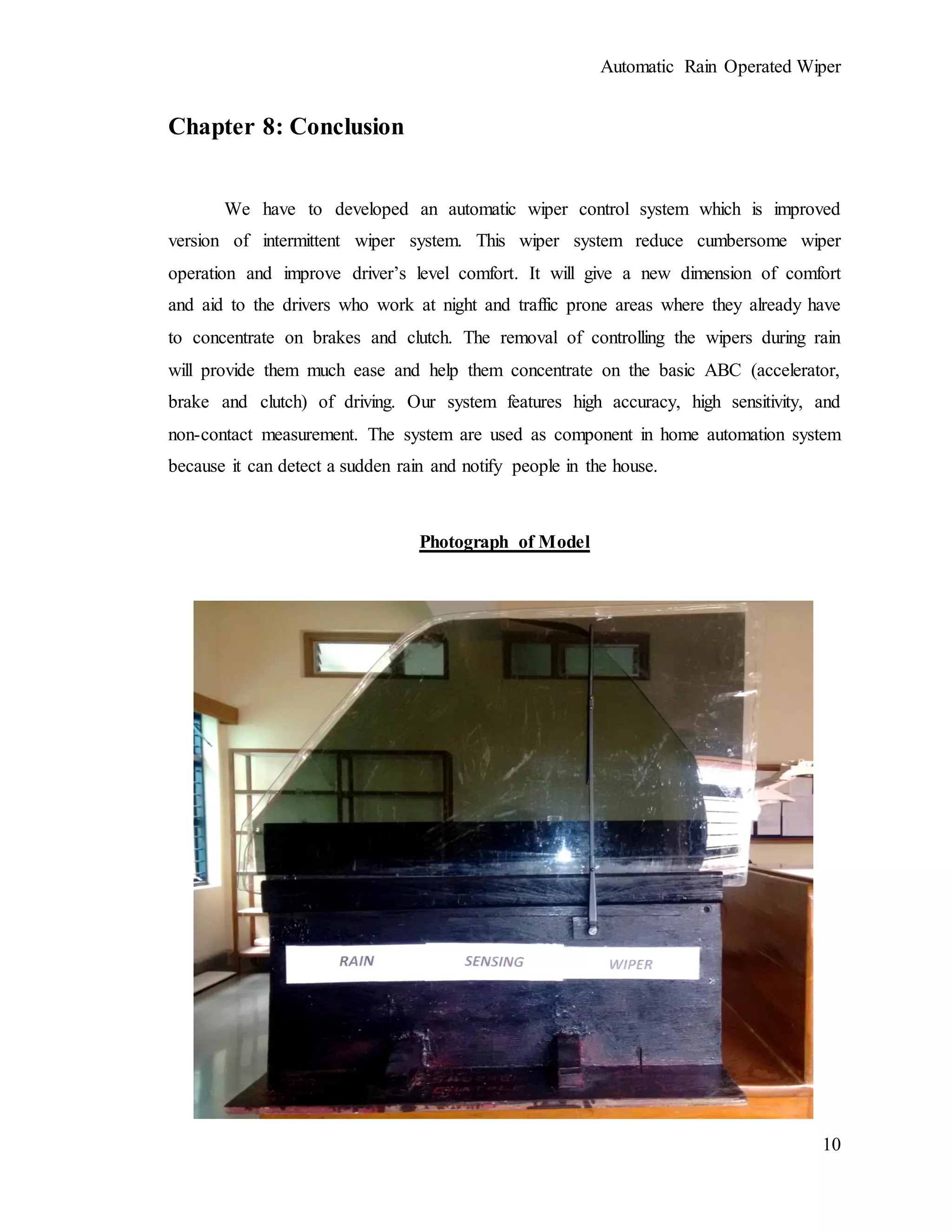
Photograph of Model
Automatic Rain Operated Wiper
11
Chapter 9: References
[1] Abhishek Shukla, Rohan Dwivedi ”Design and Implementation of Vision System Aid
in Windscreen Assembly” International Journal of Computer Applications (0975 –
8887)Volume 7– No.12, October 2010
[2] Joonwoo Son · Seon Bong Lee, Man Ho Kim · Suk Lee*, Kyung Chang Lee**”
Intelligent Rain Sensing and Fuzzy Wiper Control Algorithmfor Vision-based Smart
Windshield Wiper System”
[3] Hideki Kajioka,Keiji Fujimura,Yasuhiro Fujita”Automatic wiper comtroller using
optical sensor”
[4] Wong Sai Hoong & Gilbert Thio”Design of A Moisture Controller For Wiper” Paper
reach report JASA |July 2006
[5] Shinichi KATO* Toshinori YAGI* “Development of a Rain-Light Sensor”Technical
Review 2008
[6] Bosch, "CAN Specification 2.0", in Robert Bosch GmbH, 1991.
[7] Working system of windshield wiperhttp://auto.howstuffworks.com/wiper.htm
[8] History of Windshield wiper.http://www.answers.com/topic/windscreen-wiper- 1.
[9] Lee, Mark. Cypress Semiconductor Corp. "The Art of Capacitive Touch
Sensing."PlanetAnalog.com. 06 Mar. 2006. Web. 18 Feb. 2010.
<http://www.planetanalog.com/features/showArticle.jhtml?articleID=181401898>.
[10] Brychta, Michael. "Measure Capacitive Sensors With A Sigma-Delta
Modulator."Electronicdesign.com. 28 Apr. 2005. Web. 15 Feb. 2010.
<http://electronicdesign.com/article/analog-and-mixedsignal/measure-capacitive-sensors-
with-a-sigma-delta-modu.aspx>.

Mini project rain sensing wiper

  • 1.
    Automatic Rain OperatedWiper 1 Abstract Over the past two decades, the automotive industry has aggressively researched ways to exploit modern computing and electronic advances in the development of safety, reliability, and entertainment technologies for vehicles. With drivers exposed to an ever increasing number of distractions, automatic rain-sensing wiper systems become an even more appealing feature, as they work to minimize the time the driver must take his/her hands off the wheel. Most traditional systems offer intermittent as well as variable speed operation. The traditional wiper system however requires driver constant attention in adjusting the wiper speed .Traditional windshield wiper speed constantly varies according to time and vehicle’s speed. Because the manual adjustment of the wiper distracts driver's attention, which may be a direct cause accidents. This is review paper for automatic wier in various method and also explain the basic skeleton for adjust speed of wiper automatically cording to the amount of water on the windshield and in addition with also in advance removal of moisture inside the car while raining. The system activates the wiper to operate in full automatic mode and detect moister using CAN technology. Keywords Moisture sensor (SH200), PIC 18F/16F series Microcontrollers with CAN function provisions, temperature sensor, moisture sensor, rain level sensor.
  • 2.
    Automatic Rain OperatedWiper 2 Chapter 1: Introduction We have pleasure in introducing our new project “AUTOMATIC RAIN OPERATED WIPER”, which is fully equipped by sensors circuit and wiper motor. It is a genuine project which is fully equipped and designed for Automobile vehicles. This forms an integral part of best quality. This product underwent strenuous test in our Automobile vehicles and it is good. The Automatic rain operated wiper system is a fully automation project. This is an era of automation where it is broadly defined as replacement of manual effort by mechanical power in all degrees of automation. The operation remains an essential part of the system although with changing demands on physical input as the degree of mechanization is increased. 1.1. Why Automatic Wiper? Over the past two decades, the automotive industry has aggressively researched ways to exploit modern computing and electronic advances in the development of safety, reliability, and entertainment technologies for vehicles. Previously remarkable and uncommon features such as auto dimming mirrors and rear-view cameras have become standard in the modern era. Today consumers expect their automobiles to be able to connect to their MP3 players, provide GPS-assisted visual directions, and allow hands- free phone calls via Bluetooth technology. While these features have improved the driving experience for many, they also imply the increasingly common interaction between driver and electronic gadgetry during vehicle operation. These interactions can be a dangerous distraction for the driver, who must take his/her eyes off the road to attend to a device. With drivers exposed to an ever increasing number of distractions, automatic rain- sensing wiper systems become an even more appealing feature, as they work to minimize the time the driver must take his/her hands off the wheel. These systems detect droplets of rain on the windshield and automatically turn on and adjust the wiper system in
  • 3.
    Automatic Rain OperatedWiper 3 accordance to the level of precipitation. Current rain-sensing systems use an optical sensor to detect the presence of water on the windshield, and relay wiper control data to the vehicle's body control module (BCM). Unfortunately, these optical rain sensors suffer from a small sensing area, are prone to false-positives, and are too expensive to be included as standard equipment in most vehicles. Degrees of automation are of two types, viz.  Full automation.  Semi automation. In semi automation a combination of manual effort and mechanical power is required whereas in full automation human participation is very negligible.
  • 4.
    Automatic Rain OperatedWiper 4 Chapter 2: Related Work Many attempts have been made at constructing an effective, reliable, and cheap rain detection and wiper control system for vehicles. A perfect system could subtract one more task from the driver's workload, and allow them to better keep their eyes on the road and hands on the wheel during foul weather. Despite this, automatic rain-sensing wiper systems are relatively uncommon in modern vehicles for a number of reasons. They are often too expensive, too unsightly, or too unreliable to be desired in new automobiles. While a number of different design approaches have been made to improve upon these issues, none have been successful enough for the technology to become widely adapted in new vehicles. At the beginning of Michigan State University's spring semester in 2010, HATCI tasked ECE 480 Design Team 6 with designing a new automatic rain-sensing system utilizing recent advances in capacitive sensor technology. Design Team 6 has delivered on their proposal with a compact, highly accurate, and cost effective capacitive rain sensor system. This sensor has been designed to be able to easily replace optical units, as it mounts in the same location of the vehicle, on the interior of the windshield, and relays the same control signals to the BCM of the automobile. Sigma-Delta capacitance-to- digital converter circuits from Analog Devices convert minute changes in capacitance from the sensor traces into a 24-bit digital output signal, which is then processed by an on-board microprocessor to determine appropriate wiper action. The sensor improves upon the preexisting optical unit in detection area, reliability, package size, and most importantly, cost. Design Team 6 estimates that a production-level run of capacitive rain sensors will cost under $12 per unit, significantly less than the optical sensor at $18 per unit. By far the most common rain detection method, and the one currently employed by Hyundai vehicles, is the use of an optical sensor. These optical sensors function by transmitting an infrared beam at an angle through the windshield and measuring the reflection to determine the presence of water. This is a relatively difficult task, requiring
  • 5.
    Automatic Rain OperatedWiper 5 complex circuitry and precision manufacturing. Optical sensors are thus somewhat expensive and can produce false readings when dirt or other particles on the windshield cause a reflection mimicking that of rain. Because it relies on an infrared beam for detection, the optical sensor also suffers from a very small sensing area on the windshield, limiting its effectiveness in rapidly responding to light rain. In addition, the sensor housing is physically bulky, reducing its appeal in luxury vehicles. These issues can largely be mitigated by using a capacitive sensor rather than an optical one. Instead of sending an infrared beam through the windshield glass, a capacitive sensor works by emitting an electric field which can pass through the glass to interact with objects resting on it. Because water and other objects such as dirt or rocks interfere with the electric field in very different ways, the sensor will be less likely to be fooled if designed correctly.
  • 6.
    Automatic Rain OperatedWiper 6 Chapter 3: Working Principle The battery supplies the power to the sensor as well as rain operated motor. Wiper motor is automatically ON during the time of rainfall. The senor is fixed in the vehicle glass. The conductive (Touch) sensor is used in this project. It senses the rainfall and giving control signal to the control unit. The control unit activates the wiper motor automatically. This operation is called “Automatic rain operated wiper”. The rain sensor is used to detect the amount of the rain and give the signal to the controller. The ADC in the controller detects the sensor input and gives the signal to the driver circuit. The motor driver actuates the motor to run at high speed or low speed based on the amount of the rain level detected. The rain level sensor will detect the level of water content on the windshield and based on the amount of water deposited on the windshield, the speed of the wiper is controlled. If the water level or the rain dew deposited on the windshield is more, then according to time to fill water tank speeded of wiper move automatically. In that case, the system will turn on the wiper motor to activate at high speed using the driver circuit. If the level of water content is low, then the wiper motor is activated at low speed. These are the basic building blocks of the hardware besides the resistors and capacitors that are required for any electronic circuit. BLOCK DIAGRAM
  • 7.
    Automatic Rain OperatedWiper 7 Chapter 4: Design Principle The major components of the “Automatic rain operated wiper” are follows  Conductive Sensor  Class frame and Supporting Structure  Battery  Wiper Motor and its arrangement  Relay In designing the rain sensor, the following design specifications were provided by the sponsor:  Functionality  Detect and report the presence of one drop of water placed on top of a 6mm thick glass windshield above the sensor trace area.  Accuracy  Must not falsely trigger the wipers when a hand is placed in proximity of the sensor trace area.  Provide at least two different output signal levels depending on the amount of rain present on the windshield.  Be shielded from the vehicle interior to avoid interference; only water on the windshield should activate the wipers, not objects or circuits inside the vehicle.  Maintain all performance characteristics across the temperature range from 33 – 120 degrees Fahrenheit.  Compatibility  Device mounts to interior of windshield via adhesive.  Device can operate on vehicle’s 12 V power supply.  Cost  Estimated production cost less than $12 / unit.
  • 8.
    Automatic Rain OperatedWiper 8 Model Design Circuit of Auto Rain Operating Wiper System
  • 9.
    Automatic Rain OperatedWiper 9 Chapter 5: Advantages  Low cost automation project.  Free from wear adjustment.  Less power consumption  Operating Principle is very easy.  Installation is simplified very much.  To avoid other burnable interactions viz.… (Diaphragm) is not used.  It is possible to operate Manually/automatically by proving On/Off switch.  Sensor cost is very low due to conductive sensor Chapter 6: Disadvantages  This system applied in the case of water falling on the class only.  Addition cost is required to install this system to four wheeler. Chapter 7: Applications  Four wheeler application  It is used in aircraft  It is used in train  It is used in six wheeler
  • 10.
    Automatic Rain OperatedWiper 10 Chapter 8: Conclusion We have to developed an automatic wiper control system which is improved version of intermittent wiper system. This wiper system reduce cumbersome wiper operation and improve driver’s level comfort. It will give a new dimension of comfort and aid to the drivers who work at night and traffic prone areas where they already have to concentrate on brakes and clutch. The removal of controlling the wipers during rain will provide them much ease and help them concentrate on the basic ABC (accelerator, brake and clutch) of driving. Our system features high accuracy, high sensitivity, and non-contact measurement. The system are used as component in home automation system because it can detect a sudden rain and notify people in the house. Photograph of Model
  • 11.
    Automatic Rain OperatedWiper 11 Chapter 9: References [1] Abhishek Shukla, Rohan Dwivedi ”Design and Implementation of Vision System Aid in Windscreen Assembly” International Journal of Computer Applications (0975 – 8887)Volume 7– No.12, October 2010 [2] Joonwoo Son · Seon Bong Lee, Man Ho Kim · Suk Lee*, Kyung Chang Lee**” Intelligent Rain Sensing and Fuzzy Wiper Control Algorithmfor Vision-based Smart Windshield Wiper System” [3] Hideki Kajioka,Keiji Fujimura,Yasuhiro Fujita”Automatic wiper comtroller using optical sensor” [4] Wong Sai Hoong & Gilbert Thio”Design of A Moisture Controller For Wiper” Paper reach report JASA |July 2006 [5] Shinichi KATO* Toshinori YAGI* “Development of a Rain-Light Sensor”Technical Review 2008 [6] Bosch, "CAN Specification 2.0", in Robert Bosch GmbH, 1991. [7] Working system of windshield wiperhttp://auto.howstuffworks.com/wiper.htm [8] History of Windshield wiper.http://www.answers.com/topic/windscreen-wiper- 1. [9] Lee, Mark. Cypress Semiconductor Corp. "The Art of Capacitive Touch Sensing."PlanetAnalog.com. 06 Mar. 2006. Web. 18 Feb. 2010. <http://www.planetanalog.com/features/showArticle.jhtml?articleID=181401898>. [10] Brychta, Michael. "Measure Capacitive Sensors With A Sigma-Delta Modulator."Electronicdesign.com. 28 Apr. 2005. Web. 15 Feb. 2010. <http://electronicdesign.com/article/analog-and-mixedsignal/measure-capacitive-sensors- with-a-sigma-delta-modu.aspx>.