Implementation of eCall in PSAPs
Our experience in Spain
| 26-04-2018 | © Atos2
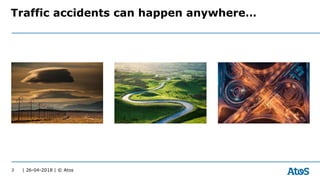
Traffic accidents can happen anywhere…
| 26-04-2018 | © Atos3
Contents
Chapter 1 - Implementation of eCall in PSAPs; our
experience in Spain. Chapter 2 - Remaining issues
from the PSAP perspective. Chapter 3 - Conclusions
& recommendations. Contact details
Implementation of eCall in
PSAPs
| 26-04-2018 | © Atos
▶ Opted for 112-based eCall, without any dedicated eCall PSAPs. The result was a
collaborative work between:
– Spanish Government –> General Traffic Directorate (DGT) and Secretariat of State for
the Information Society and the Digital Agenda (SESIAD)
– Autonomous Regions –> 19 regional 112 PSAPs
– MNOs -> Movistar, Vodafone & Orange
▶ All 112 PSAPs committed to deploying eCall service at their regional level in due time, for a
complete coverage of the Spanish territory.
– They provided MNO managers with dedicated long numbers to redirect eCalls.
– They committed to self-assessment of conformity operations of each eCall PSAP.
– No TPS involvement.
▶ Other organizations involved: Telefónica Soluciones, CTAG, other local entities…
5
eCall implementation in Spain
| 26-04-2018 | © Atos6
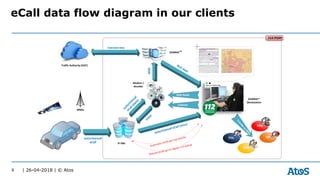
eCall data flow diagram in our clients
112 PSAP
GEMMA™
Workstation
IP PBX
GEMMATM
auto/m
anual
eCall(data)
VoiceMSD
Extended data
Traffic Authority (DGT)
auto/manual eCall (voice)
Rich data
MSD Rebid
Callback
Modem /
decoder
auto/manual
eCall
Transferto
EROs
FRS
EMS
CPPOL
Automatic eCalls get top priority
Manual eCalls go to regular 112 queue
MNOs
| 26-04-2018 | © Atos
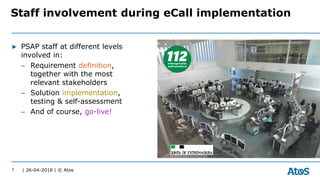
▶ PSAP staff at different levels
involved in:
– Requirement definition,
together with the most
relevant stakeholders
– Solution implementation,
testing & self-assessment
– And of course, go-live!
Staff involvement during eCall implementation
7
| 26-04-2018 | © Atos8
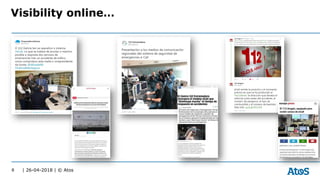
Visibility online…
| 26-04-2018 | © Atos
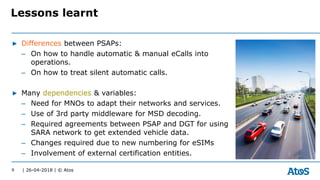
▶ Differences between PSAPs:
– On how to handle automatic & manual eCalls into
operations.
– On how to treat silent automatic calls.
▶ Many dependencies & variables:
– Need for MNOs to adapt their networks and services.
– Use of 3rd party middleware for MSD decoding.
– Required agreements between PSAP and DGT for using
SARA network to get extended vehicle data.
– Changes required due to new numbering for eSIMs
– Involvement of external certification entities.
Lessons learnt
9
Remaining issues from the
PSAP perspective
| 26-04-2018 | © Atos
▶ Very slow start…
– Some PSAPs haven’t received any real eCall yet!
– Also getting lots of test calls in live environment
▶ Could eSIM-less eCalls happen?
▶ False eCalls…
– During car repairs or checkups
– Unintentionally pressing the SOS button
▶ IP PBX issues: eSIM numbering extended up to 18
digits due to international calling codes
11
Remaining issues from PSAP perspective (1/2)
| 26-04-2018 | © Atos
▶ Extended data unavailable for vehicles not registered
in Spain
▶ Security concerns raised by the public:
– How easy/hard is it to hack the IVS?
▶ Working (or not) with TPSP:
– Give long numbers of all regional 112 to all
TPSPs?
– Specific agreements for each or framework
agreement for all?
12
Remaining issues from PSAP perspective (2/2)
Conclusions &
recommendations
| 26-04-2018 | © Atos
▶ Not all PSAPs had same eCall implementation timelines for acquiring
middleware and adapting their platforms. Some PSAPs went for public tenders,
others used existing contracts.
▶ No single solution for all PSAPs in Spain:
– A few 112 PSAPs opted for developing own solutions
– Most used 3rd party middleware from a limited number of vendors.
▶ Some PSAPs needed to update their agreements with the Traffic Authority in
order to get extended vehicle details.
▶ Not all MNOs did the required adaptations at the same time.
Conclusions
14
| 26-04-2018 | © Atos
▶ Do not wait until it’s almost too late!!!!!
▶ And also….
– Define and plan end-to-end test cases involving ALL stakeholders
– Plan for non-technical/operational tasks (i.e. Access Level
Agreements with key external entities)
– Take full advantage of related EU projects / initiatives (ex.
HeERO, HeERO 2, I_HeERO, …)
Our recommendations…
15
Atos, the Atos logo, Atos Codex, Atos Consulting, Atos Worldgrid, Bull, Canopy, equensWorldline, Unify,
Worldline and Zero Email are registered trademarks of the Atos group. April 2018. © 2018 Atos
Thanks ! Hvala lepa!
Contact: Iratxe Gomez Susaeta
M+ 34 609 077 340
iratxe.gomezsusaeta@atos.net

EENA 2018 - eCall implementation remaining issues

  • 1.
    Implementation of eCallin PSAPs Our experience in Spain
  • 2.
    | 26-04-2018 |© Atos2 Traffic accidents can happen anywhere…
  • 3.
    | 26-04-2018 |© Atos3 Contents Chapter 1 - Implementation of eCall in PSAPs; our experience in Spain. Chapter 2 - Remaining issues from the PSAP perspective. Chapter 3 - Conclusions & recommendations. Contact details
  • 4.
  • 5.
    | 26-04-2018 |© Atos ▶ Opted for 112-based eCall, without any dedicated eCall PSAPs. The result was a collaborative work between: – Spanish Government –> General Traffic Directorate (DGT) and Secretariat of State for the Information Society and the Digital Agenda (SESIAD) – Autonomous Regions –> 19 regional 112 PSAPs – MNOs -> Movistar, Vodafone & Orange ▶ All 112 PSAPs committed to deploying eCall service at their regional level in due time, for a complete coverage of the Spanish territory. – They provided MNO managers with dedicated long numbers to redirect eCalls. – They committed to self-assessment of conformity operations of each eCall PSAP. – No TPS involvement. ▶ Other organizations involved: Telefónica Soluciones, CTAG, other local entities… 5 eCall implementation in Spain
  • 6.
    | 26-04-2018 |© Atos6 eCall data flow diagram in our clients 112 PSAP GEMMA™ Workstation IP PBX GEMMATM auto/m anual eCall(data) VoiceMSD Extended data Traffic Authority (DGT) auto/manual eCall (voice) Rich data MSD Rebid Callback Modem / decoder auto/manual eCall Transferto EROs FRS EMS CPPOL Automatic eCalls get top priority Manual eCalls go to regular 112 queue MNOs
  • 7.
    | 26-04-2018 |© Atos ▶ PSAP staff at different levels involved in: – Requirement definition, together with the most relevant stakeholders – Solution implementation, testing & self-assessment – And of course, go-live! Staff involvement during eCall implementation 7
  • 8.
    | 26-04-2018 |© Atos8 Visibility online…
  • 9.
    | 26-04-2018 |© Atos ▶ Differences between PSAPs: – On how to handle automatic & manual eCalls into operations. – On how to treat silent automatic calls. ▶ Many dependencies & variables: – Need for MNOs to adapt their networks and services. – Use of 3rd party middleware for MSD decoding. – Required agreements between PSAP and DGT for using SARA network to get extended vehicle data. – Changes required due to new numbering for eSIMs – Involvement of external certification entities. Lessons learnt 9
  • 10.
    Remaining issues fromthe PSAP perspective
  • 11.
    | 26-04-2018 |© Atos ▶ Very slow start… – Some PSAPs haven’t received any real eCall yet! – Also getting lots of test calls in live environment ▶ Could eSIM-less eCalls happen? ▶ False eCalls… – During car repairs or checkups – Unintentionally pressing the SOS button ▶ IP PBX issues: eSIM numbering extended up to 18 digits due to international calling codes 11 Remaining issues from PSAP perspective (1/2)
  • 12.
    | 26-04-2018 |© Atos ▶ Extended data unavailable for vehicles not registered in Spain ▶ Security concerns raised by the public: – How easy/hard is it to hack the IVS? ▶ Working (or not) with TPSP: – Give long numbers of all regional 112 to all TPSPs? – Specific agreements for each or framework agreement for all? 12 Remaining issues from PSAP perspective (2/2)
  • 13.
  • 14.
    | 26-04-2018 |© Atos ▶ Not all PSAPs had same eCall implementation timelines for acquiring middleware and adapting their platforms. Some PSAPs went for public tenders, others used existing contracts. ▶ No single solution for all PSAPs in Spain: – A few 112 PSAPs opted for developing own solutions – Most used 3rd party middleware from a limited number of vendors. ▶ Some PSAPs needed to update their agreements with the Traffic Authority in order to get extended vehicle details. ▶ Not all MNOs did the required adaptations at the same time. Conclusions 14
  • 15.
    | 26-04-2018 |© Atos ▶ Do not wait until it’s almost too late!!!!! ▶ And also…. – Define and plan end-to-end test cases involving ALL stakeholders – Plan for non-technical/operational tasks (i.e. Access Level Agreements with key external entities) – Take full advantage of related EU projects / initiatives (ex. HeERO, HeERO 2, I_HeERO, …) Our recommendations… 15
  • 16.
    Atos, the Atoslogo, Atos Codex, Atos Consulting, Atos Worldgrid, Bull, Canopy, equensWorldline, Unify, Worldline and Zero Email are registered trademarks of the Atos group. April 2018. © 2018 Atos Thanks ! Hvala lepa! Contact: Iratxe Gomez Susaeta M+ 34 609 077 340 iratxe.gomezsusaeta@atos.net