

DYSBARISM


                                 Dr Sumesh Arora
                                   Staff Specialist
            Department of Intensive Care Medicine
                 Prince of Wales Hospital, Sydney
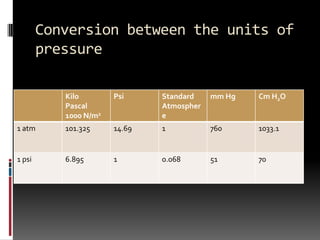
Conversion between the units of
        pressure

           Kilo        Psi     Standard    mm Hg   Cm H2O
           Pascal              Atmospher
           1000 N/m2           e
1 atm      101.325     14.69   1           760     1033.1


1 psi      6.895       1       0.068       51      70
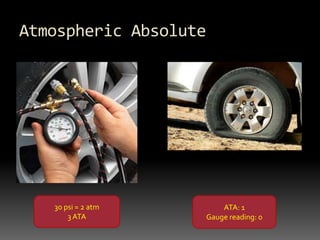
Atmospheric Absolute


   30 psi = 2 atm       ATA: 1
       3 ATA        Gauge reading: 0
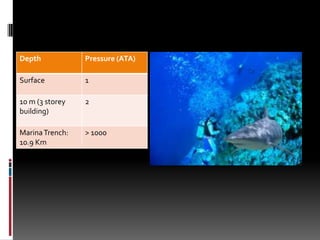
Depth            Pressure (ATA)

Surface          1

10 m (3 storey   2
building)

Marina Trench:   > 1000
10.9 Km
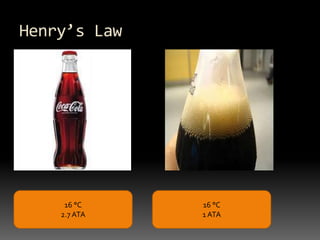
Henry’s Law


     16 °C    16 °C
    2.7 ATA   1 ATA
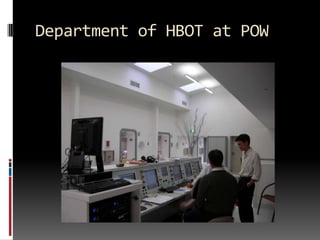
Department of HBOT at POW
Basic mechanism of action

 Increase in the solubility of all gases in blood
  at high pressure. Henry’s law
 Attainment of very high oxygen level
   Displacement of toxins like CO from haemoglobin
   Kills anaerobic organisms
 Anti-inflammatory action of hyperbaric
  oxygen
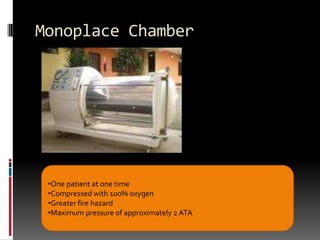
Monoplace Chamber


 •One patient at one time
 •Compressed with 100% oxygen
 •Greater fire hazard
 •Maximum pressure of approximately 2 ATA
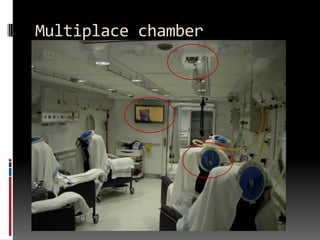
Multiplace chamber
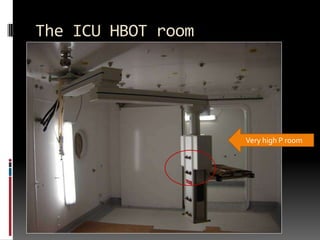
The ICU HBOT room


                    Very high P room
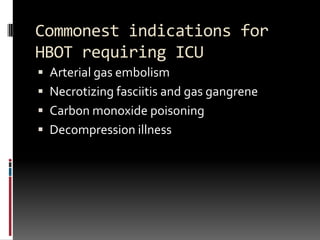
Commonest indications for
HBOT requiring ICU
 Arterial gas embolism
 Necrotizing fasciitis and gas gangrene
 Carbon monoxide poisoning
 Decompression illness
Arterial Gas Embolism
Referral and transfer for HBOT:
Things to remember
 Diagnosis of AGE is clinical

 supine position.
    Lateral decubitus with head down increases ICP


 High concentration O2 is extremely important.
    If patient is intubated, use 100%

 If air transfer:
    Possibility of exacerbation of injury due to
     decompression and increase is size of bubbles
Necrotizing fasciitis and gas
gangrene
Pain out of proportion to physical signs

In later stages, development of anaesthesia over the
    affected area indicate destruction of nerves

Easy separation of tissue planes at the time of debridement

Foul smelling exudate may suggest anaerobic infection

Hypocalcemia may be indicative of extensive fat necrosis
Imaging to diagnose Necrotizing
fasciitis?
Really early in the course of disease, CT may identify gas

MR may overestimate the extent of deep tissue
  involvement
Treatment before transfer for HBOT


 Early surgery and debriment.
   Commonest mistake is to refer for HBOT before
    debridement
   Obtain tissue samples


 Broad spectrum antibiotics
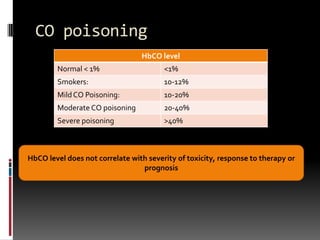
CO poisoning
                                 HbCO level
        Normal < 1%                     <1%
        Smokers:                        10-12%
        Mild CO Poisoning:              10-20%
        Moderate CO poisoning           20-40%
        Severe poisoning                >40%


HbCO level does not correlate with severity of toxicity, response to therapy or
                                 prognosis
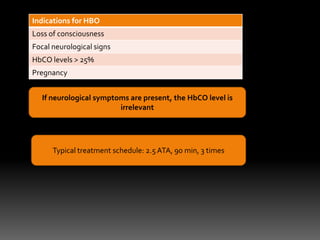
Indications for HBO
Loss of consciousness
Focal neurological signs
HbCO levels > 25%
Pregnancy


   If neurological symptoms are present, the HbCO level is
                         irrelevant


      Typical treatment schedule: 2.5 ATA, 90 min, 3 times
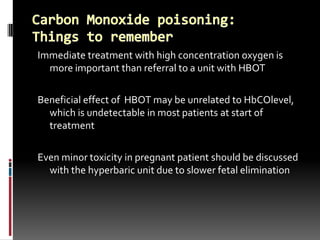
Immediate treatment with high concentration oxygen is
  more important than referral to a unit with HBOT

Beneficial effect of HBOT may be unrelated to HbCOlevel,
  which is undetectable in most patients at start of
  treatment

Even minor toxicity in pregnant patient should be discussed
  with the hyperbaric unit due to slower fetal elimination
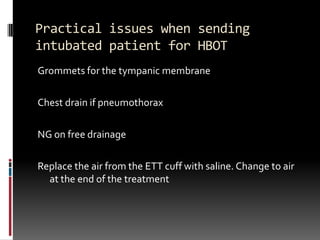
Practical issues when sending
intubated patient for HBOT
Grommets for the tympanic membrane

Chest drain if pneumothorax

NG on free drainage

Replace the air from the ETT cuff with saline. Change to air
  at the end of the treatment
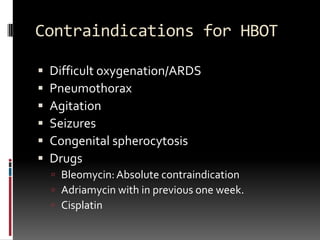
Contraindications for HBOT

   Difficult oxygenation/ARDS
   Pneumothorax
   Agitation
   Seizures
   Congenital spherocytosis
   Drugs
     Bleomycin: Absolute contraindication
     Adriamycin with in previous one week.
     Cisplatin
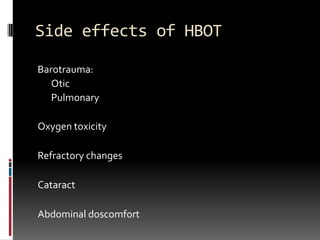
Side effects of HBOT

Barotrauma:
   Otic
   Pulmonary

Oxygen toxicity

Refractory changes

Cataract

Abdominal doscomfort
When in doubt,
speak with your referral HBOT unit
Thank you

Sumesh Arora on Dysbarism

  • 1.
    DYSBARISM Dr Sumesh Arora Staff Specialist Department of Intensive Care Medicine Prince of Wales Hospital, Sydney
  • 2.
    Conversion between theunits of pressure Kilo Psi Standard mm Hg Cm H2O Pascal Atmospher 1000 N/m2 e 1 atm 101.325 14.69 1 760 1033.1 1 psi 6.895 1 0.068 51 70
  • 3.
    Atmospheric Absolute 30 psi = 2 atm ATA: 1 3 ATA Gauge reading: 0
  • 4.
    Depth Pressure (ATA) Surface 1 10 m (3 storey 2 building) Marina Trench: > 1000 10.9 Km
  • 5.
    Henry’s Law 16 °C 16 °C 2.7 ATA 1 ATA
  • 6.
  • 7.
    Basic mechanism ofaction  Increase in the solubility of all gases in blood at high pressure. Henry’s law  Attainment of very high oxygen level  Displacement of toxins like CO from haemoglobin  Kills anaerobic organisms  Anti-inflammatory action of hyperbaric oxygen
  • 8.
    Monoplace Chamber •Onepatient at one time •Compressed with 100% oxygen •Greater fire hazard •Maximum pressure of approximately 2 ATA
  • 10.
  • 11.
    The ICU HBOTroom Very high P room
  • 12.
    Commonest indications for HBOTrequiring ICU  Arterial gas embolism  Necrotizing fasciitis and gas gangrene  Carbon monoxide poisoning  Decompression illness
  • 13.
    Arterial Gas Embolism Referraland transfer for HBOT: Things to remember  Diagnosis of AGE is clinical  supine position.  Lateral decubitus with head down increases ICP  High concentration O2 is extremely important.  If patient is intubated, use 100%  If air transfer:  Possibility of exacerbation of injury due to decompression and increase is size of bubbles
  • 14.
    Necrotizing fasciitis andgas gangrene Pain out of proportion to physical signs In later stages, development of anaesthesia over the affected area indicate destruction of nerves Easy separation of tissue planes at the time of debridement Foul smelling exudate may suggest anaerobic infection Hypocalcemia may be indicative of extensive fat necrosis
  • 15.
    Imaging to diagnoseNecrotizing fasciitis? Really early in the course of disease, CT may identify gas MR may overestimate the extent of deep tissue involvement
  • 16.
    Treatment before transferfor HBOT  Early surgery and debriment.  Commonest mistake is to refer for HBOT before debridement  Obtain tissue samples  Broad spectrum antibiotics
  • 17.
    CO poisoning HbCO level Normal < 1% <1% Smokers: 10-12% Mild CO Poisoning: 10-20% Moderate CO poisoning 20-40% Severe poisoning >40% HbCO level does not correlate with severity of toxicity, response to therapy or prognosis
  • 18.
    Indications for HBO Lossof consciousness Focal neurological signs HbCO levels > 25% Pregnancy If neurological symptoms are present, the HbCO level is irrelevant Typical treatment schedule: 2.5 ATA, 90 min, 3 times
  • 19.
    Immediate treatment withhigh concentration oxygen is more important than referral to a unit with HBOT Beneficial effect of HBOT may be unrelated to HbCOlevel, which is undetectable in most patients at start of treatment Even minor toxicity in pregnant patient should be discussed with the hyperbaric unit due to slower fetal elimination
  • 20.
    Practical issues whensending intubated patient for HBOT Grommets for the tympanic membrane Chest drain if pneumothorax NG on free drainage Replace the air from the ETT cuff with saline. Change to air at the end of the treatment
  • 21.
    Contraindications for HBOT  Difficult oxygenation/ARDS  Pneumothorax  Agitation  Seizures  Congenital spherocytosis  Drugs  Bleomycin: Absolute contraindication  Adriamycin with in previous one week.  Cisplatin
  • 22.
    Side effects ofHBOT Barotrauma: Otic Pulmonary Oxygen toxicity Refractory changes Cataract Abdominal doscomfort
  • 23.
    When in doubt, speakwith your referral HBOT unit
  • 24.

Editor's Notes

  • #2 Dysbarism means problems associated with high pressure (as in scuba divers), or low pressure (as with high altitude) or due to rapid change in the pressure an individual is exposed to. I work at Prince of Wales Hospital in Sydney, which provides hyperbaric services for the state of NSW. I will give a brief introduction to the case mix of patients who require both HBOT and who need to be in ICU.
  • #3 Several units for measurement of pressure are in common use, to the delight of examiners for primary Anaesthetic and ICU. It may be worth reviewing those. 1 atmosphere is equal to 101 Kpa, 14.7 psi, 760 mm Hg.
  • #4 Most pressure gauge measure the difference between the atmospheric pressure, and place where the pressure is being measured. For example when we fill the tyre of a car to 32 psi, or approximately 2 atm, what the gauge is really telling us is that pressure inside the tyre is 2 atm above the atmospheric pressure, or 3 Atmospheric absolute. Similarly, if we have a flat tyre, the gauge reading is 0, but it does not imply that there is vaccum inside the tyre. The pressure inside is the same as outside, or = 1 ATAIn the discussion of Hyperbaric treatment, all pressures will be quoted as atmospheric absolute.ATA refers to the pressure at a place, when the ambient air pressure is added to the pressure. is the ambient pressure including the pressure of the air column above water. Remember, the gauge is usually reading the difference between the pressure at the tyre and the atmospheric pressure.
  • #5 People who dive would know that at a depth of 10 m, the ambient pressure goes up to 2 ATA. , the pressure increases to 2 ATA.Marina trench is located in the Western Pacific Ocean. The deepest point is called Challenger Deep, which is over 11 km deep. Pressure of the water column there is &gt;1100 ATA
  • #6 At room temperature, the bottle of coke is pressurised to 2.7 ATA. At such high pressure, the solubility of CO2 in the coke is high, and all of it is in dissolved form. As soon as we open the bottle, the coke in the bottle is not exposed to atmospheric pressure. As a result the solubility of coke to CO2 decreases, and it starts to escape in the form of bubbes. Henry Law states that the solubility of a gas in liquid is directly proportional to the pressure the gas is exposed to. As a result, when a diver is a 20 m below the surface of water, large amount of N is dissolved in the blood and tissues. If the diver now ascends quickly, N2 solubility decreases and it forms bubbles in the blood and tissues, leading to characteristic symptoms of decompression illness.
  • #7 This is the most beautiful ward in the whole hospital, with sunlight bathing the whole foyer during day time. You step out of the ward, and you are already in the cafeteria. Right behind the bridge, not shown in this picture, is the office of the hyperbaric registrar, perhaps the biggest registrar office in the hospital.Some of the pictures, that I am going to show have been provided the courtesy of Department of Hyperbaric Medicine at POWH. I do not work in the department. Prince of Wales Hospital HBOT unit provides service to the whole of NSW and parts of the southern Pacific.
  • #8 Increased solubility of oxygen in blood: To put things in perspective, at 3 ATA, when breathing 100% oxygen, there will be enough oxygen dissolved in the blood for use by the tissues, that the mixed venous blood is still 100% saturated. During a routine session of HBOT ar 2-3 ATA, PaO2 of 1000-1500 are achieved.
  • #9 There are two types of chambers. Monoplace and Multiplace chambers. Monoplace chamber is designed for one patient at any time. 100% oxygen is used to compress the chamber.
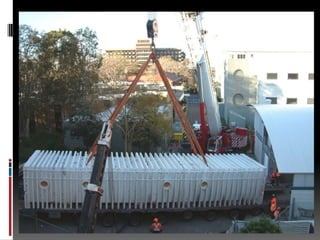
  • #10 The multiplace chamber at POW is the largest in the southern hemisphere. Unlike the clothes we are wearing, and the chairs we are sitting on, this chamber is made in AustraliaRectangular shape for best economy of spaceThe covering ribs are the reinforcements to prevent deformation under high pressure`
  • #11 The inside of the chamber looks very futuristic. You get the feeling as if you are at the sets of Star-TrekMultiplace chamber can have many patients at the same time. The chamber is compressed with airHyperbaric oxygenation is achieved with the help of supplemental oxygen, provided by Oxygen hoods (which are shown here) or with the help of masks, which are not so different from CPAP masks, and look like the mask used by Tom Cruise in ‘Top Gun’. TV encased in special cover to prevent high concentration of oxygen reaching, to reduce fire hazard. High pressure sprinklers
  • #12 Compressed with airThe patient is brought to the ICU on a bed compatible with HBOT and the monitor is compatible with HBOT as well. Medical and nursing staff specially trained in HB treatment accompanies the patient at all times. Outlets for Oxygen, air and helioxVery high pressure room for divers with serious injury.Heliox used for treatment. Heliox is used because it is highly soluble in blood. He replaces N2 in the bubbles. Than during decompression, it readily dissolves in the blood and is cleared by the lungs in exhaled air.
  • #13 Hyperbaric oxygen is often mocked as a treatment modality searching for a disease. The Undersea and hyperbaric Medicine society in the USA publishes the indications for HB treatment, which are updated every few years, based on the available evidence. Many cases of arterial gas embolism are iatrogenic. One of the commonest reason is removal of CVC in sitting position, leading to large venous air embolism, which manages to reach the arterial side through PFO or through the lung. Patients typically present with collapse after removal of CVC. Other cases recently encountered in our unit included air embolism during CPB and accidental air injection through the flush line during cerebral angiogram.Necrotizing fasciitis and CO poisoning are next in the list. Occasionally, we have divers with decompression illness or arterial gas embolism.
  • #14 CT scan is insensitive for picking up small quantity of air. CXR should be done to rule out pneumothorax in appropriate clinical setting. If transfer by air, the helicopter may have to fly at an altitude of &lt; 1000 feet. Fixed wings chamber should pressurized to as close to atmospheric pressure as possible.
  • #15 Differentiation between necrotizing soft tissue infection and simple cellulitis is not always obvious. Clues to diagnosis of necrotizing infection are:
  • #17 send for early G stain and culture, before they dry up. Penicillin, Clindamycin, extended spectrum penicillin, Vancomycin.Clindamycin and Metronidazole for gas gangrene if penicillin allergy
  • #18 Smokers: 10% is the uppeImportant to know the Time since exposureSupplemental oxygen since exposurer limit of normal in smokers.
  • #19 NNT 4-20
  • #21 Any air filled cavity will shrink when subjected to hyperbaric pressureThe volume will increase when decompressed to 1 ATA pressureEars are most vulnerable to pressure change. All of us must have experienced at one time or other, some pain in the ear at the time of ascend or descent of the aeroplane, particularly if we are suffering from upper respiratory infection.
  • #22 Difficult oxygenation is not an absolute contraindication. If lung function is so poor that oxygenation is hard to maintain, than use of HBOT may not achieve tissue oxygen concentration high enough to be effective.