
Routing protocols are set of rules used by
routers to communicate between source
& destination.
 They do not move the information to
source to destination only update the
routing table.
 Each protocol has its own algorithm to
choose the best path.

The matrices by routing table.
*Number of network layer devices along
with the path.
*Bandwidth
*Delay
*Load
*MTU
*Cost
Routing protocol store the result of this
matrices in Routing Table.

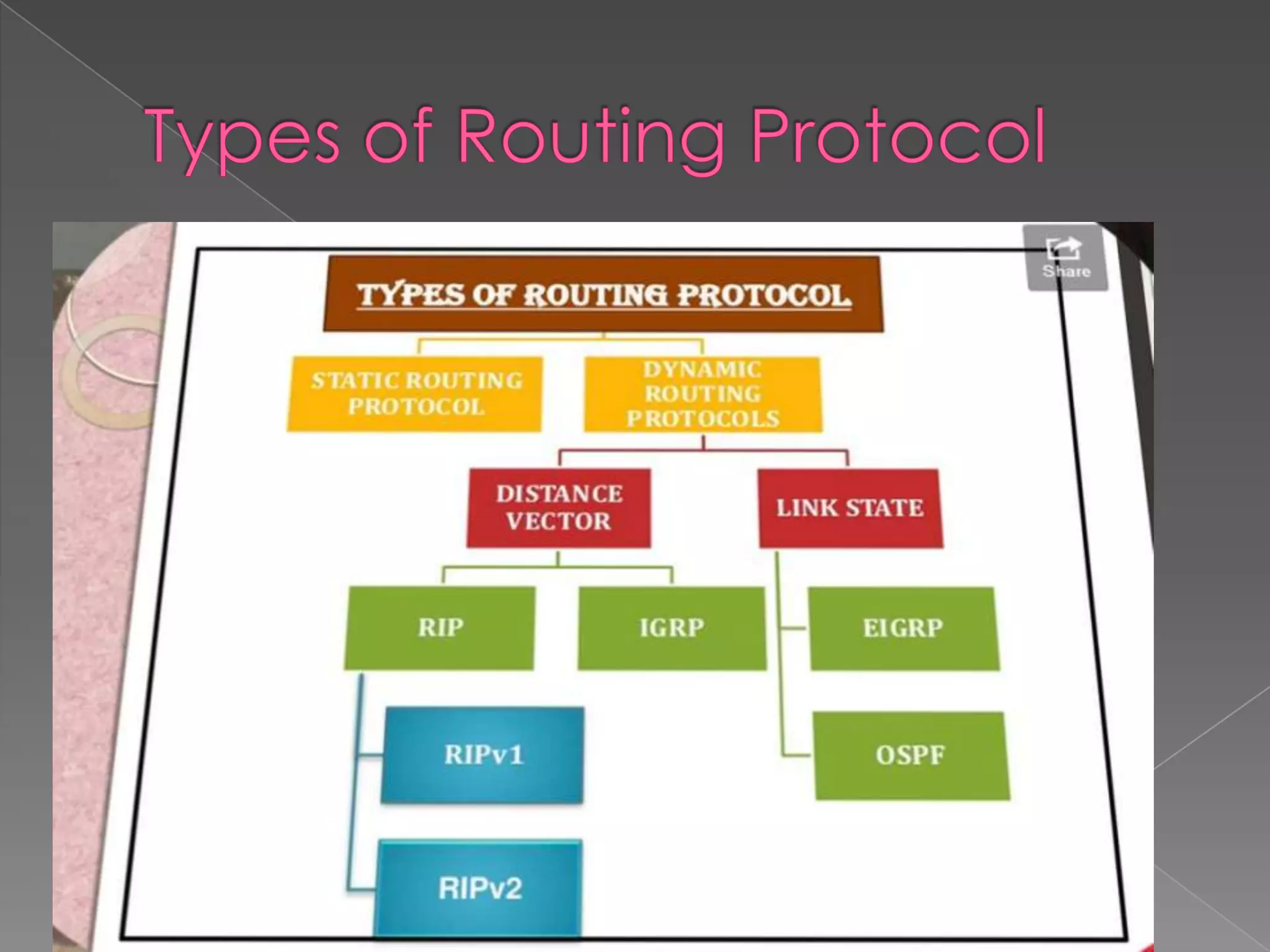
Static Routing is a simplistic approach
 Shortcomings


› Cumbersome to configure
› Cannot adapt to addition of new links or nodes
› Cannot adapt to link or node failures
› Cannot easily handle multiple paths to a

destination
› Does not scale to large networks


Solution is to use Dynamic Routing









Automatically detect and adapt to
topology changes
Provide optimal routing
Scalability
Robustness
Simplicity
Rapid convergence
Some control of routing choices
› E.g. which links we prefer to use


Four well known IGPs today
› RIP
› EIGRP

› ISIS
› OSPF
Stands for “Routing Information Protocol
 Lots of scaling problems
 RIPv1 is classful , and officially obsolete
 RIPv2 is classless


› has improvements over RIPv1
› is not widely used in the Internet industry
 Only use is at the internet edge, between dial
aggregation devices which can only speak RIPv2 and
the next layer of the network



“Enhanced Interior Gateway Routing Protocol”
Predecessor was IGRP which was classful
› IGRP developed by Cisco in mid 1980s to overcome

scalability problems with RIP




Cisco proprietary routing protocol
Distance Vector Routing Protocol
› Has very good metric control



Widely used in many enterprise networks and in
some ISP networks
› Multiprotocol (supports more than IP)
› Exhibits good scalability and rapid convergence
› Supports unequal cost load balancing
Intermediate System to Intermediate
System”
 Selected in 1987 by ANSI as OSI intradomain
routing protocol (CLNP – connectionless
network protocol)


› Based on work by DEC for DECnet/OSI (DECnet

Phase V)



Extensions for IP developed in 1988
› NSFnet deployed, its IGP based on early ISIS-IP

draft.


Open Shortest Path First

› “Open” means it is public domain
› Uses “Shortest Path First” algorithm.

IETF Working Group formed in 1988 to
design an IGP for IP
 OSPF v1 published in 1989 – RFC1131
 OSPF v2 published in 1991 – RFC1247
 Developments continued through the 90s
and today


› OSPFv3 includes extensions to support IPv6
Routing protocol pre

Routing protocol pre

  • 2.
    Routing protocols areset of rules used by routers to communicate between source & destination.  They do not move the information to source to destination only update the routing table.  Each protocol has its own algorithm to choose the best path. 
  • 3.
    The matrices byrouting table. *Number of network layer devices along with the path. *Bandwidth *Delay *Load *MTU *Cost Routing protocol store the result of this matrices in Routing Table. 
  • 5.
    Static Routing isa simplistic approach  Shortcomings  › Cumbersome to configure › Cannot adapt to addition of new links or nodes › Cannot adapt to link or node failures › Cannot easily handle multiple paths to a destination › Does not scale to large networks  Solution is to use Dynamic Routing
  • 6.
           Automatically detect andadapt to topology changes Provide optimal routing Scalability Robustness Simplicity Rapid convergence Some control of routing choices › E.g. which links we prefer to use
  • 7.
     Four well knownIGPs today › RIP › EIGRP › ISIS › OSPF
  • 8.
    Stands for “RoutingInformation Protocol  Lots of scaling problems  RIPv1 is classful , and officially obsolete  RIPv2 is classless  › has improvements over RIPv1 › is not widely used in the Internet industry  Only use is at the internet edge, between dial aggregation devices which can only speak RIPv2 and the next layer of the network
  • 9.
      “Enhanced Interior GatewayRouting Protocol” Predecessor was IGRP which was classful › IGRP developed by Cisco in mid 1980s to overcome scalability problems with RIP   Cisco proprietary routing protocol Distance Vector Routing Protocol › Has very good metric control  Widely used in many enterprise networks and in some ISP networks › Multiprotocol (supports more than IP) › Exhibits good scalability and rapid convergence › Supports unequal cost load balancing
  • 10.
    Intermediate System toIntermediate System”  Selected in 1987 by ANSI as OSI intradomain routing protocol (CLNP – connectionless network protocol)  › Based on work by DEC for DECnet/OSI (DECnet Phase V)  Extensions for IP developed in 1988 › NSFnet deployed, its IGP based on early ISIS-IP draft.
  • 11.
     Open Shortest PathFirst › “Open” means it is public domain › Uses “Shortest Path First” algorithm. IETF Working Group formed in 1988 to design an IGP for IP  OSPF v1 published in 1989 – RFC1131  OSPF v2 published in 1991 – RFC1247  Developments continued through the 90s and today  › OSPFv3 includes extensions to support IPv6