IS-IS An introduction to IGP routing protocols Hagai Kahana
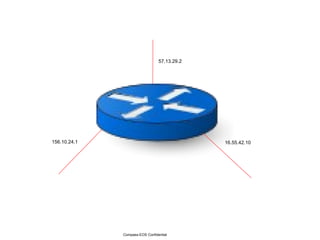
Compass-EOS Confidential 156.10.24.1 16.55.42.10 57.13.29.2
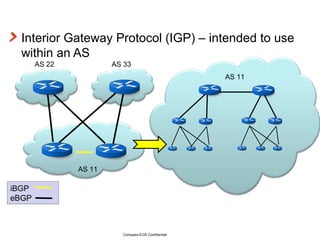
Interior Gateway Protocol (IGP) – intended to use within an AS Compass-EOS Confidential AS 11 AS 22 AS 33 iBGP eBGP AS 11
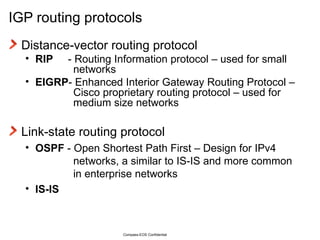
IGP routing protocols Distance-vector routing protocol RIP   - Routing Information protocol – used for small  networks  EIGRP - Enhanced Interior Gateway Routing Protocol –  Cisco proprietary routing protocol – used for  medium size networks Link-state routing protocol  OSPF  - Open Shortest Path First – Design for IPv4  networks, a similar to IS-IS and more common in enterprise networks  IS-IS Compass-EOS Confidential
IS-IS introduction Was first published as ISO 10589 in 1987 IETF republished the protocol in  RFC 1142  for the Internet community and extended for IP routing as  RFC 1195  in 1990 Runs natively on  Layer 2  of the OSI model (Ethernet/PPP) Compass-EOS Confidential
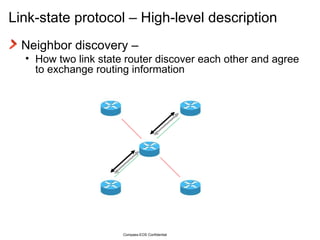
Link-state protocol – High-level description Neighbor discovery –  How two link state router discover each other and agree to exchange routing information Compass-EOS Confidential
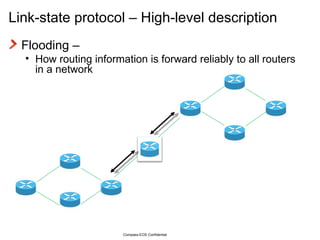
Link-state protocol – High-level description Flooding –  How routing information is forward reliably to all routers in a network Compass-EOS Confidential
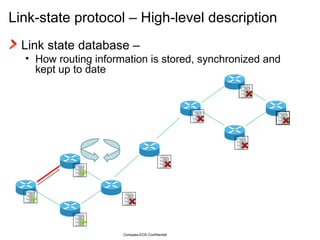
Link-state protocol – High-level description Link state database –  How routing information is stored, synchronized and kept up to date Compass-EOS Confidential
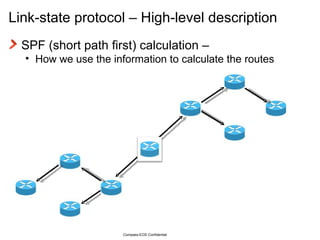
Link-state protocol – High-level description SPF (short path first) calculation –  How we use the information to calculate the routes Compass-EOS Confidential
IS-IS introduction Neighbor discovery. Flooding. Link state database Synchronization. SPF (short path first) calculation. Compass-EOS Confidential
IS-IS Addressing System ID – Unique identifier, can be set by using the IP loopback address Area ID Compass-EOS Confidential
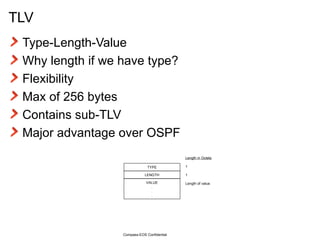
TLV Type-Length-Value Why length if we have type? Flexibility Max of 256 bytes Contains sub-TLV Major advantage over OSPF Compass-EOS Confidential Length in Octets 1 1 Length of value TYPE LENGTH VALUE . . .
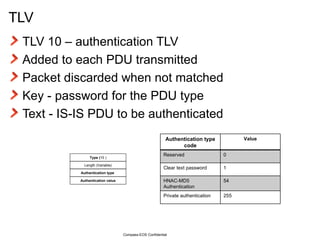
TLV TLV 10 – authentication TLV Added to each PDU transmitted Packet discarded when not matched Key - password for the PDU type Text - IS-IS PDU to be authenticated Compass-EOS Confidential Type ( 10 ) Length (Variable) Authentication type  Authentication value Authentication type code Value Reserved 0 Clear text password 1 HNAC-MD5 Authentication  54 Private authentication  255
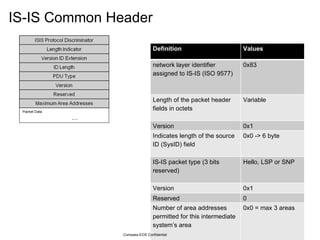
IS-IS Common Header Compass-EOS Confidential Packet Data    … Definition Values network layer identifier assigned to IS-IS (ISO 9577) 0x83 Length of the packet header fields in octets Variable Version 0x1 Indicates length of the source ID (SysID) field 0x0 -> 6 byte IS-IS packet type (3 bits reserved)  Hello, LSP or SNP Version 0x1 Reserved 0 Number of area addresses permitted for this intermediate system’s area 0x0 = max 3 areas
Neighbor discovery
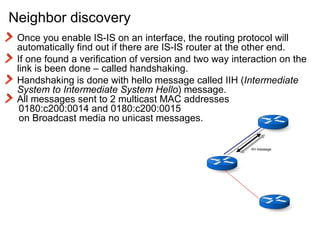
Neighbor discovery Once you enable IS-IS on an interface, the routing protocol will automatically find out if there are IS-IS router at the other end. If one found a verification of version and two way interaction on the link is been done – called handshaking. Handshaking is done with hello message called IIH ( Intermediate System to Intermediate System Hello ) message.  All messages sent to 2 multicast MAC addresses 0180:c200:0014 and 0180:c200:0015  on Broadcast media no unicast messages. IIH message
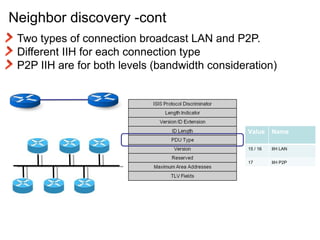
Neighbor discovery -cont Two types of connection broadcast LAN and P2P. Different IIH for each connection type  P2P IIH are for both levels (bandwidth consideration) Value Name 15 / 16 IIH LAN 17 IIH P2P
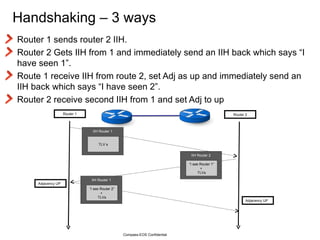
Handshaking – 3 ways Router 1 sends router 2 IIH. Router 2 Gets IIH from 1 and immediately send an IIH back which says “I have seen 1”. Route 1 receive IIH from route 2, set Adj as up and immediately send an IIH back which says “I have seen 2”. Router 2 receive second IIH from 1 and set Adj to up Compass-EOS Confidential Adjacency UP Adjacency UP Router 2 Router 1 IIH Router 1 TLV s IIH Router 1 “ I see Router 2” +  TLVs IIH Router 2 “ I see Router 1” +  TLVs
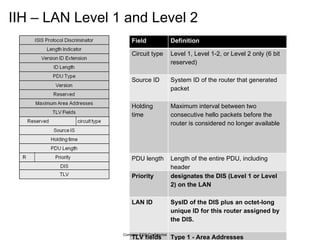
IIH – LAN Level 1 and Level 2  Compass-EOS Confidential Field Definition Circuit type Level 1, Level 1-2, or Level 2 only (6 bit reserved) Source ID System ID of the router that generated packet Holding time Maximum interval between two consecutive hello packets before the router is considered no longer available PDU length Length of the entire PDU, including header Priority designates the DIS (Level 1 or Level 2) on the LAN LAN ID SysID of the DIS plus an octet-long unique ID for this router assigned by the DIS. TLV fields Type 1 - Area Addresses  Type 6 - IS Neighbors  Type 8 - Padding  Type 10 - Authentication Type
IIH – IS-IS Hello Packet Hello Interval  – time between each IIH packets Hold-time  - maximum time lapse allowed between receipts of two consecutive hello packets received  If hold-time expire an adjacency is declared “dead” Can be modified on the fly (unlike OSPF) Compass-EOS Confidential
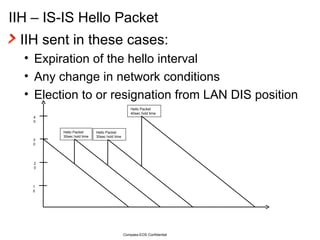
IIH – IS-IS Hello Packet IIH sent in these cases: Expiration of the hello interval Any change in network conditions Election to or resignation from LAN DIS position Compass-EOS Confidential 40 30 20 10 Hello Packet 30sec hold time  Hello Packet 30sec hold time  Hello Packet 40sec hold time
Flooding
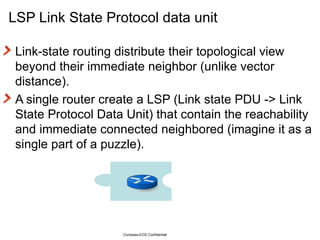
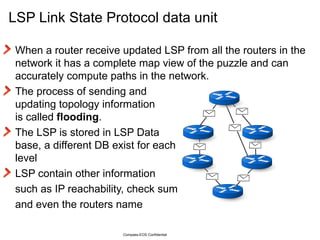
LSP Link State Protocol data unit Link-state routing distribute their topological view beyond their immediate neighbor (unlike vector distance). A single router create a LSP (Link state PDU -> Link State Protocol Data Unit) that contain the reachability and immediate connected neighbored (imagine it as a single part of a puzzle). Compass-EOS Confidential
LSP Link State Protocol data unit When a router receive updated LSP from all the routers in the network it has a complete map view of the puzzle and can accurately compute paths in the network. The process of sending and  updating topology information  is called  flooding .  The LSP is stored in LSP Data  base, a different DB exist for each  level LSP contain other information  such as IP reachability, check sum and even the routers name Compass-EOS Confidential
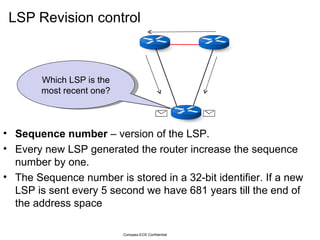
LSP Revision control Compass-EOS Confidential Sequence number  – version of the LSP. Every new LSP generated the router increase the sequence number by one.  The Sequence number is stored in a 32-bit identifier. If a new LSP is sent every 5 second we have 681 years till the end of the address space  Which LSP is the most recent one?
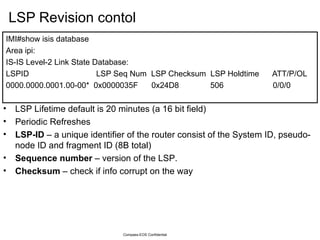
LSP Revision contol IMI#show isis database  Area ipi: IS-IS Level-2 Link State Database: LSPID  LSP Seq Num  LSP Checksum  LSP Holdtime  ATT/P/OL 0000.0000.0001.00-00*  0x0000035F  0x24D8  506  0/0/0 Compass-EOS Confidential LSP Lifetime default is 20 minutes (a 16 bit field) Periodic Refreshes LSP-ID  – a unique identifier of the router consist of the System ID, pseudo-node ID and fragment ID (8B total) Sequence number  – version of the LSP. Checksum  – check if info corrupt on the way
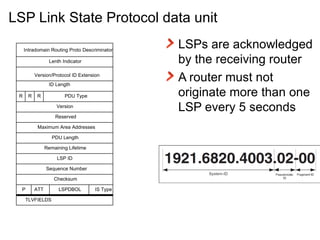
LSP Link State Protocol data unit LSPs are acknowledged by the receiving router A router must not originate more than one LSP every 5 seconds  Intradomain Routing Proto Descriminator Lenth Indicator Version/Protocol ID Extension ID Length PDU Type R R R Version Reserved Maximum Area Addresses PDU Length Remaining Lifetime LSP ID Sequence Number Checksum LSPDBOL IS Type P ATT TLVFIELDS
LSP Link State Protocol data unit Purge LSP - negative LSP update DIS election Expiration of LSP Duplicate System IDs Compass-EOS Confidential
Link state database Synchronization.
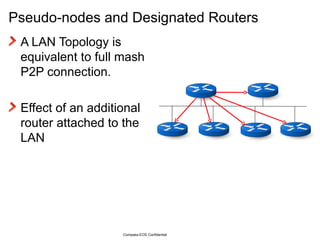
Pseudo-nodes and Designated Routers A LAN Topology is equivalent to full mash P2P connection. Effect of an additional router attached to the LAN Compass-EOS Confidential
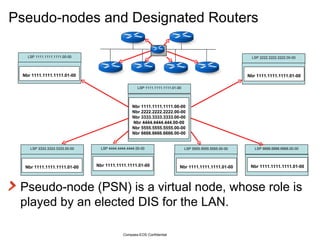
Pseudo-nodes and Designated Routers Pseudo-node (PSN) is a virtual node, whose role is played by an elected DIS for the LAN. Compass-EOS Confidential LSP 1111.1111.1111.01-00 LSP 5555.5555.5555.00-00 LSP 6666.6666.6666.00-00 LSP 3333.3333.3333.00-00 LSP 4444.4444.4444.00-00 Nbr 1111.1111.1111.00-00 Nbr 2222.2222.2222.00-00 Nbr 3333.3333.3333.00-00 Nbr 4444.4444.444.00-00 Nbr 5555.5555.5555.00-00 Nbr 6666.6666.6666.00-00 Nbr 1111.1111.1111.01-00 Nbr 1111.1111.1111.01-00 Nbr 1111.1111.1111.01-00 Nbr 1111.1111.1111.01-00 LSP 1111.1111.1111.00-00 Nbr 1111.1111.1111.01-00 LSP 2222.2222.2222.00-00 Nbr 1111.1111.1111.01-00
Pseudo-nodes and Designated Routers DIS election is preemptive, based on interface priority with the highest SNPA (MAC address) breaking ties Separate DISs are elected for Level 1 and 2 routing DIS transmits IIH three times faster other routers, for quick detection of failure and immediate replacement. Compass-EOS Confidential
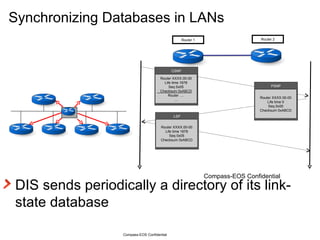
Synchronizing Databases in LANs DIS sends periodically a directory of its link-state database Compass-EOS Confidential Compass-EOS Confidential Router 2 Router 1 CSNP Router XXXX.00-00 Life time 1678 Seq 0x05 Checksum 0xABCD Router …. … . PSNP Router XXXX.00-00 Life time 0 Seq 0x00 Checksum 0xABCD LSP Router XXXX.00-00 Life time 1678 Seq 0x05 Checksum 0xABCD
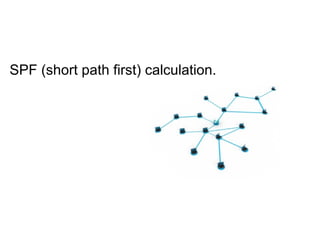
SPF (short path first) calculation.
SPF There are three type of SPF calulation Full SPF  – Find the shortest path tree on the topology – also called  first pass . Partial SPF  – Extract prefix and metric information from link state database – also called  second pass. Incremental SPF  – optimization on the full SPF calculation Compass-EOS Confidential
SPF – Hold down A trigger for SPF calculate does not invoke the calculation immediately.  A change in the network invoke several LSP flooding. An SPF cause a burst of CPU usage without hold down the router will choke under the SPF calculation stress. Compass-EOS Confidential
Thank you Compass-EOS Confidential

An intoroduction to the IS-IS IGP routing protocol

  • 1.
    IS-IS An introductionto IGP routing protocols Hagai Kahana
  • 2.
  • 3.
    Interior Gateway Protocol(IGP) – intended to use within an AS Compass-EOS Confidential AS 11 AS 22 AS 33 iBGP eBGP AS 11
  • 4.
    IGP routing protocolsDistance-vector routing protocol RIP - Routing Information protocol – used for small networks EIGRP - Enhanced Interior Gateway Routing Protocol – Cisco proprietary routing protocol – used for medium size networks Link-state routing protocol OSPF - Open Shortest Path First – Design for IPv4 networks, a similar to IS-IS and more common in enterprise networks IS-IS Compass-EOS Confidential
  • 5.
    IS-IS introduction Wasfirst published as ISO 10589 in 1987 IETF republished the protocol in RFC 1142 for the Internet community and extended for IP routing as RFC 1195 in 1990 Runs natively on Layer 2 of the OSI model (Ethernet/PPP) Compass-EOS Confidential
  • 6.
    Link-state protocol –High-level description Neighbor discovery – How two link state router discover each other and agree to exchange routing information Compass-EOS Confidential
  • 7.
    Link-state protocol –High-level description Flooding – How routing information is forward reliably to all routers in a network Compass-EOS Confidential
  • 8.
    Link-state protocol –High-level description Link state database – How routing information is stored, synchronized and kept up to date Compass-EOS Confidential
  • 9.
    Link-state protocol –High-level description SPF (short path first) calculation – How we use the information to calculate the routes Compass-EOS Confidential
  • 10.
    IS-IS introduction Neighbordiscovery. Flooding. Link state database Synchronization. SPF (short path first) calculation. Compass-EOS Confidential
  • 11.
    IS-IS Addressing SystemID – Unique identifier, can be set by using the IP loopback address Area ID Compass-EOS Confidential
  • 12.
    TLV Type-Length-Value Whylength if we have type? Flexibility Max of 256 bytes Contains sub-TLV Major advantage over OSPF Compass-EOS Confidential Length in Octets 1 1 Length of value TYPE LENGTH VALUE . . .
  • 13.
    TLV TLV 10– authentication TLV Added to each PDU transmitted Packet discarded when not matched Key - password for the PDU type Text - IS-IS PDU to be authenticated Compass-EOS Confidential Type ( 10 ) Length (Variable) Authentication type Authentication value Authentication type code Value Reserved 0 Clear text password 1 HNAC-MD5 Authentication 54 Private authentication 255
  • 14.
    IS-IS Common HeaderCompass-EOS Confidential Packet Data … Definition Values network layer identifier assigned to IS-IS (ISO 9577) 0x83 Length of the packet header fields in octets Variable Version 0x1 Indicates length of the source ID (SysID) field 0x0 -> 6 byte IS-IS packet type (3 bits reserved) Hello, LSP or SNP Version 0x1 Reserved 0 Number of area addresses permitted for this intermediate system’s area 0x0 = max 3 areas
  • 15.
  • 16.
    Neighbor discovery Onceyou enable IS-IS on an interface, the routing protocol will automatically find out if there are IS-IS router at the other end. If one found a verification of version and two way interaction on the link is been done – called handshaking. Handshaking is done with hello message called IIH ( Intermediate System to Intermediate System Hello ) message. All messages sent to 2 multicast MAC addresses 0180:c200:0014 and 0180:c200:0015 on Broadcast media no unicast messages. IIH message
  • 17.
    Neighbor discovery -contTwo types of connection broadcast LAN and P2P. Different IIH for each connection type P2P IIH are for both levels (bandwidth consideration) Value Name 15 / 16 IIH LAN 17 IIH P2P
  • 18.
    Handshaking – 3ways Router 1 sends router 2 IIH. Router 2 Gets IIH from 1 and immediately send an IIH back which says “I have seen 1”. Route 1 receive IIH from route 2, set Adj as up and immediately send an IIH back which says “I have seen 2”. Router 2 receive second IIH from 1 and set Adj to up Compass-EOS Confidential Adjacency UP Adjacency UP Router 2 Router 1 IIH Router 1 TLV s IIH Router 1 “ I see Router 2” + TLVs IIH Router 2 “ I see Router 1” + TLVs
  • 19.
    IIH – LANLevel 1 and Level 2 Compass-EOS Confidential Field Definition Circuit type Level 1, Level 1-2, or Level 2 only (6 bit reserved) Source ID System ID of the router that generated packet Holding time Maximum interval between two consecutive hello packets before the router is considered no longer available PDU length Length of the entire PDU, including header Priority designates the DIS (Level 1 or Level 2) on the LAN LAN ID SysID of the DIS plus an octet-long unique ID for this router assigned by the DIS. TLV fields Type 1 - Area Addresses Type 6 - IS Neighbors Type 8 - Padding Type 10 - Authentication Type
  • 20.
    IIH – IS-ISHello Packet Hello Interval – time between each IIH packets Hold-time - maximum time lapse allowed between receipts of two consecutive hello packets received If hold-time expire an adjacency is declared “dead” Can be modified on the fly (unlike OSPF) Compass-EOS Confidential
  • 21.
    IIH – IS-ISHello Packet IIH sent in these cases: Expiration of the hello interval Any change in network conditions Election to or resignation from LAN DIS position Compass-EOS Confidential 40 30 20 10 Hello Packet 30sec hold time Hello Packet 30sec hold time Hello Packet 40sec hold time
  • 22.
  • 23.
    LSP Link StateProtocol data unit Link-state routing distribute their topological view beyond their immediate neighbor (unlike vector distance). A single router create a LSP (Link state PDU -> Link State Protocol Data Unit) that contain the reachability and immediate connected neighbored (imagine it as a single part of a puzzle). Compass-EOS Confidential
  • 24.
    LSP Link StateProtocol data unit When a router receive updated LSP from all the routers in the network it has a complete map view of the puzzle and can accurately compute paths in the network. The process of sending and updating topology information is called flooding . The LSP is stored in LSP Data base, a different DB exist for each level LSP contain other information such as IP reachability, check sum and even the routers name Compass-EOS Confidential
  • 25.
    LSP Revision controlCompass-EOS Confidential Sequence number – version of the LSP. Every new LSP generated the router increase the sequence number by one. The Sequence number is stored in a 32-bit identifier. If a new LSP is sent every 5 second we have 681 years till the end of the address space Which LSP is the most recent one?
  • 26.
    LSP Revision contolIMI#show isis database Area ipi: IS-IS Level-2 Link State Database: LSPID LSP Seq Num LSP Checksum LSP Holdtime ATT/P/OL 0000.0000.0001.00-00* 0x0000035F 0x24D8 506 0/0/0 Compass-EOS Confidential LSP Lifetime default is 20 minutes (a 16 bit field) Periodic Refreshes LSP-ID – a unique identifier of the router consist of the System ID, pseudo-node ID and fragment ID (8B total) Sequence number – version of the LSP. Checksum – check if info corrupt on the way
  • 27.
    LSP Link StateProtocol data unit LSPs are acknowledged by the receiving router A router must not originate more than one LSP every 5 seconds Intradomain Routing Proto Descriminator Lenth Indicator Version/Protocol ID Extension ID Length PDU Type R R R Version Reserved Maximum Area Addresses PDU Length Remaining Lifetime LSP ID Sequence Number Checksum LSPDBOL IS Type P ATT TLVFIELDS
  • 28.
    LSP Link StateProtocol data unit Purge LSP - negative LSP update DIS election Expiration of LSP Duplicate System IDs Compass-EOS Confidential
  • 29.
    Link state databaseSynchronization.
  • 30.
    Pseudo-nodes and DesignatedRouters A LAN Topology is equivalent to full mash P2P connection. Effect of an additional router attached to the LAN Compass-EOS Confidential
  • 31.
    Pseudo-nodes and DesignatedRouters Pseudo-node (PSN) is a virtual node, whose role is played by an elected DIS for the LAN. Compass-EOS Confidential LSP 1111.1111.1111.01-00 LSP 5555.5555.5555.00-00 LSP 6666.6666.6666.00-00 LSP 3333.3333.3333.00-00 LSP 4444.4444.4444.00-00 Nbr 1111.1111.1111.00-00 Nbr 2222.2222.2222.00-00 Nbr 3333.3333.3333.00-00 Nbr 4444.4444.444.00-00 Nbr 5555.5555.5555.00-00 Nbr 6666.6666.6666.00-00 Nbr 1111.1111.1111.01-00 Nbr 1111.1111.1111.01-00 Nbr 1111.1111.1111.01-00 Nbr 1111.1111.1111.01-00 LSP 1111.1111.1111.00-00 Nbr 1111.1111.1111.01-00 LSP 2222.2222.2222.00-00 Nbr 1111.1111.1111.01-00
  • 32.
    Pseudo-nodes and DesignatedRouters DIS election is preemptive, based on interface priority with the highest SNPA (MAC address) breaking ties Separate DISs are elected for Level 1 and 2 routing DIS transmits IIH three times faster other routers, for quick detection of failure and immediate replacement. Compass-EOS Confidential
  • 33.
    Synchronizing Databases inLANs DIS sends periodically a directory of its link-state database Compass-EOS Confidential Compass-EOS Confidential Router 2 Router 1 CSNP Router XXXX.00-00 Life time 1678 Seq 0x05 Checksum 0xABCD Router …. … . PSNP Router XXXX.00-00 Life time 0 Seq 0x00 Checksum 0xABCD LSP Router XXXX.00-00 Life time 1678 Seq 0x05 Checksum 0xABCD

  • 34.
    SPF (short pathfirst) calculation.
  • 35.
    SPF There arethree type of SPF calulation Full SPF – Find the shortest path tree on the topology – also called first pass . Partial SPF – Extract prefix and metric information from link state database – also called second pass. Incremental SPF – optimization on the full SPF calculation Compass-EOS Confidential
  • 36.
    SPF – Holddown A trigger for SPF calculate does not invoke the calculation immediately. A change in the network invoke several LSP flooding. An SPF cause a burst of CPU usage without hold down the router will choke under the SPF calculation stress. Compass-EOS Confidential
  • 37.

Editor's Notes

  • #2 July 10, 2000
  • #3 July 10, 2000
  • #4 July 10, 2000
  • #5 July 10, 2000
  • #6 July 10, 2000
  • #7 July 10, 2000
  • #8 July 10, 2000
  • #9 July 10, 2000
  • #10 July 10, 2000
  • #11 July 10, 2000
  • #12 July 10, 2000
  • #13 July 10, 2000
  • #14 July 10, 2000
  • #15 July 10, 2000
  • #16 July 10, 2000
  • #17 July 10, 2000
  • #18 July 10, 2000
  • #19 July 10, 2000
  • #20 July 10, 2000
  • #21 In OSPF all timers must align with the DR (designated router) July 10, 2000
  • #22 Any change in network conditions causing changes in TLV information advertised in the most recent hello transmitted ID length in the IIH. This field indicates the length of the SysID and the SysID must be consistent on all routers across the domain Maximum number of areas. addresses supported in a single router configuration must match between adjacent neighbors, default maximum value of 3. July 10, 2000
  • #23 July 10, 2000
  • #24 POP - close collection of routers July 10, 2000
  • #25 POP - close collection of routers July 10, 2000
  • #26 If pseudo-node ID is 00 it means that this is a real router. Since IS-IS is on layer 2 there is no fragmentation service, do it is part of the IS-IS itself July 10, 2000
  • #27 If pseudo-node ID is 00 it means that this is a real router. Since IS-IS is on layer 2 there is no fragmentation service, do it is part of the IS-IS itself July 10, 2000
  • #28 July 10, 2000
  • #29 July 10, 2000
  • #30 July 10, 2000
  • #31 July 10, 2000
  • #32 July 10, 2000
  • #33 July 10, 2000
  • #34 Synchronizing DB and resulting routing tables is crucial for bringing packets closer to their destination. CSNP by default is sends every 10 seconds. Can be configured. CSNP can be more than one packet. Start and end LAN-ID is used to identify it: 0000.0000.0000.00-00 to ffff.ffff.ffff.ff-ff SRM – set on a link the corresponding LSP has to be sent out on that link. SSN – the corresponding LSP should be included in the next PSNP Behavior when CSNP reporting an older version of the LSP\\a more recent version of LSP\\ an unknown LSP July 10, 2000
  • #35 July 10, 2000
  • #36 July 10, 2000
  • #37 July 10, 2000
  • #38 TLV - Type Length Value Authentication is applied on the entire PDU July 10, 2000