Dynamic Light Scattering
1
Suman Kundu
Contact: sumankundu.sxc@gmail.com
2
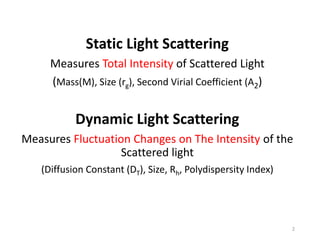
Static Light Scattering
Measures Total Intensity of Scattered Light
(Mass(M), Size (rg), Second Virial Coefficient (A2)
Dynamic Light Scattering
Measures Fluctuation Changes on The Intensity of the
Scattered light
(Diffusion Constant (DT), Size, Rh, Polydispersity Index)
3
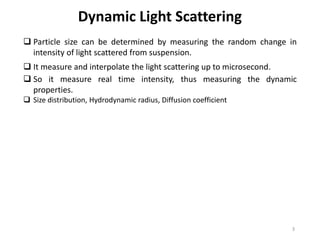
Dynamic Light Scattering
 Particle size can be determined by measuring the random change in
intensity of light scattered from suspension.
 It measure and interpolate the light scattering up to microsecond.
 So it measure real time intensity, thus measuring the dynamic
properties.
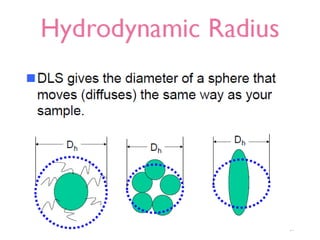
 Size distribution, Hydrodynamic radius, Diffusion coefficient
4
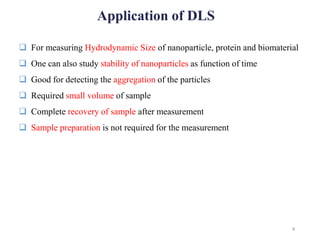
 For measuring Hydrodynamic Size of nanoparticle, protein and biomaterial
 One can also study stability of nanoparticles as function of time
 Good for detecting the aggregation of the particles
 Required small volume of sample
 Complete recovery of sample after measurement
 Sample preparation is not required for the measurement
Application of DLS
5
6
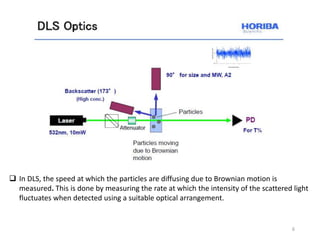
 In DLS, the speed at which the particles are diffusing due to Brownian motion is
measured. This is done by measuring the rate at which the intensity of the scattered light
fluctuates when detected using a suitable optical arrangement.
7
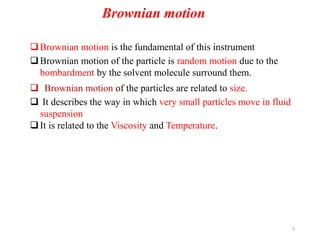
Brownian motion is the fundamental of this instrument
Brownian motion of the particle is random motion due to the
bombardment by the solvent molecule surround them.
 Brownian motion of the particles are related to size.
 It describes the way in which very small particles move in fluid
suspension
It is related to the Viscosity and Temperature.
Brownian motion
8
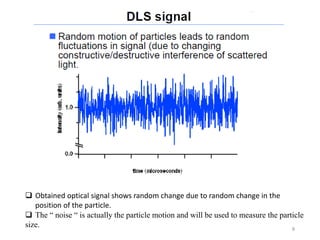
 Obtained optical signal shows random change due to random change in the
position of the particle.
 The “ noise “ is actually the particle motion and will be used to measure the particle
size.
9
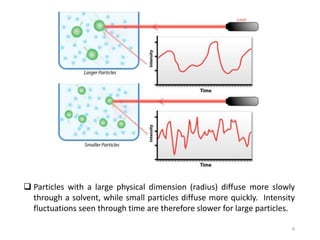
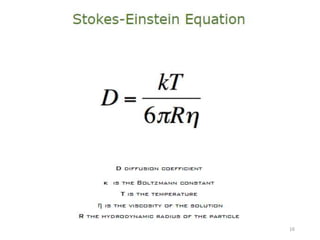
 Particles with a large physical dimension (radius) diffuse more slowly
through a solvent, while small particles diffuse more quickly. Intensity
fluctuations seen through time are therefore slower for large particles.
10
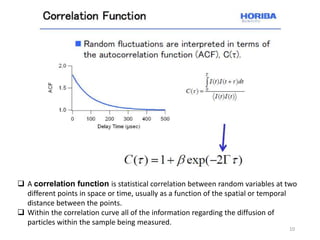
 A correlation function is statistical correlation between random variables at two
different points in space or time, usually as a function of the spatial or temporal
distance between the points.
 Within the correlation curve all of the information regarding the diffusion of
particles within the sample being measured.
11
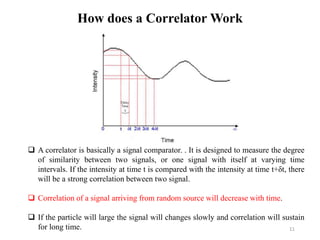
 A correlator is basically a signal comparator. . It is designed to measure the degree
of similarity between two signals, or one signal with itself at varying time
intervals. If the intensity at time t is compared with the intensity at time t+δt, there
will be a strong correlation between two signal.
 Correlation of a signal arriving from random source will decrease with time.
 If the particle will large the signal will changes slowly and correlation will sustain
for long time.
How does a Correlator Work
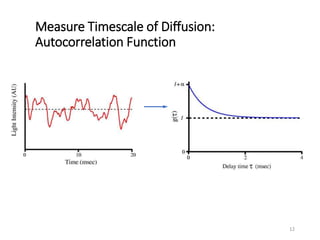
Measure Timescale of Diffusion:
Autocorrelation Function
12
13
14
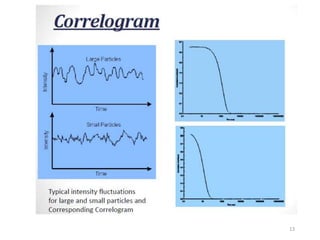
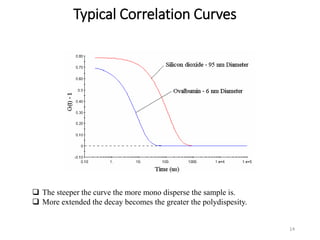
Typical Correlation Curves
 The steeper the curve the more mono disperse the sample is.
 More extended the decay becomes the greater the polydispesity.
The Correlation Function for monodisperse particle
15
G() = A [ 1 + B exp (-2)]
A = the baseline of the correlation function
B = intercept of the correlation function.
 = Dq2
D = translational diffusion coefficient, q = scattering vector
q = (4 n / o) sin (/2)
n = refractive index of dispersant
o = wavelength of the laser
 = scattering angle.
16
17
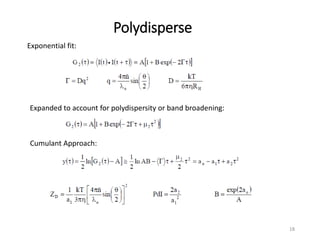
Polydisperse
18
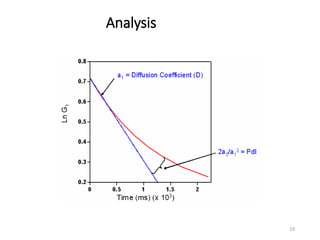
Exponential fit:
Expanded to account for polydispersity or band broadening:
Cumulant Approach:
Analysis
19
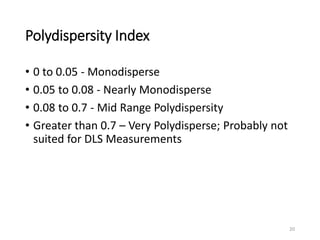
Polydispersity Index
• 0 to 0.05 - Monodisperse
• 0.05 to 0.08 - Nearly Monodisperse
• 0.08 to 0.7 - Mid Range Polydispersity
• Greater than 0.7 – Very Polydisperse; Probably not
suited for DLS Measurements
20
Intensity Size distributions
21
Typical Results
22
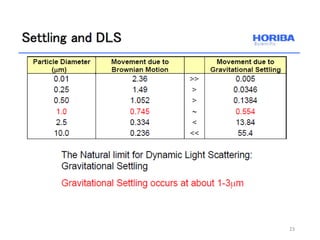
23
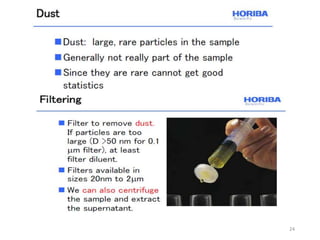
24
25
Thank You

Dynamic light scattering (dls)

  • 1.
    Dynamic Light Scattering 1 SumanKundu Contact: sumankundu.sxc@gmail.com
  • 2.
    2 Static Light Scattering MeasuresTotal Intensity of Scattered Light (Mass(M), Size (rg), Second Virial Coefficient (A2) Dynamic Light Scattering Measures Fluctuation Changes on The Intensity of the Scattered light (Diffusion Constant (DT), Size, Rh, Polydispersity Index)
  • 3.
    3 Dynamic Light Scattering Particle size can be determined by measuring the random change in intensity of light scattered from suspension.  It measure and interpolate the light scattering up to microsecond.  So it measure real time intensity, thus measuring the dynamic properties.  Size distribution, Hydrodynamic radius, Diffusion coefficient
  • 4.
    4  For measuringHydrodynamic Size of nanoparticle, protein and biomaterial  One can also study stability of nanoparticles as function of time  Good for detecting the aggregation of the particles  Required small volume of sample  Complete recovery of sample after measurement  Sample preparation is not required for the measurement Application of DLS
  • 5.
  • 6.
    6  In DLS,the speed at which the particles are diffusing due to Brownian motion is measured. This is done by measuring the rate at which the intensity of the scattered light fluctuates when detected using a suitable optical arrangement.
  • 7.
    7 Brownian motion isthe fundamental of this instrument Brownian motion of the particle is random motion due to the bombardment by the solvent molecule surround them.  Brownian motion of the particles are related to size.  It describes the way in which very small particles move in fluid suspension It is related to the Viscosity and Temperature. Brownian motion
  • 8.
    8  Obtained opticalsignal shows random change due to random change in the position of the particle.  The “ noise “ is actually the particle motion and will be used to measure the particle size.
  • 9.
    9  Particles witha large physical dimension (radius) diffuse more slowly through a solvent, while small particles diffuse more quickly. Intensity fluctuations seen through time are therefore slower for large particles.
  • 10.
    10  A correlationfunction is statistical correlation between random variables at two different points in space or time, usually as a function of the spatial or temporal distance between the points.  Within the correlation curve all of the information regarding the diffusion of particles within the sample being measured.
  • 11.
    11  A correlatoris basically a signal comparator. . It is designed to measure the degree of similarity between two signals, or one signal with itself at varying time intervals. If the intensity at time t is compared with the intensity at time t+δt, there will be a strong correlation between two signal.  Correlation of a signal arriving from random source will decrease with time.  If the particle will large the signal will changes slowly and correlation will sustain for long time. How does a Correlator Work
  • 12.
    Measure Timescale ofDiffusion: Autocorrelation Function 12
  • 13.
  • 14.
    14 Typical Correlation Curves The steeper the curve the more mono disperse the sample is.  More extended the decay becomes the greater the polydispesity.
  • 15.
    The Correlation Functionfor monodisperse particle 15 G() = A [ 1 + B exp (-2)] A = the baseline of the correlation function B = intercept of the correlation function.  = Dq2 D = translational diffusion coefficient, q = scattering vector q = (4 n / o) sin (/2) n = refractive index of dispersant o = wavelength of the laser  = scattering angle.
  • 16.
  • 17.
  • 18.
    Polydisperse 18 Exponential fit: Expanded toaccount for polydispersity or band broadening: Cumulant Approach:
  • 19.
  • 20.
    Polydispersity Index • 0to 0.05 - Monodisperse • 0.05 to 0.08 - Nearly Monodisperse • 0.08 to 0.7 - Mid Range Polydispersity • Greater than 0.7 – Very Polydisperse; Probably not suited for DLS Measurements 20
  • 21.
  • 22.
  • 23.
  • 24.
  • 25.

Editor's Notes

  • #13 12
  • #14 In dynamic light scattering instrumentation, the correlation summations are performed using an integrated digital correlator. Examples of correlation curves measured for two sub-micron particles are given in Figure 3. For the smaller and hence faster diffusing protein, the measured correlation curve has decayed to baseline within 100 μs, while the larger and slower diffusing silicon dioxide particle requires nearly 1000 μs before correlation in the signal is completely lost.
  • #16 In dynamic light scattering, all of the information regarding the motion or diffusion of the particles in the solution is embodied within the measured correlation curve. For a large number of monodisperse particles in Brownian motion, the correlation function (given the symbol [G]) is an exponential decaying function of the correlator time delay  :
  • #19  In the light scattering area, the term polydispersity is derived from the polydispersity index, a parameter calculated from a Cumulants analysis of the DLS measured intensity autocorrelation function. In the Cumulants analysis, a single particle size is assumed and a single exponential fit is applied to the autocorrelation function. The autocorrelation function, along with the exponential fitting expression, is shown below, where I is the scattering intensity, t is the initial time, τ is the delay time, A is the amplitude or intercept of the correlation function, B is the baseline, D is the diffusion coefficient, q is the scattering vector, λo is the vacuum laser wavelength, ñ is the medium refractive index, θ is the scattering angle, k is the Boltzmann constant, T is the absolute temperature, η is the viscosity of the medium, and RH is the hydrodynamic radius. In the Cumulants approach, the exponential fitting expression is expanded to account for polydispersity or peak broadening effects The expression is then linearized and the data fit to the form shown below, where the D subscript notation is used to indicate diameter. The 1st Cumulant or moment (a1) is used to calculate the intensity weighted Z average mean size and the 2nd moment (a2) is used to calculate a parameter defined as the polydispersity index (PdI).
  • #20 Note from the figure below that the 1st moment is proportional to the initial slope of the linear form of the correlogram and the 2nd moment is related to the inflection point at which log G deviates from linearity.
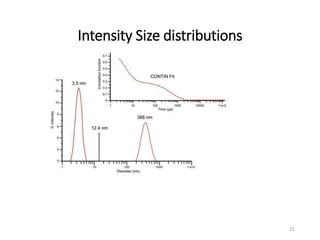
  • #22 While the Cumulant algorithm and the Z average are useful for describing general solution characteristics, for multimodal solutions consisting of multiple particle size groups, the Z average can be misleading. For multimodal solutions, it is more appropriate to fit the correlation curve to a multiple exponential form, using common algorithms such as CONTIN or Non Negative Lease Squares (NNLS).