
Light Scattering:
Fundamentals
Andrea Vaccaro, LS Instruments
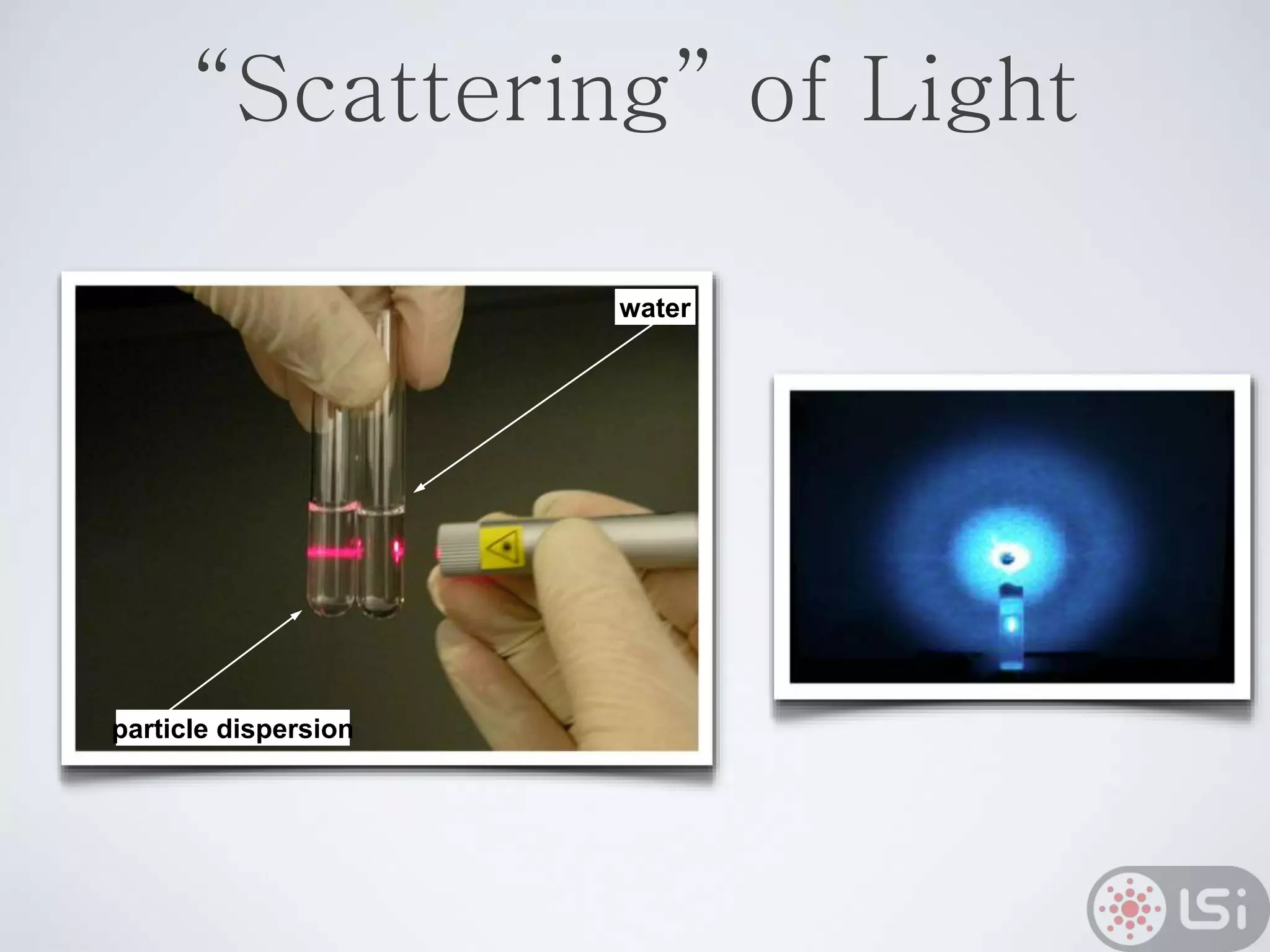
“Scattering” of Light
particle dispersion
water
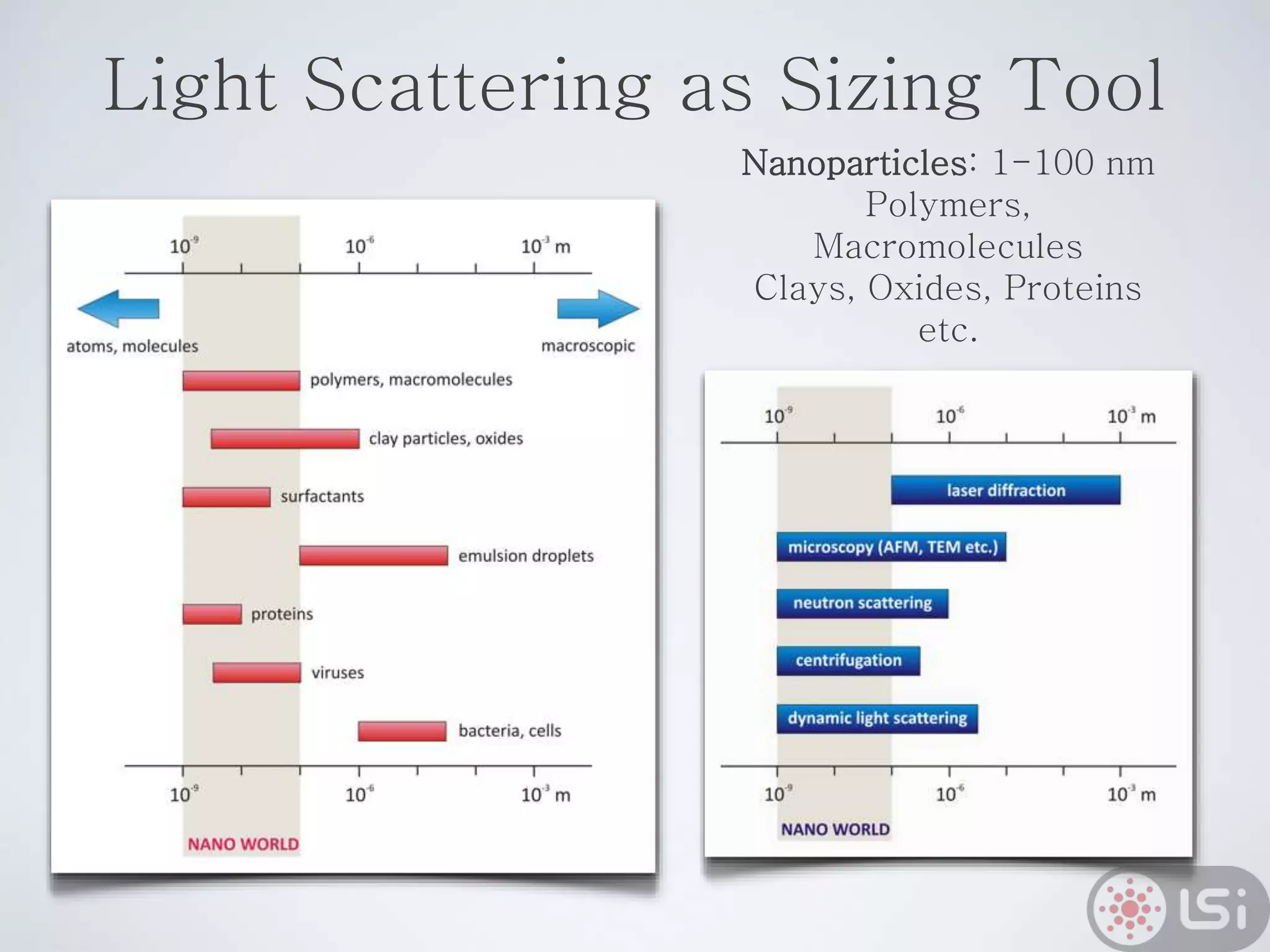
Light Scattering as Sizing Tool
Nanoparticles: 1-100 nm
Polymers,
Macromolecules
Clays, Oxides, Proteins
etc.
Part I: Theory
Fundamentals
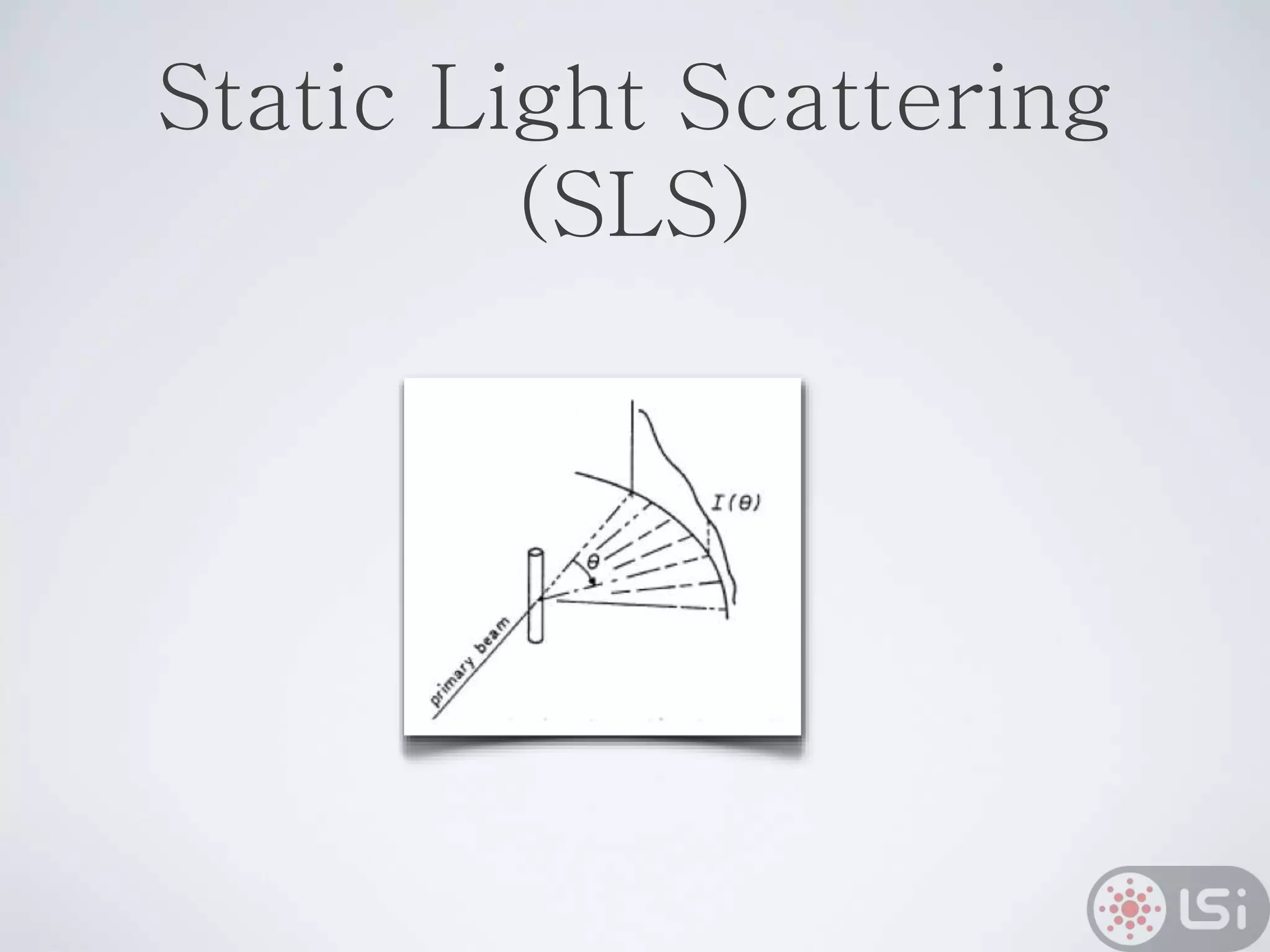
Static Light Scattering
(SLS)
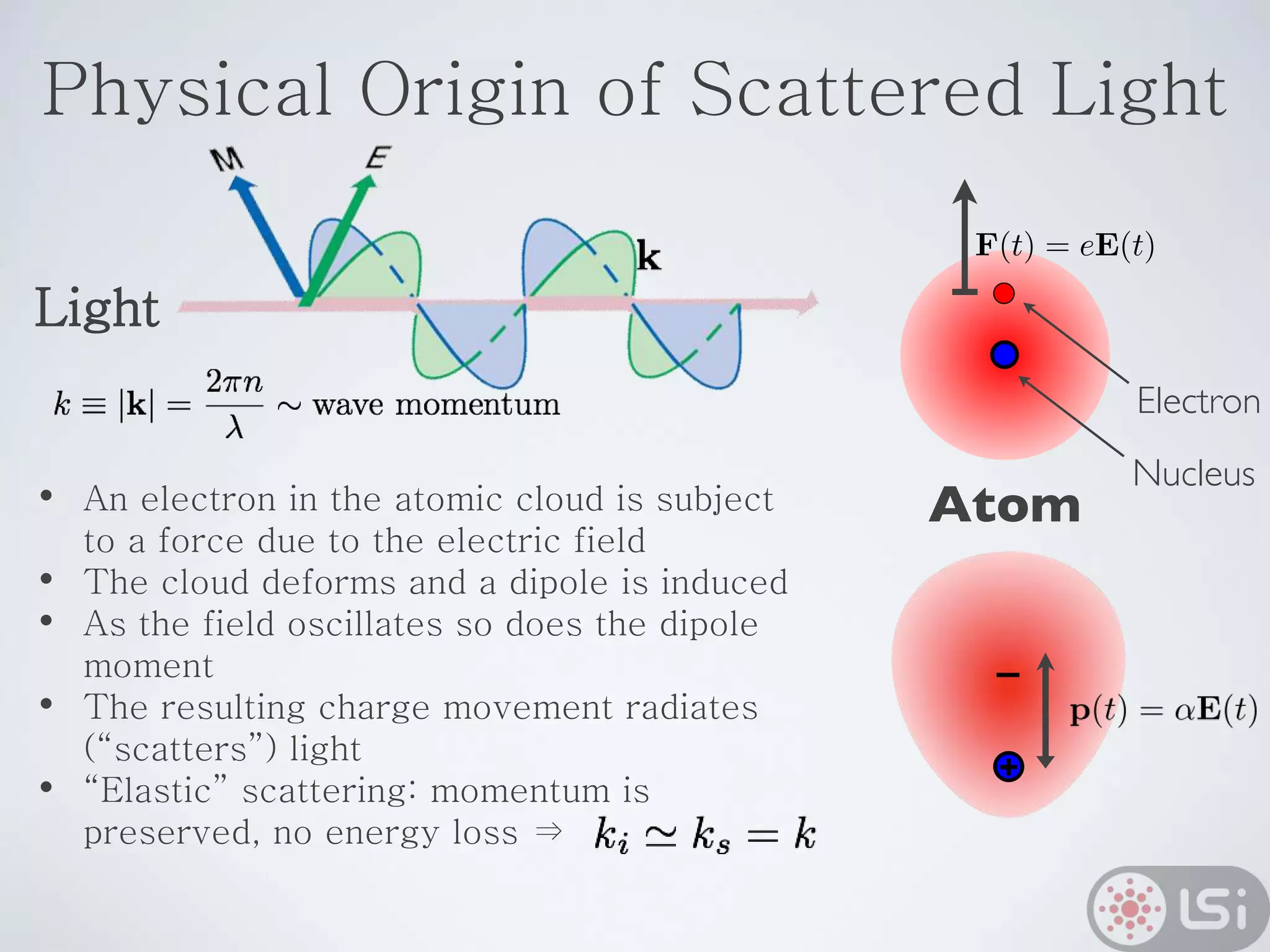
Physical Origin of Scattered Light
• An electron in the atomic cloud is subject
to a force due to the electric field
• The cloud deforms and a dipole is induced
• As the field oscillates so does the dipole
moment
• The resulting charge movement radiates
(“scatters”) light
• “Elastic” scattering: momentum is
preserved, no energy loss ⇒
+
–
Light
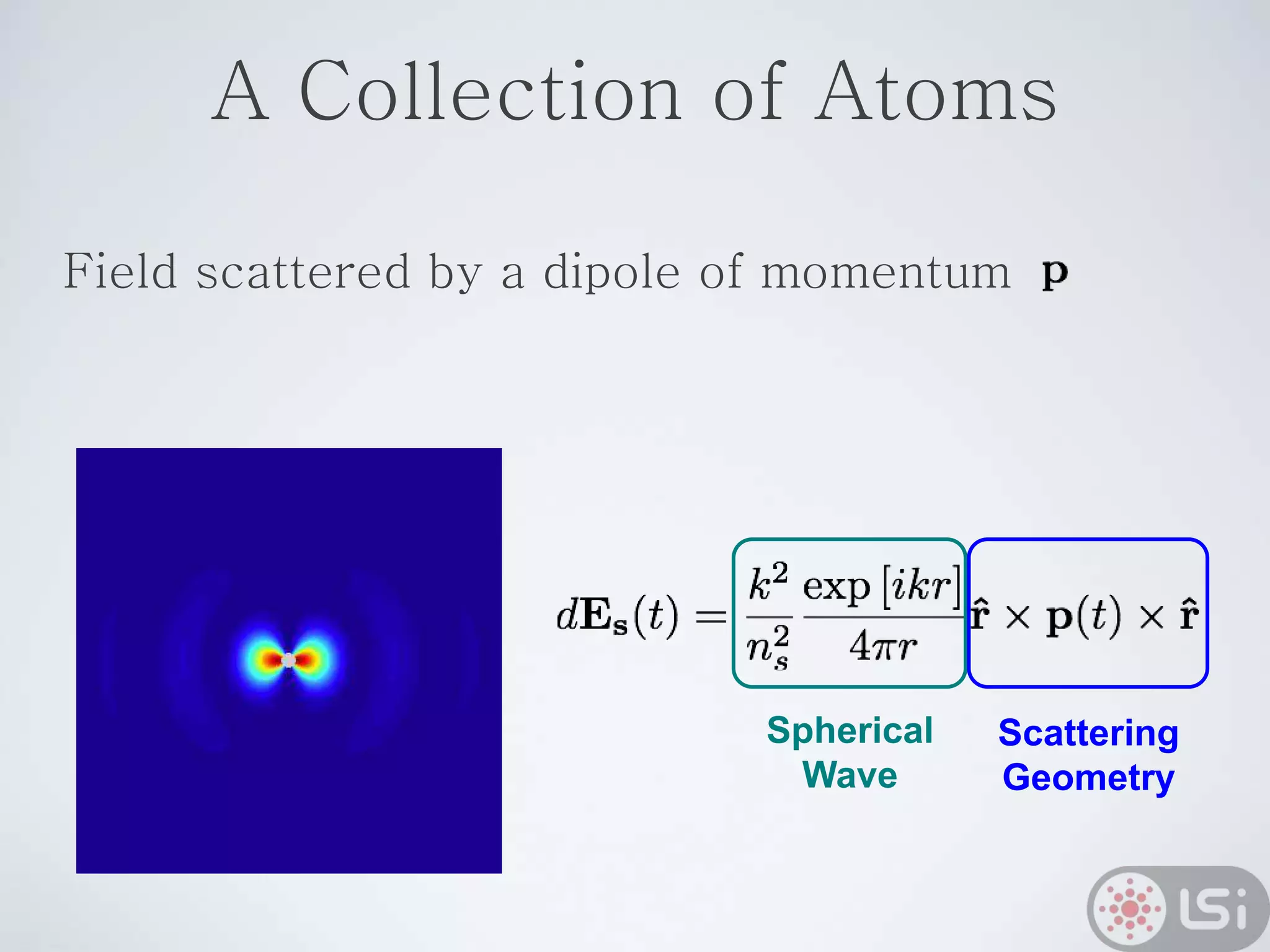
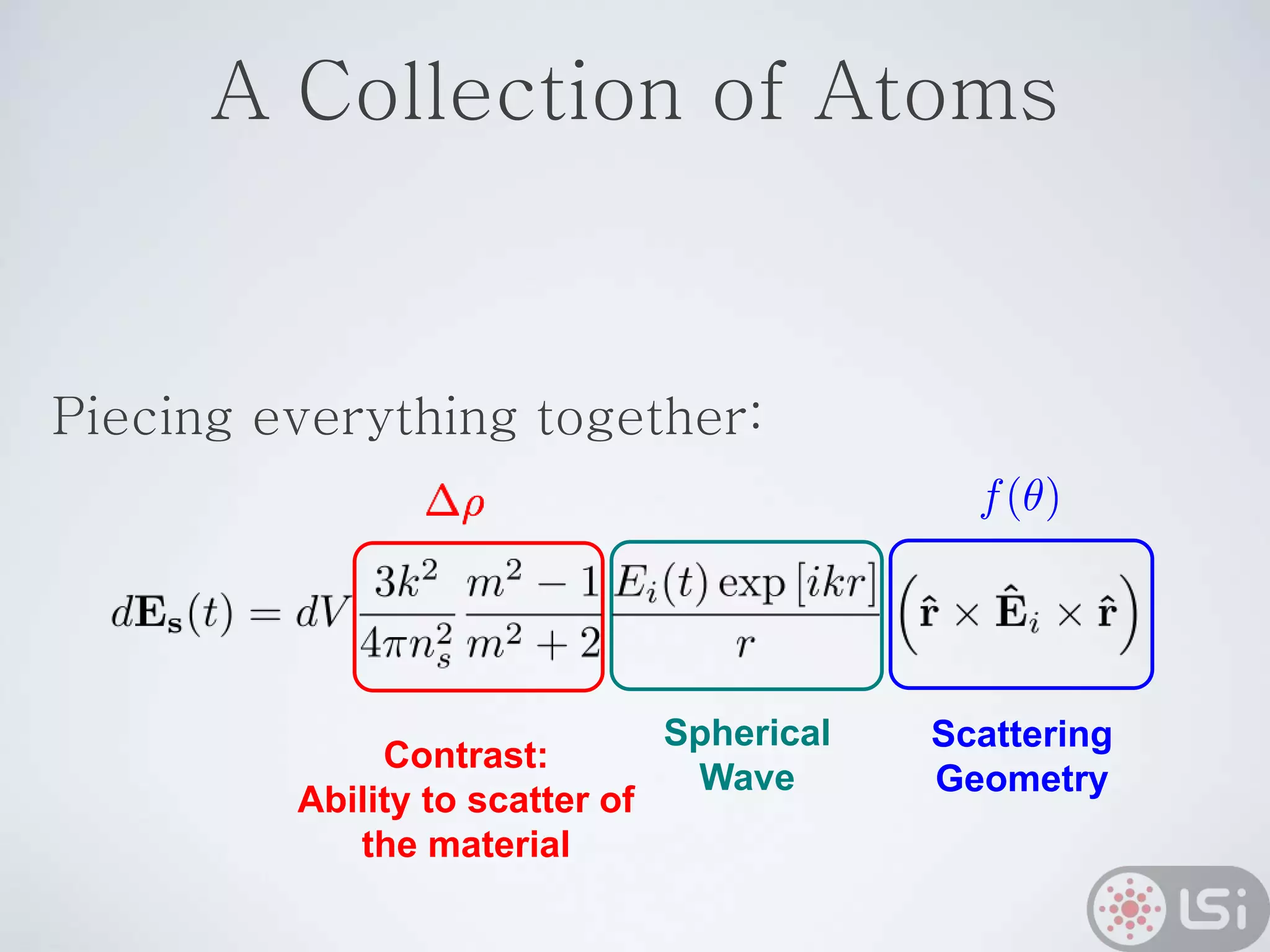
A Collection of Atoms
Field scattered by a dipole of momentum
Spherical
Wave
Scattering
Geometry
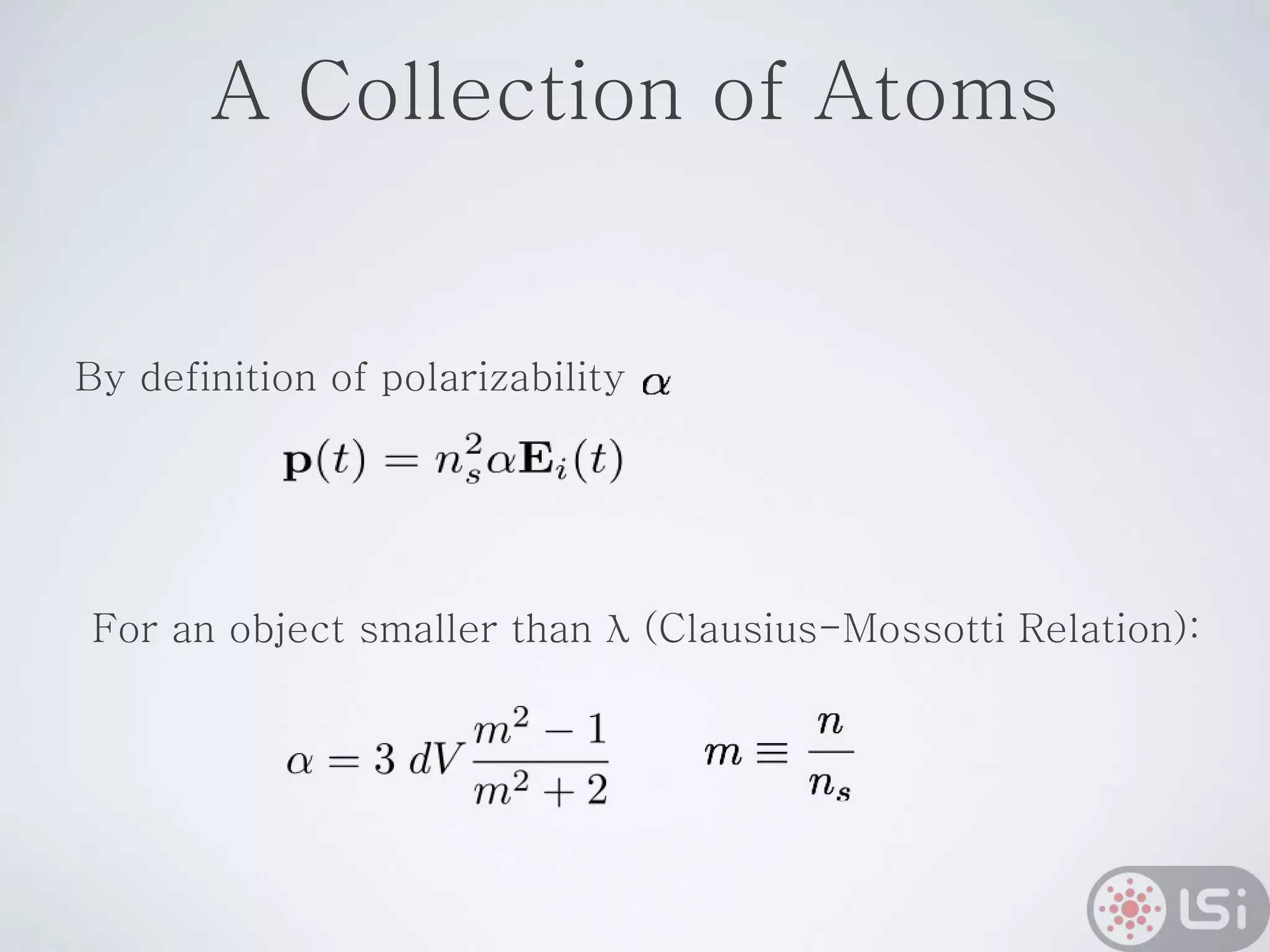
A Collection of Atoms
By definition of polarizability
For an object smaller than λ (Clausius-Mossotti Relation):
A Collection of Atoms
Spherical
Wave
Contrast:
Ability to scatter of
the material
Piecing everything together:
Scattering
Geometry
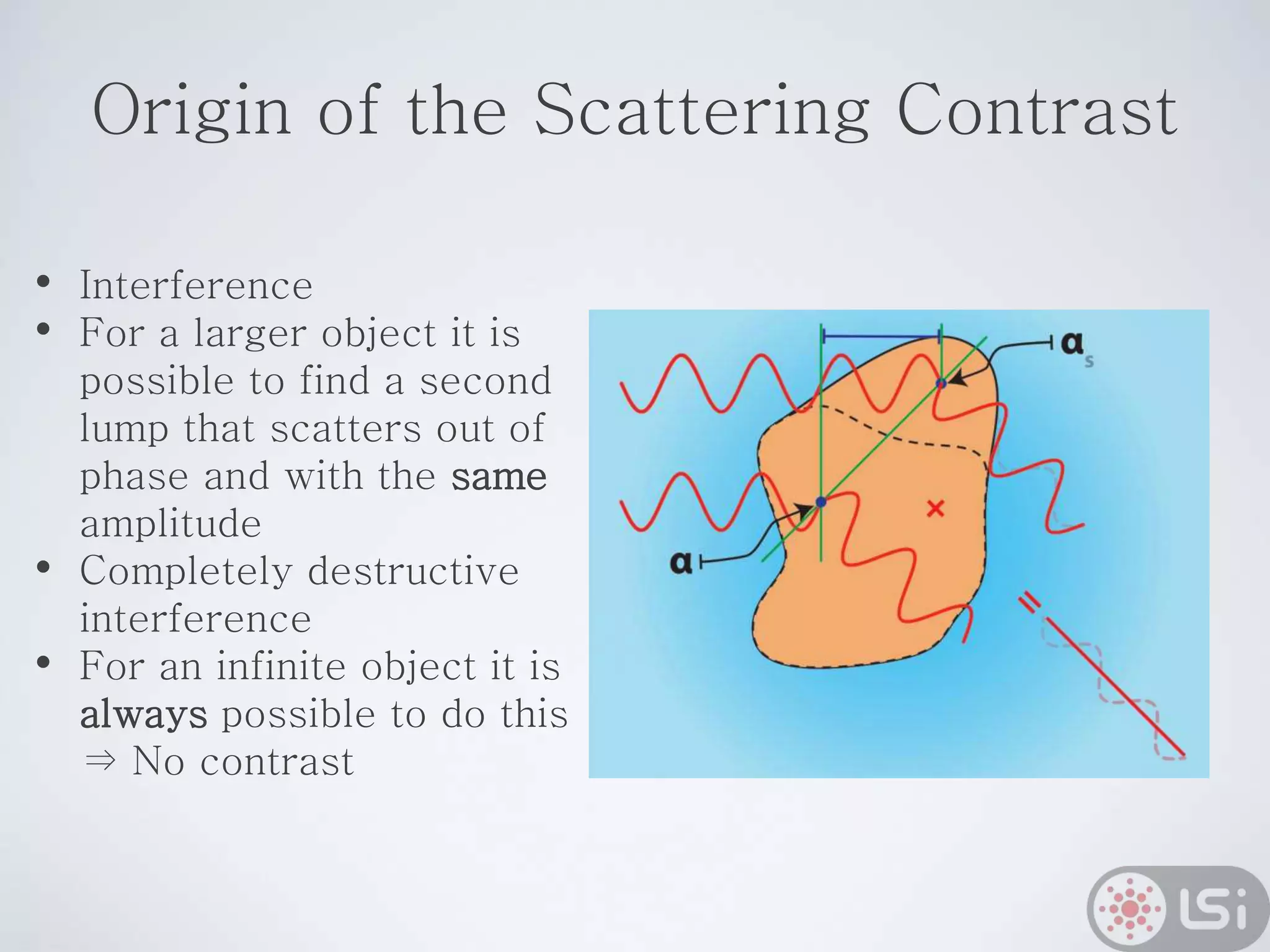
Origin of the Scattering Contrast
• Interference
• For a larger object it is
possible to find a second
lump that scatters out of
phase and with the same
amplitude
• Completely destructive
interference
• For an infinite object it is
always possible to do this
⇒ No contrast
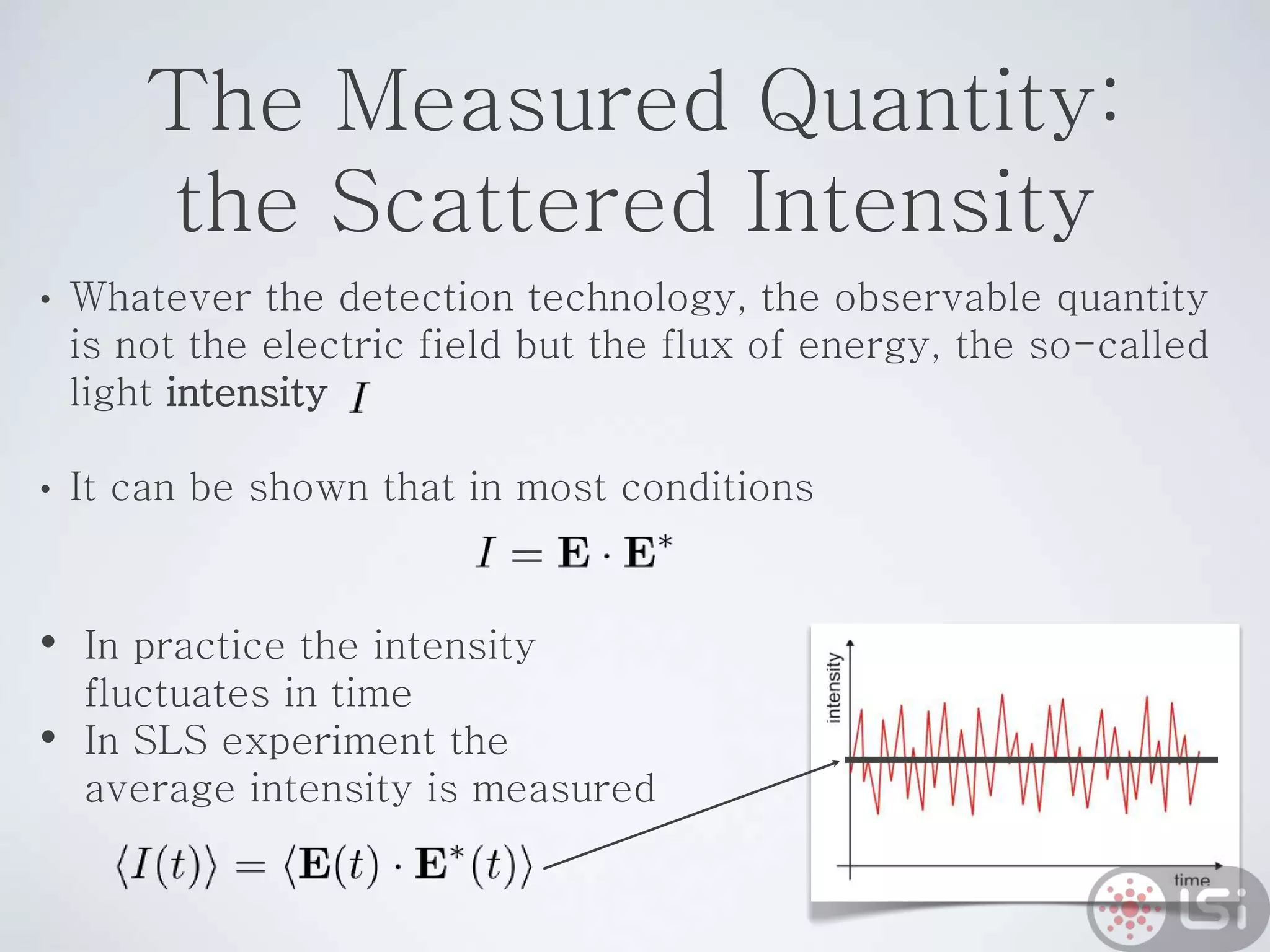
The Measured Quantity:
the Scattered Intensity
• Whatever the detection technology, the observable quantity
is not the electric field but the flux of energy, the so-called
light intensity
• It can be shown that in most conditions
• In practice the intensity
fluctuates in time
• In SLS experiment the
average intensity is measured
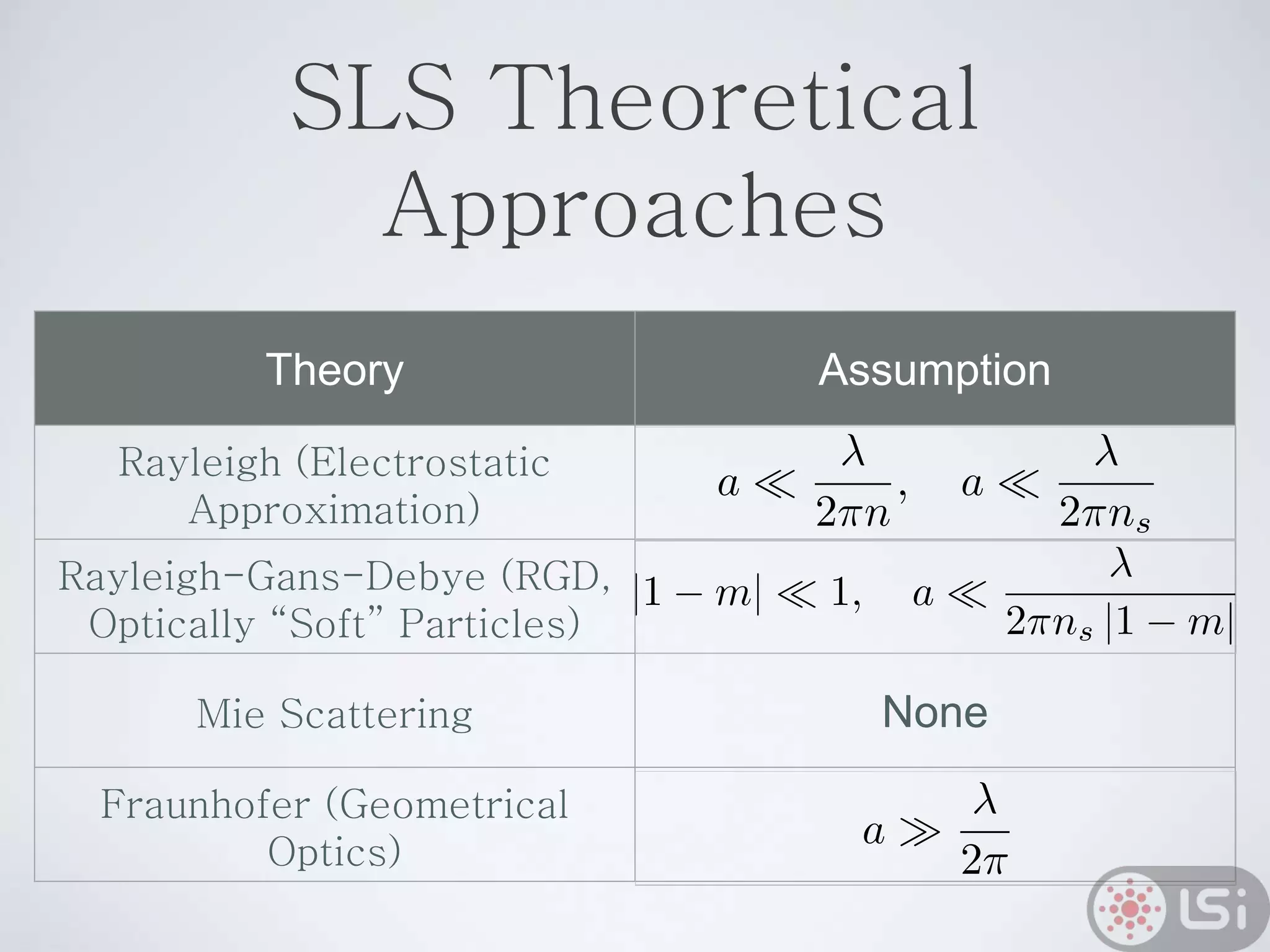
SLS Theoretical
Approaches
Theory Assumption
Rayleigh (Electrostatic
Approximation)
Rayleigh-Gans-Debye (RGD,
Optically “Soft” Particles)
Mie Scattering None
Fraunhofer (Geometrical
Optics)
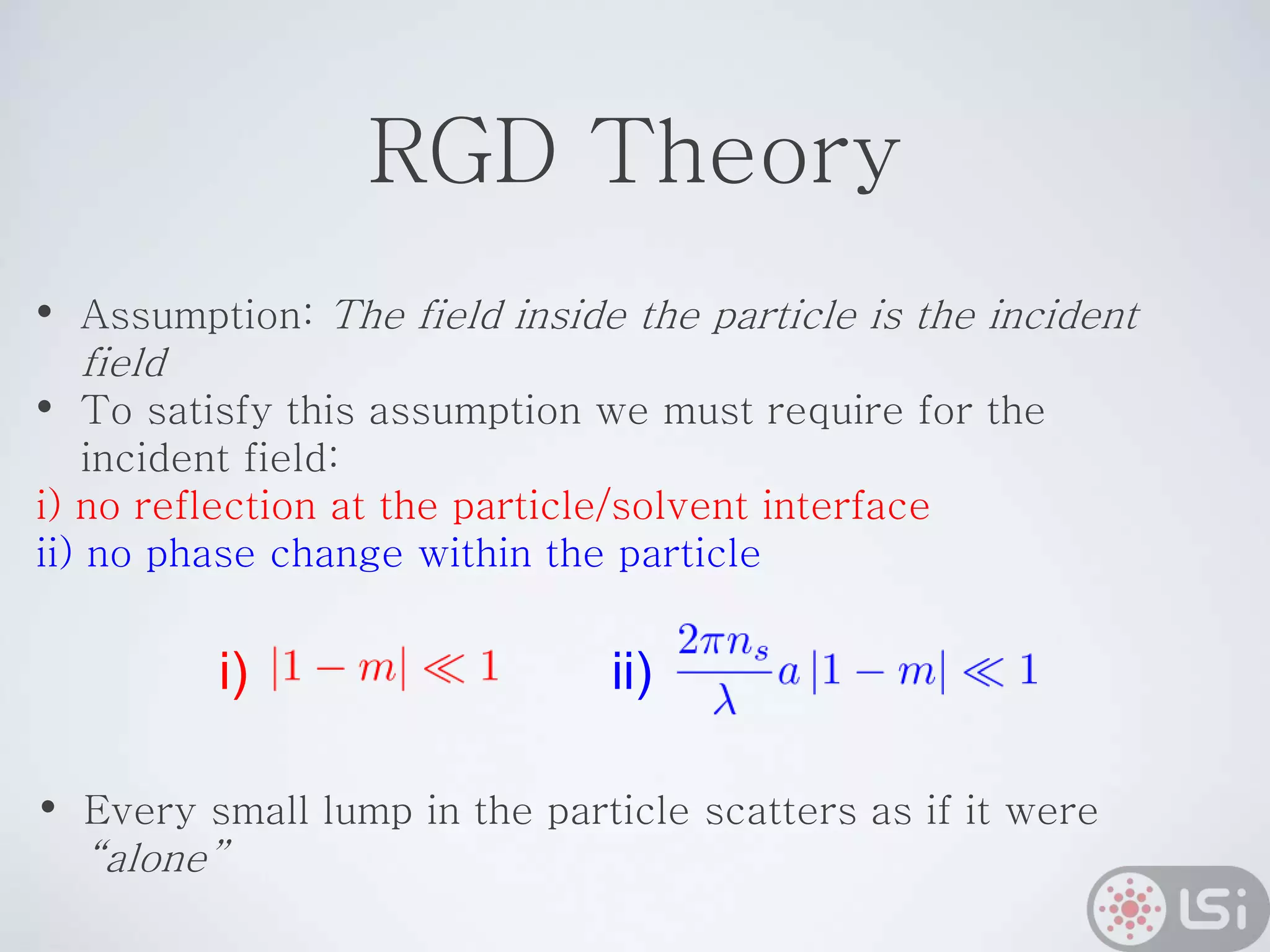
RGD Theory
• Assumption: The field inside the particle is the incident
field
• To satisfy this assumption we must require for the
incident field:
i) no reflection at the particle/solvent interface
ii) no phase change within the particle
i) ii)
• Every small lump in the particle scatters as if it were
“alone”
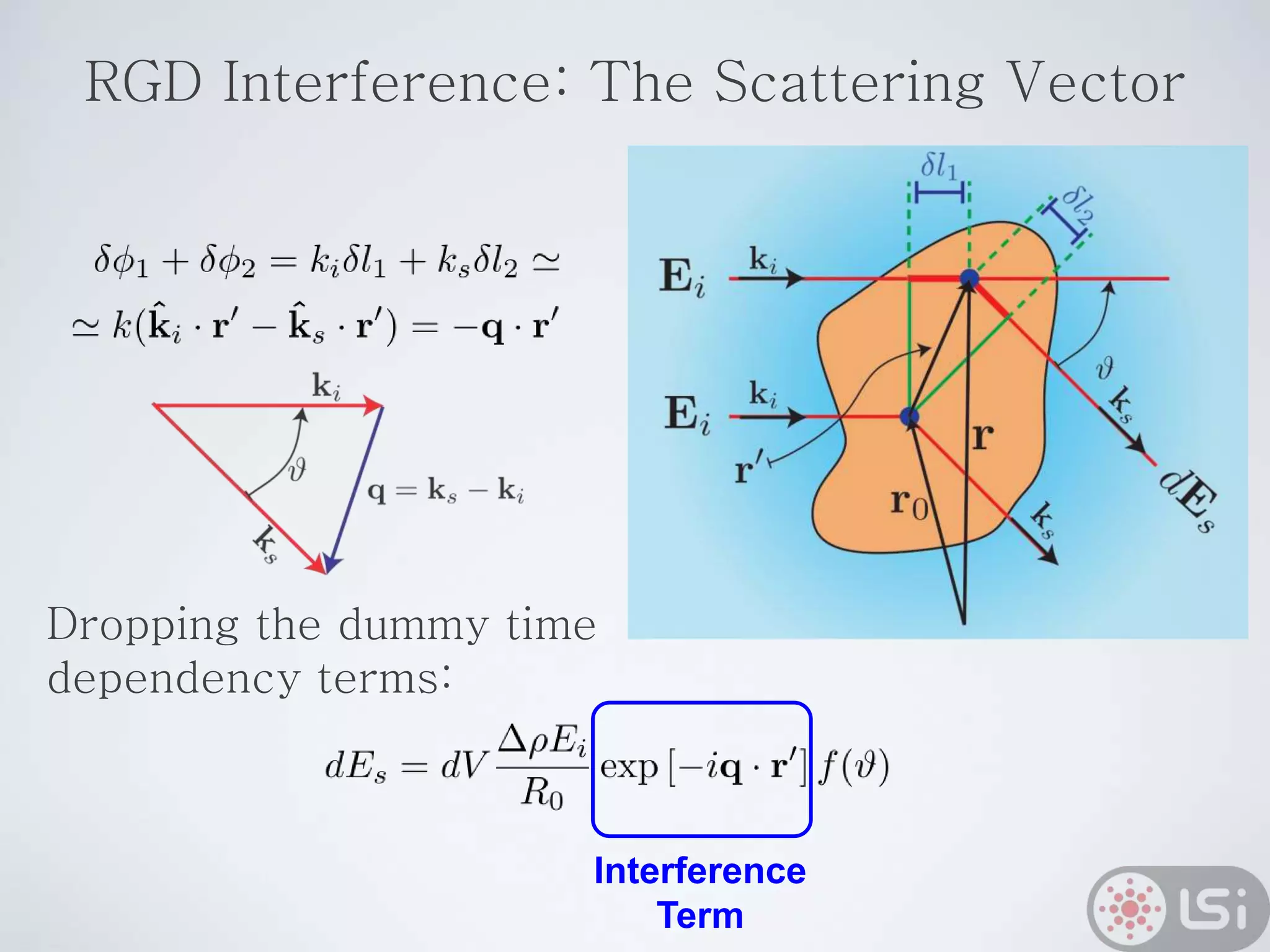
RGD Interference: The Scattering Vector
Interference
Term
Dropping the dummy time
dependency terms:
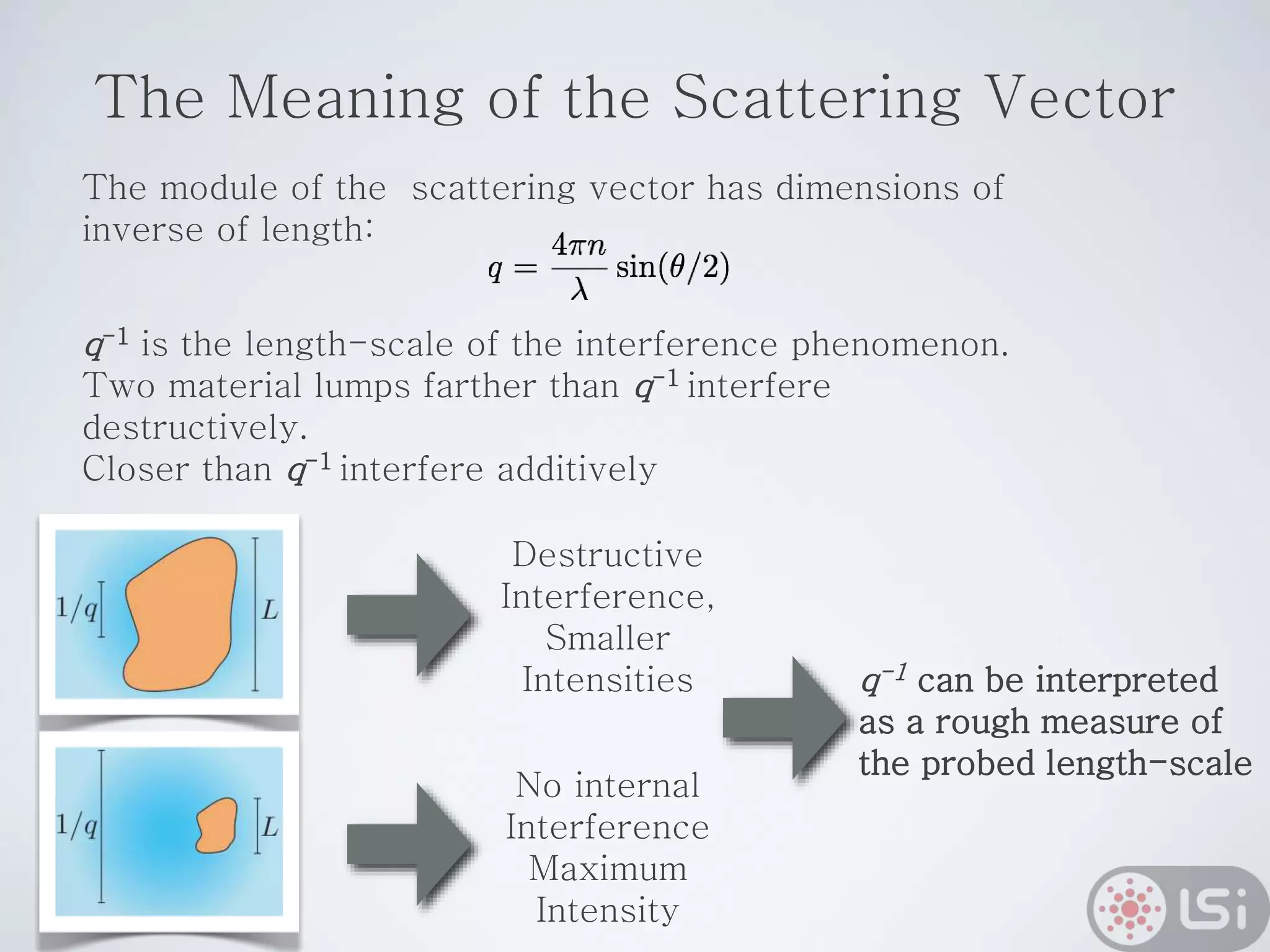
The Meaning of the Scattering Vector
The module of the scattering vector has dimensions of
inverse of length:
q-1 is the length-scale of the interference phenomenon.
Two material lumps farther than q-1 interfere
destructively.
Closer than q-1 interfere additively
Destructive
Interference,
Smaller
Intensities
No internal
Interference
Maximum
Intensity
q-1 can be interpreted
as a rough measure of
the probed length-scale
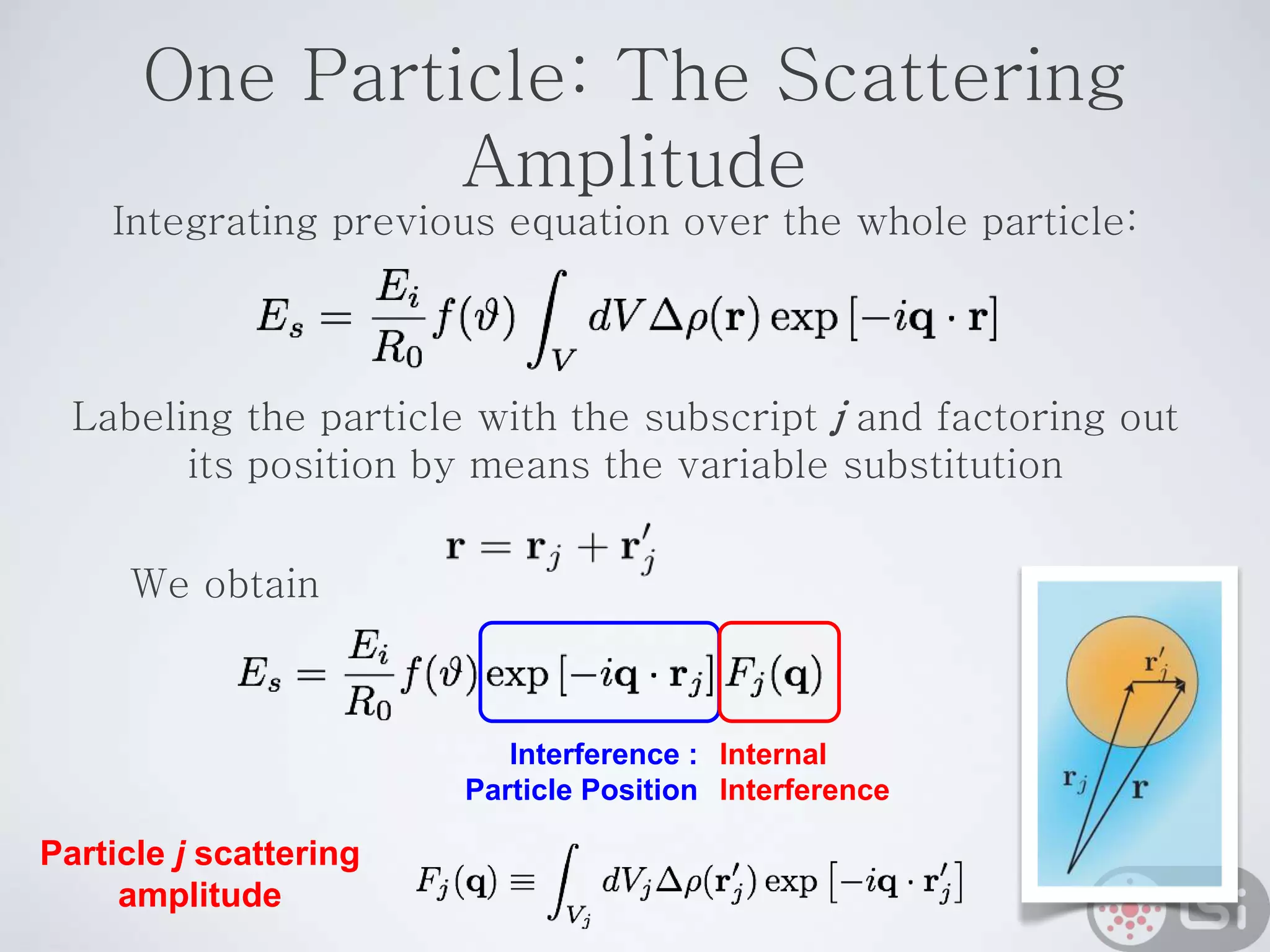
One Particle: The Scattering
Amplitude
Integrating previous equation over the whole particle:
Labeling the particle with the subscript j and factoring out
its position by means the variable substitution
We obtain
Particle j scattering
amplitude
Interference :
Particle Position
Internal
Interference
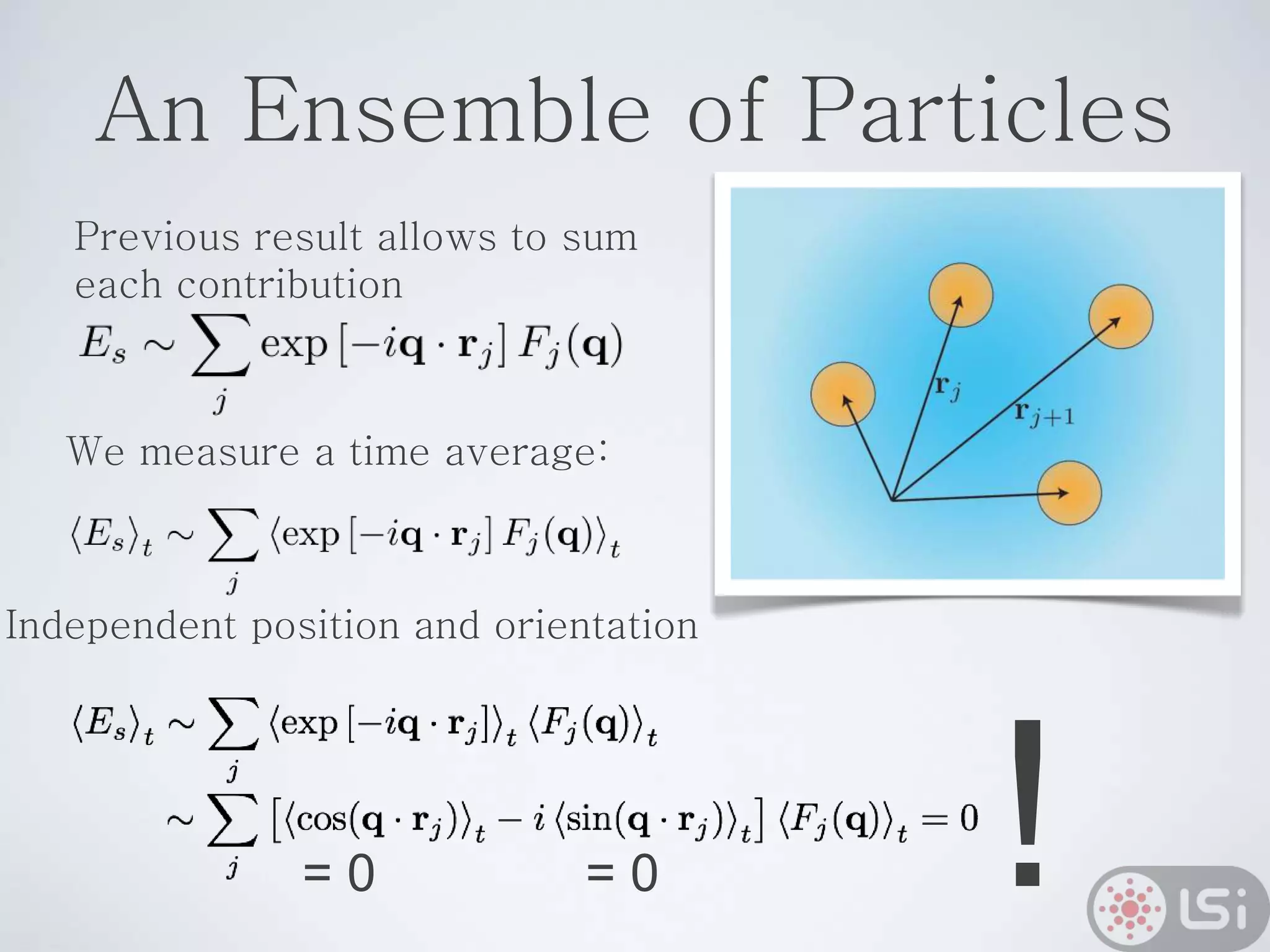
An Ensemble of Particles
Previous result allows to sum
each contribution
= 0 = 0 !
Independent position and orientation
We measure a time average:
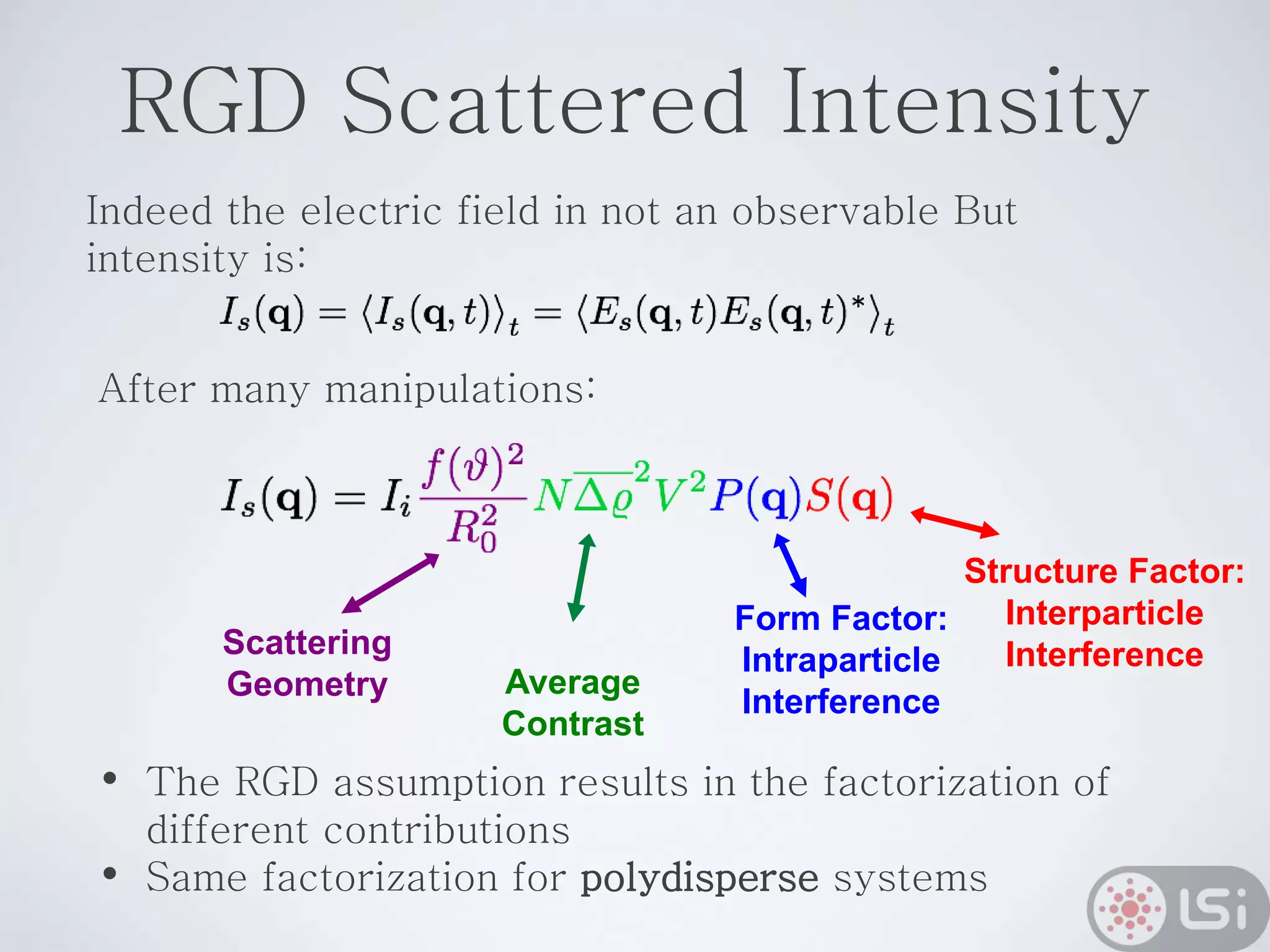
RGD Scattered Intensity
Indeed the electric field in not an observable But
intensity is:
Average
Contrast
Structure Factor:
Interparticle
Interference
Form Factor:
Intraparticle
Interference
Scattering
Geometry
• The RGD assumption results in the factorization of
different contributions
• Same factorization for polydisperse systems
After many manipulations:
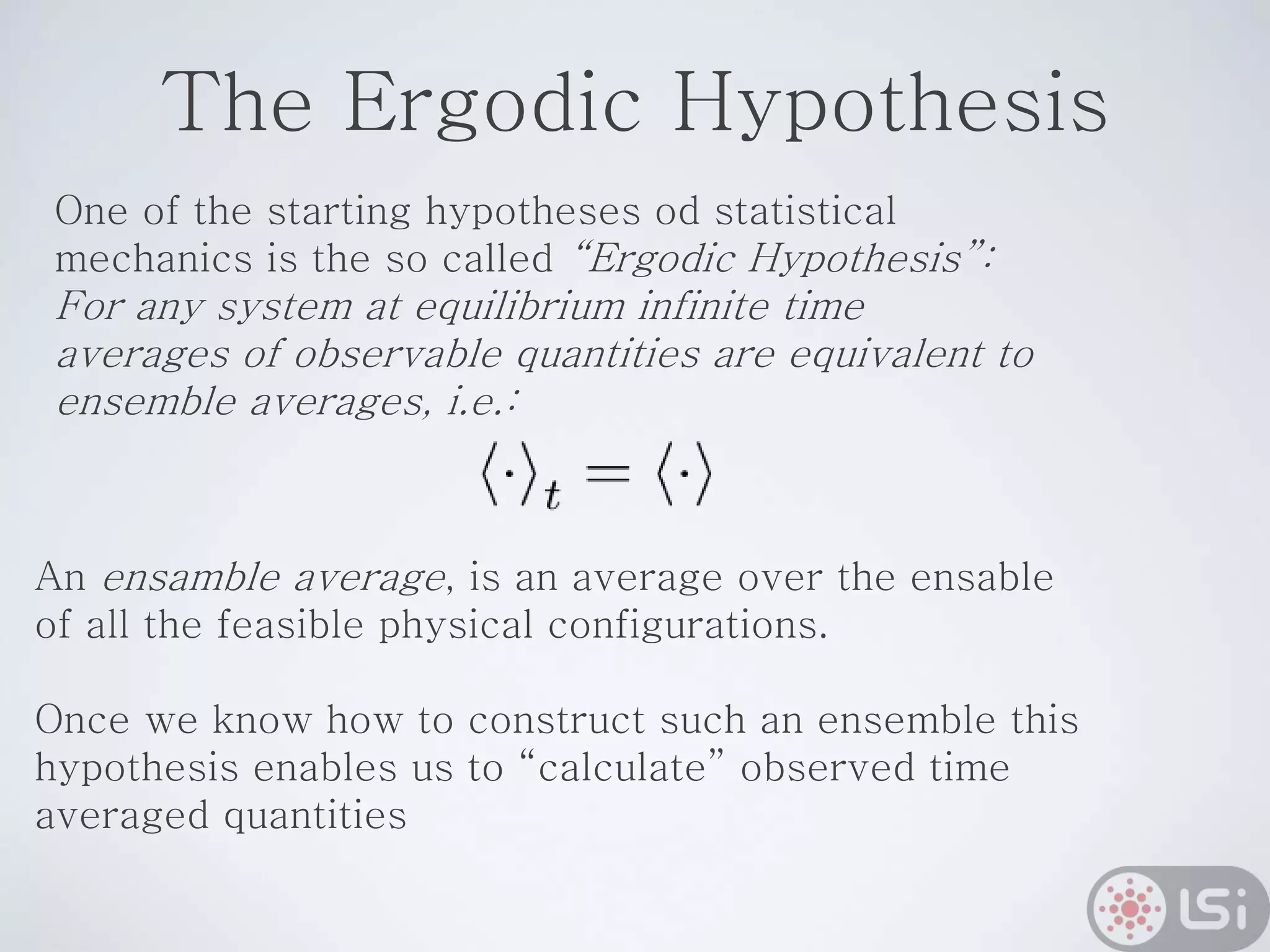
The Ergodic Hypothesis
One of the starting hypotheses od statistical
mechanics is the so called “Ergodic Hypothesis”:
For any system at equilibrium infinite time
averages of observable quantities are equivalent to
ensemble averages, i.e.:
An ensamble average, is an average over the ensable
of all the feasible physical configurations.
Once we know how to construct such an ensemble this
hypothesis enables us to “calculate” observed time
averaged quantities
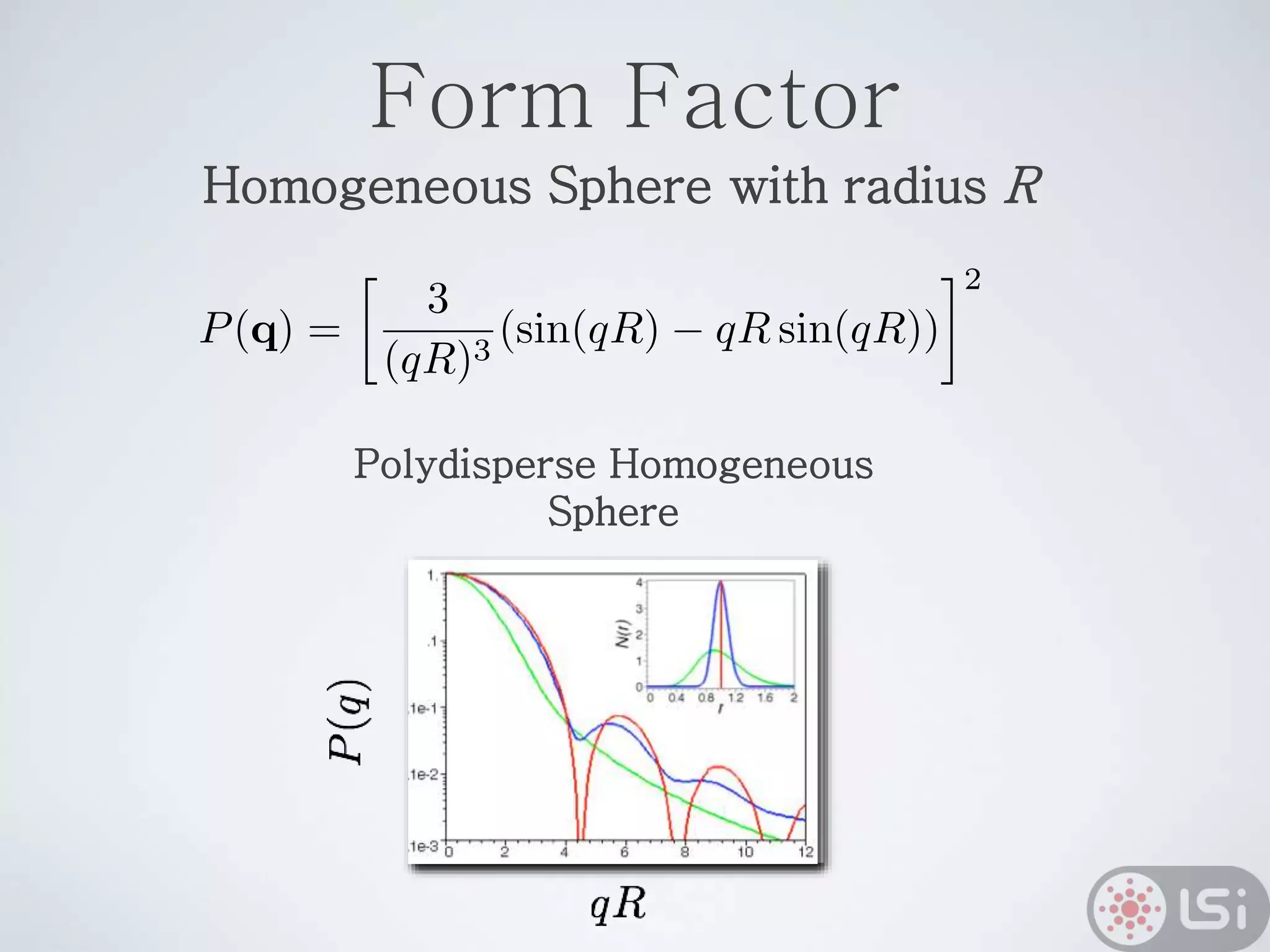
Form Factor
Homogeneous Sphere with radius R
Polydisperse Homogeneous
Sphere
Form Factor
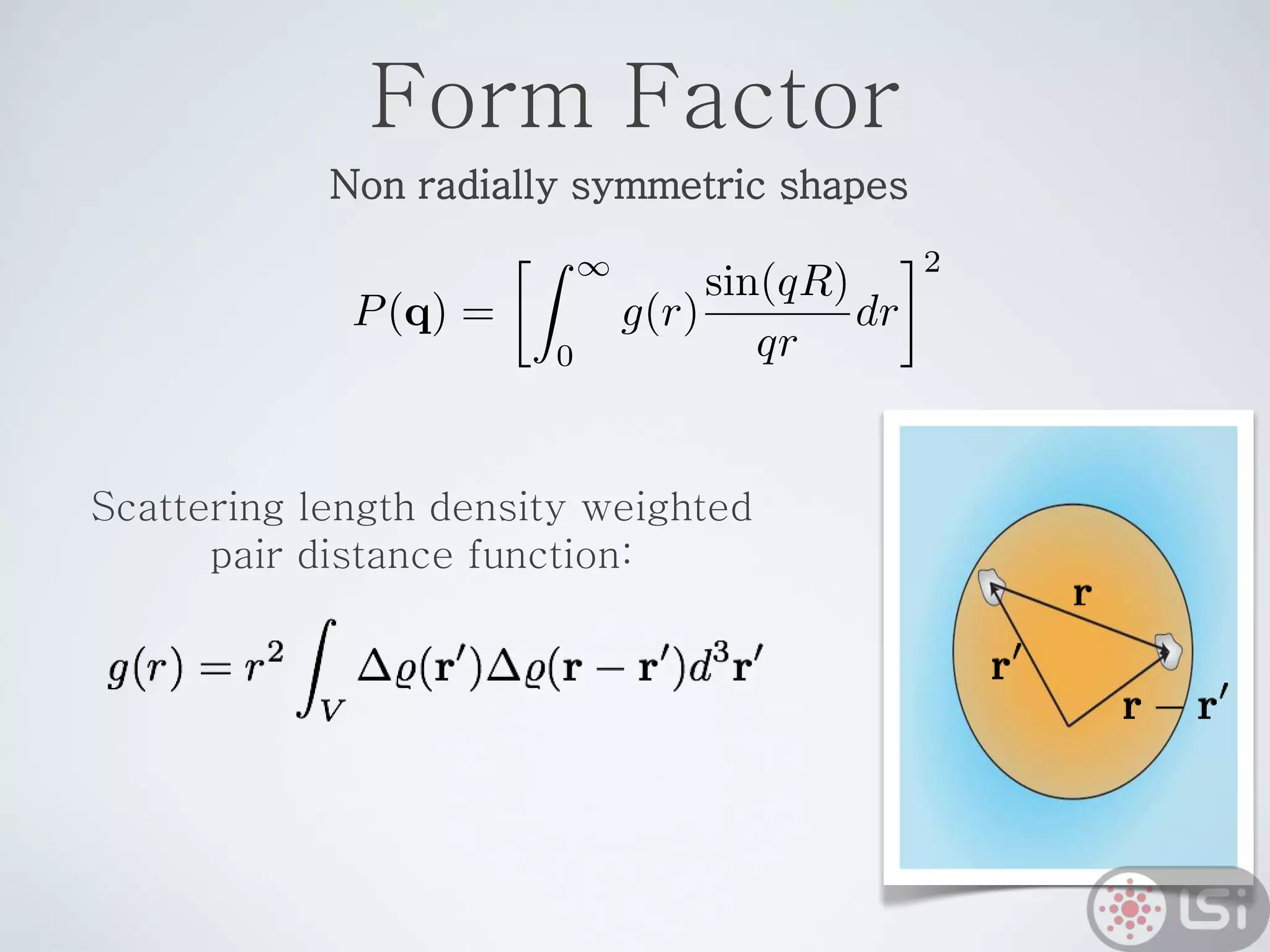
Non radially symmetric shapes
Scattering length density weighted
pair distance function:
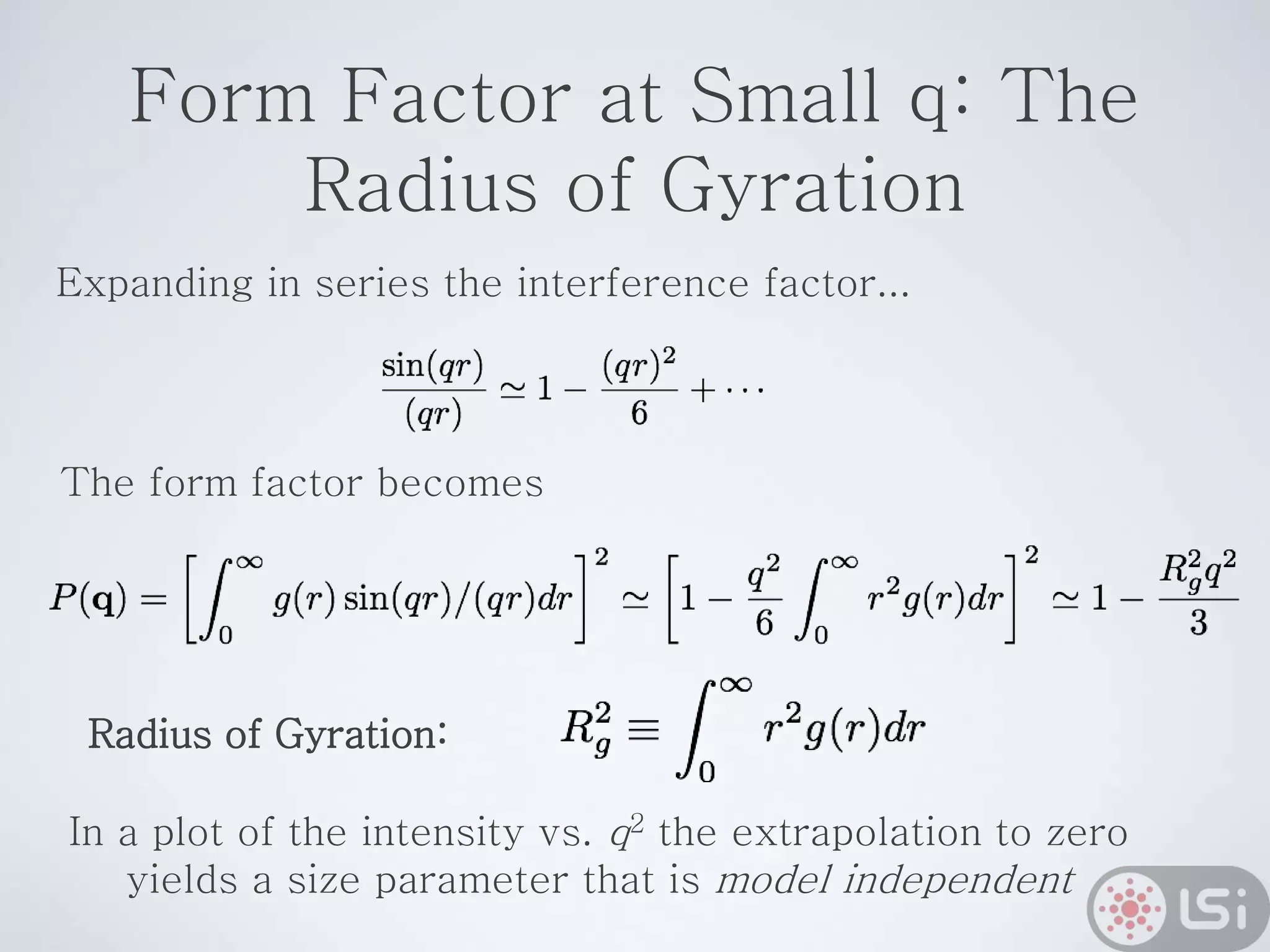
Form Factor at Small q: The
Radius of Gyration
Expanding in series the interference factor...
The form factor becomes
Radius of Gyration:
In a plot of the intensity vs. q2 the extrapolation to zero
yields a size parameter that is model independent
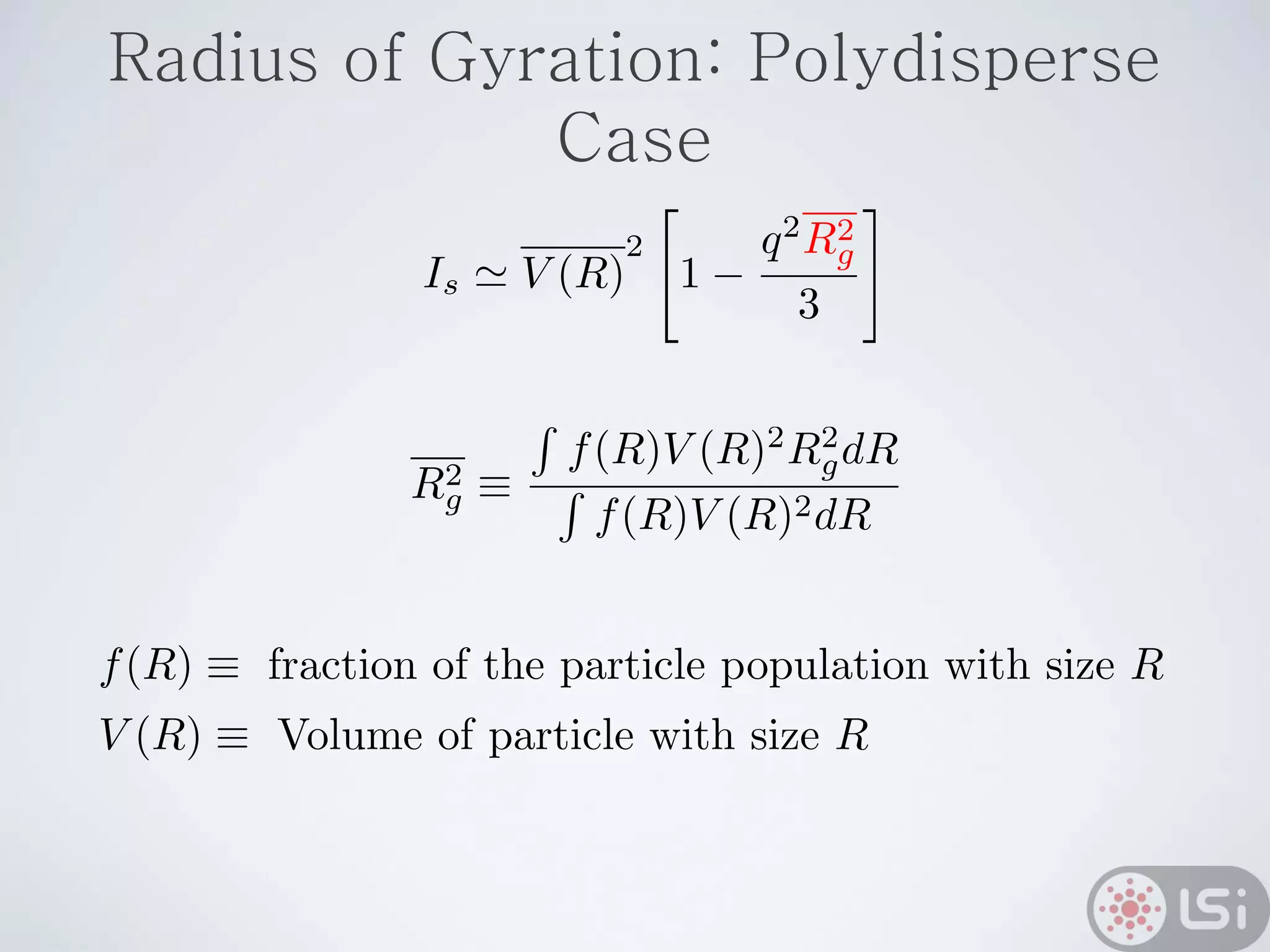
Radius of Gyration: Polydisperse
Case
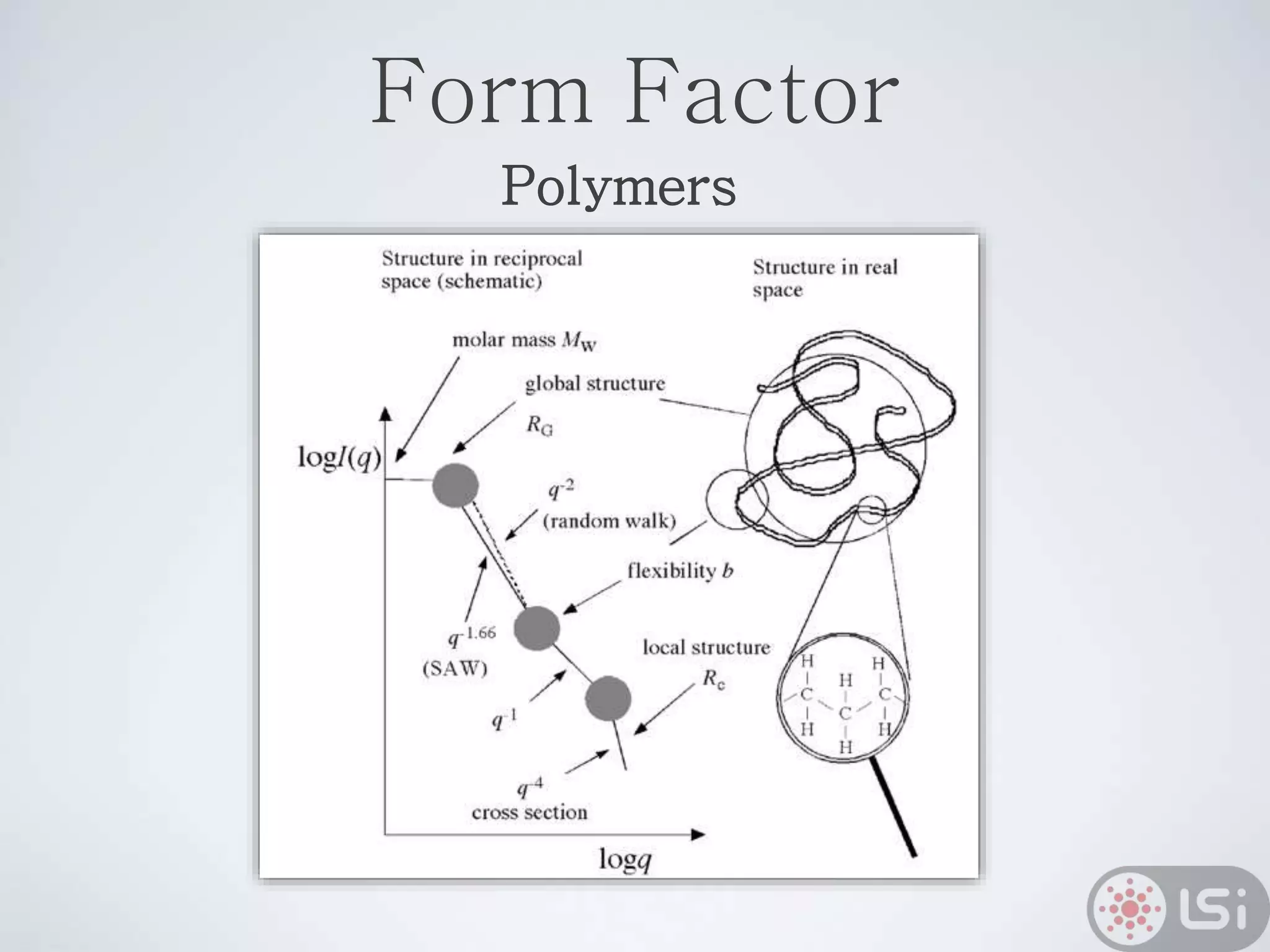
Form Factor
Polymers
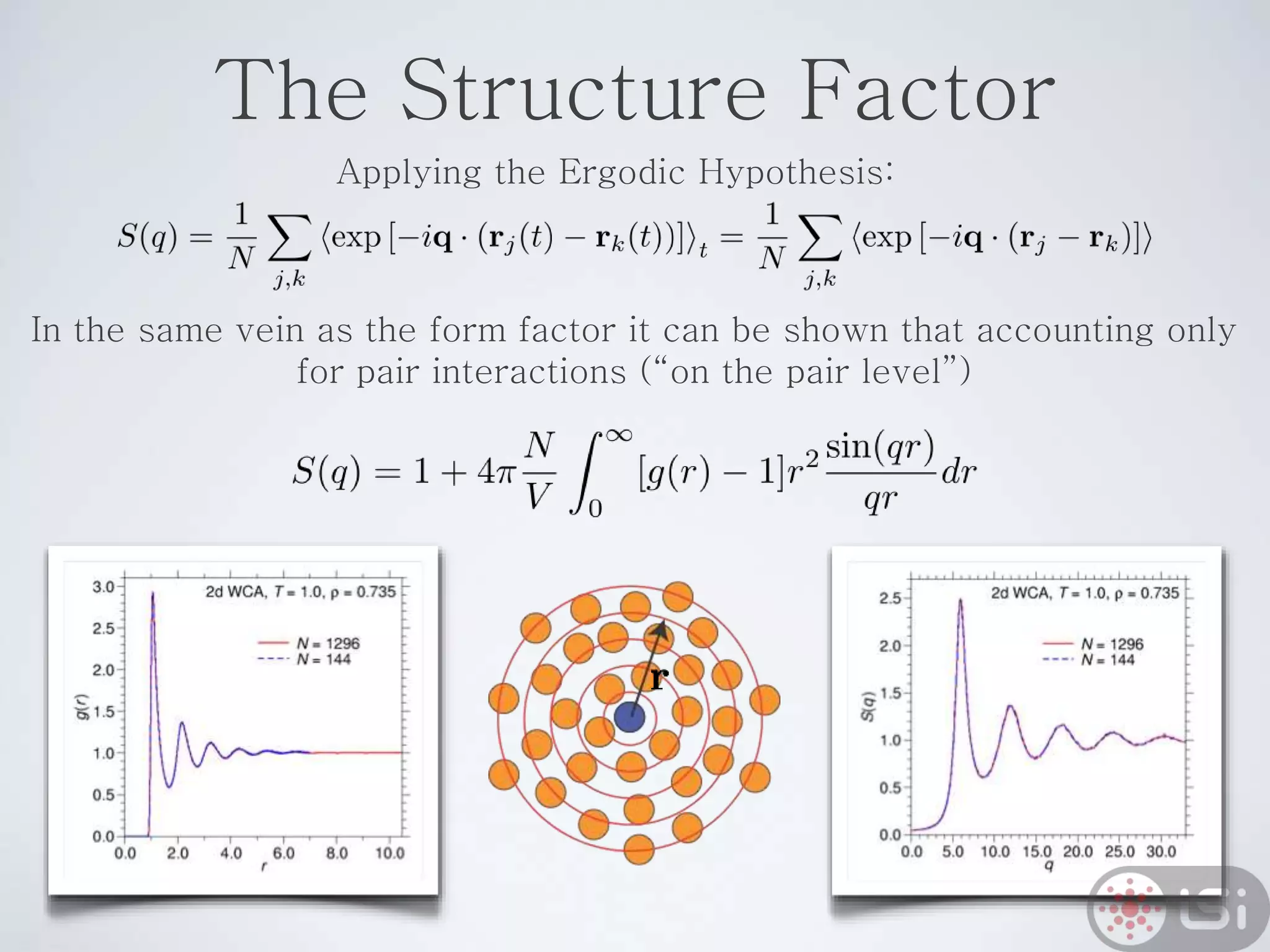
The Structure Factor
In the same vein as the form factor it can be shown that accounting only
for pair interactions (“on the pair level”)
Applying the Ergodic Hypothesis:
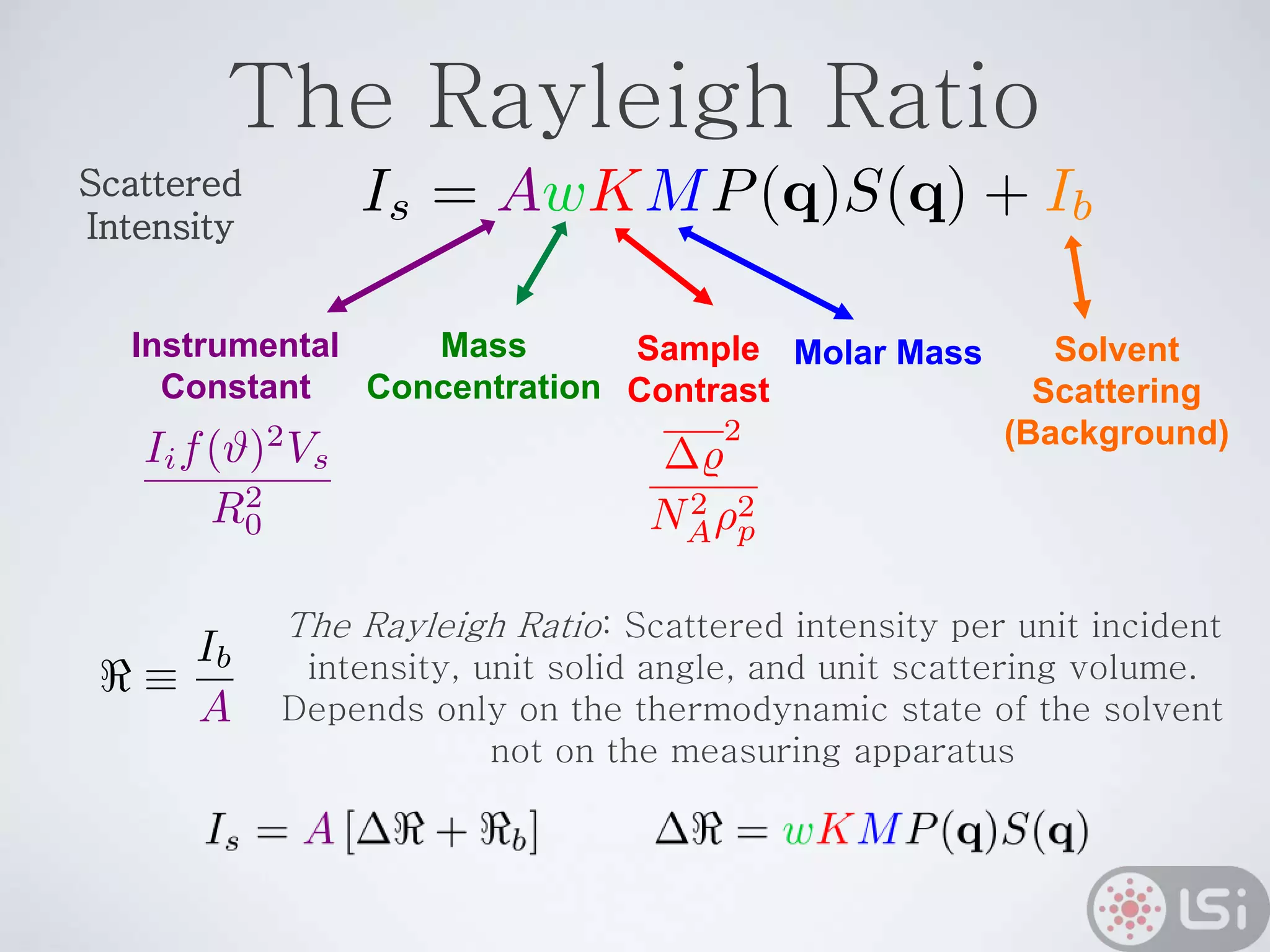
The Rayleigh Ratio
Scattered
Intensity
The Rayleigh Ratio: Scattered intensity per unit incident
intensity, unit solid angle, and unit scattering volume.
Depends only on the thermodynamic state of the solvent
not on the measuring apparatus
Mass
Concentration
Sample
Contrast
Molar MassInstrumental
Constant
Solvent
Scattering
(Background)
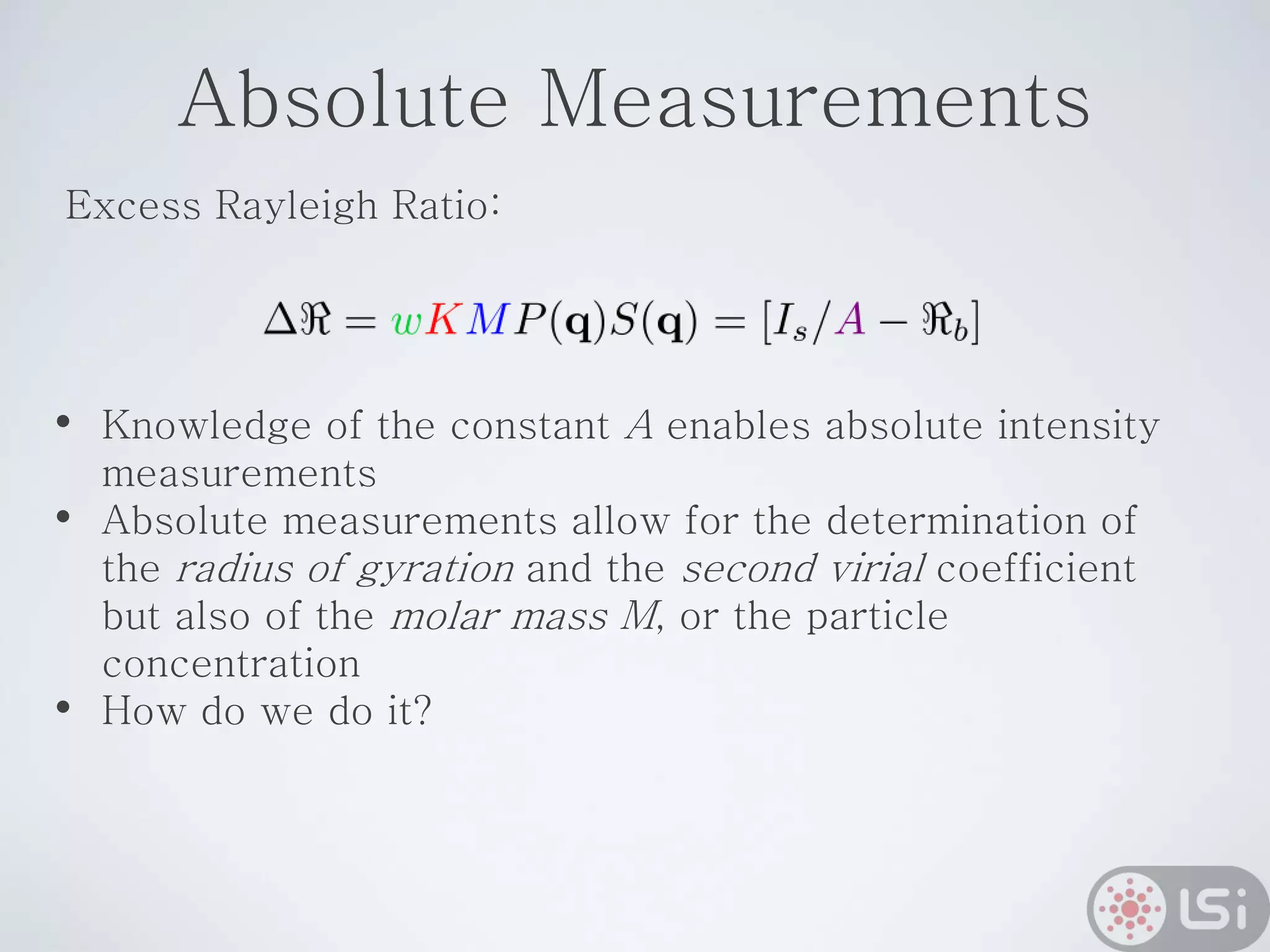
Absolute Measurements
• Knowledge of the constant A enables absolute intensity
measurements
• Absolute measurements allow for the determination of
the radius of gyration and the second virial coefficient
but also of the molar mass M, or the particle
concentration
• How do we do it?
Excess Rayleigh Ratio:
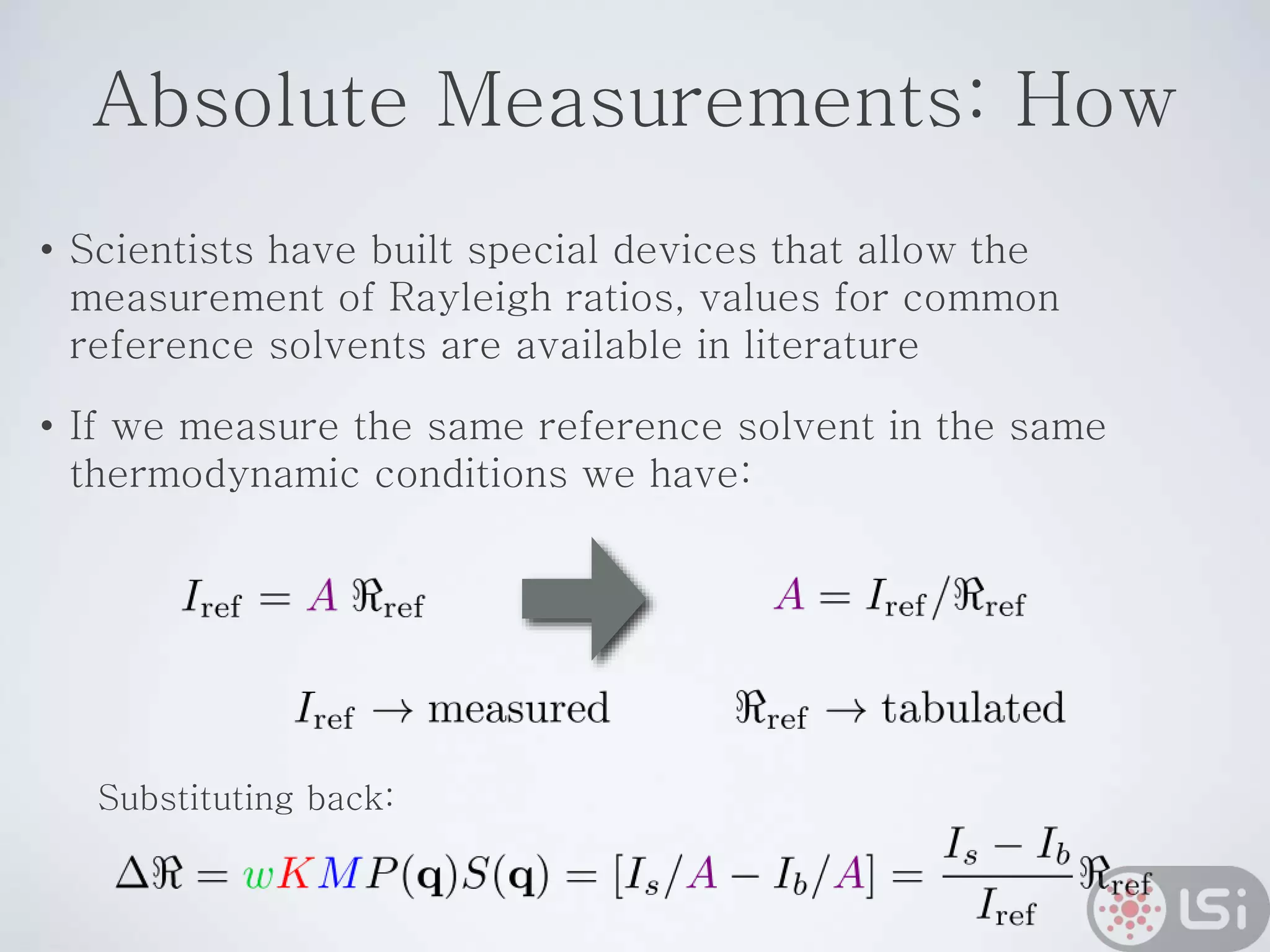
Absolute Measurements: How
• Scientists have built special devices that allow the
measurement of Rayleigh ratios, values for common
reference solvents are available in literature
• If we measure the same reference solvent in the same
thermodynamic conditions we have:
Substituting back:
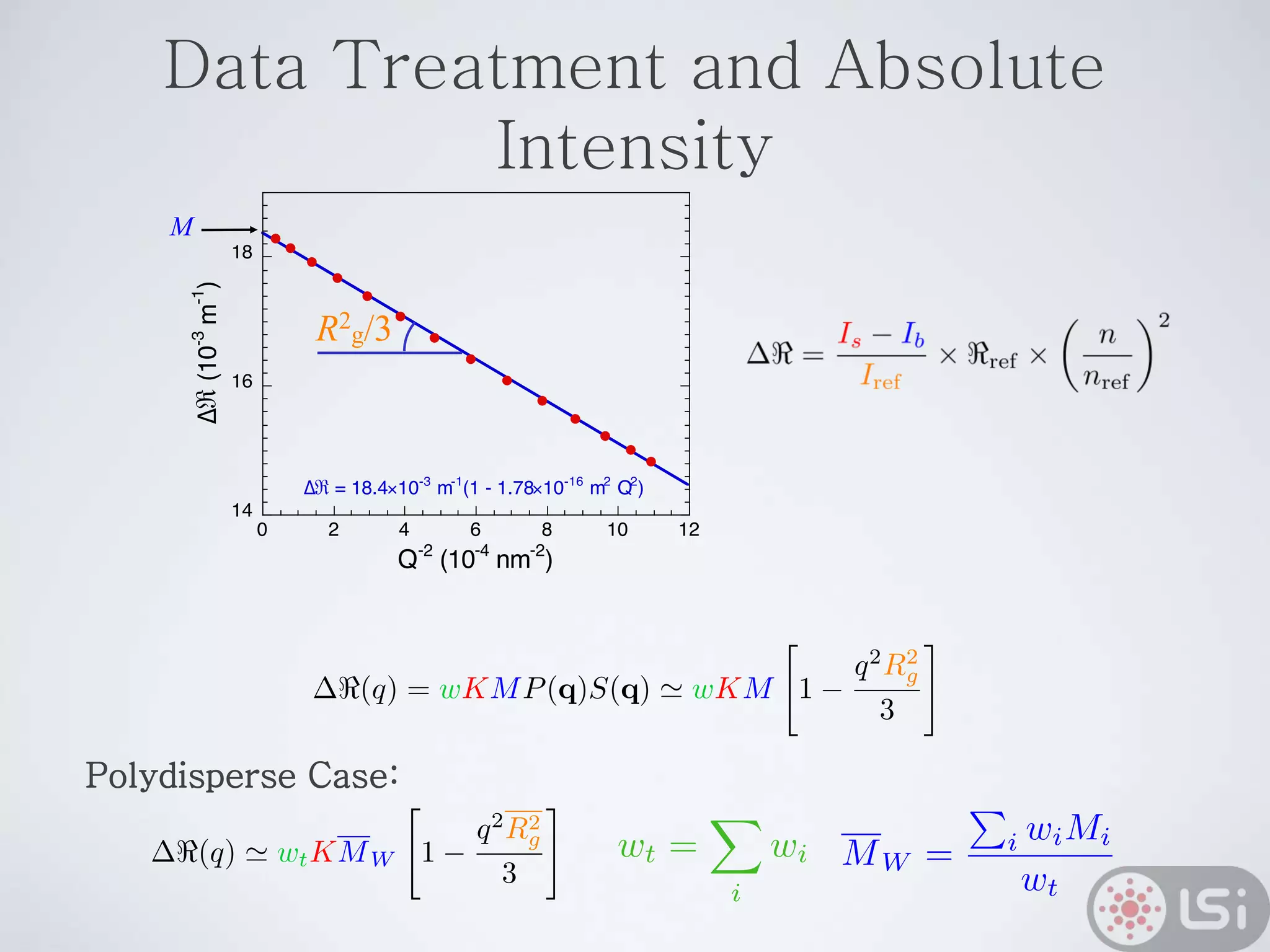
Data Treatment and Absolute
Intensity
M
R2
g/3
Polydisperse Case:
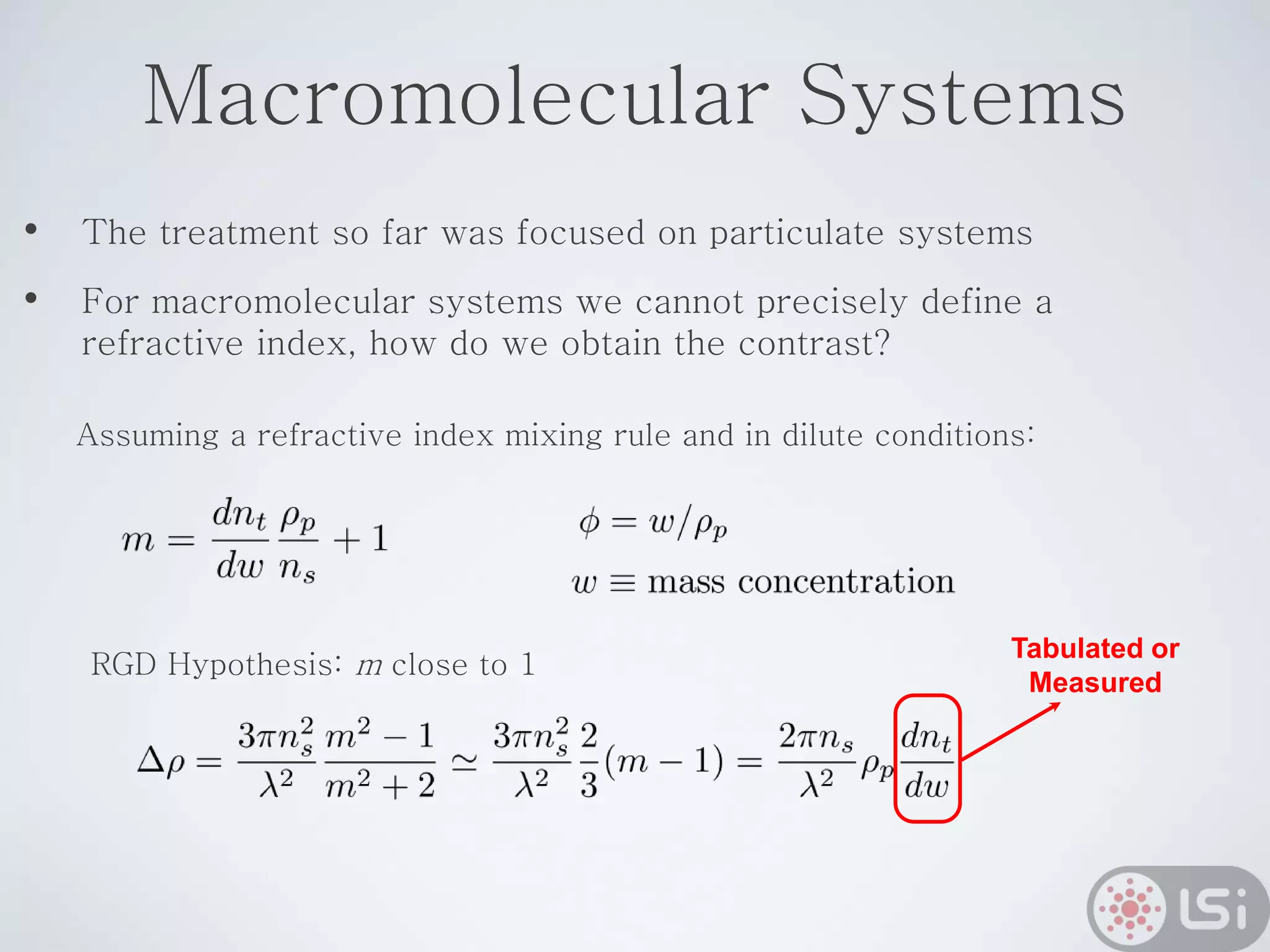
Macromolecular Systems
• The treatment so far was focused on particulate systems
• For macromolecular systems we cannot precisely define a
refractive index, how do we obtain the contrast?
Tabulated or
Measured
Assuming a refractive index mixing rule and in dilute conditions:
RGD Hypothesis: m close to 1
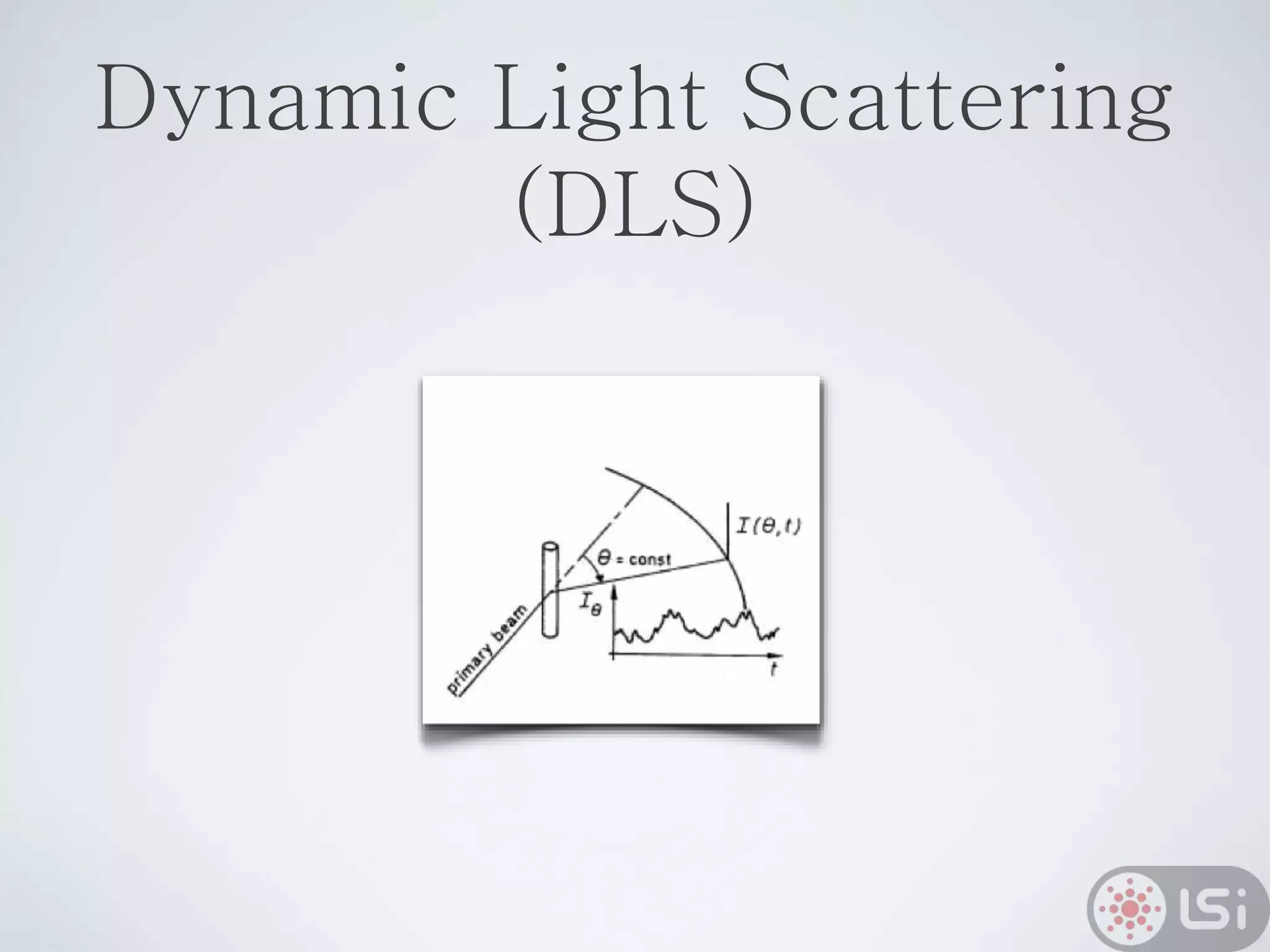
Dynamic Light Scattering
(DLS)
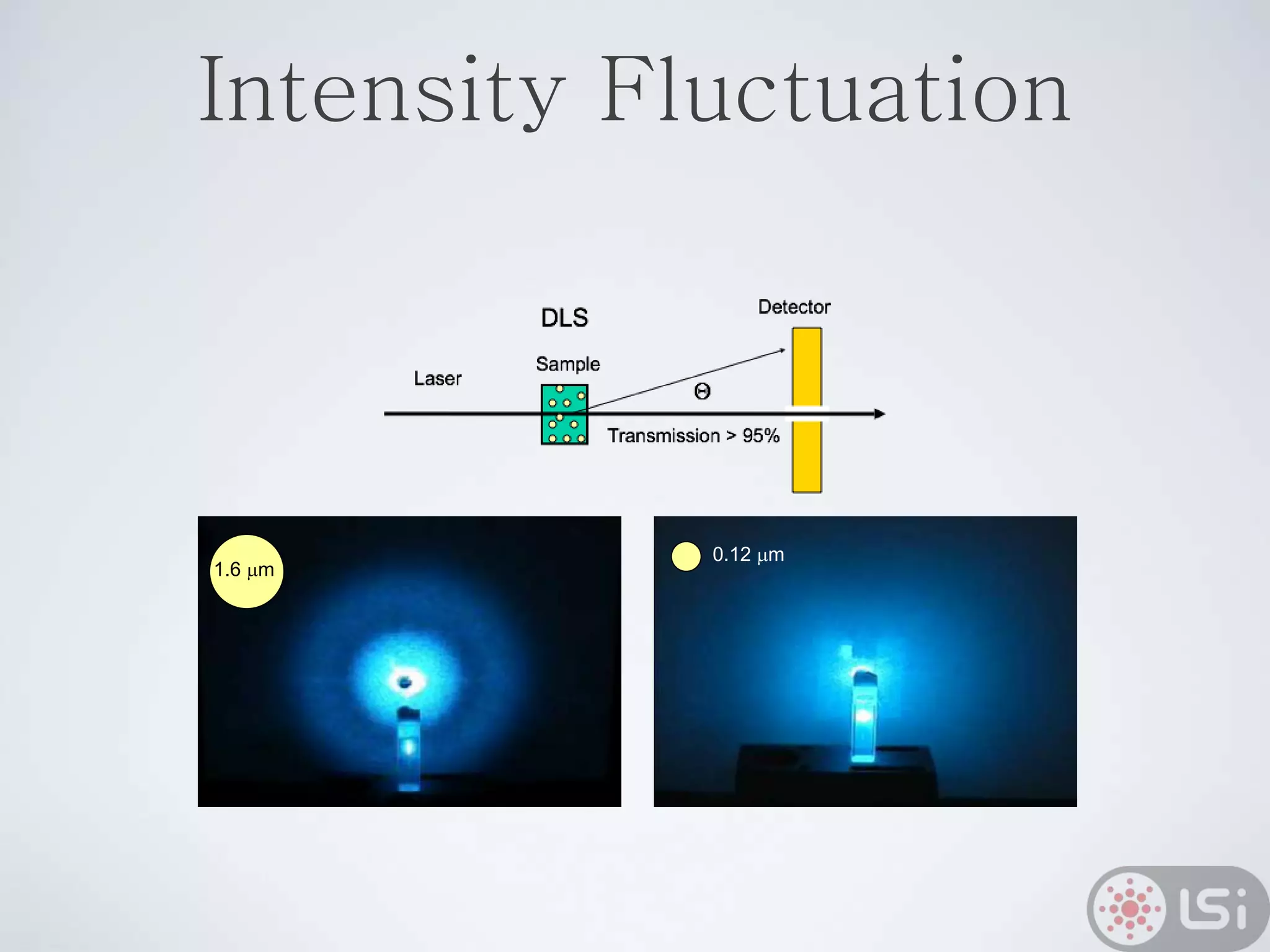
Intensity Fluctuation
1.6 mm
0.12 mm
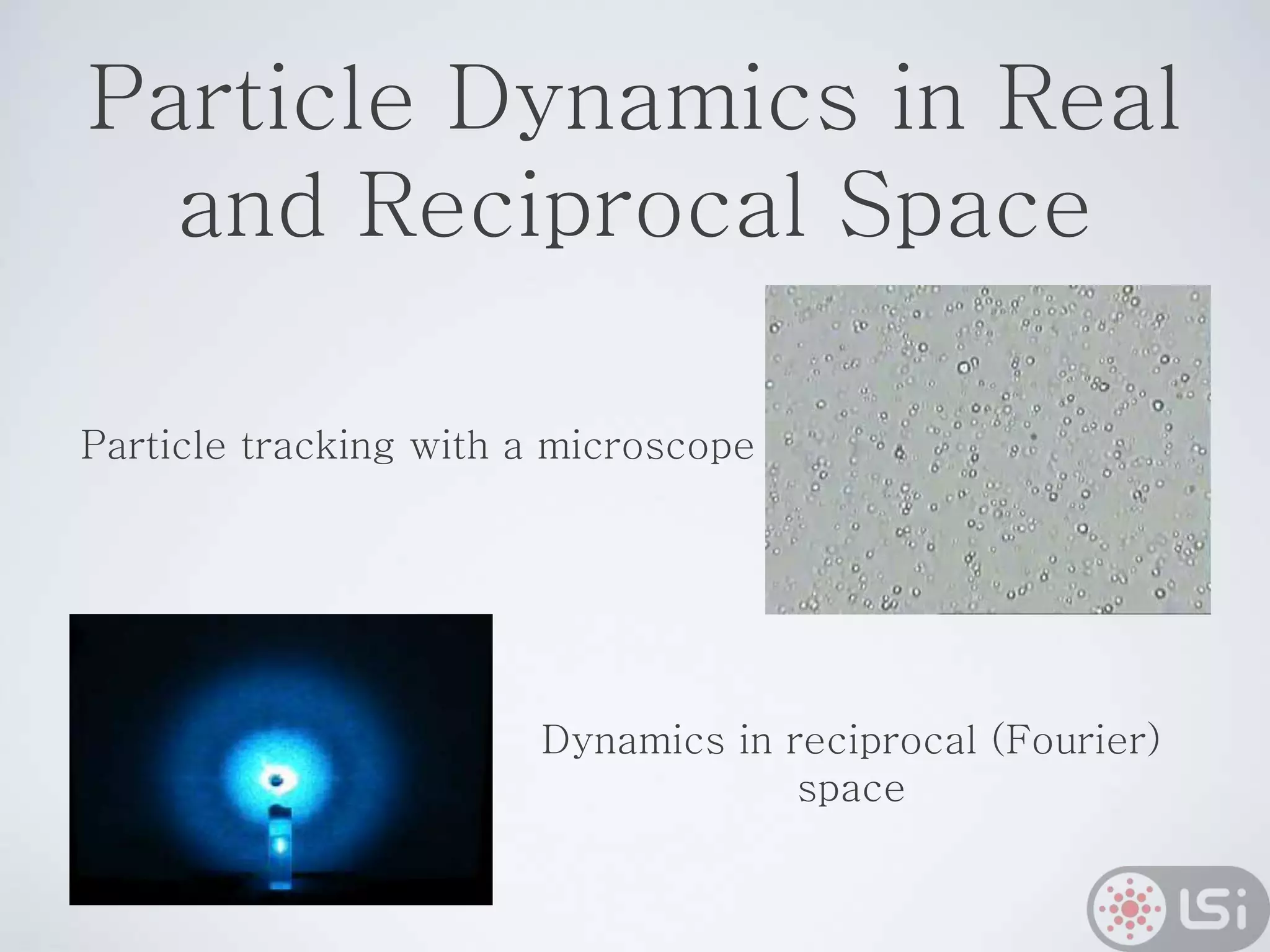
Particle Dynamics in Real
and Reciprocal Space
Particle tracking with a microscope
Dynamics in reciprocal (Fourier)
space
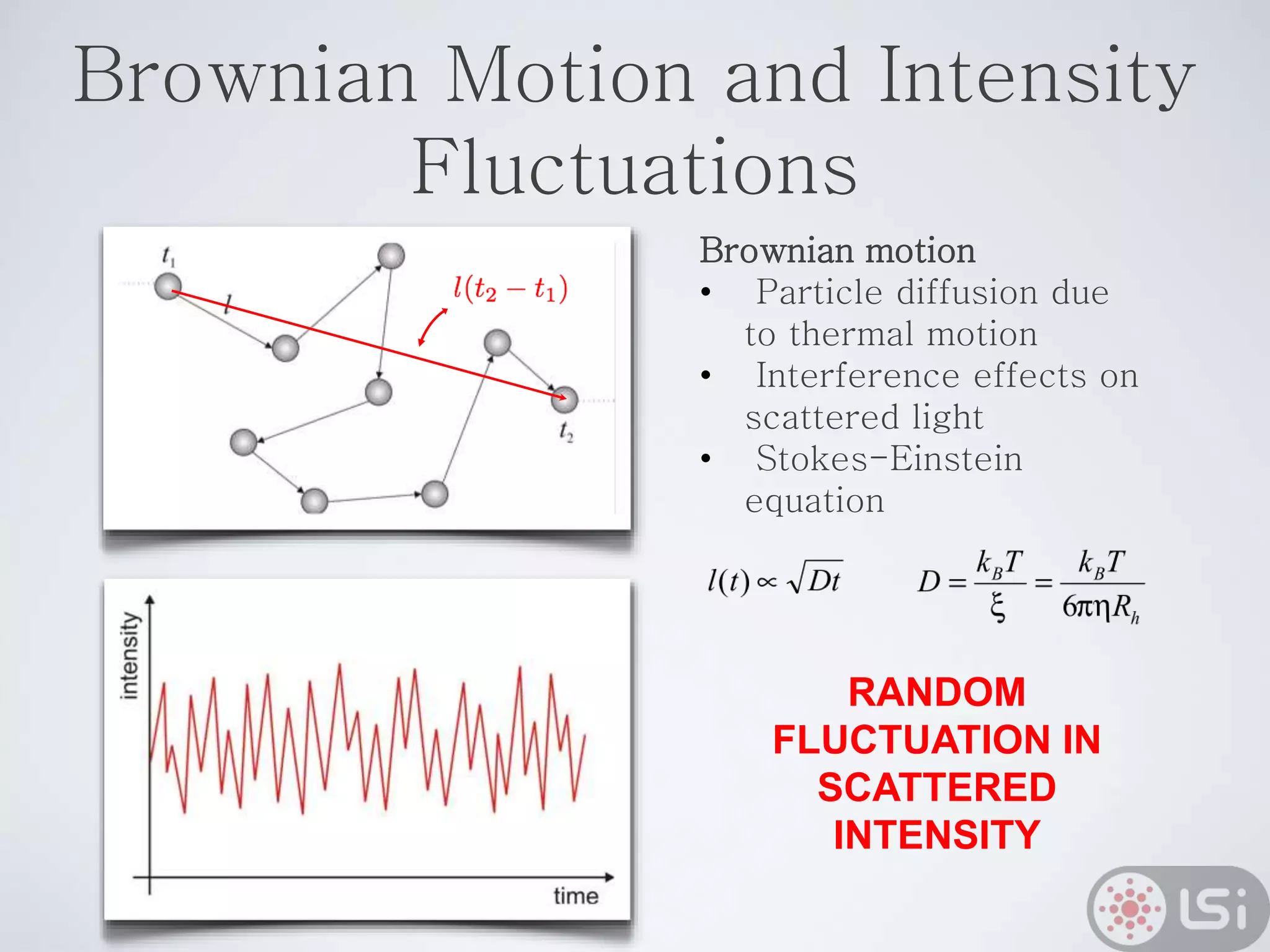
Brownian Motion and Intensity
Fluctuations
Brownian motion
• Particle diffusion due
to thermal motion
• Interference effects on
scattered light
• Stokes-Einstein
equation
RANDOM
FLUCTUATION IN
SCATTERED
INTENSITY
Intensity Decorrelation
9
Intensity correlation function
∗
small large
CORRELATION DECORRELATION
>
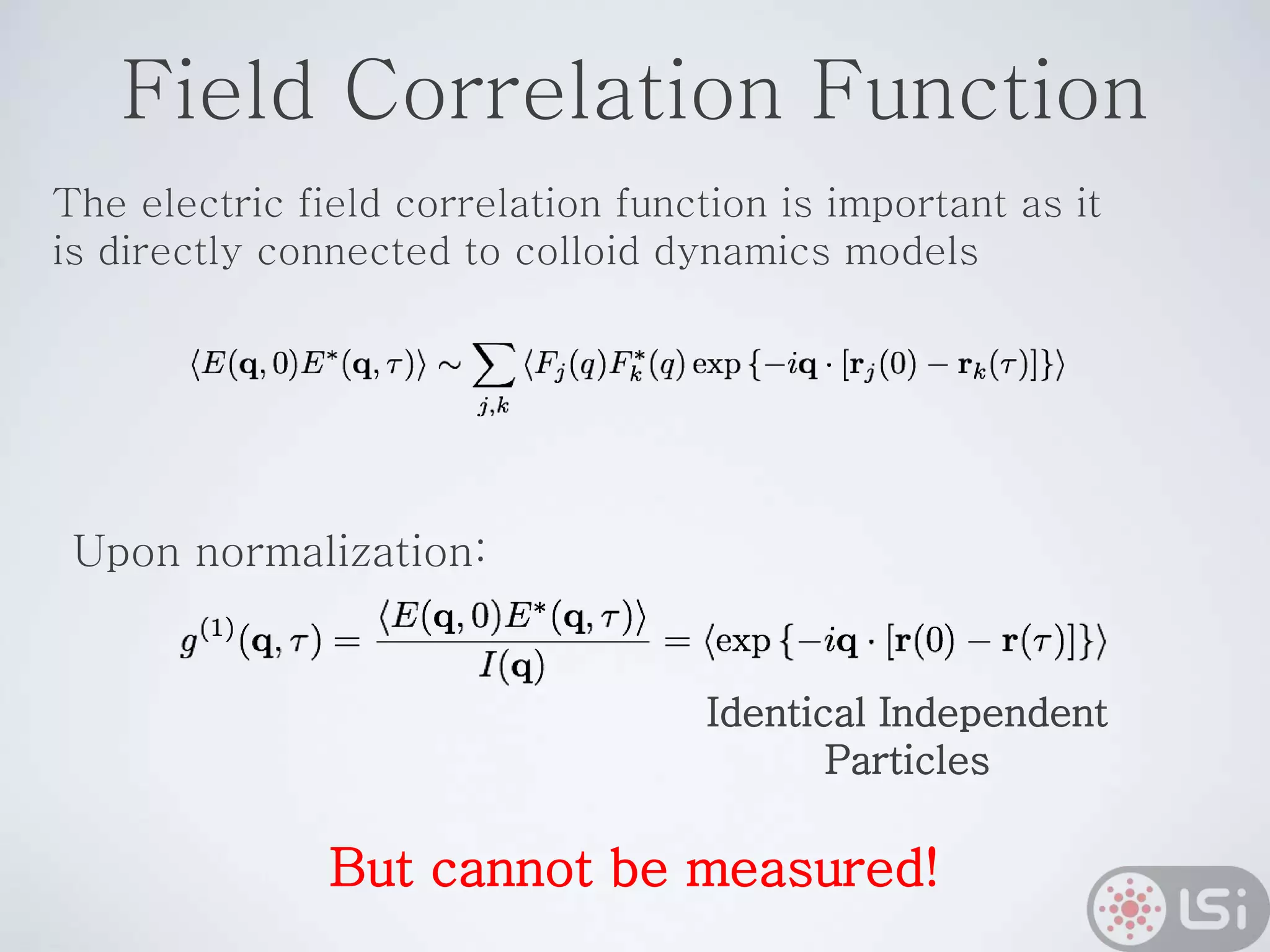
Field Correlation Function
Upon normalization:
Identical Independent
Particles
But cannot be measured!
The electric field correlation function is important as it
is directly connected to colloid dynamics models
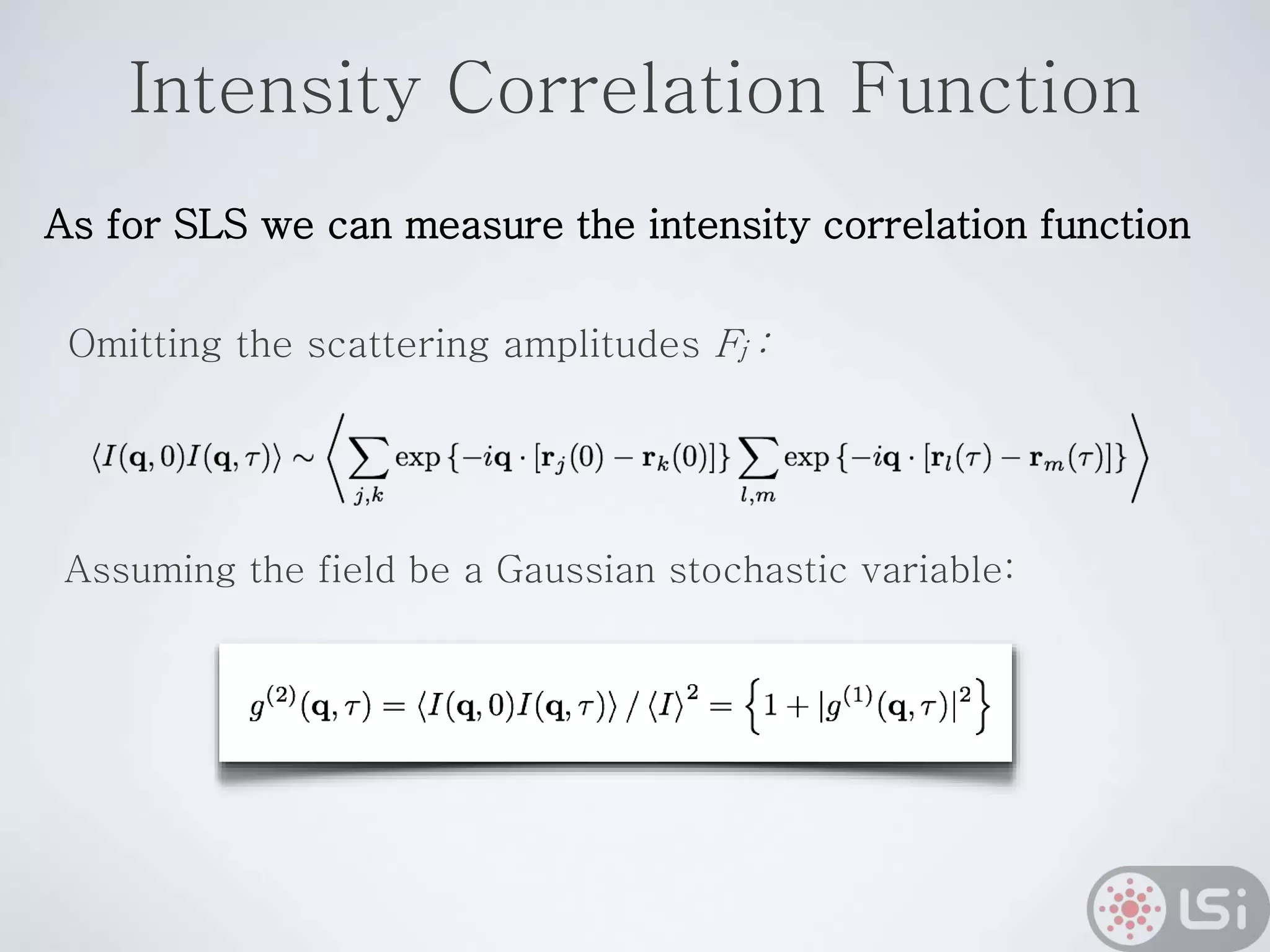
Intensity Correlation Function
Assuming the field be a Gaussian stochastic variable:
As for SLS we can measure the intensity correlation function
Omitting the scattering amplitudes Fj :
Coherence Area, Siegert
Relationship
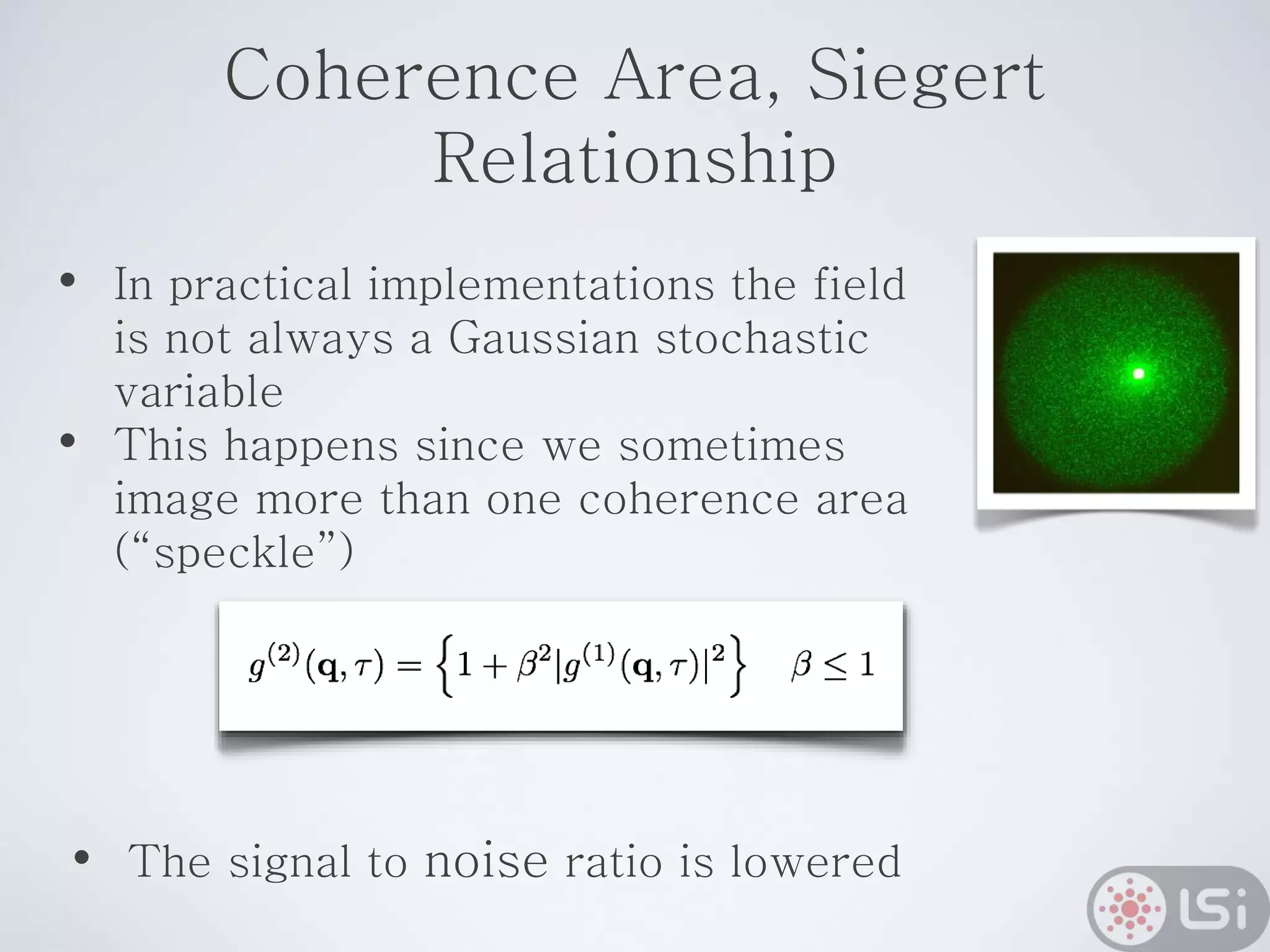
• In practical implementations the field
is not always a Gaussian stochastic
variable
• This happens since we sometimes
image more than one coherence area
(“speckle”)
• The signal to noise ratio is lowered
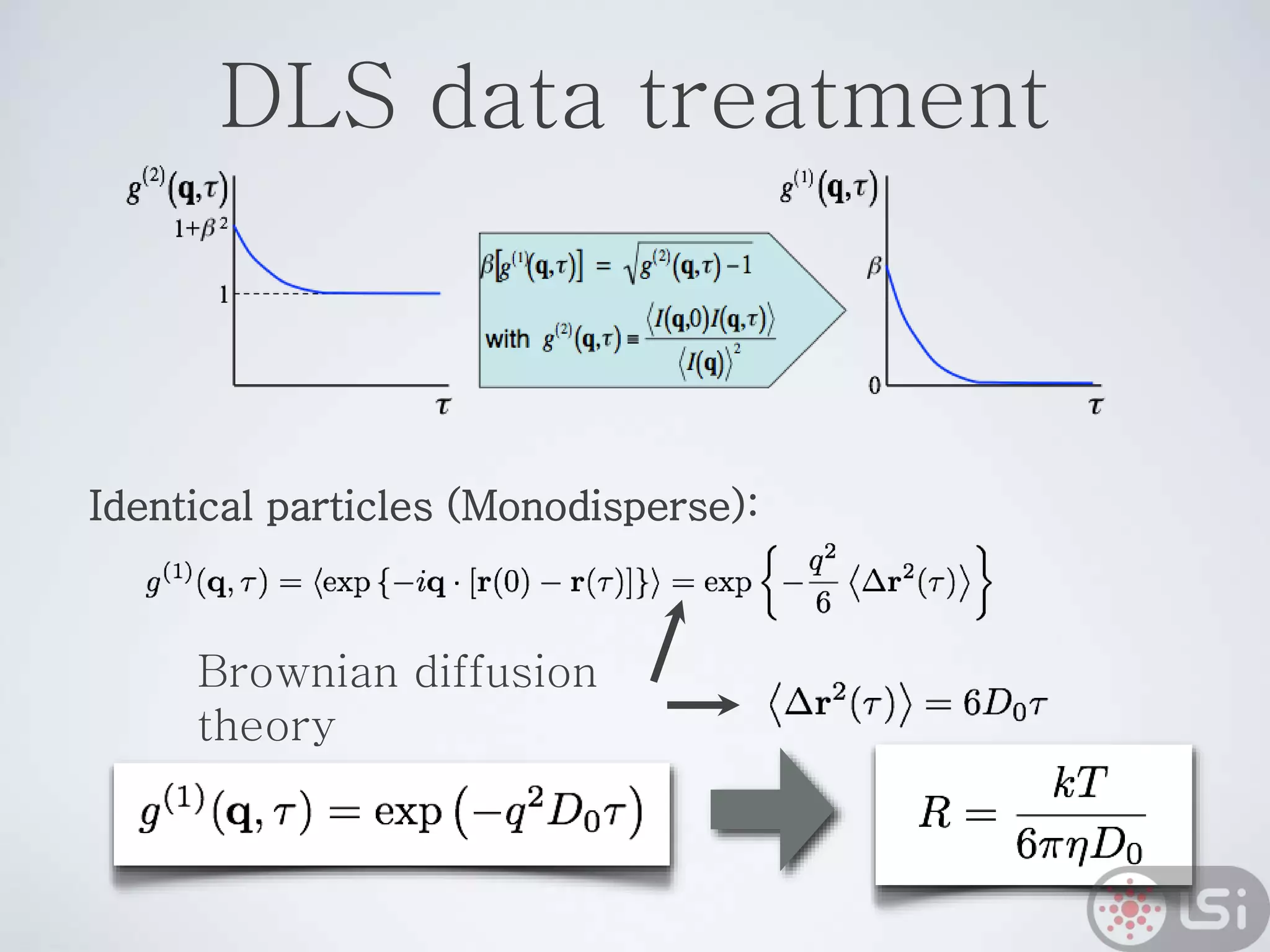
DLS data treatment
Identical particles (Monodisperse):
Brownian diffusion
theory
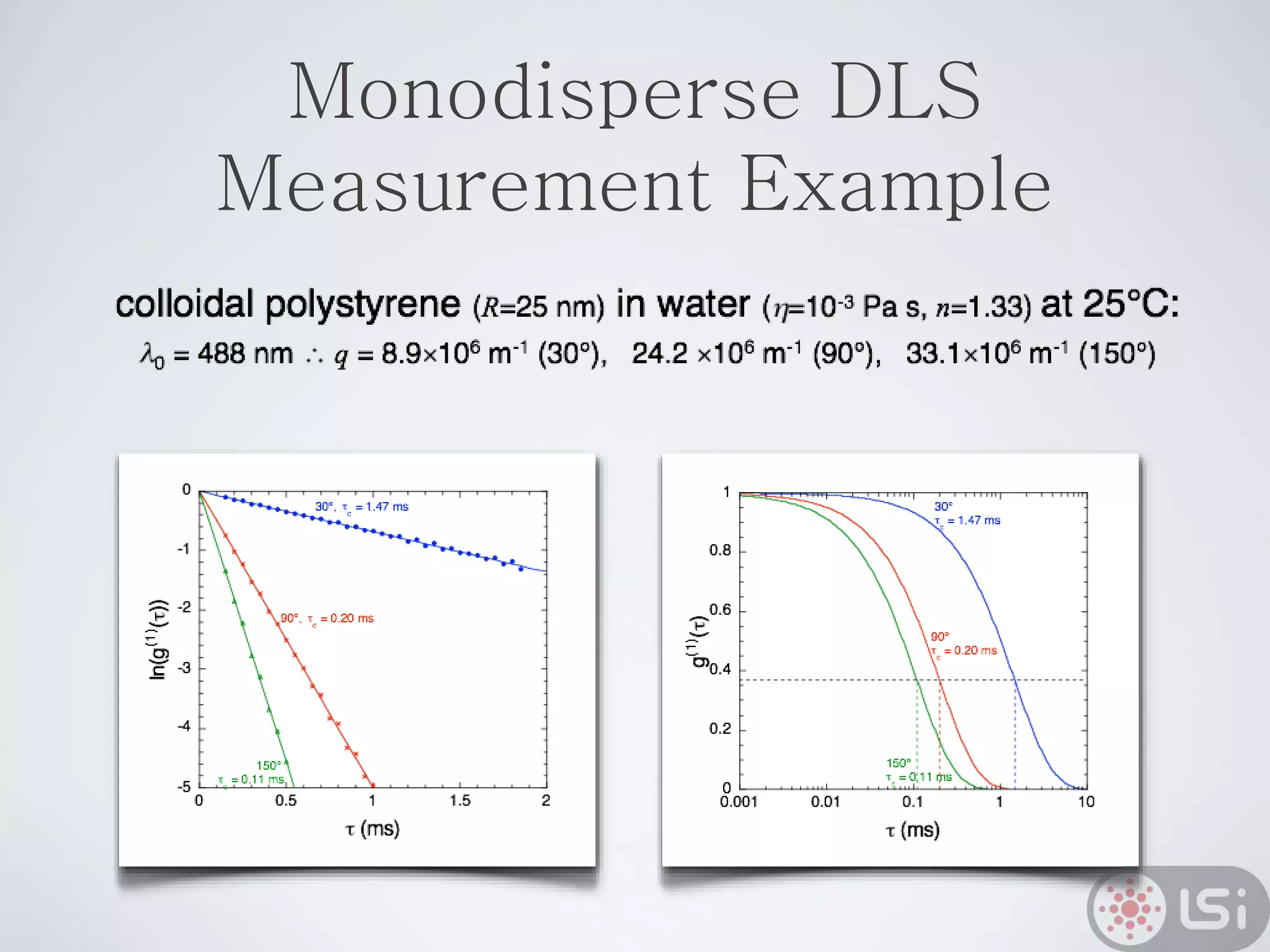
Monodisperse DLS
Measurement Example
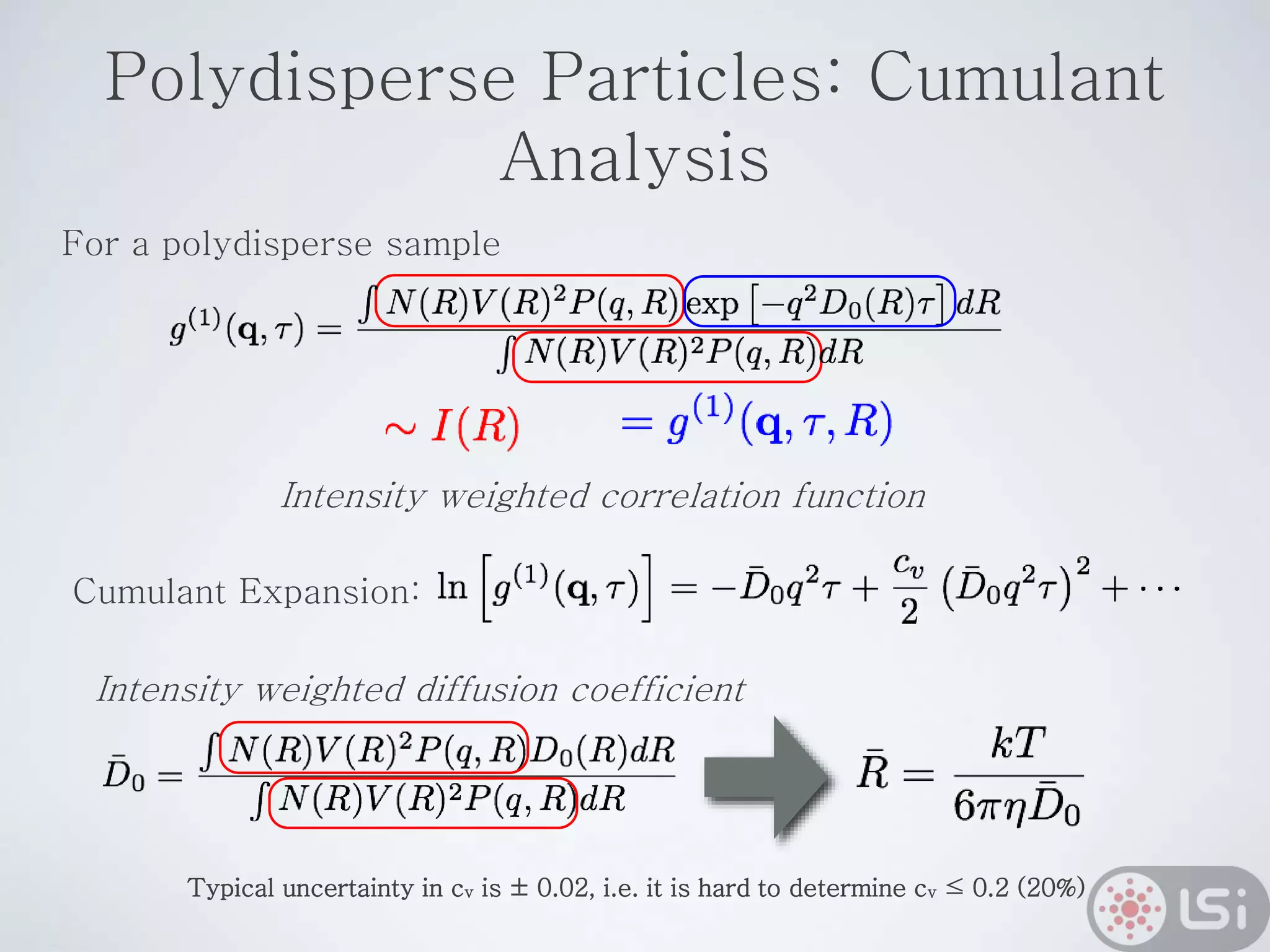
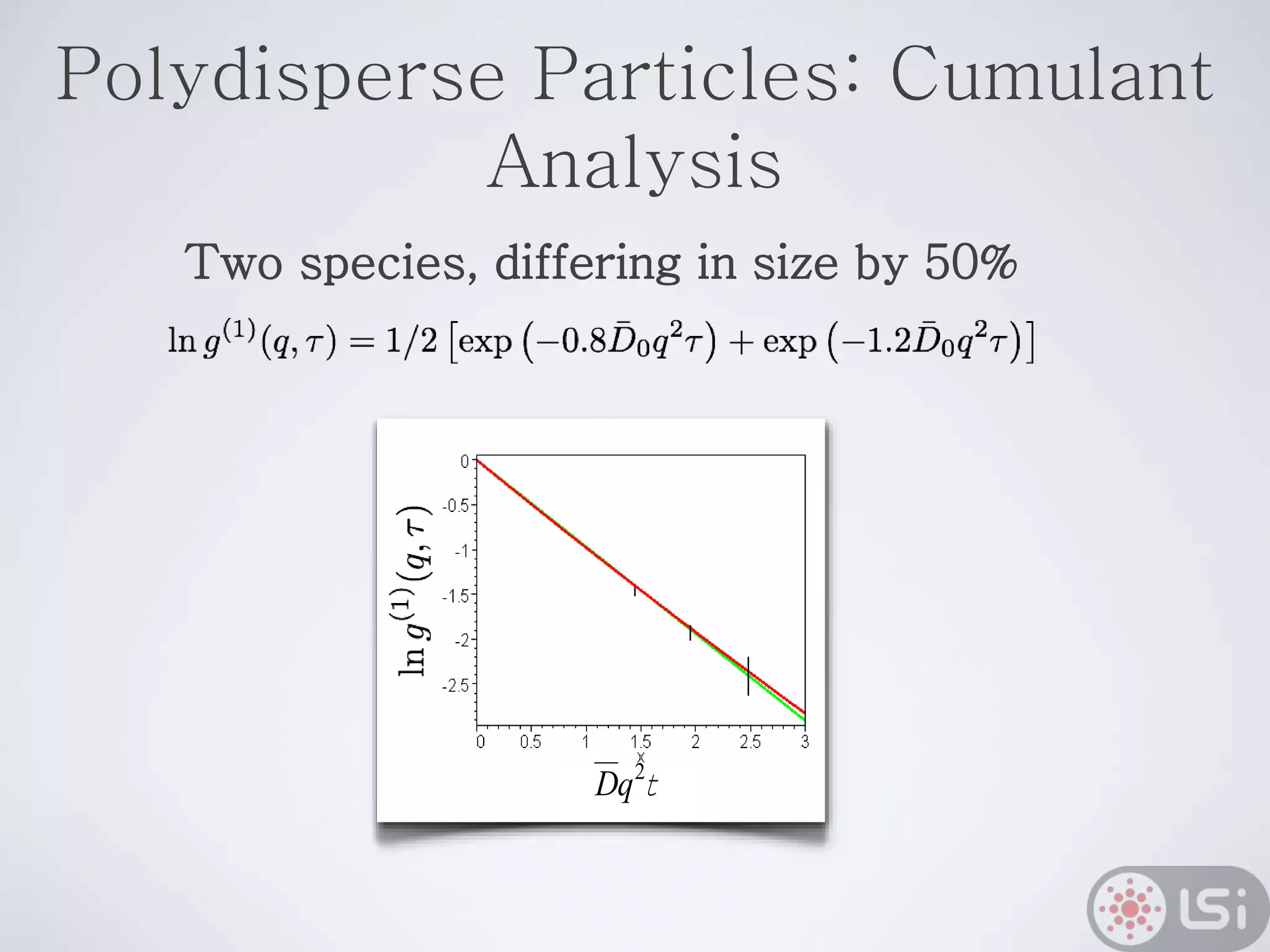
Polydisperse Particles: Cumulant
Analysis
Intensity weighted correlation function
Cumulant Expansion:
Typical uncertainty in cv is ± 0.02, i.e. it is hard to determine cv ≤ 0.2 (20%)
For a polydisperse sample
Intensity weighted diffusion coefficient
Polydisperse Particles: Cumulant
Analysis
t2
qD
Two species, differing in size by 50%
Part II: Applications
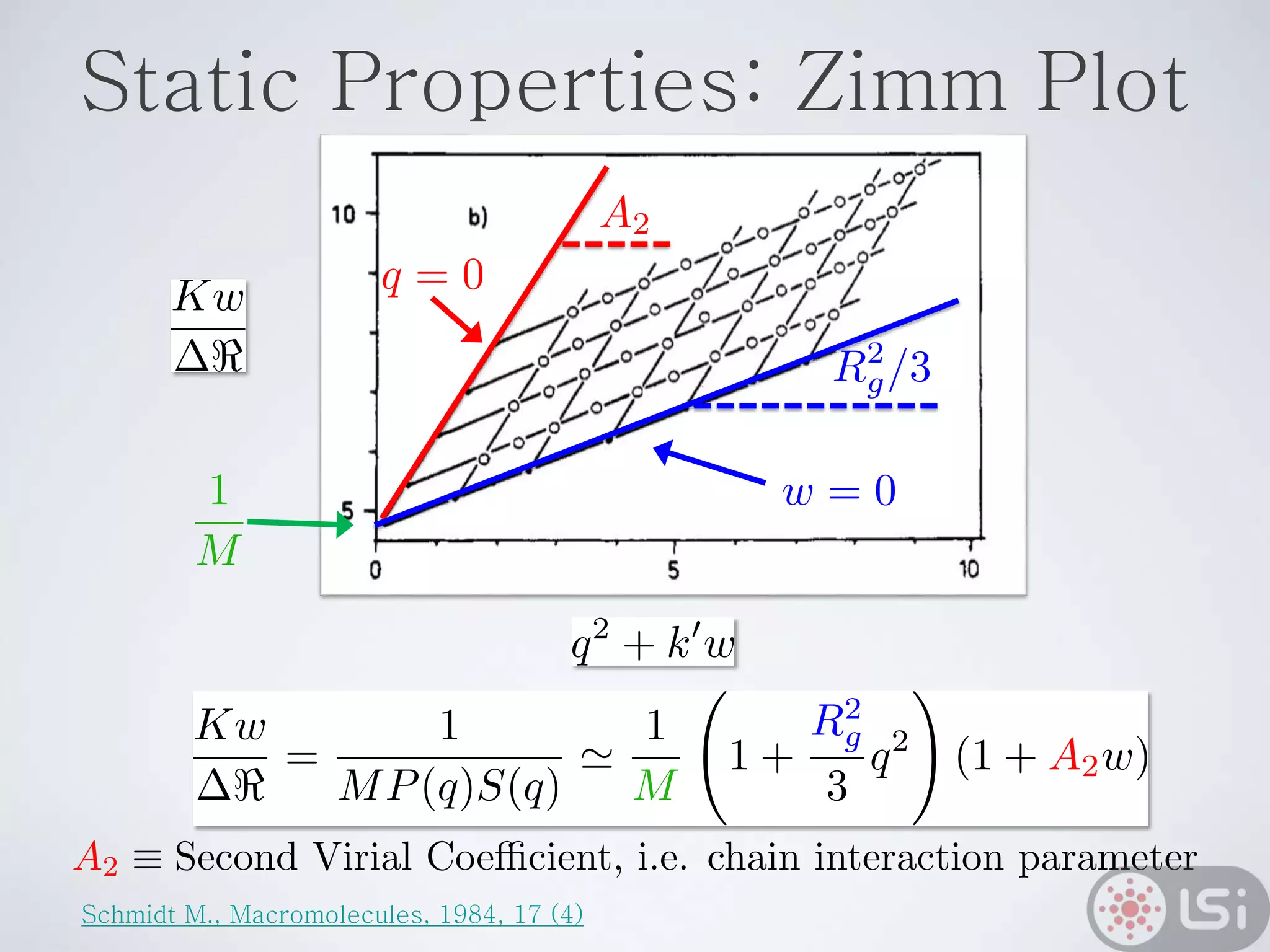
Static Properties: Zimm Plot
Schmidt M., Macromolecules, 1984, 17 (4)
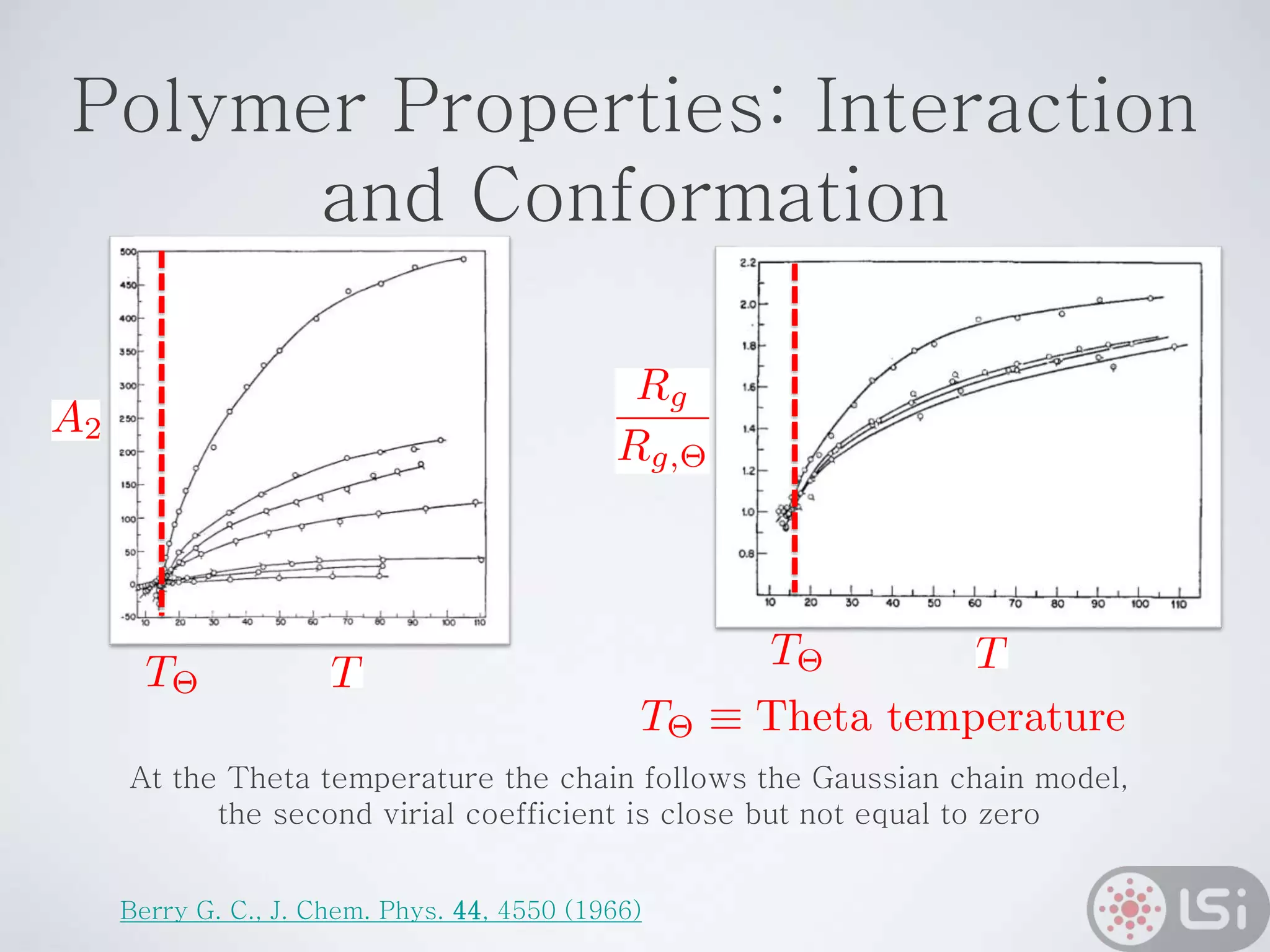
Polymer Properties: Interaction
and Conformation
At the Theta temperature the chain follows the Gaussian chain model,
the second virial coefficient is close but not equal to zero
Berry G. C., J. Chem. Phys. 44, 4550 (1966)
Polymer Properties: Chain
Conformation
Dependency of chain size on
solvent “goodness”
Dependency of chain
size on molar mass (at
Theta solvent conditions)
Outer P. et al., J. Chem. Phys. 18, 830 (1950)
Dynamic Properties:
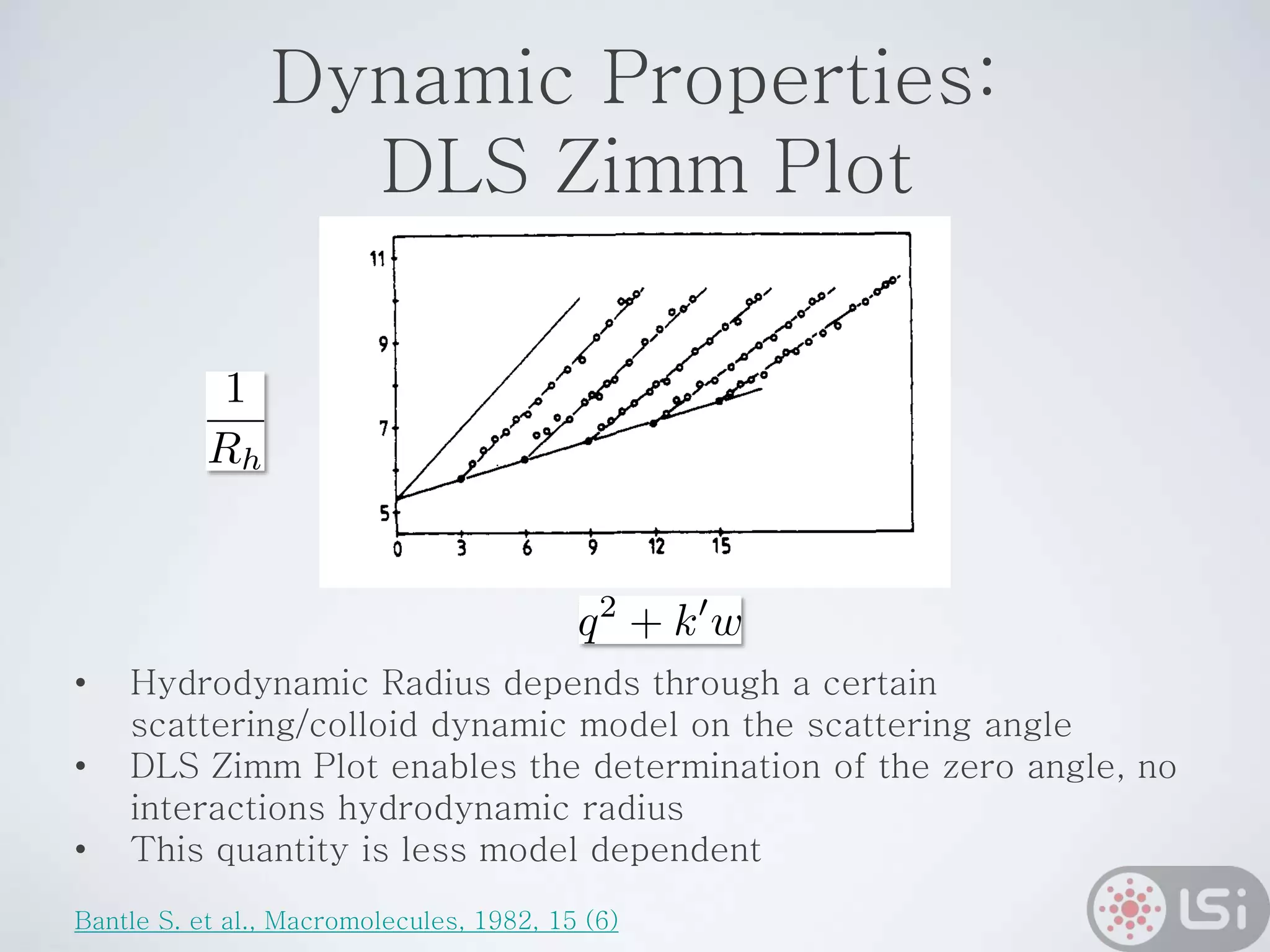
DLS Zimm Plot
• Hydrodynamic Radius depends through a certain
scattering/colloid dynamic model on the scattering angle
• DLS Zimm Plot enables the determination of the zero angle, no
interactions hydrodynamic radius
• This quantity is less model dependent
Bantle S. et al., Macromolecules, 1982, 15 (6)
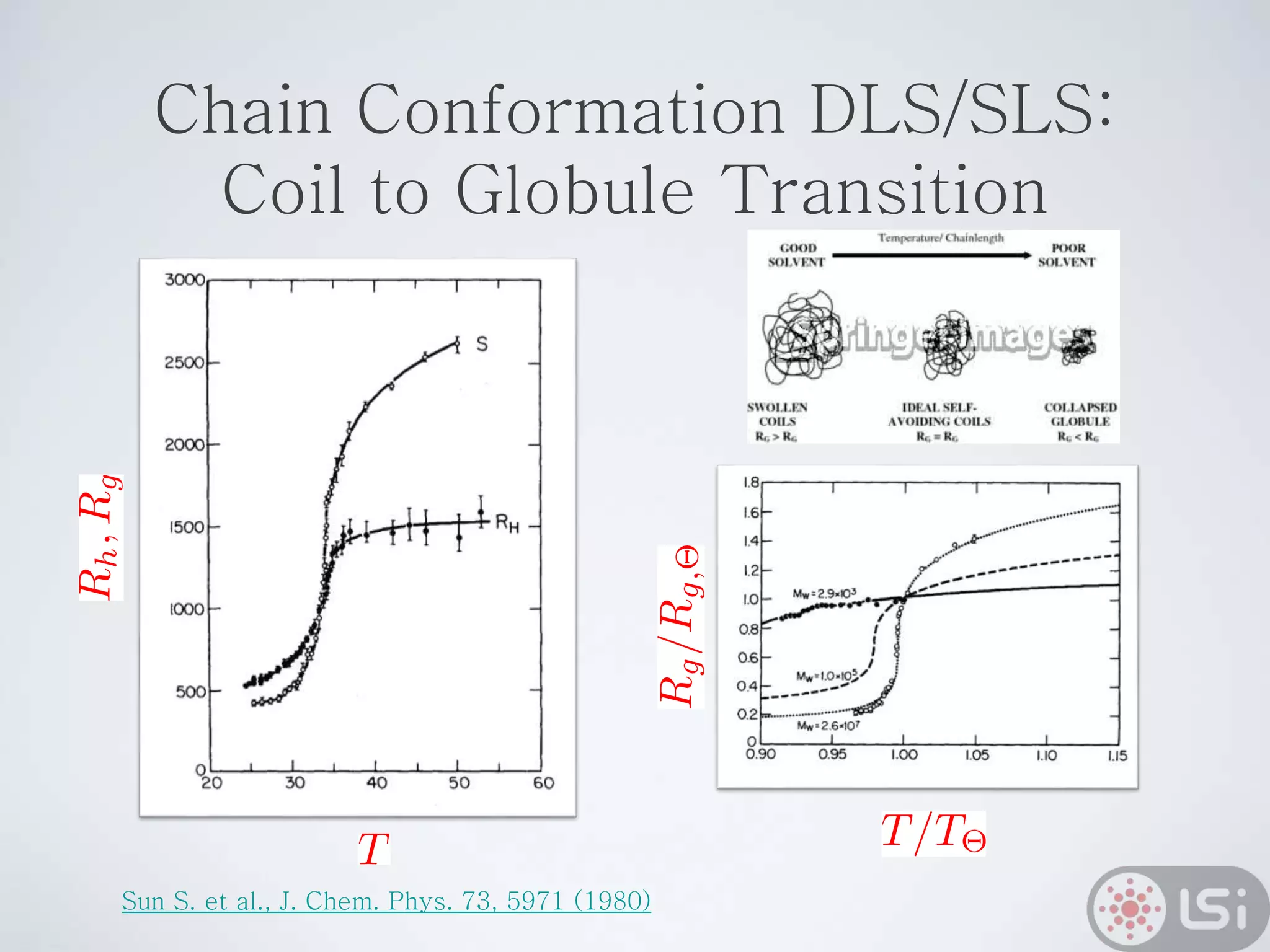
Chain Conformation DLS/SLS:
Coil to Globule Transition
Sun S. et al., J. Chem. Phys. 73, 5971 (1980)
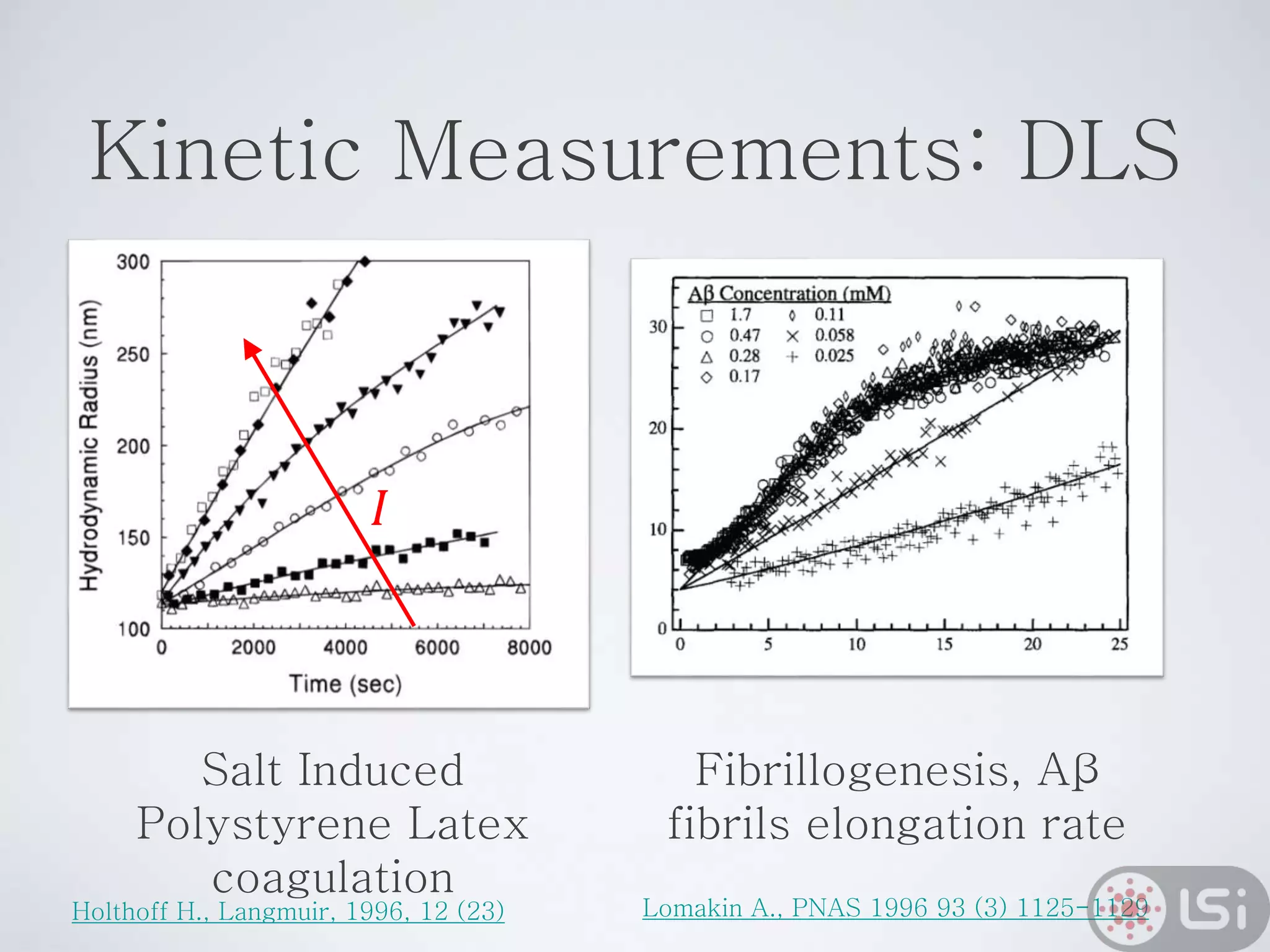
Kinetic Measurements: DLS
Salt Induced
Polystyrene Latex
coagulation
Fibrillogenesis, Aβ
fibrils elongation rate
𝐼
Holthoff H., Langmuir, 1996, 12 (23) Lomakin A., PNAS 1996 93 (3) 1125-1129
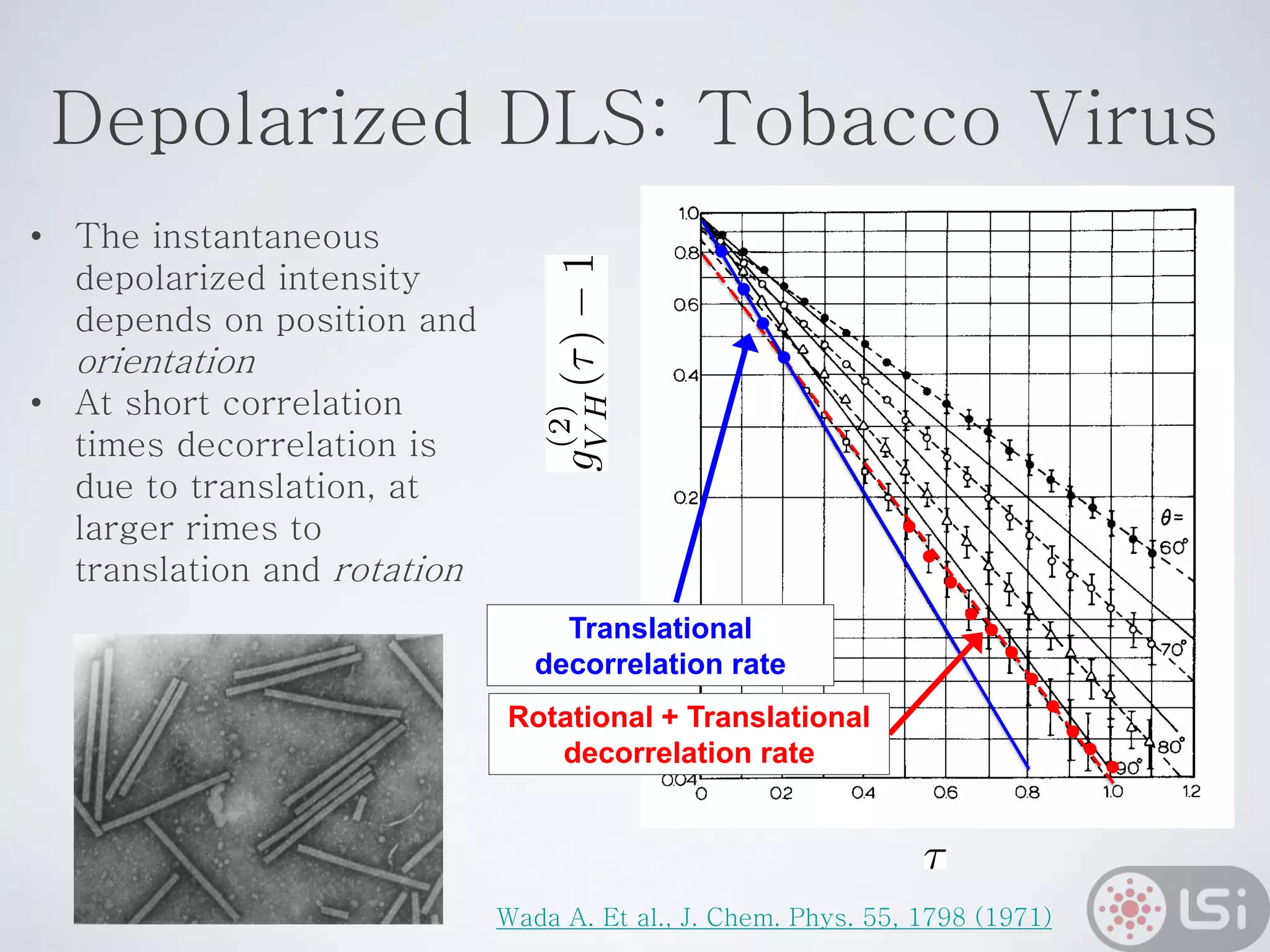
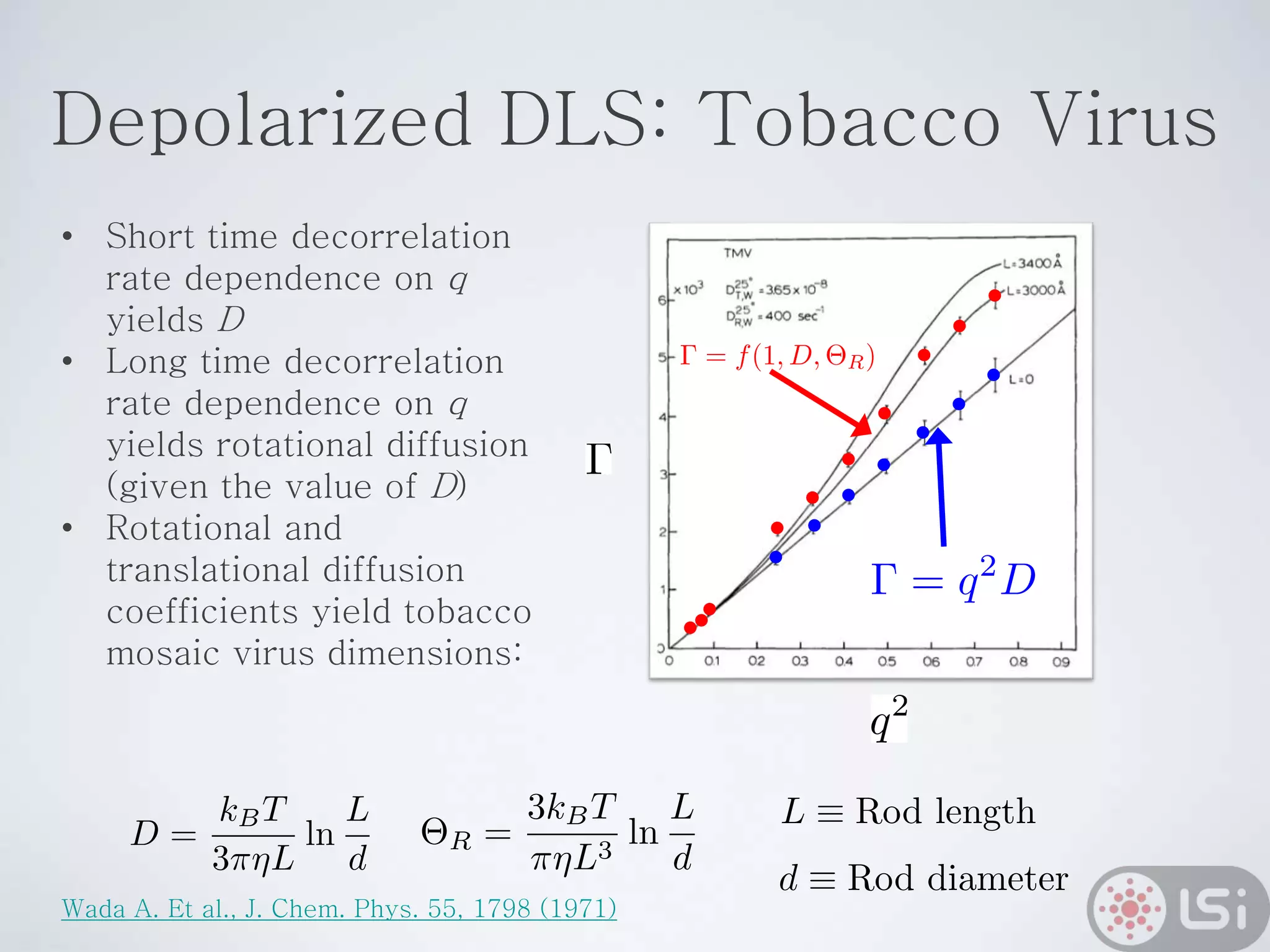
Depolarized DLS: Tobacco Virus
Rotational + Translational
decorrelation rate
Translational
decorrelation rate
• The instantaneous
depolarized intensity
depends on position and
orientation
• At short correlation
times decorrelation is
due to translation, at
larger rimes to
translation and rotation
Wada A. Et al., J. Chem. Phys. 55, 1798 (1971)
Depolarized DLS: Tobacco Virus
• Short time decorrelation
rate dependence on q
yields D
• Long time decorrelation
rate dependence on q
yields rotational diffusion
(given the value of D)
• Rotational and
translational diffusion
coefficients yield tobacco
mosaic virus dimensions:
Wada A. Et al., J. Chem. Phys. 55, 1798 (1971)
Part III: Concentrated
Systems
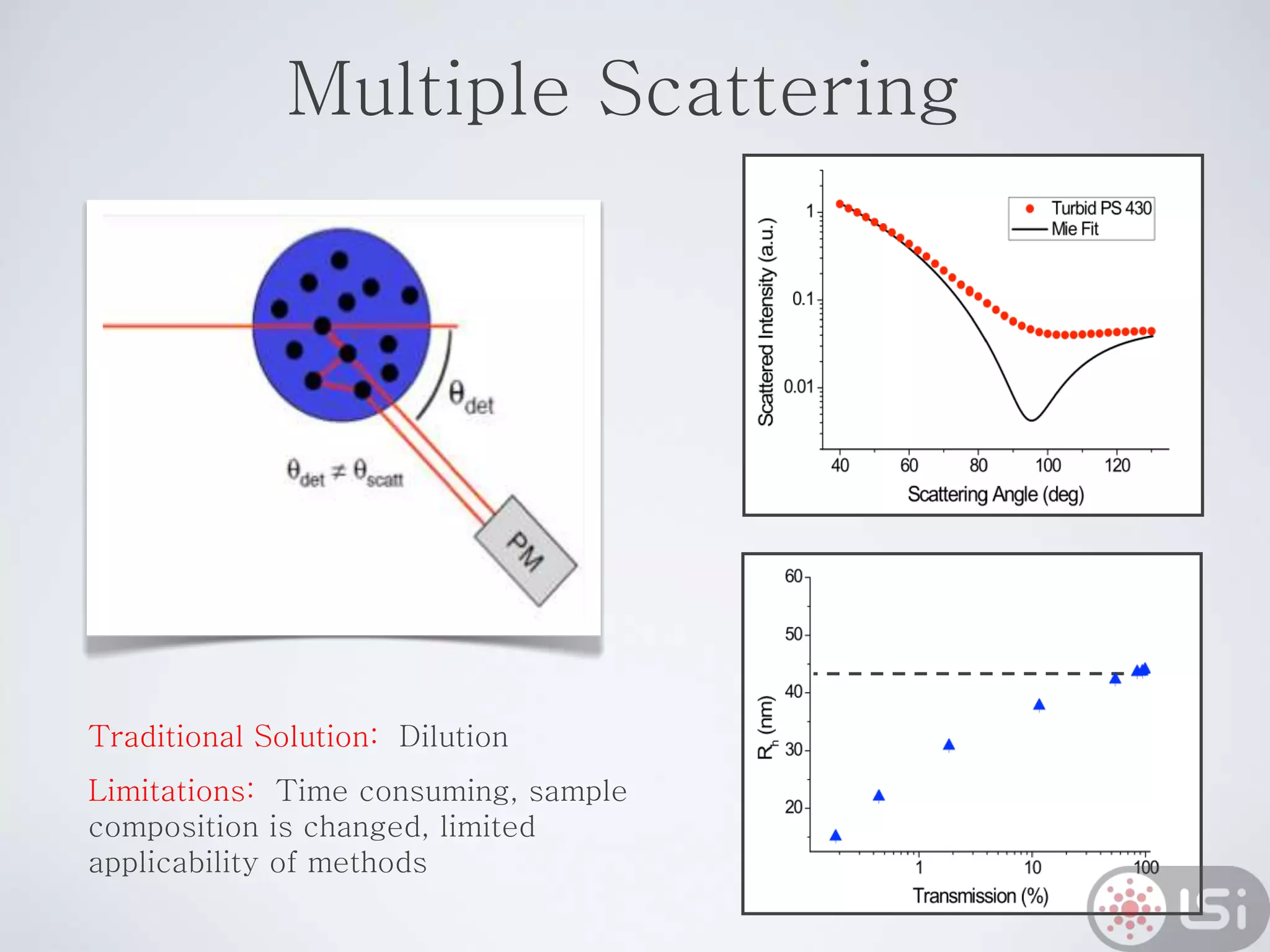
Traditional Solution: Dilution
Limitations: Time consuming, sample
composition is changed, limited
applicability of methods
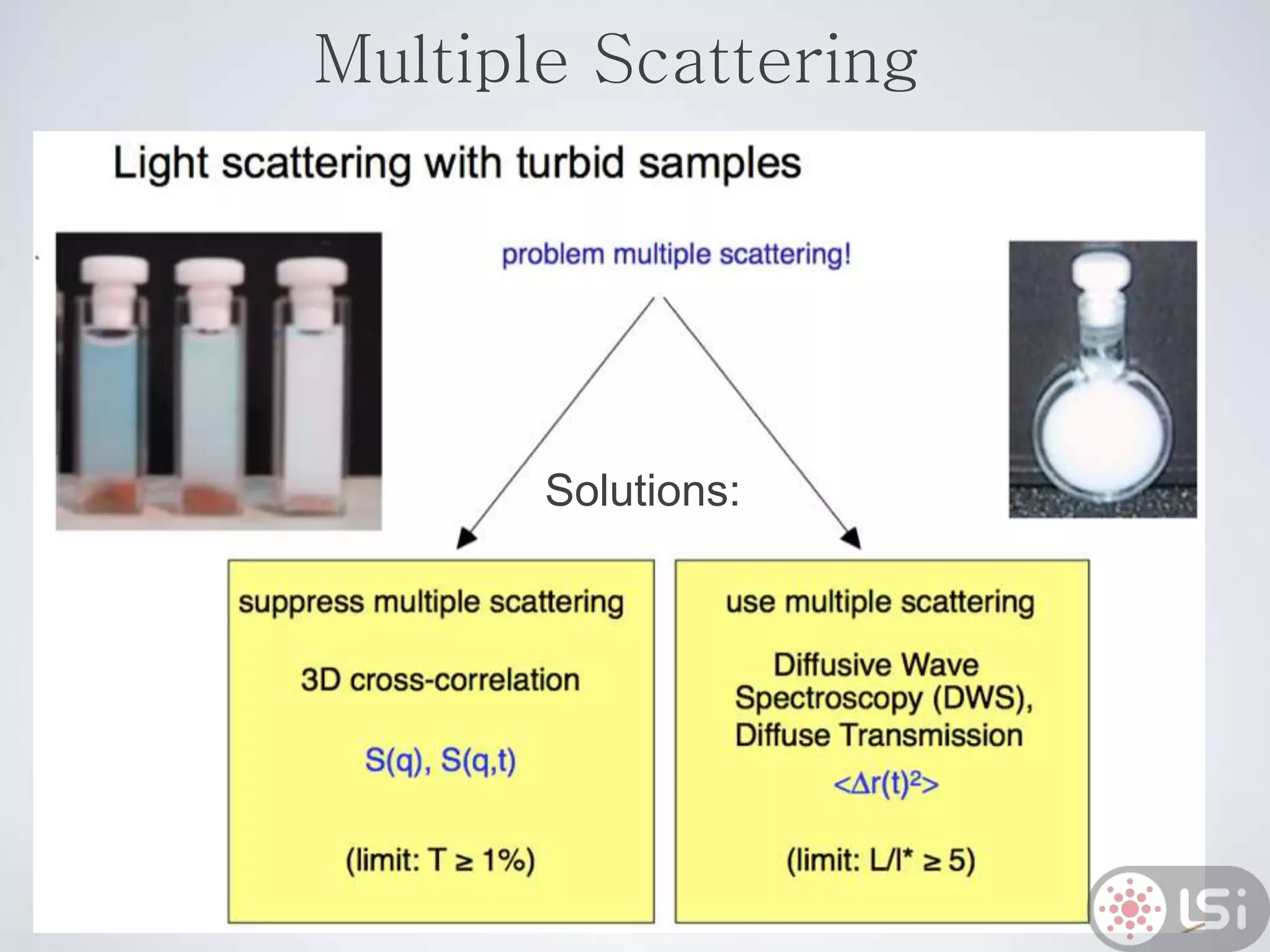
Multiple Scattering
Solutions:
Multiple Scattering
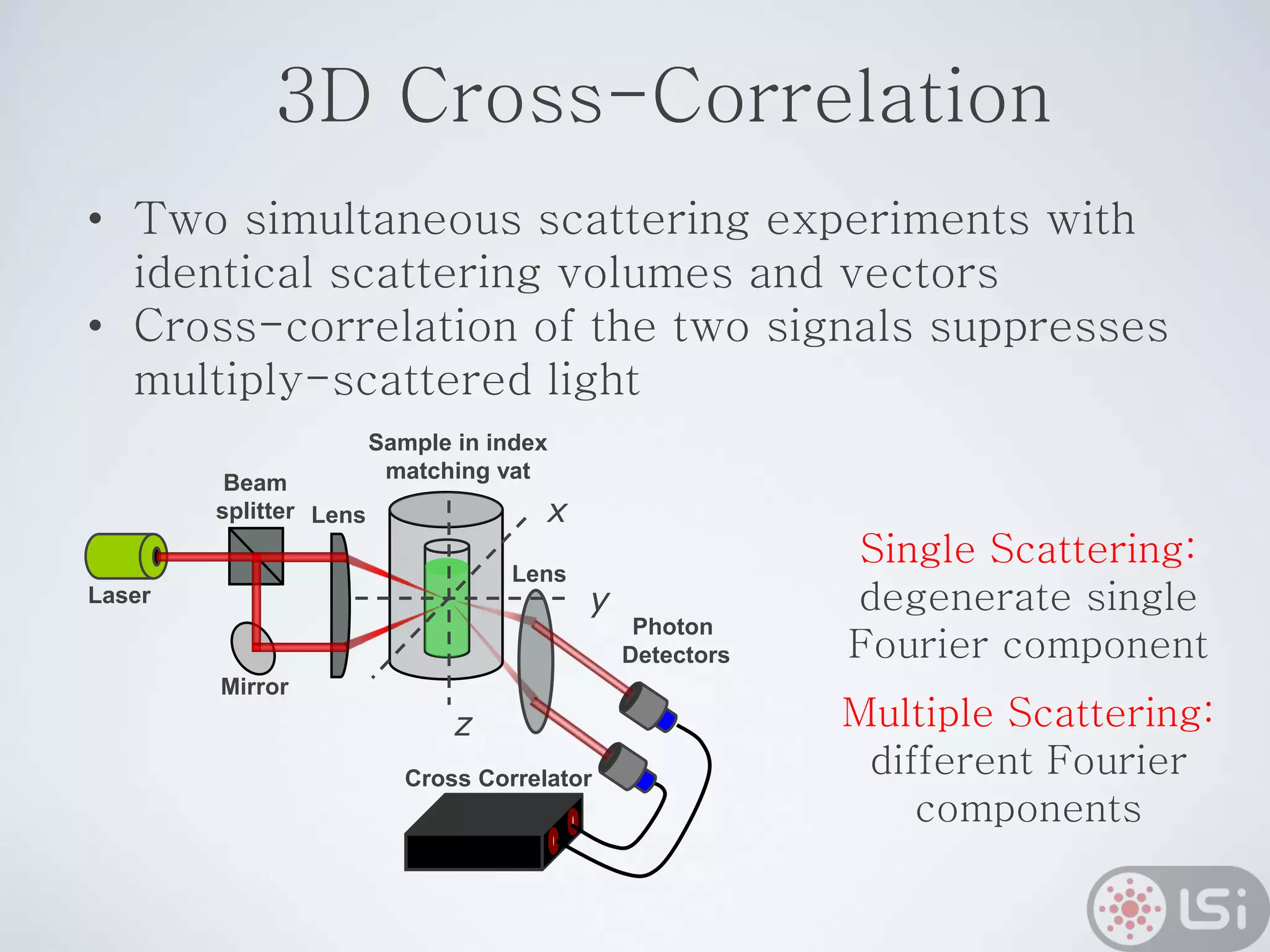
3D Cross-Correlation
• Two simultaneous scattering experiments with
identical scattering volumes and vectors
• Cross-correlation of the two signals suppresses
multiply-scattered light
Single Scattering:
degenerate single
Fourier component
Multiple Scattering:
different Fourier
components
Laser
Sample in index
matching vat
Photon
Detectors
Cross Correlator
Beam
splitter Lens
Lens
Mirror
y
x
z
32
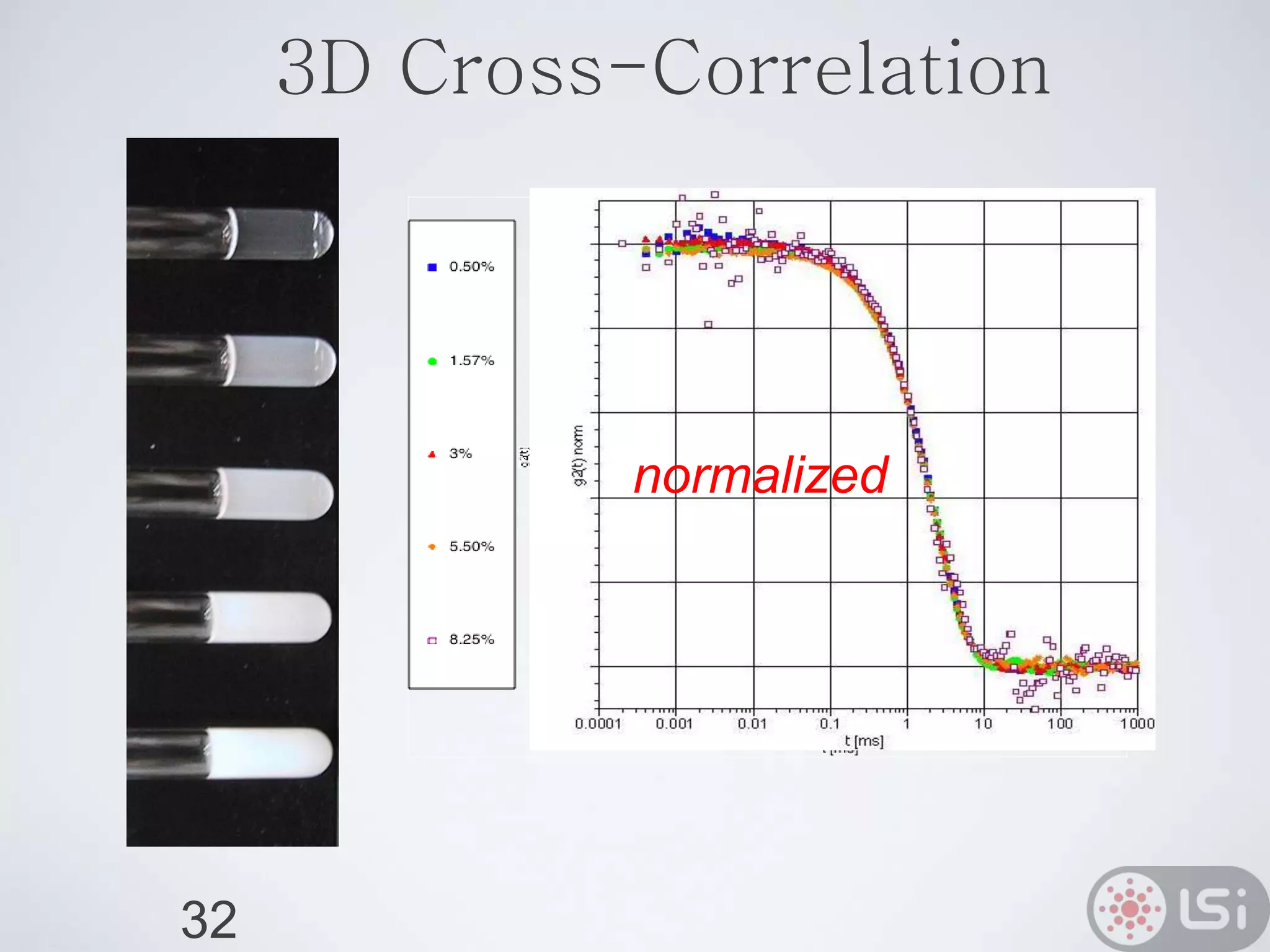
normalized
3D Cross-Correlation
Laser
Sample in index
matching vat
Photon
Detectors
Cross Correlator
Beam
splitter Lens Lens
Mirror
Intensity
Modulator
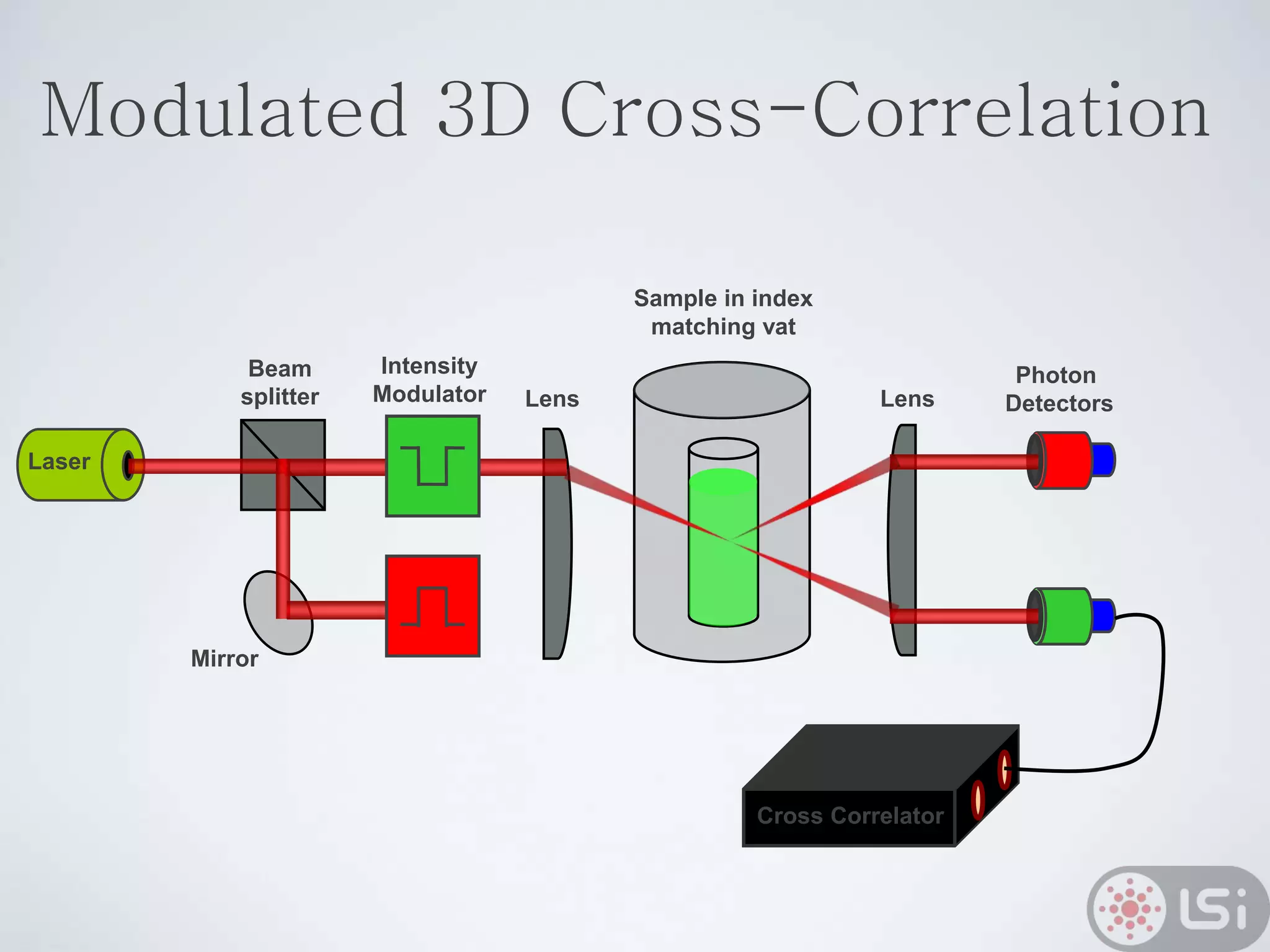
Modulated 3D Cross-Correlation
Laser
Sample in index
matching vat
Photon
Detectors
Cross Correlator
Beam
splitter Lens Lens
Mirror
Intensity
Modulator
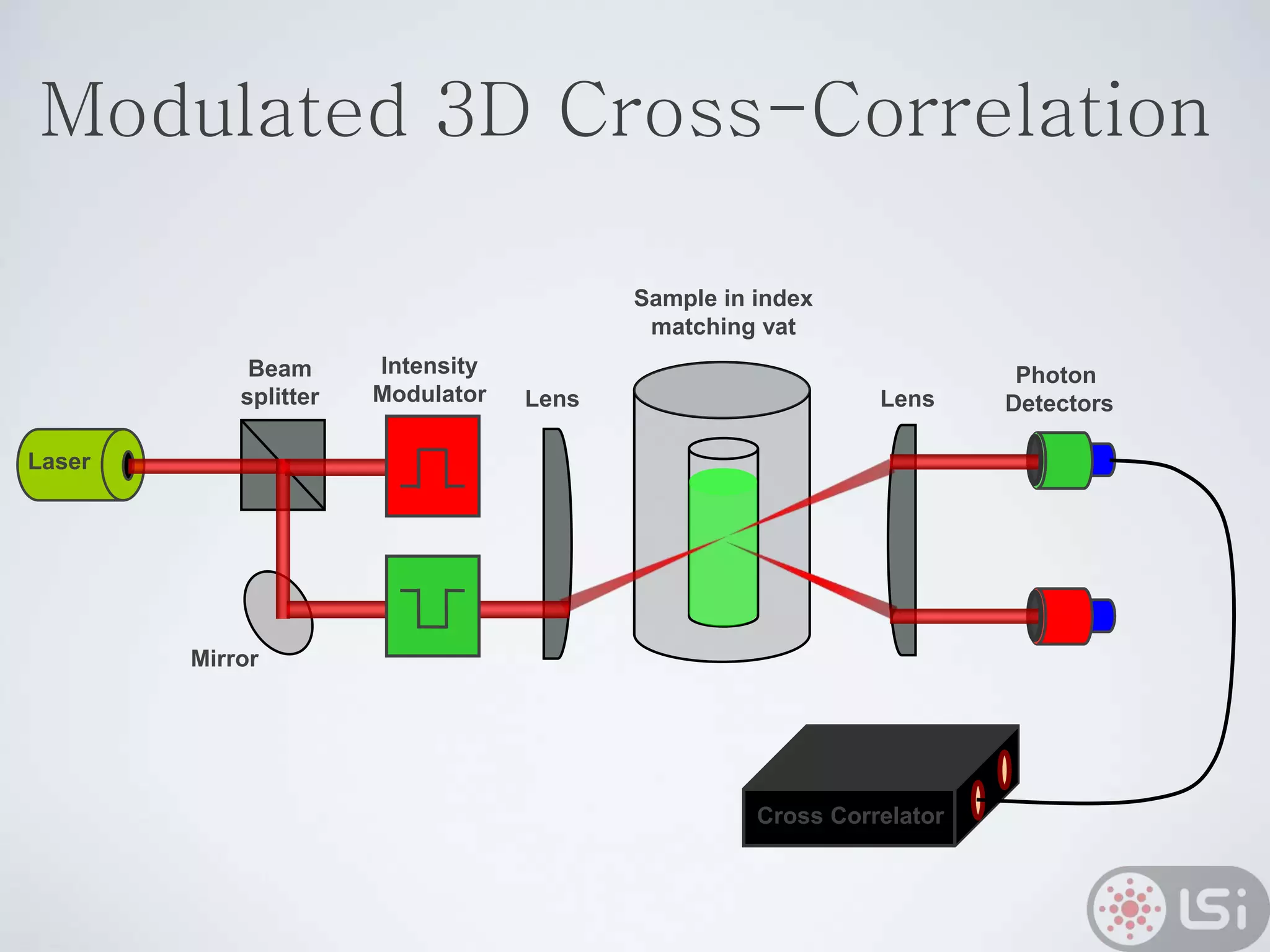
Modulated 3D Cross-Correlation
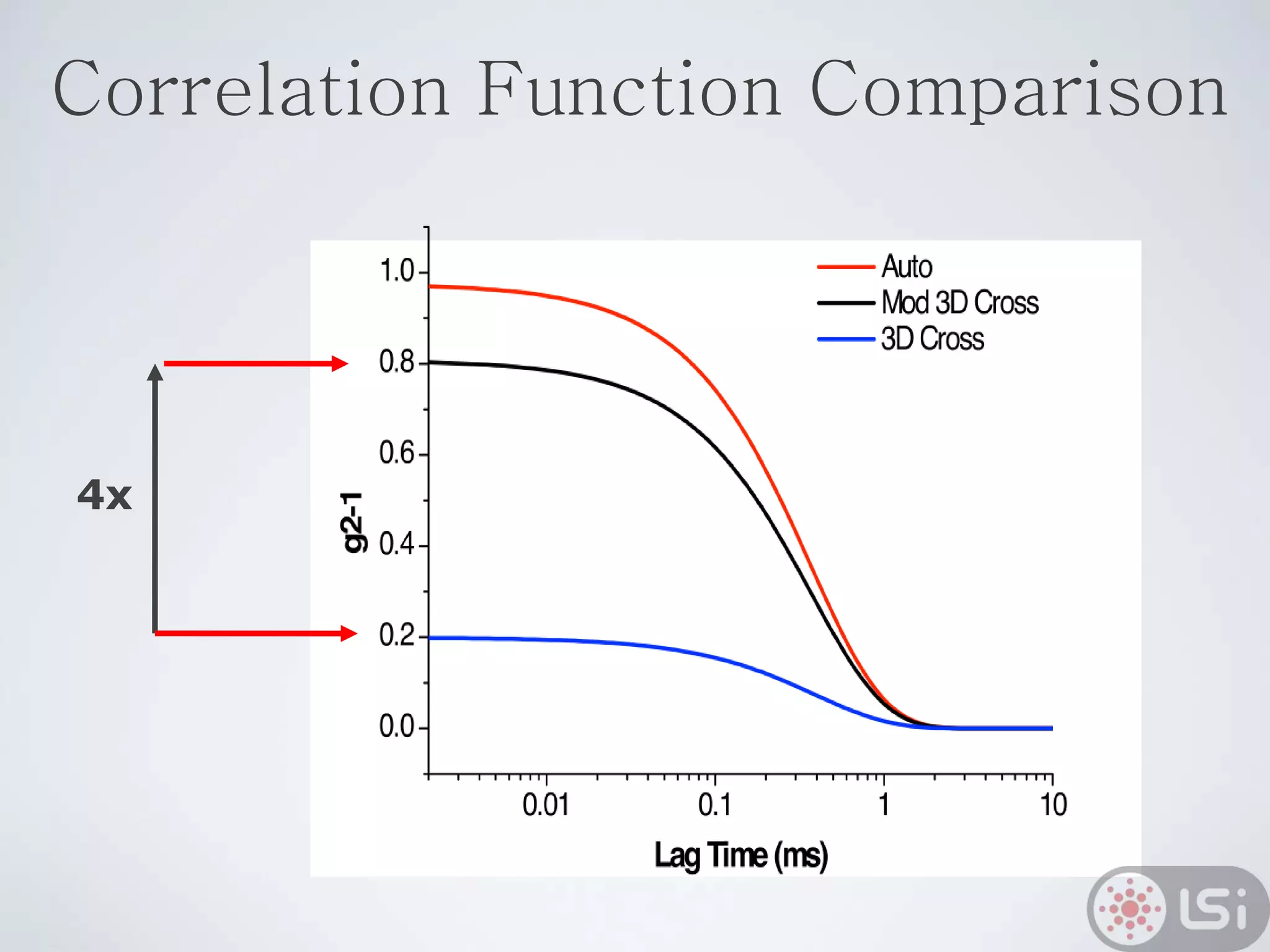
4x
Correlation Function Comparison
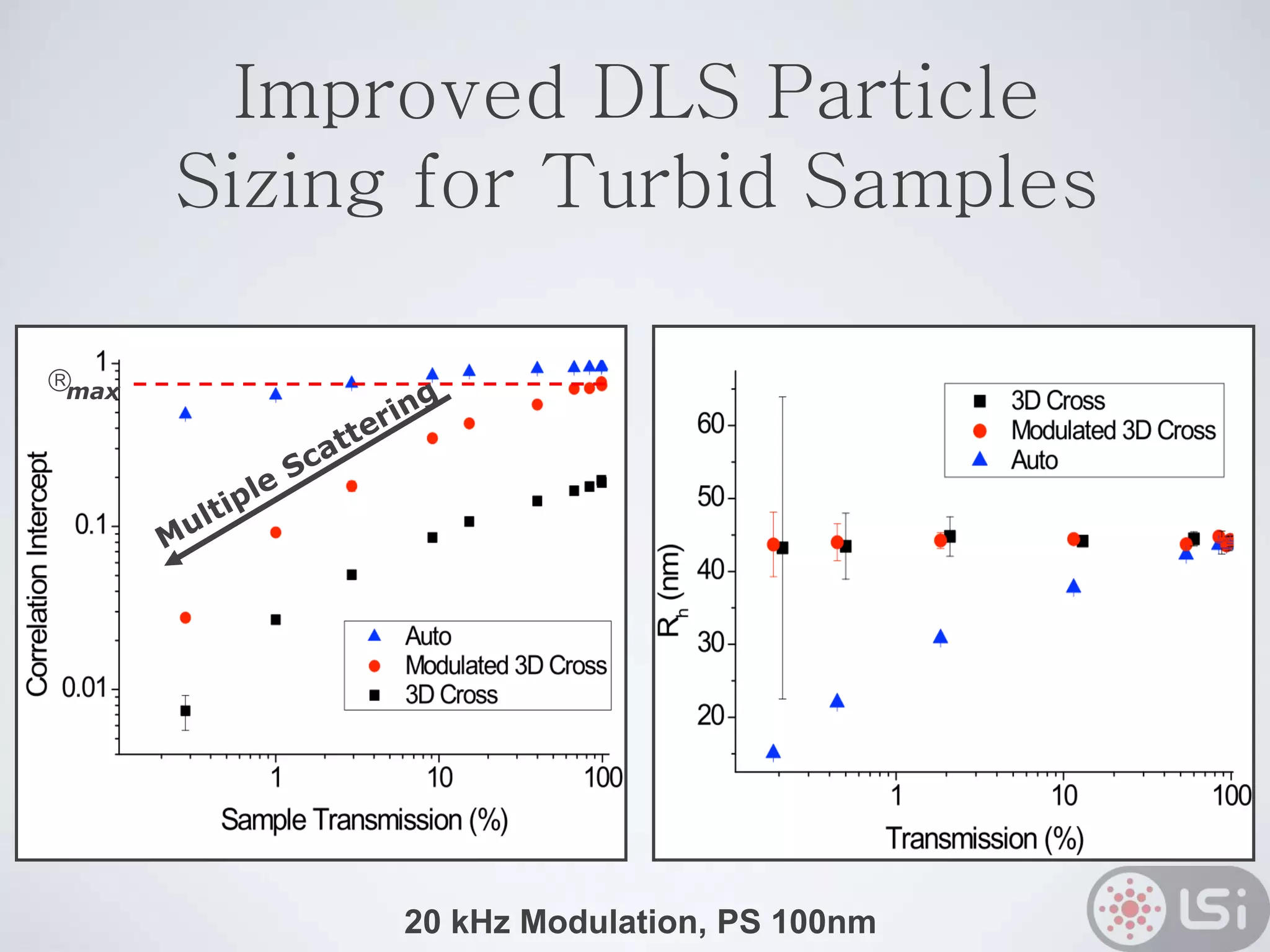
Improved DLS Particle
Sizing for Turbid Samples
20 kHz Modulation, PS 100nm
max
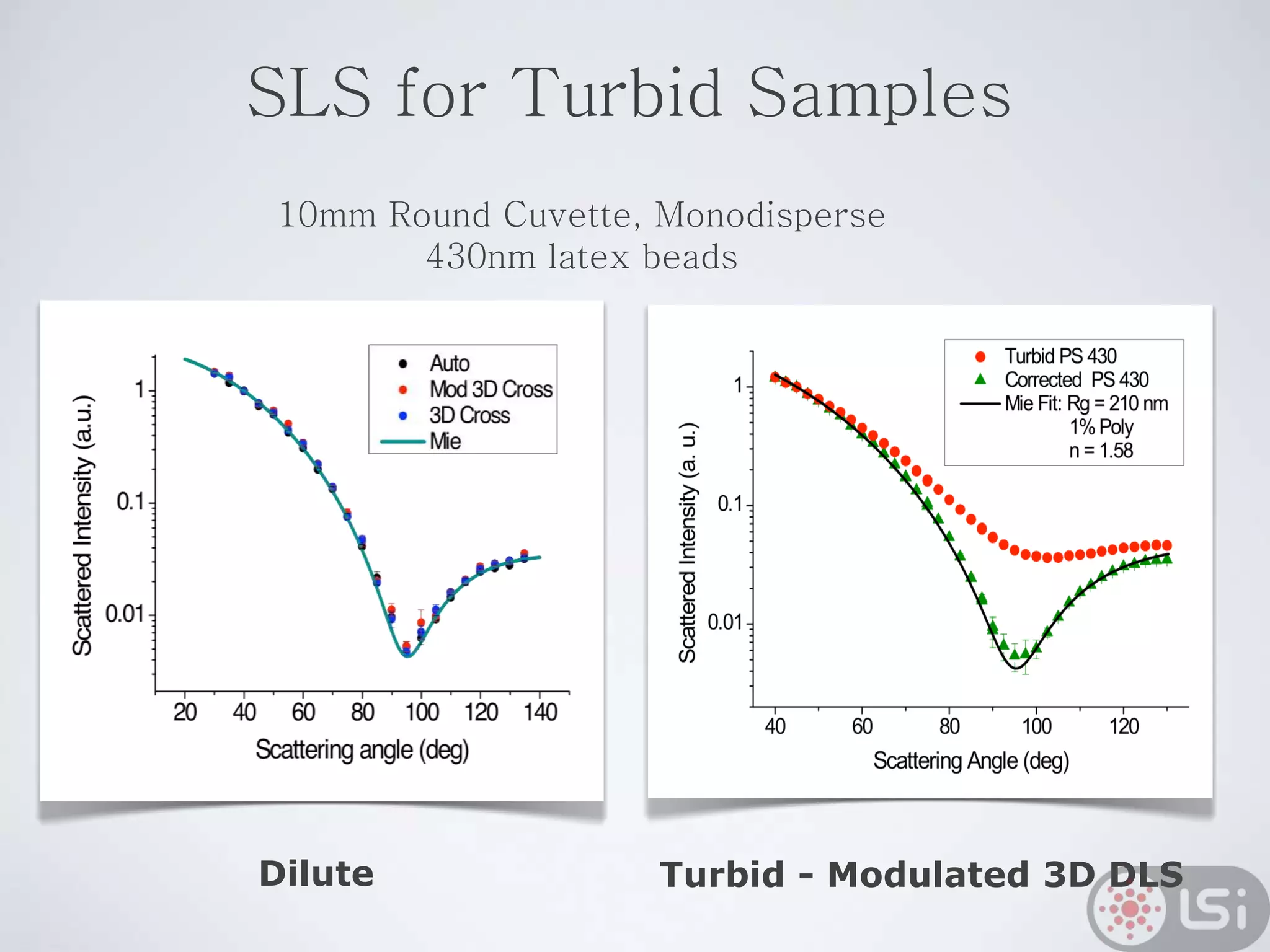
SLS for Turbid Samples
Dilute
Correct scattered intensity
to get single scattering
contribution
Turbid - Modulated 3D DLS
10mm Round Cuvette, Monodisperse
430nm latex beads
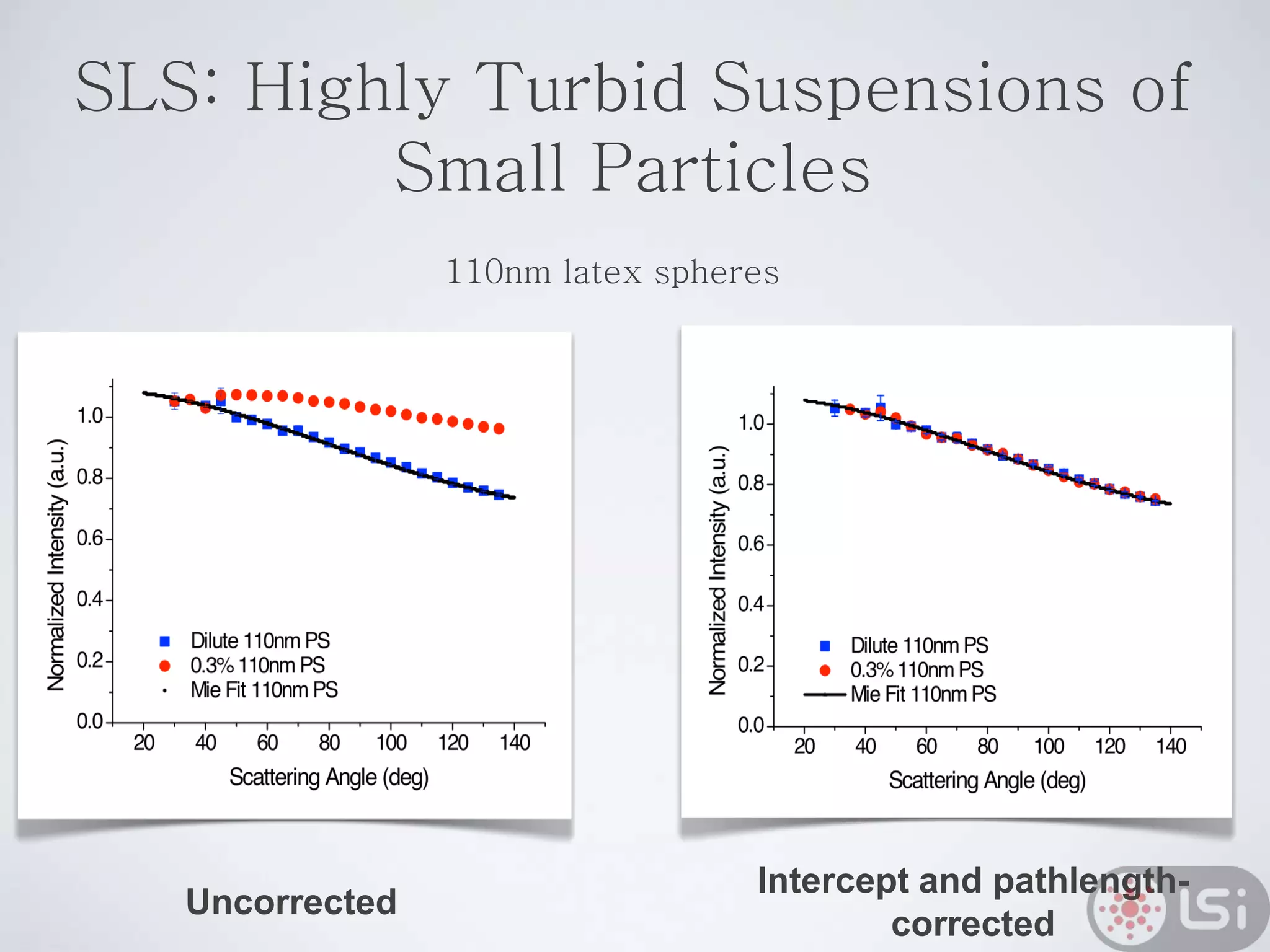
SLS: Highly Turbid Suspensions of
Small Particles
110nm latex spheres
Intercept and pathlength-
corrected
Uncorrected
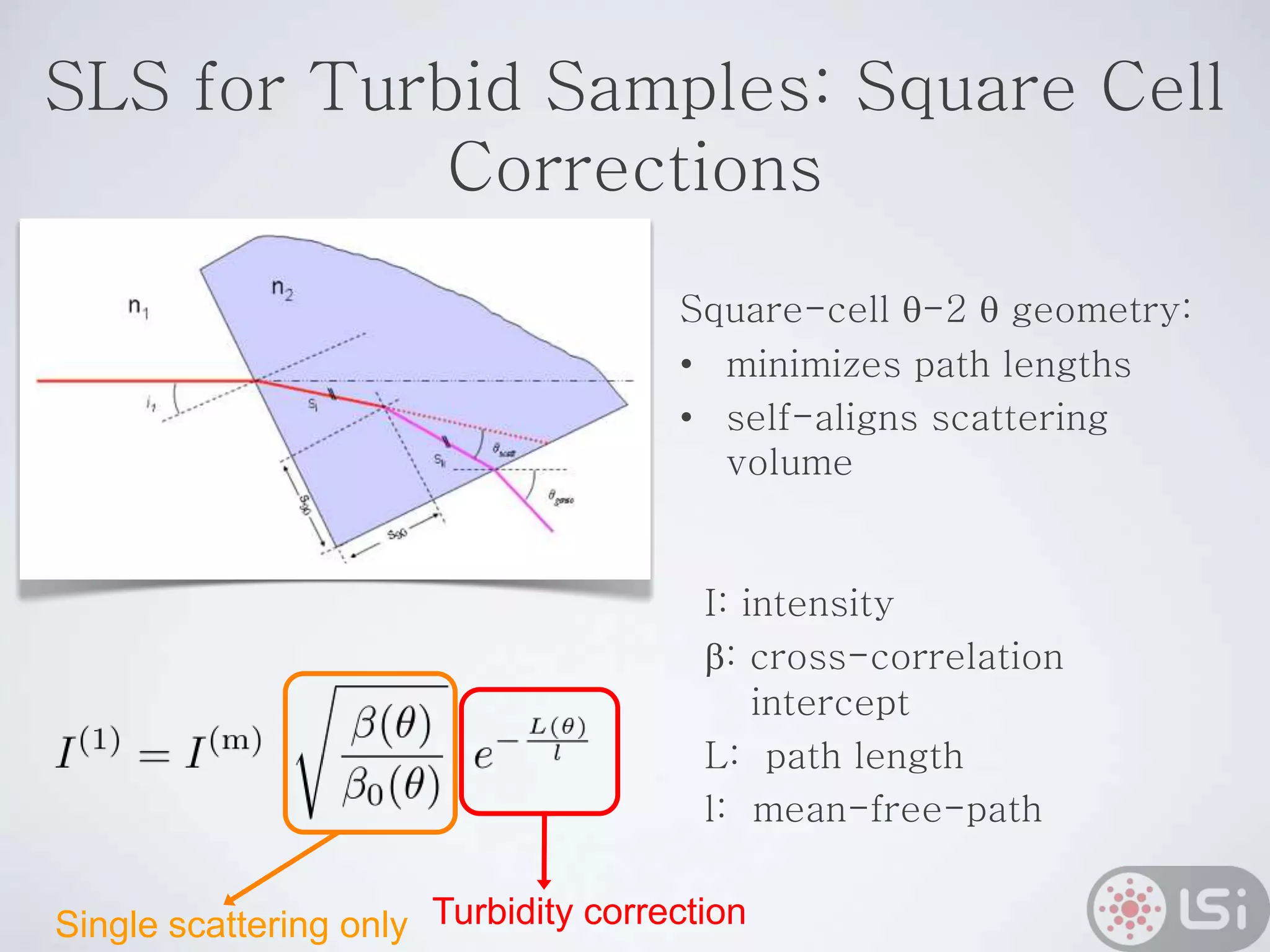
SLS for Turbid Samples: Square Cell
Corrections
I: intensity
: cross-correlation
intercept
L: path length
l: mean-free-path
Square-cell -2  geometry:
• minimizes path lengths
• self-aligns scattering
volume
Turbidity correctionSingle scattering only
Thank you for your attention!

Light Scattering Fundamentals (2019 Logo)

  • 1.
  • 2.
  • 3.
    Light Scattering asSizing Tool Nanoparticles: 1-100 nm Polymers, Macromolecules Clays, Oxides, Proteins etc.
  • 4.
  • 5.
  • 6.
    Physical Origin ofScattered Light • An electron in the atomic cloud is subject to a force due to the electric field • The cloud deforms and a dipole is induced • As the field oscillates so does the dipole moment • The resulting charge movement radiates (“scatters”) light • “Elastic” scattering: momentum is preserved, no energy loss ⇒ + – Light
  • 7.
    A Collection ofAtoms Field scattered by a dipole of momentum Spherical Wave Scattering Geometry
  • 8.
    A Collection ofAtoms By definition of polarizability For an object smaller than λ (Clausius-Mossotti Relation):
  • 9.
    A Collection ofAtoms Spherical Wave Contrast: Ability to scatter of the material Piecing everything together: Scattering Geometry
  • 10.
    Origin of theScattering Contrast • Interference • For a larger object it is possible to find a second lump that scatters out of phase and with the same amplitude • Completely destructive interference • For an infinite object it is always possible to do this ⇒ No contrast
  • 11.
    The Measured Quantity: theScattered Intensity • Whatever the detection technology, the observable quantity is not the electric field but the flux of energy, the so-called light intensity • It can be shown that in most conditions • In practice the intensity fluctuates in time • In SLS experiment the average intensity is measured
  • 12.
    SLS Theoretical Approaches Theory Assumption Rayleigh(Electrostatic Approximation) Rayleigh-Gans-Debye (RGD, Optically “Soft” Particles) Mie Scattering None Fraunhofer (Geometrical Optics)
  • 13.
    RGD Theory • Assumption:The field inside the particle is the incident field • To satisfy this assumption we must require for the incident field: i) no reflection at the particle/solvent interface ii) no phase change within the particle i) ii) • Every small lump in the particle scatters as if it were “alone”
  • 14.
    RGD Interference: TheScattering Vector Interference Term Dropping the dummy time dependency terms:
  • 15.
    The Meaning ofthe Scattering Vector The module of the scattering vector has dimensions of inverse of length: q-1 is the length-scale of the interference phenomenon. Two material lumps farther than q-1 interfere destructively. Closer than q-1 interfere additively Destructive Interference, Smaller Intensities No internal Interference Maximum Intensity q-1 can be interpreted as a rough measure of the probed length-scale
  • 16.
    One Particle: TheScattering Amplitude Integrating previous equation over the whole particle: Labeling the particle with the subscript j and factoring out its position by means the variable substitution We obtain Particle j scattering amplitude Interference : Particle Position Internal Interference
  • 17.
    An Ensemble ofParticles Previous result allows to sum each contribution = 0 = 0 ! Independent position and orientation We measure a time average:
  • 18.
    RGD Scattered Intensity Indeedthe electric field in not an observable But intensity is: Average Contrast Structure Factor: Interparticle Interference Form Factor: Intraparticle Interference Scattering Geometry • The RGD assumption results in the factorization of different contributions • Same factorization for polydisperse systems After many manipulations:
  • 19.
    The Ergodic Hypothesis Oneof the starting hypotheses od statistical mechanics is the so called “Ergodic Hypothesis”: For any system at equilibrium infinite time averages of observable quantities are equivalent to ensemble averages, i.e.: An ensamble average, is an average over the ensable of all the feasible physical configurations. Once we know how to construct such an ensemble this hypothesis enables us to “calculate” observed time averaged quantities
  • 20.
    Form Factor Homogeneous Spherewith radius R Polydisperse Homogeneous Sphere
  • 21.
    Form Factor Non radiallysymmetric shapes Scattering length density weighted pair distance function:
  • 22.
    Form Factor atSmall q: The Radius of Gyration Expanding in series the interference factor... The form factor becomes Radius of Gyration: In a plot of the intensity vs. q2 the extrapolation to zero yields a size parameter that is model independent
  • 23.
    Radius of Gyration:Polydisperse Case
  • 24.
  • 25.
    The Structure Factor Inthe same vein as the form factor it can be shown that accounting only for pair interactions (“on the pair level”) Applying the Ergodic Hypothesis:
  • 26.
    The Rayleigh Ratio Scattered Intensity TheRayleigh Ratio: Scattered intensity per unit incident intensity, unit solid angle, and unit scattering volume. Depends only on the thermodynamic state of the solvent not on the measuring apparatus Mass Concentration Sample Contrast Molar MassInstrumental Constant Solvent Scattering (Background)
  • 27.
    Absolute Measurements • Knowledgeof the constant A enables absolute intensity measurements • Absolute measurements allow for the determination of the radius of gyration and the second virial coefficient but also of the molar mass M, or the particle concentration • How do we do it? Excess Rayleigh Ratio:
  • 28.
    Absolute Measurements: How •Scientists have built special devices that allow the measurement of Rayleigh ratios, values for common reference solvents are available in literature • If we measure the same reference solvent in the same thermodynamic conditions we have: Substituting back:
  • 29.
    Data Treatment andAbsolute Intensity M R2 g/3 Polydisperse Case:
  • 30.
    Macromolecular Systems • Thetreatment so far was focused on particulate systems • For macromolecular systems we cannot precisely define a refractive index, how do we obtain the contrast? Tabulated or Measured Assuming a refractive index mixing rule and in dilute conditions: RGD Hypothesis: m close to 1
  • 31.
  • 32.
  • 33.
    Particle Dynamics inReal and Reciprocal Space Particle tracking with a microscope Dynamics in reciprocal (Fourier) space
  • 34.
    Brownian Motion andIntensity Fluctuations Brownian motion • Particle diffusion due to thermal motion • Interference effects on scattered light • Stokes-Einstein equation RANDOM FLUCTUATION IN SCATTERED INTENSITY
  • 35.
    Intensity Decorrelation 9 Intensity correlationfunction ∗ small large CORRELATION DECORRELATION >
  • 36.
    Field Correlation Function Uponnormalization: Identical Independent Particles But cannot be measured! The electric field correlation function is important as it is directly connected to colloid dynamics models
  • 37.
    Intensity Correlation Function Assumingthe field be a Gaussian stochastic variable: As for SLS we can measure the intensity correlation function Omitting the scattering amplitudes Fj :
  • 38.
    Coherence Area, Siegert Relationship •In practical implementations the field is not always a Gaussian stochastic variable • This happens since we sometimes image more than one coherence area (“speckle”) • The signal to noise ratio is lowered
  • 39.
    DLS data treatment Identicalparticles (Monodisperse): Brownian diffusion theory
  • 40.
  • 41.
    Polydisperse Particles: Cumulant Analysis Intensityweighted correlation function Cumulant Expansion: Typical uncertainty in cv is ± 0.02, i.e. it is hard to determine cv ≤ 0.2 (20%) For a polydisperse sample Intensity weighted diffusion coefficient
  • 42.
    Polydisperse Particles: Cumulant Analysis t2 qD Twospecies, differing in size by 50%
  • 43.
  • 44.
    Static Properties: ZimmPlot Schmidt M., Macromolecules, 1984, 17 (4)
  • 45.
    Polymer Properties: Interaction andConformation At the Theta temperature the chain follows the Gaussian chain model, the second virial coefficient is close but not equal to zero Berry G. C., J. Chem. Phys. 44, 4550 (1966)
  • 46.
    Polymer Properties: Chain Conformation Dependencyof chain size on solvent “goodness” Dependency of chain size on molar mass (at Theta solvent conditions) Outer P. et al., J. Chem. Phys. 18, 830 (1950)
  • 47.
    Dynamic Properties: DLS ZimmPlot • Hydrodynamic Radius depends through a certain scattering/colloid dynamic model on the scattering angle • DLS Zimm Plot enables the determination of the zero angle, no interactions hydrodynamic radius • This quantity is less model dependent Bantle S. et al., Macromolecules, 1982, 15 (6)
  • 48.
    Chain Conformation DLS/SLS: Coilto Globule Transition Sun S. et al., J. Chem. Phys. 73, 5971 (1980)
  • 49.
    Kinetic Measurements: DLS SaltInduced Polystyrene Latex coagulation Fibrillogenesis, Aβ fibrils elongation rate 𝐼 Holthoff H., Langmuir, 1996, 12 (23) Lomakin A., PNAS 1996 93 (3) 1125-1129
  • 50.
    Depolarized DLS: TobaccoVirus Rotational + Translational decorrelation rate Translational decorrelation rate • The instantaneous depolarized intensity depends on position and orientation • At short correlation times decorrelation is due to translation, at larger rimes to translation and rotation Wada A. Et al., J. Chem. Phys. 55, 1798 (1971)
  • 51.
    Depolarized DLS: TobaccoVirus • Short time decorrelation rate dependence on q yields D • Long time decorrelation rate dependence on q yields rotational diffusion (given the value of D) • Rotational and translational diffusion coefficients yield tobacco mosaic virus dimensions: Wada A. Et al., J. Chem. Phys. 55, 1798 (1971)
  • 52.
  • 53.
    Traditional Solution: Dilution Limitations:Time consuming, sample composition is changed, limited applicability of methods Multiple Scattering
  • 54.
  • 55.
    3D Cross-Correlation • Twosimultaneous scattering experiments with identical scattering volumes and vectors • Cross-correlation of the two signals suppresses multiply-scattered light Single Scattering: degenerate single Fourier component Multiple Scattering: different Fourier components Laser Sample in index matching vat Photon Detectors Cross Correlator Beam splitter Lens Lens Mirror y x z
  • 56.
  • 57.
    Laser Sample in index matchingvat Photon Detectors Cross Correlator Beam splitter Lens Lens Mirror Intensity Modulator Modulated 3D Cross-Correlation
  • 58.
    Laser Sample in index matchingvat Photon Detectors Cross Correlator Beam splitter Lens Lens Mirror Intensity Modulator Modulated 3D Cross-Correlation
  • 59.
  • 60.
    Improved DLS Particle Sizingfor Turbid Samples 20 kHz Modulation, PS 100nm max
  • 61.
    SLS for TurbidSamples Dilute Correct scattered intensity to get single scattering contribution Turbid - Modulated 3D DLS 10mm Round Cuvette, Monodisperse 430nm latex beads
  • 62.
    SLS: Highly TurbidSuspensions of Small Particles 110nm latex spheres Intercept and pathlength- corrected Uncorrected
  • 63.
    SLS for TurbidSamples: Square Cell Corrections I: intensity : cross-correlation intercept L: path length l: mean-free-path Square-cell -2  geometry: • minimizes path lengths • self-aligns scattering volume Turbidity correctionSingle scattering only
  • 64.
    Thank you foryour attention!

Editor's Notes

  • #2 add fourier space and natural space mention add contin and regularization method, integral diskretization, matrix inversion, problem, least square formulation, smoothness add a slide for spherical planar wave and wavevecror and it’s use to calculate phase shifts
  • #15 Time dependent terms are dummy as they disappear when we calculate intensities
  • #49 Key concept: R_g and R_h are weighted differently and depend differently on the chain conformation.. it’s clear that R_g is more sensitive as for R:h the solvent “penetrates” the loose expanded chain. When the chain is globule the difference is less marked as the macromolecule is a sphere : R_h = sqrt(3/5)R_g
  • #54 interaction effects are lost if you dilute – crystallization, gelling, ageing, Calculated polydispersity is wrong by 1 order of magnitude and difficult to accurately fit size/index mention interactions can lead to increase of dynamics at high volume fractions, but these effects are an order of magnitude less. Also mention volume fraction here perhaps.
  • #56 Only singly scattered light at the pricisely defined geometry yields correlated fluctuations - multiply scattered light does not have a common q vector for each detector. Suppression of 3 orders of magnitude. For multiple scattering, each detector is in general going to see a different q vector. Only single scattered light has a common q vector for the detector pairs and thus correlated. Fluctuations of different fourier components are statistically independent.
  • #58 Emphasize ease of implementation, describe physically how this is implemented, including correlating at longer timescales. Undersampling.
  • #59 Current limitations of switching speed is 1 MHz…1 us minimum lag time for correlation function.
  • #61 Explain how our statistics get worse with multiple scattering. 3d is not doing magic, its simply extracting information that’s already there.
  • #62 For borderline samples, we get better data. Enables more turbid samples and improved data. In form factor minimum single scattering intensity is very very small – we’re losing the data in the noise. Less than 5% single scattered light!!
  • #63 Explain how our statistics get worse with multiple scattering. 3d is not doing magic, its simply extracting information that’s already there.