DYNAMIC LIGHT
SCATTERING (DLS)
BY AMINA KHAN
MS CHEMISTRY
DYNAMIC LIGHT
SCATTERING (DLS)
Dynamic light scattering (DLS) is a technique in physics that can be used to
determine the size distribution profile of small particles in suspension or
polymers in solution.
SYNONYMS;
 Photon correlation spectroscopy
 Quasi-elastic light scattering.
MEASURES DYNAMIC PROPERTIES
It measures the dynamic properties like;
Size distribution
Hydrodynamic radius
Diffusion coefficient
PRINCIPLE OF DLS;
DLS is used to analyze size range from a few nanometers to a few
micrometers. This technique operates on the principle that particles
move randomly in gas or liquid i.e. undergo Brownian motion (random
motion). The movement (diffusion) of these particles is described by the
Stokes-Einstein equation.
BROWNIAN MOTION;
Brownian motion is the fundamental of this instrument.
Brownian motion of the particle is random motion due to the
bombardment by the solvent molecule surround them.
CONTINUE…
Brownian motion of the particle related to size.
It describes the way in which very small particles move in fluid
suspension.
Brownian motion is influenced by
Particle size
Temperature
Sample viscosity
STOKES-EINSTEIN EQUATION
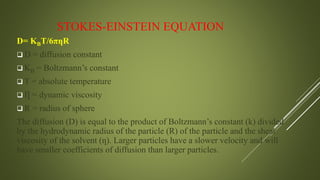
D= KBT/6πƞR
 D = diffusion constant
 KB = Boltzmann’s constant
 T = absolute temperature
 Ƞ = dynamic viscosity
 R = radius of sphere
The diffusion (D) is equal to the product of Boltzmann’s constant (k) divided
by the hydrodynamic radius of the particle (R) of the particle and the shear
viscosity of the solvent (ƞ). Larger particles have a slower velocity and will
have smaller coefficients of diffusion than larger particles.
EXPLANATION;
In DLS we measured the speed at which the particles are diffusing due to
Brownian motion.
Speed of diffusion is measured by measuring the rate at which the
intensity of the scattered light fluctuates.
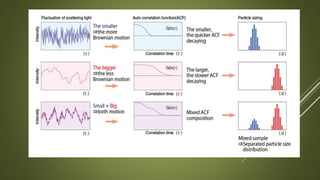
Small particles causes the intensity to more fluctuate than larger.
It measures the diffusion coefficient by using correlation coefficient.
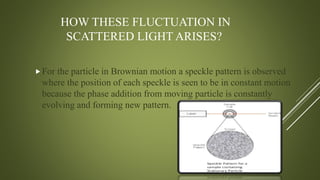
HOW THESE FLUCTUATION IN
SCATTERED LIGHT ARISES?
For the particle in Brownian motion a speckle pattern is observed
where the position of each speckle is seen to be in constant motion
because the phase addition from moving particle is constantly
evolving and forming new pattern.
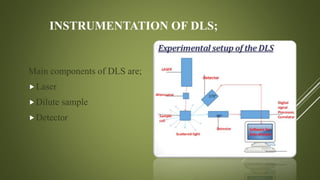
INSTRUMENTATION OF DLS;
Main components of DLS are;
Laser
Dilute sample
Detector
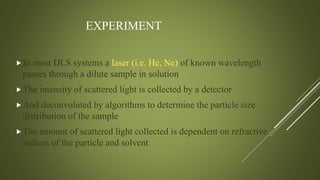
EXPERIMENT
In most DLS systems a laser (i.e. He, Ne) of known wavelength
passes through a dilute sample in solution
The intensity of scattered light is collected by a detector
And deconvoluted by algorithms to determine the particle size
distribution of the sample
The amount of scattered light collected is dependent on refractive
indices of the particle and solvent
CONTINUE…
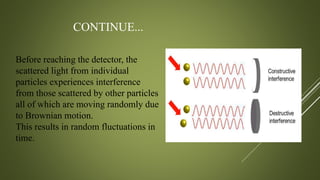
Before reaching the detector, the
scattered light from individual
particles experiences interference
from those scattered by other particles
all of which are moving randomly due
to Brownian motion.
This results in random fluctuations in
time.
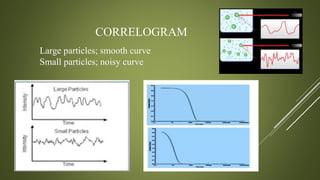
CORRELOGRAM
Large particles; smooth curve
Small particles; noisy curve
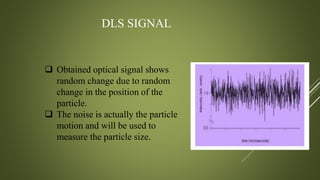
DLS SIGNAL
 Obtained optical signal shows
random change due to random
change in the position of the
particle.
 The noise is actually the particle
motion and will be used to
measure the particle size.
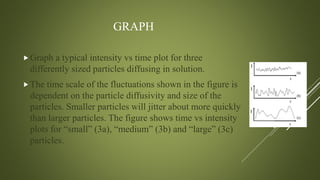
GRAPH
Graph a typical intensity vs time plot for three
differently sized particles diffusing in solution.
The time scale of the fluctuations shown in the figure is
dependent on the particle diffusivity and size of the
particles. Smaller particles will jitter about more quickly
than larger particles. The figure shows time vs intensity
plots for “small” (3a), “medium” (3b) and “large” (3c)
particles.
APPLICATIONS
CHARACTERIZE SIZE OF VARIOUS PARTICLES;
DLS is used to characterize size of various particles
including proteins, polymers, micelles, vesicles,
carbohydrates, nanoparticles, biological cells and gels.
AGGREGATION OF PARTICLES;
This technique is best for detecting the aggregation of
particles.
CONTINUE…
DETERMINATION OF EFFECTIVE DIAMETER;
If the system is not disperse in size, the mean effective diameter of
the particles can be determined. This measurement depends on the
size of the particle core, the size of surface structures, particle
concentration, and the type of ions in the medium.
DETERMINATION OF DIFFUSION COEFFICIENT;
DLS essentially measures fluctuations in scattered light intensity due
to diffusing particles, the diffusion coefficient of the particles can be
determined.
CONTINUE…
DISPLAYS PARTICLE POPULATION;
DLS software of commercial instruments typically displays the
particle population at different diameters. If the system is
monodisperse, there should only be one population, whereas a
polydisperse system would show multiple particle populations.
ANALYSIS OF STABILITY;
Stability studies can be done conveniently using DLS. In some DLS
machines, stability depending on temperature can be analyzed by
controlling the temperature in situ. We can study stability of Nano
particles as function of time.
ADVANTAGES
Some of the advantages of DLS technology include
Accurate,
Reliable,
Repeatable particle size analysis is 1 or 2 min
Turbid samples can be measured directly
It requires small volume of sample.
Complete recovery of sample can be done after
measurement.
LIMITATIONS
We measure the hydrodynamic radius of the particle, not
able to measure the actual size of the particle.
The particles having size greater than 1000nm are not
measured by this method.
Size of solid particles are not measured by DLS.
REFERENCES
 Langevin, D., Lozano, O., Salvati, A., Kestens, V., Monopoli, M., Raspaud, E., ... & Haase, A.
(2018). Inter-laboratory comparison of nanoparticle size measurements using dynamic light
scattering and differential centrifugal sedimentation. NanoImpact, 10, 97-107.
 Augstein, B., Coyne, J., Wiggins, A., Sears, B., Harding, S., Schaefer, D., & Simpson, J.
(2018). Characterization of Dynamic Light Scattering Instrumentation to Determine
Nanoparticle Size. Bulletin of the American Physical Society.
 Mao, Y., Liu, K., Zhan, C., Geng, L., Chu, B., & Hsiao, B. S. (2017). Characterization of
nanocellulose using small-angle neutron, X-ray, and dynamic light scattering techniques. The
Journal of Physical Chemistry B, 121(6), 1340-1351.
REFERENCES
 Burchard, W. (2016). Dynamic Light Scattering. Polysaccharide Hydrogels: Characterization
and Biomedical Applications, 167.
 Stetefeld, J., McKenna, S. A., & Patel, T. R. (2016). Dynamic light scattering: a practical guide
and applications in biomedical sciences. Biophysical reviews, 8(4), 409-427.
 Hassan, P. A., Rana, S., & Verma, G. (2014). Making sense of Brownian motion: colloid
characterization by dynamic light scattering. Langmuir, 31(1), 3-12.
 Dynamic light scattering: with applications to Chemistr, biology and physics, Bruce J. Berne
and Robert Pecora, DOVER publications, INC. Mineola. New York
DLS dynamic light scattering

DLS dynamic light scattering

  • 1.
    DYNAMIC LIGHT SCATTERING (DLS) BYAMINA KHAN MS CHEMISTRY
  • 2.
    DYNAMIC LIGHT SCATTERING (DLS) Dynamiclight scattering (DLS) is a technique in physics that can be used to determine the size distribution profile of small particles in suspension or polymers in solution. SYNONYMS;  Photon correlation spectroscopy  Quasi-elastic light scattering.
  • 3.
    MEASURES DYNAMIC PROPERTIES Itmeasures the dynamic properties like; Size distribution Hydrodynamic radius Diffusion coefficient
  • 4.
    PRINCIPLE OF DLS; DLSis used to analyze size range from a few nanometers to a few micrometers. This technique operates on the principle that particles move randomly in gas or liquid i.e. undergo Brownian motion (random motion). The movement (diffusion) of these particles is described by the Stokes-Einstein equation. BROWNIAN MOTION; Brownian motion is the fundamental of this instrument. Brownian motion of the particle is random motion due to the bombardment by the solvent molecule surround them.
  • 5.
    CONTINUE… Brownian motion ofthe particle related to size. It describes the way in which very small particles move in fluid suspension. Brownian motion is influenced by Particle size Temperature Sample viscosity
  • 6.
    STOKES-EINSTEIN EQUATION D= KBT/6πƞR D = diffusion constant  KB = Boltzmann’s constant  T = absolute temperature  Ƞ = dynamic viscosity  R = radius of sphere The diffusion (D) is equal to the product of Boltzmann’s constant (k) divided by the hydrodynamic radius of the particle (R) of the particle and the shear viscosity of the solvent (ƞ). Larger particles have a slower velocity and will have smaller coefficients of diffusion than larger particles.
  • 7.
    EXPLANATION; In DLS wemeasured the speed at which the particles are diffusing due to Brownian motion. Speed of diffusion is measured by measuring the rate at which the intensity of the scattered light fluctuates. Small particles causes the intensity to more fluctuate than larger. It measures the diffusion coefficient by using correlation coefficient.
  • 8.
    HOW THESE FLUCTUATIONIN SCATTERED LIGHT ARISES? For the particle in Brownian motion a speckle pattern is observed where the position of each speckle is seen to be in constant motion because the phase addition from moving particle is constantly evolving and forming new pattern.
  • 9.
    INSTRUMENTATION OF DLS; Maincomponents of DLS are; Laser Dilute sample Detector
  • 10.
    EXPERIMENT In most DLSsystems a laser (i.e. He, Ne) of known wavelength passes through a dilute sample in solution The intensity of scattered light is collected by a detector And deconvoluted by algorithms to determine the particle size distribution of the sample The amount of scattered light collected is dependent on refractive indices of the particle and solvent
  • 11.
    CONTINUE… Before reaching thedetector, the scattered light from individual particles experiences interference from those scattered by other particles all of which are moving randomly due to Brownian motion. This results in random fluctuations in time.
  • 12.
    CORRELOGRAM Large particles; smoothcurve Small particles; noisy curve
  • 13.
    DLS SIGNAL  Obtainedoptical signal shows random change due to random change in the position of the particle.  The noise is actually the particle motion and will be used to measure the particle size.
  • 14.
    GRAPH Graph a typicalintensity vs time plot for three differently sized particles diffusing in solution. The time scale of the fluctuations shown in the figure is dependent on the particle diffusivity and size of the particles. Smaller particles will jitter about more quickly than larger particles. The figure shows time vs intensity plots for “small” (3a), “medium” (3b) and “large” (3c) particles.
  • 16.
    APPLICATIONS CHARACTERIZE SIZE OFVARIOUS PARTICLES; DLS is used to characterize size of various particles including proteins, polymers, micelles, vesicles, carbohydrates, nanoparticles, biological cells and gels. AGGREGATION OF PARTICLES; This technique is best for detecting the aggregation of particles.
  • 17.
    CONTINUE… DETERMINATION OF EFFECTIVEDIAMETER; If the system is not disperse in size, the mean effective diameter of the particles can be determined. This measurement depends on the size of the particle core, the size of surface structures, particle concentration, and the type of ions in the medium. DETERMINATION OF DIFFUSION COEFFICIENT; DLS essentially measures fluctuations in scattered light intensity due to diffusing particles, the diffusion coefficient of the particles can be determined.
  • 18.
    CONTINUE… DISPLAYS PARTICLE POPULATION; DLSsoftware of commercial instruments typically displays the particle population at different diameters. If the system is monodisperse, there should only be one population, whereas a polydisperse system would show multiple particle populations. ANALYSIS OF STABILITY; Stability studies can be done conveniently using DLS. In some DLS machines, stability depending on temperature can be analyzed by controlling the temperature in situ. We can study stability of Nano particles as function of time.
  • 19.
    ADVANTAGES Some of theadvantages of DLS technology include Accurate, Reliable, Repeatable particle size analysis is 1 or 2 min Turbid samples can be measured directly It requires small volume of sample. Complete recovery of sample can be done after measurement.
  • 20.
    LIMITATIONS We measure thehydrodynamic radius of the particle, not able to measure the actual size of the particle. The particles having size greater than 1000nm are not measured by this method. Size of solid particles are not measured by DLS.
  • 21.
    REFERENCES  Langevin, D.,Lozano, O., Salvati, A., Kestens, V., Monopoli, M., Raspaud, E., ... & Haase, A. (2018). Inter-laboratory comparison of nanoparticle size measurements using dynamic light scattering and differential centrifugal sedimentation. NanoImpact, 10, 97-107.  Augstein, B., Coyne, J., Wiggins, A., Sears, B., Harding, S., Schaefer, D., & Simpson, J. (2018). Characterization of Dynamic Light Scattering Instrumentation to Determine Nanoparticle Size. Bulletin of the American Physical Society.  Mao, Y., Liu, K., Zhan, C., Geng, L., Chu, B., & Hsiao, B. S. (2017). Characterization of nanocellulose using small-angle neutron, X-ray, and dynamic light scattering techniques. The Journal of Physical Chemistry B, 121(6), 1340-1351.
  • 22.
    REFERENCES  Burchard, W.(2016). Dynamic Light Scattering. Polysaccharide Hydrogels: Characterization and Biomedical Applications, 167.  Stetefeld, J., McKenna, S. A., & Patel, T. R. (2016). Dynamic light scattering: a practical guide and applications in biomedical sciences. Biophysical reviews, 8(4), 409-427.  Hassan, P. A., Rana, S., & Verma, G. (2014). Making sense of Brownian motion: colloid characterization by dynamic light scattering. Langmuir, 31(1), 3-12.  Dynamic light scattering: with applications to Chemistr, biology and physics, Bruce J. Berne and Robert Pecora, DOVER publications, INC. Mineola. New York