Dynamic
Light
Scattering
(DLS)
BY DR. ABBAS JAFARIZAD
 What is DLS
 Application
 Brownian motion
 Stoke s einstein equation: relating particle size to particle motion
 How DLS works
 The correlation function
 How correlator work
 Limitation of DLS
Outline
/18
11/10/2023 2
 Particle size can be determined by measuring the random change in
intensity of light scattered from suspension.
 It measure and interpolate the light scattering up to microsecond
 So it measure real time intensity, thus measuring the dynamic
properties
 Size distribution
 Hydrodynamic radius
 Diffusion coefficient
What Is Dynamic Light
Scattering
/18
11/10/2023
 We measure Hydrodynamic Size of nanoparticle, protein and
biomaterial
 we can also study stability of nanoparticles as function of time
 Good for detecting the aggregation of the particles Other Then
these
 required small volume of sample
 Complete recovery of sample after measurement
 Sample preparation is not required for the measurement
Application of DLS
/18
11/10/2023 4
 Brownian motion is the fundamental of this instrument
 Brownian motion of the particle is random motion due to
the bombardment by the solvent molecule surround
them
 Brownian motion of the particles are related to size .
 It describes the way in which very small particles move
in fluid suspension
Brownian motion
11/10/2023 5
Stoke s einstein equation: relating
particle size to particle motion
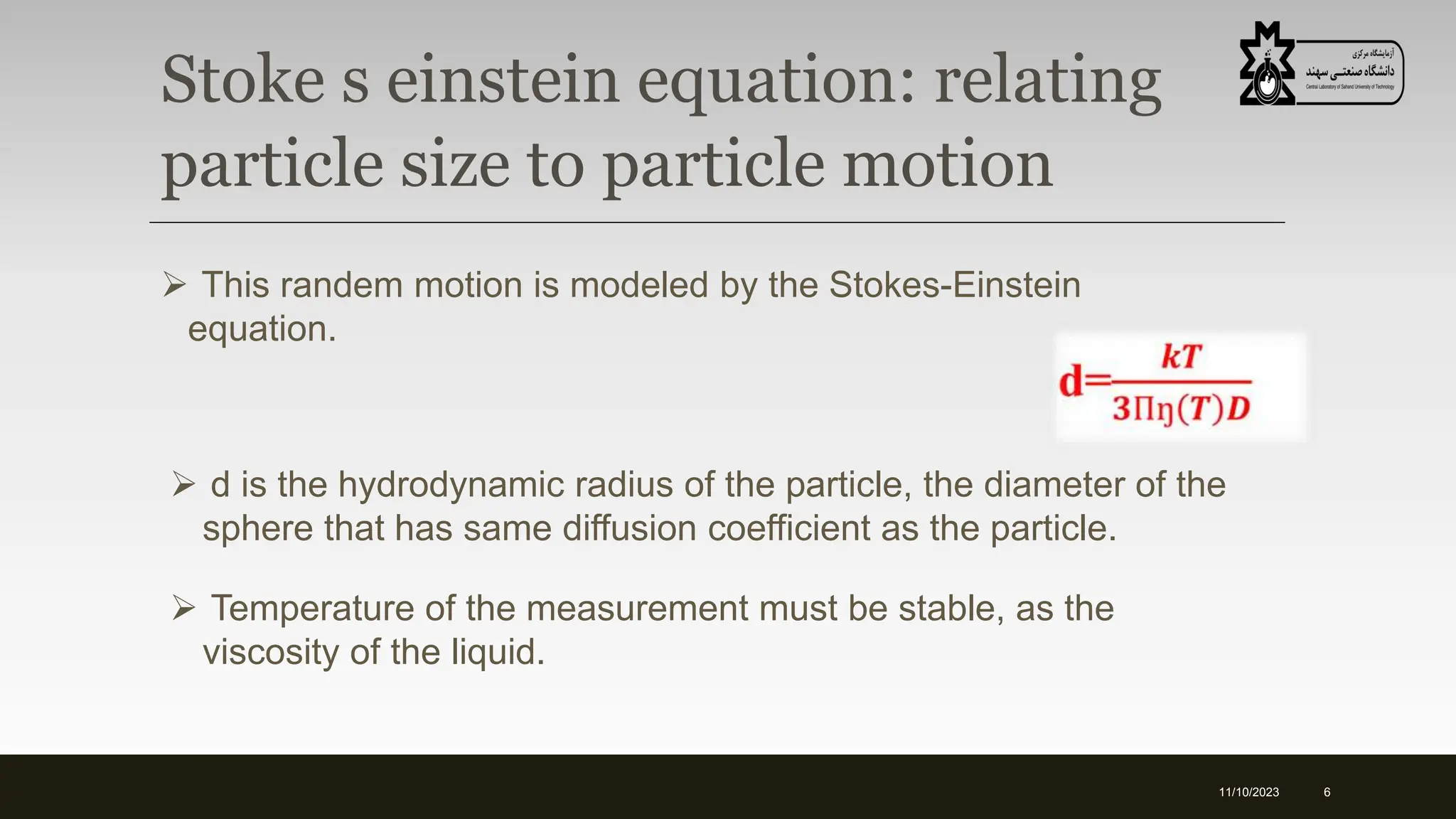
 This randem motion is modeled by the Stokes-Einstein
equation.
 d is the hydrodynamic radius of the particle, the diameter of the
sphere that has same diffusion coefficient as the particle.
 Temperature of the measurement must be stable, as the
viscosity of the liquid.
11/10/2023 6
 The size of the hypothetical hard sphere that diffuses in the same
fashion as that of the particle being measured.
Hydrodynamic radius
11/10/2023 7
 In DLS we measured the speed at which the
particles are diffusing due to Brownian motion.
 Speed of diffusion is measured by measuring
the rate at which the intensity of the scattered
light fluctuates.
 Small particles causes the Intensity to more
fluctuate than larger.
 It measure the diffusion coefficient by using
correlation function.
How DLS Works
11/10/2023 8
For particle in Brownian motion
a speckle pattern is observe,
where the position of each
speckle is seen to be in
constant motion. Because the
phase addition from moving
particle is constantly evolving
and forming new pattern.
How these fluctuation in scattered light
arises?
11/10/2023 9
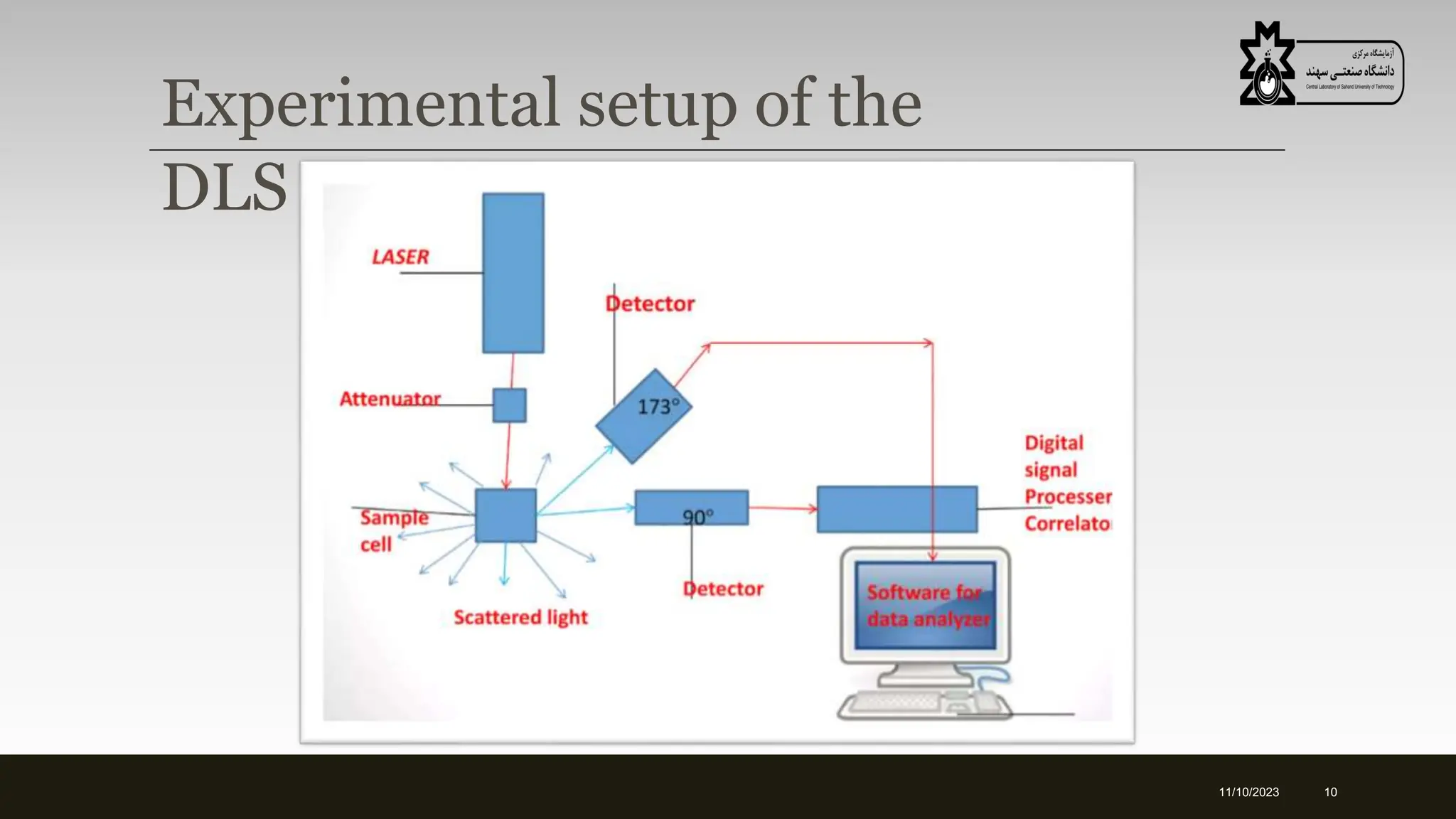
Experimental setup of the
DLS
11/10/2023 10
 Obtained optical signal shows random change due to random
change in position of the particle.
 The noise is actually the particle motion and will be used to
measure the particle size
DLS signal
11/10/2023 11
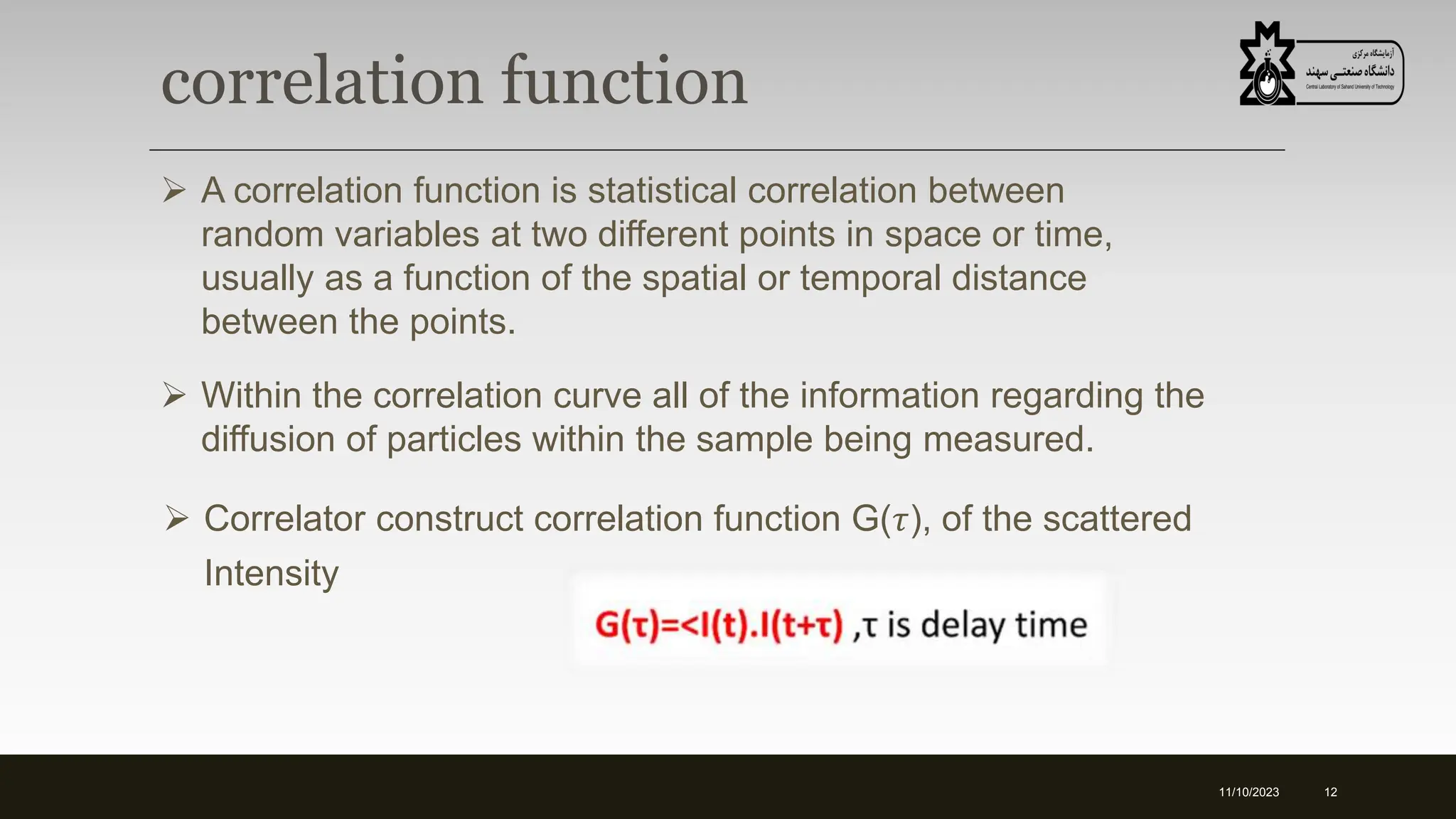
 A correlation function is statistical correlation between
random variables at two different points in space or time,
usually as a function of the spatial or temporal distance
between the points.
 Within the correlation curve all of the information regarding the
diffusion of particles within the sample being measured.
 Correlator construct correlation function G(𝜏), of the scattered
Intensity
correlation function
11/10/2023 12
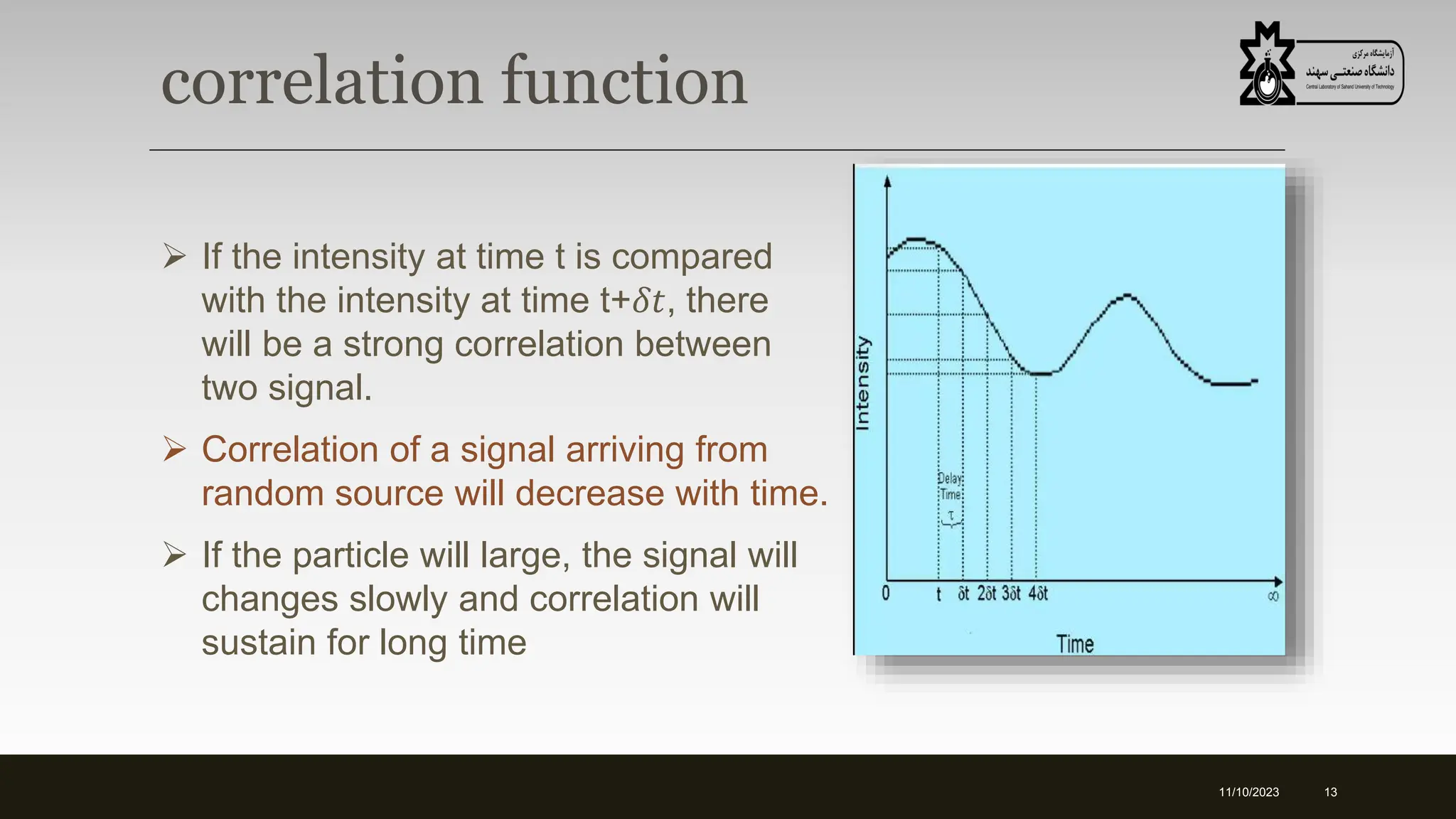
 If the intensity at time t is compared
with the intensity at time t+𝛿𝑡, there
will be a strong correlation between
two signal.
 Correlation of a signal arriving from
random source will decrease with time.
 If the particle will large, the signal will
changes slowly and correlation will
sustain for long time
correlation function
11/10/2023 13
correlogram
11/10/2023 14
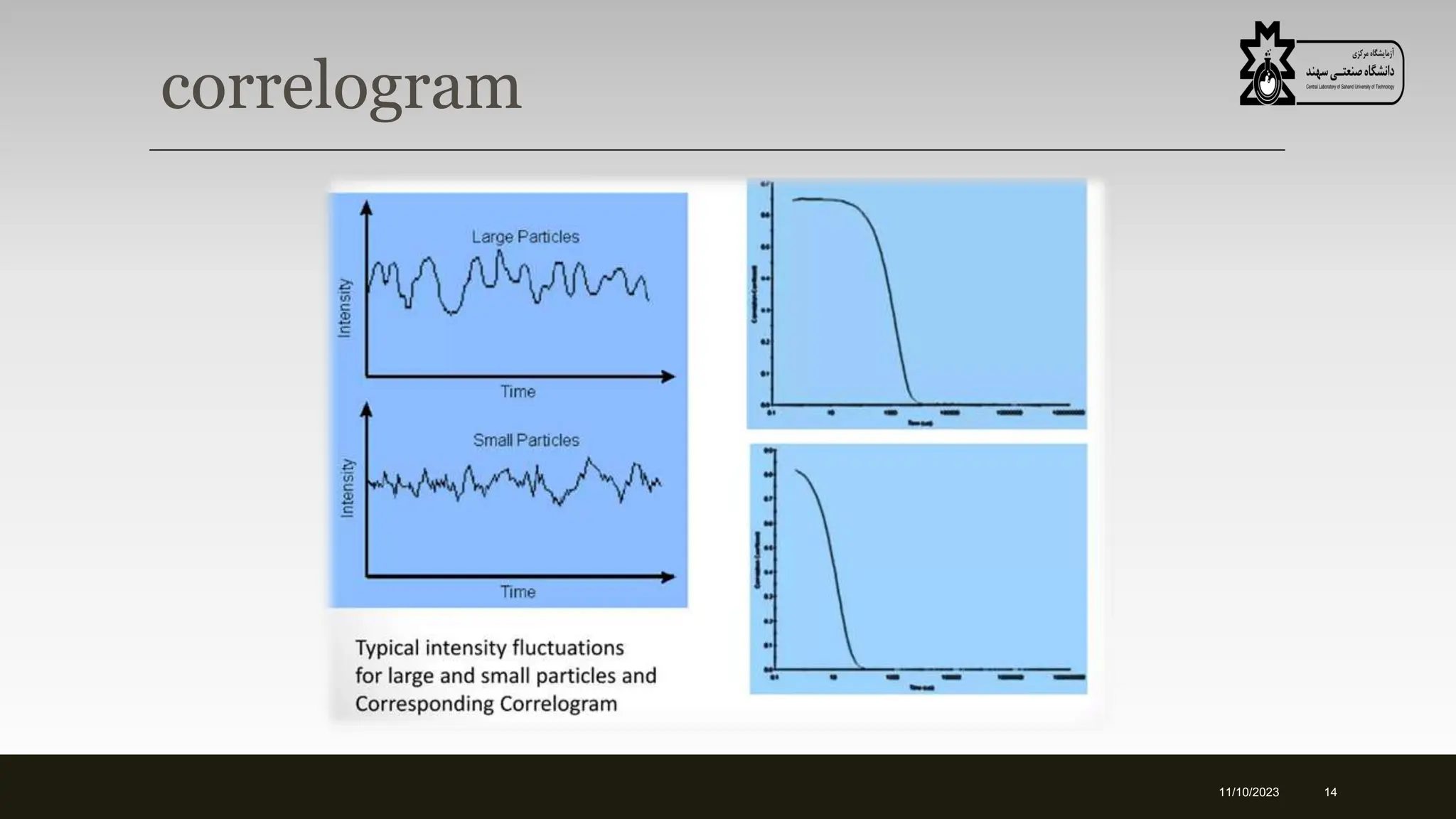
 It is a signal comparator. It is design to measure the simianty
between two signals or one signals with itself with varying time
 The correlogram give many information, the time at which the
correlation starts significantly decay is an indication of the mean
size of the sample
 The steeper the curve the more mono disperse the sample is .
 More extended the decay becomes the greater the
polydispersity.
How the correlator
works
11/10/2023 15
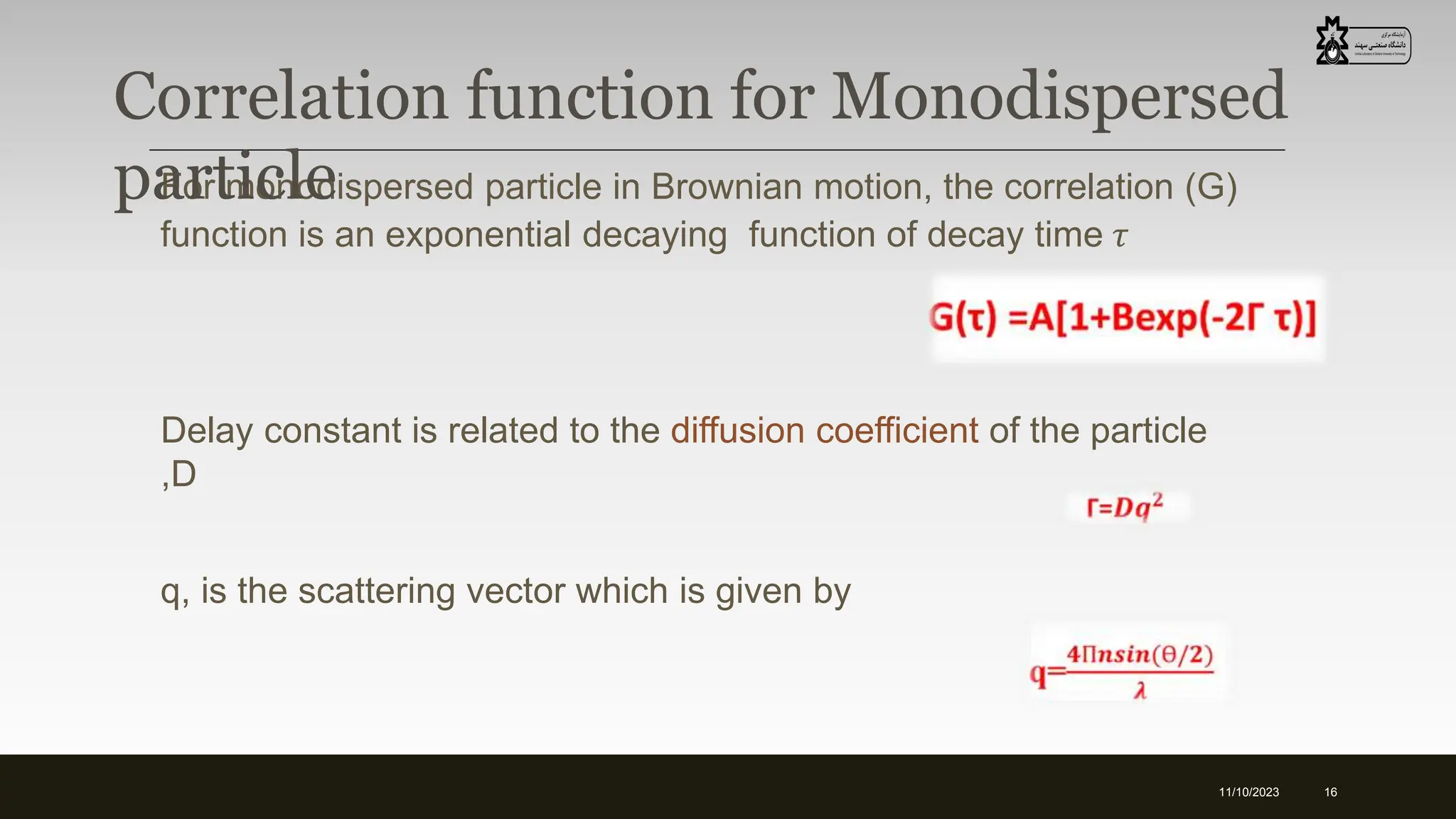
For monodispersed particle in Brownian motion, the correlation (G)
function is an exponential decaying function of decay time 𝜏
Correlation function for Monodispersed
particle
q, is the scattering vector which is given by
Delay constant is related to the diffusion coefficient of the particle
,D
11/10/2023 16
 measure the distribution of size in our sample.
 for monodisperse it is about 0.01
-
0.05 but the value greater than
0.7 indicate that sample has a very broad size distribution.
The correlation function for polydisperse
particle
11/10/2023 17
 We measure the hydrodynamic radius of the particle, not able to
measure the actual size of the particle .
 The particles having size greater than 1000nm are not measured
by this method.
 Size of Solid particles are not measured by DLS.
Limitation of DLS
11/10/2023 18

Dynamic Light Scattering (DLS).pptx

  • 1.
  • 2.
     What isDLS  Application  Brownian motion  Stoke s einstein equation: relating particle size to particle motion  How DLS works  The correlation function  How correlator work  Limitation of DLS Outline /18 11/10/2023 2
  • 3.
     Particle sizecan be determined by measuring the random change in intensity of light scattered from suspension.  It measure and interpolate the light scattering up to microsecond  So it measure real time intensity, thus measuring the dynamic properties  Size distribution  Hydrodynamic radius  Diffusion coefficient What Is Dynamic Light Scattering /18 11/10/2023
  • 4.
     We measureHydrodynamic Size of nanoparticle, protein and biomaterial  we can also study stability of nanoparticles as function of time  Good for detecting the aggregation of the particles Other Then these  required small volume of sample  Complete recovery of sample after measurement  Sample preparation is not required for the measurement Application of DLS /18 11/10/2023 4
  • 5.
     Brownian motionis the fundamental of this instrument  Brownian motion of the particle is random motion due to the bombardment by the solvent molecule surround them  Brownian motion of the particles are related to size .  It describes the way in which very small particles move in fluid suspension Brownian motion 11/10/2023 5
  • 6.
    Stoke s einsteinequation: relating particle size to particle motion  This randem motion is modeled by the Stokes-Einstein equation.  d is the hydrodynamic radius of the particle, the diameter of the sphere that has same diffusion coefficient as the particle.  Temperature of the measurement must be stable, as the viscosity of the liquid. 11/10/2023 6
  • 7.
     The sizeof the hypothetical hard sphere that diffuses in the same fashion as that of the particle being measured. Hydrodynamic radius 11/10/2023 7
  • 8.
     In DLSwe measured the speed at which the particles are diffusing due to Brownian motion.  Speed of diffusion is measured by measuring the rate at which the intensity of the scattered light fluctuates.  Small particles causes the Intensity to more fluctuate than larger.  It measure the diffusion coefficient by using correlation function. How DLS Works 11/10/2023 8
  • 9.
    For particle inBrownian motion a speckle pattern is observe, where the position of each speckle is seen to be in constant motion. Because the phase addition from moving particle is constantly evolving and forming new pattern. How these fluctuation in scattered light arises? 11/10/2023 9
  • 10.
    Experimental setup ofthe DLS 11/10/2023 10
  • 11.
     Obtained opticalsignal shows random change due to random change in position of the particle.  The noise is actually the particle motion and will be used to measure the particle size DLS signal 11/10/2023 11
  • 12.
     A correlationfunction is statistical correlation between random variables at two different points in space or time, usually as a function of the spatial or temporal distance between the points.  Within the correlation curve all of the information regarding the diffusion of particles within the sample being measured.  Correlator construct correlation function G(𝜏), of the scattered Intensity correlation function 11/10/2023 12
  • 13.
     If theintensity at time t is compared with the intensity at time t+𝛿𝑡, there will be a strong correlation between two signal.  Correlation of a signal arriving from random source will decrease with time.  If the particle will large, the signal will changes slowly and correlation will sustain for long time correlation function 11/10/2023 13
  • 14.
  • 15.
     It isa signal comparator. It is design to measure the simianty between two signals or one signals with itself with varying time  The correlogram give many information, the time at which the correlation starts significantly decay is an indication of the mean size of the sample  The steeper the curve the more mono disperse the sample is .  More extended the decay becomes the greater the polydispersity. How the correlator works 11/10/2023 15
  • 16.
    For monodispersed particlein Brownian motion, the correlation (G) function is an exponential decaying function of decay time 𝜏 Correlation function for Monodispersed particle q, is the scattering vector which is given by Delay constant is related to the diffusion coefficient of the particle ,D 11/10/2023 16
  • 17.
     measure thedistribution of size in our sample.  for monodisperse it is about 0.01 - 0.05 but the value greater than 0.7 indicate that sample has a very broad size distribution. The correlation function for polydisperse particle 11/10/2023 17
  • 18.
     We measurethe hydrodynamic radius of the particle, not able to measure the actual size of the particle .  The particles having size greater than 1000nm are not measured by this method.  Size of Solid particles are not measured by DLS. Limitation of DLS 11/10/2023 18