Using ICT to “adapt” rather than
  “mitigate” Global Warming


               Bill St. Arnaud
       Bill.st.arnaud@gmail.com

   Unless otherwise noted all material in this slide deck may be
   reproduced, modified or distributed without prior permission of the author
Theme of this talk
• We have already lost the battle to save the planet from extreme
  climate change. Rather than focusing on reducing energy
  consumption, (Mitigation) we now need to focus on surviving
  climate change (Adaptation)

• Explosion of data and energy consumption by computers and
  networks is contributing to energy demand and CO2 emissions

• Designing solutions to address adaptation will at the same time also
  address mitigation but in addition provide many significant business
  opportunities
    – Think of solutions that use no carbon and not connected to the
      electrical grid

• Use the Internet and IT, in combination with electric vehicle to build
  the “Energy Internet”
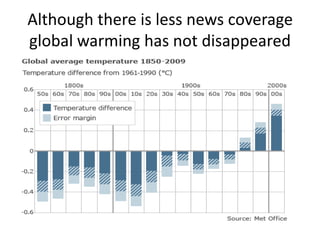
Although there is less news coverage
global warming has not disappeared
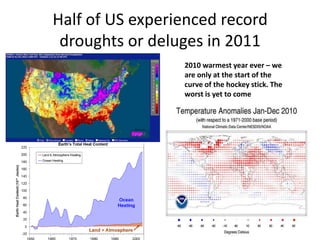
Half of US experienced record
 droughts or deluges in 2011
                 2010 warmest year ever – we
                 are only at the start of the
                 curve of the hockey stick. The
                 worst is yet to come
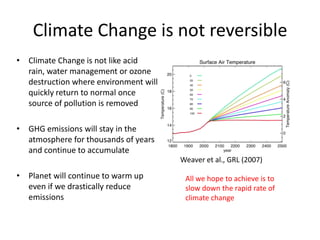
Climate Change is not reversible
• Climate Change is not like acid
  rain, water management or ozone
  destruction where environment will
  quickly return to normal once
  source of pollution is removed

• GHG emissions will stay in the
  atmosphere for thousands of years
  and continue to accumulate
                                       Weaver et al., GRL (2007)

• Planet will continue to warm up       All we hope to achieve is to
  even if we drastically reduce         slow down the rapid rate of
  emissions                             climate change
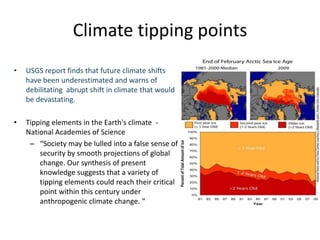
Climate tipping points
•   USGS report finds that future climate shifts
    have been underestimated and warns of
    debilitating abrupt shift in climate that would
    be devastating.

•   Tipping elements in the Earth's climate -
    National Academies of Science
     – “Society may be lulled into a false sense of
        security by smooth projections of global
        change. Our synthesis of present
        knowledge suggests that a variety of
        tipping elements could reach their critical
        point within this century under
        anthropogenic climate change. “
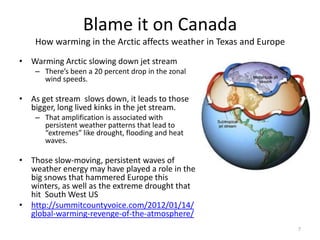
Blame it on Canada
    How warming in the Arctic affects weather in Texas and Europe
• Warming Arctic slowing down jet stream
    – There’s been a 20 percent drop in the zonal
      wind speeds.

• As get stream slows down, it leads to those
  bigger, long lived kinks in the jet stream.
    – That amplification is associated with
      persistent weather patterns that lead to
      “extremes” like drought, flooding and heat
      waves.

• Those slow-moving, persistent waves of
  weather energy may have played a role in the
  big snows that hammered Europe this
  winters, as well as the extreme drought that
  hit South West US
• http://summitcountyvoice.com/2012/01/14/
  global-warming-revenge-of-the-atmosphere/
                                                                    7
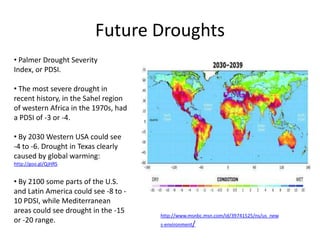
Future Droughts
• Palmer Drought Severity
Index, or PDSI.

• The most severe drought in
recent history, in the Sahel region
of western Africa in the 1970s, had
a PDSI of -3 or -4.

• By 2030 Western USA could see
-4 to -6. Drought in Texas clearly
caused by global warming:
http://goo.gl/QjHRS


• By 2100 some parts of the U.S.
and Latin America could see -8 to -
10 PDSI, while Mediterranean
areas could see drought in the -15
                                      http://www.msnbc.msn.com/id/39741525/ns/us_new
or -20 range.                         s-environment/
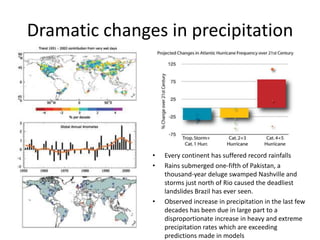
Dramatic changes in precipitation


               •   Every continent has suffered record rainfalls
               •   Rains submerged one-fifth of Pakistan, a
                   thousand-year deluge swamped Nashville and
                   storms just north of Rio caused the deadliest
                   landslides Brazil has ever seen.
               •   Observed increase in precipitation in the last few
                   decades has been due in large part to a
                   disproportionate increase in heavy and extreme
                   precipitation rates which are exceeding
                   predictions made in models
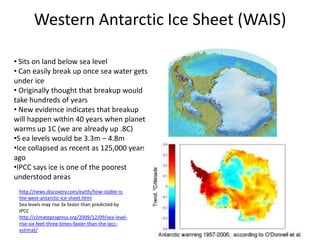
Western Antarctic Ice Sheet (WAIS)

• Sits on land below sea level
• Can easily break up once sea water gets
under ice
• Originally thought that breakup would
take hundreds of years
• New evidence indicates that breakup
will happen within 40 years when planet
warms up 1C (we are already up .8C)
•S ea levels would be 3.3m – 4.8m
•Ice collapsed as recent as 125,000 years
ago
•IPCC says ice is one of the poorest
understood areas
 http://news.discovery.com/earth/how-stable-is-
 the-west-antarctic-ice-sheet.html
 Sea levels may rise 3x faster than predicted by
 IPCC
 http://climateprogress.org/2009/12/09/sea-level-
 rise-six-feet-three-times-faster-than-the-ipcc-
 estimat/
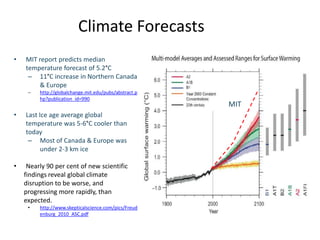
Climate Forecasts
•   MIT report predicts median
    temperature forecast of 5.2°C
     – 11°C increase in Northern Canada
        & Europe
     –   http://globalchange.mit.edu/pubs/abstract.p
         hp?publication_id=990
                                                       MIT
•   Last Ice age average global
    temperature was 5-6°C cooler than
    today
     – Most of Canada & Europe was
          under 2-3 km ice

•    Nearly 90 per cent of new scientific
    findings reveal global climate
    disruption to be worse, and
    progressing more rapidly, than
    expected.
     •   http://www.skepticalscience.com/pics/Freud
         enburg_2010_ASC.pdf
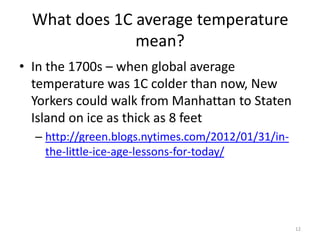
What does 1C average temperature
               mean?
• In the 1700s – when global average
  temperature was 1C colder than now, New
  Yorkers could walk from Manhattan to Staten
  Island on ice as thick as 8 feet
  – http://green.blogs.nytimes.com/2012/01/31/in-
    the-little-ice-age-lessons-for-today/


                                                    12
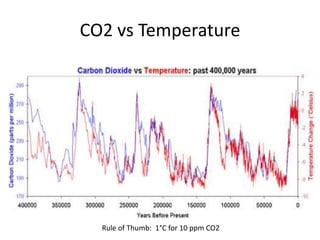
CO2 vs Temperature


  Rule of Thumb: 1°C for 10 ppm CO2
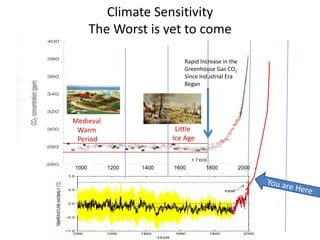
Climate Sensitivity
       The Worst is yet to come

                            Rapid Increase in the
                            Greenhouse Gas CO2
                            Since Industrial Era
                            Began


Medieval
 Warm                     Little
 Period                  Ice Age


1000       1200   1400   1600       1800            2000
Urgency of Action
                             •   “We’re uncertain about the magnitude of climate change, which is
                                 inevitable, because we’re talking about reaching levels of carbon
                                 dioxide in the atmosphere not seen in millions of years.

                             •   You might think that this uncertainty weakens the case for action, but it
                                 actually strengthens it.

                             •   This risk of catastrophe, rather than the details of cost-benefit
                                 calculations, makes the most powerful case for strong climate policy.


Nobel Laureate Paul          •   Current projections of global warming in the absence of action are just
Krugman                          too close to the kinds of numbers associated with doomsday scenarios.
                                 It would be irresponsible — it’s tempting to say criminally irresponsible
http://www.nytimes.com/201       — not to step back from what could all too easily turn out to be the
0/04/11/magazine/11Econom        edge of a cliff.”
y-t.html?pagewanted=1
New Challenge: Climate Adaptation
• Obama’s National Science Advisor John Holdren
  “Mitigation alone won’t work, because the climate is
  already changing, we’re already experiencing
  impacts….A mitigation only strategy would be
  insanity,”

• Equal emphasis given to adaptation – avoiding the
  unmanageable, and adaptation – managing the
  unavoidable.”

• Obama’s Climate Adaptation Executive Order
   –   http://www.stumbleupon.com/su/1tU8go/www.good.is/post/obama-s-secret-climate-adaptation-plan/
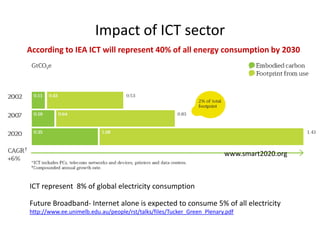
Impact of ICT sector
According to IEA ICT will represent 40% of all energy consumption by 2030


                                                                        www.smart2020.org


ICT represent 8% of global electricity consumption

Future Broadband- Internet alone is expected to consume 5% of all electricity
http://www.ee.unimelb.edu.au/people/rst/talks/files/Tucker_Green_Plenary.pdf
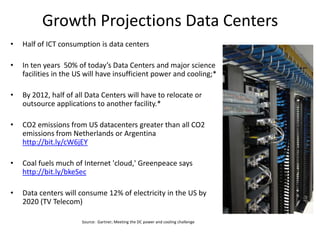
Growth Projections Data Centers
•   Half of ICT consumption is data centers

•   In ten years 50% of today’s Data Centers and major science
    facilities in the US will have insufficient power and cooling;*

•   By 2012, half of all Data Centers will have to relocate or
    outsource applications to another facility.*

•   CO2 emissions from US datacenters greater than all CO2
    emissions from Netherlands or Argentina
    http://bit.ly/cW6jEY

•   Coal fuels much of Internet 'cloud,' Greenpeace says
    http://bit.ly/bkeSec

•   Data centers will consume 12% of electricity in the US by
    2020 (TV Telecom)

                       Source: Gartner; Meeting the DC power and cooling challenge
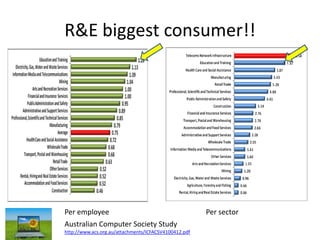
R&E biggest consumer!!


Per employee                                           Per sector
Australian Computer Society Study
http://www.acs.org.au/attachments/ICFACSV4100412.pdf
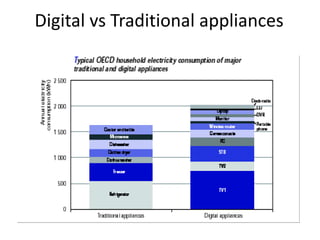
Digital vs Traditional appliances
The Falsehood of Energy Efficiency
•   Most current approaches to reduce carbon footprint are focused on increased
    energy efficiency of equipment and processes
     – No question it save money, but does little for the environment

•   Greenpeace Report “Electricity demand of IT remains on the rise, efficiency can only
    slow emission growth. In order to achieve the reductions necessary to keep the
    sector’s emissions in check and maintains afe levels of global greenhouse
    gases, clean energy needs to become the primary source of power for IT
    infrastructure.
      – Greenpeace “How dirty is your data”
         http://www.greenpeace.org/international/Global/international/publications/cli
         mate/2011/Cool%20IT/dirty-data-report-greenpeace.pdf

•   But greater efficiency can paradoxically increase energy consumption by reducing
    overall cost service and therefore stimulates demand
     – Khazzoom-Brookes postulate (aka Jevons paradox - not to be confused with
        rebound effect)

•   The issue is not the amount of energy that we use, but the type of energy
Zero Carbon strategy essential
• Zero carbon strategy using renewable energy critically important if
  governments mandate carbon neutrality, or if there is a climate
  catastrophe

• With a zero carbon strategy growth in demand for services will not effect
  GHG emissions
   – Anything times zero is always zero

• Wind and solar power are most likely candidates because of opportunity
  cost/benefit analysis especially time to deploy
   – Nuclear has high opportunity cost because of time to deploy
   – http://climateprogress.org/2008/12/14/stanford-study-part-1-wind-
      solar-baseload-easily-beat-nuclear-and-they-all-best-clean-coal/

• But renewable energy sites are usually located far from cities and
  electrical distribution systems are not designed to carry load
   – http://www.americanprogress.org/issues/2008/12/pdf/renewable_tra
      nsmission.pdf
   – Local wind/solar will be an important component
Get off the Grid!
• Purchasing green power locally is expensive with significant transmission line
  losses
    –Demand for green power within cities expected to grow dramatically

• ICT facilities DON’T NEED TO BE LOCATED IN CITIES
    –-Cooling also a major problem in cities

• But most renewable energy sites are very remote and impractical to connect to
  electrical grid.
    – Can be easily reached by an optical network
    – Provide independence from electrical utility and high costs in wheeling
    power
    – Savings in transmission line losses (up to 15%) alone, plus carbon offsets
    can pay for moving ICT facilities to renewable energy site

 •ICT is only industry ideally suited to relocate to renewable energy sites
     – Also ideal for business continuity in event of climate catastrophe
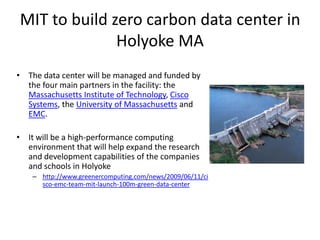
MIT to build zero carbon data center in
              Holyoke MA
• The data center will be managed and funded by
  the four main partners in the facility: the
  Massachusetts Institute of Technology, Cisco
  Systems, the University of Massachusetts and
  EMC.

• It will be a high-performance computing
  environment that will help expand the research
  and development capabilities of the companies
  and schools in Holyoke
    – http://www.greenercomputing.com/news/2009/06/11/ci
      sco-emc-team-mit-launch-100m-green-data-center
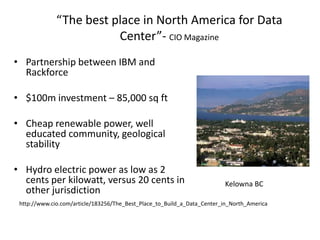
“The best place in North America for Data
                         Center”- CIO Magazine
• Partnership between IBM and
  Rackforce
• $100m investment – 85,000 sq ft

• Cheap renewable power, well
  educated community, geological
  stability

• Hydro electric power as low as 2
  cents per kilowatt, versus 20 cents in                                 Kelowna BC
  other jurisdiction
 http://www.cio.com/article/183256/The_Best_Place_to_Build_a_Data_Center_in_North_America
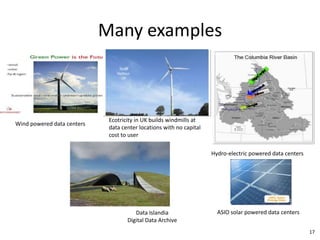
Many examples


                             Ecotricity in UK builds windmills at
Wind powered data centers
                             data center locations with no capital
                             cost to user

                                                                     Hydro-electric powered data centers


                                       Data Islandia                   ASIO solar powered data centers
                                    Digital Data Archive
                                                                                                           17
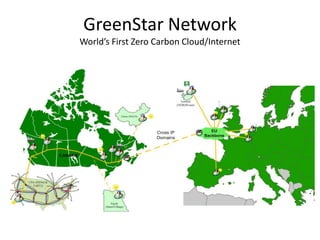
GreenStar Network
World’s First Zero Carbon Cloud/Internet
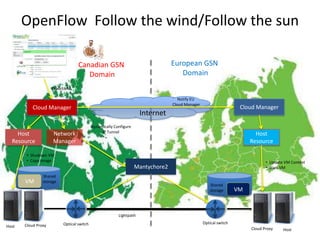
OpenFlow Follow the wind/Follow the sun

                                  Canadian GSN                                   European GSN
                                     Domain                                         Domain
                     Export VM

                                                                                    Notify EU
                                                                                 Cloud Manager
           Cloud Manager                                                                                           Cloud Manager
                                                                     Internet
                                           Dynamically Configure
                                                IP Tunnel
    Host             Network                                                                                             Host
  Resource           Manager                                                                                           Resource

        • Shudown VM
        • Copy Image                                                                                                          • Update VM Context
                                                                   Mantychore2                                                • Start VM
                Shared
       VM       storage
                                                                                                    Shared
                                                                                                    storage       VM


                                                         Lightpath
                          Optical switch                                                         Optical switch
Host   Cloud Proxy
                                                                                                                       Cloud Proxy    Host
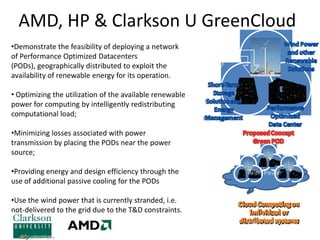
AMD, HP & Clarkson U GreenCloud
•Demonstrate the feasibility of deploying a network
of Performance Optimized Datacenters
(PODs), geographically distributed to exploit the
availability of renewable energy for its operation.

• Optimizing the utilization of the available renewable
power for computing by intelligently redistributing
computational load;

•Minimizing losses associated with power
transmission by placing the PODs near the power
source;

•Providing energy and design efficiency through the
use of additional passive cooling for the PODs

•Use the wind power that is currently stranded, i.e.
not-delivered to the grid due to the T&D constraints.
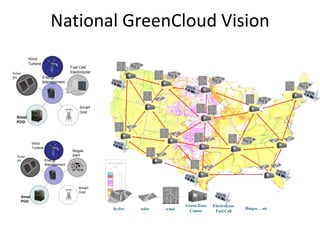
National GreenCloud Vision
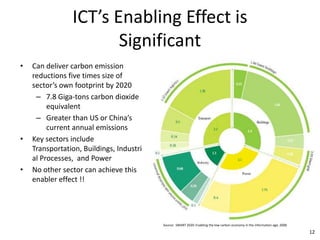
ICT’s Enabling Effect is
                       Significant
•   Can deliver carbon emission
    reductions five times size of
    sector’s own footprint by 2020
     – 7.8 Giga-tons carbon dioxide
         equivalent
     – Greater than US or China’s
         current annual emissions
•   Key sectors include
    Transportation, Buildings, Industri
    al Processes, and Power
•   No other sector can achieve this
    enabler effect !!


                                          Source: SMART 2020: Enabling the low carbon economy in the information age, 2008

                                                                                                                             12
Carbon rewards instead of carbon
                taxes?
• Governments have been wrestling with the challenge of how to reduce CO2
  emissions
    – E.g US Congress Cap and trade bill
    – BC Carbon taxes

• Rather than penalize consumers and businesses for carbon emissions, can
  we reward them for reducing their carbon emissions?
    – And stimulate important sectors of the economy that plays to our strengths


• Carbon rewards can be virtual products delivered over broadband networks
  such movies, books, education, health services, collaborative education and
  research technologies etc

• Carbon reward can also be free services (with low carbon footprint) such as
  Internet, cell phone, fiber to the home, etc
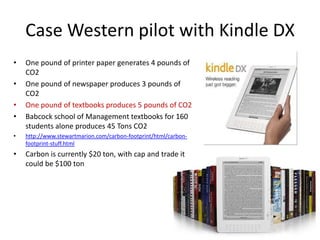
Case Western pilot with Kindle DX
•   One pound of printer paper generates 4 pounds of
    CO2
•   One pound of newspaper produces 3 pounds of
    CO2
•   One pound of textbooks produces 5 pounds of CO2
•   Babcock school of Management textbooks for 160
    students alone produces 45 Tons CO2
•   http://www.stewartmarion.com/carbon-footprint/html/carbon-
    footprint-stuff.html
•   Carbon is currently $20 ton, with cap and trade it
    could be $100 ton
Carbon Reward Strategy – Free
              Fiber to the Home
• Provide free high speed Internet and fiber to the home with resale of electrical
  and gas power
    – http://www.newamerica.net/files/HomesWithTails_wu_slater.pdf

• Customer pays a premium on their gas and electric bill

• Customers encouraged to save money through reduced energy consumption
  and reduced carbon output

• Customer NOT penalized if they reduce energy consumption
    – May end up paying substantially less then they do now for gas + electricity +
      broadband + telephone + cable

• Network operator gets guaranteed revenue based on energy consumption
  rather than fickle triple play
    – See http://free-fiber-to-the-home.blogspot.com/
Get off the Grid Part II

 Building the Future
  “Energy Internet”

 Business Opportunities


                           35
Current limitations of eVehicles (EV)
• High capital cost due to large cost of batteries

• High operating cost because batteries need to be replaced every 2-5 years

• Limited range, especially in cold weather when battery capacity is reduced

• Battery capacity reduced by up to 1/3 if air conditioning or cabin heating
  is required

• Long time to re-charge between trips
    – So a small number of short trips within a day can deplete batteries
    – Inhibits spontaneity of taking a long trip because of uncertainty of charge state

• Although operational cost (i.e. fuel consumption) is less than traditional
  automobile overall amortized cost higher

                                                                                     36
Alternative to the battery
• Rather than waiting for perfect battery why not change
  the charging system?

• Old world thinking that vehicles must be stationary to
  be refueled.
   – This was true when using fossil fuels

• But with electric vehicles there is no reason why they
  cannot be charged while on the move

• Dynamic (on the move) charging

                                                           37
Two alternative approaches
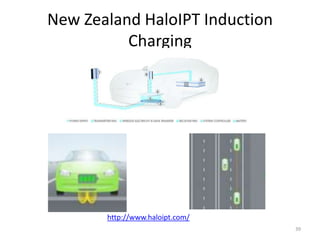
•   Induction charging with embedded induction pads in the road
    – Auckland University company in $70m deal with Qualcomm for
      inductive car charging technology
    – http://tinyurl.com/73pdksw
    – But induction charging requires precise tolerances and alignment
    – Difficult to maintain in heavy traffic and inclement weather such as ice
      and snow
    – Also requires specialized electronics in vehicle

•   Capacitive Charging using overhead “electrical umbrellas” -
    capabuses
    – Currently operation in Shanghai with public buses
    – http://www.technologyreview.com/energy/23754/


                                                                             38
New Zealand HaloIPT Induction
          Charging


       http://www.haloipt.com/
                                 39
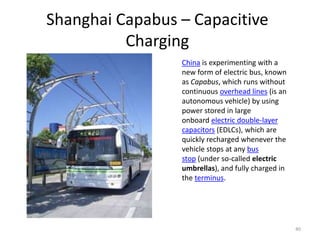
Shanghai Capabus – Capacitive
          Charging
                 China is experimenting with a
                 new form of electric bus, known
                 as Capabus, which runs without
                 continuous overhead lines (is an
                 autonomous vehicle) by using
                 power stored in large
                 onboard electric double-layer
                 capacitors (EDLCs), which are
                 quickly recharged whenever the
                 vehicle stops at any bus
                 stop (under so-called electric
                 umbrellas), and fully charged in
                 the terminus.


                                                    40
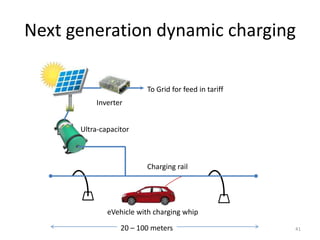
Next generation dynamic charging

                         To Grid for feed in tariff
          Inverter


      Ultra-capacitor


                         Charging rail


              eVehicle with charging whip

                  20 – 100 meters                     41
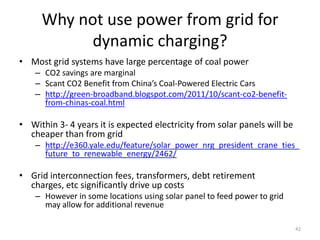
Why not use power from grid for
           dynamic charging?
• Most grid systems have large percentage of coal power
    – CO2 savings are marginal
    – Scant CO2 Benefit from China’s Coal-Powered Electric Cars
    – http://green-broadband.blogspot.com/2011/10/scant-co2-benefit-
      from-chinas-coal.html

• Within 3- 4 years it is expected electricity from solar panels will be
  cheaper than from grid
    – http://e360.yale.edu/feature/solar_power_nrg_president_crane_ties_
      future_to_renewable_energy/2462/

• Grid interconnection fees, transformers, debt retirement
  charges, etc significantly drive up costs
    – However in some locations using solar panel to feed power to grid
      may allow for additional revenue

                                                                           42
Initial target markets
• Drive through banks, fast food restaurants, parking
  garages, universities, golf courses, etc
    – “Will that be fries with your free electrical charge?”
    – Complete package of PV system on roof connected to ultra-capacitor
      and charge rail
    – When PV is not charging vehicles it can be making money from feed in
      tariff
    – Guaranteed 6-10% return even if not a single vehicle charged

• Initial target vehicles: campus service vehicles, utility fleets, golf
  carts, ride sharing, early EV adopters

• Eventually deployed at toll plazas, on/off ramps, stop lights and
  intersections


                                                                           43
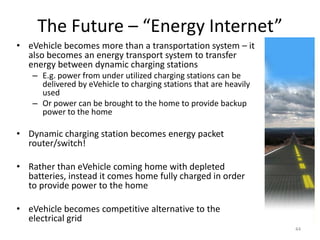
The Future – “Energy Internet”
• eVehicle becomes more than a transportation system – it
  also becomes an energy transport system to transfer
  energy between dynamic charging stations
   – E.g. power from under utilized charging stations can be
     delivered by eVehicle to charging stations that are heavily
     used
   – Or power can be brought to the home to provide backup
     power to the home

• Dynamic charging station becomes energy packet
  router/switch!

• Rather than eVehicle coming home with depleted
  batteries, instead it comes home fully charged in order
  to provide power to the home

• eVehicle becomes competitive alternative to the
  electrical grid
                                                                   44
GHG Regulation in British
         Columbia
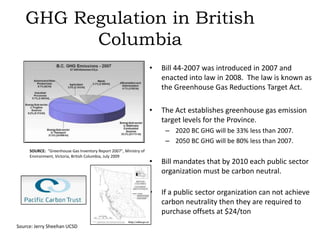
                                                                   •   Bill 44-2007 was introduced in 2007 and
                                                                       enacted into law in 2008. The law is known as
                                                                       the Greenhouse Gas Reductions Target Act.

                                                                   •   The Act establishes greenhouse gas emission
                                                                       target levels for the Province.
                                                                        – 2020 BC GHG will be 33% less than 2007.
                                                                        – 2050 BC GHG will be 80% less than 2007.
     SOURCE: “Greenhouse Gas Inventory Report 2007”, Ministry of
     Environment, Victoria, British Columbia, July 2009
                                                                   •   Bill mandates that by 2010 each public sector
                                                                       organization must be carbon neutral.

                                                                   •   If a public sector organization can not achieve
                                                                       carbon neutrality then they are required to
                                                                       purchase offsets at $24/ton
Source: Jerry Sheehan UCSD
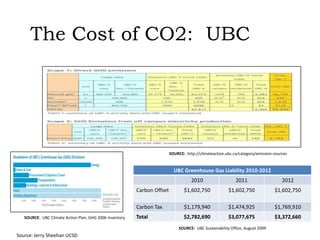
The Cost of CO2: UBC


                                                                         SOURCE: http://climateaction.ubc.ca/category/emission-sources


                                                                           UBC Greenhouse Gas Liability 2010-2012
                                                                                    2010                    2011                   2012
                                                         Carbon Offset          $1,602,750              $1,602,750             $1,602,750

                                                         Carbon Tax             $1,179,940              $1,474,925             $1,769,910
   SOURCE: UBC Climate Action Plan, GHG 2006 Inventory   Total                  $2,782,690              $3,077,675             $3,372,660
                                                                              SOURCE: UBC Sustainability Office, August 2009
Source: Jerry Sheehan UCSD
$1 billion funding program
•   Green revolving funds are either part of a university endowment program or publicly traded
    entities.
     – http://www.sustainablebusiness.com/index.cfm/go/news.display/id/23028

•   They make investments in energy efficiency and GHG reduction initiatives. Payback typically
    32%

•   ICT can represent up to 40% of the electrical energy consumption at university and growing

•   The obvious low hanging fruit is to move, as much as possible the closet clusters and campus
    data center facilities to commercial clouds. Next is network infrastructure such as routing
    and servers

•   Other obvious money saving practices are to power laptop and cell phone charging stations
    with roof top solar panels or micro windmills, deploy solar/wind powered WiFi nodes, and
    use on the move electric charging for campus utility vehicles, etc

•   Campus IT folk and NRENs need to educate managers of such funds the IT and networking
    can play a much more significant role in reducing energy consumption and GHG emissions
                                                                                                 47
    then traditional facilities based solutions
Further Reading
•   Green Investment Opportunity for small business - on the move electric car
    charging
    http://green-broadband.blogspot.com/2010/04/green-investment-opportunity-
    for-small.html

•   How California suburban sprawl could be the answer to global warming
    http://green-broadband.blogspot.com/2010/12/how-california-suburban-sprawl-
    could-be.html

•   The "Energy Internet" - how the Internet + renewable energy can transform the
    economy
    http://green-broadband.blogspot.com/2011/10/energy-internet-how-internet-
    renewable.html#more

•   Electric roads and Internet will allow coast to coast driving with no stopping and
    no emissions
    http://green-broadband.blogspot.com/2011/05/electric-roads-and-internet-will-
    allow.html


                                                                                         48
Let’s Keep The Conversation Going
                  E-mail list

                  Bill.St.Arnaud@gmail.com


                   Blogspot
Bill St. Arnaud
                   http://green-broadband.blogspot.com


                    Twitter

                    http://twitter.com/BillStArnaud

Okanagan

  • 1.
    Using ICT to“adapt” rather than “mitigate” Global Warming Bill St. Arnaud Bill.st.arnaud@gmail.com Unless otherwise noted all material in this slide deck may be reproduced, modified or distributed without prior permission of the author
  • 2.
    Theme of thistalk • We have already lost the battle to save the planet from extreme climate change. Rather than focusing on reducing energy consumption, (Mitigation) we now need to focus on surviving climate change (Adaptation) • Explosion of data and energy consumption by computers and networks is contributing to energy demand and CO2 emissions • Designing solutions to address adaptation will at the same time also address mitigation but in addition provide many significant business opportunities – Think of solutions that use no carbon and not connected to the electrical grid • Use the Internet and IT, in combination with electric vehicle to build the “Energy Internet”
  • 3.
    Although there isless news coverage global warming has not disappeared
  • 4.
    Half of USexperienced record droughts or deluges in 2011 2010 warmest year ever – we are only at the start of the curve of the hockey stick. The worst is yet to come
  • 5.
    Climate Change isnot reversible • Climate Change is not like acid rain, water management or ozone destruction where environment will quickly return to normal once source of pollution is removed • GHG emissions will stay in the atmosphere for thousands of years and continue to accumulate Weaver et al., GRL (2007) • Planet will continue to warm up All we hope to achieve is to even if we drastically reduce slow down the rapid rate of emissions climate change
  • 6.
    Climate tipping points • USGS report finds that future climate shifts have been underestimated and warns of debilitating abrupt shift in climate that would be devastating. • Tipping elements in the Earth's climate - National Academies of Science – “Society may be lulled into a false sense of security by smooth projections of global change. Our synthesis of present knowledge suggests that a variety of tipping elements could reach their critical point within this century under anthropogenic climate change. “
  • 7.
    Blame it onCanada How warming in the Arctic affects weather in Texas and Europe • Warming Arctic slowing down jet stream – There’s been a 20 percent drop in the zonal wind speeds. • As get stream slows down, it leads to those bigger, long lived kinks in the jet stream. – That amplification is associated with persistent weather patterns that lead to “extremes” like drought, flooding and heat waves. • Those slow-moving, persistent waves of weather energy may have played a role in the big snows that hammered Europe this winters, as well as the extreme drought that hit South West US • http://summitcountyvoice.com/2012/01/14/ global-warming-revenge-of-the-atmosphere/ 7
  • 8.
    Future Droughts • PalmerDrought Severity Index, or PDSI. • The most severe drought in recent history, in the Sahel region of western Africa in the 1970s, had a PDSI of -3 or -4. • By 2030 Western USA could see -4 to -6. Drought in Texas clearly caused by global warming: http://goo.gl/QjHRS • By 2100 some parts of the U.S. and Latin America could see -8 to - 10 PDSI, while Mediterranean areas could see drought in the -15 http://www.msnbc.msn.com/id/39741525/ns/us_new or -20 range. s-environment/
  • 9.
    Dramatic changes inprecipitation • Every continent has suffered record rainfalls • Rains submerged one-fifth of Pakistan, a thousand-year deluge swamped Nashville and storms just north of Rio caused the deadliest landslides Brazil has ever seen. • Observed increase in precipitation in the last few decades has been due in large part to a disproportionate increase in heavy and extreme precipitation rates which are exceeding predictions made in models
  • 10.
    Western Antarctic IceSheet (WAIS) • Sits on land below sea level • Can easily break up once sea water gets under ice • Originally thought that breakup would take hundreds of years • New evidence indicates that breakup will happen within 40 years when planet warms up 1C (we are already up .8C) •S ea levels would be 3.3m – 4.8m •Ice collapsed as recent as 125,000 years ago •IPCC says ice is one of the poorest understood areas http://news.discovery.com/earth/how-stable-is- the-west-antarctic-ice-sheet.html Sea levels may rise 3x faster than predicted by IPCC http://climateprogress.org/2009/12/09/sea-level- rise-six-feet-three-times-faster-than-the-ipcc- estimat/
  • 11.
    Climate Forecasts • MIT report predicts median temperature forecast of 5.2°C – 11°C increase in Northern Canada & Europe – http://globalchange.mit.edu/pubs/abstract.p hp?publication_id=990 MIT • Last Ice age average global temperature was 5-6°C cooler than today – Most of Canada & Europe was under 2-3 km ice • Nearly 90 per cent of new scientific findings reveal global climate disruption to be worse, and progressing more rapidly, than expected. • http://www.skepticalscience.com/pics/Freud enburg_2010_ASC.pdf
  • 12.
    What does 1Caverage temperature mean? • In the 1700s – when global average temperature was 1C colder than now, New Yorkers could walk from Manhattan to Staten Island on ice as thick as 8 feet – http://green.blogs.nytimes.com/2012/01/31/in- the-little-ice-age-lessons-for-today/ 12
  • 13.
    CO2 vs Temperature Rule of Thumb: 1°C for 10 ppm CO2
  • 14.
    Climate Sensitivity The Worst is yet to come Rapid Increase in the Greenhouse Gas CO2 Since Industrial Era Began Medieval Warm Little Period Ice Age 1000 1200 1400 1600 1800 2000
  • 15.
    Urgency of Action • “We’re uncertain about the magnitude of climate change, which is inevitable, because we’re talking about reaching levels of carbon dioxide in the atmosphere not seen in millions of years. • You might think that this uncertainty weakens the case for action, but it actually strengthens it. • This risk of catastrophe, rather than the details of cost-benefit calculations, makes the most powerful case for strong climate policy. Nobel Laureate Paul • Current projections of global warming in the absence of action are just Krugman too close to the kinds of numbers associated with doomsday scenarios. It would be irresponsible — it’s tempting to say criminally irresponsible http://www.nytimes.com/201 — not to step back from what could all too easily turn out to be the 0/04/11/magazine/11Econom edge of a cliff.” y-t.html?pagewanted=1
  • 16.
    New Challenge: ClimateAdaptation • Obama’s National Science Advisor John Holdren “Mitigation alone won’t work, because the climate is already changing, we’re already experiencing impacts….A mitigation only strategy would be insanity,” • Equal emphasis given to adaptation – avoiding the unmanageable, and adaptation – managing the unavoidable.” • Obama’s Climate Adaptation Executive Order – http://www.stumbleupon.com/su/1tU8go/www.good.is/post/obama-s-secret-climate-adaptation-plan/
  • 17.
    Impact of ICTsector According to IEA ICT will represent 40% of all energy consumption by 2030 www.smart2020.org ICT represent 8% of global electricity consumption Future Broadband- Internet alone is expected to consume 5% of all electricity http://www.ee.unimelb.edu.au/people/rst/talks/files/Tucker_Green_Plenary.pdf
  • 18.
    Growth Projections DataCenters • Half of ICT consumption is data centers • In ten years 50% of today’s Data Centers and major science facilities in the US will have insufficient power and cooling;* • By 2012, half of all Data Centers will have to relocate or outsource applications to another facility.* • CO2 emissions from US datacenters greater than all CO2 emissions from Netherlands or Argentina http://bit.ly/cW6jEY • Coal fuels much of Internet 'cloud,' Greenpeace says http://bit.ly/bkeSec • Data centers will consume 12% of electricity in the US by 2020 (TV Telecom) Source: Gartner; Meeting the DC power and cooling challenge
  • 19.
    R&E biggest consumer!! Peremployee Per sector Australian Computer Society Study http://www.acs.org.au/attachments/ICFACSV4100412.pdf
  • 20.
  • 21.
    The Falsehood ofEnergy Efficiency • Most current approaches to reduce carbon footprint are focused on increased energy efficiency of equipment and processes – No question it save money, but does little for the environment • Greenpeace Report “Electricity demand of IT remains on the rise, efficiency can only slow emission growth. In order to achieve the reductions necessary to keep the sector’s emissions in check and maintains afe levels of global greenhouse gases, clean energy needs to become the primary source of power for IT infrastructure. – Greenpeace “How dirty is your data” http://www.greenpeace.org/international/Global/international/publications/cli mate/2011/Cool%20IT/dirty-data-report-greenpeace.pdf • But greater efficiency can paradoxically increase energy consumption by reducing overall cost service and therefore stimulates demand – Khazzoom-Brookes postulate (aka Jevons paradox - not to be confused with rebound effect) • The issue is not the amount of energy that we use, but the type of energy
  • 22.
    Zero Carbon strategyessential • Zero carbon strategy using renewable energy critically important if governments mandate carbon neutrality, or if there is a climate catastrophe • With a zero carbon strategy growth in demand for services will not effect GHG emissions – Anything times zero is always zero • Wind and solar power are most likely candidates because of opportunity cost/benefit analysis especially time to deploy – Nuclear has high opportunity cost because of time to deploy – http://climateprogress.org/2008/12/14/stanford-study-part-1-wind- solar-baseload-easily-beat-nuclear-and-they-all-best-clean-coal/ • But renewable energy sites are usually located far from cities and electrical distribution systems are not designed to carry load – http://www.americanprogress.org/issues/2008/12/pdf/renewable_tra nsmission.pdf – Local wind/solar will be an important component
  • 23.
    Get off theGrid! • Purchasing green power locally is expensive with significant transmission line losses –Demand for green power within cities expected to grow dramatically • ICT facilities DON’T NEED TO BE LOCATED IN CITIES –-Cooling also a major problem in cities • But most renewable energy sites are very remote and impractical to connect to electrical grid. – Can be easily reached by an optical network – Provide independence from electrical utility and high costs in wheeling power – Savings in transmission line losses (up to 15%) alone, plus carbon offsets can pay for moving ICT facilities to renewable energy site •ICT is only industry ideally suited to relocate to renewable energy sites – Also ideal for business continuity in event of climate catastrophe
  • 24.
    MIT to buildzero carbon data center in Holyoke MA • The data center will be managed and funded by the four main partners in the facility: the Massachusetts Institute of Technology, Cisco Systems, the University of Massachusetts and EMC. • It will be a high-performance computing environment that will help expand the research and development capabilities of the companies and schools in Holyoke – http://www.greenercomputing.com/news/2009/06/11/ci sco-emc-team-mit-launch-100m-green-data-center
  • 25.
    “The best placein North America for Data Center”- CIO Magazine • Partnership between IBM and Rackforce • $100m investment – 85,000 sq ft • Cheap renewable power, well educated community, geological stability • Hydro electric power as low as 2 cents per kilowatt, versus 20 cents in Kelowna BC other jurisdiction http://www.cio.com/article/183256/The_Best_Place_to_Build_a_Data_Center_in_North_America
  • 26.
    Many examples Ecotricity in UK builds windmills at Wind powered data centers data center locations with no capital cost to user Hydro-electric powered data centers Data Islandia ASIO solar powered data centers Digital Data Archive 17
  • 27.
    GreenStar Network World’s FirstZero Carbon Cloud/Internet
  • 28.
    OpenFlow Follow thewind/Follow the sun Canadian GSN European GSN Domain Domain Export VM Notify EU Cloud Manager Cloud Manager Cloud Manager Internet Dynamically Configure IP Tunnel Host Network Host Resource Manager Resource • Shudown VM • Copy Image • Update VM Context Mantychore2 • Start VM Shared VM storage Shared storage VM Lightpath Optical switch Optical switch Host Cloud Proxy Cloud Proxy Host
  • 29.
    AMD, HP &Clarkson U GreenCloud •Demonstrate the feasibility of deploying a network of Performance Optimized Datacenters (PODs), geographically distributed to exploit the availability of renewable energy for its operation. • Optimizing the utilization of the available renewable power for computing by intelligently redistributing computational load; •Minimizing losses associated with power transmission by placing the PODs near the power source; •Providing energy and design efficiency through the use of additional passive cooling for the PODs •Use the wind power that is currently stranded, i.e. not-delivered to the grid due to the T&D constraints.
  • 30.
  • 31.
    ICT’s Enabling Effectis Significant • Can deliver carbon emission reductions five times size of sector’s own footprint by 2020 – 7.8 Giga-tons carbon dioxide equivalent – Greater than US or China’s current annual emissions • Key sectors include Transportation, Buildings, Industri al Processes, and Power • No other sector can achieve this enabler effect !! Source: SMART 2020: Enabling the low carbon economy in the information age, 2008 12
  • 32.
    Carbon rewards insteadof carbon taxes? • Governments have been wrestling with the challenge of how to reduce CO2 emissions – E.g US Congress Cap and trade bill – BC Carbon taxes • Rather than penalize consumers and businesses for carbon emissions, can we reward them for reducing their carbon emissions? – And stimulate important sectors of the economy that plays to our strengths • Carbon rewards can be virtual products delivered over broadband networks such movies, books, education, health services, collaborative education and research technologies etc • Carbon reward can also be free services (with low carbon footprint) such as Internet, cell phone, fiber to the home, etc
  • 33.
    Case Western pilotwith Kindle DX • One pound of printer paper generates 4 pounds of CO2 • One pound of newspaper produces 3 pounds of CO2 • One pound of textbooks produces 5 pounds of CO2 • Babcock school of Management textbooks for 160 students alone produces 45 Tons CO2 • http://www.stewartmarion.com/carbon-footprint/html/carbon- footprint-stuff.html • Carbon is currently $20 ton, with cap and trade it could be $100 ton
  • 34.
    Carbon Reward Strategy– Free Fiber to the Home • Provide free high speed Internet and fiber to the home with resale of electrical and gas power – http://www.newamerica.net/files/HomesWithTails_wu_slater.pdf • Customer pays a premium on their gas and electric bill • Customers encouraged to save money through reduced energy consumption and reduced carbon output • Customer NOT penalized if they reduce energy consumption – May end up paying substantially less then they do now for gas + electricity + broadband + telephone + cable • Network operator gets guaranteed revenue based on energy consumption rather than fickle triple play – See http://free-fiber-to-the-home.blogspot.com/
  • 35.
    Get off theGrid Part II Building the Future “Energy Internet” Business Opportunities 35
  • 36.
    Current limitations ofeVehicles (EV) • High capital cost due to large cost of batteries • High operating cost because batteries need to be replaced every 2-5 years • Limited range, especially in cold weather when battery capacity is reduced • Battery capacity reduced by up to 1/3 if air conditioning or cabin heating is required • Long time to re-charge between trips – So a small number of short trips within a day can deplete batteries – Inhibits spontaneity of taking a long trip because of uncertainty of charge state • Although operational cost (i.e. fuel consumption) is less than traditional automobile overall amortized cost higher 36
  • 37.
    Alternative to thebattery • Rather than waiting for perfect battery why not change the charging system? • Old world thinking that vehicles must be stationary to be refueled. – This was true when using fossil fuels • But with electric vehicles there is no reason why they cannot be charged while on the move • Dynamic (on the move) charging 37
  • 38.
    Two alternative approaches • Induction charging with embedded induction pads in the road – Auckland University company in $70m deal with Qualcomm for inductive car charging technology – http://tinyurl.com/73pdksw – But induction charging requires precise tolerances and alignment – Difficult to maintain in heavy traffic and inclement weather such as ice and snow – Also requires specialized electronics in vehicle • Capacitive Charging using overhead “electrical umbrellas” - capabuses – Currently operation in Shanghai with public buses – http://www.technologyreview.com/energy/23754/ 38
  • 39.
    New Zealand HaloIPTInduction Charging http://www.haloipt.com/ 39
  • 40.
    Shanghai Capabus –Capacitive Charging China is experimenting with a new form of electric bus, known as Capabus, which runs without continuous overhead lines (is an autonomous vehicle) by using power stored in large onboard electric double-layer capacitors (EDLCs), which are quickly recharged whenever the vehicle stops at any bus stop (under so-called electric umbrellas), and fully charged in the terminus. 40
  • 41.
    Next generation dynamiccharging To Grid for feed in tariff Inverter Ultra-capacitor Charging rail eVehicle with charging whip 20 – 100 meters 41
  • 42.
    Why not usepower from grid for dynamic charging? • Most grid systems have large percentage of coal power – CO2 savings are marginal – Scant CO2 Benefit from China’s Coal-Powered Electric Cars – http://green-broadband.blogspot.com/2011/10/scant-co2-benefit- from-chinas-coal.html • Within 3- 4 years it is expected electricity from solar panels will be cheaper than from grid – http://e360.yale.edu/feature/solar_power_nrg_president_crane_ties_ future_to_renewable_energy/2462/ • Grid interconnection fees, transformers, debt retirement charges, etc significantly drive up costs – However in some locations using solar panel to feed power to grid may allow for additional revenue 42
  • 43.
    Initial target markets •Drive through banks, fast food restaurants, parking garages, universities, golf courses, etc – “Will that be fries with your free electrical charge?” – Complete package of PV system on roof connected to ultra-capacitor and charge rail – When PV is not charging vehicles it can be making money from feed in tariff – Guaranteed 6-10% return even if not a single vehicle charged • Initial target vehicles: campus service vehicles, utility fleets, golf carts, ride sharing, early EV adopters • Eventually deployed at toll plazas, on/off ramps, stop lights and intersections 43
  • 44.
    The Future –“Energy Internet” • eVehicle becomes more than a transportation system – it also becomes an energy transport system to transfer energy between dynamic charging stations – E.g. power from under utilized charging stations can be delivered by eVehicle to charging stations that are heavily used – Or power can be brought to the home to provide backup power to the home • Dynamic charging station becomes energy packet router/switch! • Rather than eVehicle coming home with depleted batteries, instead it comes home fully charged in order to provide power to the home • eVehicle becomes competitive alternative to the electrical grid 44
  • 45.
    GHG Regulation inBritish Columbia • Bill 44-2007 was introduced in 2007 and enacted into law in 2008. The law is known as the Greenhouse Gas Reductions Target Act. • The Act establishes greenhouse gas emission target levels for the Province. – 2020 BC GHG will be 33% less than 2007. – 2050 BC GHG will be 80% less than 2007. SOURCE: “Greenhouse Gas Inventory Report 2007”, Ministry of Environment, Victoria, British Columbia, July 2009 • Bill mandates that by 2010 each public sector organization must be carbon neutral. • If a public sector organization can not achieve carbon neutrality then they are required to purchase offsets at $24/ton Source: Jerry Sheehan UCSD
  • 46.
    The Cost ofCO2: UBC SOURCE: http://climateaction.ubc.ca/category/emission-sources UBC Greenhouse Gas Liability 2010-2012 2010 2011 2012 Carbon Offset $1,602,750 $1,602,750 $1,602,750 Carbon Tax $1,179,940 $1,474,925 $1,769,910 SOURCE: UBC Climate Action Plan, GHG 2006 Inventory Total $2,782,690 $3,077,675 $3,372,660 SOURCE: UBC Sustainability Office, August 2009 Source: Jerry Sheehan UCSD
  • 47.
    $1 billion fundingprogram • Green revolving funds are either part of a university endowment program or publicly traded entities. – http://www.sustainablebusiness.com/index.cfm/go/news.display/id/23028 • They make investments in energy efficiency and GHG reduction initiatives. Payback typically 32% • ICT can represent up to 40% of the electrical energy consumption at university and growing • The obvious low hanging fruit is to move, as much as possible the closet clusters and campus data center facilities to commercial clouds. Next is network infrastructure such as routing and servers • Other obvious money saving practices are to power laptop and cell phone charging stations with roof top solar panels or micro windmills, deploy solar/wind powered WiFi nodes, and use on the move electric charging for campus utility vehicles, etc • Campus IT folk and NRENs need to educate managers of such funds the IT and networking can play a much more significant role in reducing energy consumption and GHG emissions 47 then traditional facilities based solutions
  • 48.
    Further Reading • Green Investment Opportunity for small business - on the move electric car charging http://green-broadband.blogspot.com/2010/04/green-investment-opportunity- for-small.html • How California suburban sprawl could be the answer to global warming http://green-broadband.blogspot.com/2010/12/how-california-suburban-sprawl- could-be.html • The "Energy Internet" - how the Internet + renewable energy can transform the economy http://green-broadband.blogspot.com/2011/10/energy-internet-how-internet- renewable.html#more • Electric roads and Internet will allow coast to coast driving with no stopping and no emissions http://green-broadband.blogspot.com/2011/05/electric-roads-and-internet-will- allow.html 48
  • 49.
    Let’s Keep TheConversation Going E-mail list Bill.St.Arnaud@gmail.com Blogspot Bill St. Arnaud http://green-broadband.blogspot.com Twitter http://twitter.com/BillStArnaud

Editor's Notes

  • #25 Building a zero carbon ICT infrastructurePurchasing green power locally is expensive with significant transmission line lossesDemand for green power within cities expected to grow dramaticallyICT facilities DON’T NEED TO BE LOCATED IN CITIES-Cooling also a major problem in citiesBut most renewable energy sites are very remote and impractical to connect to electrical grid. Can be easily reached by an optical network Provide independence from electrical utility and high costs in wheeling power Savings in transmission line losses (up to 15%) alone, plus carbon offsets can pay for moving ICT facilities to renewable energy siteICT is only industry ideally suited to relocate to renewable energy sites Also ideal for business continuity in event of climate catastrophe