10 years agoThree major issues:Very hierarchical IP networksLimited ability to innovate or support high end usersSupporting high science users on campusFirewalls, misconfigs, limited bandwidth Heterogeneous independent customer owned fiber networksBut how do you build end to end solutions from independent federated networks?
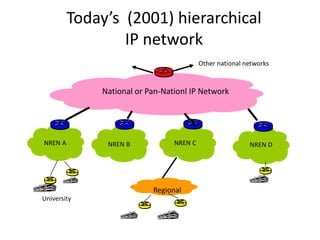
RegionalToday’s  (2001) hierarchical IP networkOther national networksNational or Pan-Nationl IP NetworkNREN ANREN CNREN BNREN DUniversity
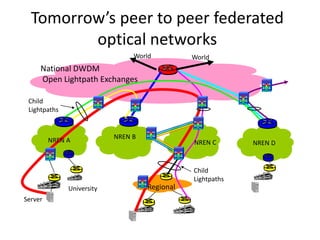
RegionalTomorrow’s peer to peer federated optical networksWorldWorldNational DWDMOpen Lightpath ExchangesChildLightpathsNREN BNREN ANREN CNREN DChild LightpathsUniversityServer
Thanks to GLIF and LHCONEOur vision for optical lightpath exchanges (GOLEs) is now becoming a realityLHCONE will drive this new network realityHierarchical IP R&E networks will not disappear – but will be complemented by direct optical connections through GLIF and GOLEs especially for eScience
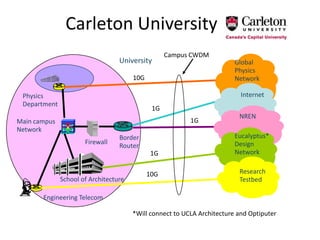
Carleton UniversityCampus CWDMUniversityGlobalPhysicsNetwork10GInternetPhysicsDepartment1GNREN1GMain campusNetworkEucalyptus*Design NetworkBorderRouterFirewall1GResearchTestbed10GSchool of ArchitectureEngineering Telecom*Will connect to UCLA Architecture and Optiputer
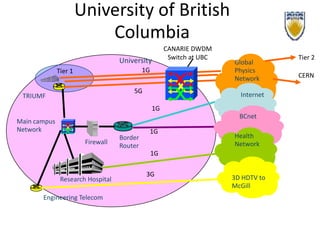
University of British ColumbiaCANARIE DWDMSwitch at UBCTier 2UniversityGlobalPhysicsNetwork1GTier 1CERN5GInternetTRIUMF1GBCnetMain campusNetwork1GHealth NetworkBorderRouterFirewall1G3G3D HDTV toMcGillResearch HospitalEngineering Telecom
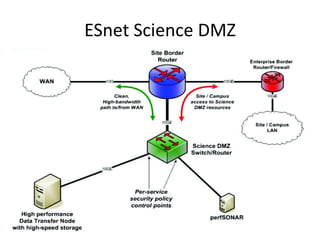
ESnet Science DMZ
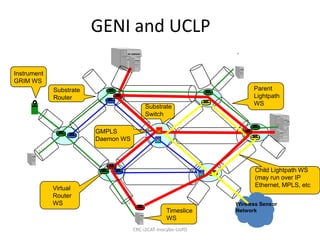
GENI and UCLP InstrumentGRIM WSParentLightpathWSSubstrate RouterSubstrateSwitchGMPLSDaemon WSChild Lightpath WS(may run over IPEthernet, MPLS, etcVirtualRouterWSWireless SensorNetworkTimesliceWSCRC-i2CAT-Inocybe-UofO
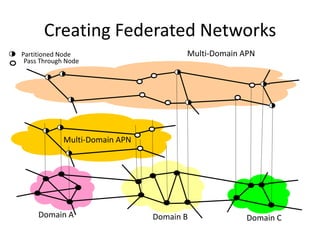
Creating Federated NetworksMulti-Domain APNPartitioned NodePass Through NodeMulti-Domain APNDomain ADomain BDomain C
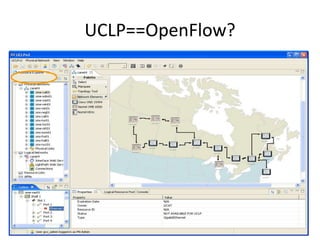
CRC-i2CAT-Inocybe-UofOUCLP==OpenFlow?
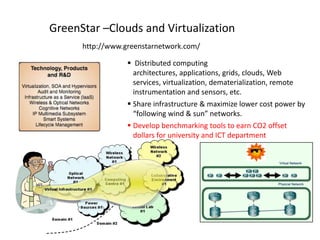
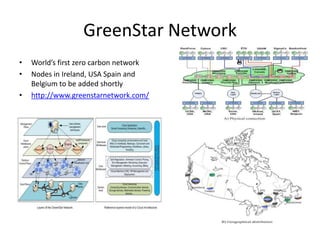
GreenStar –Clouds and Virtualizationhttp://www.greenstarnetwork.com/ Distributed computing architectures, applications, grids, clouds, Web services, virtualization, dematerialization, remote instrumentation and sensors, etc.
Share infrastructure & maximize lower cost power by “following wind & sun” networks.
Develop benchmarking tools to earn CO2 offset dollars for university and ICT departmentGreenStar NetworkWorld’s first zero carbon networkNodes in Ireland, USA Spain and Belgium to be added shortlyhttp://www.greenstarnetwork.com/
What are the major future challenges and opportunities?Universities are under increasing financial pressure Need to reduce costs across the board including fees to eScience infrastructureIT energy consumption 20-40%Increasing demand for more eScience research and applicationsIncreasing demand for nation wide mobile seamless services especially for personal health applications Very little disaster planning, especially from climate change
My predictions -1R&E networks will need to partner with industry and campus IT to develop solutions for eScience and general IP to reduce staff workload and energy costsCampus IT don’t have technical resources or budget to deal with DNSESC, IPv6, eScienceOttawa University recently contract with Bell Canada for management of their 3500 HotspotsFederated optical network linking GOLEs will be dominant network architecture (perhaps based on OpenFLOW

On vector looking forward

  • 1.
    10 years agoThreemajor issues:Very hierarchical IP networksLimited ability to innovate or support high end usersSupporting high science users on campusFirewalls, misconfigs, limited bandwidth Heterogeneous independent customer owned fiber networksBut how do you build end to end solutions from independent federated networks?
  • 2.
    RegionalToday’s (2001)hierarchical IP networkOther national networksNational or Pan-Nationl IP NetworkNREN ANREN CNREN BNREN DUniversity
  • 3.
    RegionalTomorrow’s peer topeer federated optical networksWorldWorldNational DWDMOpen Lightpath ExchangesChildLightpathsNREN BNREN ANREN CNREN DChild LightpathsUniversityServer
  • 4.
    Thanks to GLIFand LHCONEOur vision for optical lightpath exchanges (GOLEs) is now becoming a realityLHCONE will drive this new network realityHierarchical IP R&E networks will not disappear – but will be complemented by direct optical connections through GLIF and GOLEs especially for eScience
  • 5.
    Carleton UniversityCampus CWDMUniversityGlobalPhysicsNetwork10GInternetPhysicsDepartment1GNREN1GMaincampusNetworkEucalyptus*Design NetworkBorderRouterFirewall1GResearchTestbed10GSchool of ArchitectureEngineering Telecom*Will connect to UCLA Architecture and Optiputer
  • 6.
    University of BritishColumbiaCANARIE DWDMSwitch at UBCTier 2UniversityGlobalPhysicsNetwork1GTier 1CERN5GInternetTRIUMF1GBCnetMain campusNetwork1GHealth NetworkBorderRouterFirewall1G3G3D HDTV toMcGillResearch HospitalEngineering Telecom
  • 7.
  • 8.
    GENI and UCLPInstrumentGRIM WSParentLightpathWSSubstrate RouterSubstrateSwitchGMPLSDaemon WSChild Lightpath WS(may run over IPEthernet, MPLS, etcVirtualRouterWSWireless SensorNetworkTimesliceWSCRC-i2CAT-Inocybe-UofO
  • 9.
    Creating Federated NetworksMulti-DomainAPNPartitioned NodePass Through NodeMulti-Domain APNDomain ADomain BDomain C
  • 10.
  • 11.
    GreenStar –Clouds andVirtualizationhttp://www.greenstarnetwork.com/ Distributed computing architectures, applications, grids, clouds, Web services, virtualization, dematerialization, remote instrumentation and sensors, etc.
  • 12.
    Share infrastructure &maximize lower cost power by “following wind & sun” networks.
  • 13.
    Develop benchmarking toolsto earn CO2 offset dollars for university and ICT departmentGreenStar NetworkWorld’s first zero carbon networkNodes in Ireland, USA Spain and Belgium to be added shortlyhttp://www.greenstarnetwork.com/
  • 14.
    What are themajor future challenges and opportunities?Universities are under increasing financial pressure Need to reduce costs across the board including fees to eScience infrastructureIT energy consumption 20-40%Increasing demand for more eScience research and applicationsIncreasing demand for nation wide mobile seamless services especially for personal health applications Very little disaster planning, especially from climate change
  • 15.
    My predictions -1R&Enetworks will need to partner with industry and campus IT to develop solutions for eScience and general IP to reduce staff workload and energy costsCampus IT don’t have technical resources or budget to deal with DNSESC, IPv6, eScienceOttawa University recently contract with Bell Canada for management of their 3500 HotspotsFederated optical network linking GOLEs will be dominant network architecture (perhaps based on OpenFLOW