NREN strategies for Data-Intensive
Science in a Carbon Constrained
             World


               Bill St. Arnaud
       Bill.st.arnaud@gmail.com

   Unless otherwise noted all material in this slide deck may be reproduced,
   modified or distributed without prior permission of the author
Theme of this talk

• We have already lost the battle to save the planet from extreme
  climate change. Rather than focusing on reducing energy
  consumption, (Mitigation) we now need to focus on surviving
  climate change (Adaptation)

• Explosion of data and energy consumption by computers and
  networks is contributing to energy demand and CO2 emissions

• But big data and science will be critical as move to focus on
  adapting to climate change

• How can Internet and IT help us build NRENs and support science
  and education that can adapt to global warming?
Changing NREN
           networking environment
• Global Virtual Research Communities
• Increasing co-operation between public and private
  researchers
• Rapidly changing users demands
• Increasing potential of commercial ICT-service providers
• Education: any time, any place, any device
• Citizen Science and M2M communications and sensors
• The disappearing campus IT & diminishing expertise in ICT
  centres of connected institutions
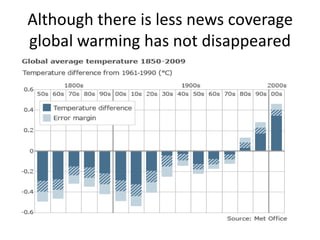
Although there is less news coverage
global warming has not disappeared
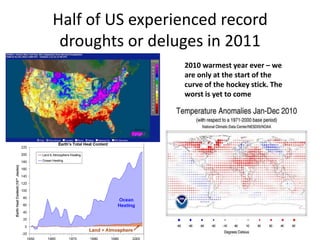
Half of US experienced record
 droughts or deluges in 2011
                 2010 warmest year ever – we
                 are only at the start of the
                 curve of the hockey stick. The
                 worst is yet to come
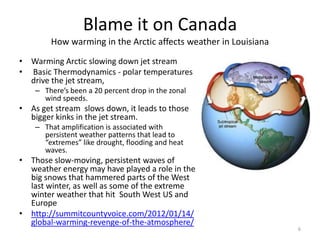
Blame it on Canada
        How warming in the Arctic affects weather in Louisiana
• Warming Arctic slowing down jet stream
• Basic Thermodynamics - polar temperatures
  drive the jet stream,
    – There’s been a 20 percent drop in the zonal
      wind speeds.
• As get stream slows down, it leads to those
  bigger kinks in the jet stream.
    – That amplification is associated with
      persistent weather patterns that lead to
      “extremes” like drought, flooding and heat
      waves.
• Those slow-moving, persistent waves of
  weather energy may have played a role in the
  big snows that hammered parts of the West
  last winter, as well as some of the extreme
  winter weather that hit South West US and
  Europe
• http://summitcountyvoice.com/2012/01/14/
  global-warming-revenge-of-the-atmosphere/
                                                                 6
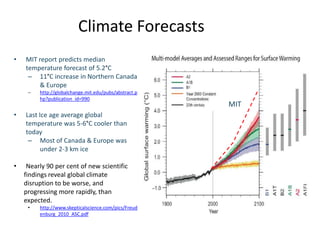
Climate Forecasts
•   MIT report predicts median
    temperature forecast of 5.2°C
     – 11°C increase in Northern Canada
        & Europe
     –   http://globalchange.mit.edu/pubs/abstract.p
         hp?publication_id=990
                                                       MIT
•   Last Ice age average global
    temperature was 5-6°C cooler than
    today
     – Most of Canada & Europe was
          under 2-3 km ice

•    Nearly 90 per cent of new scientific
    findings reveal global climate
    disruption to be worse, and
    progressing more rapidly, than
    expected.
     •   http://www.skepticalscience.com/pics/Freud
         enburg_2010_ASC.pdf
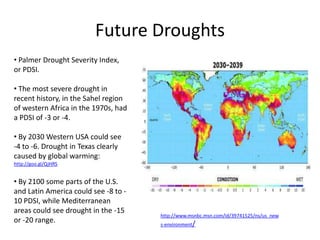
Future Droughts
• Palmer Drought Severity Index,
or PDSI.

• The most severe drought in
recent history, in the Sahel region
of western Africa in the 1970s, had
a PDSI of -3 or -4.

• By 2030 Western USA could see
-4 to -6. Drought in Texas clearly
caused by global warming:
http://goo.gl/QjHRS


• By 2100 some parts of the U.S.
and Latin America could see -8 to -
10 PDSI, while Mediterranean
areas could see drought in the -15
                                      http://www.msnbc.msn.com/id/39741525/ns/us_new
or -20 range.                         s-environment/
Dramatic changes in precipitation


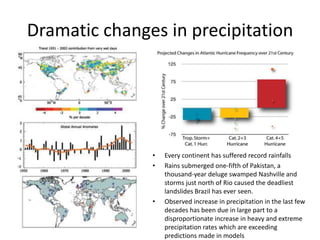
               •   Every continent has suffered record rainfalls
               •   Rains submerged one-fifth of Pakistan, a
                   thousand-year deluge swamped Nashville and
                   storms just north of Rio caused the deadliest
                   landslides Brazil has ever seen.
               •   Observed increase in precipitation in the last few
                   decades has been due in large part to a
                   disproportionate increase in heavy and extreme
                   precipitation rates which are exceeding
                   predictions made in models
New Challenge: Climate Adaptation
• Obama’s National Science Advisor John Holdren
  “Mitigation alone won’t work, because the climate is
  already changing, we’re already experiencing
  impacts….A mitigation only strategy would be
  insanity,”

• Equal emphasis given to adaptation – avoiding the
  unmanageable, and adaptation – managing the
  unavoidable.”

• Obama’s Climate Adaptation Executive Order
   –   http://www.stumbleupon.com/su/1tU8go/www.good.is/post/obama-s-secret-climate-adaptation-plan/
Climate Change Impact on Internet
              and NRENs
• UK Government study Climate Change could ruin the Internet
    –   http://www.grist.org/list/2011-05-09-climate-change-could-ruin-the-internet


• California aims to have 30% renewable power
    – Impact on reliability of power systems

• Last year Nuclear power plants in France were forced to shut down
  because cooling water was too warm

• Germany is committed to shutting down all of its nuclear plants

• Droughts will restrict production of hydro-electric power

• Energy shortages and disruptions are predicted to increase in the
  coming years
Impact on ICT sector
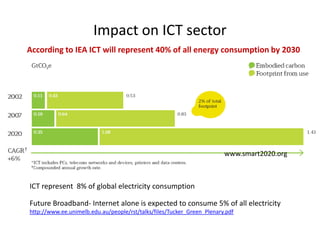
According to IEA ICT will represent 40% of all energy consumption by 2030


                                                                        www.smart2020.org


ICT represent 8% of global electricity consumption

Future Broadband- Internet alone is expected to consume 5% of all electricity
http://www.ee.unimelb.edu.au/people/rst/talks/files/Tucker_Green_Plenary.pdf
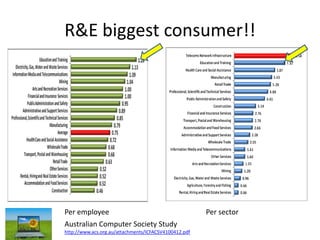
R&E biggest consumer!!


Per employee                                           Per sector
Australian Computer Society Study
http://www.acs.org.au/attachments/ICFACSV4100412.pdf
The ICT energy consumption in
                   higher- ed
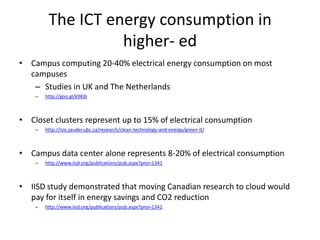
• Campus computing 20-40% electrical energy consumption on most
  campuses
   – Studies in UK and The Netherlands
    –   http://goo.gl/k9Kib


• Closet clusters represent up to 15% of electrical consumption
    –   http://isis.sauder.ubc.ca/research/clean-technology-and-energy/green-it/


• Campus data center alone represents 8-20% of electrical consumption
    –   http://www.iisd.org/publications/pub.aspx?pno=1341


• IISD study demonstrated that moving Canadian research to cloud would
  pay for itself in energy savings and CO2 reduction
    –   http://www.iisd.org/publications/pub.aspx?pno=1341
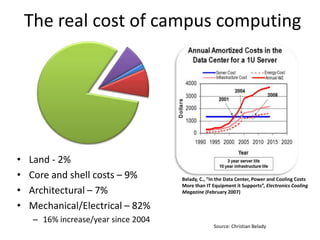
The real cost of campus computing


•   Land - 2%
•   Core and shell costs – 9%         Belady, C., “In the Data Center, Power and Cooling Costs
                                      More than IT Equipment it Supports”, Electronics Cooling
•   Architectural – 7%                Magazine (February 2007)

•   Mechanical/Electrical – 82%
     – 16% increase/year since 2004
                                                    Source: Christian Belady
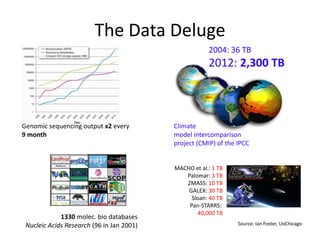
The Data Deluge
                                                       2004: 36 TB
                                                       2012: 2,300 TB


Genomic sequencing output x2 every         Climate
9 month                                    model intercomparison
                                           project (CMIP) of the IPCC


                                           MACHO et al.: 1 TB
                                              Palomar: 3 TB
                                              2MASS: 10 TB
                                               GALEX: 30 TB
                                                Sloan: 40 TB
                                               Pan-STARRS:
                                                  40,000 TB
             1330 molec. bio databases
 Nucleic Acids Research (96 in Jan 2001)                         Source: Ian Foster, UoChicago
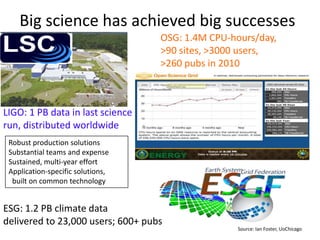
Big science has achieved big successes
                                   OSG: 1.4M CPU-hours/day,
                                   >90 sites, >3000 users,
                                   >260 pubs in 2010


LIGO: 1 PB data in last science
run, distributed worldwide
 Robust production solutions
 Substantial teams and expense
 Sustained, multi-year effort
 Application-specific solutions,
  built on common technology


ESG: 1.2 PB climate data
delivered to 23,000 users; 600+ pubs
                                                   Source: Ian Foster, UoChicago
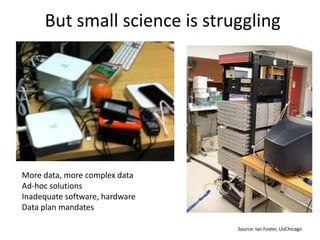
But small science is struggling


More data, more complex data
Ad-hoc solutions
Inadequate software, hardware
Data plan mandates

                                Source: Ian Foster, UoChicago
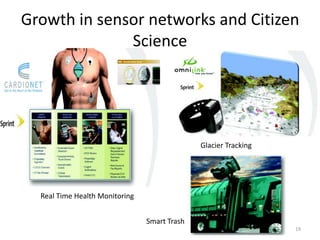
Growth in sensor networks and Citizen
              Science


                                              Glacier Tracking


  Real Time Health Monitoring


                                Smart Trash
                                                                 19
THE CHALLENGE
We need solutions to address climate change, data deluge,
needs of scientists, global collaboration, the evolving
network of any time, any place, any device and yet addresses
the challenge of disappearing IT on campus while still
providing a leadership role in next generation Internet and
broadband, and find ways to pay for it all in an era of severe
fiscal constraint.
THE SOLUTION

 1.   Brokered Green Clouds and off site campus IT
 2.   Software Defined Networks (OpenFlow)
 3.   NREN national wireless network
 4.   Global Interconnected Dynamic Optical Networks
 5.   eScience Platforms with next gen IdM
 6.   Community anchor IXPs with CDN and M2M hosting
 7.   New billion dollar revolving green energy funds at many
      universities

                                                                21
1. Brokered Green Clouds and off
site CAMPUS IT


                                   22
Universities moving to eliminate IT
               departments
• Already many primary functions of IT department are being outsourced to
  the cloud
    – E-mail, web, DNS, research computing, etc
    – University of Western Australia has outsourced virtually all campus servers to
      an external private cloud

• Even routing, network and firewall functions being outsourced to NREN
    – AARnet, SUnet and other NRENs offering border gateway routing services with
      collapsed IP backbones
    – Software Defined Networks makes it easy to configure outsourced LAN
    – Network facilities can be located

• Increasingly most traffic is in/out of campus, instead of within
    – Social networking, P2P, Clouds, Kuali, Blackboard
    – Future of Campus IT – high speed optical network connected to WiFi/5G hot
      spots with tablets
    – No servers, no LAN
MIT to build zero carbon data center in
              Holyoke MA
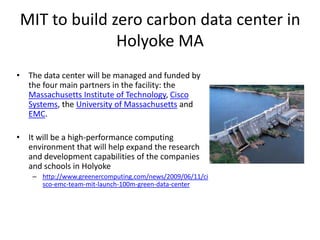
• The data center will be managed and funded by
  the four main partners in the facility: the
  Massachusetts Institute of Technology, Cisco
  Systems, the University of Massachusetts and
  EMC.

• It will be a high-performance computing
  environment that will help expand the research
  and development capabilities of the companies
  and schools in Holyoke
    – http://www.greenercomputing.com/news/2009/06/11/ci
      sco-emc-team-mit-launch-100m-green-data-center
NREN Brokered Cloud for IT
            departments and Researchers
• Internet 2 Net +
   – Provisioning of multi vendor cloud services leveraging the Internet2
      Network and InCommon Federated Authentication
   – Interoperable marketplace for services where individual institutions
      might procure services from a wide range of cloud services
      providers.

• HEFCE and JISC to Deliver Cloud-Based Services for UK Research
   – Besides providing brokered cloud services they are also providing cloud
     “solutions” for IT departments and researchers
    –   http://www.hpcinthecloud.com/hpccloud/2011-06-27/hefce_and_jisc_to_deliver_cloud-
        based_services_for_uk_research.html?utm_medium=twitter&utm_source=twitterfeed


• SURFnet: Community Cloud Models and the Role of the R&E network as a
  broker for cloud services
    –   http://www.slideshare.net/haroldteunissen/community-clouds-shared-infrastructure-as-a-service
2. Software Defined networks


                               26
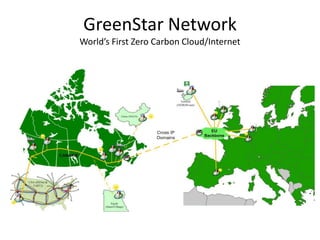
GreenStar Network
World’s First Zero Carbon Cloud/Internet
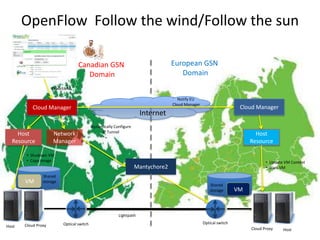
OpenFlow Follow the wind/Follow the sun

                                  Canadian GSN                                   European GSN
                                     Domain                                         Domain
                     Export VM

                                                                                    Notify EU
                                                                                 Cloud Manager
           Cloud Manager                                                                                           Cloud Manager
                                                                     Internet
                                           Dynamically Configure
                                                IP Tunnel
    Host             Network                                                                                             Host
  Resource           Manager                                                                                           Resource

        • Shudown VM
        • Copy Image                                                                                                          • Update VM Context
                                                                   Mantychore2                                                • Start VM
                Shared
       VM       storage
                                                                                                    Shared
                                                                                                    storage       VM


                                                         Lightpath
                          Optical switch                                                         Optical switch
Host   Cloud Proxy
                                                                                                                       Cloud Proxy    Host
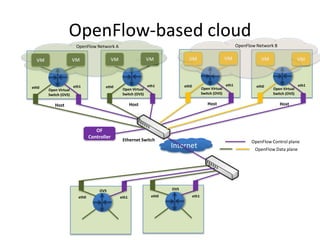
OpenFlow-based cloud
                       OpenFlow Network A                                                                           OpenFlow Network B

  VM                  VM                    VM                   VM               VM                         VM                VM                  VM


                      eth1            eth0                       eth1           eth0                         eth1            eth0                  eth1
eth0                                              Open Virtual                                Open Virtual                          Open Virtual
       Open Virtual
       Switch (OVS)                               Switch (OVS)                                Switch (OVS)                          Switch (OVS)

          Host                                          Host                                     Host                                    Host


                                  OF
                               Controller
                                                  Ethernet Switch                                                         OpenFlow Control plane
                                                                          Internet                                          OpenFlow Data plane


                                    OVS                                   OVS

                        eth0                     eth1              eth0                eth1
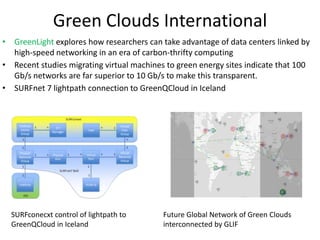
Green Clouds International
• GreenLight explores how researchers can take advantage of data centers linked by
  high-speed networking in an era of carbon-thrifty computing
• Recent studies migrating virtual machines to green energy sites indicate that 100
  Gb/s networks are far superior to 10 Gb/s to make this transparent.
• SURFnet 7 lightpath connection to GreenQCloud in Iceland


  SURFconecxt control of lightpath to      Future Global Network of Green Clouds
  GreenQCloud in Iceland                   interconnected by GLIF
Science Cloud Communication Services Network

• Enterprise clouds use commodity internet; computational clouds for data-intensive
  science require dynamic cloud provisioning integrated with dynamic high
  performance.
• TransCloud: example of dynamic networking & dynamic cloud provisioning
                                  Example of working in the TransCloud
                                  [1] Build trans-continental applications spanning clouds:
                                  • Distributed query application based on Hadoop/Pig
                                  • Store archived Network trace data using HDFS
                                  • Query data using Pig over Hadoop clusters
                                  [2] Perform distributed query on TransCloud, which currently spans the following
                                  sites:
                                  • HP OpenCirrus
                                  • Northwestern OpenCloud
                                  • UC San Diego
                                  • Kaiserslautern


                                                                                          Source: Maxine Brown
3.0 NREN National Wireless
Network


                             32
Building a NREN wireless network
• Vision: to allow students, researchers and employees to collaborate,
  research, learn anytime and anywhere they seem fit!

• Also Internet of Things – Machine to Machine communications

• Existing 3G and 4G networks cannot handle data load
   – Roaming gateways prevent global seamless access
   – Voice centric architectures

• New mobile networks seamlessly integrate with WiFi on campus
   – New Wifi 2.0 standards 802.11u allow for data handoff from 3G
     networks
   – Eduroam can be the global authorization tool
   – OpenFlow can be used to architect integrated solutions from wireless
     node across optical network
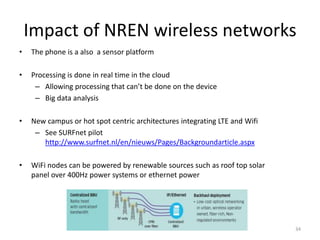
Impact of NREN wireless networks
•   The phone is a also a sensor platform

•   Processing is done in real time in the cloud
     – Allowing processing that can’t be done on the device
     – Big data analysis

•   New campus or hot spot centric architectures integrating LTE and Wifi
     – See SURFnet pilot
       http://www.surfnet.nl/en/nieuws/Pages/Backgroundarticle.aspx

•   WiFi nodes can be powered by renewable sources such as roof top solar
    panel over 400Hz power systems or ethernet power


                                                                            34
The Regulatory Challenge
• Today’s SIM-card locks user to the network

• If NREN becomes a MVNO with own SIM-cards, users could
  roam seamlessly around the globe

• Only public service providers have access to IMSI-numbers for
  SIM-cards

• One option is to lobby regulators to give R&E networks access
  to IMSI-numbers
4. Global Interconnected Dynamic
Optical Networks


                                   36
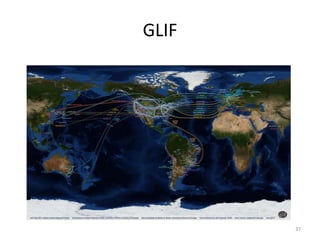
GLIF


       37
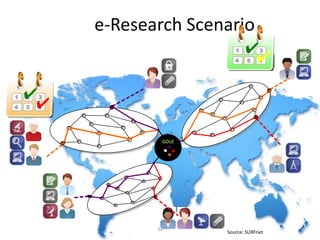
e-Research Scenario


        GOLE


       38
               Source: SURFnet
Importance of GOLEs
• Increasingly more research and education is international collaboration
    – Cornell- Technion announcement
    – US overseas university campuses in UK and elsewhere
    – GOLES enable direct peering of regional networks or even institutions

• Many researchers need access to commercial clouds and data specialists
    – AUP issues often prevent NRENs from directly connecting up these institutions
    – Genomics and bio-informatics processing and climate modeling

• Many commercial research institutions need access to lightpaths
    – GOLES provide neutral access points for interconnect to AUP free lightpaths

• Enables new services
    – Software Defined Network using Switched lambdas


                                                                                    39
5. eScience Platforms with next gen
IdM


                                      40
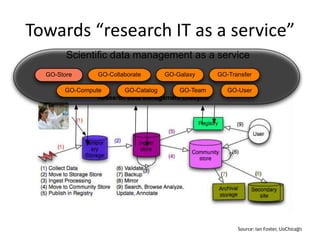
Towards “research IT as a service”
        Scientific data management as a service
  GO-Store      GO-Collaborate       GO-Galaxy     GO-Transfer

       GO-Compute       GO-Catalog       GO-Team      GO-User


                                                         Source: Ian Foster, UoChicago
                                                                                    41
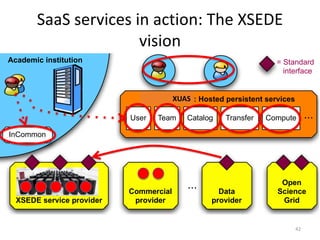
SaaS services in action: The XSEDE
                      vision
Academic institution                                              = Standard
                                                                    interface


                                     XUAS
                              Globus Online: Hosted persistent services

                           User   Team    Catalog   Transfer   Compute         ...
                       2
InCommon


                                          ...                      Open
                           Commercial             Data            Science
  XSEDE service provider    provider            provider           Grid


                                                                          42
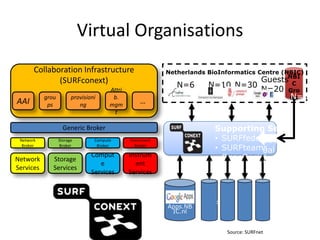
Virtual Organisations
       Collaboration Infrastructure                         Netherlands BioInformatics Centre (NBIC)
              (SURFconext)                                                              GuestsNBI
                                                               N=6      N=10 N=30                C
                                       Attri                                            N=20 Gro
           grou         provisioni      b.                                                      N=66
                                                                                                up
AAI         ps             ng          mgm
                                                   …
                                         t

                    Generic Broker                                       Supporting Services
 Network          Storage        Compute       Instrument                • SURFfederatie
                                                                                    Virt
  Broker          Broker          Broker         Broker
                                                                         • SURFteamsual
                                Comput         Instrum                   • OpenSocial
Network       Storage
                                   e             ent                                IdP
Services      Services
                                Services       Services


                                                                         Experiment


                                                                                                               Publisher
                                                                                                   Grid res.
                                                                                          PubMed
                                                                             My
                                                            Apps.NB
                                                             IC.nl


                                                                                      Source: SURFnet
6. eScience and Big Data for Citizen
Science and Community


                                       44
Extending science and education to
            the community
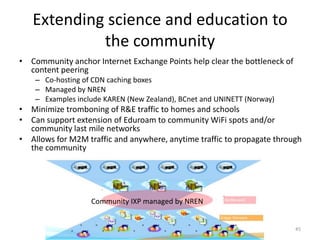
• Community anchor Internet Exchange Points help clear the bottleneck of
  content peering
    – Co-hosting of CDN caching boxes
    – Managed by NREN
    – Examples include KAREN (New Zealand), BCnet and UNINETT (Norway)
• Minimize tromboning of R&E traffic to homes and schools
• Can support extension of Eduroam to community WiFi spots and/or
  community last mile networks
• Allows for M2M traffic and anywhere, anytime traffic to propagate through
  the community


                   Community IXP managed by NREN


                                                                           45
7. How to pay for it all


                           46
$1 billion funding program
•   Green revolving funds are either part of a university endowment program or publicly traded
    entities.
     – http://www.sustainablebusiness.com/index.cfm/go/news.display/id/23028

•   They make investments in energy efficiency and GHG reduction initiatives. Payback typically
    32%

•   ICT can represent up to 40% of the electrical energy consumption at university and growing

•   The obvious low hanging fruit is to move, as much as possible the closet clusters and campus
    data center facilities to commercial clouds. Next is network infrastructure such as routing
    and servers

•   Other obvious money saving practices are to power laptop and cell phone charging stations
    with roof top solar panels or micro windmills, deploy solar/wind powered WiFi nodes, and
    use on the move electric charging for campus utility vehicles, etc

•   Campus IT folk and NRENs need to educate managers of such funds the IT and networking
    can play a much more significant role in reducing energy consumption and GHG emissions
                                                                                                 47
    then traditional facilities based solutions
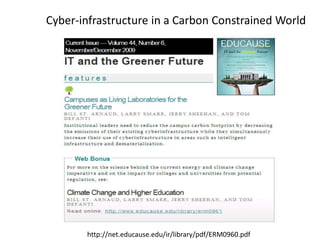
Cyber-infrastructure in a Carbon Constrained World


       http://net.educause.edu/ir/library/pdf/ERM0960.pdf
Let’s Keep The Conversation Going
                  E-mail list

                  Bill.St.Arnaud@gmail.com


                   Blogspot
Bill St. Arnaud
                   http://green-broadband.blogspot.com


                    Twitter

                    http://twitter.com/BillStArnaud

Joint techs keynote january

  • 1.
    NREN strategies forData-Intensive Science in a Carbon Constrained World Bill St. Arnaud Bill.st.arnaud@gmail.com Unless otherwise noted all material in this slide deck may be reproduced, modified or distributed without prior permission of the author
  • 2.
    Theme of thistalk • We have already lost the battle to save the planet from extreme climate change. Rather than focusing on reducing energy consumption, (Mitigation) we now need to focus on surviving climate change (Adaptation) • Explosion of data and energy consumption by computers and networks is contributing to energy demand and CO2 emissions • But big data and science will be critical as move to focus on adapting to climate change • How can Internet and IT help us build NRENs and support science and education that can adapt to global warming?
  • 3.
    Changing NREN networking environment • Global Virtual Research Communities • Increasing co-operation between public and private researchers • Rapidly changing users demands • Increasing potential of commercial ICT-service providers • Education: any time, any place, any device • Citizen Science and M2M communications and sensors • The disappearing campus IT & diminishing expertise in ICT centres of connected institutions
  • 4.
    Although there isless news coverage global warming has not disappeared
  • 5.
    Half of USexperienced record droughts or deluges in 2011 2010 warmest year ever – we are only at the start of the curve of the hockey stick. The worst is yet to come
  • 6.
    Blame it onCanada How warming in the Arctic affects weather in Louisiana • Warming Arctic slowing down jet stream • Basic Thermodynamics - polar temperatures drive the jet stream, – There’s been a 20 percent drop in the zonal wind speeds. • As get stream slows down, it leads to those bigger kinks in the jet stream. – That amplification is associated with persistent weather patterns that lead to “extremes” like drought, flooding and heat waves. • Those slow-moving, persistent waves of weather energy may have played a role in the big snows that hammered parts of the West last winter, as well as some of the extreme winter weather that hit South West US and Europe • http://summitcountyvoice.com/2012/01/14/ global-warming-revenge-of-the-atmosphere/ 6
  • 7.
    Climate Forecasts • MIT report predicts median temperature forecast of 5.2°C – 11°C increase in Northern Canada & Europe – http://globalchange.mit.edu/pubs/abstract.p hp?publication_id=990 MIT • Last Ice age average global temperature was 5-6°C cooler than today – Most of Canada & Europe was under 2-3 km ice • Nearly 90 per cent of new scientific findings reveal global climate disruption to be worse, and progressing more rapidly, than expected. • http://www.skepticalscience.com/pics/Freud enburg_2010_ASC.pdf
  • 8.
    Future Droughts • PalmerDrought Severity Index, or PDSI. • The most severe drought in recent history, in the Sahel region of western Africa in the 1970s, had a PDSI of -3 or -4. • By 2030 Western USA could see -4 to -6. Drought in Texas clearly caused by global warming: http://goo.gl/QjHRS • By 2100 some parts of the U.S. and Latin America could see -8 to - 10 PDSI, while Mediterranean areas could see drought in the -15 http://www.msnbc.msn.com/id/39741525/ns/us_new or -20 range. s-environment/
  • 9.
    Dramatic changes inprecipitation • Every continent has suffered record rainfalls • Rains submerged one-fifth of Pakistan, a thousand-year deluge swamped Nashville and storms just north of Rio caused the deadliest landslides Brazil has ever seen. • Observed increase in precipitation in the last few decades has been due in large part to a disproportionate increase in heavy and extreme precipitation rates which are exceeding predictions made in models
  • 10.
    New Challenge: ClimateAdaptation • Obama’s National Science Advisor John Holdren “Mitigation alone won’t work, because the climate is already changing, we’re already experiencing impacts….A mitigation only strategy would be insanity,” • Equal emphasis given to adaptation – avoiding the unmanageable, and adaptation – managing the unavoidable.” • Obama’s Climate Adaptation Executive Order – http://www.stumbleupon.com/su/1tU8go/www.good.is/post/obama-s-secret-climate-adaptation-plan/
  • 11.
    Climate Change Impacton Internet and NRENs • UK Government study Climate Change could ruin the Internet – http://www.grist.org/list/2011-05-09-climate-change-could-ruin-the-internet • California aims to have 30% renewable power – Impact on reliability of power systems • Last year Nuclear power plants in France were forced to shut down because cooling water was too warm • Germany is committed to shutting down all of its nuclear plants • Droughts will restrict production of hydro-electric power • Energy shortages and disruptions are predicted to increase in the coming years
  • 12.
    Impact on ICTsector According to IEA ICT will represent 40% of all energy consumption by 2030 www.smart2020.org ICT represent 8% of global electricity consumption Future Broadband- Internet alone is expected to consume 5% of all electricity http://www.ee.unimelb.edu.au/people/rst/talks/files/Tucker_Green_Plenary.pdf
  • 13.
    R&E biggest consumer!! Peremployee Per sector Australian Computer Society Study http://www.acs.org.au/attachments/ICFACSV4100412.pdf
  • 14.
    The ICT energyconsumption in higher- ed • Campus computing 20-40% electrical energy consumption on most campuses – Studies in UK and The Netherlands – http://goo.gl/k9Kib • Closet clusters represent up to 15% of electrical consumption – http://isis.sauder.ubc.ca/research/clean-technology-and-energy/green-it/ • Campus data center alone represents 8-20% of electrical consumption – http://www.iisd.org/publications/pub.aspx?pno=1341 • IISD study demonstrated that moving Canadian research to cloud would pay for itself in energy savings and CO2 reduction – http://www.iisd.org/publications/pub.aspx?pno=1341
  • 15.
    The real costof campus computing • Land - 2% • Core and shell costs – 9% Belady, C., “In the Data Center, Power and Cooling Costs More than IT Equipment it Supports”, Electronics Cooling • Architectural – 7% Magazine (February 2007) • Mechanical/Electrical – 82% – 16% increase/year since 2004 Source: Christian Belady
  • 16.
    The Data Deluge 2004: 36 TB 2012: 2,300 TB Genomic sequencing output x2 every Climate 9 month model intercomparison project (CMIP) of the IPCC MACHO et al.: 1 TB Palomar: 3 TB 2MASS: 10 TB GALEX: 30 TB Sloan: 40 TB Pan-STARRS: 40,000 TB 1330 molec. bio databases Nucleic Acids Research (96 in Jan 2001) Source: Ian Foster, UoChicago
  • 17.
    Big science hasachieved big successes OSG: 1.4M CPU-hours/day, >90 sites, >3000 users, >260 pubs in 2010 LIGO: 1 PB data in last science run, distributed worldwide Robust production solutions Substantial teams and expense Sustained, multi-year effort Application-specific solutions, built on common technology ESG: 1.2 PB climate data delivered to 23,000 users; 600+ pubs Source: Ian Foster, UoChicago
  • 18.
    But small scienceis struggling More data, more complex data Ad-hoc solutions Inadequate software, hardware Data plan mandates Source: Ian Foster, UoChicago
  • 19.
    Growth in sensornetworks and Citizen Science Glacier Tracking Real Time Health Monitoring Smart Trash 19
  • 20.
    THE CHALLENGE We needsolutions to address climate change, data deluge, needs of scientists, global collaboration, the evolving network of any time, any place, any device and yet addresses the challenge of disappearing IT on campus while still providing a leadership role in next generation Internet and broadband, and find ways to pay for it all in an era of severe fiscal constraint.
  • 21.
    THE SOLUTION 1. Brokered Green Clouds and off site campus IT 2. Software Defined Networks (OpenFlow) 3. NREN national wireless network 4. Global Interconnected Dynamic Optical Networks 5. eScience Platforms with next gen IdM 6. Community anchor IXPs with CDN and M2M hosting 7. New billion dollar revolving green energy funds at many universities 21
  • 22.
    1. Brokered GreenClouds and off site CAMPUS IT 22
  • 23.
    Universities moving toeliminate IT departments • Already many primary functions of IT department are being outsourced to the cloud – E-mail, web, DNS, research computing, etc – University of Western Australia has outsourced virtually all campus servers to an external private cloud • Even routing, network and firewall functions being outsourced to NREN – AARnet, SUnet and other NRENs offering border gateway routing services with collapsed IP backbones – Software Defined Networks makes it easy to configure outsourced LAN – Network facilities can be located • Increasingly most traffic is in/out of campus, instead of within – Social networking, P2P, Clouds, Kuali, Blackboard – Future of Campus IT – high speed optical network connected to WiFi/5G hot spots with tablets – No servers, no LAN
  • 24.
    MIT to buildzero carbon data center in Holyoke MA • The data center will be managed and funded by the four main partners in the facility: the Massachusetts Institute of Technology, Cisco Systems, the University of Massachusetts and EMC. • It will be a high-performance computing environment that will help expand the research and development capabilities of the companies and schools in Holyoke – http://www.greenercomputing.com/news/2009/06/11/ci sco-emc-team-mit-launch-100m-green-data-center
  • 25.
    NREN Brokered Cloudfor IT departments and Researchers • Internet 2 Net + – Provisioning of multi vendor cloud services leveraging the Internet2 Network and InCommon Federated Authentication – Interoperable marketplace for services where individual institutions might procure services from a wide range of cloud services providers. • HEFCE and JISC to Deliver Cloud-Based Services for UK Research – Besides providing brokered cloud services they are also providing cloud “solutions” for IT departments and researchers – http://www.hpcinthecloud.com/hpccloud/2011-06-27/hefce_and_jisc_to_deliver_cloud- based_services_for_uk_research.html?utm_medium=twitter&utm_source=twitterfeed • SURFnet: Community Cloud Models and the Role of the R&E network as a broker for cloud services – http://www.slideshare.net/haroldteunissen/community-clouds-shared-infrastructure-as-a-service
  • 26.
  • 27.
    GreenStar Network World’s FirstZero Carbon Cloud/Internet
  • 28.
    OpenFlow Follow thewind/Follow the sun Canadian GSN European GSN Domain Domain Export VM Notify EU Cloud Manager Cloud Manager Cloud Manager Internet Dynamically Configure IP Tunnel Host Network Host Resource Manager Resource • Shudown VM • Copy Image • Update VM Context Mantychore2 • Start VM Shared VM storage Shared storage VM Lightpath Optical switch Optical switch Host Cloud Proxy Cloud Proxy Host
  • 29.
    OpenFlow-based cloud OpenFlow Network A OpenFlow Network B VM VM VM VM VM VM VM VM eth1 eth0 eth1 eth0 eth1 eth0 eth1 eth0 Open Virtual Open Virtual Open Virtual Open Virtual Switch (OVS) Switch (OVS) Switch (OVS) Switch (OVS) Host Host Host Host OF Controller Ethernet Switch OpenFlow Control plane Internet OpenFlow Data plane OVS OVS eth0 eth1 eth0 eth1
  • 30.
    Green Clouds International •GreenLight explores how researchers can take advantage of data centers linked by high-speed networking in an era of carbon-thrifty computing • Recent studies migrating virtual machines to green energy sites indicate that 100 Gb/s networks are far superior to 10 Gb/s to make this transparent. • SURFnet 7 lightpath connection to GreenQCloud in Iceland SURFconecxt control of lightpath to Future Global Network of Green Clouds GreenQCloud in Iceland interconnected by GLIF
  • 31.
    Science Cloud CommunicationServices Network • Enterprise clouds use commodity internet; computational clouds for data-intensive science require dynamic cloud provisioning integrated with dynamic high performance. • TransCloud: example of dynamic networking & dynamic cloud provisioning Example of working in the TransCloud [1] Build trans-continental applications spanning clouds: • Distributed query application based on Hadoop/Pig • Store archived Network trace data using HDFS • Query data using Pig over Hadoop clusters [2] Perform distributed query on TransCloud, which currently spans the following sites: • HP OpenCirrus • Northwestern OpenCloud • UC San Diego • Kaiserslautern Source: Maxine Brown
  • 32.
    3.0 NREN NationalWireless Network 32
  • 33.
    Building a NRENwireless network • Vision: to allow students, researchers and employees to collaborate, research, learn anytime and anywhere they seem fit! • Also Internet of Things – Machine to Machine communications • Existing 3G and 4G networks cannot handle data load – Roaming gateways prevent global seamless access – Voice centric architectures • New mobile networks seamlessly integrate with WiFi on campus – New Wifi 2.0 standards 802.11u allow for data handoff from 3G networks – Eduroam can be the global authorization tool – OpenFlow can be used to architect integrated solutions from wireless node across optical network
  • 34.
    Impact of NRENwireless networks • The phone is a also a sensor platform • Processing is done in real time in the cloud – Allowing processing that can’t be done on the device – Big data analysis • New campus or hot spot centric architectures integrating LTE and Wifi – See SURFnet pilot http://www.surfnet.nl/en/nieuws/Pages/Backgroundarticle.aspx • WiFi nodes can be powered by renewable sources such as roof top solar panel over 400Hz power systems or ethernet power 34
  • 35.
    The Regulatory Challenge •Today’s SIM-card locks user to the network • If NREN becomes a MVNO with own SIM-cards, users could roam seamlessly around the globe • Only public service providers have access to IMSI-numbers for SIM-cards • One option is to lobby regulators to give R&E networks access to IMSI-numbers
  • 36.
    4. Global InterconnectedDynamic Optical Networks 36
  • 37.
  • 38.
    e-Research Scenario GOLE 38 Source: SURFnet
  • 39.
    Importance of GOLEs •Increasingly more research and education is international collaboration – Cornell- Technion announcement – US overseas university campuses in UK and elsewhere – GOLES enable direct peering of regional networks or even institutions • Many researchers need access to commercial clouds and data specialists – AUP issues often prevent NRENs from directly connecting up these institutions – Genomics and bio-informatics processing and climate modeling • Many commercial research institutions need access to lightpaths – GOLES provide neutral access points for interconnect to AUP free lightpaths • Enables new services – Software Defined Network using Switched lambdas 39
  • 40.
    5. eScience Platformswith next gen IdM 40
  • 41.
    Towards “research ITas a service” Scientific data management as a service GO-Store GO-Collaborate GO-Galaxy GO-Transfer GO-Compute GO-Catalog GO-Team GO-User Source: Ian Foster, UoChicago 41
  • 42.
    SaaS services inaction: The XSEDE vision Academic institution = Standard interface XUAS Globus Online: Hosted persistent services User Team Catalog Transfer Compute ... 2 InCommon ... Open Commercial Data Science XSEDE service provider provider provider Grid 42
  • 43.
    Virtual Organisations Collaboration Infrastructure Netherlands BioInformatics Centre (NBIC) (SURFconext) GuestsNBI N=6 N=10 N=30 C Attri N=20 Gro grou provisioni b. N=66 up AAI ps ng mgm … t Generic Broker Supporting Services Network Storage Compute Instrument • SURFfederatie Virt Broker Broker Broker Broker • SURFteamsual Comput Instrum • OpenSocial Network Storage e ent IdP Services Services Services Services Experiment Publisher Grid res. PubMed My Apps.NB IC.nl Source: SURFnet
  • 44.
    6. eScience andBig Data for Citizen Science and Community 44
  • 45.
    Extending science andeducation to the community • Community anchor Internet Exchange Points help clear the bottleneck of content peering – Co-hosting of CDN caching boxes – Managed by NREN – Examples include KAREN (New Zealand), BCnet and UNINETT (Norway) • Minimize tromboning of R&E traffic to homes and schools • Can support extension of Eduroam to community WiFi spots and/or community last mile networks • Allows for M2M traffic and anywhere, anytime traffic to propagate through the community Community IXP managed by NREN 45
  • 46.
    7. How topay for it all 46
  • 47.
    $1 billion fundingprogram • Green revolving funds are either part of a university endowment program or publicly traded entities. – http://www.sustainablebusiness.com/index.cfm/go/news.display/id/23028 • They make investments in energy efficiency and GHG reduction initiatives. Payback typically 32% • ICT can represent up to 40% of the electrical energy consumption at university and growing • The obvious low hanging fruit is to move, as much as possible the closet clusters and campus data center facilities to commercial clouds. Next is network infrastructure such as routing and servers • Other obvious money saving practices are to power laptop and cell phone charging stations with roof top solar panels or micro windmills, deploy solar/wind powered WiFi nodes, and use on the move electric charging for campus utility vehicles, etc • Campus IT folk and NRENs need to educate managers of such funds the IT and networking can play a much more significant role in reducing energy consumption and GHG emissions 47 then traditional facilities based solutions
  • 48.
    Cyber-infrastructure in aCarbon Constrained World http://net.educause.edu/ir/library/pdf/ERM0960.pdf
  • 49.
    Let’s Keep TheConversation Going E-mail list Bill.St.Arnaud@gmail.com Blogspot Bill St. Arnaud http://green-broadband.blogspot.com Twitter http://twitter.com/BillStArnaud

Editor's Notes

  • #25 Building a zero carbon ICT infrastructurePurchasing green power locally is expensive with significant transmission line lossesDemand for green power within cities expected to grow dramaticallyICT facilities DON’T NEED TO BE LOCATED IN CITIES-Cooling also a major problem in citiesBut most renewable energy sites are very remote and impractical to connect to electrical grid. Can be easily reached by an optical network Provide independence from electrical utility and high costs in wheeling power Savings in transmission line losses (up to 15%) alone, plus carbon offsets can pay for moving ICT facilities to renewable energy siteICT is only industry ideally suited to relocate to renewable energy sites Also ideal for business continuity in event of climate catastrophe