Optical Networks & Green IT  Bill St. ArnaudBill.st.arnaud@gmail.comUnless otherwise noted all material in this slide deck may be reproduced, modified or distributed without prior permission of the author
Rapid Increase in the Greenhouse Gas CO2Since Industrial Era BeganSource: David JC MacKay, Sustainable Energy Without the Hot Air (2009) 388 ppm in 2010Medieval Warm PeriodLittle Ice Age
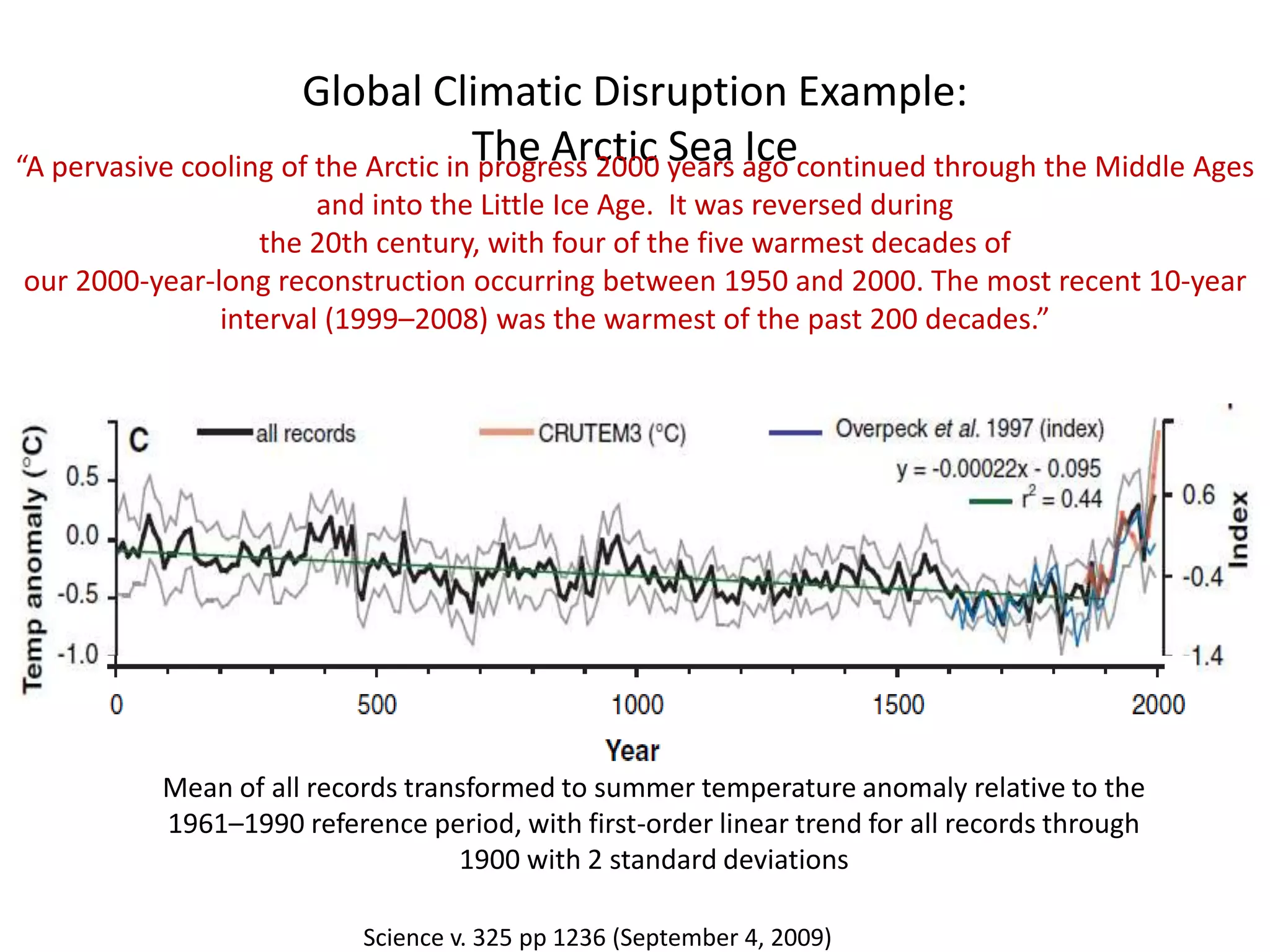
Global Climatic Disruption Example:The Arctic Sea Ice“A pervasive cooling of the Arctic in progress 2000 years ago continued through the Middle Ages and into the Little Ice Age.  It was reversed during the 20th century, with four of the five warmest decades of our 2000-year-long reconstruction occurring between 1950 and 2000. The most recent 10-year interval (1999–2008) was the warmest of the past 200 decades.”Mean of all records transformed to summer temperature anomaly relative to the 1961–1990 reference period, with first-order linear trend for all records through 1900 with 2 standard deviationsScience v. 325 pp 1236 (September 4, 2009)
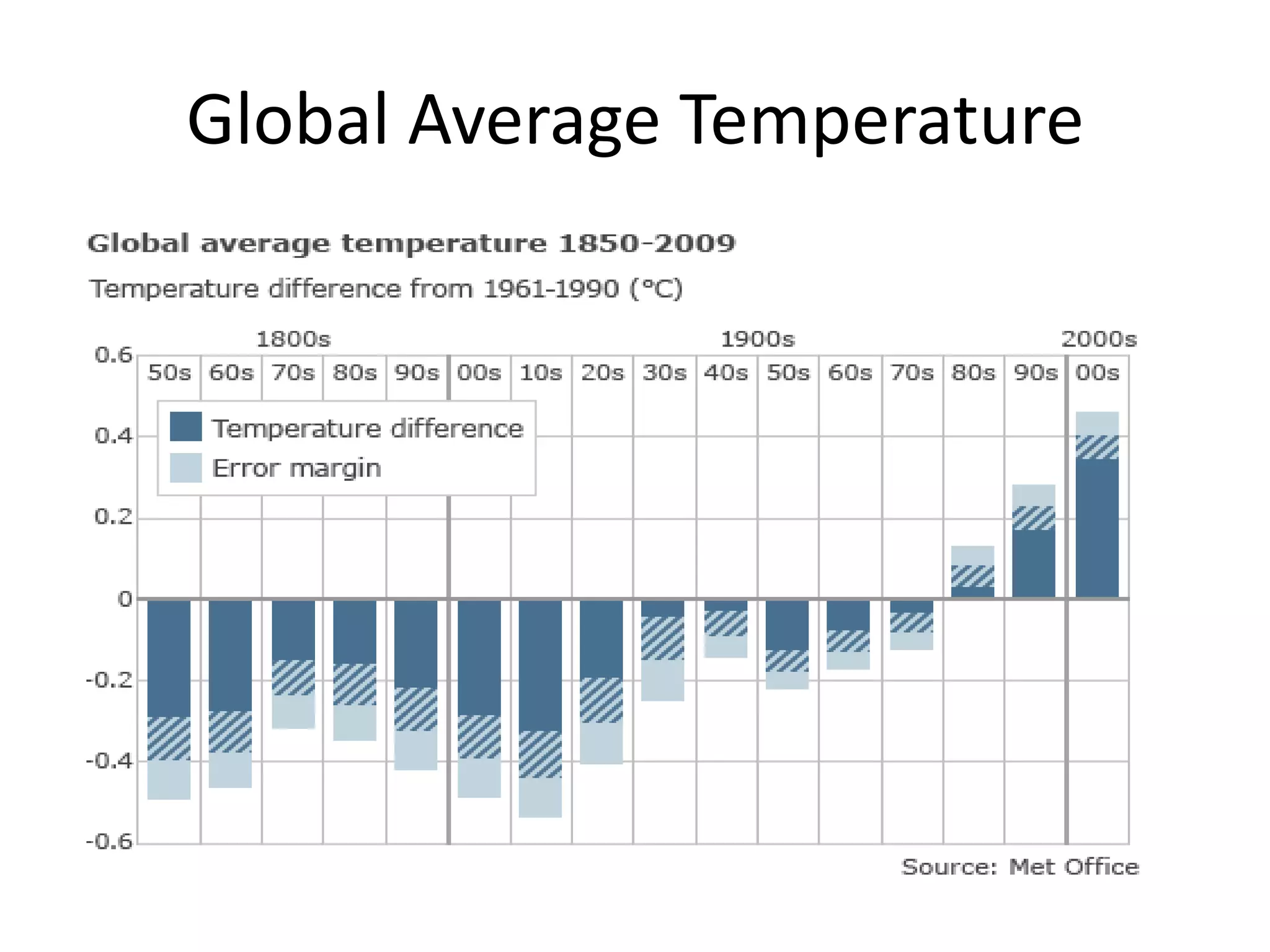
Global Average Temperature
2009 second warmest year ever
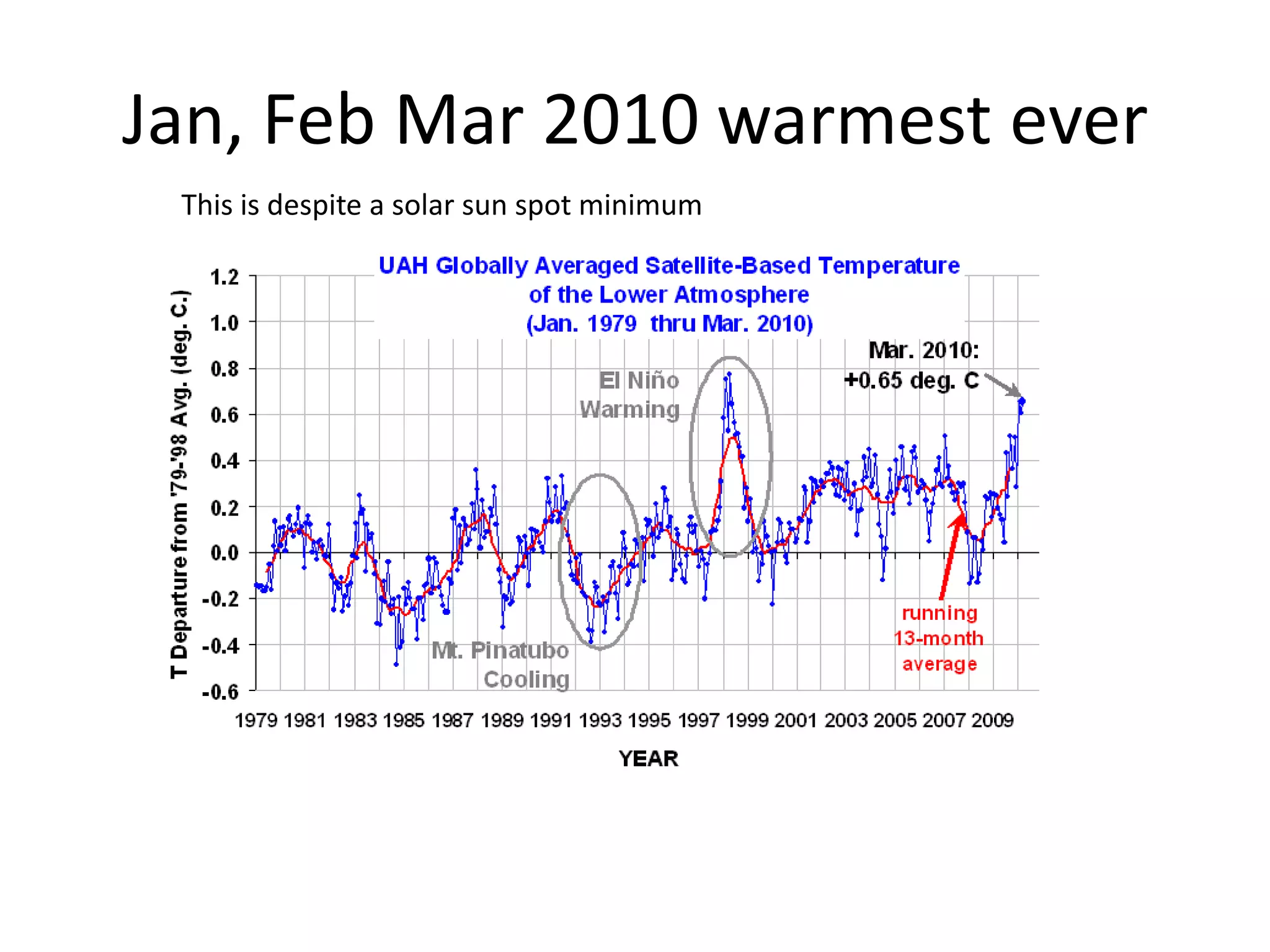
Jan, Feb Mar 2010 warmest everThis is despite a solar sun spot minimum
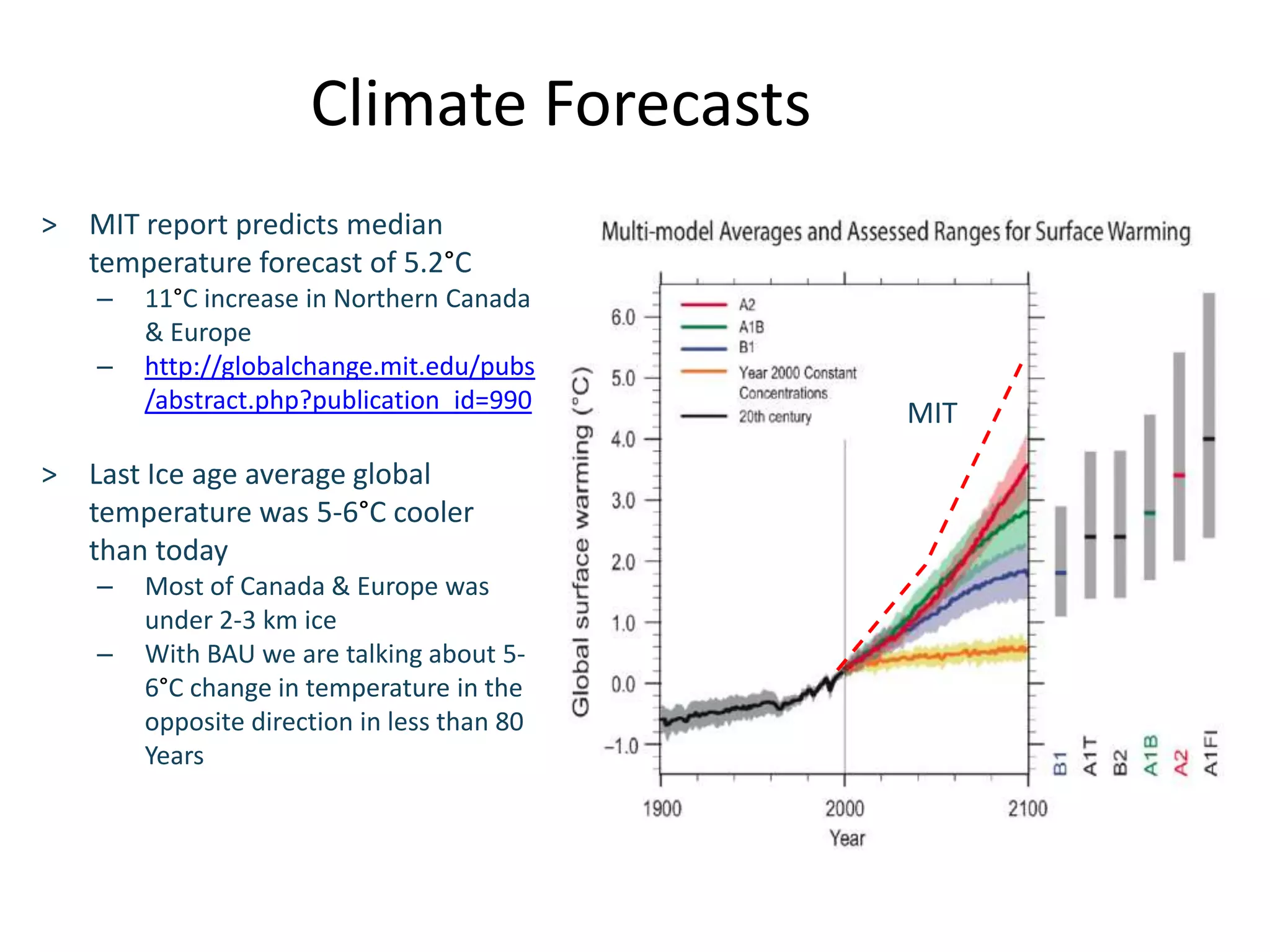
Climate ForecastsMIT report predicts median temperature forecast of 5.2°C
11°C increase in Northern Canada & Europe
http://globalchange.mit.edu/pubs/abstract.php?publication_id=990
Last Ice age average global temperature was 5-6°C cooler than today
Most of Canada & Europe was under 2-3 km ice
With BAU we are talking about 5-6°C change in temperature in the opposite direction in less than 80 YearsMIT
Climate Change is not reversibleClimate Change is not like acid rain, water management or ozone destruction where environment will quickly return to normal once source of pollution is removedGHG emissions will stay in the atmosphere for thousands of years and continue to accumulatePlanet will continue to warm up even if we drastically reduce emissionsWeaver et al., GRL (2007)All we hope to achieve is to slow down the rapid rate of climate change
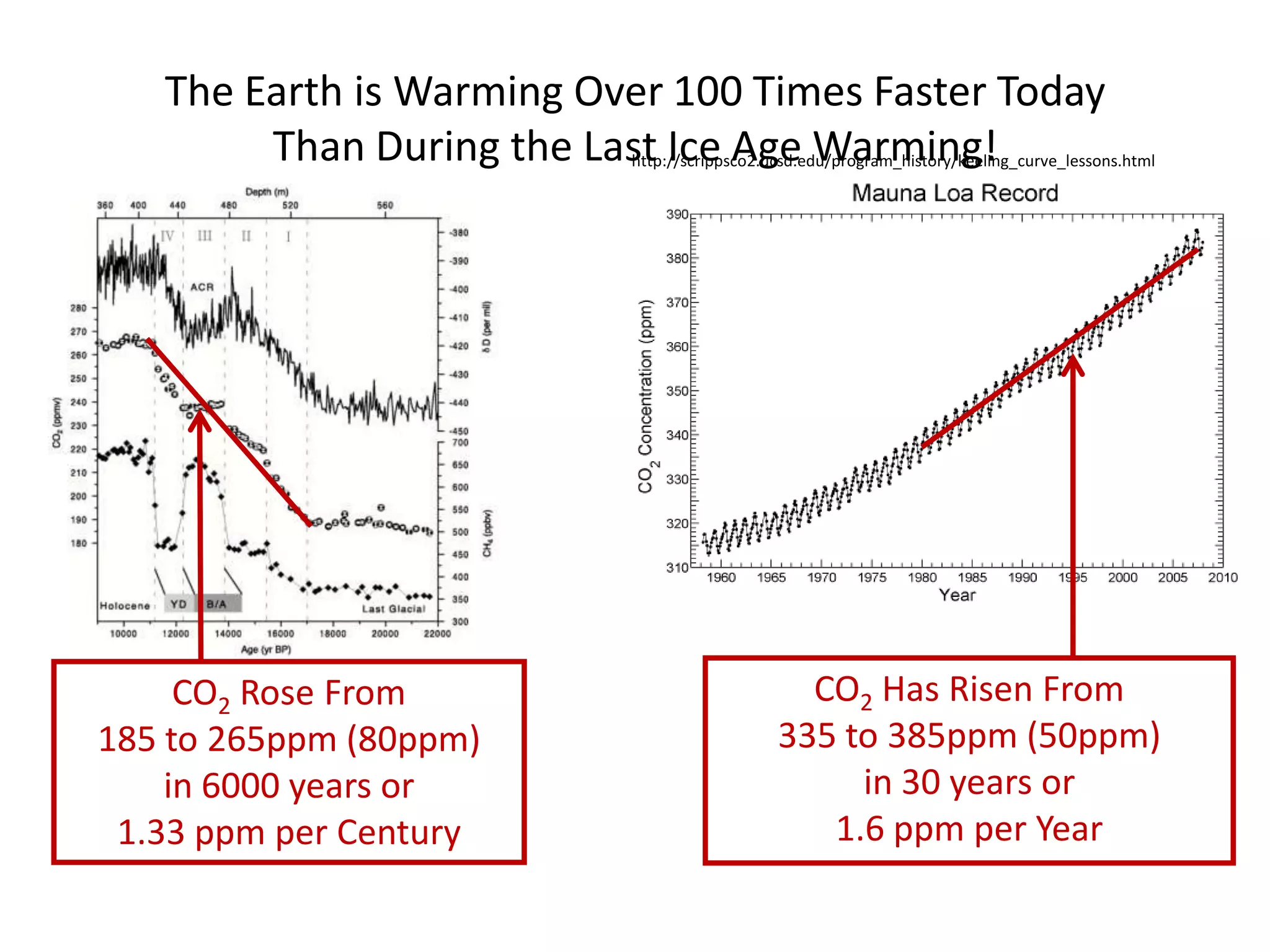
The Earth is Warming Over 100 Times Faster TodayThan During the Last Ice Age Warming!http://scrippsco2.ucsd.edu/program_history/keeling_curve_lessons.htmlCO2 Has Risen From 335 to 385ppm (50ppm) in 30 years or 1.6 ppm per YearCO2 Rose From 185 to 265ppm (80ppm) in 6000 years or 1.33 ppm per Century
Climate tipping pointsUSGS report finds that future climate shifts have been underestimated and warns of debilitating  abrupt shift in climate that would be devastating. Tipping elements in the Earth's climate  - National Academies of Science“Society may be lulled into a false sense of security by smooth projections of global change. Our synthesis of present knowledge suggests that a variety of tipping elements could reach their critical point within this century under anthropogenic climate change. “
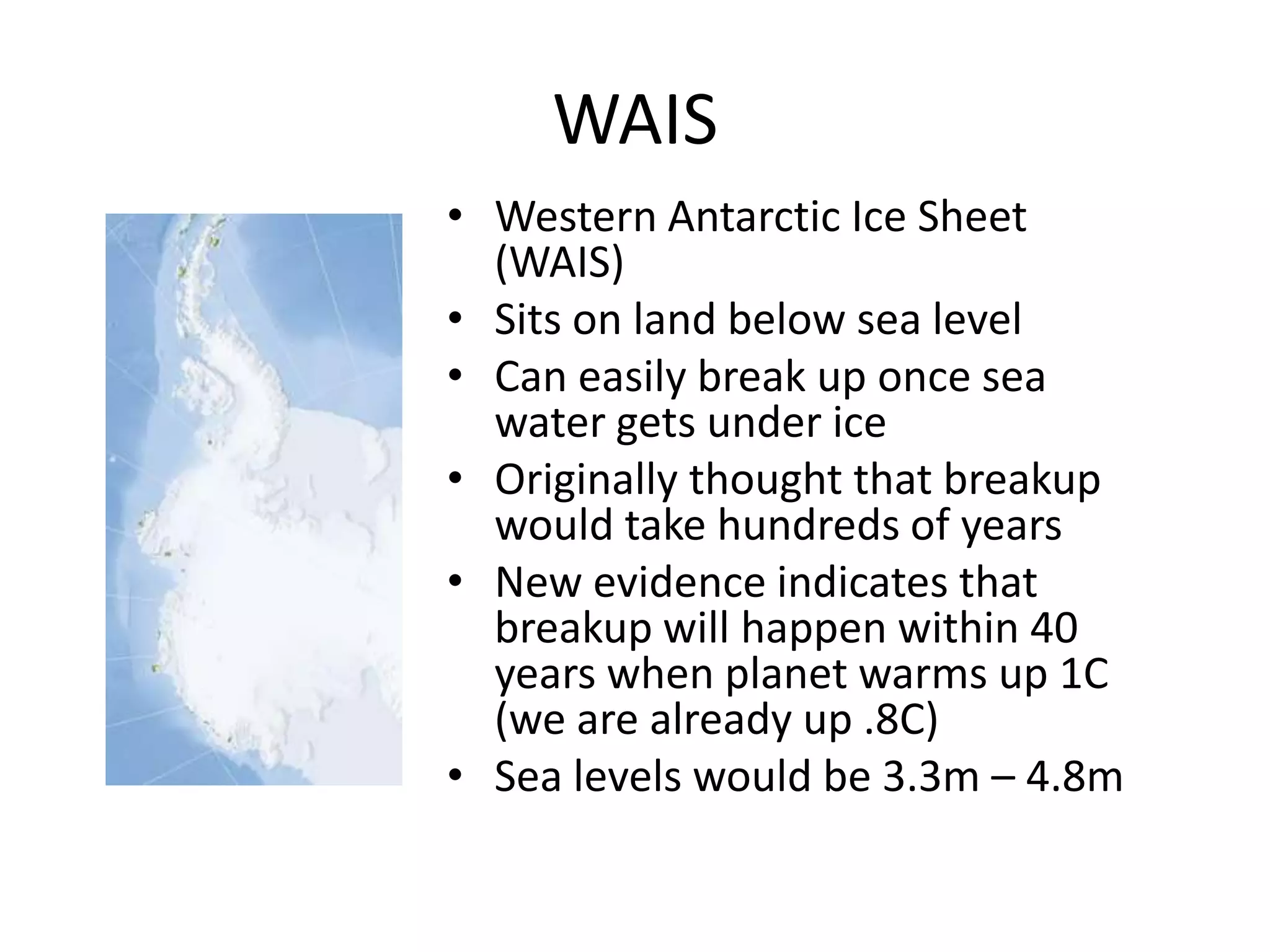
WAISWestern Antarctic Ice Sheet (WAIS)Sits on land below sea levelCan easily break up once sea water gets under iceOriginally thought that breakup would take hundreds of yearsNew evidence indicates that breakup will happen within 40 years when planet warms up 1C (we are already up .8C)Sea levels would be 3.3m – 4.8m
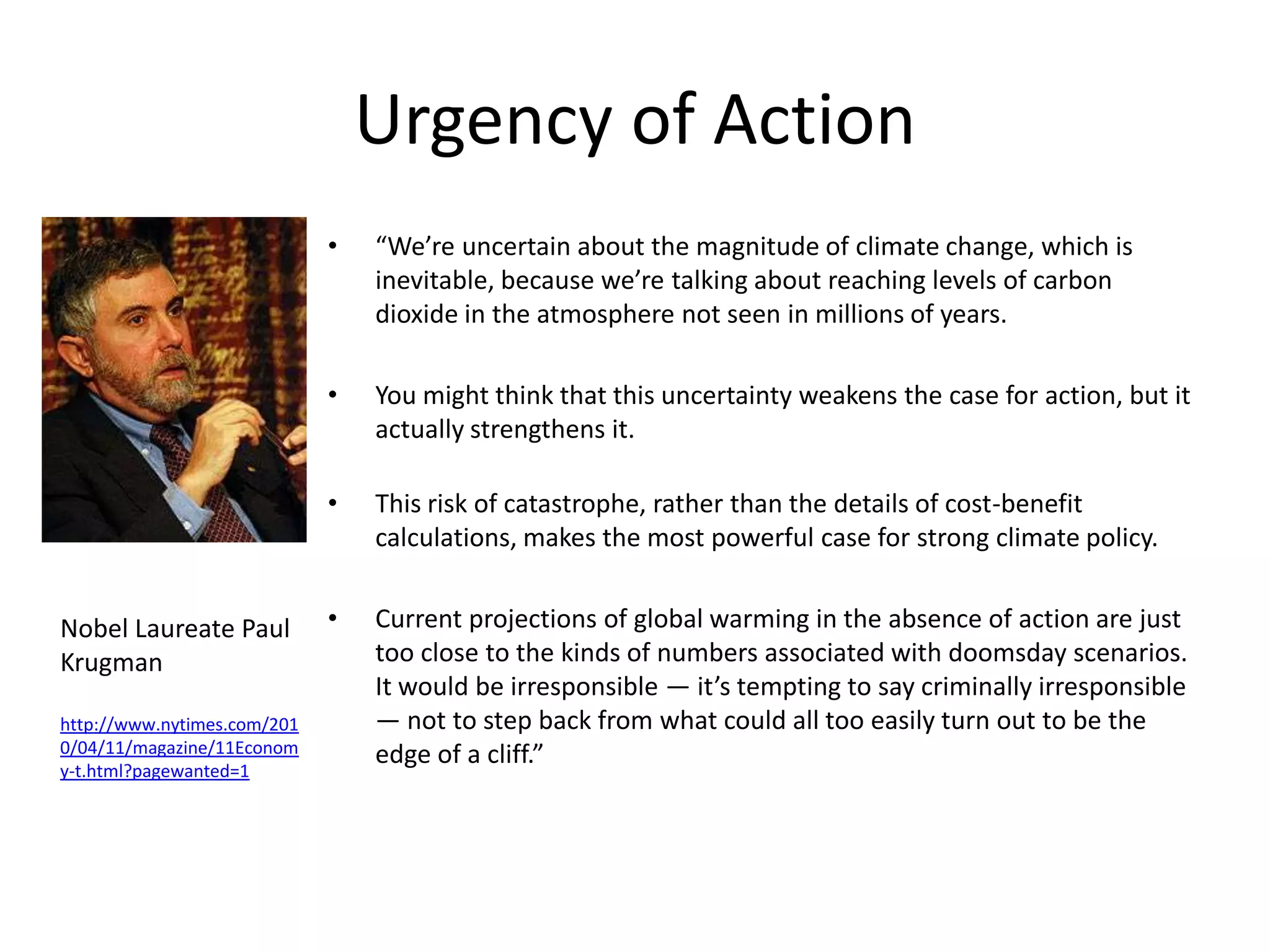
Urgency of Action“We’re uncertain about the magnitude of climate change, which is inevitable, because we’re talking about reaching levels of carbon dioxide in the atmosphere not seen in millions of years. You might think that this uncertainty weakens the case for action, but it actually strengthens it. This risk of catastrophe, rather than the details of cost-benefit calculations, makes the most powerful case for strong climate policy. Current projections of global warming in the absence of action are just too close to the kinds of numbers associated with doomsday scenarios. It would be irresponsible — it’s tempting to say criminally irresponsible — not to step back from what could all too easily turn out to be the edge of a cliff.”Nobel Laureate Paul Krugmanhttp://www.nytimes.com/2010/04/11/magazine/11Economy-t.html?pagewanted=1
The Global ICT Carbon Footprint isRoughly the Same as the Aviation Industry TodayBut ICT Emissions are Growing at 6% Annually!According to IEA ICT will represent 40% of all energy consumption by 2030www.smart2020.orgICT represent  8% of global electricity consumptionProjected to grow to as much as 20% of all electrical consumption in the US  (http://uclue.com/index.php?xq=724)Future Broadband- Internet alone is expected to consume 5% of all electricity http://www.ee.unimelb.edu.au/people/rst/talks/files/Tucker_Green_Plenary.pdf
The Global ICT Carbon Footprint by SubsectorThe Number of PCs (Desktops and Laptops) Globally is Expected to Increase from 592 Million in 2002 to More Than Four Billion in 2020 www.smart2020.orgData Centers  & Clouds Are Low Hanging FruitPCs Are Biggest ProblemTelecom & Internet fastest growing
IT biggest power drawEnergy Consumption World WideTransportation25%Energy Consumption Typical BuildingBuildings50%Lighting11%Manufacturing25%IT   Equipment    30-40%Heating,CoolingandVentilation40-50%Other6%Sources: BOMA 2006, EIA 2006, AIA 2006
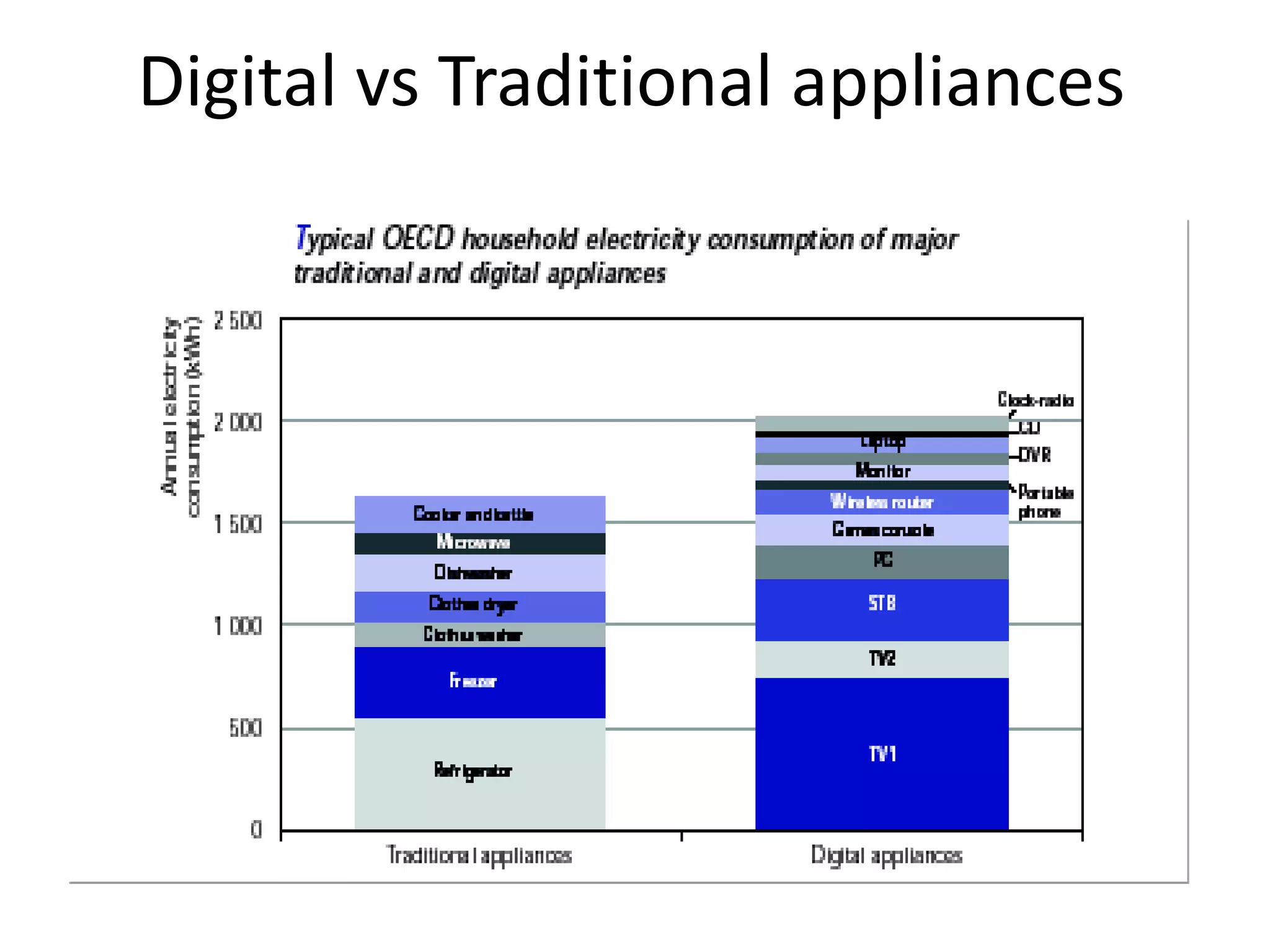
Digital vs Traditional appliances
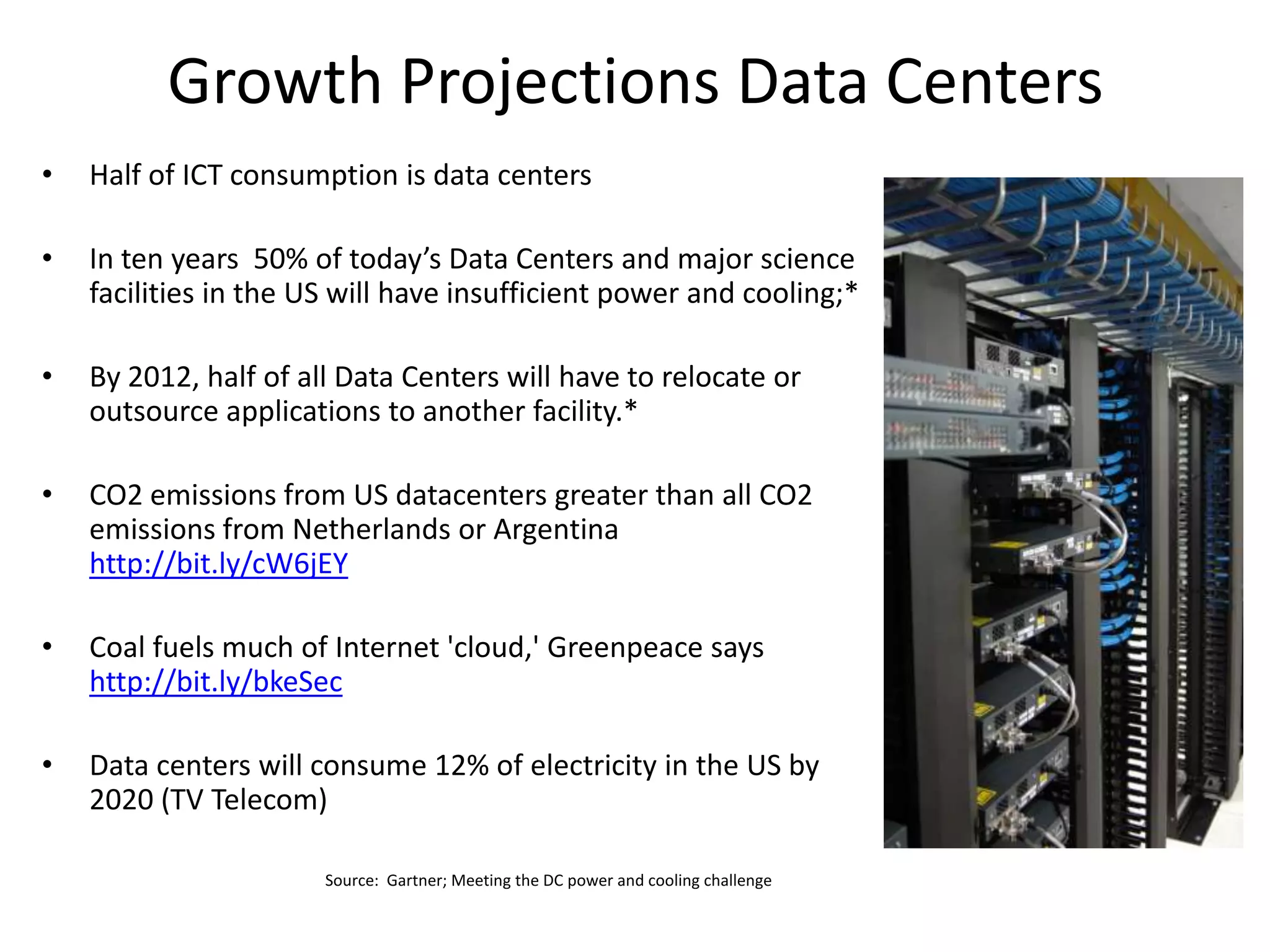
Growth Projections Data CentersHalf of ICT consumption is data centersIn ten years  50% of today’s Data Centers and major science facilities in the US will have insufficient power and cooling;*By 2012, half of all Data Centers will have to relocate or outsource applications to another facility.*CO2 emissions from US datacenters greater than all CO2 emissions from Netherlands or Argentina http://bit.ly/cW6jEYCoal fuels much of Internet 'cloud,' Greenpeace says http://bit.ly/bkeSecData centers will consume 12% of electricity in the US by 2020 (TV Telecom)Source:  Gartner; Meeting the DC power and cooling challenge
The Challenge of Energy EfficiencyMost current approaches to reduce carbon footprint are focused on increased energy efficiency of equipment and processesNo question it save money, but does little for the environmentBut greater efficiency can paradoxically increase energy consumption by reducing overall cost service and therefore stimulates demandKhazzoom-Brookes postulate (aka Jevons paradox - not to be confused with rebound effect)In last Energy crisis in 1973 Congress passed first energy efficiency laws (CAFÉ) which mandate minimum mileage for cars, home insulation and appliancesNet effect was to reduce cost of driving car, heating or cooling home, and electricity required for appliancesConsumer response was to drive further, buy bigger homes and appliancesThe issue is not the amount of energy that we use, but the type of energy
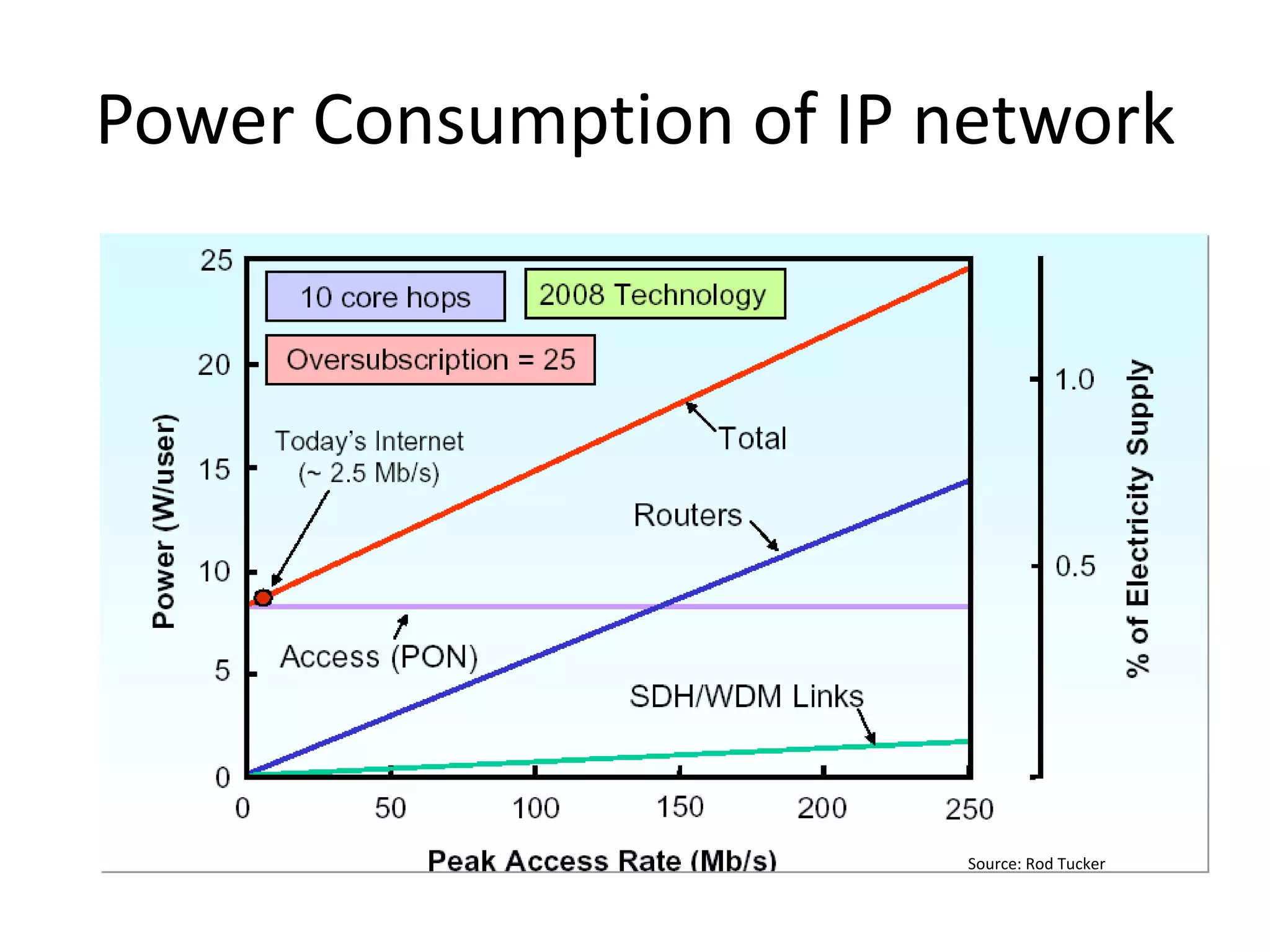
Power Consumption of IP networkSource: Rod Tucker
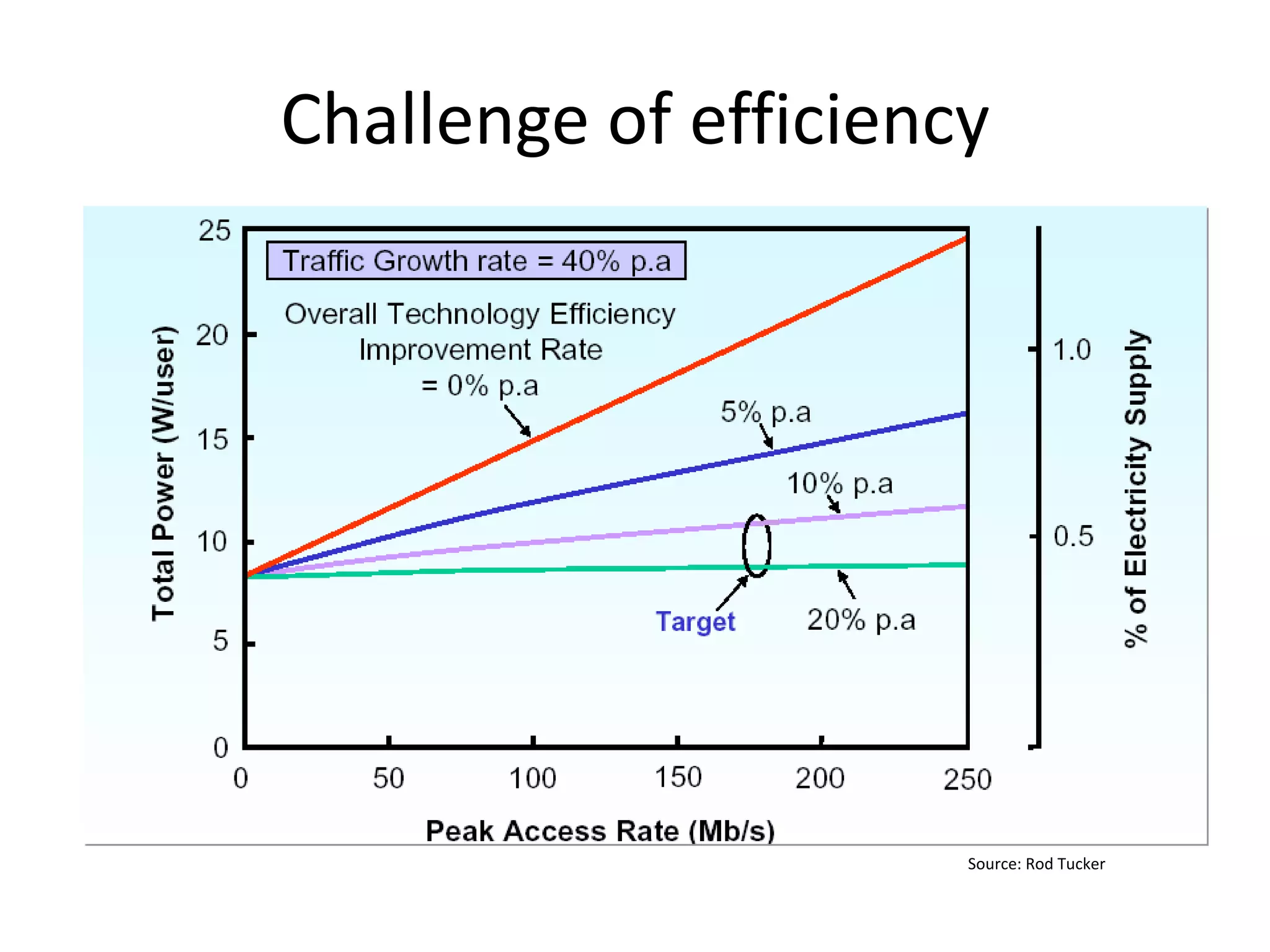
Challenge of efficiencySource: Rod Tucker
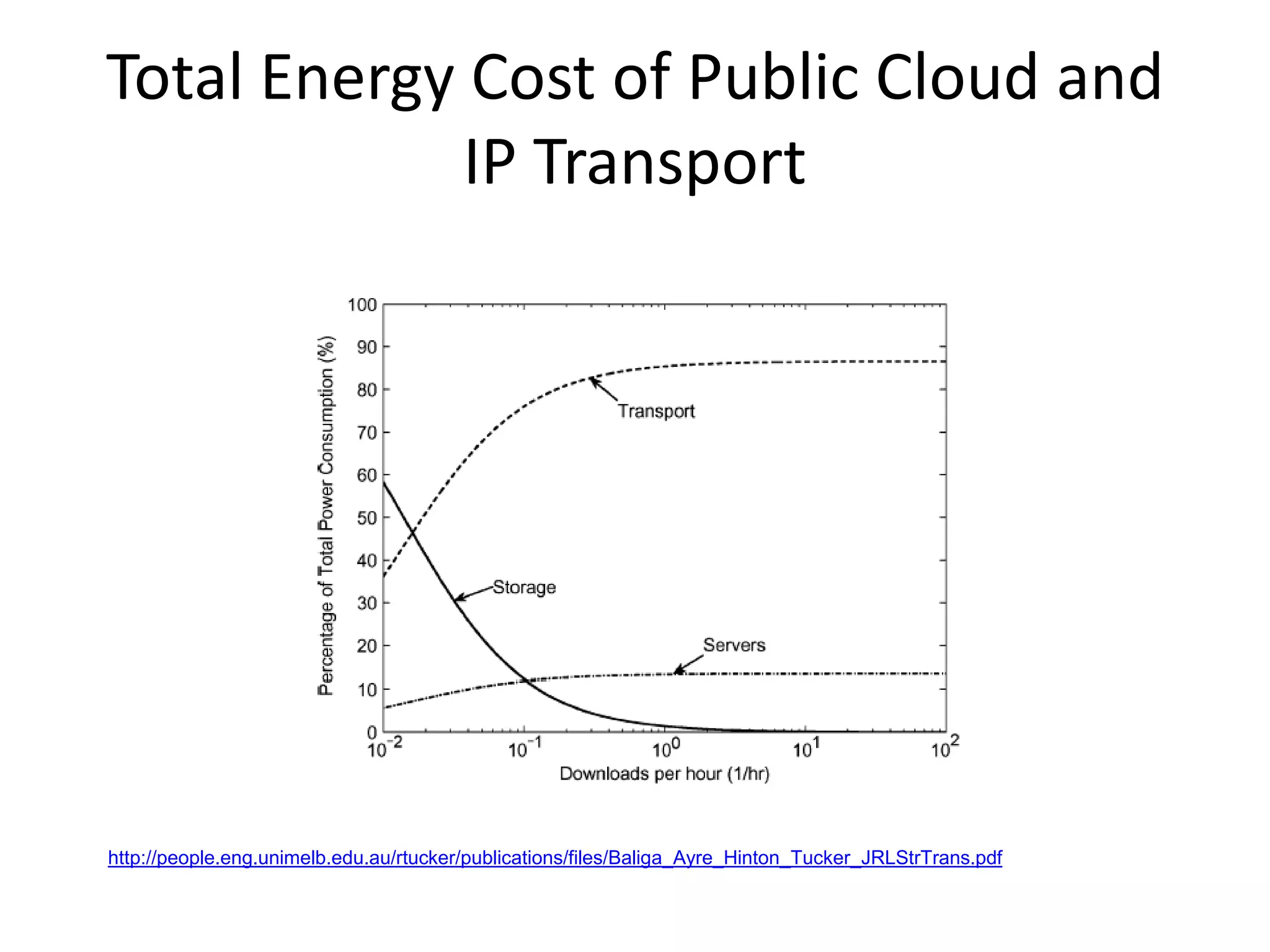
Total Energy Cost of Public Cloud and IP Transporthttp://people.eng.unimelb.edu.au/rtucker/publications/files/Baliga_Ayre_Hinton_Tucker_JRLStrTrans.pdf
Zero Carbon strategy essentialZero carbon strategy using renewable energy critically important if governments mandate carbon neutrality, or if there is a climate catastropheWith a zero carbon strategy growth in demand for services will not effect  GHG emissionsAnything times zero is always zeroWind and solar power are most likely candidates because of opportunity cost/benefit analysis especially time to deployNuclear has high opportunity cost because  of time to deployhttp://climateprogress.org/2008/12/14/stanford-study-part-1-wind-solar-baseload-easily-beat-nuclear-and-they-all-best-clean-coal/But renewable energy sites are usually located far from cities and electrical distribution systems are not designed to carry loadhttp://www.americanprogress.org/issues/2008/12/pdf/renewable_transmission.pdfLocal wind/solar will be an important component
Uncongested optical networks essentialOptical networks have much smaller footprint than routed networksEnergy consumption and CO2 not linear with bandwidthComputing and storage will be delivered by a relatively small number of international mega-scale data centersDatacenters, large science instrument and clouds will increasingly be at remote locations e.g. Norway, Iceland, CanadaTransfer of virtual machines from site to site requires large instantaneous bandwidthImpossible to know what will be source destination sites for VM beforehandSo mirroring not practical
Grand Challenge – Building solutions using renewable energy onlyMost government GHG plans plan to 30-40% of electrical power will come from renewable sources How do you provide mission critical services when energy source is unreliable?Ebbing wind or setting sunBack up diesel and batteries are not an option because they are not zero carbon and power outages can last for days or weeksNeed new energy delivery architectures and business models to ensure reliable service deliveryR&E networks and clouds can play a critical role Not so much in energy efficiency, but building smart solutions that adapt to availability of renewable power
MIT to build zero carbon data center in Holyoke MAThe data center will be managed and funded by the four main partners in the facility: the Massachusetts Institute of Technology, Cisco Systems, the University of Massachusetts and EMC.It will be a high-performance computing environment that will help expand the research and development capabilities of the companies and schools in Holyokehttp://www.greenercomputing.com/news/2009/06/11/cisco-emc-team-mit-launch-100m-green-data-center
GreenStar NetworkWorld’s first zero carbon networkNodes in Ireland, USA Spain and Belgium to be added shortlyhttp://www.greenstarnetwork.com/
How it will be achieved:GreenStar uses virtualization technologies to allow the nodes in a network (both hosts and network devices) to change its location based on renewable energy availability (hydro, solar, wind).MANTICORE (Europe) and GSN will collaborate in a joint experimentation to identify and try to address the issues of having the nodes in the network powered by unreliable power sources. MANTICORE and GSN will use a joint infrastructure, with some nodes powered by renewable energy sources, to experiment with and validate the scenarios identified by both projects. 28Carbon neutral infrastructures     Use (IaaS) services to contribute to the research performed in the GreenStar Network (GSN) project to enable carbon-neutral infrastructures.
SC|2006KREOnetThe SC06 VMT DemonstratorKoreaInternal/ExternalSensor WebsDRACControlledLightpathsDataCenter @TampaAmsterdam         NetherlightNortel’sSensor ServicesPlatformComputation at the Right Place & Time!We migrate live Virtual Machines, unbeknownst to applications and clients, for data affinity, business continuity / disaster recovery, load balancing, or power management
International Greenstar
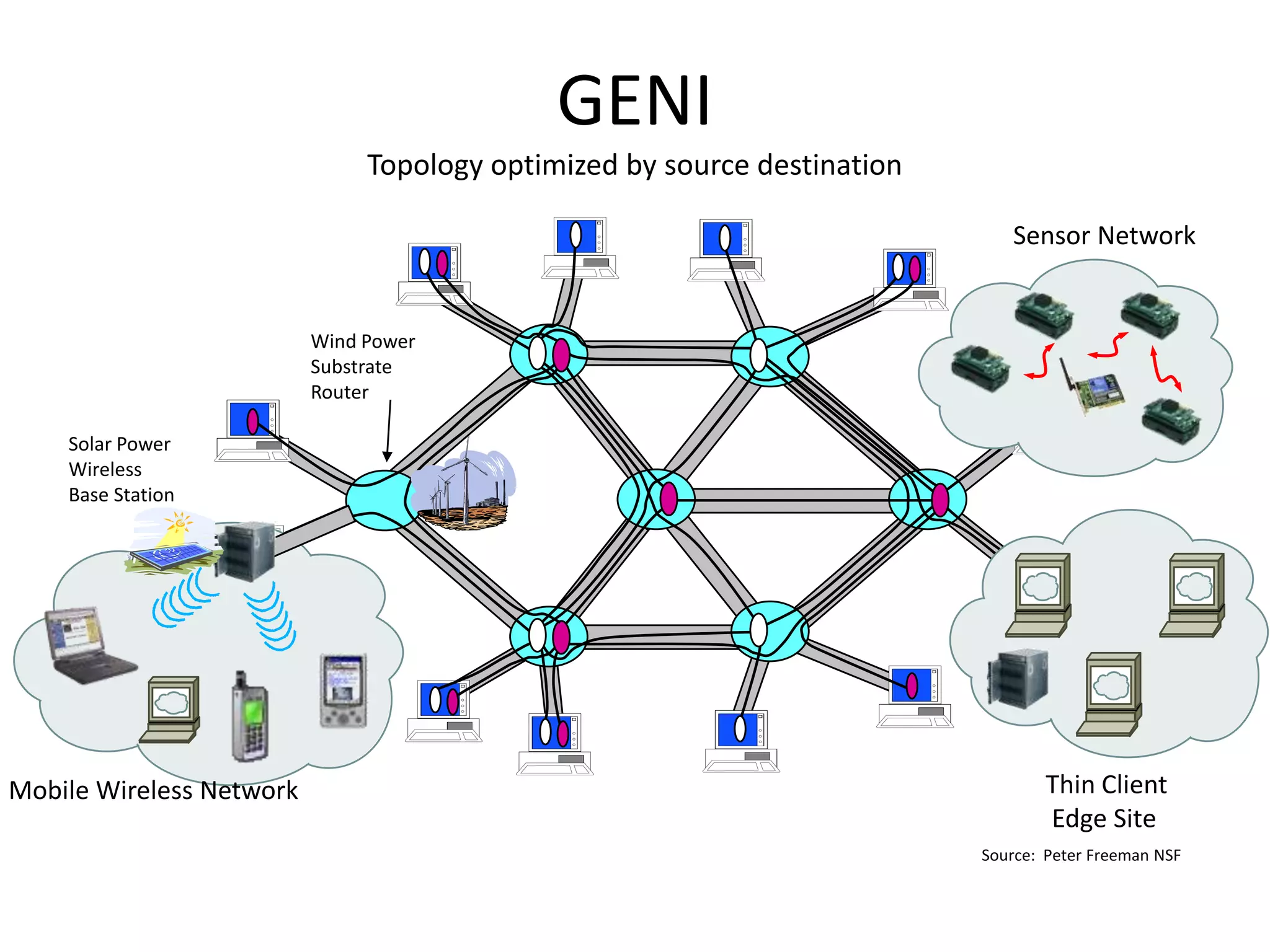
GENI Topology optimized by source destination Sensor NetworkThin Client Edge Site Mobile Wireless NetworkWind PowerSubstrateRouterSolar PowerWirelessBase StationSource:  Peter Freeman NSF
 Mobile Wireless NetworkGENI with router nodes at renewable energy sitesSensor NetworkWind PowerSubstrateRouterSolar PowerWirelessBase StationThin Client Edge SiteTopology optimized by availability of energySource:  Peter Freeman NSF
33GreenStar Global CollaborationUniversité du Québec à MontréalChina  (MOU) RackForce NetworksCanadian Standards Association (CSA), Climate Change DivisioniDealinc.California Institute for     Telecommunications andInformation Technology   USAIrelandUSASpainSIGMACOInternational Institute for Broadband TechnologyBelgium
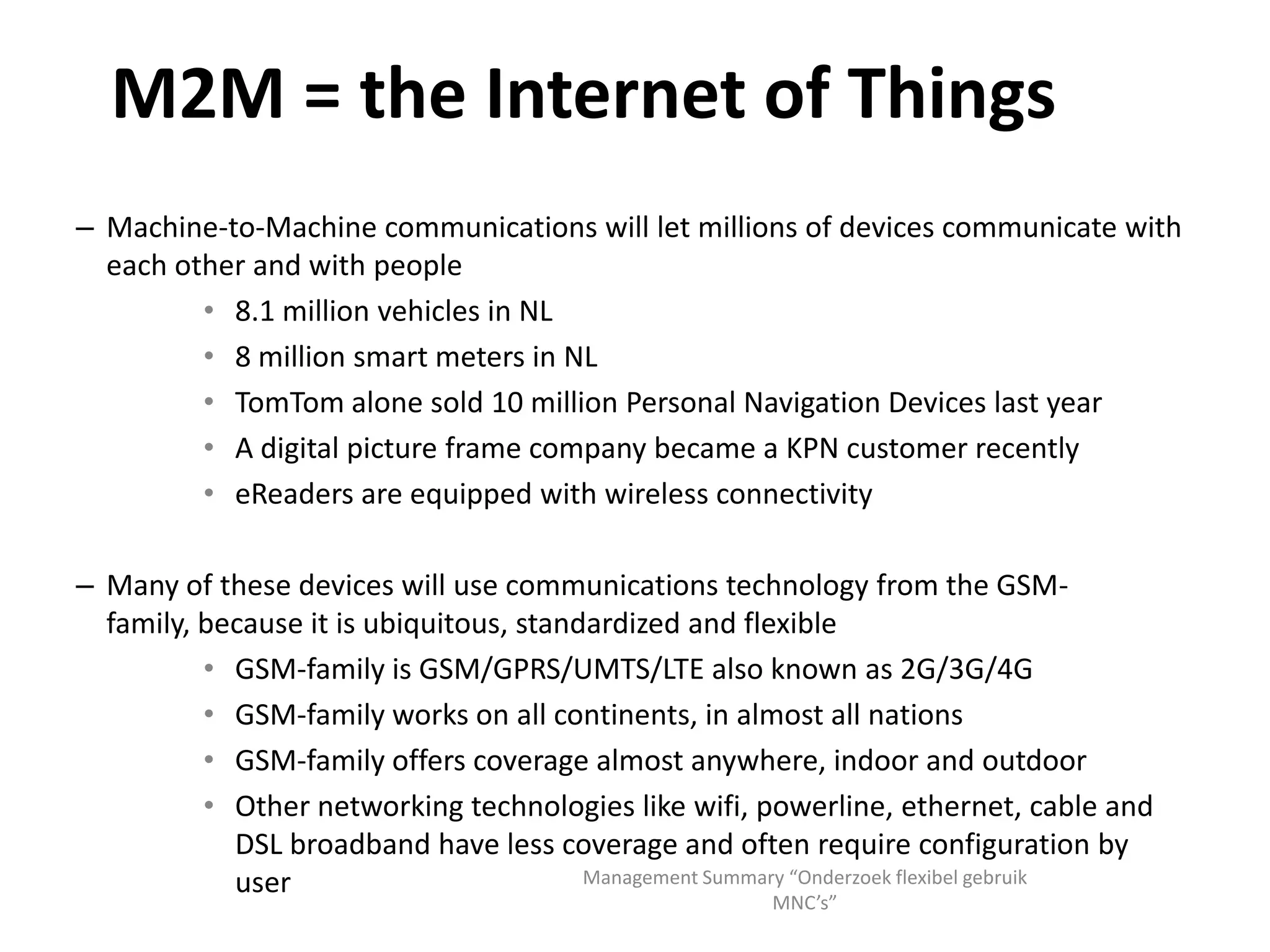
M2M = the Internet of ThingsMachine-to-Machine communications will let millions of devices communicate with each other and with people8.1 million vehicles in NL8 million smart meters in NLTomTom alone sold 10 million Personal Navigation Devices last yearA digital picture frame company became a KPN customer recentlyeReaders are equipped with wireless connectivityMany of these devices will use communications technology from the GSM-family, because it is ubiquitous, standardized and flexibleGSM-family is GSM/GPRS/UMTS/LTE also known as 2G/3G/4GGSM-family works on all continents, in almost all nationsGSM-family offers coverage almost anywhere, indoor and outdoorOther networking technologies like wifi, powerline, ethernet, cable and DSL broadband have less coverage and often require configuration by userManagement Summary “Onderzoek flexibel gebruik MNC’s”
SIM-cards lock customers to networksSIM-card designed to facilitate easy change of network or handset for consumerNo need to change handset to change network or to change number when changing handsetsEvery SIM-card has a unique unchangeable IMSI-number and cryptographic key that ties the SIM to a network. IMSI is 15 digits:Mobile Country Code (3 digits, issued by ITU)Mobile Network code (2 or 3 digits, issued by national regulator or ITU for international)Mobile Subscriber Identity Number (9 digits, issued by mobile network) For security reasons the IMSI-number and cryptographic key can’t be changed. Home Location Register verifies the cryptographic keyWholesale networks use MCC+MNC to give access to deviceMVNO switches wholesale network by changing access permissions(Inter)national roaming works the same wayManagement Summary “Onderzoek flexibel gebruik MNC’s”
Building a “5G” wireless networkOver 100,000 cell phone towers to be powered by renewable energy by 2012Vertical axis turbines and solarExisting 3G and 4G networks cannot handle data loadNeed to offload data at nearest node or towerNew Wifi standards 802.11u allow for data handoff from 3G networksWiFi nodes can be powered by renewable sources such as roof top solar panel over 400Hz power systems or ethernet powerCell phones also become sensorsSolar Powered WiFi Ericsson Wind Powered GSM
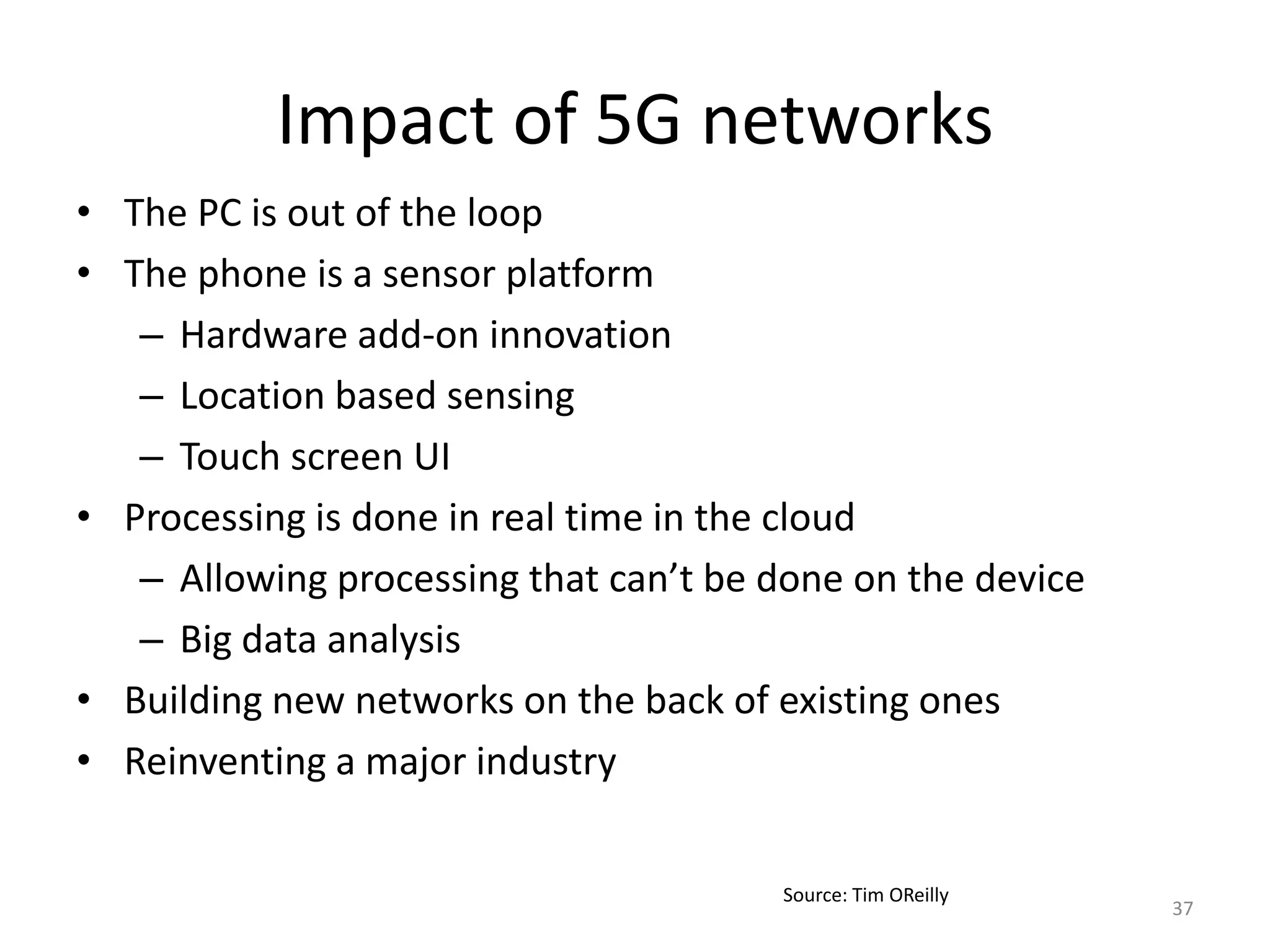
Impact of 5G networks37The PC is out of the loopThe phone is a sensor platformHardware add-on innovationLocation based sensingTouch screen UIProcessing is done in real time in the cloudAllowing processing that can’t be done on the deviceBig data analysisBuilding new networks on the back of existing onesReinventing a major industrySource: Tim OReilly
Sensors + Cloud38Source: Tim OReilly

Surfnet utrecht

  • 1.
    Optical Networks &Green IT  Bill St. ArnaudBill.st.arnaud@gmail.comUnless otherwise noted all material in this slide deck may be reproduced, modified or distributed without prior permission of the author
  • 3.
    Rapid Increase inthe Greenhouse Gas CO2Since Industrial Era BeganSource: David JC MacKay, Sustainable Energy Without the Hot Air (2009) 388 ppm in 2010Medieval Warm PeriodLittle Ice Age
  • 4.
    Global Climatic DisruptionExample:The Arctic Sea Ice“A pervasive cooling of the Arctic in progress 2000 years ago continued through the Middle Ages and into the Little Ice Age. It was reversed during the 20th century, with four of the five warmest decades of our 2000-year-long reconstruction occurring between 1950 and 2000. The most recent 10-year interval (1999–2008) was the warmest of the past 200 decades.”Mean of all records transformed to summer temperature anomaly relative to the 1961–1990 reference period, with first-order linear trend for all records through 1900 with 2 standard deviationsScience v. 325 pp 1236 (September 4, 2009)
  • 5.
  • 6.
  • 7.
    Jan, Feb Mar2010 warmest everThis is despite a solar sun spot minimum
  • 8.
    Climate ForecastsMIT reportpredicts median temperature forecast of 5.2°C
  • 9.
    11°C increase inNorthern Canada & Europe
  • 10.
  • 11.
    Last Ice ageaverage global temperature was 5-6°C cooler than today
  • 12.
    Most of Canada& Europe was under 2-3 km ice
  • 13.
    With BAU weare talking about 5-6°C change in temperature in the opposite direction in less than 80 YearsMIT
  • 14.
    Climate Change isnot reversibleClimate Change is not like acid rain, water management or ozone destruction where environment will quickly return to normal once source of pollution is removedGHG emissions will stay in the atmosphere for thousands of years and continue to accumulatePlanet will continue to warm up even if we drastically reduce emissionsWeaver et al., GRL (2007)All we hope to achieve is to slow down the rapid rate of climate change
  • 15.
    The Earth isWarming Over 100 Times Faster TodayThan During the Last Ice Age Warming!http://scrippsco2.ucsd.edu/program_history/keeling_curve_lessons.htmlCO2 Has Risen From 335 to 385ppm (50ppm) in 30 years or 1.6 ppm per YearCO2 Rose From 185 to 265ppm (80ppm) in 6000 years or 1.33 ppm per Century
  • 16.
    Climate tipping pointsUSGSreport finds that future climate shifts have been underestimated and warns of debilitating abrupt shift in climate that would be devastating. Tipping elements in the Earth's climate - National Academies of Science“Society may be lulled into a false sense of security by smooth projections of global change. Our synthesis of present knowledge suggests that a variety of tipping elements could reach their critical point within this century under anthropogenic climate change. “
  • 17.
    WAISWestern Antarctic IceSheet (WAIS)Sits on land below sea levelCan easily break up once sea water gets under iceOriginally thought that breakup would take hundreds of yearsNew evidence indicates that breakup will happen within 40 years when planet warms up 1C (we are already up .8C)Sea levels would be 3.3m – 4.8m
  • 18.
    Urgency of Action“We’reuncertain about the magnitude of climate change, which is inevitable, because we’re talking about reaching levels of carbon dioxide in the atmosphere not seen in millions of years. You might think that this uncertainty weakens the case for action, but it actually strengthens it. This risk of catastrophe, rather than the details of cost-benefit calculations, makes the most powerful case for strong climate policy. Current projections of global warming in the absence of action are just too close to the kinds of numbers associated with doomsday scenarios. It would be irresponsible — it’s tempting to say criminally irresponsible — not to step back from what could all too easily turn out to be the edge of a cliff.”Nobel Laureate Paul Krugmanhttp://www.nytimes.com/2010/04/11/magazine/11Economy-t.html?pagewanted=1
  • 19.
    The Global ICTCarbon Footprint isRoughly the Same as the Aviation Industry TodayBut ICT Emissions are Growing at 6% Annually!According to IEA ICT will represent 40% of all energy consumption by 2030www.smart2020.orgICT represent 8% of global electricity consumptionProjected to grow to as much as 20% of all electrical consumption in the US (http://uclue.com/index.php?xq=724)Future Broadband- Internet alone is expected to consume 5% of all electricity http://www.ee.unimelb.edu.au/people/rst/talks/files/Tucker_Green_Plenary.pdf
  • 20.
    The Global ICTCarbon Footprint by SubsectorThe Number of PCs (Desktops and Laptops) Globally is Expected to Increase from 592 Million in 2002 to More Than Four Billion in 2020 www.smart2020.orgData Centers & Clouds Are Low Hanging FruitPCs Are Biggest ProblemTelecom & Internet fastest growing
  • 21.
    IT biggest powerdrawEnergy Consumption World WideTransportation25%Energy Consumption Typical BuildingBuildings50%Lighting11%Manufacturing25%IT Equipment 30-40%Heating,CoolingandVentilation40-50%Other6%Sources: BOMA 2006, EIA 2006, AIA 2006
  • 22.
  • 23.
    Growth Projections DataCentersHalf of ICT consumption is data centersIn ten years 50% of today’s Data Centers and major science facilities in the US will have insufficient power and cooling;*By 2012, half of all Data Centers will have to relocate or outsource applications to another facility.*CO2 emissions from US datacenters greater than all CO2 emissions from Netherlands or Argentina http://bit.ly/cW6jEYCoal fuels much of Internet 'cloud,' Greenpeace says http://bit.ly/bkeSecData centers will consume 12% of electricity in the US by 2020 (TV Telecom)Source: Gartner; Meeting the DC power and cooling challenge
  • 24.
    The Challenge ofEnergy EfficiencyMost current approaches to reduce carbon footprint are focused on increased energy efficiency of equipment and processesNo question it save money, but does little for the environmentBut greater efficiency can paradoxically increase energy consumption by reducing overall cost service and therefore stimulates demandKhazzoom-Brookes postulate (aka Jevons paradox - not to be confused with rebound effect)In last Energy crisis in 1973 Congress passed first energy efficiency laws (CAFÉ) which mandate minimum mileage for cars, home insulation and appliancesNet effect was to reduce cost of driving car, heating or cooling home, and electricity required for appliancesConsumer response was to drive further, buy bigger homes and appliancesThe issue is not the amount of energy that we use, but the type of energy
  • 25.
    Power Consumption ofIP networkSource: Rod Tucker
  • 26.
  • 27.
    Total Energy Costof Public Cloud and IP Transporthttp://people.eng.unimelb.edu.au/rtucker/publications/files/Baliga_Ayre_Hinton_Tucker_JRLStrTrans.pdf
  • 28.
    Zero Carbon strategyessentialZero carbon strategy using renewable energy critically important if governments mandate carbon neutrality, or if there is a climate catastropheWith a zero carbon strategy growth in demand for services will not effect GHG emissionsAnything times zero is always zeroWind and solar power are most likely candidates because of opportunity cost/benefit analysis especially time to deployNuclear has high opportunity cost because of time to deployhttp://climateprogress.org/2008/12/14/stanford-study-part-1-wind-solar-baseload-easily-beat-nuclear-and-they-all-best-clean-coal/But renewable energy sites are usually located far from cities and electrical distribution systems are not designed to carry loadhttp://www.americanprogress.org/issues/2008/12/pdf/renewable_transmission.pdfLocal wind/solar will be an important component
  • 29.
    Uncongested optical networksessentialOptical networks have much smaller footprint than routed networksEnergy consumption and CO2 not linear with bandwidthComputing and storage will be delivered by a relatively small number of international mega-scale data centersDatacenters, large science instrument and clouds will increasingly be at remote locations e.g. Norway, Iceland, CanadaTransfer of virtual machines from site to site requires large instantaneous bandwidthImpossible to know what will be source destination sites for VM beforehandSo mirroring not practical
  • 30.
    Grand Challenge –Building solutions using renewable energy onlyMost government GHG plans plan to 30-40% of electrical power will come from renewable sources How do you provide mission critical services when energy source is unreliable?Ebbing wind or setting sunBack up diesel and batteries are not an option because they are not zero carbon and power outages can last for days or weeksNeed new energy delivery architectures and business models to ensure reliable service deliveryR&E networks and clouds can play a critical role Not so much in energy efficiency, but building smart solutions that adapt to availability of renewable power
  • 31.
    MIT to buildzero carbon data center in Holyoke MAThe data center will be managed and funded by the four main partners in the facility: the Massachusetts Institute of Technology, Cisco Systems, the University of Massachusetts and EMC.It will be a high-performance computing environment that will help expand the research and development capabilities of the companies and schools in Holyokehttp://www.greenercomputing.com/news/2009/06/11/cisco-emc-team-mit-launch-100m-green-data-center
  • 32.
    GreenStar NetworkWorld’s firstzero carbon networkNodes in Ireland, USA Spain and Belgium to be added shortlyhttp://www.greenstarnetwork.com/
  • 33.
    How it willbe achieved:GreenStar uses virtualization technologies to allow the nodes in a network (both hosts and network devices) to change its location based on renewable energy availability (hydro, solar, wind).MANTICORE (Europe) and GSN will collaborate in a joint experimentation to identify and try to address the issues of having the nodes in the network powered by unreliable power sources. MANTICORE and GSN will use a joint infrastructure, with some nodes powered by renewable energy sources, to experiment with and validate the scenarios identified by both projects. 28Carbon neutral infrastructures Use (IaaS) services to contribute to the research performed in the GreenStar Network (GSN) project to enable carbon-neutral infrastructures.
  • 34.
    SC|2006KREOnetThe SC06 VMTDemonstratorKoreaInternal/ExternalSensor WebsDRACControlledLightpathsDataCenter @TampaAmsterdam NetherlightNortel’sSensor ServicesPlatformComputation at the Right Place & Time!We migrate live Virtual Machines, unbeknownst to applications and clients, for data affinity, business continuity / disaster recovery, load balancing, or power management
  • 35.
  • 36.
    GENI Topology optimizedby source destination Sensor NetworkThin Client Edge Site Mobile Wireless NetworkWind PowerSubstrateRouterSolar PowerWirelessBase StationSource: Peter Freeman NSF
  • 37.
    Mobile WirelessNetworkGENI with router nodes at renewable energy sitesSensor NetworkWind PowerSubstrateRouterSolar PowerWirelessBase StationThin Client Edge SiteTopology optimized by availability of energySource: Peter Freeman NSF
  • 38.
    33GreenStar Global CollaborationUniversitédu Québec à MontréalChina (MOU) RackForce NetworksCanadian Standards Association (CSA), Climate Change DivisioniDealinc.California Institute for Telecommunications andInformation Technology USAIrelandUSASpainSIGMACOInternational Institute for Broadband TechnologyBelgium
  • 39.
    M2M = theInternet of ThingsMachine-to-Machine communications will let millions of devices communicate with each other and with people8.1 million vehicles in NL8 million smart meters in NLTomTom alone sold 10 million Personal Navigation Devices last yearA digital picture frame company became a KPN customer recentlyeReaders are equipped with wireless connectivityMany of these devices will use communications technology from the GSM-family, because it is ubiquitous, standardized and flexibleGSM-family is GSM/GPRS/UMTS/LTE also known as 2G/3G/4GGSM-family works on all continents, in almost all nationsGSM-family offers coverage almost anywhere, indoor and outdoorOther networking technologies like wifi, powerline, ethernet, cable and DSL broadband have less coverage and often require configuration by userManagement Summary “Onderzoek flexibel gebruik MNC’s”
  • 40.
    SIM-cards lock customersto networksSIM-card designed to facilitate easy change of network or handset for consumerNo need to change handset to change network or to change number when changing handsetsEvery SIM-card has a unique unchangeable IMSI-number and cryptographic key that ties the SIM to a network. IMSI is 15 digits:Mobile Country Code (3 digits, issued by ITU)Mobile Network code (2 or 3 digits, issued by national regulator or ITU for international)Mobile Subscriber Identity Number (9 digits, issued by mobile network) For security reasons the IMSI-number and cryptographic key can’t be changed. Home Location Register verifies the cryptographic keyWholesale networks use MCC+MNC to give access to deviceMVNO switches wholesale network by changing access permissions(Inter)national roaming works the same wayManagement Summary “Onderzoek flexibel gebruik MNC’s”
  • 41.
    Building a “5G”wireless networkOver 100,000 cell phone towers to be powered by renewable energy by 2012Vertical axis turbines and solarExisting 3G and 4G networks cannot handle data loadNeed to offload data at nearest node or towerNew Wifi standards 802.11u allow for data handoff from 3G networksWiFi nodes can be powered by renewable sources such as roof top solar panel over 400Hz power systems or ethernet powerCell phones also become sensorsSolar Powered WiFi Ericsson Wind Powered GSM
  • 42.
    Impact of 5Gnetworks37The PC is out of the loopThe phone is a sensor platformHardware add-on innovationLocation based sensingTouch screen UIProcessing is done in real time in the cloudAllowing processing that can’t be done on the deviceBig data analysisBuilding new networks on the back of existing onesReinventing a major industrySource: Tim OReilly
  • 43.
  • 44.
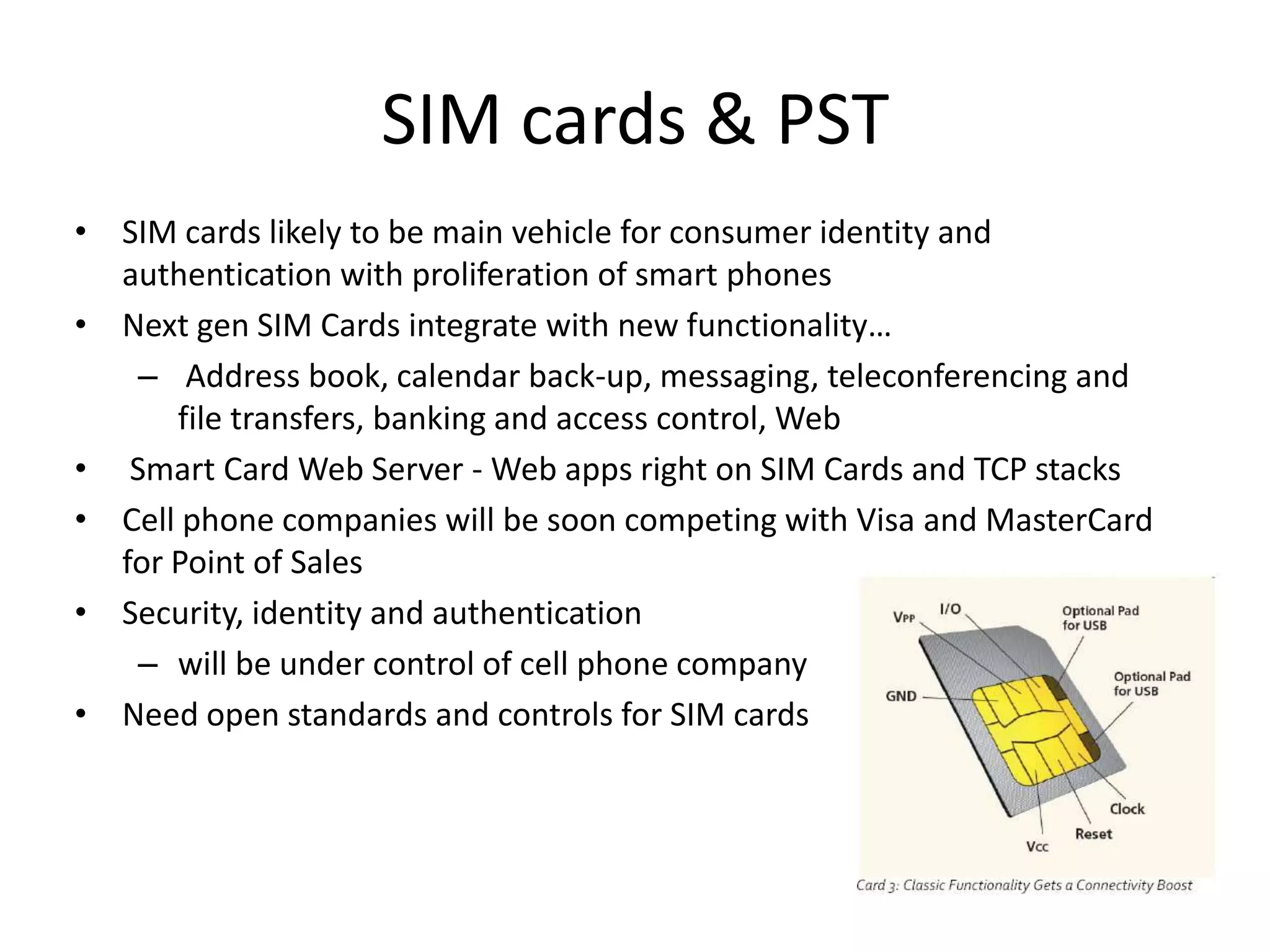
    SIM cards &PST SIM cards likely to be main vehicle for consumer identity and authentication with proliferation of smart phonesNext gen SIM Cards integrate with new functionality… Address book, calendar back-up, messaging, teleconferencing and file transfers, banking and access control, Web Smart Card Web Server - Web apps right on SIM Cards and TCP stacksCell phone companies will be soon competing with Visa and MasterCard for Point of SalesSecurity, identity and authentication will be under control of cell phone companyNeed open standards and controls for SIM cards39
  • 45.
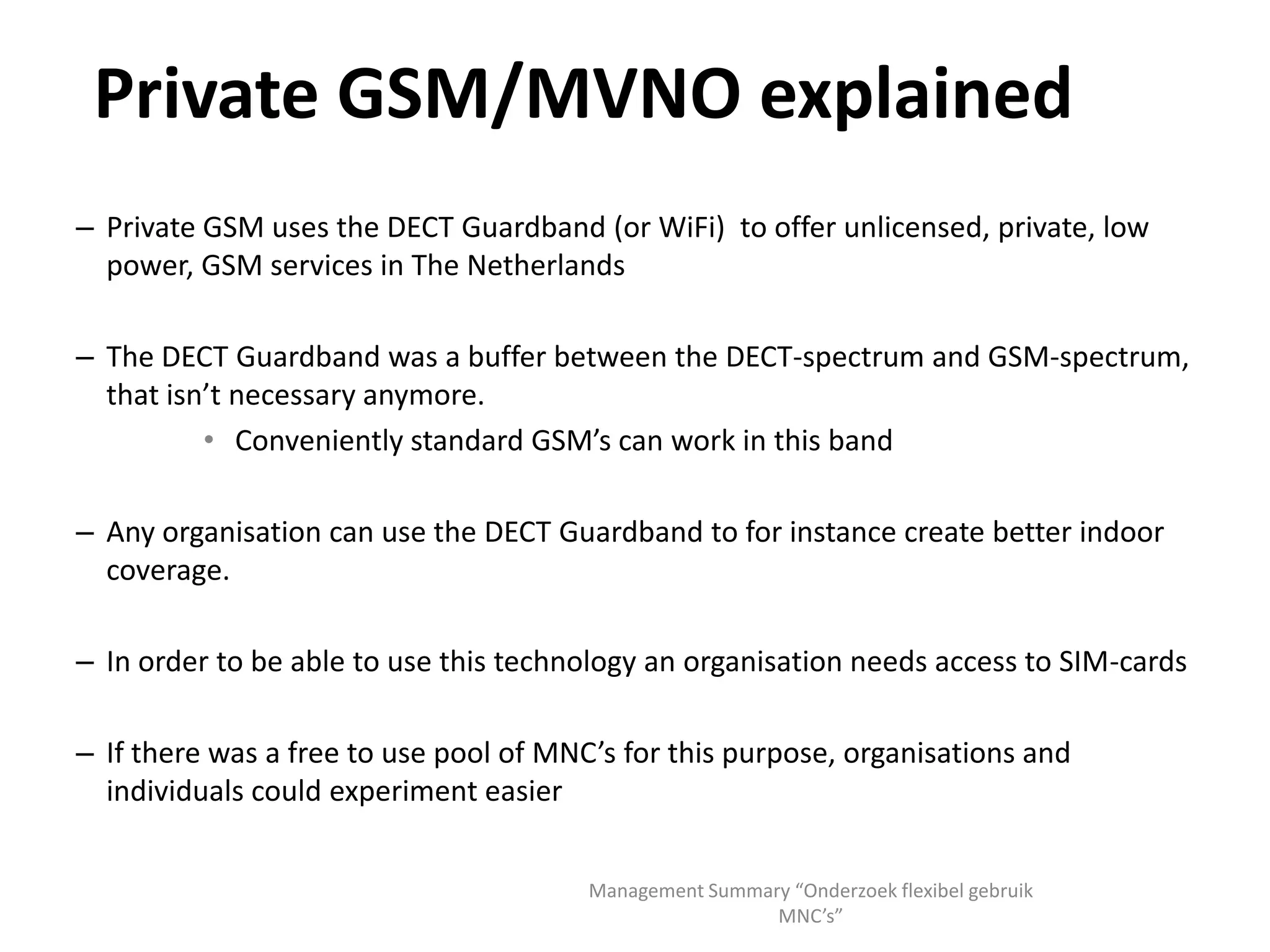
    Private GSM/MVNO explainedPrivateGSM uses the DECT Guardband (or WiFi) to offer unlicensed, private, low power, GSM services in The NetherlandsThe DECT Guardband was a buffer between the DECT-spectrum and GSM-spectrum, that isn’t necessary anymore. Conveniently standard GSM’s can work in this bandAny organisation can use the DECT Guardband to for instance create better indoor coverage. In order to be able to use this technology an organisation needs access to SIM-cardsIf there was a free to use pool of MNC’s for this purpose, organisations and individuals could experiment easierManagement Summary “Onderzoek flexibel gebruik MNC’s”
  • 46.
    New Green ITresearch fundingOECD ICCP recommendations that Green IT should be funded actual carbon savingsSeveral governments looking at fundng IT research (green and otherwise) out of carbon taxesQuebec to launch Green IT program funded from carbon tax on gasolineConference Board of Canada finds that funding green research provides more bang per buck in terms of outcome than carbon tradingLinking the base revenues for technology funds to emissions provides a direct and useful link between the sources of emissions and potential solutions.The economic impacts are expected to be significant. Identified spending over the five-year period will total $11.8 billion, the bulk of which will be in Alberta ($6.1billion) and Ontario($1.97billion), the two provinces with the largest GHG emissionsFCC, NSF, EPA to launch a formal Notice of Inquiry on Green IT
  • 47.
    Final remarksThe problemwe face is NOT energy consumption, but carbon emissionsThink carbon, not energyWe must start addressing climate change now – not in 2050 or 202080% reduction in CO2 emissions will fundamentally change everything we do including universities and networksHuge potential for innovation and new business opportunities for green communications enabled applications because 30% of energy must come from renewable sources
  • 48.
    Let’s Keep TheConversation GoingE-mail listBill.St.Arnaud@gmail.comBlogspotBill St. Arnaudhttp://green-broadband.blogspot.comTwitterhttp://twitter.com/BillStArnaud

Editor's Notes

  • #27 Building a zero carbon ICT infrastructurePurchasing green power locally is expensive with significant transmission line lossesDemand for green power within cities expected to grow dramaticallyICT facilities DON’T NEED TO BE LOCATED IN CITIES-Cooling also a major problem in citiesBut most renewable energy sites are very remote and impractical to connect to electrical grid. Can be easily reached by an optical network Provide independence from electrical utility and high costs in wheeling power Savings in transmission line losses (up to 15%) alone, plus carbon offsets can pay for moving ICT facilities to renewable energy siteICT is only industry ideally suited to relocate to renewable energy sites Also ideal for business continuity in event of climate catastrophe