PLASTIC
ROADS
By-
pavan rathode av
venkatesh b


  - For greening our constructions
CONTENTS...
Introduction
What is plastic ??
Field trails
Merits
De-Merits
Conclusion
Basic process
INTRODUCTION
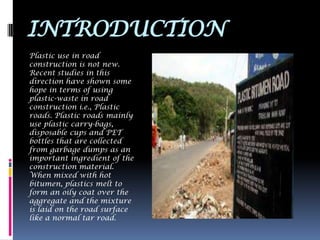
Plastic use in road
construction is not new.
Recent studies in this
direction have shown some
hope in terms of using
plastic-waste in road
construction i.e., Plastic
roads. Plastic roads mainly
use plastic carry-bags,
disposable cups and PET
bottles that are collected
from garbage dumps as an
important ingredient of the
construction material.
When mixed with hot
bitumen, plastics melt to
form an oily coat over the
aggregate and the mixture
is laid on the road surface
like a normal tar road.
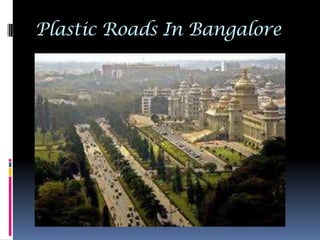
Plastic Roads In Bangalore
What is plastic??
 A plastic material is any of a wide range of
  synthetic or semi-synthetic organic
  amorphous solids used in the manufacture of
  industrial products. Plastics are typically
  polymers of high molecular mass and may
  contain other substances to improve
  performance and/or reduce costs. Monomers
  of plastic are either natural or synthetic
  organic compounds
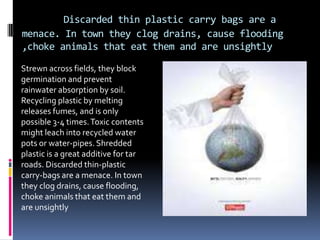
Discarded thin plastic carry bags are a
menace. In town they clog drains, cause flooding
,choke animals that eat them and are unsightly

Strewn across fields, they block
germination and prevent
rainwater absorption by soil.
Recycling plastic by melting
releases fumes, and is only
possible 3-4 times. Toxic contents
might leach into recycled water
pots or water-pipes. Shredded
plastic is a great additive for tar
roads. Discarded thin-plastic
carry-bags are a menace. In town
they clog drains, cause flooding,
choke animals that eat them and
are unsightly
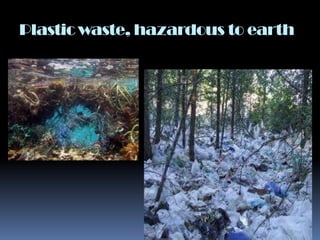
Plastic waste, hazardous to earth
Basic Processes:

1. Segregation.
2. Cleaning process.
3. Shredding process.
4. Collection process .
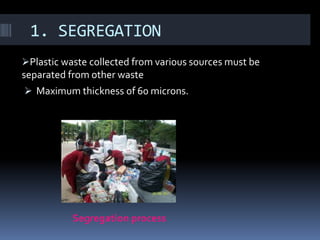
1. SEGREGATION
Plastic waste collected from various sources must be
separated from other waste
 Maximum thickness of 60 microns.


           Segregation process
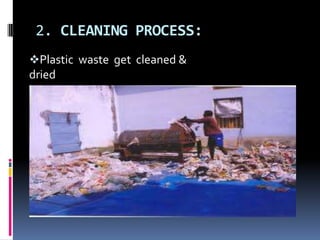
2. CLEANING PROCESS:
Plastic waste get cleaned &
dried
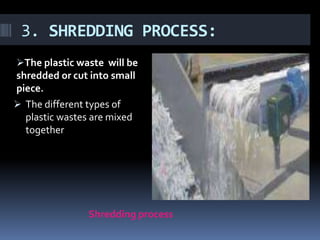
3. SHREDDING PROCESS:
The plastic waste will be
shredded or cut into small
piece.
 The different types of
  plastic wastes are mixed
  together


                Shredding process
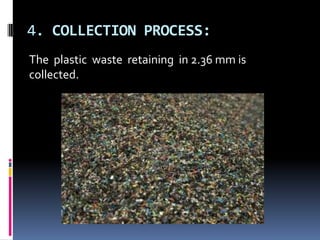
4. COLLECTION PROCESS:
The plastic waste retaining in 2.36 mm is
collected.
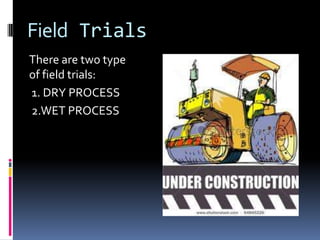
Field Trials
There are two type
of field trials:
1. DRY PROCESS
2.WET PROCESS
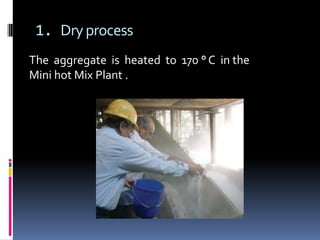
1. Dry process
The aggregate is heated to 170 ° C in the
Mini hot Mix Plant .
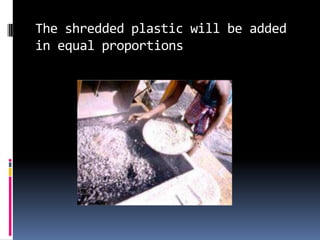
The shredded plastic will be added
in equal proportions
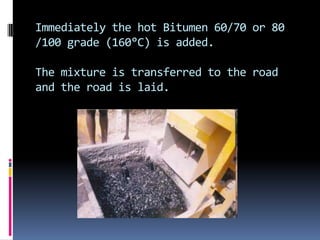
Immediately the hot Bitumen 60/70 or 80
/100 grade (160°C) is added.

The mixture is transferred to the road
and the road is laid.
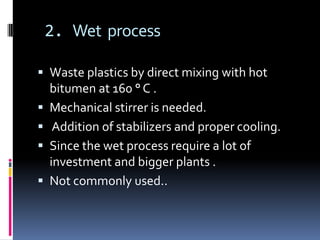
2. Wet process

 Waste plastics by direct mixing with hot
    bitumen at 160 ° C .
   Mechanical stirrer is needed.
    Addition of stabilizers and proper cooling.
   Since the wet process require a lot of
    investment and bigger plants .
   Not commonly used..
Advantages of plastic roads

 Use higher percentage of plastic waste.
 Reduce the need of bitumen by around 10%.
 Increase the strength and performance of the
  road.
 Reduce the cost to around Rs. 5000/Km. of single
  lane road.
 Generate jobs for rag pickers. Develop a
  technology, which is eco-friendly .
 100% improvement in fatigue life of roads.
 Reduced penetration and ductility, a higher
  softening point, less rutting and cold cracking
DISADVANTAGES OF PLASTIC ROADS
:
 1. Cleaning process Toxics present in the co-
  mingled plastic waste would start leaching .
  2. During the road laying process In the
  presence of chlorine will definitely release
  noxious HCL gas .
 3.After the road laying It is opined that the
  first rain will trigger leaching. As the plastics
  will merely form a sticky layer, (mechanical
  abrasion). The components of the road, once
  it has been laid, are not inert
CONCLUSION:

 Plastic will increase the melting point of the
  bitumen .
 use of the innovative technology not only
  strengthened the road construction but also
  increased the road life .
 Help to improve the environment .
 plastic road would be a boon for India’s hot
  and extremely humid climate where durable
  and eco-friendly roads which will relive the
  earth from all type of plastic waste
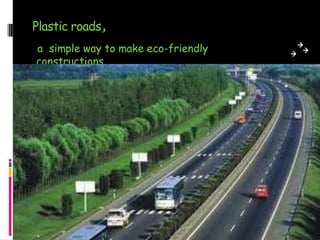
Plastic roads,
a simple way to make eco-friendly
constructions

Plastic roads

  • 1.
    PLASTIC ROADS By- pavan rathode av venkateshb - For greening our constructions
  • 2.
    CONTENTS... Introduction What is plastic?? Field trails Merits De-Merits Conclusion Basic process
  • 3.
    INTRODUCTION Plastic use inroad construction is not new. Recent studies in this direction have shown some hope in terms of using plastic-waste in road construction i.e., Plastic roads. Plastic roads mainly use plastic carry-bags, disposable cups and PET bottles that are collected from garbage dumps as an important ingredient of the construction material. When mixed with hot bitumen, plastics melt to form an oily coat over the aggregate and the mixture is laid on the road surface like a normal tar road.
  • 4.
  • 5.
    What is plastic?? A plastic material is any of a wide range of synthetic or semi-synthetic organic amorphous solids used in the manufacture of industrial products. Plastics are typically polymers of high molecular mass and may contain other substances to improve performance and/or reduce costs. Monomers of plastic are either natural or synthetic organic compounds
  • 6.
    Discarded thin plasticcarry bags are a menace. In town they clog drains, cause flooding ,choke animals that eat them and are unsightly Strewn across fields, they block germination and prevent rainwater absorption by soil. Recycling plastic by melting releases fumes, and is only possible 3-4 times. Toxic contents might leach into recycled water pots or water-pipes. Shredded plastic is a great additive for tar roads. Discarded thin-plastic carry-bags are a menace. In town they clog drains, cause flooding, choke animals that eat them and are unsightly
  • 7.
  • 8.
    Basic Processes: 1. Segregation. 2.Cleaning process. 3. Shredding process. 4. Collection process .
  • 9.
    1. SEGREGATION Plastic wastecollected from various sources must be separated from other waste  Maximum thickness of 60 microns. Segregation process
  • 10.
    2. CLEANING PROCESS: Plasticwaste get cleaned & dried
  • 11.
    3. SHREDDING PROCESS: Theplastic waste will be shredded or cut into small piece.  The different types of plastic wastes are mixed together Shredding process
  • 12.
    4. COLLECTION PROCESS: Theplastic waste retaining in 2.36 mm is collected.
  • 13.
    Field Trials There aretwo type of field trials: 1. DRY PROCESS 2.WET PROCESS
  • 14.
    1. Dry process Theaggregate is heated to 170 ° C in the Mini hot Mix Plant .
  • 15.
    The shredded plasticwill be added in equal proportions
  • 16.
    Immediately the hotBitumen 60/70 or 80 /100 grade (160°C) is added. The mixture is transferred to the road and the road is laid.
  • 17.
    2. Wet process Waste plastics by direct mixing with hot bitumen at 160 ° C .  Mechanical stirrer is needed.  Addition of stabilizers and proper cooling.  Since the wet process require a lot of investment and bigger plants .  Not commonly used..
  • 18.
    Advantages of plasticroads  Use higher percentage of plastic waste.  Reduce the need of bitumen by around 10%.  Increase the strength and performance of the road.  Reduce the cost to around Rs. 5000/Km. of single lane road.  Generate jobs for rag pickers. Develop a technology, which is eco-friendly .  100% improvement in fatigue life of roads.  Reduced penetration and ductility, a higher softening point, less rutting and cold cracking
  • 19.
    DISADVANTAGES OF PLASTICROADS :  1. Cleaning process Toxics present in the co- mingled plastic waste would start leaching . 2. During the road laying process In the presence of chlorine will definitely release noxious HCL gas .  3.After the road laying It is opined that the first rain will trigger leaching. As the plastics will merely form a sticky layer, (mechanical abrasion). The components of the road, once it has been laid, are not inert
  • 20.
    CONCLUSION:  Plastic willincrease the melting point of the bitumen .  use of the innovative technology not only strengthened the road construction but also increased the road life .  Help to improve the environment .  plastic road would be a boon for India’s hot and extremely humid climate where durable and eco-friendly roads which will relive the earth from all type of plastic waste
  • 21.
    Plastic roads, a simpleway to make eco-friendly constructions