FCC Broadband plan versus the environment Bill St. ArnaudBill.st.arnaud@gmail.comUnless otherwise noted all material in this slide deck may be reproduced, modified or distributed without prior permission of the author
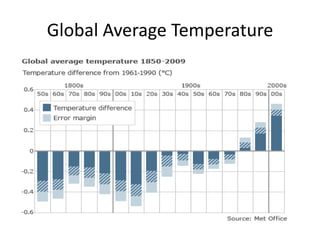
Global Average Temperature
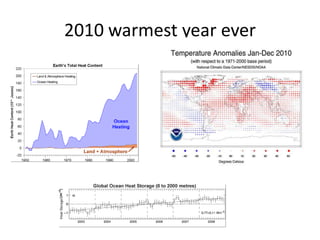
2010 warmest year ever
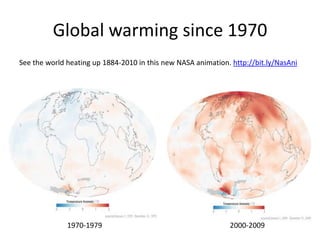
Global warming since 1970See the world heating up 1884-2010 in this new NASA animation. http://bit.ly/NasAni1970-19792000-2009
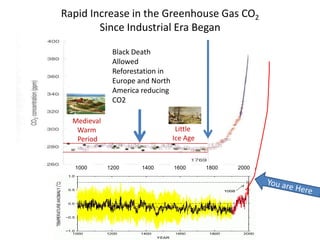
Rapid Increase in the Greenhouse Gas CO2Since Industrial Era BeganBlack Death Allowed Reforestation in Europe and North America reducing CO2Medieval Warm PeriodLittle Ice Age200018001400160012001000You are Here
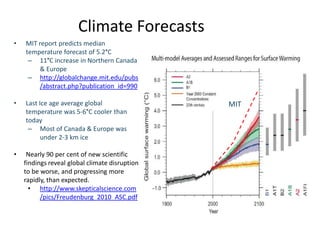
Climate ForecastsMIT report predicts median temperature forecast of 5.2°C
11°C increase in Northern Canada & Europe
http://globalchange.mit.edu/pubs/abstract.php?publication_id=990
Last Ice age average global temperature was 5-6°C cooler than today
Most of Canada & Europe was under 2-3 km ice
Nearly 90 per cent of new scientific findings reveal global climate disruption to be worse, and progressing more rapidly, than expected.
http://www.skepticalscience.com/pics/Freudenburg_2010_ASC.pdfMIT
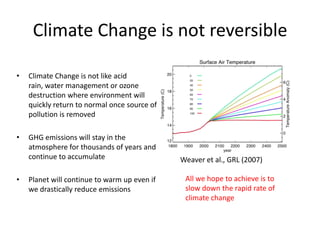
Climate Change is not reversibleClimate Change is not like acid rain, water management or ozone destruction where environment will quickly return to normal once source of pollution is removedGHG emissions will stay in the atmosphere for thousands of years and continue to accumulatePlanet will continue to warm up even if we drastically reduce emissionsWeaver et al., GRL (2007)All we hope to achieve is to slow down the rapid rate of climate change
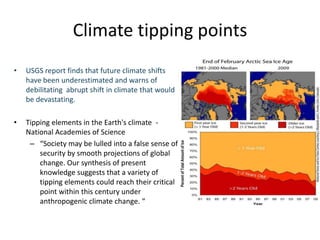
Climate tipping pointsUSGS report finds that future climate shifts have been underestimated and warns of debilitating  abrupt shift in climate that would be devastating. Tipping elements in the Earth's climate  - National Academies of Science“Society may be lulled into a false sense of security by smooth projections of global change. Our synthesis of present knowledge suggests that a variety of tipping elements could reach their critical point within this century under anthropogenic climate change. “
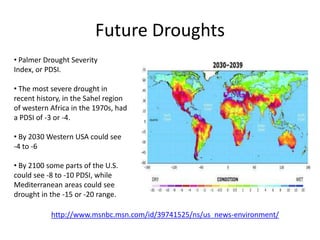
Future Droughts Palmer Drought Severity Index, or PDSI.
 The most severe drought in recent history, in the Sahel region of western Africa in the 1970s, had a PDSI of -3 or -4.
 By 2030 Western USA could see  -4 to -6
 By 2100 some parts of the U.S. could see -8 to -10 PDSI, while Mediterranean areas could see drought in the -15 or -20 range.http://www.msnbc.msn.com/id/39741525/ns/us_news-environment/
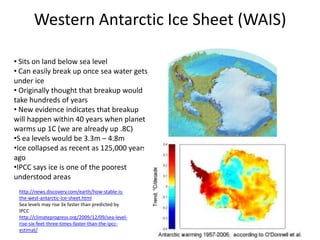
Western Antarctic Ice Sheet (WAIS) Sits on land below sea level
 Can easily break up once sea water gets under ice
 Originally thought that breakup would take hundreds of years
 New evidence indicates that breakup will happen within 40 years when planet warms up 1C (we are already up .8C)
S ea levels would be 3.3m – 4.8m
Ice collapsed as recent as 125,000 years ago
IPCC says ice is one of the poorest understood areashttp://news.discovery.com/earth/how-stable-is-the-west-antarctic-ice-sheet.htmlSea levels may rise 3x faster than predicted by IPCChttp://climateprogress.org/2009/12/09/sea-level-rise-six-feet-three-times-faster-than-the-ipcc-estimat/

Green it case western mar 28 2011

  • 1.
    FCC Broadband planversus the environment Bill St. ArnaudBill.st.arnaud@gmail.comUnless otherwise noted all material in this slide deck may be reproduced, modified or distributed without prior permission of the author
  • 2.
  • 3.
  • 4.
    Global warming since1970See the world heating up 1884-2010 in this new NASA animation. http://bit.ly/NasAni1970-19792000-2009
  • 5.
    Rapid Increase inthe Greenhouse Gas CO2Since Industrial Era BeganBlack Death Allowed Reforestation in Europe and North America reducing CO2Medieval Warm PeriodLittle Ice Age200018001400160012001000You are Here
  • 6.
    Climate ForecastsMIT reportpredicts median temperature forecast of 5.2°C
  • 7.
    11°C increase inNorthern Canada & Europe
  • 8.
  • 9.
    Last Ice ageaverage global temperature was 5-6°C cooler than today
  • 10.
    Most of Canada& Europe was under 2-3 km ice
  • 11.
    Nearly 90 percent of new scientific findings reveal global climate disruption to be worse, and progressing more rapidly, than expected.
  • 12.
  • 13.
    Climate Change isnot reversibleClimate Change is not like acid rain, water management or ozone destruction where environment will quickly return to normal once source of pollution is removedGHG emissions will stay in the atmosphere for thousands of years and continue to accumulatePlanet will continue to warm up even if we drastically reduce emissionsWeaver et al., GRL (2007)All we hope to achieve is to slow down the rapid rate of climate change
  • 14.
    Climate tipping pointsUSGSreport finds that future climate shifts have been underestimated and warns of debilitating abrupt shift in climate that would be devastating. Tipping elements in the Earth's climate - National Academies of Science“Society may be lulled into a false sense of security by smooth projections of global change. Our synthesis of present knowledge suggests that a variety of tipping elements could reach their critical point within this century under anthropogenic climate change. “
  • 15.
    Future Droughts PalmerDrought Severity Index, or PDSI.
  • 16.
    The mostsevere drought in recent history, in the Sahel region of western Africa in the 1970s, had a PDSI of -3 or -4.
  • 17.
    By 2030Western USA could see -4 to -6
  • 18.
    By 2100some parts of the U.S. could see -8 to -10 PDSI, while Mediterranean areas could see drought in the -15 or -20 range.http://www.msnbc.msn.com/id/39741525/ns/us_news-environment/
  • 19.
    Western Antarctic IceSheet (WAIS) Sits on land below sea level
  • 20.
    Can easilybreak up once sea water gets under ice
  • 21.
    Originally thoughtthat breakup would take hundreds of years
  • 22.
    New evidenceindicates that breakup will happen within 40 years when planet warms up 1C (we are already up .8C)
  • 23.
    S ea levelswould be 3.3m – 4.8m
  • 24.
    Ice collapsed asrecent as 125,000 years ago
  • 25.
    IPCC says iceis one of the poorest understood areashttp://news.discovery.com/earth/how-stable-is-the-west-antarctic-ice-sheet.htmlSea levels may rise 3x faster than predicted by IPCChttp://climateprogress.org/2009/12/09/sea-level-rise-six-feet-three-times-faster-than-the-ipcc-estimat/

Editor's Notes

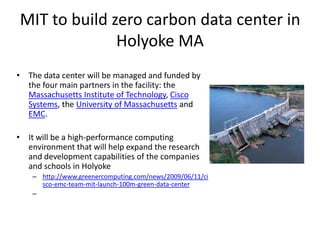
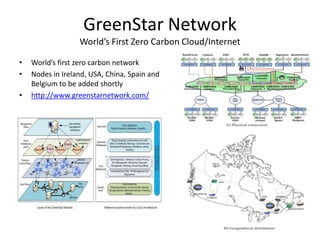
  • #19 Building a zero carbon ICT infrastructurePurchasing green power locally is expensive with significant transmission line lossesDemand for green power within cities expected to grow dramaticallyICT facilities DON’T NEED TO BE LOCATED IN CITIES-Cooling also a major problem in citiesBut most renewable energy sites are very remote and impractical to connect to electrical grid. Can be easily reached by an optical network Provide independence from electrical utility and high costs in wheeling power Savings in transmission line losses (up to 15%) alone, plus carbon offsets can pay for moving ICT facilities to renewable energy siteICT is only industry ideally suited to relocate to renewable energy sites Also ideal for business continuity in event of climate catastrophe