
SEMINAR            ONBandwidth Request for Quality of signal in WiMaxPresented by:Suman Swami
Contents ANALYSIS OF PROPOSED SCHEDULER ANALYSIS OF PROPOSED SCHEDULER ANALYSIS OF PROPOSED SCHEDULER  IntroductionProposed rtPS SchedulerAnalysis of proposed scheduler    Results  Conclusion
The IEEE 802.16 (WiMax) for broadband wireless metropolitan area network (WMAN) is becoming popular mainly due to its open standard and support to quality of service (QoS) for different categories of services.
A single cell in WiMax consists of a base station (BS) and multiple subscriber stations (SSs).
The BS schedules the traffic flow in the WiMax i.e., SSs do not communicate directly. The communication between BS and SS are bidirectional i.e., a downlink channel (from BS to SS) and an uplink channel (from SS to BS).INTRODUCTION
PROPOSED rtPS SCHEDULERIn 802.16 the rtPS bandwidth request scheduler at SS demands time slots for data transmission.In response to the request by SS the BS will provide some time slots equal to or less than the requested time slot.The time slots requested at a particular time depend on the total data in the rtPS queue at that time.
   If the request for time slot is made at time to, and request is granted at time tl, then t1 > to . As the request was made at to, the BS will allocate bandwidth for rtPS traffic waiting till to. However, between t1 & to new rtPS data might have arrived since the time last request was made.
For this new set of data, which have arrived between t1 and to, the SS has to send fresh request for bandwidth allocation.
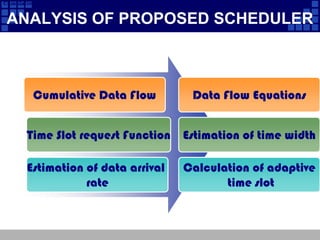
  We can remove these problems by scheduling an adaptive bandwidth allocation according to data flows in the rtPS queue.Cumulative dataflowANALYSIS OF PROPOSED SCHEDULERCumulative Data FlowData Flow EquationsAdd Your TitleTime Slot request FunctionEstimation of time widthEstimation of data arrival rateCalculation of adaptive time slot
Cumulative Data FlowData arrival curve A(t) in bytes in rtPS queue
Data Flow Equations  Let, D (t) Cumulative data departure from rtPS queue at SS X (t) Queue length in rtPS scheduler of SS C = Maximum transmission rate at output link for rtPS.
For our system we have assumed C = 2Mbps, which is taken as the optimum rate at which a given SS will transmit. Thus data service curve is a piece wise linear curve with a flat segment between slant segments Diagram        Service curve at rtPS scheduler
Time slot request functionThe time intervals Pn will have width ranging from 0 to say a maximum equal to Tmax. Let us assume that the queue length of rtPS queue is L which is in some sense optimal. The optimality of it can be further evaluated based on the ON times we are getting in this system and the data flows entering the queue as well as type of data flow.
Estimation of time widthLet us consider that the times at which request are made be ac1, ac2, ac3 ... aC. Now consider the time interval between a and the corresponding time till which it is fetched,i.e A.
Estimation of data arrival rateData arrival rate                        (A(ti+ ) - A(a ))                                                                   Vi =      _______________bi Error in this estimate as                    ~ei = vi -vi                                                                    Thus,                  ~            vi1+vi2Vi=        _______    -  ei                                  2
Calculation of adaptive time slot                            ~  ~                (X(ai) +vi*bi)                             x =    ___________                       C         Time Slot = Tslot (x)
ResultsDeparted data packets (in bytes) versus time                              (Sec) in  a SS for adaptive and weighted

Wimax

  • 1.
    SEMINAR ONBandwidth Request for Quality of signal in WiMaxPresented by:Suman Swami
  • 2.
    Contents ANALYSIS OFPROPOSED SCHEDULER ANALYSIS OF PROPOSED SCHEDULER ANALYSIS OF PROPOSED SCHEDULER IntroductionProposed rtPS SchedulerAnalysis of proposed scheduler Results Conclusion
  • 3.
    The IEEE 802.16(WiMax) for broadband wireless metropolitan area network (WMAN) is becoming popular mainly due to its open standard and support to quality of service (QoS) for different categories of services.
  • 4.
    A single cellin WiMax consists of a base station (BS) and multiple subscriber stations (SSs).
  • 5.
    The BS schedulesthe traffic flow in the WiMax i.e., SSs do not communicate directly. The communication between BS and SS are bidirectional i.e., a downlink channel (from BS to SS) and an uplink channel (from SS to BS).INTRODUCTION
  • 6.
    PROPOSED rtPS SCHEDULERIn802.16 the rtPS bandwidth request scheduler at SS demands time slots for data transmission.In response to the request by SS the BS will provide some time slots equal to or less than the requested time slot.The time slots requested at a particular time depend on the total data in the rtPS queue at that time.
  • 7.
    If the request for time slot is made at time to, and request is granted at time tl, then t1 > to . As the request was made at to, the BS will allocate bandwidth for rtPS traffic waiting till to. However, between t1 & to new rtPS data might have arrived since the time last request was made.
  • 8.
    For this newset of data, which have arrived between t1 and to, the SS has to send fresh request for bandwidth allocation.
  • 9.
    Wecan remove these problems by scheduling an adaptive bandwidth allocation according to data flows in the rtPS queue.Cumulative dataflowANALYSIS OF PROPOSED SCHEDULERCumulative Data FlowData Flow EquationsAdd Your TitleTime Slot request FunctionEstimation of time widthEstimation of data arrival rateCalculation of adaptive time slot
  • 10.
    Cumulative Data FlowDataarrival curve A(t) in bytes in rtPS queue
  • 11.
    Data Flow Equations Let, D (t) Cumulative data departure from rtPS queue at SS X (t) Queue length in rtPS scheduler of SS C = Maximum transmission rate at output link for rtPS.
  • 12.
    For our systemwe have assumed C = 2Mbps, which is taken as the optimum rate at which a given SS will transmit. Thus data service curve is a piece wise linear curve with a flat segment between slant segments Diagram Service curve at rtPS scheduler
  • 13.
    Time slot requestfunctionThe time intervals Pn will have width ranging from 0 to say a maximum equal to Tmax. Let us assume that the queue length of rtPS queue is L which is in some sense optimal. The optimality of it can be further evaluated based on the ON times we are getting in this system and the data flows entering the queue as well as type of data flow.
  • 14.
    Estimation of timewidthLet us consider that the times at which request are made be ac1, ac2, ac3 ... aC. Now consider the time interval between a and the corresponding time till which it is fetched,i.e A.
  • 15.
    Estimation of dataarrival rateData arrival rate (A(ti+ ) - A(a )) Vi = _______________bi Error in this estimate as ~ei = vi -vi   Thus, ~ vi1+vi2Vi= _______ - ei 2
  • 16.
    Calculation of adaptivetime slot ~ ~ (X(ai) +vi*bi) x = ___________ C Time Slot = Tslot (x)
  • 17.
    ResultsDeparted data packets(in bytes) versus time (Sec) in a SS for adaptive and weighted