Cell phone news and online
newspapers:
a transition to personalized, inexpensive news and
information on mobile phones: some South
African experiences and experiments
Harry Dugmore
MTN Chair of Media and Mobile Communications
Knight News Challenge Iindaba Ziyafika (‘the news is coming’)
project coordinator
School of Journalism and Media Studies
Rhodes University, South Africa
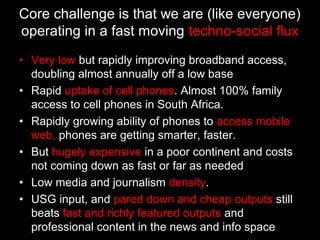
• Very low but rapidly improving broadband access,
doubling almost annually off a low base
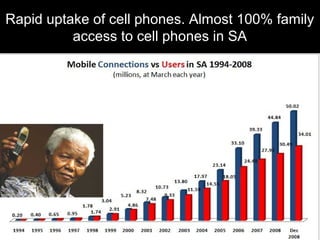
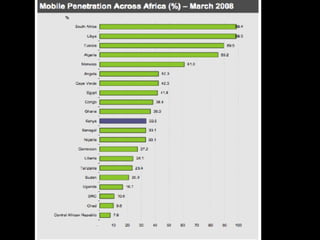
• Rapid uptake of cell phones. Almost 100% family
access to cell phones in South Africa.
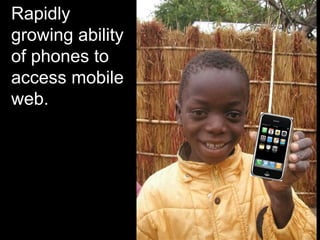
• Rapidly growing ability of phones to access mobile
web, phones are getting smarter, faster.
• But hugely expensive in a poor continent and costs
not coming down as fast or far as needed
• Low media and journalism density.
• USG input, and pared down and cheap outputs still
beats fast and richly featured outputs and
professional content in the news and info space
Core challenge is that we are (like everyone)
operating in a fast moving techno-social flux
Rapid uptake of cell phones. Almost 100% family
access to cell phones in SA
Rapidly
growing ability
of phones to
access mobile
web.
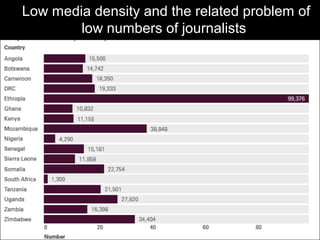
Low media density and the related problem of
low numbers of journalists
A big set of questions:
How to help create
‘informed, engaged communities’
in often undemocratic and
resource poor contexts,
with low levels of expensive, slow
broadband, and still make money
(or at least breakeven!)?
Induce and publish more and more audience
generated input, and create low bandwidth
and cheap mobile outputs (rather than
100% professional produced fast and
richly featured outputs)
Solutions in three areas:
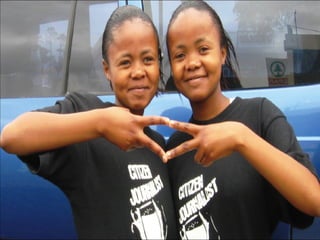
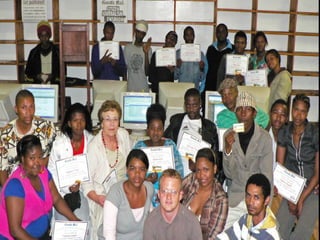
1.Train citizen journalists, offer incentives and use
more of their journalism.
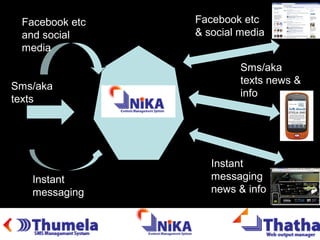
2.Use SMS/texts and Instant Messaging to supply
news and information.
3.Embracing low cost social media as critical to
the ‘news will find me’ culture
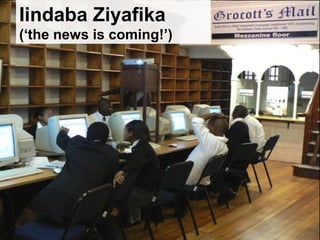
Iindaba Ziyafika
(‘the news is coming!’)
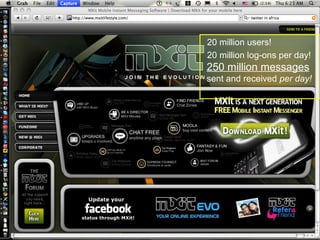
20 million users!
20 million log-ons per day!
250 million messages
sent and received per day!
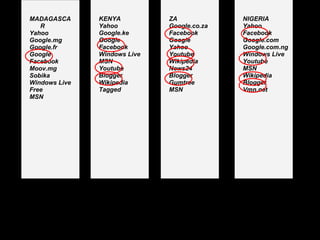
MADAGASCA
R
Yahoo
Google.mg
Google.fr
Google
Facebook
Moov.mg
Sobika
Windows Live
Free
MSN
KENYA
Yahoo
Google.ke
Google
Facebook
Windows Live
MSN
Youtube
Blogger
Wikipedia
Tagged
ZA
Google.co.za
Facebook
Google
Yahoo
Youtube
Wikipedia
News24
Blogger
Gumtree
MSN
NIGERIA
Yahoo
Facebook
Google.com
Google.com.ng
Windows Live
Youtube
MSN
Wikipedia
Blogger
Vmn.net
Instant
messaging
Sms/aka
texts
Facebook etc
and social
media
Instant
messaging
news & info
Sms/aka
texts news &
info
Facebook etc
& social media
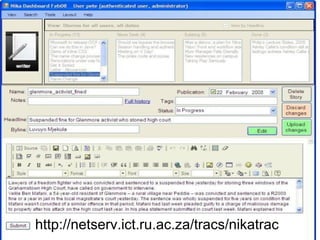
http://netserv.ict.ru.ac.za/tracs/nikatrac
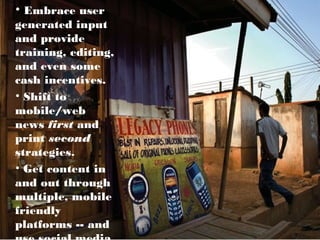
• Embrace user
generated input
and provide
training, editing,
and even some
cash incentives.
• Shift to
mobile/web
news first and
print second
strategies.
• Get content in
and out through
multiple, mobile
friendly
platforms -- and
Thank you!
Professor. Harry Dugmore
MTN Chair of Media and Mobile Communications
School of Journalism and Media Studies
Rhodes University
Grahamstown
South Africa
email: H.Dugmore@ru.ac.za
(w) (27) 046-603-7136
cell: (27) 082-885-7537
hardug@iafrica.com
Skype address: harrydugmore

Dugmore

Editor's Notes

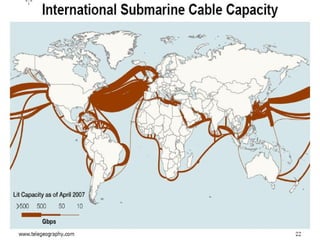
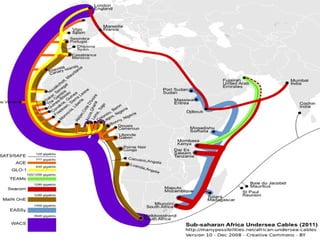
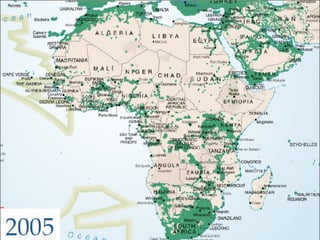
  • #4 This slide is from telegeograhy.com. As you can see, Africa has been poorly connected the rest of the world. This, coupled with poor internal connectivity, means the new technology has a long way to go to reach its potential in Africa.These are very thin ‘pipes’ even compared to South America for example.
  • #5 This slide is create by Steven Song, one of South Africa’s foremost expert on connectivity and other digital/mobile phone issues. See http://manypossibilities.net/african-undersea-cables/ But this year, all this is starting to change. African connectivity is going to improve 400 TIMES by the end of 2012, and even this year will take a giant leap. That thin black line is what we’ve had to make do with so far. So democracy is ON THE MARCH, and our connectivity is starting to change. What does this mean for NEW MEDIA, for DEEPENING DEMOCRACY?
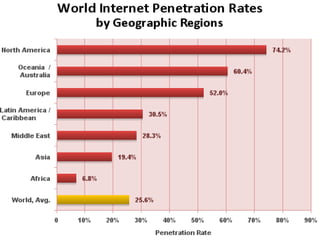
  • #6 Table from: www.internetworldststs.com
  • #7 Table from: http://www.internetworldstats.com/stats1.htm
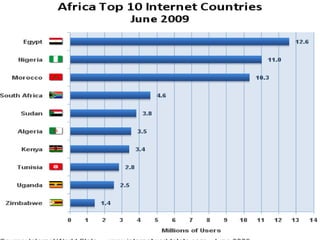
  • #8 This graphic comes from World Wide Worx, South Africa’s premier internet research company. http://www.worldwideworx.com/archives/204
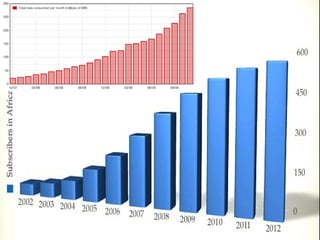
  • #10 Cell phone change everything! Almost ½ of all African now have cell phones, and by 2012, it is predicted that almost 2/3 of adults in Africa will have them. Take Ghana – it does NOT have much broadband connectivity, or even fixed phone lines. In fact it has fewer than 400,000 fixed lines in 2008. But mobile phone users rose from 215,000 in 2001 to 7.6 million by the end of December 2007. http://www.opera.com/smw/2009/11/#chart_data Mobile phones now represent around 90% of all telephone lines in Africa. The subscriber base is still growing at around 50% per year, but the growth curves are beginning to flatten in the continent’s more mature markets, forcing operators to compete more aggressively on price, quality of service and by introducing new services. However, enormous further potential remains, with overall market penetration standing at little more than 30% for the CONTINENT as a whole.
  • #11 http://whiteafrican.com/
  • #12 This slide is sourced by from a PowerPoint Presentation by Erik Hersman, Big Surprises, Small packages. http://www.slideshare.net/whiteafrican/mobile-phones-in-africa-picnic-08-presentation See Erik’s website: http://whiteafrican.com/
  • #13 African Media Development: Research Summary Report http://mediadevelopmentresearch.com/?p=170 USA has a working journalists for every 4600 Dense (1-15,000): South Africa had the most dense population per journalists with one journalist for every 1,300 citizens. With the exception of Nigeria, the other dense countries were in excess of 10,000 citizens per journalist. Medium (15-30,000): Comprising almost half of the countries surveyed, these medium density countries clustered around that of Cameroon (18,350) with Uganda (27,820) at the upper end of the category .Sparse (30,000+): Less than 20% of the surveyed countries, these countries ranged from those slightly in excess of 30,000 (Zimbabwe, Mozambique) to Ethiopia’s marked distance from others with only one journalist for every 99,000 habitants. AMDI report: summary of research finding. The USA has about 50,000 journalists, 17 journalists per 100,000 people. That might have changed – those are 2007 figures, but Robert Picard suggests, it is probably still under 1 to 20. see http://themediabusiness.blogspot.com/2009/03/overblown-journalist-employment-crisis.html
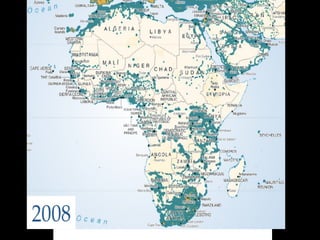
  • #14 This democracy map is from FREEDOM HOUSE for 2008/9. Overlaid on a slide from Erik Hersman found at: http://www.slideshare.net/whiteafrican/mobile-phones-in-africa-picnic-08-presentation What do we mean by this PARTIAL democracy. Just look at these three countries: why are they NOT regarded as democracies. What about Angola – it now has election, 8 parties stood, and yes, the MPLA gained 82% of the vote, and outspend the opposition by ore 100 times combined, and controlled all the media, but they were the first ‘real elections’ since 1992. But they are widely regarded as a shame. But Kenya and Nigeria? Why are they not ‘green”?
  • #17 http://www.pbs.org/idealab/harry_dugmore/
  • #21 http://whiteafrican.com/
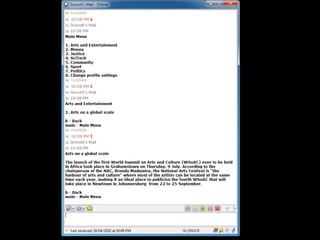
  • #22 See.www.MXIt.com
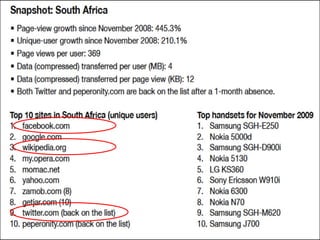
  • #24 This snapshot is from Opera Mini’s monthly State of the mobile web stats: http://www.opera.com/smw/ This selection was made by Rhodes colleague. Jude Mathurine from: http://www.slideshare.net/judem1/why-the-future-of-african-journalism-lies-in-mobile-social-networks
  • #25 This snapshot is from Opera Mini’s monthly State of the mobile web stats: http://www.opera.com/smw/ This selection was made by Rhodes colleague. Jude Mathurine from: http://www.slideshare.net/judem1/why-the-future-of-african-journalism-lies-in-mobile-social-networks
  • #27 This is a screen shot fro NIKA. Please see http://netserv.ict.ru.ac.za/tracs/nikatrac/roadmap
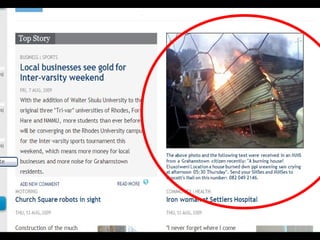
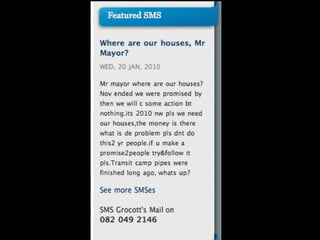
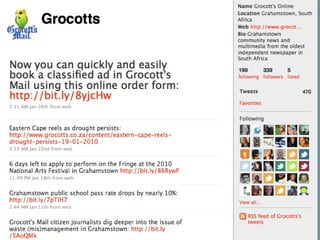
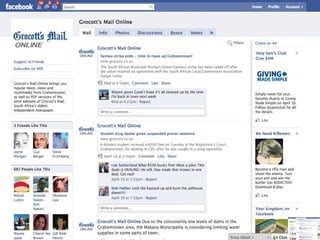
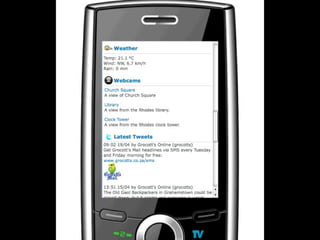
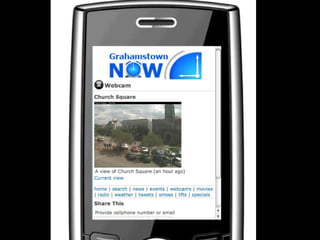
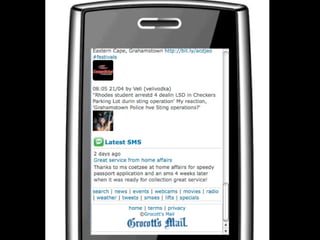
  • #29 See www.Grocotts.co.za
  • #37 SLIDE 40: Thank you!!!!!