General overview
   The list of social media
    tools could probably run on
    for paragraphs, and today’s
    technology changes so
    rapidly that many
    industries, including
    corporations and news
    media, can barely keep up.
    In the traditional world,
    newspapers, corporations,
    governments, or other
    types of leading
    organizations simply had to
    give out information, and
    people would consume it
    by reading or looking at it.
    But this seemingly tried-
    and-true method has
Social Media Literature
Review
 Media industry publications and critics often
  mention a media shift from traditional
  outlets, like newspapers and magazines, to
  digital news sources.
 ―Social media is one of the best ways to get
  traction with the mobile market. Far more
  people have crappy cell phones than
  computers. This allows journalists to reach
  lower and even middle-income communities
  and minorities that news organizations have
  been overlooking.
The Researcher of the report in
grouped into four categories
 The current state of traditional and social
  media
 popular social media tools and How media
  use them
 surrounding journalists’ ethical issues use
  of social media tools
 And How a two-way, conversationally
  driven world will change journalism.
Concluding Thoughts on the
"Social Media Revolution"
* social media has brought to light three fundamental areas
  within journalism .
    - The public’s trust of the media
    - The importance of local news organizations and their
  likelihood to remain in print
    - And the manner in which news is and will be covered using
  social media
   Social media tools like Twitter, Facebook and
    YouTube offer skeptical audiences the chance to
    receive news straight from the witnesses.
   Different Strokes: social media is not equally social
    or mediated globally. Chinese bloggers for example
    hardly ever hyper-link, Russians link obsessively –
    so blogs will have different network effects.
Types of Communication
       Medium
 The different types of communication medium into two different
  categories:-
          1. Physical media
          2. Mechanical media (everything that is  not No. 1)
* Physical media :-
  With physical media we mean channels where the person who is
  talking can    be seen and heard by the audience
               Such as example
 Large meetings, town hall meetings
 Department meetings (weekly meetings)
 Up close and personal (exclusive meetings)
 Video conferences
 Viral communication or word of mouth audience
* Mechanical media
 The two types of communication medium is mechanical media. With
 mechanical media we mean written or electronic channels. These
 channels can be used as archives for messages or for giving the big
 picture and a deeper knowledge
Such as example
   E-mail
   Weekly letters or newsletters
   Personal letters
   Billboards
   Intranet
   Magazines or papers
   Sms
   Social media
- Billboard
   One of the most forgotten types of communication medium is clearly the
    mediaa But the good thing with the billboard is that you can use billboards
    to inform people who do not have computers and/or access to the Intranet
    or to reach people that work part time and does not attend weekly meetings
    .billboard. Especially today, when everything is about social media .

                     such as example
   News summary
   Weekly letters
   Minutes from meetings
   Schedules
   Holiday lists
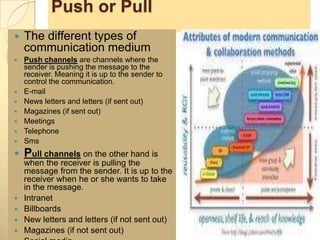
Push or Pull
   The different types of
    communication medium
   Push channels are channels where the
    sender is pushing the message to the
    receiver. Meaning it is up to the sender to
    control the communication.
   E-mail
   News letters and letters (if sent out)
   Magazines (if sent out)
   Meetings
   Telephone
   Sms
   Pull channels on the other hand is
    when the receiver is pulling the
    message from the sender. It is up to the
    receiver when he or she wants to take
    in the message.
   Intranet
   Billboards
   New letters and letters (if not sent out)
   Magazines (if not sent out)
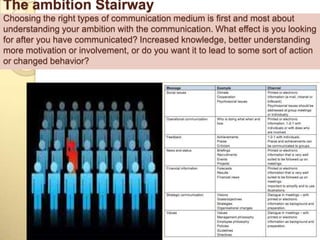
The ambition Stairway
   Choosing the right types of communication medium is first and most
    about understanding your ambition with the communication. What effect
    is you looking for after you have communicated? Increased knowledge,
    better understanding more motivation or involvement, or do you want it
    to lead to some sort of action or changed behavior?
The ambition Stairway
Choosing the right types of communication medium is first and most about
understanding your ambition with the communication. What effect is you looking
for after you have communicated? Increased knowledge, better understanding
more motivation or involvement, or do you want it to lead to some sort of action
or changed behavior?
The Arab Media
    Revolution
   From the early days of state-
    funded, heavily censored
    television to today's explosion of
    multichannel satellite TV, the
    Middle East has been an
    ideological minefield in a war of
    information. Jamal Dajani,
    producer of the daily online Arab
    news digest, Mosaic, charts the
    changes in the Arab media
    landscape and recalls how Al
    Jazeera helped start a media
    revolution that is still unfolding.
Survey of pakistan general
media
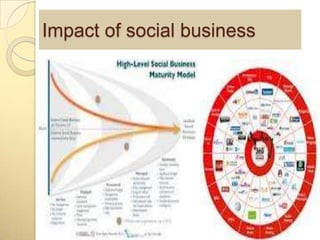
Impact of social business
New Media 1740-1915
   A continuing interest of mine
    is the interaction between us,
    our culture and the media
    that articulates and
    perpetuates that culture. The
    storage themes are obvious.
    Without storage, culture
    expression is forever
    ephemeral.
   Most ―new media‖ fail, as
    this collection of essays
    reminds us. Where is the
    optical telegraph, the
    zoetrope, the
    stereoscope, or even the
    electric telegraph? Today
    we invent new media at a
    furious pace, thanks to
    the confluence of
    broadband internet,
    personal computers,
    easy-to-use software and
    very cheap data storage.
Old to new era printing press
Impact of mobiles in Africa
    Harry Dugmore, professor at Rhodes
    University, Grahamstown, South Africa. He
    spoke about how the massive uptake of
    mobiles Africa had led some to hope the
    technology would help democracy flourish.
   The technological environment in Africa has
    evolved, starting off with mobiles with small
    screens, slow speeds and sky-high
    subscriptions. This was still the situation in
    many places, with only one of every 100
    phones in Africa being an iPhone.
   The result was a focus on SMS services to
    keep people inform and in touch.
   Mobile technology is moving towards better
    speeds, more competition and more powerful
    phones, said Dugmore. But costs are still
    high and net access can be intermittent.
   Some of the biggest changes,, have been the
    provision of free access to Facebook and
    Wikipedia on mobiles. Facebook zero means
    anyone can access Facebook on a mobile,
    even if they don’t have any credit.
Media relationship with each
other
The age of participation
 The Pew Internet & American
  Life Project found that 57% of
  American teenagers create
  content for the internet—from
  text to pictures, music and video
  .
 The mainstream media are in a
  good position to get things
  wrong.‖ The observer, after all,
  is part of the observation—a
  product of institutional media
  values even if he/she tries to
  apply the new rules of
  conversation.
 The media revolution of 1448,
  the wider implications for society
  will become visible gradually
  over a period of decades. With
  participatory media, the
  boundaries between audiences
  and creators become blurred
  and often invisible .
Thank you………
  saurav kishor

The different Media Revolution

  • 1.
    General overview  The list of social media tools could probably run on for paragraphs, and today’s technology changes so rapidly that many industries, including corporations and news media, can barely keep up. In the traditional world, newspapers, corporations, governments, or other types of leading organizations simply had to give out information, and people would consume it by reading or looking at it. But this seemingly tried- and-true method has
  • 2.
    Social Media Literature Review Media industry publications and critics often mention a media shift from traditional outlets, like newspapers and magazines, to digital news sources.  ―Social media is one of the best ways to get traction with the mobile market. Far more people have crappy cell phones than computers. This allows journalists to reach lower and even middle-income communities and minorities that news organizations have been overlooking.
  • 3.
    The Researcher ofthe report in grouped into four categories  The current state of traditional and social media  popular social media tools and How media use them  surrounding journalists’ ethical issues use of social media tools  And How a two-way, conversationally driven world will change journalism.
  • 4.
    Concluding Thoughts onthe "Social Media Revolution" * social media has brought to light three fundamental areas within journalism . - The public’s trust of the media - The importance of local news organizations and their likelihood to remain in print - And the manner in which news is and will be covered using social media  Social media tools like Twitter, Facebook and YouTube offer skeptical audiences the chance to receive news straight from the witnesses.  Different Strokes: social media is not equally social or mediated globally. Chinese bloggers for example hardly ever hyper-link, Russians link obsessively – so blogs will have different network effects.
  • 5.
    Types of Communication Medium  The different types of communication medium into two different categories:- 1. Physical media 2. Mechanical media (everything that is not No. 1) * Physical media :- With physical media we mean channels where the person who is talking can be seen and heard by the audience Such as example  Large meetings, town hall meetings  Department meetings (weekly meetings)  Up close and personal (exclusive meetings)  Video conferences  Viral communication or word of mouth audience
  • 6.
    * Mechanical media The two types of communication medium is mechanical media. With mechanical media we mean written or electronic channels. These channels can be used as archives for messages or for giving the big picture and a deeper knowledge Such as example  E-mail  Weekly letters or newsletters  Personal letters  Billboards  Intranet  Magazines or papers  Sms  Social media
  • 7.
    - Billboard  One of the most forgotten types of communication medium is clearly the mediaa But the good thing with the billboard is that you can use billboards to inform people who do not have computers and/or access to the Intranet or to reach people that work part time and does not attend weekly meetings .billboard. Especially today, when everything is about social media . such as example  News summary  Weekly letters  Minutes from meetings  Schedules  Holiday lists
  • 8.
    Push or Pull  The different types of communication medium  Push channels are channels where the sender is pushing the message to the receiver. Meaning it is up to the sender to control the communication.  E-mail  News letters and letters (if sent out)  Magazines (if sent out)  Meetings  Telephone  Sms  Pull channels on the other hand is when the receiver is pulling the message from the sender. It is up to the receiver when he or she wants to take in the message.  Intranet  Billboards  New letters and letters (if not sent out)  Magazines (if not sent out)
  • 9.
    The ambition Stairway  Choosing the right types of communication medium is first and most about understanding your ambition with the communication. What effect is you looking for after you have communicated? Increased knowledge, better understanding more motivation or involvement, or do you want it to lead to some sort of action or changed behavior?
  • 10.
    The ambition Stairway Choosingthe right types of communication medium is first and most about understanding your ambition with the communication. What effect is you looking for after you have communicated? Increased knowledge, better understanding more motivation or involvement, or do you want it to lead to some sort of action or changed behavior?
  • 11.
    The Arab Media Revolution  From the early days of state- funded, heavily censored television to today's explosion of multichannel satellite TV, the Middle East has been an ideological minefield in a war of information. Jamal Dajani, producer of the daily online Arab news digest, Mosaic, charts the changes in the Arab media landscape and recalls how Al Jazeera helped start a media revolution that is still unfolding.
  • 12.
    Survey of pakistangeneral media
  • 13.
  • 14.
    New Media 1740-1915  A continuing interest of mine is the interaction between us, our culture and the media that articulates and perpetuates that culture. The storage themes are obvious. Without storage, culture expression is forever ephemeral.
  • 15.
    Most ―new media‖ fail, as this collection of essays reminds us. Where is the optical telegraph, the zoetrope, the stereoscope, or even the electric telegraph? Today we invent new media at a furious pace, thanks to the confluence of broadband internet, personal computers, easy-to-use software and very cheap data storage.
  • 16.
    Old to newera printing press
  • 17.
    Impact of mobilesin Africa  Harry Dugmore, professor at Rhodes University, Grahamstown, South Africa. He spoke about how the massive uptake of mobiles Africa had led some to hope the technology would help democracy flourish.  The technological environment in Africa has evolved, starting off with mobiles with small screens, slow speeds and sky-high subscriptions. This was still the situation in many places, with only one of every 100 phones in Africa being an iPhone.  The result was a focus on SMS services to keep people inform and in touch.  Mobile technology is moving towards better speeds, more competition and more powerful phones, said Dugmore. But costs are still high and net access can be intermittent.  Some of the biggest changes,, have been the provision of free access to Facebook and Wikipedia on mobiles. Facebook zero means anyone can access Facebook on a mobile, even if they don’t have any credit.
  • 18.
  • 19.
    The age ofparticipation  The Pew Internet & American Life Project found that 57% of American teenagers create content for the internet—from text to pictures, music and video .  The mainstream media are in a good position to get things wrong.‖ The observer, after all, is part of the observation—a product of institutional media values even if he/she tries to apply the new rules of conversation.  The media revolution of 1448, the wider implications for society will become visible gradually over a period of decades. With participatory media, the boundaries between audiences and creators become blurred and often invisible .
  • 20.
    Thank you……… saurav kishor