Joy Robins / @joyarobins / joy@qz.com
SVP, Global Revenue & Strategy
Quartz (qz.com)
Native Advertising for
the C-Suite Executive
2
1. The promise of native advertising
2. Knowing your audience:
The Quartz Global Executives Study
3. Where do we go from here?
OUTLINE
3
1. The promise of native advertising
2. Knowing your audience:
The Quartz Global Executives Study
3. Where do we go from here?
OUTLINE
4
Industry
insights
Target
audience
5
Relevant
Industry
insights
Target
audience
6
High-
quality
Relevant
Industry
insights
Target
audience
7
High-
quality
Relevant
Industry
insights
Target
audience
In the right
place
8
High-
quality
Relevant
In the right
place
Industry
insights
Engaged
audience
9
1. The promise of native advertising
2. Knowing your audience:
The Quartz Global Executives Study
3. Where do we go from here?
OUTLINE
10
11
“There’s too much noise out there. I’d use
Twitter much more as a source of information if I
could get exactly what I need.”
Stuart Dean, CEO, GE ASEAN
The Quartz Global Executives Study documents
the changing content consumption and sharing
behaviors of the world’s business leaders.
12
13
http://insights.qz.com/GES
14
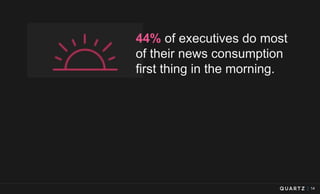
44% of executives do most
of their news consumption
first thing in the morning.
15
44% of executives do most
of their news consumption
first thing in the morning.
30% check news
throughout the day.
16
61% primarily use a mobile
device to consume news.
17
The inbox is the new
homepage.
60% of executives read an email
newsletter as their go-to source
of news.
18
Quality content gets shared.
91% of executives are likely to
share work-related content with
others, if they find it valuable.
19
86% of executives are
genuinely interested in
content from brands...
20
...particularly if that
content is a reflection of
the brand’s expertise.
68% industry analysis
58% new products
and innovations
43% leadership insights
25% company growth stories
23% social issues
Branded content topics of greatest
interest to executives:
21
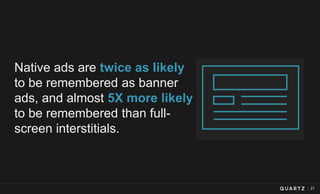
Native ads are twice as likely
to be remembered as banner
ads, and almost 5X more likely
to be remembered than full-
screen interstitials.
22
1. The promise of native advertising
2. Knowing your audience:
The Quartz Global Executives Study
3. Where do we go from here?
OUTLINE
23
1. Produce quality
2. Be relevant
3. Respect habits
4. Iterate
5. Optimize for mobile
6. Optimize for social
7. Be transparent
Our guiding principles
24
1. Produce quality
2. Be relevant
3. Respect habits
4. Iterate
5. Optimize for mobile
6. Optimize for social
7. Be transparent
Our guiding principles
25
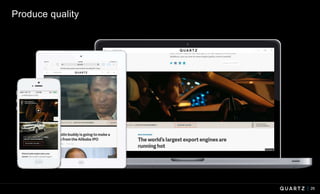
Produce quality
“Hate (hate) to say this but this
advertorial on @qzbulletin is
better than a lot of stories on
some tech sites”
Ben Rooney
Former Tech Editor
WSJ Europe
26
Produce quality
27
1. Produce quality
2. Be relevant
3. Respect habits
4. Iterate
5. Optimize for mobile
6. Optimize for social
7. Be transparent
Our guiding principles
28
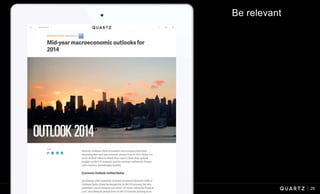
Be relevant
29
1. Produce quality
2. Be relevant
3. Respect habits
4. Iterate
5. Optimize for mobile
6. Optimize for social
7. Be transparent
Our guiding principles
“Blackrock’s branded content play
at Quartz is brilliant and perfectly
executed.”
Justin Breitfelder
Investment Strategy
Respect habits
31
1. Produce quality
2. Be relevant
3. Respect habits
4. Iterate
5. Optimize for mobile
6. Optimize for social
7. Be transparent
Our guiding principles
32
Iterate
33
Iterate
Vala Ashar
CMO, Enterasys –
Siemens Enterprise
Jeff Nelder
CMO, GOOD
Managing Partner
Turnleaf Marketing
Consulting
shared by:
34
1. Produce quality
2. Be relevant
3. Respect habits
4. Iterate
5. Optimize for mobile
6. Optimize for social
7. Take ownership
Our guiding principles
Optimize for mobile
36
1. Produce quality
2. Be relevant
3. Respect habits
4. Iterate
5. Optimize for mobile
6. Optimize for social
7. Take ownership
Our guiding principles
37
Optimize for social
38
Optimize for social
Persistent share tool
39
Optimize for social
40
Optimize for social
“First time I’ve seen a WhatsApp
share button on a website.”
Vince Buyssens
@fadawah
41
1. Produce quality
2. Be relevant
3. Respect habits
4. Iterate
5. Optimize for mobile
6. Optimize for social
7. Be transparent
Our guiding principles
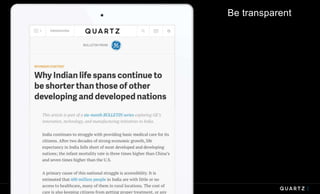
Be transparent
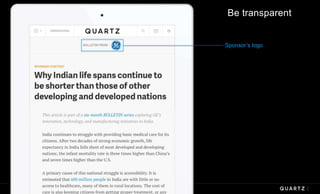
Sponsor’s logo
Be transparent
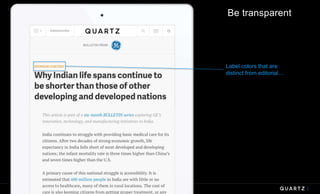
Label colors that are
distinct from editorial…
Be transparent
…including on individual
story elements
Be transparent
Disclaimer at end
Be transparent
47
1. Produce quality
2. Be relevant
3. Respect habits
4. Iterate
5. Optimize for mobile
6. Optimize for social
7. Be transparent
Our guiding principles
48
0
20
40
60
80
100
120
140
160
$0.0
$2.0
$4.0
$6.0
$8.0
$10.0
$12.0
$14.0
$16.0
$18.0
$20.0
2012 2013 2014 2015
Quartz revenue and advertiser growth, 2012-now:
87% advertiser
renewal rate
Advertisers
Revenue
Internal numbers
Thank you!
Joy Robins / @joyarobins / joy@qz.com
SVP, Global Revenue & Strategy
Quartz (qz.com)

Robins

Editor's Notes

  • #3 The promise of native advertising, particularly as it pertains to a C-suite audience, is a simple matter of supply and demand.   
  • #4 The promise of native advertising, particularly as it pertains to the C-Level audience, is a simple matter of supply and demand
  • #5 On the supply side, you have content from brands.   — For brands that are specifically targeting global executives, this content is inherently valuable.  — Why? Because your content is a byproduct of your company's expertise. Your brand's white paper isn't just the product of a team of analysts working on a single initiative for a month or two--it's the product of everything that your brand has learned and achieved and invested in throughout its existence.    — Goldman Sachs' annual macroeconomic outlook doesn't just come from the researchers and writers assigned to produce the paper--it comes from the global institution's 150 years of global economic expertise, under the leadership of people who have gone on to run the World Bank and the US Treasury. Its content is a byproduct of that accumulated knowledge.   On the demand side, you have global executives hungry for that content. — Remember: This is an audience of executives--people who are leading companies, and whose decisions about their businesses stand to benefit from that shared industry expertise.   — Even if that executive isn't in the same industry as you are, what they get from tapping into your expertise is still intrinsically valuable--because having that global perspective is a prerequisite to being a global executive.   The challenge with all this is that it's a latent market. To unlock it, we need to connect supply to demand. How?
  • #6 — Identify which pieces of content are relevant to your target audience. There are dozens of white papers and research reports on a given company's corporate site. Find the ones that are most interesting to your audience.  
  • #7 — Make it consumable. If you're a financial institution, your core expertise isn't writing for the mobile web--it's finance. If you're a management consulting firm, your core expertise isn't headline optimization--it's strategy. But the reality today is that no matter what your expertise is, you're competing against people who have built their careers around writing, coding, and designing incredible content experiences. Today, your industry position and proprietary research methodology aren't enough to get you read. You have to think about things like pixel dimensions and visual hierarchy too. (Alternative metaphor: You can't just put a neuroscience expert on a stage and expect him to deliver a scintillating lecture--he has to learn how to present.)
  • #8 — Bring it to your audience. Because they're not coming to you. They're on any one of their feeds--Facebook, Twitter, LinkedIn, email, their chosen news sites--where they can scroll forever without ever running out of content. Go find them there. 
  • #9 ...but before you can do any of that successfully, you have to learn how to do one thing first. And that's know your audience.
  • #10 Before I take you through the Global Executive Study we conducted earlier this year let me tell you why this was an imperative for our business at Quartz. For those of you who aren’t familiar with Quartz we are the digitally native business and technology site launched in September of 2012. We launched Quartz based on our conviction that there was a growing class of global business executives who were inherently mobile and increasingly social and who were being under-served by the traditional brands meant to serve their needs. We built Quartz as a free html 5 web app that’s responsive in design so you maintain the overall experience no matter what platform or screen size you are reading us on.
  • #11 Earlier this year Quartz surveyed an audience of global executives to learn more about their
  • #26 And it got the attention and praise from entities such as Thomson Reuters and executives at Pearson, and the global CEO at Havas.
  • #27  ENGAGE unit example: you have assets available to you that are beautiful, videos that you’ve taken a long time to produce, and can show those in visually appealing ways.
  • #31 Respect your audience’s habits, because they’re hard to break…
  • #33  Can’t just publish content and lean back to see what happens. The content creation process is a dynamic one.
  • #34  Can’t just publish content and lean back to see what happens. The content creation process is a dynamic one.
  • #36 The way that we have to think about ads at Quartz is basically pretending that if every single one of our readers accessed us on mobile, what would that experience look and feel like—for both editorial and ads? For ads, we’ve seen throughout our existence and amplified by the results of the survey, things like video are most recalled, so instead of this small unit, we increased the size—and the richness/quality—while still keeping it a user-first experience by making sure the ads wouldn’t accidentally get fat fingered. By sacrificing the size and quality of the ad, we were also compromising the overall user experience.
  • #38  91% of executives who read valuable content are likely to share it, and people have different preferences on which platforms they share on.
  • #39  91% of executives who read valuable content are likely to share it, and people have different preferences on which platforms they share on.
  • #40  91% of executives who read valuable content are likely to share it, and people have different preferences on which platforms they share on.
  • #41  91% of executives who read valuable content are likely to share it, and people have different preferences on which platforms they share on.
  • #49 NEED EXAMPLES OF REVENUE GROWTH (SO A CURVE WITHOUT SPECIFIC #S THAT REPRESENTS $1.5 IN 2012, $3.3 2013, $10.1 LAST YEAR, $19 THIS YEAR YEAR + GROWTH IN # OF CLIENTS OVER THAT SAME PERIOD (4 TO 40 TO 85 TO 150) + RENEWAL RATE 87%