PLURALISM AND THE
MEDIA
Pluralism: a theory which sees power
widely dispersed in democratic
societies
Does the media provide the
information required for an
informed citizen?
Does it matter who owns and
controls the media?
What is the relationship
between the ownership and
control of the media?
To what extent do the owners
of media corporations control
the content of the media they
produce?
Pluralism Theory
• Representative democracies are societies in which
the concerns and interests of the population (and
sub groups within the population) are represented
• The Electorate elect politicians to represent the
nation.
• Pressure groups represent sections of the
population (NUT, BMA,) to pressure the
government to further the interests of their
members
• No one group is dominant, all groups have a say in
the running of society, all adults have a freedom to
choose who governs
• Print out cards allocate one to each student
• Students teach each other
• Check learning with a talk-for-30-seconds-
concept card
REFLECTING PUBLIC
DEMAND
• The content of the mass media mirrors what
the public wants. They cater to the public
as a whole by responding to the demands of
the market.
• Those who own and control take a pluralist
view in that they must satisfy public
demand to stay in business.
DIVERSE SOCIETY
DIVERSE MEDIA
• No one group dominates, therefore the mass media
mirrors the diversity of societal opinions
• They represent a range of views which allows
audience freedom to choose between them
• Choice is catered for through newspapers,
magazines, films, radio, TV etc
• Bias occurs because they broadcast what people
sympathise with and want to hear. E.g. If Asylum
seekers are represented as a problem it is because
this reflects the majority view.
DIGITAL TECHNOLOGY
• All forms of communication can be coded,
stored and relayed in digital form (Films,
music, library, Kindle)
• Transfer of power is from owners to
audience who choose what they want to
watch, listen, read and when.
MEDIA CONCENTRATION
• Concentration of ownership is essential for
survival in an increasingly global market.
• Only global companies such as Time Warner,
Viacom and News International have the resources
to provide audiences with a wider choice and a
greater range of media products at affordable
prices.
• Increasing media concentration should be
welcomed
MEDIA DEREGULATION
• BBC is state owned and contents regulated by
public service broadcasting which states that the
BBC should ‘inform, educate and entertain.
• The introduction of commercial TV in 1954
brought a reduction in regulations, resulting in
rapid expansion of channels and competition
between terrestrial, satellite and cable companies.
• Most countries limit the concentration of media
ownership to prevent domination but in recent
years the laws have relaxed
PRIVATE OWNERSHIP
• Pluralist welcome media deregulation because
private ownership is the most effective way to
provide a wide range of choice and to compete
with each other to give audiences what they want.
– If they don’t they go out of business
• Publicly owned media and state regulation is
dangerous as they concentrate too much power
and offer limited choice.
EVALUATION
MEDIA CONCENTRATION
AND DEMOCRACY
• 1983 most mass media in USA was owned and
controlled by 50 corporations which had serious
consequences.
– Views are far right (conservative) because they reflect
the views of the owners. No room for liberal or radical
voices
– Less local news – programmes are pre-recorded and the
same programmes are broadcast throughout USA
– Choice has narrowed because they are broadcasting the
same thing, little diversity of opinion therefore
democracy is under threat
THE DRIVE FOR PROFITS
• BBC funded by licence fee (£140 pa) all others are
funded by advertising
• therefore should be accurate and impartial and
produce a variety of programmes to cater for all
groups
• Ofcom regulates output of both but rules are now
relaxed which means privately owned
broadcasters are in business to make money for
profit.
MONEY FOR PROFIT
• Infotainment
– Increasing readership of newspapers, human interest
stories has replaced political coverage
– News is now part of the entertainment industry. Gossip
about reality TV stars is common features.
Investigative journalists are replaced by celebrity
columnists and presenters
• Advertising revenue
– Focus on purchasing power of mass audience, the
larger the audience the higher the advertising fees. Has
lead to a decline in the number of newspapers and
minority interest programmes.
– Boundaries are being broken down, companies pay for
products to be ‘placed’ in films.
DIGITAL TECHNOLOGY
• Audiences have to pay to access the vast
libraries of digital products, however, some
cannot afford to pay
• Power lies with those who own and control
cultural products, therefore media
corporations can decide what is made
available and at what price.
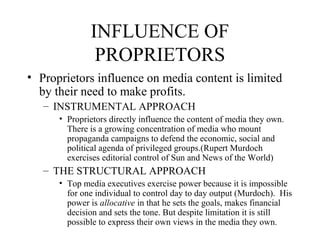
INFLUENCE OF
PROPRIETORS
• Proprietors influence on media content is limited
by their need to make profits.
– INSTRUMENTAL APPROACH
• Proprietors directly influence the content of media they own.
There is a growing concentration of media who mount
propaganda campaigns to defend the economic, social and
political agenda of privileged groups.(Rupert Murdoch
exercises editorial control of Sun and News of the World)
– THE STRUCTURAL APPROACH
• Top media executives exercise power because it is impossible
for one individual to control day to day output (Murdoch). His
power is allocative in that he sets the goals, makes financial
decision and sets the tone. But despite limitation it is still
possible to express their own views in the media they own.
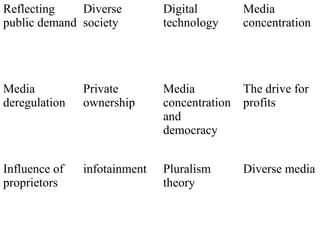
Reflecting
public demand
Diverse
society
Digital
technology
Media
concentration
Media
deregulation
Private
ownership
Media
concentration
and
democracy
The drive for
profits
Influence of
proprietors
infotainment Pluralism
theory
Diverse media

SociologyExchange.co.uk Shared Resource

  • 1.
    PLURALISM AND THE MEDIA Pluralism:a theory which sees power widely dispersed in democratic societies
  • 2.
    Does the mediaprovide the information required for an informed citizen? Does it matter who owns and controls the media? What is the relationship between the ownership and control of the media? To what extent do the owners of media corporations control the content of the media they produce?
  • 3.
    Pluralism Theory • Representativedemocracies are societies in which the concerns and interests of the population (and sub groups within the population) are represented • The Electorate elect politicians to represent the nation. • Pressure groups represent sections of the population (NUT, BMA,) to pressure the government to further the interests of their members • No one group is dominant, all groups have a say in the running of society, all adults have a freedom to choose who governs
  • 4.
    • Print outcards allocate one to each student • Students teach each other • Check learning with a talk-for-30-seconds- concept card
  • 5.
    REFLECTING PUBLIC DEMAND • Thecontent of the mass media mirrors what the public wants. They cater to the public as a whole by responding to the demands of the market. • Those who own and control take a pluralist view in that they must satisfy public demand to stay in business.
  • 6.
    DIVERSE SOCIETY DIVERSE MEDIA •No one group dominates, therefore the mass media mirrors the diversity of societal opinions • They represent a range of views which allows audience freedom to choose between them • Choice is catered for through newspapers, magazines, films, radio, TV etc • Bias occurs because they broadcast what people sympathise with and want to hear. E.g. If Asylum seekers are represented as a problem it is because this reflects the majority view.
  • 7.
    DIGITAL TECHNOLOGY • Allforms of communication can be coded, stored and relayed in digital form (Films, music, library, Kindle) • Transfer of power is from owners to audience who choose what they want to watch, listen, read and when.
  • 8.
    MEDIA CONCENTRATION • Concentrationof ownership is essential for survival in an increasingly global market. • Only global companies such as Time Warner, Viacom and News International have the resources to provide audiences with a wider choice and a greater range of media products at affordable prices. • Increasing media concentration should be welcomed
  • 9.
    MEDIA DEREGULATION • BBCis state owned and contents regulated by public service broadcasting which states that the BBC should ‘inform, educate and entertain. • The introduction of commercial TV in 1954 brought a reduction in regulations, resulting in rapid expansion of channels and competition between terrestrial, satellite and cable companies. • Most countries limit the concentration of media ownership to prevent domination but in recent years the laws have relaxed
  • 10.
    PRIVATE OWNERSHIP • Pluralistwelcome media deregulation because private ownership is the most effective way to provide a wide range of choice and to compete with each other to give audiences what they want. – If they don’t they go out of business • Publicly owned media and state regulation is dangerous as they concentrate too much power and offer limited choice.
  • 11.
  • 12.
    MEDIA CONCENTRATION AND DEMOCRACY •1983 most mass media in USA was owned and controlled by 50 corporations which had serious consequences. – Views are far right (conservative) because they reflect the views of the owners. No room for liberal or radical voices – Less local news – programmes are pre-recorded and the same programmes are broadcast throughout USA – Choice has narrowed because they are broadcasting the same thing, little diversity of opinion therefore democracy is under threat
  • 13.
    THE DRIVE FORPROFITS • BBC funded by licence fee (£140 pa) all others are funded by advertising • therefore should be accurate and impartial and produce a variety of programmes to cater for all groups • Ofcom regulates output of both but rules are now relaxed which means privately owned broadcasters are in business to make money for profit.
  • 14.
    MONEY FOR PROFIT •Infotainment – Increasing readership of newspapers, human interest stories has replaced political coverage – News is now part of the entertainment industry. Gossip about reality TV stars is common features. Investigative journalists are replaced by celebrity columnists and presenters • Advertising revenue – Focus on purchasing power of mass audience, the larger the audience the higher the advertising fees. Has lead to a decline in the number of newspapers and minority interest programmes. – Boundaries are being broken down, companies pay for products to be ‘placed’ in films.
  • 15.
    DIGITAL TECHNOLOGY • Audienceshave to pay to access the vast libraries of digital products, however, some cannot afford to pay • Power lies with those who own and control cultural products, therefore media corporations can decide what is made available and at what price.
  • 16.
    INFLUENCE OF PROPRIETORS • Proprietorsinfluence on media content is limited by their need to make profits. – INSTRUMENTAL APPROACH • Proprietors directly influence the content of media they own. There is a growing concentration of media who mount propaganda campaigns to defend the economic, social and political agenda of privileged groups.(Rupert Murdoch exercises editorial control of Sun and News of the World) – THE STRUCTURAL APPROACH • Top media executives exercise power because it is impossible for one individual to control day to day output (Murdoch). His power is allocative in that he sets the goals, makes financial decision and sets the tone. But despite limitation it is still possible to express their own views in the media they own.
  • 17.