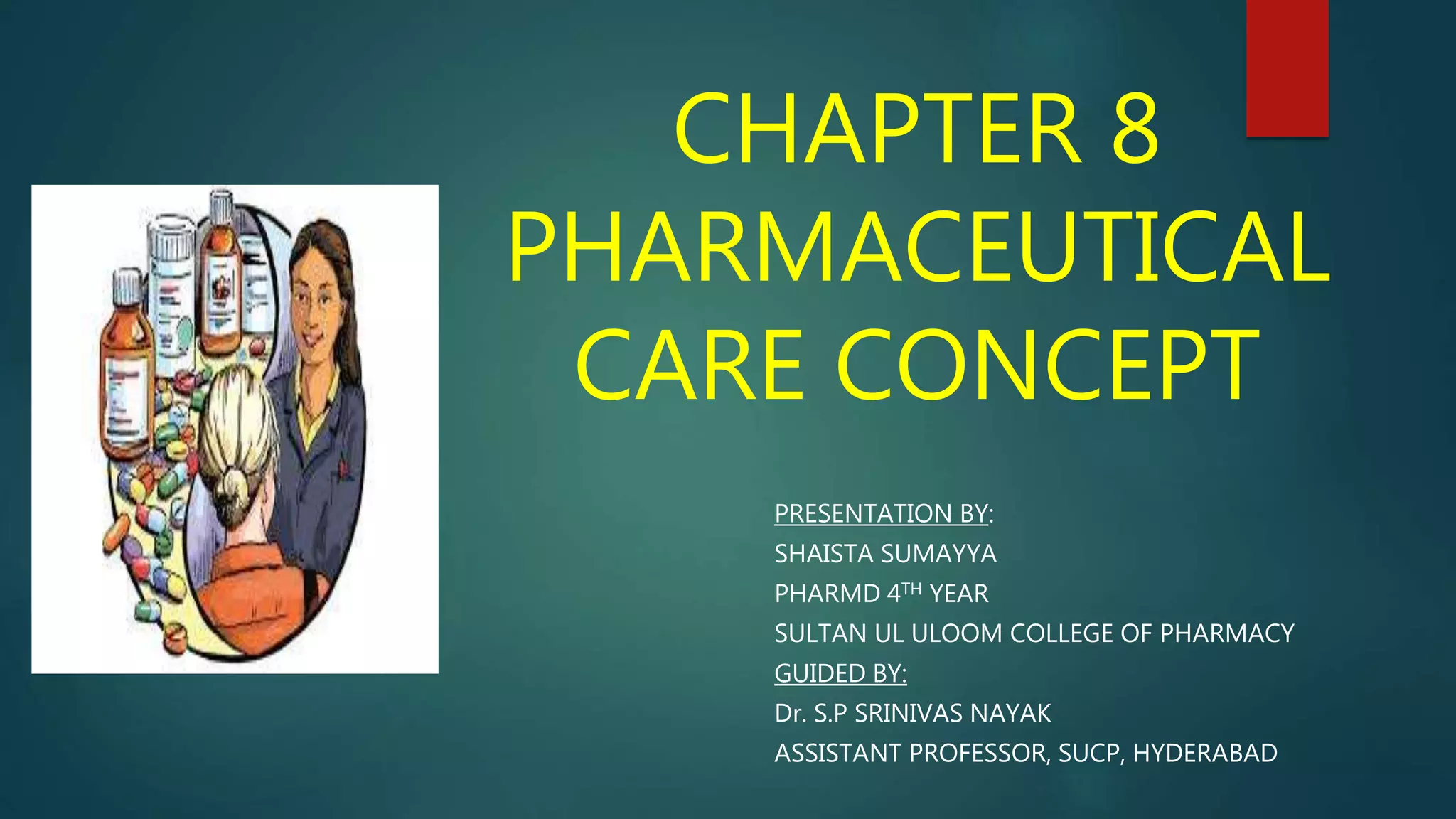
CHAPTER 8
PHARMACEUTICAL
CARE CONCEPT
PRESENTATION BY:
SHAISTA SUMAYYA
PHARMD 4TH YEAR
SULTAN UL ULOOM COLLEGE OF PHARMACY
GUIDED BY:
Dr. S.P SRINIVAS NAYAK
ASSISTANT PROFESSOR, SUCP, HYDERABAD
DEFINITION
 The pharmaceutical care is defined as “the direct,
responsible provision of medication-related care for
the purpose of achieving definite outcomes that
improve a patient’s quality of life.”
OUTCOMES
1. Cure of a disease
2. Elimination or reduction of patients symptomology
3. Arresting or slowing of a disease process
4. Preventing a disease or symptoms
PHARMACEUTICAL CARE
 Pharmaceutical care involves the process through which a
pharmacist cooperates with a patient and other professional
in designing , implementation, and monitoring a therapeutic
plan that will produce specific therapeutic outcomes for the
patient
 This in turn involves three major functions
1. Identifying potential and actual drug related problems
2. Resolving actual drug related problems
3. Preventing potential drug related problems
 Pharmaceutical care is important element of health
care and should be integrated with other elements of
health care .
 Pharmaceutical care is however provided for the
direct benefit of the patient and the pharmacist is
responsible directly to the patient of that care.
Requirements of pharmacist in
pharmaceutical care
 He must possess knowledge and skill in pharmaceutics and clinical
pharmacology
 He must be able to mobilize the drug distribution system by which
drug use decisions are implemented
 He must be able to develop relationship with the patients and other
health care professionals needed to provide pharmaceutical care
 He must be available in the society /community for patient in time
 He should have commitment to quality improvement and assessment
procedure
PROCESS OF PHARMACEUTICAL CARE
1. Establish pharmacist‐ patient relation ship
2. Collect data
3. Interpret data
4. Identify drug related problems
5. Determine priority of drug related problems
6. Determine desired outcomes(clinical or therapeutic)
7. Develop therapeutic plan
8. Develop monitoring plan
9. Implement and follow up pharmaceutical care plan
COLLECTION OF PATIENTS DATA
 The pharmacist must collect and generate subjective and objective information regarding
:
 Patients general health and activity status
 Past medical history
 Medication history
 Social history
 Diet
 Exercise
 Study
 History of present illness and
 Economic situations
Sources of Information
Sources of information may include ;but not necessarily limited
to
 The patient medical charts and reports
 Pharmacist conducted health physical assessment
 The patients family or caretaker
 Insurers and
 Other healthcare providers like his doctors ,nurse and his
regular pharmacists to whom he goes
ELEMENTS OF PATIENTS
INFORMATION DATA
 Demographics - Age, sex,
race, height‐weight
 Current problems - signs
and symptoms
 Past medical history
 Allergies and intolerance
 Pregnancy and lactation
status
 Habits
 Economic conditions
 Relevant lab data
IDENTIFICATION OF PROBLEMS
 The data collected can be used to identify actual or potential drug‐related problems.
 Since the main focus of pharmaceutical care is patient and since the pharmacist attends the
patient, it follows that the a pharmacist only can tackle , all drug related problems.
 These problems may be related to the
1. Patients current drug therapy
2. Drug administration
3. Drug compliance
4. Drug toxicity
5. Adverse drug reactions and
6. Failure to achieve desired outcomes by the treatment.
DRUG RELATED MORBIDITY
 DRM (drug related morbidity) is a phenomenon of therapeutic
malfunction .
 It is a failure of a therapeutic agents or agents together to
produce intended therapeutic outcome.
 The concept of DRM includes both treatment failure and
production of a new medical problem , like ADR or toxic drug
effect.
 If DRM is not recognized in time it may lead to drug related
mortality which is ultimate disaster
EXAMPLES OF DRUG RELATED
PROBLEMS
 Untreated indications:
 The patient has a medical problem that requires medication therapy (an indication for
medication use) but is not receiving a medication for that indication.
 Improper drug selection:
 The patient has a medication indication but is taking the wrong medication.
 Subtherapeutic dosage:
 The patient has a medical problem that is being treated with too little of the correct
medication.
 Failure to receive medication:
 The patient has a medical problem that is the result of not receiving a medication (e.g., for
pharmaceutical, psychological, sociological, or economic reasons).
 Overdosage:
 The patient has a medical problem that is being treated with too much of
the correct medication (toxicity).
 Adverse drug reactions:
 The patient has a medical problem that is the result of an adverse drug
reaction or adverse effect.
 Drug interactions:
 The patient has a medical problem that is the result of a drug–drug, drug–
food, or drug– laboratory test interaction.
 Medication use without indication:
 The patient is taking a medication for no medically valid indication.
ESTABLISHING OUTCOME GOALS
 Drug therapy can produce a range of positive clinical
outcomes it may also result in negative outcomes resulting in
disease morbidity and even in extreme case mortality.
 Clearly the potential clinical outcomes are related to the
disease being treated and the efficacy of the available drug
treatments
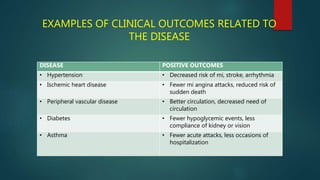
DISEASE POSITIVE OUTCOMES
• Hypertension • Decreased risk of mi, stroke, arrhythmia
• Ischemic heart disease • Fewer mi angina attacks, reduced risk of
sudden death
• Peripheral vascular disease • Better circulation, decreased need of
circulation
• Diabetes • Fewer hypoglycemic events, less
compliance of kidney or vision
• Asthma • Fewer acute attacks, less occasions of
hospitalization
EXAMPLES OF CLINICAL OUTCOMES RELATED TO
THE DISEASE
Important consideration taken into
account
1. Patients expectation of the treatment
2. Patient's suitability for the treatment
3. All his resources to meet the cost of the treatment
 A patient may have a curable disease but his other concurrent ailment
may prevent the most effective treatment to be given.
 Example:‐
 A DM patient may not be given steroids for severe allergy as it will
aggregate his condition.
 An Asthma patient also having DM cannot be treated with steroids for
his chronic airflow obstruction
 Similarly , non availability of certain most effective
drugs that cannot be prescribed due to hospitals DTC
, decisions putting restrictions on the number of
drugs per prescription or strict antibiotic policy.
 Therefore it is necessary to educate the patient for
the potential outcomes of drug therapy – positive or
negative – so that he can make an informed decision.
EVALUATING TREATMENT ALTERNATIVES BY MONITORING
AND MODIFYING THERAPEUTIC PLAN:
 While evaluating treatment alternatives or therapeutic options
the following factors have to be considered such as :
1. Efficacy and safety
2. Availability and cost of treatment
3. Suitability of the treatment to the patient .
 Efficacy and safety must be considered when evaluating the
risk benefit ratio of a particular treatment.
 The risk – benefit ratio will depend upon many factors. Some
of the factors are:
1. Seriousness of disease
2. Consequences of not treating the disease
3. The efficacy of the drug
4. ADRs associated with the drug therapy
5. Efficacy of alternative drug or non‐drug therapy
6. Side effect profile of alternative drug
Role of clinical pharmacist
 The pharmacists role especially clinical pharmacists role is increasingly becoming more
evident in evaluating therapeutic options, modifying and monitoring therapeutic plan.
 Some of the case studies to support this, can be cited as follows:
 In one case , pharmacist monitored therapeutic plan of one group was 2.4 days shorter than
the control group in which the plan was not monitored by pharmacist.
 In another case study it was found that pharmacist managed group (i.e. therapeutic plan
being constantly monitored by pharmacist) had significantly fewer active prescriptions
significantly more discharges from hospitals and significantly fewer deaths.
 The pharmacists managed group also had a less number of hospitalizations than the control
group had.
 The net monetary savings between the two groups was 7000 dollars per patient.
INDIVIDUALIZING DRUG REGIMEN:
Patient factors
1. Diagnosis
2. Treatment goals
3. Physiological and pathological factors
4. Past medical history, past medicines
received
5. Contraindication
6. Allergies and adverse effects
7. Patient compliance
8. Patients cooperation and convenience
9. Special consideration
Drug factors
1. Efficacy
2. Adverse effects
3. Prevalence, ability to minimize
4. Ability to monitor for efficacy and avoid
ADR
5. Drug‐drug interactions
6. Pharmacokinetics and pharmacodynamics
7. Dosage form
8. Route and method of administration
9. Cost to the patient
10. Government or insurance company
payments, presentation of bills in their
formats.
MONITORING OUTCOMES
 The goals of any therapeutic treatments are the following:
1. To cure the disease
2. To eliminate or reduce patients symptoms
3. To arrest or slow down disease process
4. To prevent the disease or its symptoms to reappear
 Monitoring outcomes involve monitoring four S’s These are
1. SIGNS
2. SYMPTOMS
3. SIDE EFFECTS
4. SEQUELAE(CONSEQUENCES)
 This applies to all diseases
Reasons for suboptimal results
 Inappropriate prescribing Inappropriate or unnecessary drug
regimen
 Inappropriate drug regimen
 Drugs not available - dispensing error
 Inappropriate behaviour of the patient
 Inappropriate compliance or non‐compliance of the drug
treatment
 Patient idiosyncrasy
 Inappropriate monitoring
 Inappropriate monitoring is often cited as a major cause for
therapeutic failure.
 It leads to failure to detect and resolve inappropriate therapy
decisions; and or failure to monitor for the drugs with narrow
therapeutic index.
 Example:
 If digitalis or theophylline IV delivery is not followed by TDM, either
the desired outcome to stop arrhythmia (by digitalis), or shortness of
breath (by theophylline)is not achieved or worst a digitalis or
theophylline toxicity may develop, due to overdose.
DOCUMENTATION OF INFORMATION
 One of the jobs of a pharmacist as outlined above, is to
regularly update records of the patient with documentation.
 This is a critical component of pharmaceutical care.
 Documenting the provision of pharmaceutical care is
important for many reasons, but the primary reason is to
improve the quality of patient care .
 Documentation provides a record of care provided and history
of the decision made for a specific patient.
 IF IT IS NOT DOCUMENTED, IT IS NOT DONE
THANK YOU

Pharmaceutical care concepts - clinical pharmacy

  • 1.
    CHAPTER 8 PHARMACEUTICAL CARE CONCEPT PRESENTATIONBY: SHAISTA SUMAYYA PHARMD 4TH YEAR SULTAN UL ULOOM COLLEGE OF PHARMACY GUIDED BY: Dr. S.P SRINIVAS NAYAK ASSISTANT PROFESSOR, SUCP, HYDERABAD
  • 2.
    DEFINITION  The pharmaceuticalcare is defined as “the direct, responsible provision of medication-related care for the purpose of achieving definite outcomes that improve a patient’s quality of life.”
  • 3.
    OUTCOMES 1. Cure ofa disease 2. Elimination or reduction of patients symptomology 3. Arresting or slowing of a disease process 4. Preventing a disease or symptoms
  • 4.
    PHARMACEUTICAL CARE  Pharmaceuticalcare involves the process through which a pharmacist cooperates with a patient and other professional in designing , implementation, and monitoring a therapeutic plan that will produce specific therapeutic outcomes for the patient  This in turn involves three major functions 1. Identifying potential and actual drug related problems 2. Resolving actual drug related problems 3. Preventing potential drug related problems
  • 5.
     Pharmaceutical careis important element of health care and should be integrated with other elements of health care .  Pharmaceutical care is however provided for the direct benefit of the patient and the pharmacist is responsible directly to the patient of that care.
  • 6.
    Requirements of pharmacistin pharmaceutical care  He must possess knowledge and skill in pharmaceutics and clinical pharmacology  He must be able to mobilize the drug distribution system by which drug use decisions are implemented  He must be able to develop relationship with the patients and other health care professionals needed to provide pharmaceutical care  He must be available in the society /community for patient in time  He should have commitment to quality improvement and assessment procedure
  • 7.
    PROCESS OF PHARMACEUTICALCARE 1. Establish pharmacist‐ patient relation ship 2. Collect data 3. Interpret data 4. Identify drug related problems 5. Determine priority of drug related problems 6. Determine desired outcomes(clinical or therapeutic) 7. Develop therapeutic plan 8. Develop monitoring plan 9. Implement and follow up pharmaceutical care plan
  • 8.
    COLLECTION OF PATIENTSDATA  The pharmacist must collect and generate subjective and objective information regarding :  Patients general health and activity status  Past medical history  Medication history  Social history  Diet  Exercise  Study  History of present illness and  Economic situations
  • 9.
    Sources of Information Sourcesof information may include ;but not necessarily limited to  The patient medical charts and reports  Pharmacist conducted health physical assessment  The patients family or caretaker  Insurers and  Other healthcare providers like his doctors ,nurse and his regular pharmacists to whom he goes
  • 10.
    ELEMENTS OF PATIENTS INFORMATIONDATA  Demographics - Age, sex, race, height‐weight  Current problems - signs and symptoms  Past medical history  Allergies and intolerance  Pregnancy and lactation status  Habits  Economic conditions  Relevant lab data
  • 11.
    IDENTIFICATION OF PROBLEMS The data collected can be used to identify actual or potential drug‐related problems.  Since the main focus of pharmaceutical care is patient and since the pharmacist attends the patient, it follows that the a pharmacist only can tackle , all drug related problems.  These problems may be related to the 1. Patients current drug therapy 2. Drug administration 3. Drug compliance 4. Drug toxicity 5. Adverse drug reactions and 6. Failure to achieve desired outcomes by the treatment.
  • 12.
    DRUG RELATED MORBIDITY DRM (drug related morbidity) is a phenomenon of therapeutic malfunction .  It is a failure of a therapeutic agents or agents together to produce intended therapeutic outcome.  The concept of DRM includes both treatment failure and production of a new medical problem , like ADR or toxic drug effect.  If DRM is not recognized in time it may lead to drug related mortality which is ultimate disaster
  • 13.
    EXAMPLES OF DRUGRELATED PROBLEMS  Untreated indications:  The patient has a medical problem that requires medication therapy (an indication for medication use) but is not receiving a medication for that indication.  Improper drug selection:  The patient has a medication indication but is taking the wrong medication.  Subtherapeutic dosage:  The patient has a medical problem that is being treated with too little of the correct medication.  Failure to receive medication:  The patient has a medical problem that is the result of not receiving a medication (e.g., for pharmaceutical, psychological, sociological, or economic reasons).
  • 14.
     Overdosage:  Thepatient has a medical problem that is being treated with too much of the correct medication (toxicity).  Adverse drug reactions:  The patient has a medical problem that is the result of an adverse drug reaction or adverse effect.  Drug interactions:  The patient has a medical problem that is the result of a drug–drug, drug– food, or drug– laboratory test interaction.  Medication use without indication:  The patient is taking a medication for no medically valid indication.
  • 15.
    ESTABLISHING OUTCOME GOALS Drug therapy can produce a range of positive clinical outcomes it may also result in negative outcomes resulting in disease morbidity and even in extreme case mortality.  Clearly the potential clinical outcomes are related to the disease being treated and the efficacy of the available drug treatments
  • 16.
    DISEASE POSITIVE OUTCOMES •Hypertension • Decreased risk of mi, stroke, arrhythmia • Ischemic heart disease • Fewer mi angina attacks, reduced risk of sudden death • Peripheral vascular disease • Better circulation, decreased need of circulation • Diabetes • Fewer hypoglycemic events, less compliance of kidney or vision • Asthma • Fewer acute attacks, less occasions of hospitalization EXAMPLES OF CLINICAL OUTCOMES RELATED TO THE DISEASE
  • 17.
    Important consideration takeninto account 1. Patients expectation of the treatment 2. Patient's suitability for the treatment 3. All his resources to meet the cost of the treatment  A patient may have a curable disease but his other concurrent ailment may prevent the most effective treatment to be given.  Example:‐  A DM patient may not be given steroids for severe allergy as it will aggregate his condition.  An Asthma patient also having DM cannot be treated with steroids for his chronic airflow obstruction
  • 18.
     Similarly ,non availability of certain most effective drugs that cannot be prescribed due to hospitals DTC , decisions putting restrictions on the number of drugs per prescription or strict antibiotic policy.  Therefore it is necessary to educate the patient for the potential outcomes of drug therapy – positive or negative – so that he can make an informed decision.
  • 19.
    EVALUATING TREATMENT ALTERNATIVESBY MONITORING AND MODIFYING THERAPEUTIC PLAN:  While evaluating treatment alternatives or therapeutic options the following factors have to be considered such as : 1. Efficacy and safety 2. Availability and cost of treatment 3. Suitability of the treatment to the patient .
  • 20.
     Efficacy andsafety must be considered when evaluating the risk benefit ratio of a particular treatment.  The risk – benefit ratio will depend upon many factors. Some of the factors are: 1. Seriousness of disease 2. Consequences of not treating the disease 3. The efficacy of the drug 4. ADRs associated with the drug therapy 5. Efficacy of alternative drug or non‐drug therapy 6. Side effect profile of alternative drug
  • 21.
    Role of clinicalpharmacist  The pharmacists role especially clinical pharmacists role is increasingly becoming more evident in evaluating therapeutic options, modifying and monitoring therapeutic plan.  Some of the case studies to support this, can be cited as follows:  In one case , pharmacist monitored therapeutic plan of one group was 2.4 days shorter than the control group in which the plan was not monitored by pharmacist.  In another case study it was found that pharmacist managed group (i.e. therapeutic plan being constantly monitored by pharmacist) had significantly fewer active prescriptions significantly more discharges from hospitals and significantly fewer deaths.  The pharmacists managed group also had a less number of hospitalizations than the control group had.  The net monetary savings between the two groups was 7000 dollars per patient.
  • 22.
    INDIVIDUALIZING DRUG REGIMEN: Patientfactors 1. Diagnosis 2. Treatment goals 3. Physiological and pathological factors 4. Past medical history, past medicines received 5. Contraindication 6. Allergies and adverse effects 7. Patient compliance 8. Patients cooperation and convenience 9. Special consideration Drug factors 1. Efficacy 2. Adverse effects 3. Prevalence, ability to minimize 4. Ability to monitor for efficacy and avoid ADR 5. Drug‐drug interactions 6. Pharmacokinetics and pharmacodynamics 7. Dosage form 8. Route and method of administration 9. Cost to the patient 10. Government or insurance company payments, presentation of bills in their formats.
  • 23.
    MONITORING OUTCOMES  Thegoals of any therapeutic treatments are the following: 1. To cure the disease 2. To eliminate or reduce patients symptoms 3. To arrest or slow down disease process 4. To prevent the disease or its symptoms to reappear
  • 24.
     Monitoring outcomesinvolve monitoring four S’s These are 1. SIGNS 2. SYMPTOMS 3. SIDE EFFECTS 4. SEQUELAE(CONSEQUENCES)  This applies to all diseases
  • 25.
    Reasons for suboptimalresults  Inappropriate prescribing Inappropriate or unnecessary drug regimen  Inappropriate drug regimen  Drugs not available - dispensing error  Inappropriate behaviour of the patient  Inappropriate compliance or non‐compliance of the drug treatment  Patient idiosyncrasy  Inappropriate monitoring
  • 26.
     Inappropriate monitoringis often cited as a major cause for therapeutic failure.  It leads to failure to detect and resolve inappropriate therapy decisions; and or failure to monitor for the drugs with narrow therapeutic index.  Example:  If digitalis or theophylline IV delivery is not followed by TDM, either the desired outcome to stop arrhythmia (by digitalis), or shortness of breath (by theophylline)is not achieved or worst a digitalis or theophylline toxicity may develop, due to overdose.
  • 27.
    DOCUMENTATION OF INFORMATION One of the jobs of a pharmacist as outlined above, is to regularly update records of the patient with documentation.  This is a critical component of pharmaceutical care.  Documenting the provision of pharmaceutical care is important for many reasons, but the primary reason is to improve the quality of patient care .  Documentation provides a record of care provided and history of the decision made for a specific patient.  IF IT IS NOT DOCUMENTED, IT IS NOT DONE
  • 28.