Dose Adjustment in Renal
Disease
RENAL IMPAIRMENT
• The kidney is an important organ in
• regulating body fluids,
• electrolyte balance,
• removal of metabolic waste, and
• drug excretion from the body.
• Impairment or degeneration of kidney function affects the
pharmacokinetics of drugs.
• Some of the more common causes of kidney failure include
• disease,
• injury,
• drug intoxication.
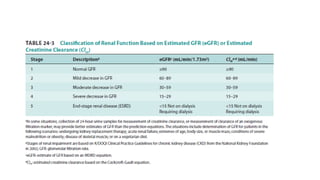
• Acute diseases or trauma to the kidney can cause uremia, in which
glomerular filtration is impaired or reduced, leading to accumulation
of excessive fluid and blood nitrogenous products in the body.
PHARMACOKINETIC CONSIDERATIONS
• Uremic patients may exhibit pharmacokinetic changes in
• bioavailability,
• volume of distribution
• clearance.
• The oral bioavailability of a drug in severe uremia may be decreased
as a result of disease-related changes in
• gastrointestinal motility and pH that are caused by nausea, vomiting, and
diarrhea.
• Mesenteric blood flow may also be altered.
• The apparent volume of distribution depends largely on
• drug–protein binding in plasma or tissues
• total body water.
• Renal impairment may alter the distribution of the drug as a result of
• changes in fluid balance,
• drug–protein binding, or
• other factors that may cause changes in the apparent volume of distribution
• The plasma protein binding of weak acidic drugs in uremic patients is
decreased, whereas the protein binding of weak basic drugs is less
affected.
• A decrease in drug–protein binding results in a larger fraction of free
drug and an increase in the volume of distribution.
• However, the net elimination half-life is generally increased as a result
of the dominant effect of reduced glomerular filtration.
• Total body clearance of drugs in uremic patients is also reduced by
either a decrease in the
• glomerular filtration rate (GFR) and possibly
• active tubular secretion or
• reduced hepatic clearance
• In clinical practice, estimation of the appropriate drug dosage
regimen in patients with impaired renal function is based on an
• estimate of the remaining renal function of the patient and a
• prediction of the total body clearance.
GENERAL APPROACHES FOR DOSE
ADJUSTMENT IN RENAL DISEASE
• Generally, drugs in patients with uremia or kidney impairment have
prolonged elimination half-lives and a change in the apparent volume
of distribution.
• Two general pharmacokinetic approaches for dose adjustment
include
• methods based on drug clearance
• methods based on the elimination half-life.
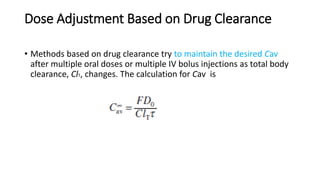
Dose Adjustment Based on Drug Clearance
• Methods based on drug clearance try to maintain the desired Cav
after multiple oral doses or multiple IV bolus injections as total body
clearance, ClT, changes. The calculation for Cav is
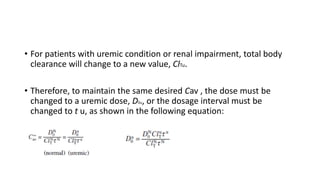
• For patients with uremic condition or renal impairment, total body
clearance will change to a new value, ClTu.
• Therefore, to maintain the same desired Cav , the dose must be
changed to a uremic dose, D0u, or the dosage interval must be
changed to t u, as shown in the following equation:
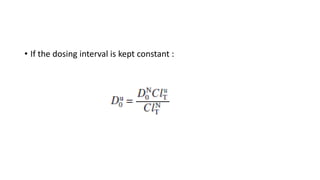
• If the dosing interval is kept constant :
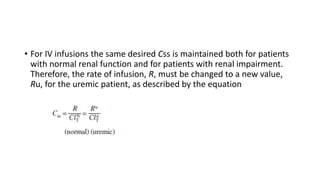
• For IV infusions the same desired Css is maintained both for patients
with normal renal function and for patients with renal impairment.
Therefore, the rate of infusion, R, must be changed to a new value,
Ru, for the uremic patient, as described by the equation
Dose Adjustment Based on Changes in the
Elimination Rate Constant
• The overall elimination rate constant for many drugs is reduced in the
uremic patient.
• A dosage regimen may be designed for the uremic patient either by
reducing the normal dose of the drug and keeping the frequency of dosing
(dosage interval) constant or by decreasing the frequency of dosing
(prolonging the dosage interval) and keeping the dose constant.
• Doses of drugs with a narrow therapeutic range should be reduced—
particularly if the drug has accumulated in the patient prior to
deterioration of kidney function.
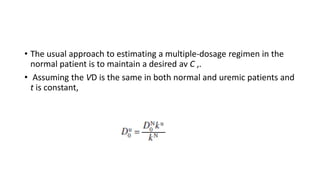
• The usual approach to estimating a multiple-dosage regimen in the
normal patient is to maintain a desired av C ,.
• Assuming the VD is the same in both normal and uremic patients and
t is constant,
• When the elimination rate constant for a drug in the uremic patient
cannot be determined directly, indirect methods are available to
calculate the predicted elimination rate constant based on the renal
function of the patient.
• The assumptions on how these dosage regimens are calculated
include the following:
• The renal elimination rate constant (kR) decreases proportionately as
renal function decreases.
• The nonrenal routes of elimination (primarily, the rate constant for
metabolism) remain unchanged.
• Changes in the renal clearance of the drug are reflected by changes in
the creatinine clearance.
MEASUREMENT OF GLOMERULAR FILTRATION
RATE
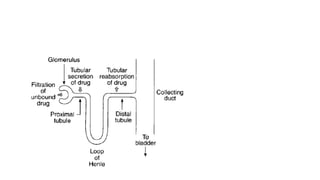
• Several criteria are necessary to use a drug as a marker to measure GFR:
1. The drug must be freely filtered at the glomerulus.
2. The drug must neither be reabsorbed nor actively secreted by the renal
tubules.
3. The drug should not be metabolized.
4. The drug should not bind significantly to plasma proteins.
5. The drug should neither have an effect on the filtration rate nor alter renal
function.
6. The drug should be nontoxic.
7. The drug may be infused in a sufficient dose to permit simple and accurate
quantitation in plasma and in urine.
• Inulin, a fructose polysaccharide, fulfills most of the criteria listed above
and is therefore used as a standard reference for the measurement of GFR.
• In practice, however, the use of inulin involves a time-consuming procedure
in which inulin is given by intravenous infusion until a constant steady-state
plasma level is obtained.
• Clearance of inulin may then be measured by the rate of infusion divided
by the steady-state plasma inulin concentration. Although this procedure
gives an accurate value for GFR, inulin clearance is not used frequently in
clinical practice.
• The clearance of creatinine is used most extensively as a measurement of GFR.
• Creatinine is an endogenous substance formed from creatine phosphate during
muscle metabolism.
• Creatinine production varies with age, weight, and gender of the individual.
• In humans, creatinine is filtered mainly at the glomerulus, with no tubular
reabsorption. However, a small amount of creatinine may be actively secreted by
the renal tubules, and the values of GFR obtained by the creatinine clearance
tend to be higher than GFR measured by inulin clearance.
• Measurement of blood urea nitrogen (BUN) is a commonly used
clinical diagnostic laboratory test for renal disease.
• Urea is the end product of protein catabolism and is excreted through
the kidney.
• Normal BUN levels range from 10 to 20 mg/dL.
• The renal clearance of urea is by glomerular filtration and partial
reabsorption in the renal tubules.
• Therefore, the renal clearance of urea is less than creatinine or inulin
clearance and does not give a quantitative measure of kidney
function.
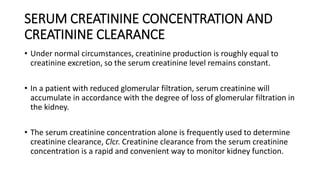
SERUM CREATININE CONCENTRATION AND
CREATININE CLEARANCE
• Under normal circumstances, creatinine production is roughly equal to
creatinine excretion, so the serum creatinine level remains constant.
• In a patient with reduced glomerular filtration, serum creatinine will
accumulate in accordance with the degree of loss of glomerular filtration in
the kidney.
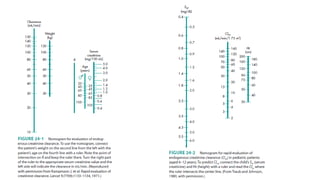
• The serum creatinine concentration alone is frequently used to determine
creatinine clearance, Clcr. Creatinine clearance from the serum creatinine
concentration is a rapid and convenient way to monitor kidney function.
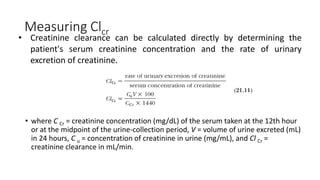
Measuring Clcr
• where C Cr = creatinine concentration (mg/dL) of the serum taken at the 12th hour
or at the midpoint of the urine-collection period, V = volume of urine excreted (mL)
in 24 hours, C u = concentration of creatinine in urine (mg/mL), and Cl Cr =
creatinine clearance in mL/min.
• Creatinine clearance can be calculated directly by determining the
patient's serum creatinine concentration and the rate of urinary
excretion of creatinine.
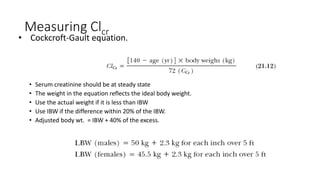
Measuring Clcr
• Serum creatinine should be at steady state
• The weight in the equation reflects the ideal body weight.
• Use the actual weight if it is less than IBW
• Use IBW if the difference within 20% of the IBW.
• Adjusted body wt. = IBW + 40% of the excess.
• Cockcroft-Gault equation.
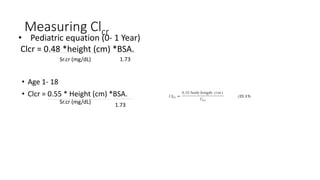
Measuring Clcr
• Age 1- 18
• Clcr = 0.55 * Height (cm) *BSA.
• Pediatric equation (0- 1 Year)
Clcr = 0.48 *height (cm) *BSA.
Sr.cr (mg/dL)
Sr.cr (mg/dL)
1.73
1.73
DOSE ADJUSTMENT FOR UREMIC PATIENTS
• The loading drug dose is based on the apparent volume of
distribution of the patient.
• It is generally assumed that the apparent volume of distribution is not
altered significantly, and therefore, the loading dose of the drug is the
same in uremic patients as in subjects with normal renal function.
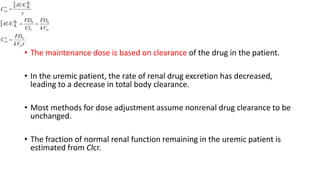
• The maintenance dose is based on clearance of the drug in the patient.
• In the uremic patient, the rate of renal drug excretion has decreased,
leading to a decrease in total body clearance.
• Most methods for dose adjustment assume nonrenal drug clearance to be
unchanged.
• The fraction of normal renal function remaining in the uremic patient is
estimated from Clcr.
 
 


D
av
DT
t
t
t
t
av
kV
FD
C
kV
FD
Cl
FD
AUC
AUC
C
0
002
1
2
1





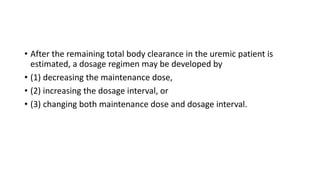
• After the remaining total body clearance in the uremic patient is
estimated, a dosage regimen may be developed by
• (1) decreasing the maintenance dose,
• (2) increasing the dosage interval, or
• (3) changing both maintenance dose and dosage interval.
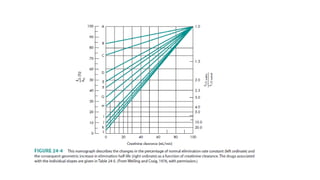
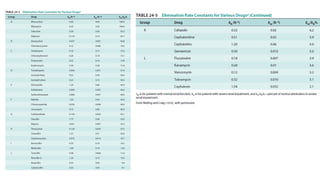
nomogram
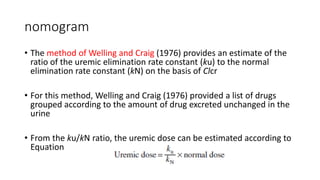
• The method of Welling and Craig (1976) provides an estimate of the
ratio of the uremic elimination rate constant (ku) to the normal
elimination rate constant (kN) on the basis of Clcr
• For this method, Welling and Craig (1976) provided a list of drugs
grouped according to the amount of drug excreted unchanged in the
urine
• From the ku/kN ratio, the uremic dose can be estimated according to
Equation
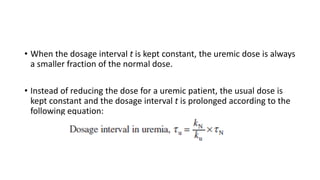
• When the dosage interval t is kept constant, the uremic dose is always
a smaller fraction of the normal dose.
• Instead of reducing the dose for a uremic patient, the usual dose is
kept constant and the dosage interval t is prolonged according to the
following equation:
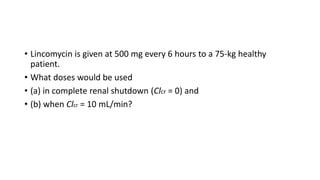
• Lincomycin is given at 500 mg every 6 hours to a 75-kg healthy
patient.
• What doses would be used
• (a) in complete renal shutdown (Clcr = 0) and
• (b) when Clcr = 10 mL/min?
Fraction of Drug Excreted Unchanged (fe) Methods
• For many drugs, the fraction of drug excreted unchanged (fe) is
available in the literature.
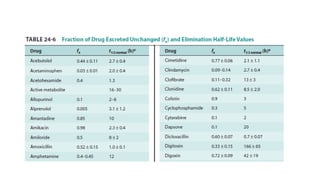
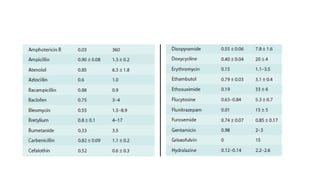
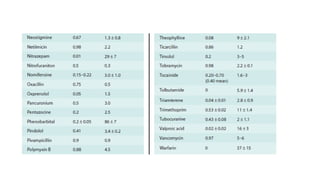
• Table 24-6 lists various drugs with their fe values and elimination half-
lives.
• The fe method for estimating a dosage regimen in the uremic patient
is a general method that may be applied to any drug whose fe is
known.
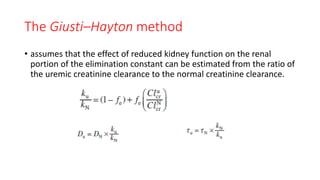
The Giusti–Hayton method
• assumes that the effect of reduced kidney function on the renal
portion of the elimination constant can be estimated from the ratio of
the uremic creatinine clearance to the normal creatinine clearance.
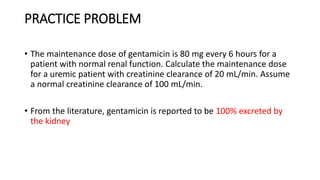
PRACTICE PROBLEM
• The maintenance dose of gentamicin is 80 mg every 6 hours for a
patient with normal renal function. Calculate the maintenance dose
for a uremic patient with creatinine clearance of 20 mL/min. Assume
a normal creatinine clearance of 100 mL/min.
• From the literature, gentamicin is reported to be 100% excreted by
the kidney
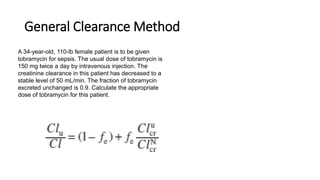
General Clearance Method
A 34-year-old, 110-lb female patient is to be given
tobramycin for sepsis. The usual dose of tobramycin is
150 mg twice a day by intravenous injection. The
creatinine clearance in this patient has decreased to a
stable level of 50 mL/min. The fraction of tobramycin
excreted unchanged is 0.9. Calculate the appropriate
dose of tobramycin for this patient.
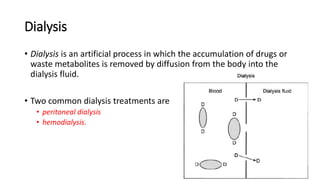
Dialysis
• Dialysis is an artificial process in which the accumulation of drugs or
waste metabolites is removed by diffusion from the body into the
dialysis fluid.
• Two common dialysis treatments are
• peritoneal dialysis
• hemodialysis.
• The principle underlying both processes is that as the uremic blood or fluid
is equilibrated with the dialysis fluid across a dialysis membrane, waste
metabolites from the patient’s blood or fluid diffuse into the dialysis fluid
and are removed.
• The dialysate is balanced with electrolytes and with respect to osmotic
pressure.
• The dialysate contains water, dextrose, electrolytes (potassium, sodium,
chloride, bicarbonate, acetate, calcium, etc), and other elements similar to
normal body fluids without the toxins.
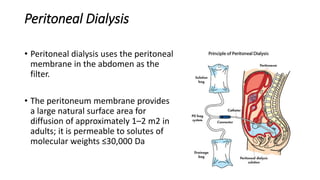
Peritoneal Dialysis
• Peritoneal dialysis uses the peritoneal
membrane in the abdomen as the
filter.
• The peritoneum membrane provides
a large natural surface area for
diffusion of approximately 1–2 m2 in
adults; it is permeable to solutes of
molecular weights ≤30,000 Da
• Placement of a peritoneal catheter is surgically simpler than hemodialysis
and does not require vascular surgery and heparinization.
• The dialysis fluid is pumped into the peritoneal cavity, where waste
metabolites in the body fluid are discharged rapidly.
• The dialysate is drained and fresh dialysate is reinstilled and then drained
periodically. Peritoneal dialysis is also more amenable to self-treatment.
However, slower drug clearance rates are obtained with peritoneal dialysis
compared to hemodialysis, and thus longer dialysis time is required.
• Continuous ambulatory peritoneal dialysis (CAPD) is the most common form of
peritoneal dialysis.
• Many diabetic patients become uremic as a result of lack of control of their disease.
About 2 L of dialysis fluid is instilled into the peritoneal cavity of the patient through a
surgically placed resident catheter.
• The objective is to remove accumulated urea and other metabolic waste in the body.
• The catheter is sealed and the patient is able to continue in an ambulatory mode. Every
4–6 hours, the fluid is emptied from the peritoneal cavity and replaced with fresh dialysis
fluid. The technique uses about 2 L of dialysis fluid; it does not require a dialysis machine
and can be performed at home.
Hemodialysis
• Hemodialysis uses a dialysis machine and filters blood through an
artificial membrane.
• Hemodialysis requires access to the blood vessels to allow the blood
to flow to the dialysis machine and back to the body.
• At the start of the hemodialysis procedure, an arterial needle allows
the blood to flow to the dialysis machine, and blood is returned to the
patient to the venous side. Heparin is used to prevent blood clotting
during the dialysis period.
• During hemodialysis, the blood flows through the dialysis machine,
where the waste material is removed from the blood by diffusion
through an artificial membrane before the blood is returned to the
body.
• Hemodialysis is a much more effective method of drug removal and is
preferred in situations when rapid removal of the drug from the body
is important, as in overdose or poisoning.
• In practice, hemodialysis is most often used for patients with end-stage renal
failure.
• Dialysis may be required from once every 2 days to 3 times a week, with each
treatment period lasting for 2–4 hours.
• Dosing of drugs in patients receiving hemodialysis is affected greatly by the
frequency and type of dialysis machine used and by the physicochemical and
pharmacokinetic properties of the drug.
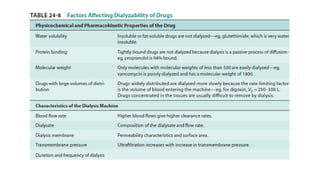
• Factors that affect drug removal in hemodialysis are listed in Table 24-8. These
factors are carefully considered before hemodialysis is used for drug removal.
• In dialysis involving uremic patients receiving drugs for therapy, the rate at
which a given drug is removed depends on
• the flow rate of blood to the dialysis machine and
• the performance of the dialysis machine.
• The term dialysance is used to describe the process of drug removal from
the dialysis machine.
• Dialysance is a clearance term similar in meaning to renal clearance, and it
describes the amount of blood completely cleared of drugs (in mL/min).
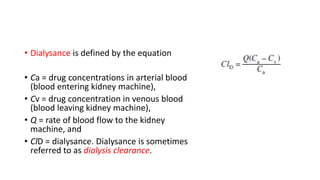
• Dialysance is defined by the equation
• Ca = drug concentrations in arterial blood
(blood entering kidney machine),
• Cv = drug concentration in venous blood
(blood leaving kidney machine),
• Q = rate of blood flow to the kidney
machine, and
• ClD = dialysance. Dialysance is sometimes
referred to as dialysis clearance.
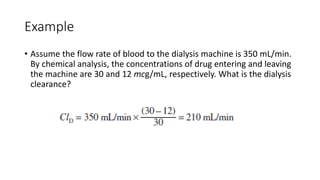
Example
• Assume the flow rate of blood to the dialysis machine is 350 mL/min.
By chemical analysis, the concentrations of drug entering and leaving
the machine are 30 and 12 mcg/mL, respectively. What is the dialysis
clearance?
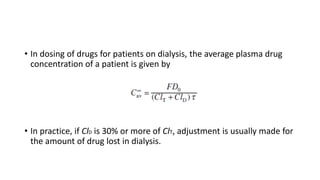
• In dosing of drugs for patients on dialysis, the average plasma drug
concentration of a patient is given by
• In practice, if ClD is 30% or more of ClT, adjustment is usually made for
the amount of drug lost in dialysis.
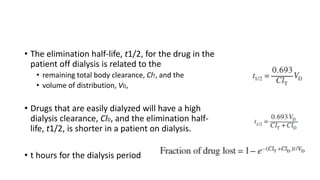
• The elimination half-life, t1/2, for the drug in the
patient off dialysis is related to the
• remaining total body clearance, ClT, and the
• volume of distribution, VD,
• Drugs that are easily dialyzed will have a high
dialysis clearance, ClD, and the elimination half-
life, t1/2, is shorter in a patient on dialysis.
• t hours for the dialysis period
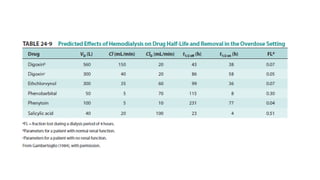
• as VD increases, the fraction of drug lost decreases.
• The fraction of drug lost during a 4-hour dialysis period for phenobarbital and salicylic acid was 0.30 and
0.50, respectively,
• whereas for digoxin and phenytoin, the fraction of drug lost was only 0.07 and 0.04, respectively.
• Both phenobarbital and salicylic acid are easily dialyzed because of their smaller volumes of distribution,
small molecular weights, and aqueous solubility.
• In contrast, digoxin has a large volume of distribution and phenytoin is highly bound to plasma proteins,
making these drugs difficult to dialyze.
• Thus, dialysis is not very useful for treating digoxin intoxication, but is useful for salicylate overdose.
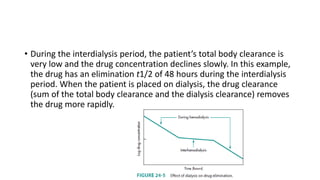
• During the interdialysis period, the patient’s total body clearance is
very low and the drug concentration declines slowly. In this example,
the drug has an elimination t1/2 of 48 hours during the interdialysis
period. When the patient is placed on dialysis, the drug clearance
(sum of the total body clearance and the dialysis clearance) removes
the drug more rapidly.
CLINICAL EXAMPLES
• The aminoglycoside antibiotics, such as gentamicin and tobramycin, are
eliminated primarily by the renal route.
• Dosing of these aminoglycosides is adjusted according to the residual renal
function in the patient as estimated by creatinine clearance.
• During hemodialysis or peritoneal dialysis, the elimination half-lives for these
antibiotics are significantly decreased.
• After dialysis, the aminoglycoside concentrations are below the therapeutic
range, and the patient needs to be given another dose of the aminoglycoside
antibiotic.
• An adult male (73 years old, 65 kg) with diabetes mellitus is placed on hemodialysis. His
residual creatinine clearance is <5 mL/min. The patient is given tobramycin, an
aminoglycoside antibiotic, at a dose of 1 mg/kg by IV bolus injection. Tobramycin is 90%
excreted unchanged in the urine, is less than 10% bound to plasma proteins, and has an
elimination half-life of approximately 2.2 hours in patients with normal renal function. In
this patient, tobramycin has an elimination t1/2 of 50 hours during the interdialysis
period and an elimination t1/2 of 8 hours during hemodialysis. The apparent volume of
distribution for tobramycin is about 0.33 L/kg. For this patient, calculate
• (a) the initial plasma antibiotic concentration after the first dose of tobramycin;
• (b) the plasma drug concentration just before the start of hemodialysis (48 hours after
the initial tobramycin dose);
• (c) the plasma drug concentration at the end of 4 hours of hemodialysis;
• (d) the amount of drug lost from the body after dialysis; and
• (e) the tobramycin dose (replenishment dose) needed to be given to the patient after
hemodialysis.

Dose adjustment in renal disease

  • 1.
    Dose Adjustment inRenal Disease
  • 2.
    RENAL IMPAIRMENT • Thekidney is an important organ in • regulating body fluids, • electrolyte balance, • removal of metabolic waste, and • drug excretion from the body. • Impairment or degeneration of kidney function affects the pharmacokinetics of drugs. • Some of the more common causes of kidney failure include • disease, • injury, • drug intoxication.
  • 4.
    • Acute diseasesor trauma to the kidney can cause uremia, in which glomerular filtration is impaired or reduced, leading to accumulation of excessive fluid and blood nitrogenous products in the body.
  • 5.
    PHARMACOKINETIC CONSIDERATIONS • Uremicpatients may exhibit pharmacokinetic changes in • bioavailability, • volume of distribution • clearance. • The oral bioavailability of a drug in severe uremia may be decreased as a result of disease-related changes in • gastrointestinal motility and pH that are caused by nausea, vomiting, and diarrhea. • Mesenteric blood flow may also be altered.
  • 6.
    • The apparentvolume of distribution depends largely on • drug–protein binding in plasma or tissues • total body water. • Renal impairment may alter the distribution of the drug as a result of • changes in fluid balance, • drug–protein binding, or • other factors that may cause changes in the apparent volume of distribution
  • 7.
    • The plasmaprotein binding of weak acidic drugs in uremic patients is decreased, whereas the protein binding of weak basic drugs is less affected. • A decrease in drug–protein binding results in a larger fraction of free drug and an increase in the volume of distribution. • However, the net elimination half-life is generally increased as a result of the dominant effect of reduced glomerular filtration.
  • 8.
    • Total bodyclearance of drugs in uremic patients is also reduced by either a decrease in the • glomerular filtration rate (GFR) and possibly • active tubular secretion or • reduced hepatic clearance
  • 9.
    • In clinicalpractice, estimation of the appropriate drug dosage regimen in patients with impaired renal function is based on an • estimate of the remaining renal function of the patient and a • prediction of the total body clearance.
  • 10.
    GENERAL APPROACHES FORDOSE ADJUSTMENT IN RENAL DISEASE • Generally, drugs in patients with uremia or kidney impairment have prolonged elimination half-lives and a change in the apparent volume of distribution. • Two general pharmacokinetic approaches for dose adjustment include • methods based on drug clearance • methods based on the elimination half-life.
  • 11.
    Dose Adjustment Basedon Drug Clearance • Methods based on drug clearance try to maintain the desired Cav after multiple oral doses or multiple IV bolus injections as total body clearance, ClT, changes. The calculation for Cav is
  • 12.
    • For patientswith uremic condition or renal impairment, total body clearance will change to a new value, ClTu. • Therefore, to maintain the same desired Cav , the dose must be changed to a uremic dose, D0u, or the dosage interval must be changed to t u, as shown in the following equation:
  • 13.
    • If thedosing interval is kept constant :
  • 14.
    • For IVinfusions the same desired Css is maintained both for patients with normal renal function and for patients with renal impairment. Therefore, the rate of infusion, R, must be changed to a new value, Ru, for the uremic patient, as described by the equation
  • 15.
    Dose Adjustment Basedon Changes in the Elimination Rate Constant • The overall elimination rate constant for many drugs is reduced in the uremic patient. • A dosage regimen may be designed for the uremic patient either by reducing the normal dose of the drug and keeping the frequency of dosing (dosage interval) constant or by decreasing the frequency of dosing (prolonging the dosage interval) and keeping the dose constant. • Doses of drugs with a narrow therapeutic range should be reduced— particularly if the drug has accumulated in the patient prior to deterioration of kidney function.
  • 16.
    • The usualapproach to estimating a multiple-dosage regimen in the normal patient is to maintain a desired av C ,. • Assuming the VD is the same in both normal and uremic patients and t is constant,
  • 17.
    • When theelimination rate constant for a drug in the uremic patient cannot be determined directly, indirect methods are available to calculate the predicted elimination rate constant based on the renal function of the patient. • The assumptions on how these dosage regimens are calculated include the following:
  • 18.
    • The renalelimination rate constant (kR) decreases proportionately as renal function decreases. • The nonrenal routes of elimination (primarily, the rate constant for metabolism) remain unchanged. • Changes in the renal clearance of the drug are reflected by changes in the creatinine clearance.
  • 19.
    MEASUREMENT OF GLOMERULARFILTRATION RATE • Several criteria are necessary to use a drug as a marker to measure GFR: 1. The drug must be freely filtered at the glomerulus. 2. The drug must neither be reabsorbed nor actively secreted by the renal tubules. 3. The drug should not be metabolized. 4. The drug should not bind significantly to plasma proteins. 5. The drug should neither have an effect on the filtration rate nor alter renal function. 6. The drug should be nontoxic. 7. The drug may be infused in a sufficient dose to permit simple and accurate quantitation in plasma and in urine.
  • 21.
    • Inulin, afructose polysaccharide, fulfills most of the criteria listed above and is therefore used as a standard reference for the measurement of GFR. • In practice, however, the use of inulin involves a time-consuming procedure in which inulin is given by intravenous infusion until a constant steady-state plasma level is obtained. • Clearance of inulin may then be measured by the rate of infusion divided by the steady-state plasma inulin concentration. Although this procedure gives an accurate value for GFR, inulin clearance is not used frequently in clinical practice.
  • 22.
    • The clearanceof creatinine is used most extensively as a measurement of GFR. • Creatinine is an endogenous substance formed from creatine phosphate during muscle metabolism. • Creatinine production varies with age, weight, and gender of the individual. • In humans, creatinine is filtered mainly at the glomerulus, with no tubular reabsorption. However, a small amount of creatinine may be actively secreted by the renal tubules, and the values of GFR obtained by the creatinine clearance tend to be higher than GFR measured by inulin clearance.
  • 23.
    • Measurement ofblood urea nitrogen (BUN) is a commonly used clinical diagnostic laboratory test for renal disease. • Urea is the end product of protein catabolism and is excreted through the kidney. • Normal BUN levels range from 10 to 20 mg/dL.
  • 24.
    • The renalclearance of urea is by glomerular filtration and partial reabsorption in the renal tubules. • Therefore, the renal clearance of urea is less than creatinine or inulin clearance and does not give a quantitative measure of kidney function.
  • 25.
    SERUM CREATININE CONCENTRATIONAND CREATININE CLEARANCE • Under normal circumstances, creatinine production is roughly equal to creatinine excretion, so the serum creatinine level remains constant. • In a patient with reduced glomerular filtration, serum creatinine will accumulate in accordance with the degree of loss of glomerular filtration in the kidney. • The serum creatinine concentration alone is frequently used to determine creatinine clearance, Clcr. Creatinine clearance from the serum creatinine concentration is a rapid and convenient way to monitor kidney function.
  • 26.
    Measuring Clcr • whereC Cr = creatinine concentration (mg/dL) of the serum taken at the 12th hour or at the midpoint of the urine-collection period, V = volume of urine excreted (mL) in 24 hours, C u = concentration of creatinine in urine (mg/mL), and Cl Cr = creatinine clearance in mL/min. • Creatinine clearance can be calculated directly by determining the patient's serum creatinine concentration and the rate of urinary excretion of creatinine.
  • 27.
    Measuring Clcr • Serumcreatinine should be at steady state • The weight in the equation reflects the ideal body weight. • Use the actual weight if it is less than IBW • Use IBW if the difference within 20% of the IBW. • Adjusted body wt. = IBW + 40% of the excess. • Cockcroft-Gault equation.
  • 28.
    Measuring Clcr • Age1- 18 • Clcr = 0.55 * Height (cm) *BSA. • Pediatric equation (0- 1 Year) Clcr = 0.48 *height (cm) *BSA. Sr.cr (mg/dL) Sr.cr (mg/dL) 1.73 1.73
  • 31.
    DOSE ADJUSTMENT FORUREMIC PATIENTS • The loading drug dose is based on the apparent volume of distribution of the patient. • It is generally assumed that the apparent volume of distribution is not altered significantly, and therefore, the loading dose of the drug is the same in uremic patients as in subjects with normal renal function.
  • 32.
    • The maintenancedose is based on clearance of the drug in the patient. • In the uremic patient, the rate of renal drug excretion has decreased, leading to a decrease in total body clearance. • Most methods for dose adjustment assume nonrenal drug clearance to be unchanged. • The fraction of normal renal function remaining in the uremic patient is estimated from Clcr.       D av DT t t t t av kV FD C kV FD Cl FD AUC AUC C 0 002 1 2 1     
  • 33.
    • After theremaining total body clearance in the uremic patient is estimated, a dosage regimen may be developed by • (1) decreasing the maintenance dose, • (2) increasing the dosage interval, or • (3) changing both maintenance dose and dosage interval.
  • 34.
    nomogram • The methodof Welling and Craig (1976) provides an estimate of the ratio of the uremic elimination rate constant (ku) to the normal elimination rate constant (kN) on the basis of Clcr • For this method, Welling and Craig (1976) provided a list of drugs grouped according to the amount of drug excreted unchanged in the urine • From the ku/kN ratio, the uremic dose can be estimated according to Equation
  • 35.
    • When thedosage interval t is kept constant, the uremic dose is always a smaller fraction of the normal dose. • Instead of reducing the dose for a uremic patient, the usual dose is kept constant and the dosage interval t is prolonged according to the following equation:
  • 38.
    • Lincomycin isgiven at 500 mg every 6 hours to a 75-kg healthy patient. • What doses would be used • (a) in complete renal shutdown (Clcr = 0) and • (b) when Clcr = 10 mL/min?
  • 39.
    Fraction of DrugExcreted Unchanged (fe) Methods • For many drugs, the fraction of drug excreted unchanged (fe) is available in the literature. • Table 24-6 lists various drugs with their fe values and elimination half- lives. • The fe method for estimating a dosage regimen in the uremic patient is a general method that may be applied to any drug whose fe is known.
  • 43.
    The Giusti–Hayton method •assumes that the effect of reduced kidney function on the renal portion of the elimination constant can be estimated from the ratio of the uremic creatinine clearance to the normal creatinine clearance.
  • 44.
    PRACTICE PROBLEM • Themaintenance dose of gentamicin is 80 mg every 6 hours for a patient with normal renal function. Calculate the maintenance dose for a uremic patient with creatinine clearance of 20 mL/min. Assume a normal creatinine clearance of 100 mL/min. • From the literature, gentamicin is reported to be 100% excreted by the kidney
  • 45.
    General Clearance Method A34-year-old, 110-lb female patient is to be given tobramycin for sepsis. The usual dose of tobramycin is 150 mg twice a day by intravenous injection. The creatinine clearance in this patient has decreased to a stable level of 50 mL/min. The fraction of tobramycin excreted unchanged is 0.9. Calculate the appropriate dose of tobramycin for this patient.
  • 46.
    Dialysis • Dialysis isan artificial process in which the accumulation of drugs or waste metabolites is removed by diffusion from the body into the dialysis fluid. • Two common dialysis treatments are • peritoneal dialysis • hemodialysis.
  • 47.
    • The principleunderlying both processes is that as the uremic blood or fluid is equilibrated with the dialysis fluid across a dialysis membrane, waste metabolites from the patient’s blood or fluid diffuse into the dialysis fluid and are removed. • The dialysate is balanced with electrolytes and with respect to osmotic pressure. • The dialysate contains water, dextrose, electrolytes (potassium, sodium, chloride, bicarbonate, acetate, calcium, etc), and other elements similar to normal body fluids without the toxins.
  • 48.
    Peritoneal Dialysis • Peritonealdialysis uses the peritoneal membrane in the abdomen as the filter. • The peritoneum membrane provides a large natural surface area for diffusion of approximately 1–2 m2 in adults; it is permeable to solutes of molecular weights ≤30,000 Da
  • 49.
    • Placement ofa peritoneal catheter is surgically simpler than hemodialysis and does not require vascular surgery and heparinization. • The dialysis fluid is pumped into the peritoneal cavity, where waste metabolites in the body fluid are discharged rapidly. • The dialysate is drained and fresh dialysate is reinstilled and then drained periodically. Peritoneal dialysis is also more amenable to self-treatment. However, slower drug clearance rates are obtained with peritoneal dialysis compared to hemodialysis, and thus longer dialysis time is required.
  • 50.
    • Continuous ambulatoryperitoneal dialysis (CAPD) is the most common form of peritoneal dialysis. • Many diabetic patients become uremic as a result of lack of control of their disease. About 2 L of dialysis fluid is instilled into the peritoneal cavity of the patient through a surgically placed resident catheter. • The objective is to remove accumulated urea and other metabolic waste in the body. • The catheter is sealed and the patient is able to continue in an ambulatory mode. Every 4–6 hours, the fluid is emptied from the peritoneal cavity and replaced with fresh dialysis fluid. The technique uses about 2 L of dialysis fluid; it does not require a dialysis machine and can be performed at home.
  • 51.
    Hemodialysis • Hemodialysis usesa dialysis machine and filters blood through an artificial membrane. • Hemodialysis requires access to the blood vessels to allow the blood to flow to the dialysis machine and back to the body. • At the start of the hemodialysis procedure, an arterial needle allows the blood to flow to the dialysis machine, and blood is returned to the patient to the venous side. Heparin is used to prevent blood clotting during the dialysis period.
  • 52.
    • During hemodialysis,the blood flows through the dialysis machine, where the waste material is removed from the blood by diffusion through an artificial membrane before the blood is returned to the body. • Hemodialysis is a much more effective method of drug removal and is preferred in situations when rapid removal of the drug from the body is important, as in overdose or poisoning.
  • 53.
    • In practice,hemodialysis is most often used for patients with end-stage renal failure. • Dialysis may be required from once every 2 days to 3 times a week, with each treatment period lasting for 2–4 hours. • Dosing of drugs in patients receiving hemodialysis is affected greatly by the frequency and type of dialysis machine used and by the physicochemical and pharmacokinetic properties of the drug. • Factors that affect drug removal in hemodialysis are listed in Table 24-8. These factors are carefully considered before hemodialysis is used for drug removal.
  • 55.
    • In dialysisinvolving uremic patients receiving drugs for therapy, the rate at which a given drug is removed depends on • the flow rate of blood to the dialysis machine and • the performance of the dialysis machine. • The term dialysance is used to describe the process of drug removal from the dialysis machine. • Dialysance is a clearance term similar in meaning to renal clearance, and it describes the amount of blood completely cleared of drugs (in mL/min).
  • 56.
    • Dialysance isdefined by the equation • Ca = drug concentrations in arterial blood (blood entering kidney machine), • Cv = drug concentration in venous blood (blood leaving kidney machine), • Q = rate of blood flow to the kidney machine, and • ClD = dialysance. Dialysance is sometimes referred to as dialysis clearance.
  • 57.
    Example • Assume theflow rate of blood to the dialysis machine is 350 mL/min. By chemical analysis, the concentrations of drug entering and leaving the machine are 30 and 12 mcg/mL, respectively. What is the dialysis clearance?
  • 58.
    • In dosingof drugs for patients on dialysis, the average plasma drug concentration of a patient is given by • In practice, if ClD is 30% or more of ClT, adjustment is usually made for the amount of drug lost in dialysis.
  • 59.
    • The eliminationhalf-life, t1/2, for the drug in the patient off dialysis is related to the • remaining total body clearance, ClT, and the • volume of distribution, VD, • Drugs that are easily dialyzed will have a high dialysis clearance, ClD, and the elimination half- life, t1/2, is shorter in a patient on dialysis. • t hours for the dialysis period
  • 61.
    • as VDincreases, the fraction of drug lost decreases. • The fraction of drug lost during a 4-hour dialysis period for phenobarbital and salicylic acid was 0.30 and 0.50, respectively, • whereas for digoxin and phenytoin, the fraction of drug lost was only 0.07 and 0.04, respectively. • Both phenobarbital and salicylic acid are easily dialyzed because of their smaller volumes of distribution, small molecular weights, and aqueous solubility. • In contrast, digoxin has a large volume of distribution and phenytoin is highly bound to plasma proteins, making these drugs difficult to dialyze. • Thus, dialysis is not very useful for treating digoxin intoxication, but is useful for salicylate overdose.
  • 62.
    • During theinterdialysis period, the patient’s total body clearance is very low and the drug concentration declines slowly. In this example, the drug has an elimination t1/2 of 48 hours during the interdialysis period. When the patient is placed on dialysis, the drug clearance (sum of the total body clearance and the dialysis clearance) removes the drug more rapidly.
  • 63.
    CLINICAL EXAMPLES • Theaminoglycoside antibiotics, such as gentamicin and tobramycin, are eliminated primarily by the renal route. • Dosing of these aminoglycosides is adjusted according to the residual renal function in the patient as estimated by creatinine clearance. • During hemodialysis or peritoneal dialysis, the elimination half-lives for these antibiotics are significantly decreased. • After dialysis, the aminoglycoside concentrations are below the therapeutic range, and the patient needs to be given another dose of the aminoglycoside antibiotic.
  • 64.
    • An adultmale (73 years old, 65 kg) with diabetes mellitus is placed on hemodialysis. His residual creatinine clearance is <5 mL/min. The patient is given tobramycin, an aminoglycoside antibiotic, at a dose of 1 mg/kg by IV bolus injection. Tobramycin is 90% excreted unchanged in the urine, is less than 10% bound to plasma proteins, and has an elimination half-life of approximately 2.2 hours in patients with normal renal function. In this patient, tobramycin has an elimination t1/2 of 50 hours during the interdialysis period and an elimination t1/2 of 8 hours during hemodialysis. The apparent volume of distribution for tobramycin is about 0.33 L/kg. For this patient, calculate • (a) the initial plasma antibiotic concentration after the first dose of tobramycin; • (b) the plasma drug concentration just before the start of hemodialysis (48 hours after the initial tobramycin dose); • (c) the plasma drug concentration at the end of 4 hours of hemodialysis; • (d) the amount of drug lost from the body after dialysis; and • (e) the tobramycin dose (replenishment dose) needed to be given to the patient after hemodialysis.