Drug Use Evaluation (DUE) /
Drug Use Review (DUR)
DR. HAMID SAEED
Assistant Professor of Clinical Pharmacy
University College of Pharmacy
University of the Punjab
Acronyms Associated with the evaluation
of medication use
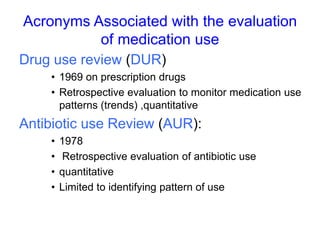
Drug use review (DUR)
• 1969 on prescription drugs
• Retrospective evaluation to monitor medication use
patterns (trends) ,quantitative
Antibiotic use Review (AUR):
• 1978
• Retrospective evaluation of antibiotic use
• quantitative
• Limited to identifying pattern of use
Acronyms Associated with the evaluation
of medication use
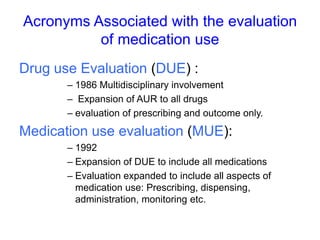
Drug use Evaluation (DUE) :
– 1986 Multidisciplinary involvement
– Expansion of AUR to all drugs
– evaluation of prescribing and outcome only.
Medication use evaluation (MUE):
– 1992
– Expansion of DUE to include all medications
– Evaluation expanded to include all aspects of
medication use: Prescribing, dispensing,
administration, monitoring etc.
Definition
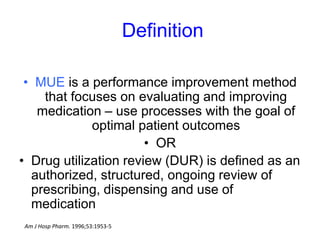
• MUE is a performance improvement method
that focuses on evaluating and improving
medication – use processes with the goal of
optimal patient outcomes
• OR
• Drug utilization review (DUR) is defined as an
authorized, structured, ongoing review of
prescribing, dispensing and use of
medication
Am J Hosp Pharm. 1996;53:1953-5
• MUE may be applied to a medication or therapeutic
class, dis- ease state or condition, a medication-use
process (prescribing, preparing and dispensing,
administering, and monitoring), or specific outcomes.
• Potential tool in the evaluation of health care system
• With main objective to ascertain drug use in society
• Casual observation, as well as more systematic study
of prescribing practices, frequently reveals a pattern of
diversity among prescribers in the treatment of even
the most common conditions.
• Specific Population
• Elderly – incorrect use of medication and poly-
pharmacy
• Children – poor development of functions and
most of the drugs are intended for adults.
• Improved Outcomes
• Potential hazards
• Un-necessary finances
• Thus, its is necessary to have a periodic review of
the pattern of drug utilization to ensure safe and
effective treatment.
Purpose
• The purpose of DUR is to ensure drugs
are used appropriately, safely and
• effectively to improve patient health
status
Why DUE is becoming more
important..?
• The boost in the marketing of new drugs,
• Wide variations in the pattern of drug prescribing and
consumption
• Growing concern about the delayed adverse effects,
• Increasing concerns regarding the cost of drugs and
• Volume of prescription
• All contribute to the increasing importance of DUE
Criteria
• Predetermined criteria for appropriate
• drug therapy are compared against a patient’s
or a population’s records.
• Non-adherence to criteria results in drug
therapy changes.
• In addition, continual improvement in the
appropriate, safe and effective use of drugs has
the potential to lower the overall cost of care
• DUR allows the pharmacist to document and
evaluate the benefit of pharmacy intervention in
improving therapeutic and economic outcomes
while demonstrating the overall value of the
pharmacist
• prospective DUR often relies on
computerized algorithms to perform key
checks including drug interactions,
duplications or contraindications with
the patient’s disease state or condition
Issues Requiring DUE
• Poly-pharmacy is one problem; providers may use three, four, five, and
sometimes more medicines to treat the most trivial conditions for the sake of
satisfying a patient’s need to receive medicines (or the pharmaceutical seller’s
need for profit).
• Other reasons for poly-pharmacy include lack of diagnostic competence or
confidence and an inadequate knowledge of treatment regimens.
• Other common medicine use problems are choosing incorrect medicines,
prescribing the incorrect dose, prescribing medicines that cause adverse drug
reactions (ADRs) or medicine interactions, and using more expensive medicines
when less expensive medicines would be equally or more effective.
General Aim
• A system of improving the quality of medicine use in
hospitals and clinics, is an ongoing, systematic,
criteria-based program of medicine evaluations that
will help ensure that appropriate use of medicine.
• A DUE can be structured so that it will assess the
actual process of administering or dispensing a
medicine (i.e., appropriate indications, dose,
medicine interactions) or assess the outcomes (i.e.,
cured infections, decreased lipid levels.)
Objectives
• Promoting optimal medication therapy.
• Preventing medication-related problems.
• Evaluating the effectiveness of medication therapy.
• Improving patient safety.
• Establishing interdisciplinary consensus on medication-use
processes.
• Stimulate improvements in medication-use processes.
• Ensure standardization in medication-use processes.
• Enhancing opportunities, through standardization, to assess the
value of innovative medication-use practices from both patient-
outcome and resource-utilization perspectives.
• Minimizing procedural variations that contribute to suboptimal
outcomes of medication use.
• Identifying areas in which further information and education
for health care professionals may be needed
• Minimizing costs of medication therapy. These costs may be
only partly related to the direct cost of medications
themselves.
• When medications are selected and managed optimally from
the outset, the costs of complications and wasted resources
are minimized, and overall costs are decreased.
• Meeting or exceeding internal and external quality standards
(e.g., professional practice standards, accreditation
standards, or government laws and regulations)
• Enhancing accountability in the medicine use process
Scope of Drug Use Evaluation
• Drug use evaluation (DUE) aims to understand how and why
drugs are used so as to improve appropriate drug use and
the health outcome (Sathvik, 2004).
• DUE can be aimed to analyze the present and the
developmental trends of drug usage at various levels of the
health care system, whether national, local or institutional.
• DUE may evaluate drug use at a population level, based on
the demographic details (Gama, 2008).
• These studies are used to calculate the reported adverse
drug reactions, to monitor the utilization of various categories
of drugs, to monitor the regulatory activities.
• Drug utilization data may be used to produce crude estimates of
disease prevalence, such as cardiovascular disease (Psaty et al.,
2006), diabetes (Duarte-Ramos and Cabrita, 2006).
• Drug utilization data may be also used to plan drug importation,
production, and distribution, and to estimate drug expenditures.
• They can document the extent of inappropriate prescribing of
drugs activities (Gama, 2008).
• DUE helps the healthcare system to understand, interpret and
improve prescription, administration and use of medications
(Sathvik, 2004).
• DUS are particularly interesting if focused on the most frequently
used and misused groups of therapeutic drugs, such as antibiotics,
chemotherapeutic agents, or those that constitute important
therapeutic innovations (Krivoy et al., 2007).
Why Drug Utilization Research is
Necessary..?
• The aim is to facilitate the rational use of drugs in
populations.
• In individual patients, the rational drug use implies the
prescription of a well-documented drug in an optimal
dose on right indication at an affordable price.
• It is important to realize that inappropriate use of drugs
represent a potential hazard to the patients and an
unnecessary expense (Hawkey et al., 1990).
• It is difficult to understand the rational use of drug
without the knowledge on how drugs are being
prescribed.
• DUE contributes to
• rational drug use by describing the drug use pattern and
interventions.
• Helps in understanding how drugs are being used by making
estimates of number of patients exposed to drugs, describing and
estimating to what extent the drugs are used at certain area,
whether overused or underused,
• It compares the observed patterns of drug use with current
recommendations or guidelines.
• Feed back is provided to the prescribers based on the drug
utilization data collected.
• Drug utilization research enables to assess whether interventions
undertaken improves the drug use by monitoring and evaluating
patterns of drug use (Sjoqvist and Brikett, 2003).
Types of Drug Use Information
• Drug based information
• Detailed information is usually required to answer
clinically important questions which may involve
aggregation of drug use at various levels, and
information on indications, doses and dosage
regimens.
• Problem based information
• The question must be addressed to know more about
the problem that is being managed instead of knowing
about the particular group of drugs used for any
condition.
• Patient information
• Demographics and other information will be useful for the studies.
• The age distribution has critical importance in some cases e.g., to
know whether the drug is being used in an age group different from
that in which clinical trials were performed.
• The co-morbidities of the patient group may be important in
determining treatment choice and adverse effects.
• For example in the management of hypertension in asthma patients,
beta blockers should be avoided.
• Prescriber information
• The differences in the drug prescribing often lack rational explanations.
• This type of information helps to determine the prescribing behavior
which is often helpful to understand how and why drugs are
prescribed.
Role of Pharmacist in DUE
• Pharmacists, by virtue of their expertise and their
mission of ensuring proper medication use, should
exert leadership role and work collaboratively with
other members of the health care team in the
ongoing process of medication-use evaluation and
improvement.
• Responsibilities of pharmacists in the MUE process
include;
• Pharmacist’s Responsibilities
• Developing an operational plan for MUE programs and
processes that are consistent with the health system’s
overall goals and resource capabilities.
• Working collaboratively with prescribers and others to
develop criteria for specific medications and to design
effective medication-use processes.
• Reviewing individual medication orders against
medication-use criteria and consulting with prescribers
and others in the process as needed.
• Managing MUE programs and processes.
• Collecting, analyzing, and evaluating patient-
specific data to identify, resolve, and prevent
medication-related problems.
• Interpreting and reporting MUE findings and
recommend changes in medication-use processes.
• Providing information and education based on MUE
findings.
A Step Wise Approach to DUE
• 1. Establish Responsibility
– Drug therapeutic committee (DTC) monitor DUEs in
hospital and clinics
– The DTC must establish procedures that will govern the
committee in its activities concerning medicine use
review and evaluation.
– DTC must establish a plan, outlining which medicines
will be a part of the DUE process.
– This plan needs to be updated and evaluated each year.
Develop Scope of Activities
• 2. The scope can be extensive or it can focus on a
single aspect of pharmaceutical therapy.
– Methods to identify medicine use problems include; ABC
or vital, essential, nonessential (VEN) analysis, defined
daily dose analysis, ADR reports, medication error
reports, antibiotic sensitivity results, procurement
studies, hospital and primary care clinic indicator
studies, patient complaints or feedback, and staff
feedback.
• DTC must concentrate on the most important medicines, those
with the highest potential for problems, to get the most return on
the work involved.
• These high priority areas would include
• High-volume medicine use
• Medicines with a low therapeutic index
• Medicines with a high incidence of ADRs
• Expensive medicines
ABC analysis
Most pharmacists and managers know that only a few drug items account for the greatest
drug expenditure.
Often 70-80% of the budget is spent on 10-20% of the medicines.
ABC analysis is the analysis of annual medicine consumption and cost in order to determine
which items account for the greatest proportion of the budget.
It can reveal:
• High usage items for which there are lower-cost alternatives on the list or
available in the market.
This information can be used to:
- choose more cost-effective alternative medicines
- identify opportunities for therapeutic substitution
- negotiate lower prices with suppliers.
• A-items: 20% of all goods contribute to 70-80% of the
annual consumption value of the items
• B-items: 30% of all goods contribute to 15-25% of the
annual consumption value of the items
• C-items: 50% of all goods contribute only 5% of the
annual consumption value of the items
• In order to calculate the annual consumption value of
any item or items:
• Annual consumption value = annual demand x item
cost per unit
• Measure the degree to which actual drug consumption
reflects public health needs and so identify irrational drug
use, through comparing drug consumption to morbidity
patterns.
• Identify purchases for items not on the hospital essential
medicines list i.e. the use of non-formulary medicines.
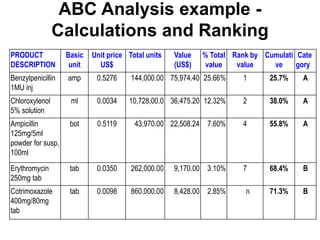
ABC Analysis example -
Calculations and Ranking
PRODUCT
DESCRIPTION
Basic
unit
Unit price
US$
Total units Value
(US$)
% Total
value
Rank by
value
Cumulati
ve
Cate
gory
Benzylpenicillin
1MU inj
amp 0.5276 144,000.00 75,974.40 25.66% 1 25.7% A
Chloroxylenol
5% solution
ml 0.0034 10,728,00.0 36,475.20 12.32% 2 38.0% A
Ampicillin
125mg/5ml
powder for susp,
100ml
bot 0.5119 43,970.00 22,508.24 7.60% 4 55.8% A
Erythromycin
250mg tab
tab 0.0350 262,000.00 9,170.00 3.10% 7 68.4% B
Cotrimoxazole
400mg/80mg
tab
tab 0.0098 860,000.00 8,428.00 2.85% n 71.3% B
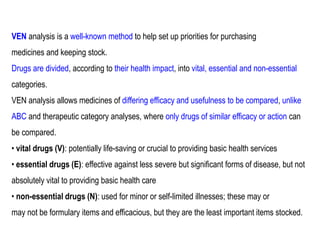
VEN analysis is a well-known method to help set up priorities for purchasing
medicines and keeping stock.
Drugs are divided, according to their health impact, into vital, essential and non-essential
categories.
VEN analysis allows medicines of differing efficacy and usefulness to be compared, unlike
ABC and therapeutic category analyses, where only drugs of similar efficacy or action can
be compared.
• vital drugs (V): potentially life-saving or crucial to providing basic health services
• essential drugs (E): effective against less severe but significant forms of disease, but not
absolutely vital to providing basic health care
• non-essential drugs (N): used for minor or self-limited illnesses; these may or
may not be formulary items and efficacious, but they are the least important items stocked.
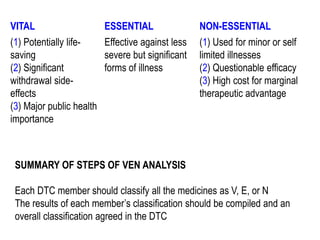
VITAL ESSENTIAL NON-ESSENTIAL
(1) Potentially life-
saving
(2) Significant
withdrawal side-
effects
(3) Major public health
importance
Effective against less
severe but significant
forms of illness
(1) Used for minor or self
limited illnesses
(2) Questionable efficacy
(3) High cost for marginal
therapeutic advantage
SUMMARY OF STEPS OF VEN ANALYSIS
Each DTC member should classify all the medicines as V, E, or N
The results of each member’s classification should be compiled and an
overall classification agreed in the DTC
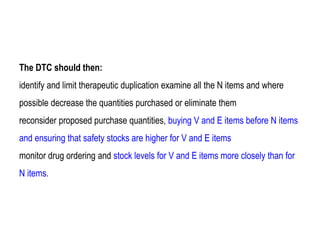
The DTC should then:
identify and limit therapeutic duplication examine all the N items and where
possible decrease the quantities purchased or eliminate them
reconsider proposed purchase quantities, buying V and E items before N items
and ensuring that safety stocks are higher for V and E items
monitor drug ordering and stock levels for V and E items more closely than for
N items.
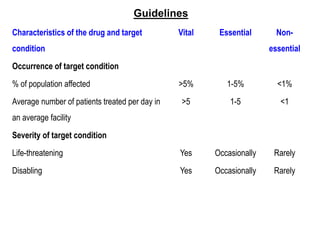
Characteristics of the drug and target
condition
Vital Essential Non-
essential
Occurrence of target condition
% of population affected >5% 1-5% <1%
Average number of patients treated per day in
an average facility
>5 1-5 <1
Severity of target condition
Life-threatening Yes Occasionally Rarely
Disabling Yes Occasionally Rarely
Guidelines
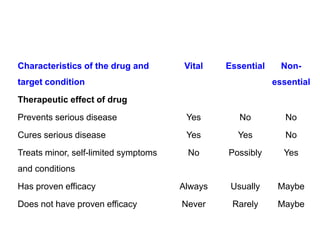
Characteristics of the drug and
target condition
Vital Essential Non-
essential
Therapeutic effect of drug
Prevents serious disease Yes No No
Cures serious disease Yes Yes No
Treats minor, self-limited symptoms
and conditions
No Possibly Yes
Has proven efficacy Always Usually Maybe
Does not have proven efficacy Never Rarely Maybe
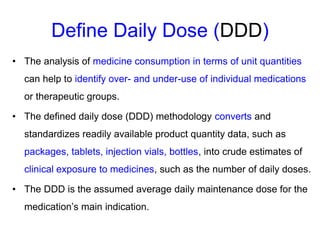
Define Daily Dose (DDD)
• The analysis of medicine consumption in terms of unit quantities
can help to identify over- and under-use of individual medications
or therapeutic groups.
• The defined daily dose (DDD) methodology converts and
standardizes readily available product quantity data, such as
packages, tablets, injection vials, bottles, into crude estimates of
clinical exposure to medicines, such as the number of daily doses.
• The DDD is the assumed average daily maintenance dose for the
medication’s main indication.
• It is defined globally for each medicine by the WHO Collaborating Centre
for Drug Statistics in Oslo, Norway, (http://www.whocc.no; see annex 6.1
for addresses and the DDDs for some medicines).
• The DDD is based on the average maintenance dose for adults, but it
can be adjusted for paediatric medicine use.
Converting aggregate quantities available from pharmacy inventory records
or sales statistics into DDDs roughly indicates how many potential treatment
days of a medicine have been procured, distributed or consumed.
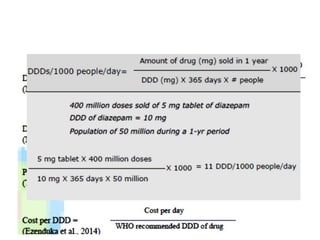
The medicines can then be compared, using units such as:
• no. of DDD per 1000 inhabitants per day, for total drug consumption
• no. of DDD per 100 beds per day (100 bed-days), for hospital use
• if the calculations for amoxicillin show that there were 4 DDDs per 1000
inhabitants per day, this suggests that on any given day, for every 1000
persons, 4 adults received a daily dose of 1 g of amoxicillin.
• If calculations of gentamicin use are expressed as 2 DDD per 100 bed-
days, this tells us that, for every 100 beds in the hospital, every day 2
patients received 240 mg of gentamicin.
• The assigned DDD for amoxicillin is 1 g and for gentamicin is 240 mg.
• These interpretations assume that the prescribed daily dose (the
quantity actually prescribed to a patient) is the same as the defined daily
dose, although this may not, in fact, be the case.
Important Points
• • DDDs provide a unit of measurement that is independent of price
and formulation, making it possible to assess trends in consumption
of medicines and to perform comparisons between population
groups and health-care systems.
• • DDDs have not been established for topical medicines, vaccines,
general/local anesthetics, contrast media and allergen extracts.
• • The DDD method should only be used in settings where reliable
procurement, inventory or sales data have been recorded.
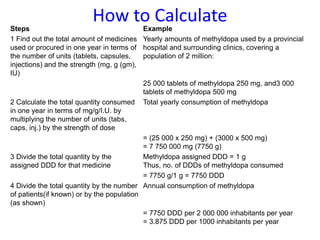
How to Calculate
Steps Example
1 Find out the total amount of medicines
used or procured in one year in terms of
the number of units (tablets, capsules,
injections) and the strength (mg, g (gm),
IU)
Yearly amounts of methyldopa used by a provincial
hospital and surrounding clinics, covering a
population of 2 million:
25 000 tablets of methyldopa 250 mg, and3 000
tablets of methyldopa 500 mg
2 Calculate the total quantity consumed
in one year in terms of mg/g/I.U. by
multiplying the number of units (tabs,
caps, inj.) by the strength of dose
Total yearly consumption of methyldopa
= (25 000 x 250 mg) + (3000 x 500 mg)
= 7 750 000 mg (7750 g)
3 Divide the total quantity by the
assigned DDD for that medicine
Methyldopa assigned DDD = 1 g
Thus, no. of DDDs of methyldopa consumed
= 7750 g/1 g = 7750 DDD
4 Divide the total quantity by the number
of patients(if known) or by the population
(as shown)
Annual consumption of methyldopa
= 7750 DDD per 2 000 000 inhabitants per year
= 3.875 DDD per 1000 inhabitants per year
Important Categories
• Medicines that are critically important
categories; cardiovascular, emergency,
toxicology, oncology, intravenous medicines,
and narcotic analgesics
• Antimicrobial medicines, both prophylactic
and therapeutic Injections
• Medicines undergoing evaluation for addition
to the formulary
• Medicines used for off-label indications
• Medicines used for high-risk patients
Establish Criteria, Define and
Establish Threshold
• Establishing criteria is the single most
important procedure in a DUE.
• Criteria for the use of any medicine should be
established by the DTC using relevant
evidence-based literature sources and
recognized international and local experts.
• The criteria for any DUE should reflect what
is in the country’s STGs (assuming that they
have been developed correctly) and any
medicine-use protocols that exist.
• Credibility of the DUE relies on criteria that are
based on evidence-based medicine. Criteria must
be developed with and accepted by the medical
staff for the process to be credible
• After developing criteria, the DTC must establish a
threshold or standard (benchmark) against which
the criteria will be judged.
• A threshold refers to the percentage of charts or
records that will meet or exceed the established
criteria for the medicine.
• Ideally, this threshold will be 100 percent,
but realistically, a smaller percentage will
be more appropriate to account for
exceptions to routine medicine prescribing.
• Therefore, a threshold of 90 to 95 percent
is typically used for many criteria, but each
instance must be carefully analyzed before
reaching a conclusion.
• A comprehensive list of indicators for
appropriate medicine use includes the
following components
• Process indicators
• o Indications—specific uses for the medicine
in question
• o Dose—specific doses for any approved
indication for appropriate duration
• o Quantity dispensed—correct number of
doses administered
• o Preparation—steps involved with preparing a
medication for administration
• o Monitoring—laboratory test necessary and
intervals of testing during the use of the medicine
• Contraindications—known contraindications
o Drug interactions—significant medicine
interactions, including medicine-medicine,
• medicine-food, and medicine-laboratory
• o Administration—specific steps necessary to
administer a medicine, especially for injectables
• o Patient education—instructions and
education that a patient should receive with
the medicine
• • Outcome indicators—specific outcomes to
be realized from medicine use
• Lowered blood pressure, stabilized blood
glucose, and fewer migraine and asthma
• attacks
• Decreased visits to the emergency room,
decreased hospitalizations
• Improved patient quality of life (obtained from
questionnaires) •
• Pharmacy administration indicators
• Correct cost to patient
• Accurate billing records
• Accurate dispensing records
• Appropriate use of generic medicines or
therapeutic equivalents
• Appropriate use of formulary medicines
• Appropriate quantity dispensed
Collect Data and Organize Results
• DUEs can be accomplished as prospective
evaluations, or they can be performed retrospectively.
• A prospective analysis involves the collection of data
as the medicine is being prepared or dispensed to the
patient.
• Retrospective analysis is done using chart reviews or
other data sources to review medicine use according
to indicators and criteria prepared in advance.
• The advantage of a prospective review is that the
pharmacist (or other reviewer) can intervene at the
time the medicine is dispensed to prevent errors in, for
example, dosage, indications, or interactions.
• Retrospective evaluation, which may
involve more of the reviewer’s time or
require access to medical records, is best
accomplished when the reviewer has time
away from the patient care areas and
distractions.
DUE Categories
• Prospective DUE
• Prospective review involves evaluating a
patient's planned drug therapy before a
medication is dispensed.
• In this process the pharmacist can identify
and resolve problems before the patient
receives the medication. Pharmacists
routinely perform prospective reviews by
assessing a prescription medication's dosage
and its directions and
• reviewing patient information for possible drug
interactions or duplicate therapy (APhA, 1995).
• A prospective study watches for outcomes, such as
the development of a disease, during the study period
and relates this to other factors such as suspected risk
or protection factor(s).
• Prospective DUE commonly addresses
• drug-disease contraindications,
• therapeutic interchange,
• generic substitution,
• incorrect drug dosage,
• inappropriate duration of drug treatment,
• drug-allergy interactions and clinical abuse/misuse.
• All efforts should be made to avoid
sources of bias such as the loss of
individuals to follow up during the study.
• Prospective studies usually have fewer
potential sources of bias and confounding
than retrospective studies
• Concurrent DUE
• Concurrent review is performed during the
course of treatment and involves the ongoing
monitoring of drug therapy to ensure positive
patient outcomes.
• It presents pharmacists with the opportunity
to alert prescribers to potential problems and
to intervene in areas such as drug- drug
interactions, duplicate therapy, and excessive
or insufficient dosing.
• This type of review allows therapy to be
altered for a patient if necessary (APhA,
1995).
• Concurrent DUE commonly addresses drug-
drug interactions, excessive doses, high or
low dosages, duplicate therapy, drug-disease
interactions, over and under utilization, drug-
age precautions, drug-gender precautions,
and drug-pregnancy precautions.
• Retrospective DUE
• A retrospective DUE is the simplest to
perform since drug therapy is reviewed after
the patient has received the medication.
• A retrospective review may detect patterns in
prescribing, dispensing, or administering
drugs to prevent recurrence of inappropriate
use or abuse and serves as a means for
developing prospective standards and target
interventions.
• In retrospective DUE, patient medical
charts or computerized records are
screened to determine whether the drug
therapy met approved criteria and aids
prescribers in improving care for their
patients, individually and within groups of
patients, such as those with diabetes,
asthma, or high blood pressure (APhA,
1995).
• Retrospective DUE commonly addresses the
issues such as
• Therapeutic appropriateness,
• Over and under utilization,
• Appropriate generic use,
• Therapeutic duplication,
• Drug-disease contraindications,
• Drug-drug interactions,
• Incorrect drug dosage,
• Inappropriate duration of treatment,
• Clinical abuse/misuse.
Analyze Data
• Data are collected, tabulated, and analyzed to see
if criteria and thresholds are met. The following
important steps should be completed when
analyzing data—
• Tabulate results for each indicator
• Analyze results to see if the criteria are met and
the thresholds are not exceeded
• Determine why thresholds are not met
• Analyze data quarterly or more frequently
• If a threshold is not met, it may indicate a medicine
use problem that requires the attention of the
DTC.
Develop Recommendations and
Action plan
• After completing the data analysis,
information is presented to the DTC and a
decision is made as to the appropriateness of
the information in the DUE.
• The DTC also must decide on whether to
continue, discontinue, or expand the
functions of the DUE in question.
• All medicines that do not meet the thresholds
must be evaluated carefully and plans must
be made to improve the use of the medicine
relative to the criteria.
• Recommendations should be prepared for
the DTC to address the following—
– Inappropriate medicine use
– Unacceptable patient outcomes
– Methods to resolve any medicine use problem
• Interventions to improve medicine use
might include—
– Education, including letters to practitioners, in-
service education, workshops, newsletters,
and face-to-face discussions
– Implementation of medicine order forms
– Prescribing restrictions
– Formulary manual changes
– Change (or better enforcement) of the STGs
Conduct DUE Follow Up
• Follow-up in every DUE is critical to ensure
resolution of any unresolved medicine use
problems.
• If the problems are not resolved, then the
DUE will have little usefulness to the health
care system.
• As a part of a follow-up plan, the DTC must
assess the need to continue, modify, or stop
the DUE activity depending on the results of
each specific medicine review.
• All programs within the DTC should be evaluated
yearly.
• This complete evaluation is necessary to look
comprehensively at the entire program and
analyze its merits and its utility in improving
medicine use.
• Programs that do not have a significant impact on
medicine use should be redesigned so that they
can provide measurable improvements.
• Without improvements in medicine use and patient
outcomes, the time spent on DUE will be of no
value.
When DUEs go Wrong
• Lack of authority and organization—The
DUE must have a clear organizational
structure defined including, for example,
• what person develops criteria,
• collects data,
• and reports results.
• Clinicians must be involved in the
development.
• Poor problem prioritization—Poor
prioritization may lead to work on medicine
use problems that may be insignificant and
make meaningful results difficult to obtain.
• Poor documentation—All activities should be
documented with a report in the DTC
minutes, and this report should be distributed
to the medical staff as necessary;
documentation should clearly discuss results
and recommendations of each DUE.
• Inadequate follow-up—This problem is one of
the most frequent to occur with DUE; follow-
up and resolution of every problem must be
accomplished with every DUE.
• Overly intrusive data collection and
evaluation—This process can consume many
individuals’ time and must be kept to a
minimum to accomplish the task of the DUE;
DUEs in general must not take a significant
amount of time away from patient care.
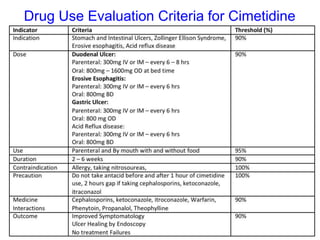
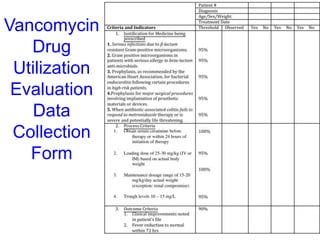
Drug Use Evaluation Criteria for Cimetidine
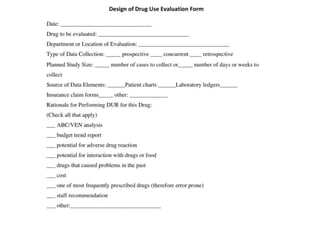
Vancomycin
Drug
Utilization
Evaluation
Data
Collection
Form
• Assignment
• Drug Use Evaluation Criteria & Data
Collection Form for Steroids -
Prednisolone

Drug utilization review or drug utilization evaluation

  • 1.
    Drug Use Evaluation(DUE) / Drug Use Review (DUR) DR. HAMID SAEED Assistant Professor of Clinical Pharmacy University College of Pharmacy University of the Punjab
  • 2.
    Acronyms Associated withthe evaluation of medication use Drug use review (DUR) • 1969 on prescription drugs • Retrospective evaluation to monitor medication use patterns (trends) ,quantitative Antibiotic use Review (AUR): • 1978 • Retrospective evaluation of antibiotic use • quantitative • Limited to identifying pattern of use
  • 3.
    Acronyms Associated withthe evaluation of medication use Drug use Evaluation (DUE) : – 1986 Multidisciplinary involvement – Expansion of AUR to all drugs – evaluation of prescribing and outcome only. Medication use evaluation (MUE): – 1992 – Expansion of DUE to include all medications – Evaluation expanded to include all aspects of medication use: Prescribing, dispensing, administration, monitoring etc.
  • 4.
    Definition • MUE isa performance improvement method that focuses on evaluating and improving medication – use processes with the goal of optimal patient outcomes • OR • Drug utilization review (DUR) is defined as an authorized, structured, ongoing review of prescribing, dispensing and use of medication Am J Hosp Pharm. 1996;53:1953-5
  • 5.
    • MUE maybe applied to a medication or therapeutic class, dis- ease state or condition, a medication-use process (prescribing, preparing and dispensing, administering, and monitoring), or specific outcomes. • Potential tool in the evaluation of health care system • With main objective to ascertain drug use in society • Casual observation, as well as more systematic study of prescribing practices, frequently reveals a pattern of diversity among prescribers in the treatment of even the most common conditions.
  • 6.
    • Specific Population •Elderly – incorrect use of medication and poly- pharmacy • Children – poor development of functions and most of the drugs are intended for adults. • Improved Outcomes • Potential hazards • Un-necessary finances • Thus, its is necessary to have a periodic review of the pattern of drug utilization to ensure safe and effective treatment.
  • 7.
    Purpose • The purposeof DUR is to ensure drugs are used appropriately, safely and • effectively to improve patient health status
  • 8.
    Why DUE isbecoming more important..? • The boost in the marketing of new drugs, • Wide variations in the pattern of drug prescribing and consumption • Growing concern about the delayed adverse effects, • Increasing concerns regarding the cost of drugs and • Volume of prescription • All contribute to the increasing importance of DUE
  • 9.
    Criteria • Predetermined criteriafor appropriate • drug therapy are compared against a patient’s or a population’s records. • Non-adherence to criteria results in drug therapy changes. • In addition, continual improvement in the appropriate, safe and effective use of drugs has the potential to lower the overall cost of care • DUR allows the pharmacist to document and evaluate the benefit of pharmacy intervention in improving therapeutic and economic outcomes while demonstrating the overall value of the pharmacist
  • 10.
    • prospective DURoften relies on computerized algorithms to perform key checks including drug interactions, duplications or contraindications with the patient’s disease state or condition
  • 11.
    Issues Requiring DUE •Poly-pharmacy is one problem; providers may use three, four, five, and sometimes more medicines to treat the most trivial conditions for the sake of satisfying a patient’s need to receive medicines (or the pharmaceutical seller’s need for profit). • Other reasons for poly-pharmacy include lack of diagnostic competence or confidence and an inadequate knowledge of treatment regimens. • Other common medicine use problems are choosing incorrect medicines, prescribing the incorrect dose, prescribing medicines that cause adverse drug reactions (ADRs) or medicine interactions, and using more expensive medicines when less expensive medicines would be equally or more effective.
  • 12.
    General Aim • Asystem of improving the quality of medicine use in hospitals and clinics, is an ongoing, systematic, criteria-based program of medicine evaluations that will help ensure that appropriate use of medicine. • A DUE can be structured so that it will assess the actual process of administering or dispensing a medicine (i.e., appropriate indications, dose, medicine interactions) or assess the outcomes (i.e., cured infections, decreased lipid levels.)
  • 13.
    Objectives • Promoting optimalmedication therapy. • Preventing medication-related problems. • Evaluating the effectiveness of medication therapy. • Improving patient safety. • Establishing interdisciplinary consensus on medication-use processes. • Stimulate improvements in medication-use processes. • Ensure standardization in medication-use processes. • Enhancing opportunities, through standardization, to assess the value of innovative medication-use practices from both patient- outcome and resource-utilization perspectives. • Minimizing procedural variations that contribute to suboptimal outcomes of medication use.
  • 14.
    • Identifying areasin which further information and education for health care professionals may be needed • Minimizing costs of medication therapy. These costs may be only partly related to the direct cost of medications themselves. • When medications are selected and managed optimally from the outset, the costs of complications and wasted resources are minimized, and overall costs are decreased. • Meeting or exceeding internal and external quality standards (e.g., professional practice standards, accreditation standards, or government laws and regulations) • Enhancing accountability in the medicine use process
  • 15.
    Scope of DrugUse Evaluation • Drug use evaluation (DUE) aims to understand how and why drugs are used so as to improve appropriate drug use and the health outcome (Sathvik, 2004). • DUE can be aimed to analyze the present and the developmental trends of drug usage at various levels of the health care system, whether national, local or institutional. • DUE may evaluate drug use at a population level, based on the demographic details (Gama, 2008). • These studies are used to calculate the reported adverse drug reactions, to monitor the utilization of various categories of drugs, to monitor the regulatory activities.
  • 16.
    • Drug utilizationdata may be used to produce crude estimates of disease prevalence, such as cardiovascular disease (Psaty et al., 2006), diabetes (Duarte-Ramos and Cabrita, 2006). • Drug utilization data may be also used to plan drug importation, production, and distribution, and to estimate drug expenditures. • They can document the extent of inappropriate prescribing of drugs activities (Gama, 2008). • DUE helps the healthcare system to understand, interpret and improve prescription, administration and use of medications (Sathvik, 2004). • DUS are particularly interesting if focused on the most frequently used and misused groups of therapeutic drugs, such as antibiotics, chemotherapeutic agents, or those that constitute important therapeutic innovations (Krivoy et al., 2007).
  • 17.
    Why Drug UtilizationResearch is Necessary..? • The aim is to facilitate the rational use of drugs in populations. • In individual patients, the rational drug use implies the prescription of a well-documented drug in an optimal dose on right indication at an affordable price. • It is important to realize that inappropriate use of drugs represent a potential hazard to the patients and an unnecessary expense (Hawkey et al., 1990). • It is difficult to understand the rational use of drug without the knowledge on how drugs are being prescribed.
  • 18.
    • DUE contributesto • rational drug use by describing the drug use pattern and interventions. • Helps in understanding how drugs are being used by making estimates of number of patients exposed to drugs, describing and estimating to what extent the drugs are used at certain area, whether overused or underused, • It compares the observed patterns of drug use with current recommendations or guidelines. • Feed back is provided to the prescribers based on the drug utilization data collected. • Drug utilization research enables to assess whether interventions undertaken improves the drug use by monitoring and evaluating patterns of drug use (Sjoqvist and Brikett, 2003).
  • 19.
    Types of DrugUse Information • Drug based information • Detailed information is usually required to answer clinically important questions which may involve aggregation of drug use at various levels, and information on indications, doses and dosage regimens. • Problem based information • The question must be addressed to know more about the problem that is being managed instead of knowing about the particular group of drugs used for any condition.
  • 20.
    • Patient information •Demographics and other information will be useful for the studies. • The age distribution has critical importance in some cases e.g., to know whether the drug is being used in an age group different from that in which clinical trials were performed. • The co-morbidities of the patient group may be important in determining treatment choice and adverse effects. • For example in the management of hypertension in asthma patients, beta blockers should be avoided. • Prescriber information • The differences in the drug prescribing often lack rational explanations. • This type of information helps to determine the prescribing behavior which is often helpful to understand how and why drugs are prescribed.
  • 21.
    Role of Pharmacistin DUE • Pharmacists, by virtue of their expertise and their mission of ensuring proper medication use, should exert leadership role and work collaboratively with other members of the health care team in the ongoing process of medication-use evaluation and improvement. • Responsibilities of pharmacists in the MUE process include;
  • 22.
    • Pharmacist’s Responsibilities •Developing an operational plan for MUE programs and processes that are consistent with the health system’s overall goals and resource capabilities. • Working collaboratively with prescribers and others to develop criteria for specific medications and to design effective medication-use processes. • Reviewing individual medication orders against medication-use criteria and consulting with prescribers and others in the process as needed.
  • 23.
    • Managing MUEprograms and processes. • Collecting, analyzing, and evaluating patient- specific data to identify, resolve, and prevent medication-related problems. • Interpreting and reporting MUE findings and recommend changes in medication-use processes. • Providing information and education based on MUE findings.
  • 24.
    A Step WiseApproach to DUE • 1. Establish Responsibility – Drug therapeutic committee (DTC) monitor DUEs in hospital and clinics – The DTC must establish procedures that will govern the committee in its activities concerning medicine use review and evaluation. – DTC must establish a plan, outlining which medicines will be a part of the DUE process. – This plan needs to be updated and evaluated each year.
  • 25.
    Develop Scope ofActivities • 2. The scope can be extensive or it can focus on a single aspect of pharmaceutical therapy. – Methods to identify medicine use problems include; ABC or vital, essential, nonessential (VEN) analysis, defined daily dose analysis, ADR reports, medication error reports, antibiotic sensitivity results, procurement studies, hospital and primary care clinic indicator studies, patient complaints or feedback, and staff feedback.
  • 26.
    • DTC mustconcentrate on the most important medicines, those with the highest potential for problems, to get the most return on the work involved. • These high priority areas would include • High-volume medicine use • Medicines with a low therapeutic index • Medicines with a high incidence of ADRs • Expensive medicines
  • 27.
    ABC analysis Most pharmacistsand managers know that only a few drug items account for the greatest drug expenditure. Often 70-80% of the budget is spent on 10-20% of the medicines. ABC analysis is the analysis of annual medicine consumption and cost in order to determine which items account for the greatest proportion of the budget. It can reveal: • High usage items for which there are lower-cost alternatives on the list or available in the market. This information can be used to: - choose more cost-effective alternative medicines - identify opportunities for therapeutic substitution - negotiate lower prices with suppliers.
  • 28.
    • A-items: 20%of all goods contribute to 70-80% of the annual consumption value of the items • B-items: 30% of all goods contribute to 15-25% of the annual consumption value of the items • C-items: 50% of all goods contribute only 5% of the annual consumption value of the items • In order to calculate the annual consumption value of any item or items: • Annual consumption value = annual demand x item cost per unit
  • 29.
    • Measure thedegree to which actual drug consumption reflects public health needs and so identify irrational drug use, through comparing drug consumption to morbidity patterns. • Identify purchases for items not on the hospital essential medicines list i.e. the use of non-formulary medicines.
  • 30.
    ABC Analysis example- Calculations and Ranking PRODUCT DESCRIPTION Basic unit Unit price US$ Total units Value (US$) % Total value Rank by value Cumulati ve Cate gory Benzylpenicillin 1MU inj amp 0.5276 144,000.00 75,974.40 25.66% 1 25.7% A Chloroxylenol 5% solution ml 0.0034 10,728,00.0 36,475.20 12.32% 2 38.0% A Ampicillin 125mg/5ml powder for susp, 100ml bot 0.5119 43,970.00 22,508.24 7.60% 4 55.8% A Erythromycin 250mg tab tab 0.0350 262,000.00 9,170.00 3.10% 7 68.4% B Cotrimoxazole 400mg/80mg tab tab 0.0098 860,000.00 8,428.00 2.85% n 71.3% B
  • 31.
    VEN analysis isa well-known method to help set up priorities for purchasing medicines and keeping stock. Drugs are divided, according to their health impact, into vital, essential and non-essential categories. VEN analysis allows medicines of differing efficacy and usefulness to be compared, unlike ABC and therapeutic category analyses, where only drugs of similar efficacy or action can be compared. • vital drugs (V): potentially life-saving or crucial to providing basic health services • essential drugs (E): effective against less severe but significant forms of disease, but not absolutely vital to providing basic health care • non-essential drugs (N): used for minor or self-limited illnesses; these may or may not be formulary items and efficacious, but they are the least important items stocked.
  • 32.
    VITAL ESSENTIAL NON-ESSENTIAL (1)Potentially life- saving (2) Significant withdrawal side- effects (3) Major public health importance Effective against less severe but significant forms of illness (1) Used for minor or self limited illnesses (2) Questionable efficacy (3) High cost for marginal therapeutic advantage SUMMARY OF STEPS OF VEN ANALYSIS Each DTC member should classify all the medicines as V, E, or N The results of each member’s classification should be compiled and an overall classification agreed in the DTC
  • 33.
    The DTC shouldthen: identify and limit therapeutic duplication examine all the N items and where possible decrease the quantities purchased or eliminate them reconsider proposed purchase quantities, buying V and E items before N items and ensuring that safety stocks are higher for V and E items monitor drug ordering and stock levels for V and E items more closely than for N items.
  • 34.
    Characteristics of thedrug and target condition Vital Essential Non- essential Occurrence of target condition % of population affected >5% 1-5% <1% Average number of patients treated per day in an average facility >5 1-5 <1 Severity of target condition Life-threatening Yes Occasionally Rarely Disabling Yes Occasionally Rarely Guidelines
  • 35.
    Characteristics of thedrug and target condition Vital Essential Non- essential Therapeutic effect of drug Prevents serious disease Yes No No Cures serious disease Yes Yes No Treats minor, self-limited symptoms and conditions No Possibly Yes Has proven efficacy Always Usually Maybe Does not have proven efficacy Never Rarely Maybe
  • 36.
    Define Daily Dose(DDD) • The analysis of medicine consumption in terms of unit quantities can help to identify over- and under-use of individual medications or therapeutic groups. • The defined daily dose (DDD) methodology converts and standardizes readily available product quantity data, such as packages, tablets, injection vials, bottles, into crude estimates of clinical exposure to medicines, such as the number of daily doses. • The DDD is the assumed average daily maintenance dose for the medication’s main indication.
  • 37.
    • It isdefined globally for each medicine by the WHO Collaborating Centre for Drug Statistics in Oslo, Norway, (http://www.whocc.no; see annex 6.1 for addresses and the DDDs for some medicines). • The DDD is based on the average maintenance dose for adults, but it can be adjusted for paediatric medicine use. Converting aggregate quantities available from pharmacy inventory records or sales statistics into DDDs roughly indicates how many potential treatment days of a medicine have been procured, distributed or consumed. The medicines can then be compared, using units such as: • no. of DDD per 1000 inhabitants per day, for total drug consumption • no. of DDD per 100 beds per day (100 bed-days), for hospital use
  • 38.
    • if thecalculations for amoxicillin show that there were 4 DDDs per 1000 inhabitants per day, this suggests that on any given day, for every 1000 persons, 4 adults received a daily dose of 1 g of amoxicillin. • If calculations of gentamicin use are expressed as 2 DDD per 100 bed- days, this tells us that, for every 100 beds in the hospital, every day 2 patients received 240 mg of gentamicin. • The assigned DDD for amoxicillin is 1 g and for gentamicin is 240 mg. • These interpretations assume that the prescribed daily dose (the quantity actually prescribed to a patient) is the same as the defined daily dose, although this may not, in fact, be the case.
  • 39.
    Important Points • •DDDs provide a unit of measurement that is independent of price and formulation, making it possible to assess trends in consumption of medicines and to perform comparisons between population groups and health-care systems. • • DDDs have not been established for topical medicines, vaccines, general/local anesthetics, contrast media and allergen extracts. • • The DDD method should only be used in settings where reliable procurement, inventory or sales data have been recorded.
  • 40.
    How to Calculate StepsExample 1 Find out the total amount of medicines used or procured in one year in terms of the number of units (tablets, capsules, injections) and the strength (mg, g (gm), IU) Yearly amounts of methyldopa used by a provincial hospital and surrounding clinics, covering a population of 2 million: 25 000 tablets of methyldopa 250 mg, and3 000 tablets of methyldopa 500 mg 2 Calculate the total quantity consumed in one year in terms of mg/g/I.U. by multiplying the number of units (tabs, caps, inj.) by the strength of dose Total yearly consumption of methyldopa = (25 000 x 250 mg) + (3000 x 500 mg) = 7 750 000 mg (7750 g) 3 Divide the total quantity by the assigned DDD for that medicine Methyldopa assigned DDD = 1 g Thus, no. of DDDs of methyldopa consumed = 7750 g/1 g = 7750 DDD 4 Divide the total quantity by the number of patients(if known) or by the population (as shown) Annual consumption of methyldopa = 7750 DDD per 2 000 000 inhabitants per year = 3.875 DDD per 1000 inhabitants per year
  • 42.
    Important Categories • Medicinesthat are critically important categories; cardiovascular, emergency, toxicology, oncology, intravenous medicines, and narcotic analgesics • Antimicrobial medicines, both prophylactic and therapeutic Injections • Medicines undergoing evaluation for addition to the formulary • Medicines used for off-label indications • Medicines used for high-risk patients
  • 43.
    Establish Criteria, Defineand Establish Threshold • Establishing criteria is the single most important procedure in a DUE. • Criteria for the use of any medicine should be established by the DTC using relevant evidence-based literature sources and recognized international and local experts. • The criteria for any DUE should reflect what is in the country’s STGs (assuming that they have been developed correctly) and any medicine-use protocols that exist.
  • 44.
    • Credibility ofthe DUE relies on criteria that are based on evidence-based medicine. Criteria must be developed with and accepted by the medical staff for the process to be credible • After developing criteria, the DTC must establish a threshold or standard (benchmark) against which the criteria will be judged. • A threshold refers to the percentage of charts or records that will meet or exceed the established criteria for the medicine.
  • 45.
    • Ideally, thisthreshold will be 100 percent, but realistically, a smaller percentage will be more appropriate to account for exceptions to routine medicine prescribing. • Therefore, a threshold of 90 to 95 percent is typically used for many criteria, but each instance must be carefully analyzed before reaching a conclusion.
  • 46.
    • A comprehensivelist of indicators for appropriate medicine use includes the following components • Process indicators • o Indications—specific uses for the medicine in question • o Dose—specific doses for any approved indication for appropriate duration • o Quantity dispensed—correct number of doses administered
  • 47.
    • o Preparation—stepsinvolved with preparing a medication for administration • o Monitoring—laboratory test necessary and intervals of testing during the use of the medicine • Contraindications—known contraindications o Drug interactions—significant medicine interactions, including medicine-medicine, • medicine-food, and medicine-laboratory • o Administration—specific steps necessary to administer a medicine, especially for injectables
  • 48.
    • o Patienteducation—instructions and education that a patient should receive with the medicine • • Outcome indicators—specific outcomes to be realized from medicine use • Lowered blood pressure, stabilized blood glucose, and fewer migraine and asthma • attacks • Decreased visits to the emergency room, decreased hospitalizations
  • 49.
    • Improved patientquality of life (obtained from questionnaires) • • Pharmacy administration indicators • Correct cost to patient • Accurate billing records • Accurate dispensing records • Appropriate use of generic medicines or therapeutic equivalents • Appropriate use of formulary medicines • Appropriate quantity dispensed
  • 50.
    Collect Data andOrganize Results • DUEs can be accomplished as prospective evaluations, or they can be performed retrospectively. • A prospective analysis involves the collection of data as the medicine is being prepared or dispensed to the patient. • Retrospective analysis is done using chart reviews or other data sources to review medicine use according to indicators and criteria prepared in advance. • The advantage of a prospective review is that the pharmacist (or other reviewer) can intervene at the time the medicine is dispensed to prevent errors in, for example, dosage, indications, or interactions.
  • 51.
    • Retrospective evaluation,which may involve more of the reviewer’s time or require access to medical records, is best accomplished when the reviewer has time away from the patient care areas and distractions.
  • 52.
    DUE Categories • ProspectiveDUE • Prospective review involves evaluating a patient's planned drug therapy before a medication is dispensed. • In this process the pharmacist can identify and resolve problems before the patient receives the medication. Pharmacists routinely perform prospective reviews by assessing a prescription medication's dosage and its directions and
  • 53.
    • reviewing patientinformation for possible drug interactions or duplicate therapy (APhA, 1995). • A prospective study watches for outcomes, such as the development of a disease, during the study period and relates this to other factors such as suspected risk or protection factor(s). • Prospective DUE commonly addresses • drug-disease contraindications, • therapeutic interchange, • generic substitution, • incorrect drug dosage, • inappropriate duration of drug treatment, • drug-allergy interactions and clinical abuse/misuse.
  • 54.
    • All effortsshould be made to avoid sources of bias such as the loss of individuals to follow up during the study. • Prospective studies usually have fewer potential sources of bias and confounding than retrospective studies
  • 55.
    • Concurrent DUE •Concurrent review is performed during the course of treatment and involves the ongoing monitoring of drug therapy to ensure positive patient outcomes. • It presents pharmacists with the opportunity to alert prescribers to potential problems and to intervene in areas such as drug- drug interactions, duplicate therapy, and excessive or insufficient dosing.
  • 56.
    • This typeof review allows therapy to be altered for a patient if necessary (APhA, 1995). • Concurrent DUE commonly addresses drug- drug interactions, excessive doses, high or low dosages, duplicate therapy, drug-disease interactions, over and under utilization, drug- age precautions, drug-gender precautions, and drug-pregnancy precautions.
  • 57.
    • Retrospective DUE •A retrospective DUE is the simplest to perform since drug therapy is reviewed after the patient has received the medication. • A retrospective review may detect patterns in prescribing, dispensing, or administering drugs to prevent recurrence of inappropriate use or abuse and serves as a means for developing prospective standards and target interventions.
  • 58.
    • In retrospectiveDUE, patient medical charts or computerized records are screened to determine whether the drug therapy met approved criteria and aids prescribers in improving care for their patients, individually and within groups of patients, such as those with diabetes, asthma, or high blood pressure (APhA, 1995).
  • 59.
    • Retrospective DUEcommonly addresses the issues such as • Therapeutic appropriateness, • Over and under utilization, • Appropriate generic use, • Therapeutic duplication, • Drug-disease contraindications, • Drug-drug interactions, • Incorrect drug dosage, • Inappropriate duration of treatment, • Clinical abuse/misuse.
  • 60.
    Analyze Data • Dataare collected, tabulated, and analyzed to see if criteria and thresholds are met. The following important steps should be completed when analyzing data— • Tabulate results for each indicator • Analyze results to see if the criteria are met and the thresholds are not exceeded • Determine why thresholds are not met • Analyze data quarterly or more frequently • If a threshold is not met, it may indicate a medicine use problem that requires the attention of the DTC.
  • 61.
    Develop Recommendations and Actionplan • After completing the data analysis, information is presented to the DTC and a decision is made as to the appropriateness of the information in the DUE. • The DTC also must decide on whether to continue, discontinue, or expand the functions of the DUE in question. • All medicines that do not meet the thresholds must be evaluated carefully and plans must be made to improve the use of the medicine relative to the criteria.
  • 62.
    • Recommendations shouldbe prepared for the DTC to address the following— – Inappropriate medicine use – Unacceptable patient outcomes – Methods to resolve any medicine use problem
  • 63.
    • Interventions toimprove medicine use might include— – Education, including letters to practitioners, in- service education, workshops, newsletters, and face-to-face discussions – Implementation of medicine order forms – Prescribing restrictions – Formulary manual changes – Change (or better enforcement) of the STGs
  • 64.
    Conduct DUE FollowUp • Follow-up in every DUE is critical to ensure resolution of any unresolved medicine use problems. • If the problems are not resolved, then the DUE will have little usefulness to the health care system. • As a part of a follow-up plan, the DTC must assess the need to continue, modify, or stop the DUE activity depending on the results of each specific medicine review.
  • 65.
    • All programswithin the DTC should be evaluated yearly. • This complete evaluation is necessary to look comprehensively at the entire program and analyze its merits and its utility in improving medicine use. • Programs that do not have a significant impact on medicine use should be redesigned so that they can provide measurable improvements. • Without improvements in medicine use and patient outcomes, the time spent on DUE will be of no value.
  • 66.
    When DUEs goWrong • Lack of authority and organization—The DUE must have a clear organizational structure defined including, for example, • what person develops criteria, • collects data, • and reports results. • Clinicians must be involved in the development.
  • 67.
    • Poor problemprioritization—Poor prioritization may lead to work on medicine use problems that may be insignificant and make meaningful results difficult to obtain. • Poor documentation—All activities should be documented with a report in the DTC minutes, and this report should be distributed to the medical staff as necessary; documentation should clearly discuss results and recommendations of each DUE.
  • 68.
    • Inadequate follow-up—Thisproblem is one of the most frequent to occur with DUE; follow- up and resolution of every problem must be accomplished with every DUE. • Overly intrusive data collection and evaluation—This process can consume many individuals’ time and must be kept to a minimum to accomplish the task of the DUE; DUEs in general must not take a significant amount of time away from patient care.
  • 70.
    Drug Use EvaluationCriteria for Cimetidine
  • 71.
  • 72.
    • Assignment • DrugUse Evaluation Criteria & Data Collection Form for Steroids - Prednisolone