Mrs.DRISYA.V.R.
2nd Year MSc Nursing
PREMENSTRUAL SYNDROME
(PMS)
• Premenstrual syndrome (PMS) is a psychoneuro endocrine
disorder of unknown aetiology, often noticed just prior to
menstruation.
• There is cyclic appearance of a large number of symptoms
during the last 7-10 days of the menstrual cycle.
It should fulfill the following criteria (ACOG):
• Not related to any organic lesion.
• Regularly occurs during the luteal phase of each
ovulatory menstrual cycle.
• Symptoms must be severe enough to disturb the life
style of the woman or she requires medical help.
• Symptom-free period during rest of the cycle.
• When these symptoms disrupt daily functioning they
are grouped under the name premenstrual dysphoric
disorder (PMDD).
Pathophysiology
The exact cause is not known but the following
hypotheses are postulated:
1. Alteration in the level of oestrogen and
progesterone starting from the midluteal phase.
Either there is altered oestrogen: progesterone
ratio or diminished progesterone level.
2. Neuroendocrine factors :
Serotonin
Endorphins
γ-aminobutyric acid (GABA)
3.Psychological and psychosocial factors may be involved to
produce behavioural changes.
4.Others
These are thyrotrophin releasing hormone (TRH) prolactin,
renin, aldosterone, prostaglandins and others.
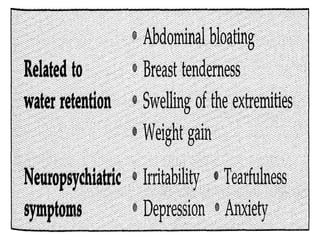
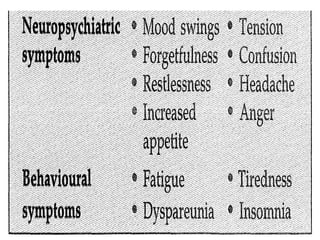
Clinical features :
• PMS is more common in women aged 30-45.
• It may be related to childbirth or a disturbing
life event.
TREATMENT
• Life style modification and congnitive behaviour therapy are
important steps.
• General
1.Nonpharmacological:
• (a) Assurance, Yoga, Stress management, Diet manipulation,
• (b) Avoidance of salt, caffeine and alcohol specially in second
half of cycle improves the symptoms.
2.Nonhormonal:
• a. Tranquilizers or antidepressant drugs, may be of
help logically.
• b. Pyridoxine -100 mg twice daily
• c. Diuretics in the second half of the cycle -
Frusemide 20 mg daily for consecutive 5 days
• d. Anxiolytic agents - Alprazolam (0.25 mg, Bd)
• e. Spironolactone — It is given in the luteal phase
(25-200 mg/day). It improves the symptoms of
PMDD.
f. Selective Serotonin Reuptake Inhibitors
(SSRI) and Noradrenaline Reuptake Inhibitors
(SNRI) are found to be very effective.
• Fluoxetine -A single oral dose of 20 mg was
• Other drugs used are : Sertraline (50 mg/day)
and Venlafaxine.
• 3.Hormones :
a.Oral contraceptive pills
• The idea is to suppress ovulation and to maintain an uniform
hormonal milieu.
• The therapy is to be continued for 3-6 cycles.
• b. Progesterone
Levonorgestrel intrauterine system (IUS)
• d. Bromocriptine — 2.5 mg daily or twice
daily
• 4.Suppression of ovarian cycle — Suppression of the
endogenous ovarian cycle can be achieved by :
a. Danazol 200 mg daily is to be adjusted so as to produce
amenorrhoea.
Barrier method of contraception should be advised during the
treatment.
b. GnRH analogues
• Goserelin (Zoladex): 3.6 mg is given subcutaneously at
every 4 weeks.
• Leuprorelin acetate (Prostap): 3.75 mg is given by SC or
IM at every 4 weeks.
• Triptorelin (Decapeptyl): 3 mg is given IM every four
weeks.
5.Oophorectomy
MENOPAUSE
• It is the permanent cessation of menstruation
at the end of reproductive life due to loss of
ovarian follicular activity.
• The clinical diagnosis is confirmed following
stoppage of menstruation for 12 consecutive
months without any other pathology.
• Pre menopause
• Post menopause
• Peri menopause / climacteric
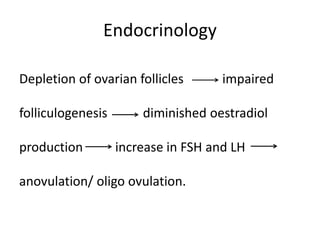
Endocrinology
Depletion of ovarian follicles impaired
folliculogenesis diminished oestradiol
production increase in FSH and LH
anovulation/ oligo ovulation.
• Oestrogens – oestrone and oestradiol
• Androgen – androstenedione and
testosterone
• Progesterone
• Gonadotrophins
Organ changes
• Ovaries – shrink in size,become wrinkled and
white. Abundance of stromal cells.
• Fallopian tubes –atrophy.cilia disappear, plicae
less prominent, muscle coat becomes thinner
• Uterus – smaller, endometrium thin, scanty
cervical secretions
• Vagina – narrow, thin vaginal epithelium,
flattened rugae, alkaline pH.
• Vulva – atrophy, flattened labia, scantier pubic
hair, narrow introitus.
• Breast- fat is reabsorbed, atrophic glands,
decrease in size of nipples, becomes flat and
pendulous
• Bladder and urethra – changes same as
vagina, thin epithelium, more prone to
damage and infection, dysuria, frequency,
stress incontinence
• Loss of muscle tone – pelvic relaxation,
uterine descent
• Bone metabolism- osteoporosis
• Cardiovascular – high risk for CVD
Menopausal symptoms
• Vasomotor symptoms
o Hot flush
o Palpitation
o Fatigue
o Weakness
o Disturbed sleep
• Genital and urinary system
o Dyspareunia
o Frequency
o Urgency
o Stress incontinence
• Vagina
o Dyspareunia
o Vaginal infections
o Dryness
o Pruritis
o Leucorrhoea
o UTI
• Sexual dysfunction
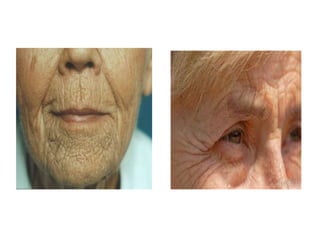
• Skin and hair
o Thinning, loss of elasticity and wrinkling of
skin
o Purse string wrinkling around mouth
o Crow feet wrinkling around eyes
• Psychological changes
o Anxiety
o Headache
o Insomnia
o Irritability
o Dysphagia
o Depression, dementia, mood swings
• Osteoporosis and fracture
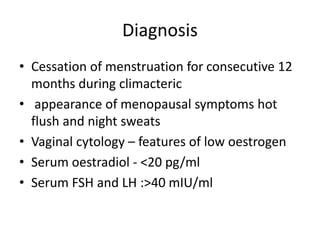
Diagnosis
• Cessation of menstruation for consecutive 12
months during climacteric
• appearance of menopausal symptoms hot
flush and night sweats
• Vaginal cytology – features of low oestrogen
• Serum oestradiol - <20 pg/ml
• Serum FSH and LH :>40 mIU/ml
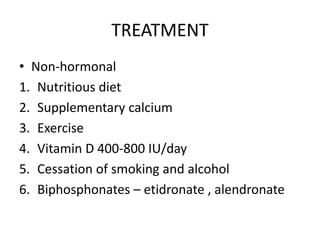
TREATMENT
• Non-hormonal
1. Nutritious diet
2. Supplementary calcium
3. Exercise
4. Vitamin D 400-800 IU/day
5. Cessation of smoking and alcohol
6. Biphosphonates – etidronate , alendronate
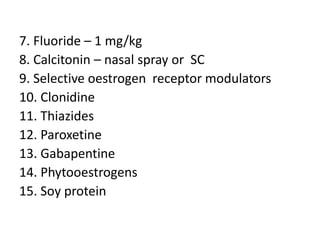
7. Fluoride – 1 mg/kg
8. Calcitonin – nasal spray or SC
9. Selective oestrogen receptor modulators
10. Clonidine
11. Thiazides
12. Paroxetine
13. Gabapentine
14. Phytooestrogens
15. Soy protein
HRT
• Indications
 Relief of menopausal symptoms
Prevention of osteoporosis
To maintain the quality of life in menopausal
years
• Benefits
Improvement of vasomotor symptoms
Improvement in urogenital atrophy
Increase in bone mineral density
Decreased risk in vertebral and hip fractures
Reduction in colorectal cancer
Possibly cardio protection
• Risks
Endometrial cancer
Breast cancer
Venous thromboembolic disease
CHD
Lipid metabolism
Dementia, alzheimers
Contra indications
 Undiagnosed genital tract bleeding
 Oestrogen dependent neoplasm in the body
 History of venous thromboembolism
 Active liver disease
 Gall bladder disease
Preparations used
• Oestrogens – conjugated oeastogen (0.625 –
1.25 mg/day), micronised oestardiol( 1 – 2
mg/day)
• Progestins – medroxyprogesterone acetate (2.5
-5 mg/day), micronised progesterone (100 –
300 mg/day), dydrogesterone ( 5 – 10 mg/day)
• Oral oestrogen regime – conjugated equine
oestrogen 0.3 mg or 0.625 mg daily
• Oestrogen and cyclic progestin - with intact
uterus, oestrogen contineusly for 25 days and
progestin is added for last 12 – 14 days
• Continuous oestrogen and progestin therapy
o Subdermal implants
o Percutaneous oestrogen gel
o Transdermal patch
o Vaginal cream
o Progestins
o Tibolone
• Monitor
a. Physical examination including pelvic
examination
b. BP
c. Breast examination and mammography
d. Cervical cytology
e. Pelvic USG
Pms