ABNORMAL
UTERINE
BLEEDING
Audi Adibah
Nashriq Aiman
Nurul Hidayu
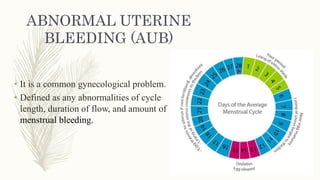
• It is a common gynecological problem.
• Defined as any abnormalities of cycle
length, duration of flow, and amount of
menstrual bleeding.
ABNORMAL UTERINE
BLEEDING (AUB)
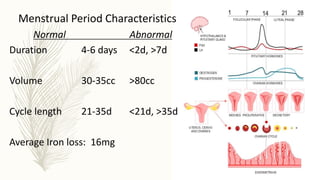
Menstrual Period Characteristics
Normal Abnormal
Duration 4-6 days <2d, >7d
Volume 30-35cc >80cc
Cycle length 21-35d <21d, >35d
Average Iron loss: 16mg
4
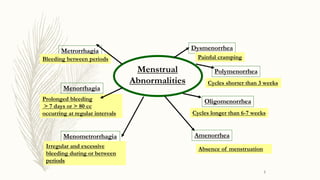
Menstrual
Abnormalities
Amenorrhea
Dysmenorrhea
Menorrhagia
Oligomenorrhea
Menometrorrhagia
Metrorrhagia
Absence of menstruation
Painful cramping
Prolonged bleeding
> 7 days or > 80 cc
occurring at regular intervals Cycles longer than 6-7 weeks
Irregular and excessive
bleeding during or between
periods
Bleeding between periods
Polymenorrhea
Cycles shorter than 3 weeks
Causes of abnormal uterine bleeding according to age group
Age group Causes
Pre-puberty Precocious puberty ( hypothalamic, pituitary, or ovarian origin)
Adolescence Anovulatory cycles , coagulation disorders
Reproductive age - Complications of pregnancy ( abortion, ectopic pregnancy, trophoblastic
diseases)
- Organic lesions ( leiomyomas, adenomyosis, polyps, endometrial hyperplasia ,
carcinomas)
-Dysfunctional uterine bleeding
-Anovulatory cycles
-Ovarian dysfunctional bleeding (i.e. inadequate luteal phase)
Perimenopausal -Dysfunctional uterine bleeding
-Anovulatory cycles
- organic lesions( hyperplasia, polyps, carcinoma)
Postmenopausal -Endometrial atrophy
-Organic lesions ( carcinoma, hyperplasia, polyps)
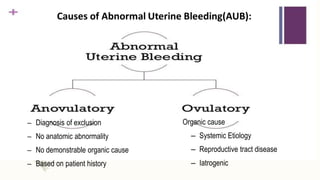
Organic cause
– Systemic Etiology
– Reproductive tract disease
– Iatrogenic
– Diagnosis of exclusion
– No anatomic abnormality
– No demonstrable organic cause
– Based on patient history
Associated with ovulatory cycles
• Organic cause
– Systemic Etiology : - Coagulation defect
- Leukemia
- ITP
-- Reproductive tract disease : -Gestational events
(Abortions, Ectopic pregnancies & Trophoblastic
disease)
- Malignancies
(Endometrial, Ovarian, Cervical & Vaginal)
- Benign
(Atrophy, Leiomyoma, Polyps, Cervical lesions,
Foreign body)
– Iatrogenic : -Intra-uterine device
-Oral and injectable steroids
-Psychotropic drugs
Associated with Anovulatory cycles
– The most frequent cause of dysfunctional bleeding is anovulation
(failure to ovulate)
– Anovulatory cycles result from subtle hormonal imbalances and are
most common at menarche and in the perimenopausal period.
Less commonly, anovulation is the result of:
– Endocrine disorders, such as thyroid disease, adrenal disease, or pituitary
tumors
– Ovarian lesions, such as a functioning ovarian tumor (granulosa cell
tumors) or polycystic ovaries
– Generalized metabolic disturbances, such as obesity, malnutrition, or
other chronic systemic diseases
Dysfunctional Uterine Bleeding
(DUB)
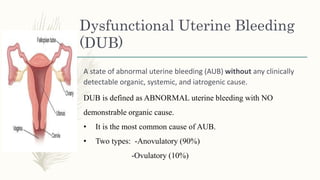
A state of abnormal uterine bleeding (AUB) without any clinically
detectable organic, systemic, and iatrogenic cause.
DUB is defined as ABNORMAL uterine bleeding with NO
demonstrable organic cause.
• It is the most common cause of AUB.
• Two types: -Anovulatory (90%)
-Ovulatory (10%)
Anovulatory DUB (90%)
• Most women with DUB do not ovulate
• In these women, there is continuous estrogen production
without corpus luteum formation and progesterone production.
• This gives rise to continuously proliferating endometrium
which may outgrow its blood supply or lose nutrients with
varying degrees of necrosis.
Cause: Hypothalamic – Pituitary – Ovarian hormonal axis imbalance
Ovulatory DUB (10%)
• Progesterone secretion is prolonged because
estrogen levels are low.
• This causes irregular shedding of the uterine lining
and break-through bleeding.
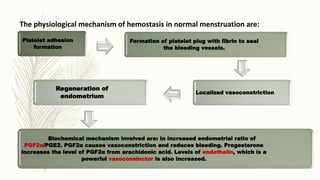
The physiological mechanism of hemostasis in normal menstruation are:
Platelet adhesion
formation
Formation of platelet plug with fibrin to seal
the bleeding vessels.
Localized vasoconstriction
Regeneration of
endometrium
Biochemical mechanism involved are: In increased endometrial ratio of
PGF2α/PGE2. PGF2α causes vasoconstriction and reduces bleeding. Progesterone
increases the level of PGF2α from arachidonic acid. Levels of endothelin, which is a
powerful vasoconsinctor is also increased.
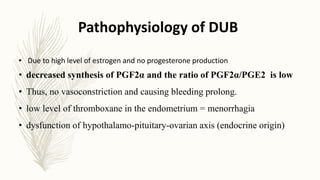
Pathophysiology of DUB
• Due to high level of estrogen and no progesterone production
• decreased synthesis of PGF2α and the ratio of PGF2α/PGE2 is low
• Thus, no vasoconstriction and causing bleeding prolong.
• low level of thromboxane in the endometrium = menorrhagia
• dysfunction of hypothalamo-pituitary-ovarian axis (endocrine origin)
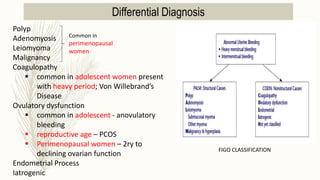
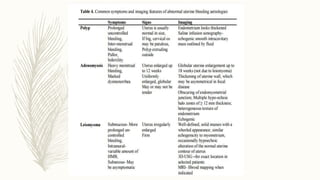
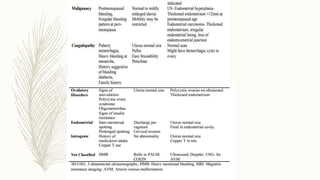
Polyp
Adenomyosis
Leiomyoma
Malignancy
Coagulopathy
 common in adolescent women present
with heavy period; Von Willebrand’s
Disease
Ovulatory dysfunction
 common in adolescent - anovulatory
bleeding
 reproductive age – PCOS
 Perimenopausal women – 2ry to
declining ovarian function
Endometrial Process
Iatrogenic
Common in
perimenopausal
women
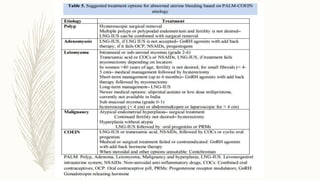
FIGO CLASSIFICATION
Differential Diagnosis
MANAGEMENT
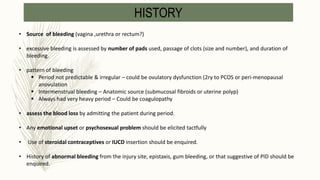
• Source of bleeding (vagina ,urethra or rectum?)
• excessive bleeding is assessed by number of pads used, passage of clots (size and number), and duration of
bleeding.
• pattern of bleeding
 Period not predictable & irregular – could be ovulatory dysfunction (2ry to PCOS or peri-menopausal
anovulation
 Intermenstrual bleeding – Anatomic source (submucosal fibroids or uterine polyp)
 Always had very heavy period – Could be coagulopathy
• assess the blood loss by admitting the patient during period.
• Any emotional upset or psychosexual problem should be elicited tactfully
• Use of steroidal contraceptives or IUCD insertion should be enquired.
• History of abnormal bleeding from the injury site, epistaxis, gum bleeding, or that suggestive of PID should be
enquired.
HISTORY
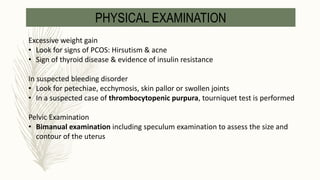
Excessive weight gain
• Look for signs of PCOS: Hirsutism & acne
• Sign of thyroid disease & evidence of insulin resistance
In suspected bleeding disorder
• Look for petechiae, ecchymosis, skin pallor or swollen joints
• In a suspected case of thrombocytopenic purpura, tourniquet test is performed
Pelvic Examination
• Bimanual examination including speculum examination to assess the size and
contour of the uterus
PHYSICAL EXAMINATION
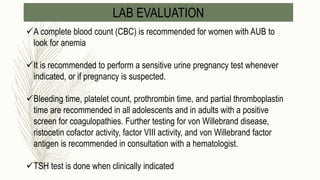
LAB EVALUATION
A complete blood count (CBC) is recommended for women with AUB to
look for anemia
It is recommended to perform a sensitive urine pregnancy test whenever
indicated, or if pregnancy is suspected.
Bleeding time, platelet count, prothrombin time, and partial thromboplastin
time are recommended in all adolescents and in adults with a positive
screen for coagulopathies. Further testing for von Willebrand disease,
ristocetin cofactor activity, factor VIII activity, and von Willebrand factor
antigen is recommended in consultation with a hematologist.
TSH test is done when clinically indicated
LAB EVALUATION
Imaging Recommendations on imaging
 Ultrasonography is mandatory in AUB to evaluate uterus, adnexa and
endometrial thickness
 Doppler ultrasonography: In suspected arteriovenous malformation,
malignancy cases and to differentiate between fibroid and adenomyomas
 Hysteroscopy: For diagnosis and characterization of intrauterine
abnormalities
 MRI: To differentiate between fibroids and adenomyomas and for mapping
exact location of fibroids while planning conservative surgery and prior to
therapeutic embolization for fibroids
 Endometrial Biopsy – to rule out endometrial hyperplasia or endometrial
cancer
 Suggested for women > 40 years old who have the risk factors such as
obesity & diabetes.
HOW TO
TREAT ?
I. General
II. Medical
III.Surgical intervention
Rest is advised during bleeding phase. Assurance and sympathetic
handling are helpful particularly in adolescents. Anemia should be
corrected energetically by diet, hematinics, and even by blood
transfusion.
General
Medical
• Hormones: With the introduction of potent orally active progestins, they became
the mainstay in the management of DUB in all age groups and practically replaced
the isolated use of estrogens and androgens.
• Progestins: The common preparations used are norethisterone acetate and
medroxyprogesterone acetate
• Progestins have an antiestrogenic action
• The preparations are used:
• Cyclic therapy
• Continuous therapy
• To stop bleeding and regulate the cycle : Norethisterone preparations (5 mg
tab) are used thrice daily till bleeding stops, which it usually does by 3–7 days.
• In ovular bleeding: Any low dose combined oral pills are
effective when given from 5th to 25th day of cycle for 3
consecutive cycles. It causes endometrial atrophy
• It suppress the hypothalamo-pituitary axis
• Normal menstruation is expected to resume with restoration of
normally functioning pituitary–ovarian-endometrial axis
• It serves as a contraceptive as well.
Cyclic Therapy
• In ovular bleeding, where the patient wants pregnancy or in cases of irregular shedding or
irregular ripening of the endometrium, dydrogesterone (oral progestogen) 1 tab (10 mg) daily or
twice a day from 15th to 25th day may cure the state.
• This regimen is less effective than 5th to 25th day course. However, it does not suppress
ovulation.
• In anovular bleeding: Cyclic progestogen preparation of medroxyprogesterone
acetate (MPA) 10 mg or norethisterone 5 mg is used from 5th to 25th day of cycle for
3 cycles.
Cyclic Therapy
Continuous Therapy (progesterone)
• Progestins also inhibit pituitary gonadotropin secretion and
ovarian hormone production. Medroxyprogesterone acetate 10
mg thrice daily is given and treatment is usually continued for
at least 90 days.
Intrauterine progestogen: Levonorgestrel intrauterine
system (LNG-IUS)
• Induce endometrial glandular atrophy, stromal decidualization and endometrial
cell inactivation. It is effective for 5 years.
• It has minimal systemic absorption. Reduction of blood loss is up to 97
percent. In addition to its many other health benefits it is an effective
contraceptive measure.
• LNGIUS is recommended as a first line therapy for a woman with HMB in the
absence of any structural or histological abnormality.
Other drugs
• Mifepristone
• Anti-fibrinolytic agents – eg. tranexamic acid
• GnRH agonists
• Desmopressin – use for clotting disorder
• NSAIDS – Mefenamic Acid
SURGICAL MANAGEMENT OF DUB
• Uterine curettage
• Hysterectomy
• Endometrial Ablation (however
endometrial hyperplasia must be rule
out first by endometrial biopsy
Uterine Curettage
• It is done predominantly as a diagnostic tool for elderly women but at
times, it has got hemostatic and therapeutic effect by removing the
necrosed and unhealthy endometrium.
• It should be done following ultrasonography for detection of
endometrial pathology.
• The indication is an urgent one, if the bleeding is acyclic and where
endometrial pathology is suspected. Ideally hysteroscopy and directed
biopsy should be considered both for the purpose of diagnosis and
therapy.
Hysterectomy
• Hysterectomy is justified when the conservative treatment fails or contraindicated and
the blood loss impairs the health and quality of life.
• Presence of endometrial hyperplasia and atypia on endometrial histology is an
indication for hysterectomy.
• The decision can be made easily as the patient is approaching 40.
• Hysterectomy may be done depending on the route by vaginal, abdominal, or
laparoscopic assisted vaginal method.
• In this regard, the factors to consider are: uterine size, mobility, descent, previous
surgery, and presence of comorbidities (obesity, diabetes, heart disease, or
hypertension).
• Healthy ovaries may be preserved at the time of hysterectomy especially those under
45 years of age.
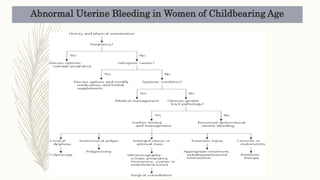
Abnormal Uterine Bleeding in Women of Childbearing Age
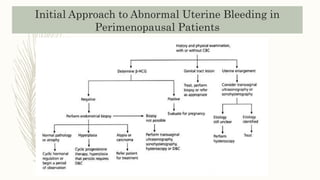
Initial Approach to Abnormal Uterine Bleeding in
Perimenopausal Patients
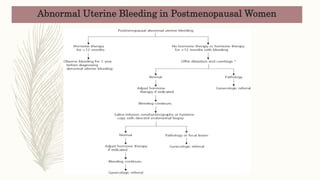
Abnormal Uterine Bleeding in Postmenopausal Women
Thank You
REFERENCE
1. American College of Obstetricians and Gynaecologists
(ACOG)
2. Ten Teachers 19th Edition
3. Federation of Obstetric and Gynaecological Societies of
India (FOGSI)

24-170429054807 (1).pdf

  • 1.
  • 2.
    • It isa common gynecological problem. • Defined as any abnormalities of cycle length, duration of flow, and amount of menstrual bleeding. ABNORMAL UTERINE BLEEDING (AUB)
  • 3.
    Menstrual Period Characteristics NormalAbnormal Duration 4-6 days <2d, >7d Volume 30-35cc >80cc Cycle length 21-35d <21d, >35d Average Iron loss: 16mg
  • 4.
    4 Menstrual Abnormalities Amenorrhea Dysmenorrhea Menorrhagia Oligomenorrhea Menometrorrhagia Metrorrhagia Absence of menstruation Painfulcramping Prolonged bleeding > 7 days or > 80 cc occurring at regular intervals Cycles longer than 6-7 weeks Irregular and excessive bleeding during or between periods Bleeding between periods Polymenorrhea Cycles shorter than 3 weeks
  • 5.
    Causes of abnormaluterine bleeding according to age group Age group Causes Pre-puberty Precocious puberty ( hypothalamic, pituitary, or ovarian origin) Adolescence Anovulatory cycles , coagulation disorders Reproductive age - Complications of pregnancy ( abortion, ectopic pregnancy, trophoblastic diseases) - Organic lesions ( leiomyomas, adenomyosis, polyps, endometrial hyperplasia , carcinomas) -Dysfunctional uterine bleeding -Anovulatory cycles -Ovarian dysfunctional bleeding (i.e. inadequate luteal phase) Perimenopausal -Dysfunctional uterine bleeding -Anovulatory cycles - organic lesions( hyperplasia, polyps, carcinoma) Postmenopausal -Endometrial atrophy -Organic lesions ( carcinoma, hyperplasia, polyps)
  • 6.
    Organic cause – SystemicEtiology – Reproductive tract disease – Iatrogenic – Diagnosis of exclusion – No anatomic abnormality – No demonstrable organic cause – Based on patient history
  • 7.
    Associated with ovulatorycycles • Organic cause – Systemic Etiology : - Coagulation defect - Leukemia - ITP -- Reproductive tract disease : -Gestational events (Abortions, Ectopic pregnancies & Trophoblastic disease) - Malignancies (Endometrial, Ovarian, Cervical & Vaginal) - Benign (Atrophy, Leiomyoma, Polyps, Cervical lesions, Foreign body) – Iatrogenic : -Intra-uterine device -Oral and injectable steroids -Psychotropic drugs
  • 8.
    Associated with Anovulatorycycles – The most frequent cause of dysfunctional bleeding is anovulation (failure to ovulate) – Anovulatory cycles result from subtle hormonal imbalances and are most common at menarche and in the perimenopausal period. Less commonly, anovulation is the result of: – Endocrine disorders, such as thyroid disease, adrenal disease, or pituitary tumors – Ovarian lesions, such as a functioning ovarian tumor (granulosa cell tumors) or polycystic ovaries – Generalized metabolic disturbances, such as obesity, malnutrition, or other chronic systemic diseases
  • 9.
    Dysfunctional Uterine Bleeding (DUB) Astate of abnormal uterine bleeding (AUB) without any clinically detectable organic, systemic, and iatrogenic cause. DUB is defined as ABNORMAL uterine bleeding with NO demonstrable organic cause. • It is the most common cause of AUB. • Two types: -Anovulatory (90%) -Ovulatory (10%)
  • 10.
    Anovulatory DUB (90%) •Most women with DUB do not ovulate • In these women, there is continuous estrogen production without corpus luteum formation and progesterone production. • This gives rise to continuously proliferating endometrium which may outgrow its blood supply or lose nutrients with varying degrees of necrosis. Cause: Hypothalamic – Pituitary – Ovarian hormonal axis imbalance
  • 11.
    Ovulatory DUB (10%) •Progesterone secretion is prolonged because estrogen levels are low. • This causes irregular shedding of the uterine lining and break-through bleeding.
  • 12.
    The physiological mechanismof hemostasis in normal menstruation are: Platelet adhesion formation Formation of platelet plug with fibrin to seal the bleeding vessels. Localized vasoconstriction Regeneration of endometrium Biochemical mechanism involved are: In increased endometrial ratio of PGF2α/PGE2. PGF2α causes vasoconstriction and reduces bleeding. Progesterone increases the level of PGF2α from arachidonic acid. Levels of endothelin, which is a powerful vasoconsinctor is also increased.
  • 13.
    Pathophysiology of DUB •Due to high level of estrogen and no progesterone production • decreased synthesis of PGF2α and the ratio of PGF2α/PGE2 is low • Thus, no vasoconstriction and causing bleeding prolong. • low level of thromboxane in the endometrium = menorrhagia • dysfunction of hypothalamo-pituitary-ovarian axis (endocrine origin)
  • 14.
    Polyp Adenomyosis Leiomyoma Malignancy Coagulopathy  common inadolescent women present with heavy period; Von Willebrand’s Disease Ovulatory dysfunction  common in adolescent - anovulatory bleeding  reproductive age – PCOS  Perimenopausal women – 2ry to declining ovarian function Endometrial Process Iatrogenic Common in perimenopausal women FIGO CLASSIFICATION Differential Diagnosis
  • 15.
  • 16.
    • Source ofbleeding (vagina ,urethra or rectum?) • excessive bleeding is assessed by number of pads used, passage of clots (size and number), and duration of bleeding. • pattern of bleeding  Period not predictable & irregular – could be ovulatory dysfunction (2ry to PCOS or peri-menopausal anovulation  Intermenstrual bleeding – Anatomic source (submucosal fibroids or uterine polyp)  Always had very heavy period – Could be coagulopathy • assess the blood loss by admitting the patient during period. • Any emotional upset or psychosexual problem should be elicited tactfully • Use of steroidal contraceptives or IUCD insertion should be enquired. • History of abnormal bleeding from the injury site, epistaxis, gum bleeding, or that suggestive of PID should be enquired. HISTORY
  • 19.
    Excessive weight gain •Look for signs of PCOS: Hirsutism & acne • Sign of thyroid disease & evidence of insulin resistance In suspected bleeding disorder • Look for petechiae, ecchymosis, skin pallor or swollen joints • In a suspected case of thrombocytopenic purpura, tourniquet test is performed Pelvic Examination • Bimanual examination including speculum examination to assess the size and contour of the uterus PHYSICAL EXAMINATION
  • 20.
    LAB EVALUATION A completeblood count (CBC) is recommended for women with AUB to look for anemia It is recommended to perform a sensitive urine pregnancy test whenever indicated, or if pregnancy is suspected. Bleeding time, platelet count, prothrombin time, and partial thromboplastin time are recommended in all adolescents and in adults with a positive screen for coagulopathies. Further testing for von Willebrand disease, ristocetin cofactor activity, factor VIII activity, and von Willebrand factor antigen is recommended in consultation with a hematologist. TSH test is done when clinically indicated
  • 21.
    LAB EVALUATION Imaging Recommendationson imaging  Ultrasonography is mandatory in AUB to evaluate uterus, adnexa and endometrial thickness  Doppler ultrasonography: In suspected arteriovenous malformation, malignancy cases and to differentiate between fibroid and adenomyomas  Hysteroscopy: For diagnosis and characterization of intrauterine abnormalities  MRI: To differentiate between fibroids and adenomyomas and for mapping exact location of fibroids while planning conservative surgery and prior to therapeutic embolization for fibroids  Endometrial Biopsy – to rule out endometrial hyperplasia or endometrial cancer  Suggested for women > 40 years old who have the risk factors such as obesity & diabetes.
  • 22.
    HOW TO TREAT ? I.General II. Medical III.Surgical intervention
  • 23.
    Rest is advisedduring bleeding phase. Assurance and sympathetic handling are helpful particularly in adolescents. Anemia should be corrected energetically by diet, hematinics, and even by blood transfusion. General
  • 24.
    Medical • Hormones: Withthe introduction of potent orally active progestins, they became the mainstay in the management of DUB in all age groups and practically replaced the isolated use of estrogens and androgens. • Progestins: The common preparations used are norethisterone acetate and medroxyprogesterone acetate • Progestins have an antiestrogenic action • The preparations are used: • Cyclic therapy • Continuous therapy • To stop bleeding and regulate the cycle : Norethisterone preparations (5 mg tab) are used thrice daily till bleeding stops, which it usually does by 3–7 days.
  • 25.
    • In ovularbleeding: Any low dose combined oral pills are effective when given from 5th to 25th day of cycle for 3 consecutive cycles. It causes endometrial atrophy • It suppress the hypothalamo-pituitary axis • Normal menstruation is expected to resume with restoration of normally functioning pituitary–ovarian-endometrial axis • It serves as a contraceptive as well. Cyclic Therapy
  • 26.
    • In ovularbleeding, where the patient wants pregnancy or in cases of irregular shedding or irregular ripening of the endometrium, dydrogesterone (oral progestogen) 1 tab (10 mg) daily or twice a day from 15th to 25th day may cure the state. • This regimen is less effective than 5th to 25th day course. However, it does not suppress ovulation. • In anovular bleeding: Cyclic progestogen preparation of medroxyprogesterone acetate (MPA) 10 mg or norethisterone 5 mg is used from 5th to 25th day of cycle for 3 cycles. Cyclic Therapy
  • 27.
    Continuous Therapy (progesterone) •Progestins also inhibit pituitary gonadotropin secretion and ovarian hormone production. Medroxyprogesterone acetate 10 mg thrice daily is given and treatment is usually continued for at least 90 days.
  • 28.
    Intrauterine progestogen: Levonorgestrelintrauterine system (LNG-IUS) • Induce endometrial glandular atrophy, stromal decidualization and endometrial cell inactivation. It is effective for 5 years. • It has minimal systemic absorption. Reduction of blood loss is up to 97 percent. In addition to its many other health benefits it is an effective contraceptive measure. • LNGIUS is recommended as a first line therapy for a woman with HMB in the absence of any structural or histological abnormality.
  • 29.
    Other drugs • Mifepristone •Anti-fibrinolytic agents – eg. tranexamic acid • GnRH agonists • Desmopressin – use for clotting disorder • NSAIDS – Mefenamic Acid
  • 30.
    SURGICAL MANAGEMENT OFDUB • Uterine curettage • Hysterectomy • Endometrial Ablation (however endometrial hyperplasia must be rule out first by endometrial biopsy
  • 31.
    Uterine Curettage • Itis done predominantly as a diagnostic tool for elderly women but at times, it has got hemostatic and therapeutic effect by removing the necrosed and unhealthy endometrium. • It should be done following ultrasonography for detection of endometrial pathology. • The indication is an urgent one, if the bleeding is acyclic and where endometrial pathology is suspected. Ideally hysteroscopy and directed biopsy should be considered both for the purpose of diagnosis and therapy.
  • 32.
    Hysterectomy • Hysterectomy isjustified when the conservative treatment fails or contraindicated and the blood loss impairs the health and quality of life. • Presence of endometrial hyperplasia and atypia on endometrial histology is an indication for hysterectomy. • The decision can be made easily as the patient is approaching 40. • Hysterectomy may be done depending on the route by vaginal, abdominal, or laparoscopic assisted vaginal method. • In this regard, the factors to consider are: uterine size, mobility, descent, previous surgery, and presence of comorbidities (obesity, diabetes, heart disease, or hypertension). • Healthy ovaries may be preserved at the time of hysterectomy especially those under 45 years of age.
  • 34.
    Abnormal Uterine Bleedingin Women of Childbearing Age
  • 35.
    Initial Approach toAbnormal Uterine Bleeding in Perimenopausal Patients
  • 36.
    Abnormal Uterine Bleedingin Postmenopausal Women
  • 37.
    Thank You REFERENCE 1. AmericanCollege of Obstetricians and Gynaecologists (ACOG) 2. Ten Teachers 19th Edition 3. Federation of Obstetric and Gynaecological Societies of India (FOGSI)