T E J A S P A N D I R K A R 1 5 2 0 1 0 0 2 0
V A I B H A V S A T H E 1 5 2 0 1 0 0 3 0
F A T E M A P A N V E L W A L A 1 5 2 0 1 1 0 3 1
K A R I S H M A D A S G A O N K A R 1 5 2 0 1 1 0 3 5
Steganography
What is Steganography?
 Steganography comes from the Greek words:
STEGANOS – covered and GRAPHIA– writing.
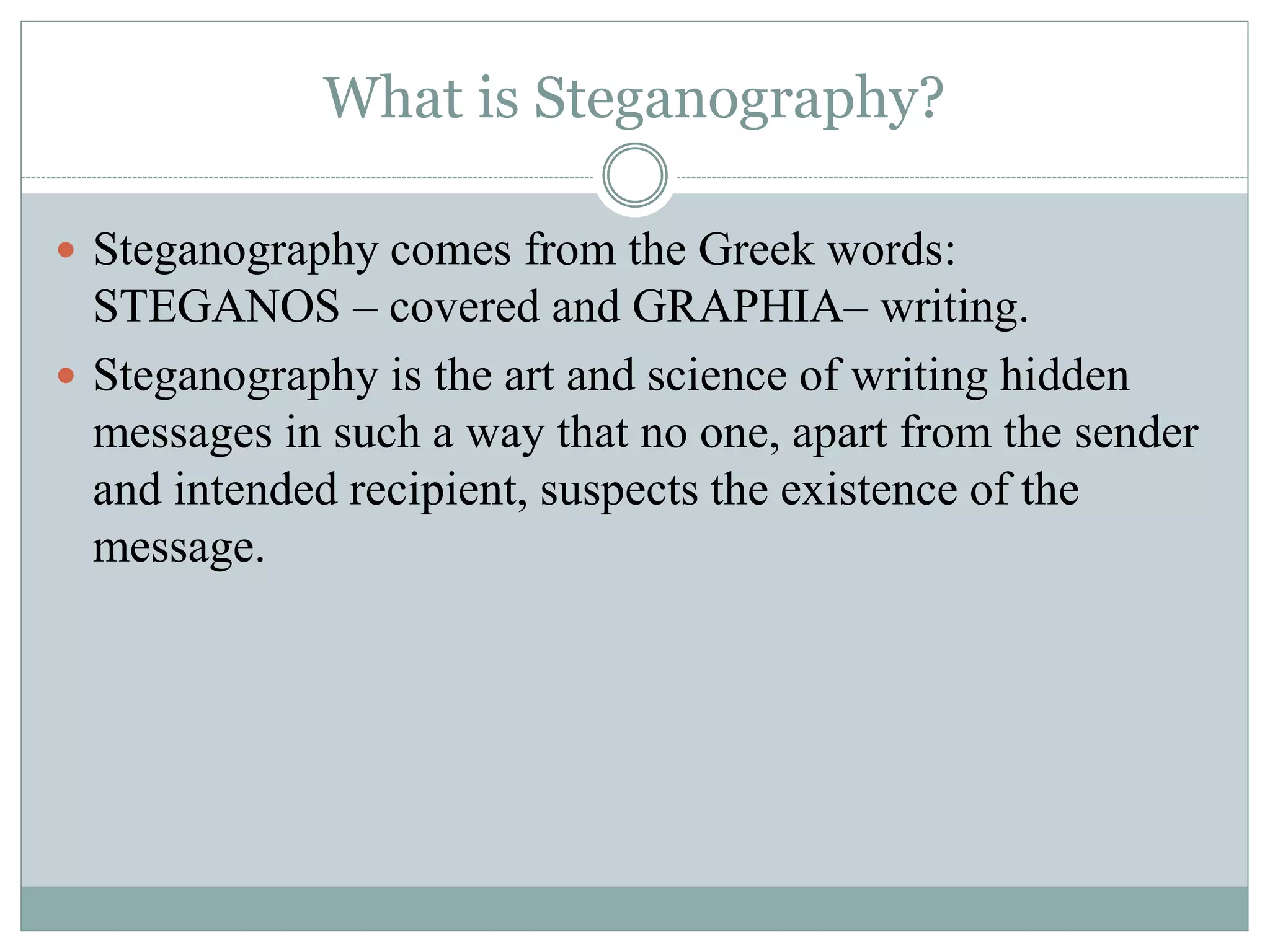
 Steganography is the art and science of writing hidden
messages in such a way that no one, apart from the sender
and intended recipient, suspects the existence of the
message.
 The point of steganography is:
If attacker knows there is a message, even if
encrypted, he will try to decrypt it. However, if there is
no visible message, then the message is safe!
Example:
Since everyone can read, encoding text
in neutral sentences is doubtfully effective
Since Everyone Can Read, Encoding Text
In Neutral Sentences Is Doubtfully Effective
‘Secret inside’
History of Steganography
 The first recorded uses of steganography can be traced back to 440 BC
when Herotodus mentions two examples of steganography in
his Histories.
 Wax tablets were in common use then as reusable writing surfaces,
sometimes used for shorthand.
 Ancient example is that of histories, who shaved the head of his most
trusted slave and tattooed a message on it. After his hair had grown the
message was hidden. The purpose was to instigate a revolt against the
Persians.
 Special “inks” were important stenographic tools even during Second
World War.
History of Steganography
 Ancient Chinese wrote messages on fine silk, which was then crunched
into a tiny ball and covered in wax. The messenger then swallowed the
ball of wax.
 During Second World War a technique was developed to shrink
photographically a page of text into a dot less than one millimeter in
diameter, and then hide this microdot in an apparently innocuous letter.
(The first microdot has been spotted by FBI in 1941.)
 In October 2001, the New York Times published an article claiming
that al-Qaeda had used steganography to encode messages into images,
and then transported these via e-mail and possibly via USENET to
prepare and execute the September 11, 2001 terrorist attack.
Physical Techniques
 Hidden messages within wax tablets
 Hidden messages on messenger's body
 Hidden messages on paper written in secret inks
 Messages written in Morse code on knitting yarn and
then knitted into a piece of clothing worn by a courier
 Messages written on envelopes in the area covered
by postage stamps.
Digital Techniques
 Concealing messages within the lowest bits
of noisy images or sound files.
 Pictures embedded in video material (optionally played
at slower or faster speed).
 Modifying the echo of a sound file (Echo
Steganography)
 Including data in ignored sections of a file, such as after
the logical end of the carrier file.
Steganography V/S Cryptography
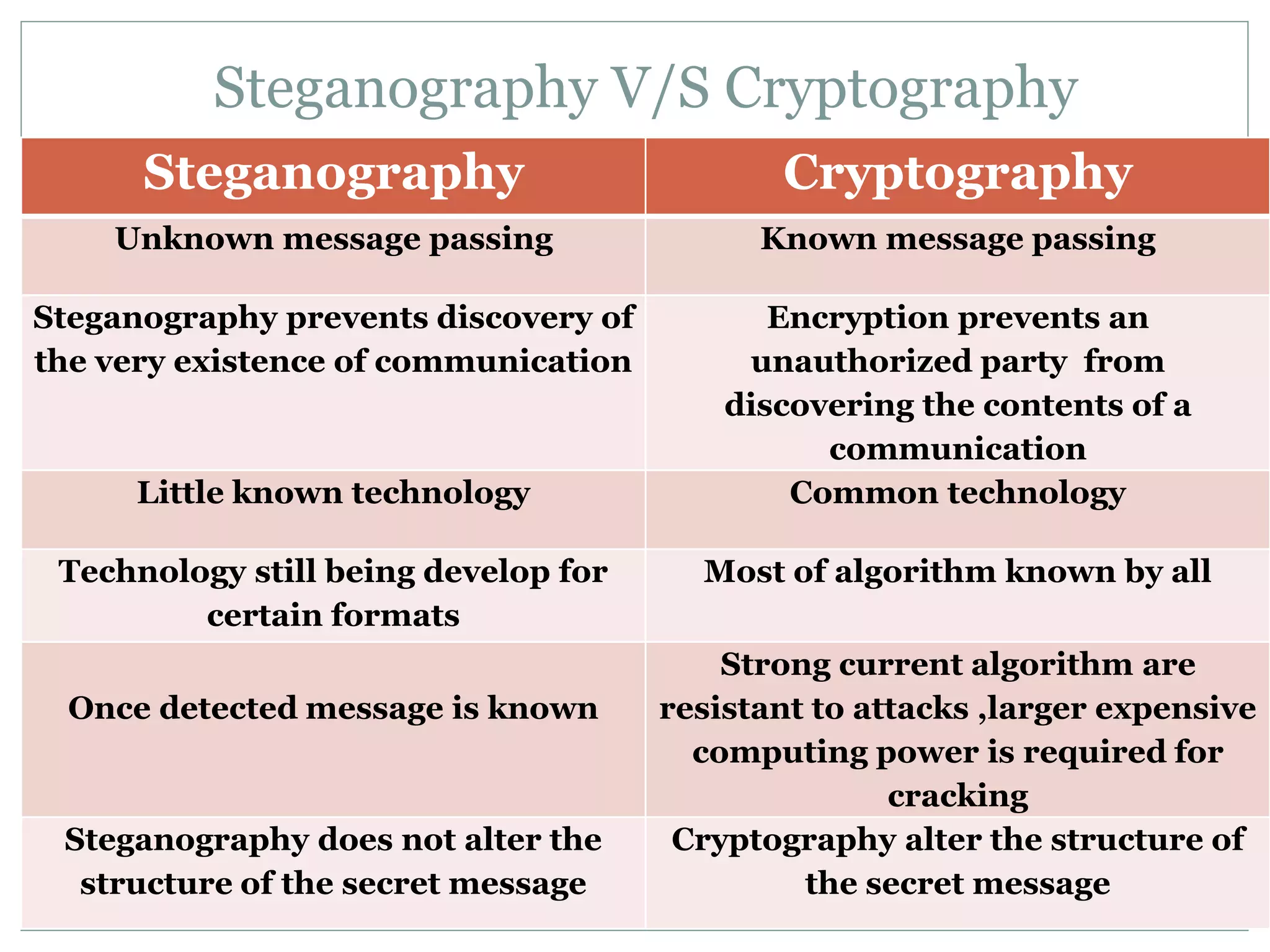
Steganography Cryptography
Unknown message passing Known message passing
Steganography prevents discovery of
the very existence of communication
Encryption prevents an
unauthorized party from
discovering the contents of a
communication
Little known technology Common technology
Technology still being develop for
certain formats
Most of algorithm known by all
Once detected message is known
Strong current algorithm are
resistant to attacks ,larger expensive
computing power is required for
cracking
Steganography does not alter the
structure of the secret message
Cryptography alter the structure of
the secret message
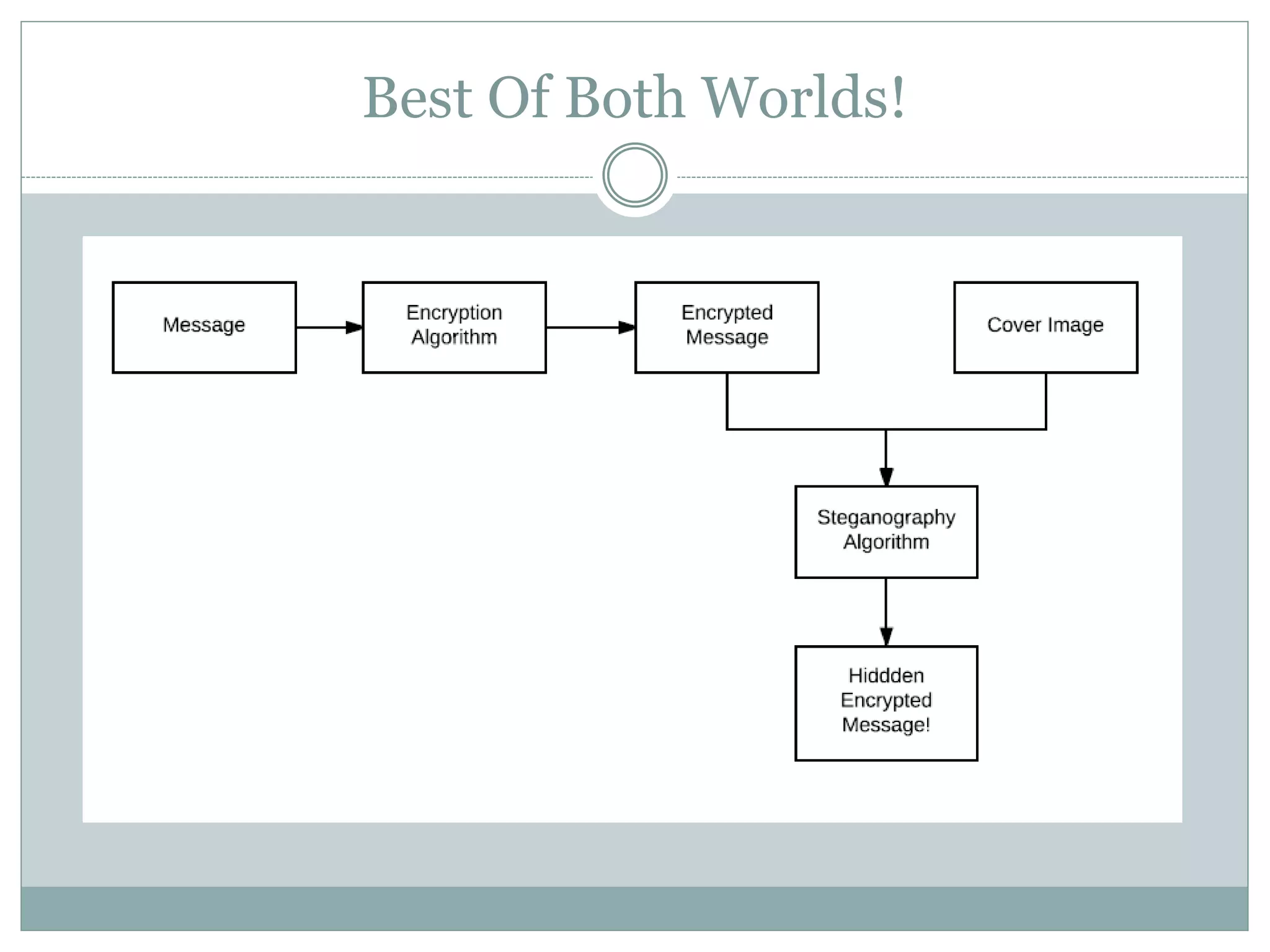
Best Of Both Worlds!
Terms related to Steganography
 Carrier or Cover File - A Original message or a file in which
hidden information will be stored inside of it .
 Stego-Medium - The medium in which the information is
hidden.
 Embedded or Payload - The information which is to be
hidden or concealed.
 Steganalysis - The process of detecting hidden information
inside a file.
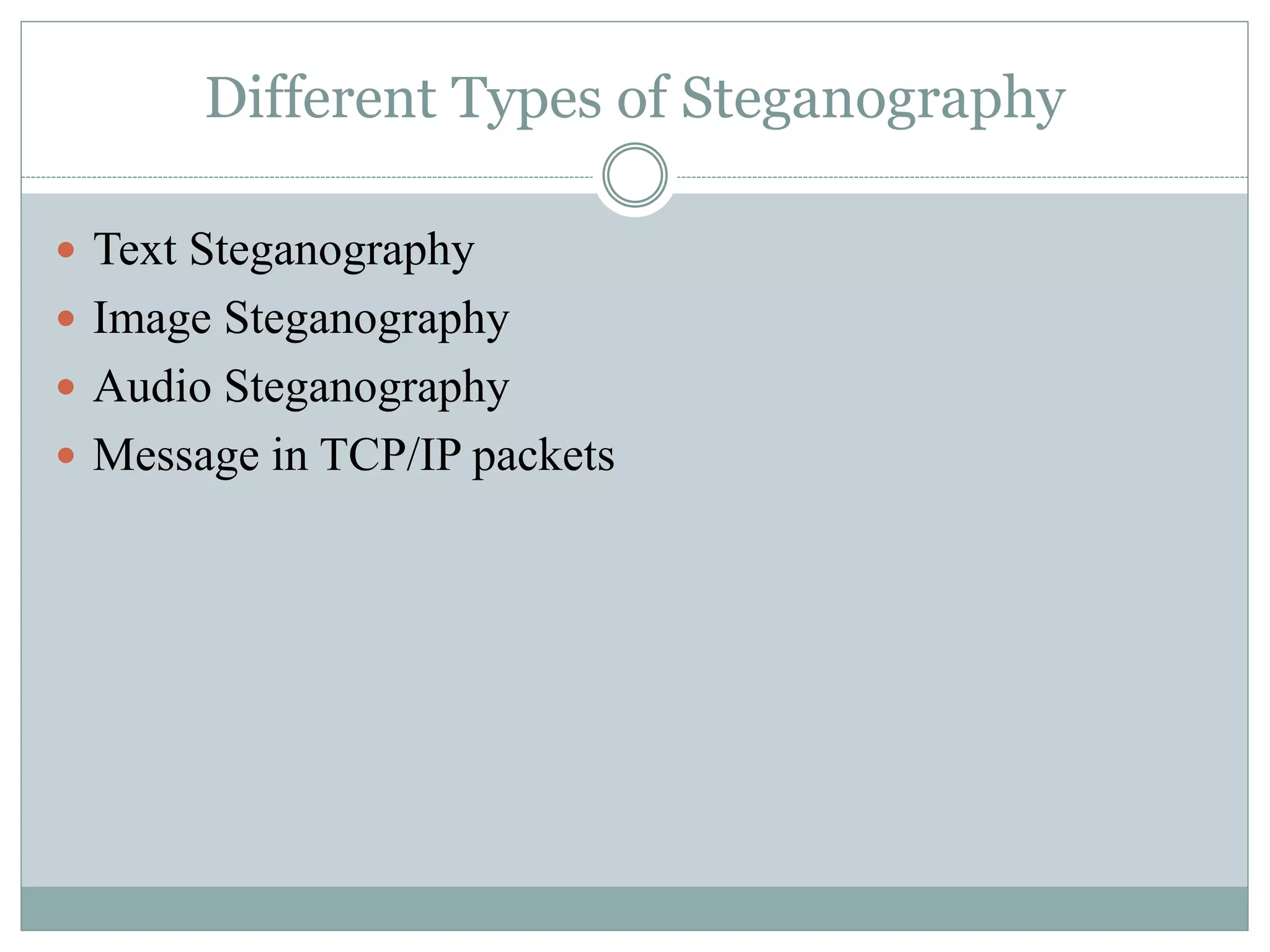
Different Types of Steganography
 Text Steganography
 Image Steganography
 Audio Steganography
 Message in TCP/IP packets
Text Steganography
 Text steganography can be applied in the digital makeup
format such as PDF, digital watermark or information
hiding
 It is more difficult to realize the information hiding based
on text. The simplest method of information hiding is to
select the cover first, adopt given rules to add the
phraseological or spelling mistakes, or replace with
synonymy words.
Example:
 An example of a message containing cipher text by
German Spy in World War II:
“Apparently neutral's protest is thoroughly discounted
And ignored. Isman hard hit. Blockade issue affects
.Pretext for embargo on by products, ejecting suets and
Vegetable oils. ”
 Taking the second letter in each word the following
message emerges:
Pershing sails from NY June 1.
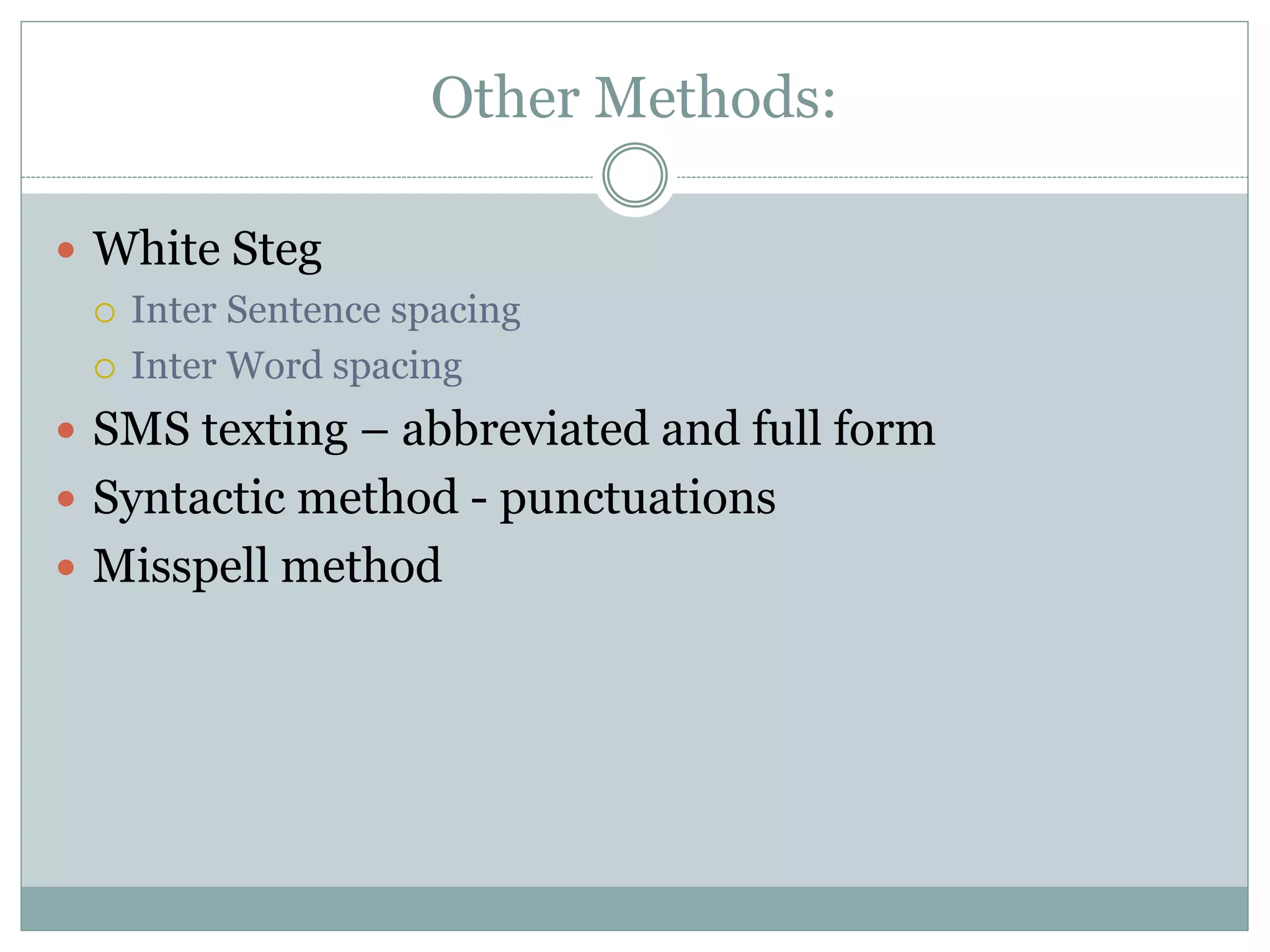
Other Methods:
 White Steg
 Inter Sentence spacing
 Inter Word spacing
 SMS texting – abbreviated and full form
 Syntactic method - punctuations
 Misspell method
Image Steganography
Least Significant Bit Method
 Least significant bit (LSB) insertion is a common, simple
approach to embedding information in a cover image
 The least significant bit (in other words, the 8th bit) of some or
all of the bytes inside an image is changed to a bit of the secret
message
 When using a 24-bit image, a bit of each of the red, green and
blue color components can be used, since they are each
represented by a byte. In other words, one can store 3 bits in each
pixel. An 800 × 600 pixel image, can thus store a total amount of
1,440,000 bits or 180,000 bytes of embedded data
 In its simplest form, LSB makes use of BMP images, since they
use lossless compression
Example
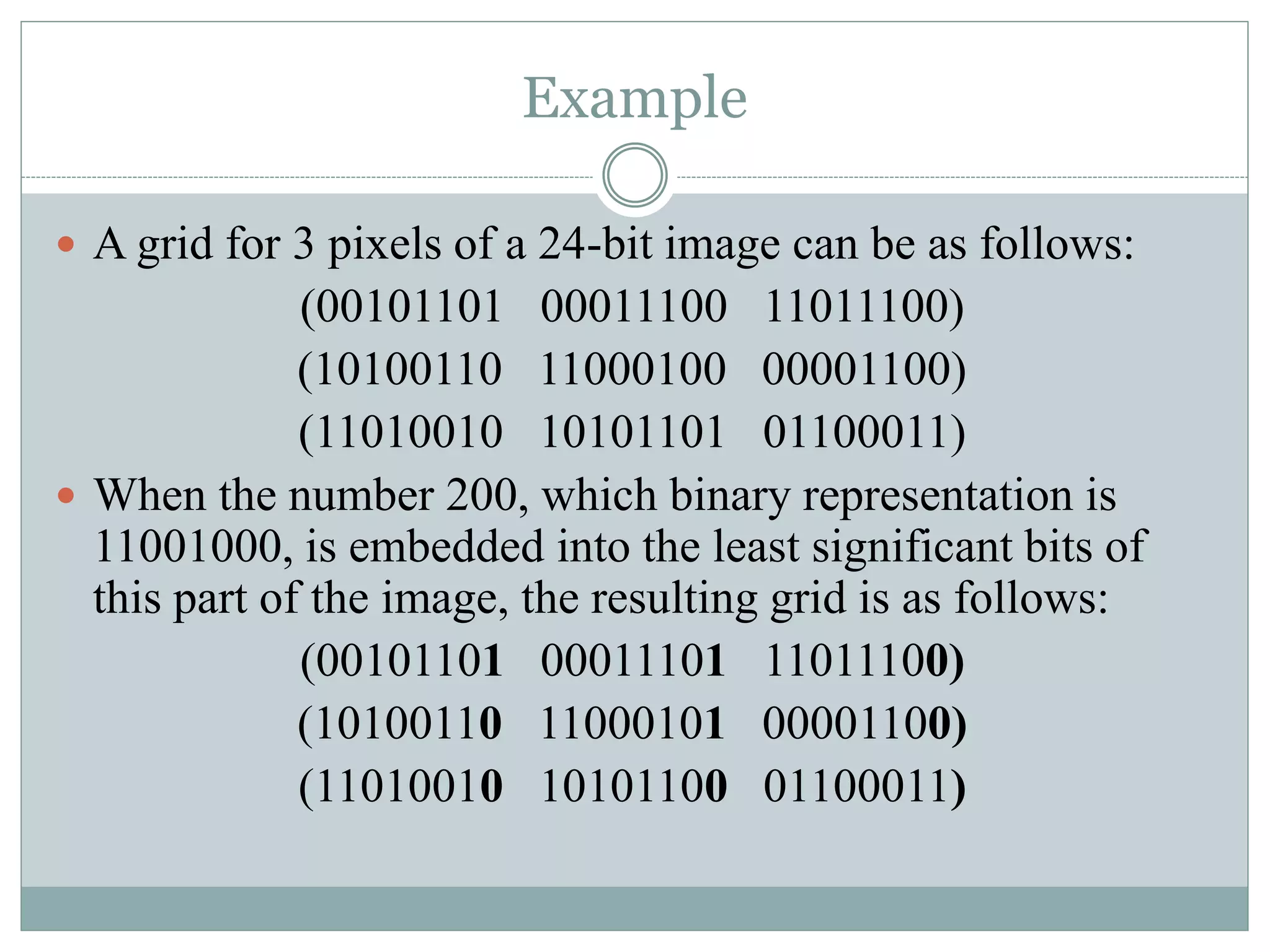
 A grid for 3 pixels of a 24-bit image can be as follows:
(00101101 00011100 11011100)
(10100110 11000100 00001100)
(11010010 10101101 01100011)
 When the number 200, which binary representation is
11001000, is embedded into the least significant bits of
this part of the image, the resulting grid is as follows:
(00101101 00011101 11011100)
(10100110 11000101 00001100)
(11010010 10101100 01100011)
 Original Image Modified Image
 The difference is invisible to naked eye!
Pixel Indicator
Applications
 Storing passwords and/or other confidential information
 Covert communication of sensitive data
 Speculated uses in terrorist activities
 Being widely used to hide and/or transfer illegal content
SPS – Static Parsing Steganography
 The sender and the receiver agree on a cover image.
 The protocol does not modify the cover image.
 Rather determines the bits of the secret message that
match the ones in the cover image and stores their
different locations (i.e. in the cover image) in a vector.
 Then it is sent to the recipient.
Example
Masking & Filtering
 Masks secret data over the original data by changing the
luminance of particular areas
 During masking, it embed the message within significant
bits of the cover image
 Not susceptible to lossy techniques because image
manipulation does not affect the secret message
Audio Steganography
 Embedding secret messages into digital sound is known as
Audio Steganography.
 Audio Steganography methods can embed messages in
WAV, AU, and even MP3 sound files.
 The properties of the Human Auditory System (HAS) are
exploited in the process of audio Steganography
 To embed data secretly onto digital audio file there are
few techniques :
 LSB Coding
 Phase Coding
 Parity Coding
 Spread Spectrum
 Let us see how these techniques are used…
Audio Steganography
Flowchart:
Phase Coding
The phase coding method works by substituting the phase of
an initial audio segment with a reference phase that
represents the data. The procedure are as follows :
 Original sound sequence is broken into a series of N short
segments.
 A discrete Fourier transform(DFT) is applied to each
segment to create a matrix of the phase and magnitude.
 Phase difference between each adjacent segment is
calculated.
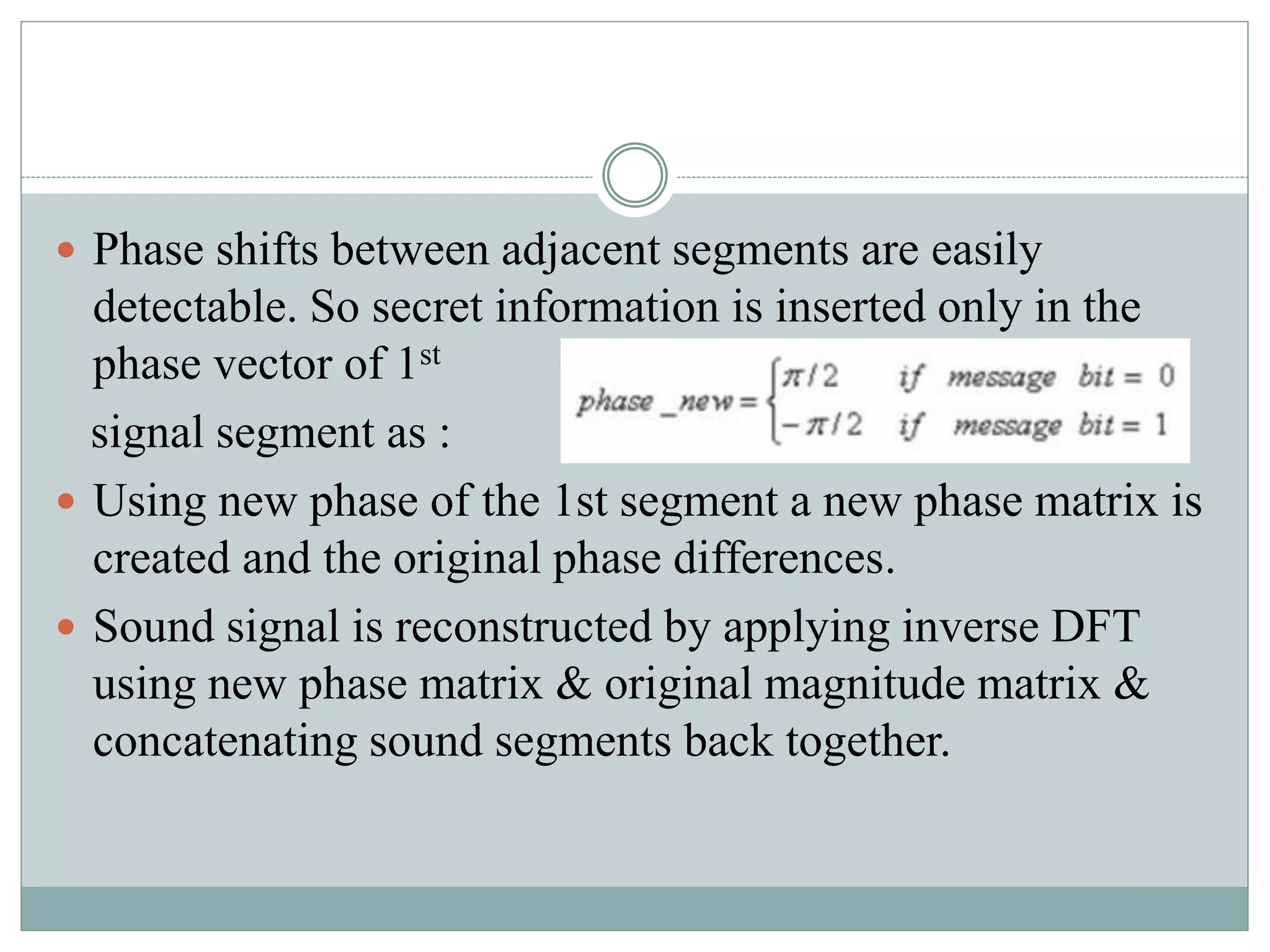
 Phase shifts between adjacent segments are easily
detectable. So secret information is inserted only in the
phase vector of 1st
signal segment as :
 Using new phase of the 1st segment a new phase matrix is
created and the original phase differences.
 Sound signal is reconstructed by applying inverse DFT
using new phase matrix & original magnitude matrix &
concatenating sound segments back together.
 The receiver must know the segment length to extract the
secret information from the sound file.
 Then receiver can use the DFT to get the phases and
extract the secret information
Parity Coding
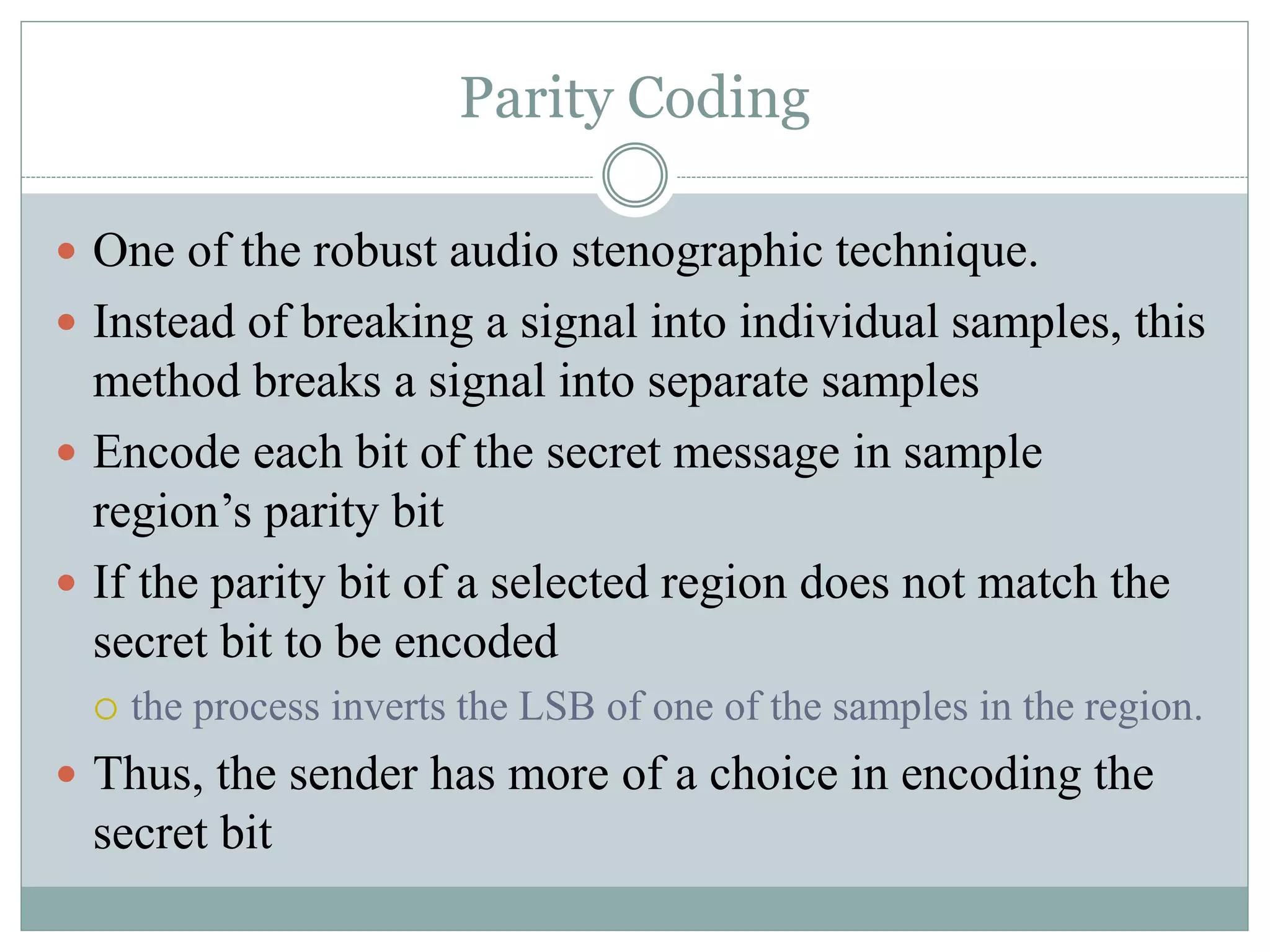
 One of the robust audio stenographic technique.
 Instead of breaking a signal into individual samples, this
method breaks a signal into separate samples
 Encode each bit of the secret message in sample
region’s parity bit
 If the parity bit of a selected region does not match the
secret bit to be encoded
 the process inverts the LSB of one of the samples in the region.
 Thus, the sender has more of a choice in encoding the
secret bit
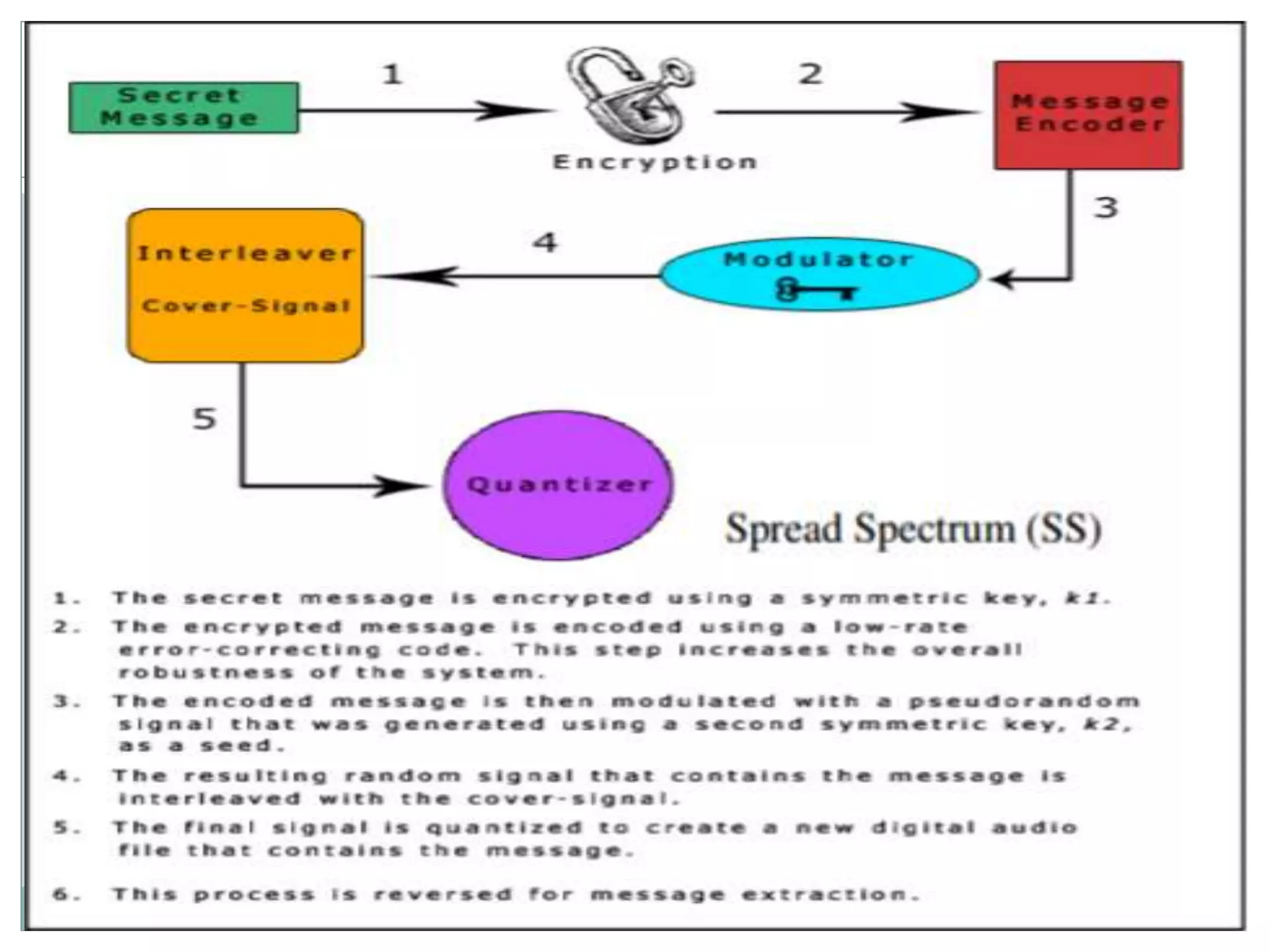
Spread Spectrum
 The basic spread spectrum (SS) method attempts to spread
secret information across the frequency spectrum of the
audio signal.
 This is similar to a system which uses an implementation
of the LSB that spreads the message bits randomly over
the entire sound file.
 Unlike LSB coding, the SS method spreads the secret
information over the frequency spectrum of the sound file
using a code which is independent of the actual signal
 As a result, the final signal occupies a bandwidth which is
more than what is actually required for transmission.
Steganography in TCP / IP Packets
 Protocols in the OSI network model have vulnerabilities
that can be used to hide information.
 The TCP packet header has six unused(reserved) bits and
the IP packet header has two reserved bits.
 They provide an excellent covert communication channel
if unchecked.
Tool Demo
Future Scope of Steganography
 Steganography, though is still a fairly new idea. There are
constant advancements in the computer field, suggesting
advancements in the field of steganography as well. It is
likely that there will soon be more efficient and more
advanced techniques for Steganalysis. A hopeful
advancement is the improved sensitivity to small
messages. Knowing how difficult it is to detect the
presence of a fairly large text file within an image,
imagine how difficult it is to detect even one or two
sentences embedded in an image! It is like finding a
microscopic needle in the ultimate haystack.
 What is scary is that such a small file of only one or two
sentences may be all that is needed to commence a
terrorist attack. In the future, it is hoped that the technique
of Steganalysis will advance such that it will become
much easier to detect even small messages within an
image.
Thank You!

Steganography and its techniques

  • 1.
    T E JA S P A N D I R K A R 1 5 2 0 1 0 0 2 0 V A I B H A V S A T H E 1 5 2 0 1 0 0 3 0 F A T E M A P A N V E L W A L A 1 5 2 0 1 1 0 3 1 K A R I S H M A D A S G A O N K A R 1 5 2 0 1 1 0 3 5 Steganography
  • 2.
    What is Steganography? Steganography comes from the Greek words: STEGANOS – covered and GRAPHIA– writing.  Steganography is the art and science of writing hidden messages in such a way that no one, apart from the sender and intended recipient, suspects the existence of the message.
  • 3.
     The pointof steganography is: If attacker knows there is a message, even if encrypted, he will try to decrypt it. However, if there is no visible message, then the message is safe!
  • 4.
    Example: Since everyone canread, encoding text in neutral sentences is doubtfully effective Since Everyone Can Read, Encoding Text In Neutral Sentences Is Doubtfully Effective ‘Secret inside’
  • 5.
    History of Steganography The first recorded uses of steganography can be traced back to 440 BC when Herotodus mentions two examples of steganography in his Histories.  Wax tablets were in common use then as reusable writing surfaces, sometimes used for shorthand.  Ancient example is that of histories, who shaved the head of his most trusted slave and tattooed a message on it. After his hair had grown the message was hidden. The purpose was to instigate a revolt against the Persians.  Special “inks” were important stenographic tools even during Second World War.
  • 6.
    History of Steganography Ancient Chinese wrote messages on fine silk, which was then crunched into a tiny ball and covered in wax. The messenger then swallowed the ball of wax.  During Second World War a technique was developed to shrink photographically a page of text into a dot less than one millimeter in diameter, and then hide this microdot in an apparently innocuous letter. (The first microdot has been spotted by FBI in 1941.)  In October 2001, the New York Times published an article claiming that al-Qaeda had used steganography to encode messages into images, and then transported these via e-mail and possibly via USENET to prepare and execute the September 11, 2001 terrorist attack.
  • 7.
    Physical Techniques  Hiddenmessages within wax tablets  Hidden messages on messenger's body  Hidden messages on paper written in secret inks  Messages written in Morse code on knitting yarn and then knitted into a piece of clothing worn by a courier  Messages written on envelopes in the area covered by postage stamps.
  • 8.
    Digital Techniques  Concealingmessages within the lowest bits of noisy images or sound files.  Pictures embedded in video material (optionally played at slower or faster speed).  Modifying the echo of a sound file (Echo Steganography)  Including data in ignored sections of a file, such as after the logical end of the carrier file.
  • 9.
    Steganography V/S Cryptography SteganographyCryptography Unknown message passing Known message passing Steganography prevents discovery of the very existence of communication Encryption prevents an unauthorized party from discovering the contents of a communication Little known technology Common technology Technology still being develop for certain formats Most of algorithm known by all Once detected message is known Strong current algorithm are resistant to attacks ,larger expensive computing power is required for cracking Steganography does not alter the structure of the secret message Cryptography alter the structure of the secret message
  • 10.
    Best Of BothWorlds!
  • 11.
    Terms related toSteganography  Carrier or Cover File - A Original message or a file in which hidden information will be stored inside of it .  Stego-Medium - The medium in which the information is hidden.  Embedded or Payload - The information which is to be hidden or concealed.  Steganalysis - The process of detecting hidden information inside a file.
  • 12.
    Different Types ofSteganography  Text Steganography  Image Steganography  Audio Steganography  Message in TCP/IP packets
  • 13.
    Text Steganography  Textsteganography can be applied in the digital makeup format such as PDF, digital watermark or information hiding  It is more difficult to realize the information hiding based on text. The simplest method of information hiding is to select the cover first, adopt given rules to add the phraseological or spelling mistakes, or replace with synonymy words.
  • 14.
    Example:  An exampleof a message containing cipher text by German Spy in World War II: “Apparently neutral's protest is thoroughly discounted And ignored. Isman hard hit. Blockade issue affects .Pretext for embargo on by products, ejecting suets and Vegetable oils. ”  Taking the second letter in each word the following message emerges: Pershing sails from NY June 1.
  • 15.
    Other Methods:  WhiteSteg  Inter Sentence spacing  Inter Word spacing  SMS texting – abbreviated and full form  Syntactic method - punctuations  Misspell method
  • 16.
  • 17.
    Least Significant BitMethod  Least significant bit (LSB) insertion is a common, simple approach to embedding information in a cover image  The least significant bit (in other words, the 8th bit) of some or all of the bytes inside an image is changed to a bit of the secret message  When using a 24-bit image, a bit of each of the red, green and blue color components can be used, since they are each represented by a byte. In other words, one can store 3 bits in each pixel. An 800 × 600 pixel image, can thus store a total amount of 1,440,000 bits or 180,000 bytes of embedded data  In its simplest form, LSB makes use of BMP images, since they use lossless compression
  • 18.
    Example  A gridfor 3 pixels of a 24-bit image can be as follows: (00101101 00011100 11011100) (10100110 11000100 00001100) (11010010 10101101 01100011)  When the number 200, which binary representation is 11001000, is embedded into the least significant bits of this part of the image, the resulting grid is as follows: (00101101 00011101 11011100) (10100110 11000101 00001100) (11010010 10101100 01100011)
  • 19.
     Original ImageModified Image  The difference is invisible to naked eye!
  • 20.
  • 21.
    Applications  Storing passwordsand/or other confidential information  Covert communication of sensitive data  Speculated uses in terrorist activities  Being widely used to hide and/or transfer illegal content
  • 22.
    SPS – StaticParsing Steganography  The sender and the receiver agree on a cover image.  The protocol does not modify the cover image.  Rather determines the bits of the secret message that match the ones in the cover image and stores their different locations (i.e. in the cover image) in a vector.  Then it is sent to the recipient.
  • 23.
  • 24.
    Masking & Filtering Masks secret data over the original data by changing the luminance of particular areas  During masking, it embed the message within significant bits of the cover image  Not susceptible to lossy techniques because image manipulation does not affect the secret message
  • 25.
    Audio Steganography  Embeddingsecret messages into digital sound is known as Audio Steganography.  Audio Steganography methods can embed messages in WAV, AU, and even MP3 sound files.  The properties of the Human Auditory System (HAS) are exploited in the process of audio Steganography
  • 26.
     To embeddata secretly onto digital audio file there are few techniques :  LSB Coding  Phase Coding  Parity Coding  Spread Spectrum  Let us see how these techniques are used… Audio Steganography
  • 27.
  • 29.
    Phase Coding The phasecoding method works by substituting the phase of an initial audio segment with a reference phase that represents the data. The procedure are as follows :  Original sound sequence is broken into a series of N short segments.  A discrete Fourier transform(DFT) is applied to each segment to create a matrix of the phase and magnitude.  Phase difference between each adjacent segment is calculated.
  • 30.
     Phase shiftsbetween adjacent segments are easily detectable. So secret information is inserted only in the phase vector of 1st signal segment as :  Using new phase of the 1st segment a new phase matrix is created and the original phase differences.  Sound signal is reconstructed by applying inverse DFT using new phase matrix & original magnitude matrix & concatenating sound segments back together.
  • 31.
     The receivermust know the segment length to extract the secret information from the sound file.  Then receiver can use the DFT to get the phases and extract the secret information
  • 32.
    Parity Coding  Oneof the robust audio stenographic technique.  Instead of breaking a signal into individual samples, this method breaks a signal into separate samples  Encode each bit of the secret message in sample region’s parity bit  If the parity bit of a selected region does not match the secret bit to be encoded  the process inverts the LSB of one of the samples in the region.  Thus, the sender has more of a choice in encoding the secret bit
  • 34.
    Spread Spectrum  Thebasic spread spectrum (SS) method attempts to spread secret information across the frequency spectrum of the audio signal.  This is similar to a system which uses an implementation of the LSB that spreads the message bits randomly over the entire sound file.  Unlike LSB coding, the SS method spreads the secret information over the frequency spectrum of the sound file using a code which is independent of the actual signal  As a result, the final signal occupies a bandwidth which is more than what is actually required for transmission.
  • 36.
    Steganography in TCP/ IP Packets  Protocols in the OSI network model have vulnerabilities that can be used to hide information.  The TCP packet header has six unused(reserved) bits and the IP packet header has two reserved bits.  They provide an excellent covert communication channel if unchecked.
  • 37.
  • 38.
    Future Scope ofSteganography  Steganography, though is still a fairly new idea. There are constant advancements in the computer field, suggesting advancements in the field of steganography as well. It is likely that there will soon be more efficient and more advanced techniques for Steganalysis. A hopeful advancement is the improved sensitivity to small messages. Knowing how difficult it is to detect the presence of a fairly large text file within an image, imagine how difficult it is to detect even one or two sentences embedded in an image! It is like finding a microscopic needle in the ultimate haystack.
  • 39.
     What isscary is that such a small file of only one or two sentences may be all that is needed to commence a terrorist attack. In the future, it is hoped that the technique of Steganalysis will advance such that it will become much easier to detect even small messages within an image.
  • 40.