PRESENTED BY: Himanshi Manawat
MSc (chem) 2nd sem
 The versatile differential thermal analysis (DTA) also known as thermography.
 It was introduced by Le chatelier and modified by Robert Austin, Burgess, Norton, Grim and Foldvari-
vogl.
 Since differential thermocouples are used, hence the technique is named as differential thermal analysis.
 Differential thermal analysis (DTA), in analytical chemistry, a technique for identifying and
quantitatively analyzing the chemical composition of substances by observing the thermal behavior of a
sample as it is heated.
 The technique is based on the fact that as a substance is heated, it undergoes reactions and phase
changes that involve absorption or emission of heat.
 DTA is a technique in which the temperature differences (ΔT) between the sample
and a thermally inert reference material are continuously recorded as a function of
temperature or time whilst the substance and reference are subjected to a controlled
temperature programme.
The basic principle involved in DTA is the temperature
difference (∆T) between the test sample and an inert
reference sample under controlled and identical conditions
of heating or cooling is recorded continuously as a
function of temperature or time, thus the heat absorbed or
emitted by a chemical system is determined.
If the sample does not undergo any chemical or physical changes
then there will be no temperature difference between sample and
the reference.
 If any reaction takes place in the sample, then the temperature difference will occur between the
sample and the reference material.
 for instance in an endothermic change such as melting or dehydration of the sample the
temperature of sample will be lower than the reference (i.e.) ∆T = ‒ve (for endothermic process) .
 On completion of the process the sample will again show zero difference of temperature as
compared to reference.
 On the other hand if an exothermic reaction takes place the sample temperature will be higher
than that of the reference material (i.e.) ∆T = + ve (exothermic process)
THEORY:
 Boersma deduced the following expression for the peak area by employing a sample block
constructed from high thermal conductivity material like nickel.

t1
t2
ΔT dt =
qa2
4λ
 Where λ is the thermal conductivity of the sample, a is the radius of the cavity filled with sample, 𝜟𝑻
is the differential temperature, q is heat of transformation per unit volume, t1 and t2 are the times at
the beginning and end of the peak.
 Boersma suggested the use of sample cup and reference cup an the temperature difference was to be
measured from outside the sample and reference material. The peak area depends upon the sample,
heat of transformation and calibration factor of the instrumentation.
 Hence, heat of reaction can be expressed as, 𝛥𝐻 =
𝛹
𝑚 𝑡1
𝑡2
𝛥𝑇 𝑑𝑡
 Where Ψ is the experimentally determined constant and m is the mass of the sample.
 If Ψ is known, the heat of transformation can be calculated by using above equation.
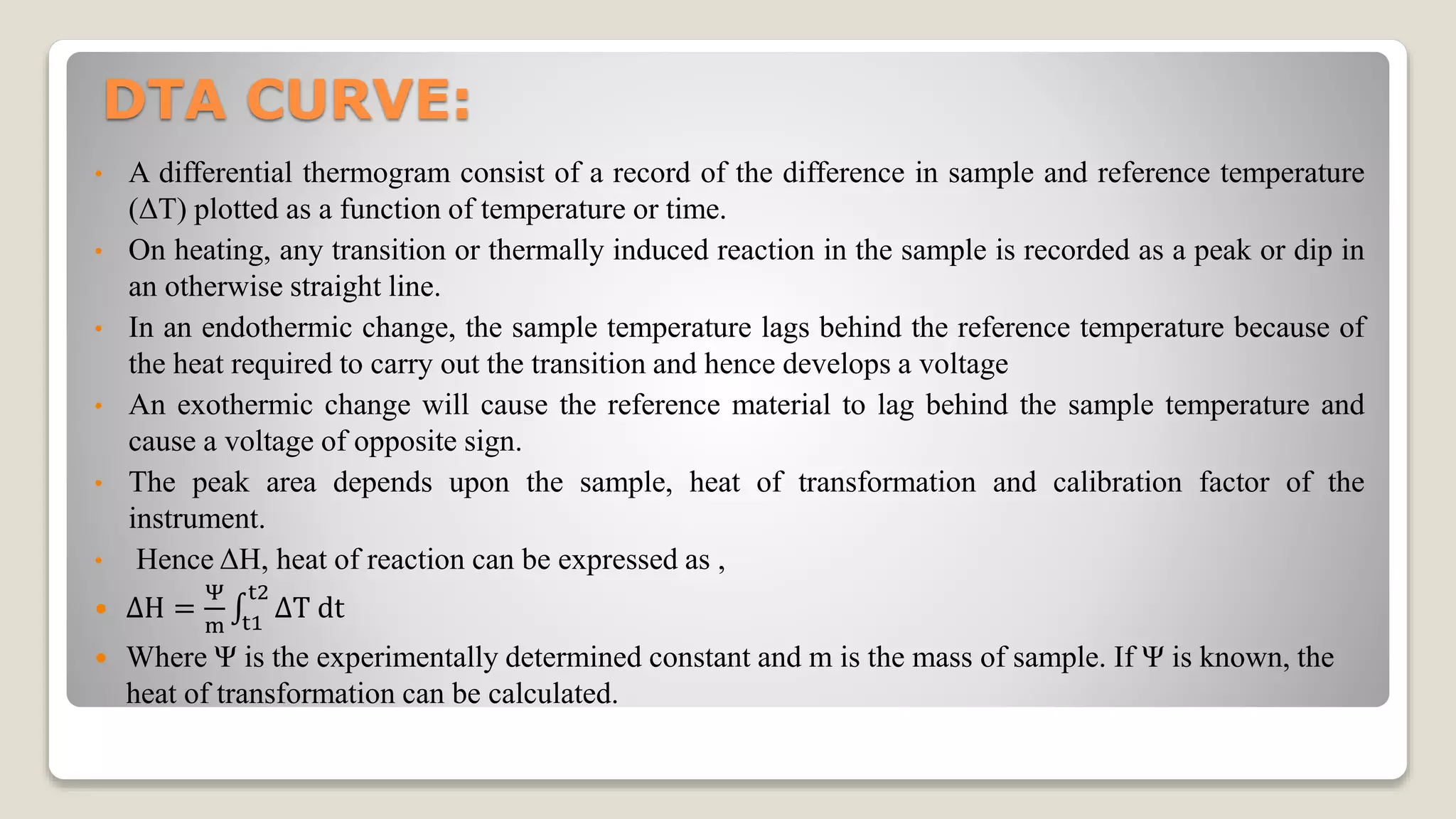
DTA CURVE:
• A differential thermogram consist of a record of the difference in sample and reference temperature
(ΔT) plotted as a function of temperature or time.
• On heating, any transition or thermally induced reaction in the sample is recorded as a peak or dip in
an otherwise straight line.
• In an endothermic change, the sample temperature lags behind the reference temperature because of
the heat required to carry out the transition and hence develops a voltage
• An exothermic change will cause the reference material to lag behind the sample temperature and
cause a voltage of opposite sign.
• The peak area depends upon the sample, heat of transformation and calibration factor of the
instrument.
• Hence ΔH, heat of reaction can be expressed as ,
 ΔH =
Ψ
m t1
t2
ΔT dt
 Where Ψ is the experimentally determined constant and m is the mass of sample. If Ψ is known, the
heat of transformation can be calculated.
 Heat effects associated with physical and chemical changes of a substance are recorded when it is
heated at a linear rate.
 Physical changes usually result in Endothermic peak, whereas chemical reactions those of an
oxidative nature are exothermic.
 Endothermic reaction (absorption of energy) includes vaporization, sublimation, and absorption &
gives downward peak.
 Exothermic reaction (liberation of energy) includes oxidation, polymerization, and catalytic reaction
& gives upward peak.
 Thus the endo and exothermal peaks appearing on the thermogram give information regarding the
enthalpic changes.
 The shape and the size of the peak give information about the nature of the test sample.
 Sharp endothermic peaks indicate phase changes (such as melting, fusion etc.) transition from one
crystalline form to another crystalline form.
 Broad endothermic peaks are obtained from dehydration reactions
 Chemical reactions like oxidative reactions are exothermic
DTA

DTA

  • 1.
    PRESENTED BY: HimanshiManawat MSc (chem) 2nd sem
  • 3.
     The versatiledifferential thermal analysis (DTA) also known as thermography.  It was introduced by Le chatelier and modified by Robert Austin, Burgess, Norton, Grim and Foldvari- vogl.  Since differential thermocouples are used, hence the technique is named as differential thermal analysis.  Differential thermal analysis (DTA), in analytical chemistry, a technique for identifying and quantitatively analyzing the chemical composition of substances by observing the thermal behavior of a sample as it is heated.  The technique is based on the fact that as a substance is heated, it undergoes reactions and phase changes that involve absorption or emission of heat.  DTA is a technique in which the temperature differences (ΔT) between the sample and a thermally inert reference material are continuously recorded as a function of temperature or time whilst the substance and reference are subjected to a controlled temperature programme.
  • 4.
    The basic principleinvolved in DTA is the temperature difference (∆T) between the test sample and an inert reference sample under controlled and identical conditions of heating or cooling is recorded continuously as a function of temperature or time, thus the heat absorbed or emitted by a chemical system is determined.
  • 5.
    If the sampledoes not undergo any chemical or physical changes then there will be no temperature difference between sample and the reference.
  • 6.
     If anyreaction takes place in the sample, then the temperature difference will occur between the sample and the reference material.  for instance in an endothermic change such as melting or dehydration of the sample the temperature of sample will be lower than the reference (i.e.) ∆T = ‒ve (for endothermic process) .  On completion of the process the sample will again show zero difference of temperature as compared to reference.  On the other hand if an exothermic reaction takes place the sample temperature will be higher than that of the reference material (i.e.) ∆T = + ve (exothermic process)
  • 7.
    THEORY:  Boersma deducedthe following expression for the peak area by employing a sample block constructed from high thermal conductivity material like nickel.  t1 t2 ΔT dt = qa2 4λ  Where λ is the thermal conductivity of the sample, a is the radius of the cavity filled with sample, 𝜟𝑻 is the differential temperature, q is heat of transformation per unit volume, t1 and t2 are the times at the beginning and end of the peak.  Boersma suggested the use of sample cup and reference cup an the temperature difference was to be measured from outside the sample and reference material. The peak area depends upon the sample, heat of transformation and calibration factor of the instrumentation.  Hence, heat of reaction can be expressed as, 𝛥𝐻 = 𝛹 𝑚 𝑡1 𝑡2 𝛥𝑇 𝑑𝑡  Where Ψ is the experimentally determined constant and m is the mass of the sample.  If Ψ is known, the heat of transformation can be calculated by using above equation.
  • 9.
    DTA CURVE: • Adifferential thermogram consist of a record of the difference in sample and reference temperature (ΔT) plotted as a function of temperature or time. • On heating, any transition or thermally induced reaction in the sample is recorded as a peak or dip in an otherwise straight line. • In an endothermic change, the sample temperature lags behind the reference temperature because of the heat required to carry out the transition and hence develops a voltage • An exothermic change will cause the reference material to lag behind the sample temperature and cause a voltage of opposite sign. • The peak area depends upon the sample, heat of transformation and calibration factor of the instrument. • Hence ΔH, heat of reaction can be expressed as ,  ΔH = Ψ m t1 t2 ΔT dt  Where Ψ is the experimentally determined constant and m is the mass of sample. If Ψ is known, the heat of transformation can be calculated.
  • 10.
     Heat effectsassociated with physical and chemical changes of a substance are recorded when it is heated at a linear rate.  Physical changes usually result in Endothermic peak, whereas chemical reactions those of an oxidative nature are exothermic.  Endothermic reaction (absorption of energy) includes vaporization, sublimation, and absorption & gives downward peak.  Exothermic reaction (liberation of energy) includes oxidation, polymerization, and catalytic reaction & gives upward peak.  Thus the endo and exothermal peaks appearing on the thermogram give information regarding the enthalpic changes.  The shape and the size of the peak give information about the nature of the test sample.  Sharp endothermic peaks indicate phase changes (such as melting, fusion etc.) transition from one crystalline form to another crystalline form.  Broad endothermic peaks are obtained from dehydration reactions  Chemical reactions like oxidative reactions are exothermic